AKB48 fan arrested for taking their business model to its logical conclusion

Today we have news of a fan of girl pop group AKB48 who just had to keep the fantasy going, no matter the cost:

Police on Friday re-arrested an overzealous fan of idol group AKB48, adding to previous charges of theft for which he is already on trial. Masayuki Fujioka, 35, is suspected of committing 151 robberies in four prefectures. He was quoted by police as saying, “I needed money for train fare and concerts so I could chase AKB48.”

According to police, Fujioka illegally trespassed in a construction site in Tochigi City on the night of Oct 6, breaking into a vending machine and stealing 4,700 yen. Authorities say that, since around December 2002, Fujioka committed 151 robberies in Tochigi, Saitama, Ibaraki and Gunma prefectures, stealing a total of 4.1 million yen.

While we have no way of knowing whether this guy really was spending it all on AKB48, it certainly rings true. AKB48 has been a phenomenal success story in what is otherwise a shrinking and lackluster music scene in Japan. The concept is “idols you can actually meet.” While the music and dancing are nothing special, they are very able at appealing to an audience of young “otaku” men. In 2009, AKB48 became more popular than ever, moving from the “fringe” status as an otaku group to more mainstream exposure on TV and magazines.

The group consists of 3 “teams” of around 16 members each (age range: 16-24) who perform semi-independently. With so many to choose from, in addition to dozens of “trainees” aged 15-20, the fans tend to choose one favorite and follow her closely.

The producer, Yasushi Akimoto, exercises total control over the process and has been called a genius for his business model. It combines the J-pop practice of building a long-term, loyal fan base (many old bands long past their prime can still crank out hit singles and fill arenas for this reason), the penchant for fawning over young, innocent girls in the otaku subculture, and the revenue maximization strategy of a hostess bar.

It’s that last part that has led to some illegality and controversy. Here’s a list of some of the group’s money-making practices, some of which I cribbed from a lengthy piece in the Sankei Shimbun:

  • Perhaps the group’s biggest source of revenue is “handshaking events” where fans who bought a limited edition single on the official website receive a ticket that lets them meet and greet a member of their choice. The rarity of these tickets makes them popular items on Yahoo Auctions, Japan’s answer to eBay. The biggest fans find a girl they like and try to attend as many of the events as possible. Of course, the group also releases CDs and holds concert tours just like any other band, though they operate their own proprietary ticketing system.
  • One CD came with a “ballot” that the buyer could use to vote for who will sing on the next AKB48 single. Some of the more avid fans bought hundreds of CDs to vote for their favorites. A journalist in the Sankei explains this is very similar to when a customer at a hostess bar will buy drink after drink for his favorite to help her succeed.
  • Another CD release came with a poster of a random member included. Fans started trading on online auctions to try and collect them all.
  • The group’s home turf is the 8th floor of the Don Quijote discount shop in Akihabara. Members perform just about every day (having a giant roster of 100 members and sub-members helps keep this going).
  • Members also regularly appear in weekly magazine photo spreads in what is very close to softcore porn, not something an earlier, similar group Morning Musume would have done.
  • On their website, there is a link to an address where you are invited to send “fan letters and gifts.”
  • Akimoto is trying to franchise the “48” idea to other countries, envisioning a Paris 48 or Jakarta 48. There was a documentary a couple months ago about his trip to a marketing convention to try and sell the idea, but so far I have not heard whether he succeeded or not.

In addition to the thief mentioned earlier, other criminals have sold counterfeit event tickets, and one fan started stealing a member’s mail. Clearly some kind of fan worship goes on with any popular group, but AKB48 has clearly done a better job than most of exploiting the relationship between performer and fan.

Via CNNgo and Japan Today

Activists stalk English teachers in South Korea – a glimpse at Japan’s future?

The LA Times has a story on how an activist group in South Korea, sinisterly named the “Anti-English Spectrum” has been following foreign English teachers to ferret out suspected wrong-doing:

The volunteer manager of a controversial group known as the Anti-English Spectrum, Yie investigates complaints by South Korean parents, often teaming up with authorities, and turns over information from his efforts for possible prosecution.

Outraged teachers groups call Yie an instigator and a stalker.

Yie waves off the criticism. “It’s not stalking, it’s following,” he said. “There’s no law against that.”

Since its founding in 2005, critics say, Yie’s group has waged an invective-filled nationalistic campaign against the 20,000 foreign-born English teachers in South Korea.

On their website and through fliers, members have spread rumors of a foreign English teacher crime wave. They have alleged that some teachers are knowingly spreading AIDS, speculation that has been reported in the Korean press.

The debate over foreign English teachers is symbolic of a social shift taking place in a nation that has long prided itself on its racial purity and singular culture, South Korean analysts say.

In less than a decade, the number of foreigners living in South Korea, with a population of nearly 49 million, has doubled to 1.2 million, many of them migrant workers from other Asian nations.

Also included are the foreign English teachers, most from the United States, drawn here by compensation packages that may include as much as $2,500 a month plus free rent and a round-trip ticket to teach a Korean population obsessed with learning from native speakers.

While the idea of vigilantes following English teachers around is definitely unnerving, the effort seems much smaller and more reasonable than I expected from the headline. No reports of violence and just one threatening e-mail. If there are troublemakers in the country I think the citizens have a right to their activism. The “activists” seem more like a community of Internet hobbyists going after a group that’s done nothing to them for no reason other than self-satisfaction, very similar to the incidents of “enjo” flaming campaigns in Japan (or scambaiters, “Anonymous” protests against Scientology, etc. in the English-speaking world). I am tempted to write it off, but given what I am reading here and all the reports on English teachers smuggling drugs and getting into other trouble, the relationship between the foreign English teachers and the local Koreans seems genuinely strained.

Given the relative similarity of the situation in Japan (homogeneous Asian population, fetish over learning English from natives), it struck me how nothing like this has sprung up yet, especially given the industry’s business/hiring practices and the excesses of some of the teachers. There are stirrings of anti-foreigner sentiment here and there, but what strong feelings there are tend to come from fringe rightist groups railing against Koreans.

It’s possible there is a difference of degree in Korea – the Internet is a more integral part of life, there are proportionally more English teachers there, and foreigners in general are a more visible presence. That said, it could offer a glimpse at where Japan might be headed.

Korea remains one of the most connected nations on the planet, and has become famous for flaming campaigns. There was a recent string of celebrity suicides, some apparently a result of internet harassment.

In Japan, these attacks are quite common, though I have yet to hear about any high-profile suicides. Japanese net users have turned their ire on Westerners before, most notably in the “WaiWai incident” when they became outraged over lewd, liberally translated articles on the Mainichi Daily News site. If a foreign English teacher commits a heinous crime (or the police decide to play it up), it’s possible the 2ch crowd could start something a “Spectrum” of its own. If it comes to that, we will all no doubt back our dismissive comments about Debito and beg him for help (I am guessing there is no Debito equivalent in Korea – prominent Korea blogger Marmot has very little sympathy with his wayward fellow Westerners). Even so, I don’t get the impression that average Japanese people feel uneasy about Western English teachers – quite the contrary, they tend to be treated very well. Maybe we can thank the JET program for bringing in more “high quality” talent with its more rigorous selection process.

Next, there are a lot of English teachers in Korea! If the article’s figure of 20,000 is correct, it’s even more than the roughly 14,000 in Japan (and shrinking) even though Korea’s population is just 40% of Japan’s. If Japan had the same proportion of English teachers there’d be 36,000 of them, and businesses would probably have to lower standards even more to fill all the positions.

According to the article, foreigners make up 2.4% of South Korea’s population. In Japan that number is 1.74% and growing. Also, from all accounts the US military presence is felt a lot more in Korea, be it from soldiers on the street or the daily awareness that the country remains in a state of imminent war.

But with the foreign population on the rise in Japan, its greater visibility means there will definitely be some kind of reaction. Some might feel the kind of anger that’s directed at the government’s proposal to give permanent residence the vote. Those protests have yet to produce any violence or anything worth calling an “incident” but it’s a potential rallying point, and the bill hasn’t come up for debate yet.

The article draws a link between the Anti-English Spectrum and the overall issue of dealing with foreigners in “racially pure” South Korea, noting there have been some recent racially motivated attacks. I think there’s a clue in this for people watching Japan. When the net activists start wielding the hammer of anti-foreigner rage, Western English teachers might start to look more and more like a nail.

Self-proclaimed veteran translator: modern fansubbing a mess

From the “almost two years old but news to me” department:

Via the comments section at Neojaponisme, we have this series of videos decrying modern anime fansubbers as cliquey, Japanese language-worshiping elitists who offer “Japanese lessons” instead of actual translations. Their refusal to create plain, easily digested subtitles and refusal to translate culturally specific Japanese (instead offering copious on-screen liner notes) scares away potential new fans and is generally useless, he argues.

Watch here:

Part 1 / Part 2 / Part 3 / Part 4 / Part 5

On a basic level, he is absolutely right that for a general audience, translations should be very clear and nearly invisible. It’s what I strive for in my job and on this blog, for sure. But from my (admittedly limited) experience with fansubbed anime, it’s clear enough that fansubbers are not in it for the benefit of a general audience. In the era of Wikipedia, BitTorrent, and Youtube where esoteric cultural knowledge is rapidly becoming obsolete, being an elite fansubber is one of the few sure-fire ways left to secure King Geek status. Maybe having an insular subculture makes it harder for good anime titles to break through into the mainstream (as has been fansubbing’s most often-cited benefit), but isn’t that kind of the whole point?

Giving all permanent residents the right to vote = terrible idea

The DPJ has agreed to submit a bill that would grant foreign permanent residents of Japan (let’s call them PRs) the right to vote and run in local elections. Getting voting rights without having to give up Korean citizenship has long been a goal of zainichi Korean activist groups. But this proposal would apply both to “special” permanent residents that include the population of “zainichi” Koreans and Chinese from Taiwan who remained in the country after WW2, and to any foreigner granted permanent residency.

The bill has stirred up a firestorm of criticism, most loudly from the right wing. However, in support of the bill are some powerful forces, first and foremost DPJ Secretary General Ichiro Ozawa, whose job it is to ensure a lasting majority for his party. According to at least one critic, the decision to offer suffrage to all PRs may be  an attempt to secure a more permanent voting base because the zainichi population has been falling precipitously as the original group dies off and their decendants naturalize.

Personally, although I could potentially benefit from this bill if I one day am granted permanent residency, I don’t think it’s a good idea. Except for unique circumstances, only the citizens of a country should be allowed to vote.

Right-wing anger

The right wing and their allies in the opposition LDP have mobilized against this bill. Right-leaning Sankei Shimbun has run features pointing out the “big problems” with the bill. Financial services minister and conservative People’s New Party President Shizuka Kamei is against the proposal, noting he would refuse to sign a cabinet decision on the matter. In a statement, he worried that some areas with large foreign populations would see an upheaval of political power. He also suggested the compromise measure of loosening the requirements to naturalize, without being specific.

Protests have been common, and generally have taken a highly xenophobic tone. The crux of the argument is that there is no good reason to give PRs the vote and that almost no nations unilaterally grant foreign citizens the right to vote (some EU countries allow it for other EU citizens, along with some other exceptions made for special groups (PDF)). Some of the criticism veers into the paranoid, however. In addition to the long, long list of furious red herring arguments documented by Debito, here is a video of one activist calmly explaining that this is an attempt by China to take over Japan by populating the country with foreign voters.

Almost non-existent support

It’s obvious enough that these protesters are making ridiculous arguments and have cranked the outrage way out of proportion. But what is the case for giving PRs the vote?

In addition to expected support from zainichi Korean groups, we have some uncharacteristically half-baked support from Debito, the well-known human rights agitator: “Debito.org is in support, given how difficult it can be to get PR in Japan, not to mention how arbitrary the naturalization procedures are.” But just because it’s tough to get the status, that doesn’t mean one should get the right to vote and be elected. I am not accusing foreigners in Japan of being spies or degenerates, but a basic tenet of a country and the Japanese constitution is that it is to be governed by its citizens. That requirement helps assure those who will be involved in politics are committed citizens of the country. Permanent residents are already protected under the law and do not need to renew their visa to stay in the country. I think if they want more than that they should be ready to give up their original passport and become citizens.

In an article in Japan Focus, professor Chris Burgess praises the zainichi suffrage movement as “multiculturalism in practice” but makes no mention of the expanded proposal.

I can understand giving the special permanent residents the vote because they are for all practical purposes citizens of the country. The current DPJ proposal would essentially exclude those who did not explicitly take South Korean citizenship (朝鮮籍維持者), if I understand correctly. But I would not even have a problem with these people getting the vote as it was an tragedy of history that put them in the country in the first place. If Japan would permit dual citizenship that would be one thing, but absent that letting them vote one way to let them participate in society.

But really, what constituency of non-zainichi PRs is actually asking for the right to vote? The only one who really stands to gain is the DPJ itself which would earn itself an expanded and loyal voter base. That’s an irresponsible way to decide election policy in this country, and as much as it pains me to side with rabid right-wingers who may wish me ill will, they are right on this issue. There are more important issues in my opinion (allowing dual citizenship, establishing an immigration policy) that should be given more priority.

(Thanks to Mulboyne for the video link)

Subway planning Japan surge

Great news, people. Subway will open 80 new Japanese locations in 2010 (sub req’d). Most new stores will be in highway service areas and shopping centers where other fast food restaurants have shut their doors. That means you could start seeing Subways where the now-defunct Wendy’s used to be.

That will bring the number of Subways in Japan to around 270. Say what you will about their quality, Subway is the one of the only easy places to get a real deli sandwich in Tokyo. Mrs. Adamu and I love it.

I will be watching developments on this front very closely as I am considering moving out of Ayase at some point in the next year or so. Being near a Subway will be a major plus.

One interesting fact about Subway Japan – about 90% of their locations are franchisee-owned. So that older gentleman watching over the teenage part-timers making your sandwich? He probably has a very direct stake in making sure you’re satisfied. The same goes for most of the 957 Baskin Robbins stores.

The only rule of commuting that matters – just blend in

Reuters has a list of Japanese commuters’ common pet peeves:

1. Noisy conversation, horsing around

2. Music from headphones

3. The way passengers sit

4. Cellphone ringtones and talking on phones

5. Manners when getting on and off trains

6. Applying make-up

7. Littering

8. Sitting on the floor of the train

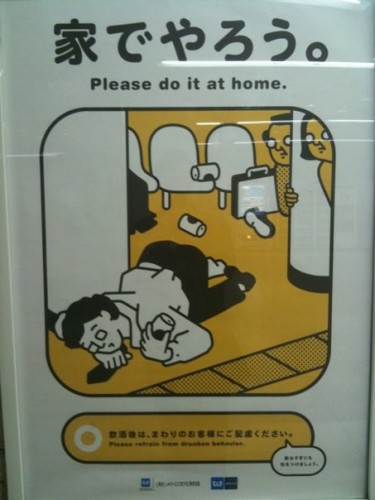
9. Riding the train drunk

10. Riding a crowded train with a child stroller

Most Mutant Frog readers will probably not find anything new on the list. Even the train companies are aware of them – most are covered in Tokyo Metro’s awesome “Please do it at Home” poster series (above, and read the Sandra Japandra blog if you want to laugh your ass off). Some seem more reasonable than others – can a mother really avoid bringing her kid on the train?

Pet peeves about daily life are simply a part of the human condition – American motorists all get pissed off at people who don’t use their blinkers, and on and on. However, in Japan these complaints seem to take on an extra sense of urgency because commuting on a packed train (often for more than an hour each way) is often so intimate and potentially dangerous. The pressure on your chest as that last person piles on. The feeling of being shoved as people stampede out at a major transfer station. The anxiety women must feel that the hand behind them could start getting too familiar.

With trains as crowded as Tokyo’s, everyone has an interest in maintaining some semblance of order and control. That’s maybe the one thing that keeps people in a tightly packed train from suffering a breakdown (and allows people to concentrate on a newspaper or Nintendo DS).

To deal with this, I think the people of Tokyo (and possibly all Japanese cities) have come up with one unwritten, overarching meta-rule that unites them all – do not stand out. People who stand out violate this order and thus subject themselves to the furtive glance of doom, that momentary registering of disapproval.

Even those who violate a few of the pet peeves themselves will feel annoyed at others who do the same. That’s because this rule is enforced by a million individual pet peeves manifesting themselves passive-aggressively. For example, I sometimes eat chocolate on the train but hate it when someone eats a sandwich or something I can smell. In my head, I feel like my eating is cleaner and therefore less rude.

This might be a stretch, but as a foreigner I feel like I automatically violate the rule just by being different. Once people see a white man they can never be sure if I’ll follow all the rules. Hence, just about every time I enter a reasonably packed train car I am greeted with half a dozen glances. I don’t necessarily think it’s racist–for most people it’s based on experience and it’s no more hostile than the automatic glances that would be directed toward other potential scofflaws – construction workers, thuggishly dressed kids, gyaru, etc etc.

Day in and day out, I share the train with the people who glare at me, and I start to glare back. I get territorial about my comfort zone – the handrail in front of the bench seats gives you enough room to read – and resent anyone who would violate it. I start to understand why people go out of their way to avoid talking to strangers. And I definitely get why people don’t bother giving up their seats to old people and pregnant ladies. Those people are breaking the rule!

This is why I think alleviating the insanely crowded train situation is vital to improving the national mood. I ridiculed Roger Cohen for talking about the gloomy attitude in Japan, but on that point he was right. People look like hateful, unhappy zombies during their commutes. The train companies are doing their best, but I feel like the media and politicians avoid really focusing on it because it’s one of those tough, intractable problems with no good solution. Better to let the plebes focus on how awful it is that some celebrities use drugs. But why not try some bolder solutions, like a second, identical Yamanote line, or double-decker train cars?

As a man with a short commute, I should be the last to complain about this. But I can’t help but thinking about it. It’s a national obsession, and in almost three years of living here it’s become mine as well.

Ichihashi’s very dubious version of events

The latest news on the Lindsey Ann Hawker murder case: alleged perpetrator Tatsuya Ichihashi has confessed. Unfortunately, his story sounds bogus and calculated to avoid a death sentence:

According to the indictment, Ichihashi assaulted Hawker at his apartment in Ichikawa between March 25 and 26, 2007, tied her wrists with adhesive tape and raped her before strangling her to death. Sources close to the investigation said Ichihashi had remained silent over the incident ever since his arrest in Osaka on Nov. 10 this year.

Meanwhile, an attorney for Ichihashi said he started explaining about the events leading up to Hawker’s death after he was first charged with murder on Dec. 2.

“Because she yelled, I strangled her from behind, and she became motionless. After that, I gave her CPR. I didn’t mean to kill her,” Ichihashi was quoted as telling his attorney.

Hawker was alive until dawn on March 26, Ichihashi was quoted as telling his lawyer. The pair reportedly spent some time listening to a Martin Luther King speech via the Internet.

Investigative sources said DNA from body fluid found on Hawker’s body matched that of Ichihashi’s, and that in addition to heavy beating to her face and body, her neck was broken.

The case is slated to be put on a lay judge trial.

I really wish I could know why Ichihashi made her listen to Martin Luther King…

Japanese exchange students skipping over US

According to the Asahi Shimbun, OECD data shows Japanese university students are increasingly skipping over the US in favor other other destinations. The US captured a whopping 75% of the “market share” for Japanese students in 1997 with 47,000 America-bound that year. However, by 2007 that number had fallen under 50% with around 37,000 students. China has been on the rise as a destination – 19,000 students in 2005 (up 100% from 10 years ago). The total number of students was around 80,000 in 2005, up 30% from 1995. US diplomats in the country are concerned and have noticed a drop-of in attendance at their annual study abroad fairs in Tokyo.

Reasons for the shift include:

  • The erosion of America’s image as a vibrant, exciting country. (Note: My mistake. See comments) Students see America as a highly competitive place to study and may choose Canada or Australia instead for the more laid-back image. The article claims that some even choose Scandinavia, thinking that learning English among non-natives will be easier because they speak slower.
  • A growing interest in the broader world among Japanese students (and more universities forming exchange relationships with a more diverse set of schools)
  • A university source claims more students are asking whether Japanese-language service is available in the host university, though that’s almost never the case.

The tone of the article is that kids these days are more “inwardly oriented” and less willing to challenge themselves. However, more and more Japanese students are studying abroad. I find it much more plausible that Japanese kids are simply more interested in Asia and the wider world, partly because those countries are a lot more developed and accessible now than they were even a decade ago.

The article does not get into another major hurdle for Japanese students who want to study in the US – the draconian visa process and the image that the US has become harder to get into. Since 9/11 the US has made the visa process progressively more restrictive and annoying. As a result, even though the number of foreign students to the US from all countries rose from 475,169 in 2000 to 595,874 in 2007, the US saw its market share fall from 25% to 19.7% in the same period.

More detailed data in English on all countries can be found at the OECD website.

Roger Cohen does Japan

After working out with Yoko Ono’s lawyer and crossing the street outside the Imperial Palace, Roger Cohen is ready to tell us what he thinks of Japan: a sad place where the only way to have fun is develop unhealthy obsession with cartoons:

My sense is that four factors have contributed to [over-the-top hobbyism and high-tech obsession in Japan]: wealth, postmodernism, conformism and despair. Japan is rich enough, bored enough with national ambition, strait-jacketed enough and gloomy enough to find immense attraction in playful escapism and quirky obsession.

As Tokyo Reporter noted in comments in my last post, Cohen uses some ridiculous examples to make what is ultimately a pretty valid point. There is a definite “ennui” here that, like much of the world, leads people to pursue escapism. Where I differ with Cohen the most is that I don’t think Japan is any more advanced in its escapism than America, just different. Here was my comment to the nytimes.com site that focused mainly on the silly parts of his column:

In common usage, “otaku” usually refers not to “geek-like obsession” but to actual obsessed geeks, which make up a pretty small proportion of Japan’s population (probably not much higher than the ratio of Americans who obsess over their hobbies). I would agree that “we’re all going a little otaku” as you defined it but that statement applies equally to most Japanese as it does to Americans.

I would also like to point out that Yoko Ono’s lawyer gave you some bad information. Unless you were using some new model of treadmill I am unaware of, those pictures tell you how many calories you are burning, as you suspected. It’s a neat feature I think American runners would like as well.

Sure, Japanese attention to detail, cuteness, and what have you are obvious to any outside visitor, but what does that have to do with Japan’s international standing? Does a lack of cute images on American treadmills signify the decline of the American superpower?

One bonus nitpick that I didn’t tell the Times: that area in front of the Imperial Palace is closed to traffic so they can open it up to bicycles. The traffic guards are there to make sure no one is run over by an out of control tourist. All the same, I think anyone who has been there will agree the old men directing traffic (who work for a travel agency) are extremely power-drunk and over-earnest in making sure no one jaywalks.