Green solidarity? Emphasize the white

One of my best friends in college was a Taiwanese guy firmly in the “green” (pro-independence) camp. We had many conversations about the symbolism of green in the independence movements of both Ireland and Taiwan. We were also both into vexillology, the study of flags, and we often compared the evolution of Irish flags to the evolution of flags in Taiwan.

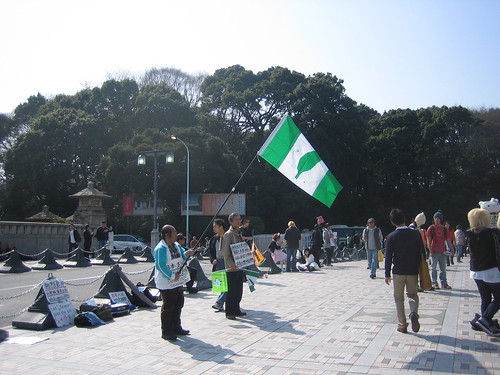
Fast forward a few years. Today was the St Patrick’s Day parade down Omotesando in Tokyo. Much to my curiosity, there were a couple of elderly Taiwan independence protesters out with their green Taiwan independence flags, which made for an interesting comparison with the Irish tricolors hung from flagpoles farther down the avenue. It was also an interesting contrast with the typical crowd of subculture groupies and bemused foreigners that hang out by the entrance to Yoyogi Park.

Green nationalist solidarity

Despite being color-coordinated for the occasion, they seemed rather lonely at their posts. Apparently getting Taiwan admitted to the UN is not high on the political priority list of most Tokyo residents.

Taiwan independence movement

For whatever reason, green is an underused national flag color once you go east of the Indian subcontinent and the extensive Islamic influence in that half of Asia. Macau has a nice green flag (as does Tokyo), but the nations of East and Southeast Asia have generally adopted red, white and blue in varying proportions, with yellow stars sprinkled here and there.

The consensus among books I’ve read and people I’ve spoken to is that green became associated with Ireland (and its native Catholics) simply because Ireland is a very green country–they don’t call it the “Emerald Isle” for nothing. (Although green is prominent in the flags of other Catholic countries–Italy, Portugal, Mexico and Brazil for instance–it doesn’t have religious significance in the stories behind any of these flags.)

Wikipedia’s explanation for the Taiwanese independence movement’s use of green is that the Democratic Progressive Party adopted green because environmentalism was a major part of its agenda, and the color eventually became associated with everything else the DPP advocated.

In both cases, it seems that green took on another meaning: it drew a sharp contrast to powerful adversaries who flew red and blue flags, namely the British in Ireland and the communists and Kuomintang in China and Taiwan. Then you have the United States, where the Green Party is the most popular (if you can call it that) alternative to the “red” and “blue” parties.

I’m not sure if there is really a point to these parallels, besides that people will find ways to divide themselves by color even when they’re all the same color to begin with. The Irish flag acknowledges this in its own way–it stands for peace (the white mid-section) between two opposing sides (the green Catholics and orange Protestants). Ireland eventually got this peace after a few decades of faking it. Who knows where Taiwan is headed–all I know is that I will support a green flag in Asia, because this part of the world is crying out for vexillological diversity.

Jenkins book finally available in English

For those of you who have been waiting for it, the story of the famous Vietnam war era deserter to North Korea, Charles Jenkins, is finally out in English. Normally I would explicitly avoid promoting something I was notified about through spam from the publisher, but I think I can safely say that a clear majority of people who would be reading this blog want to read Jenkins’ story.

I’m sure it’s on Amazon etc. but here’s the official book web page at the University of California Press site.

I can’t wait to read this book. I just hope there’s a special edition, in which Jenkins’ impenetrable southern drawl is transcribed phonetically, like an Irvine Welsh novel.

Falun Gong theatre in New York

The NYT has a rather funny article about New Yorkers who attended what they thought would be a traditional Chinese New Year theatrical spectacle at the Radio City Music Hall, but ended up seeing a very different kind of show.

Then the lyrics to some of the songs, sung in Chinese but translated into English in the program, began referring to “persecution” and “oppression.” Each time, almost at the moment a vocalist hit these words, a few audience members collected their belongings and trudged up an aisle toward the exit.

Before long came a ballet piece in which three women were imprisoned by a group of officers, and one was killed. At the end of the number, more members of the audience, in twos and fours and larger groups, began to walk out. At intermission, dozens of people, perhaps a few hundred, were leaving.

They had realized that the show was not simply a celebration of the Chinese New Year, but an outreach of Falun Gong, a spiritual practice of calisthenics and meditation that is banned in China. More than three years after flooding city corners and subway stations to spread the word about the Chinese government’s repression, Falun Gong practitioners are again trying to publicize their cause. Only this time, it involves costumed dancers and paying audiences in that most storied of New York concert halls, Radio City.

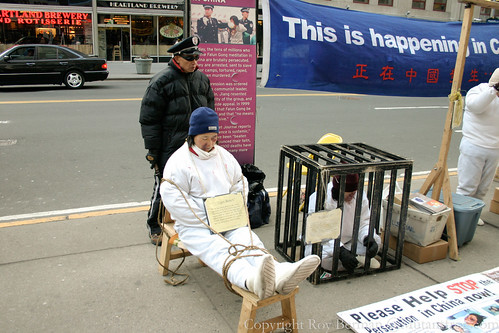
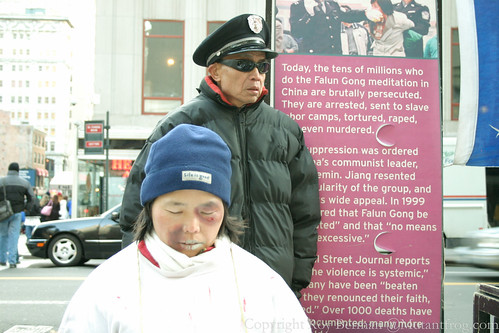
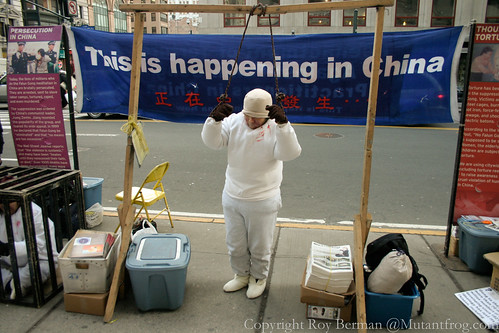
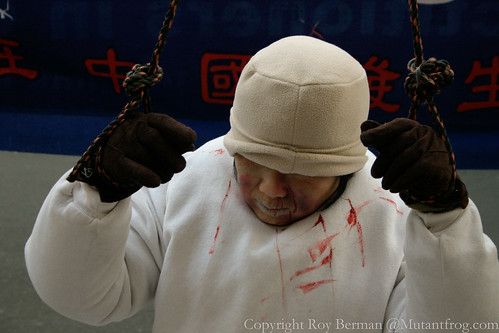
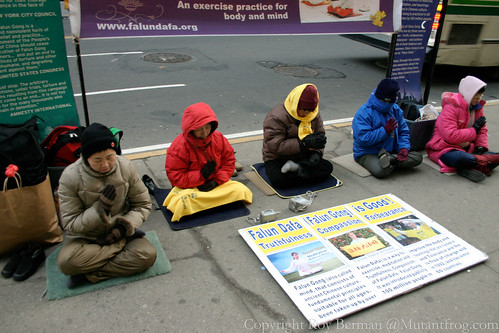
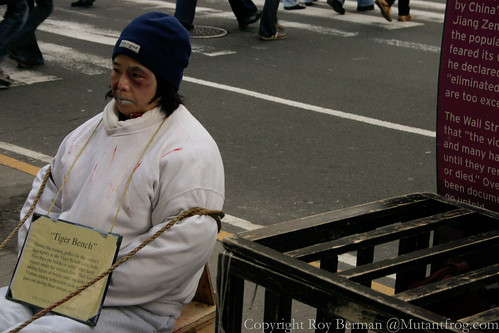
The article then goes on to mention that Faul Gong is well known for their elaborate street theatre protests around the city, in which they use props and stage makeup to dramatize the torture their compatriots are undergoing in China, as they hand out literature on the subject. Here are some photos I took of one such protest back in May of 2005.

IMG_9400

IMG_9401

IMG_9403

IMG_9404

IMG_9405

IMG_9406

Has anyone ever seen something like this anywhere besides New York? I saw Falun Gong protesters in Hong Kong, by Victoria Bay, and handing out flyers and DVDs outside of Taipei’s National Palace Museum (prime location to find tourists from the mainland) but never anything like this sort of dramatic reenactment.

New and old

For those who are curious, the old voting machines in my area looked very much like this one, color and all

voting_machine_joke.jpg

The actual controls were a bit different, and significantly the big lever was vertical along the right side, but you certainly get the idea.

Unfortunately, I couldn’t find a photo of the new machines I could embed, but you can see a hilariously 1980s educational film style demonstration of them, courtesy of the Essex County Clerk’s office here on their web site.

“Super Tuesday”

I just came back from voting in my first presidential primary election. I did vote in both the 2000 and 2004 general elections, but I was living at college an hour away and voted through absentee ballot since I did not want to skip class to come back to my hometown, the only district in which I have ever been registered to vote. But absentee ballots are not available for the primary, and I didn’t even consider skipping class for that (I believe I was also in Japan during the 2004 New Jersey primary).

I have however voted in person before, during a couple of the less significant election years between the presidential race, and I also spent several election days in the polling location at Edgemont Elementary School around the corner from my house when my father held a Democratic party position involved with supervising the polling station during my childhood.

Voting today was nearly the same experience as before. I told the man sitting at the A-K half of the desk my name, signed the blank signature line next to the photocopy of my signature from my voter registration card, and was given a pink voting slip, which I also signed. I had brought my passport along to use as ID, since I did not remember if any documentation is required, but in fact the only verification is a signature check, and knowing your own name and address. I then proceeded to the curtain-encircled voting machine and handed the pink slip to the woman sitting next to it. Her job is to collect each slip, make sure it is properly filled-out, and then pierce it on one of those spiked receipt collector things one often sees next to cash registers and the like. She then presses the button on the rear of the voting machine to prime it for the next voter.

Next, I stepped inside the curtain. This is the point at which there was a slight variation from the old days. I had grown up with the awesome yet clunky great blue mechanical voting machine, which had now been supplanted by electronic ones. There was something viscerally satisfying about actually flipping each little mechanical switch into the correct position before locking and then through the pull of the oversized lever on the right of everything else, transmitting your choices through a series of gears into the hole-puncher in the rear of the machine, encoding your vote onto the long and wide paper feed spooling one line at a time through the apparatus.

Now it is electronic, but thankfully not one of the overcomplicated and eminently hackable touchscreen monstrosities used in many areas. The New Jersey machine, at least the one I used here in Montclair, Essex County, simply has a plastic insert printed with the exact same material as the sample ballot I received in the mail a week or two ago, laid over a series of light-up buttons. When the machine is activated by the attendant, a backlight comes on behind the applicable ballot portion: Republican, Democrat or both depending upon your registered affiliation (both is for people like me who register as unaffiliated). Today is only a primary vote and not a real election, so the sole choice was for choice of presidential nominee. I clicked the Barack Obama button, the names of his four convention delegates to the right, the little red light behind his name came on, and I pressed the finalize button on the bottom right. It took only a couple of seconds, and I was out of there.

But in my heart, voting will never truly feel like democracy to me if you don’t get to pull a big, blue, metal lever at the end.

Update: How did my vote  do? Well, Obama and Clinton are currently looking like they’re tied neck and neck nationwide, Clinton won New Jersey by about 9%, but Obama won my Essex County by around 15%. I believe this means that, since delegates are more or less apportioned  at the county level, the candidate I voted for technically won in the election which my vote directly counted towards.

Manila an “anti-birth-control dystopia”

At least, that is how it is described in the words of Carol Lloyd, blogger on women’s issues at Salon.com. Due to the centuries as a Spanish colony, The Philippines is a firmly Catholic country-one in which the Church holds a level of influence rarely seen in the western world. Although the Catholic Church has oddly never managed to have any appreciable effect on the Philippines endemic Southeast Asian liberalism towards homosexuality and gender identity, they have managed to keep abortion illegal in all circumstances but to save the life of the mother. (More information on abortion in SE Asia here.) Although pre-conception birth control remains legal throughout The Philippines, in 2000 conservative Catholic Mayor Jose “Lito” Atienza of Manila issued an executive order removing all contraception from free clinics within the city. Many women in the desperately poor slums of Manila find it impossible to fit contraception in with food and other basic needs into their family budget, which has the eventual effect of a larger and even harder to feed family. This is what has women living in three urban slums to file a lawsuit demanding revocation of the order. From Reuters:

Emma Monzaga, one of the petitioners, said she was getting injections once every three months to prevent her from becoming pregnant, but was told on her third visit to a public clinic that the treatment was no longer available. “I was asked to go somewhere else to get the shots because the city hall has stopped funding the family planning program,” Monzaga said, adding her family could not afford to spend extra for contraceptives. “We used to get it for free. It’s becoming a burden because we have to eat and send our six children to school.” She said she has given up the idea of saving some money from her husband’s 300 pesos ($7) daily wage as a construction worker to pay for the vaccines because of rising cost of basic needs.

Amazingly, it took almost eight years before a local NGO managed to file the lawsuit “because the women feared political reprisals.” Unsurprisingly, there is now a different mayor in charge, and many hope that he will revoke the previous order without the need for the lawsuit to proceed. The Center for Reproductive Rights has a 50 page report, full of testimony, on the issue entitled “Imposing Misery: The Impact of Manila’s Contraception Ban on Women and Families,” which may be downloaded in PDF from their website at the above link. The report claims that the executive order violates the Republic’s 1987 constitution, stating:

The 1987 Philippine Constitution guarantees the
rights to liberty, health, equality, information and education for all citizens,
as well as the right of spouses to found a family in accordance with their
personal religious convictions. These basic principles, reinforced by
several pieces of legislation, create the foundation under national law for a
right to reproductive health, including access to contraception. [p. 9]

The report suggests that “The Manila City government should revoke Executive Order No. 003” as well as various further plans. [p. 11]

While many people look at issues such as these primarily in terms of individual rights and their effect on individuals and families, it is critical to consider the broader picture as well.

The Philippines today has a population of just under 90 million, a staggering number of whom live in poverty. I can attest from my own visit to the country that the cities are clogged with slums, illegal shanty-towns line the rivers and fill public parks, and the ratio of the population with no gainful employment appears to be easily several times that of anyplace else I have ever been. I have even heard that the unemployment rate in Metro Manila may be almost 50%.

Without high quality and aggressive family planning, that 90 million could nearly double in a generation- and the country’s scarce economic resources would be stretched even thinner. Could the unemployment rate rise even above 50%? Will The Philippines be plunged into a Malthusian crisis like Bangladesh or parts of Africa? Lack of birth control is hardly the only factor that has made Manila, and many other third-world regions, into dystopias, but it is one.

More apologies

This is already a week old, but did anyone notice that the very same day US Congressman Mike Honda (D, California) issued yet another call for Japan to issue a more concrete apology to former comfort women, New Jersey became the first Northern state in the United States to issue a formal apology for our state’s history of slavery? Although four Southern states of Virginia, Maryland, Alabama, and North Carolina had previously issued similar resolutions, the fact that many Northern states still allowed slave-holding well into the 19th century has been largely ignored. New Jersey, for example, did not finally ban slavery until 1846. There has been no such resolution at the federal level.

While it might be nice to see the Japanese government officially acknowledge past crimes in more specificity, perhaps the US Congress should apologize for slavery at the national level before its members go overseas to demand that foreign governments do the same thing. Maybe by setting a moral example, Mister Honda might convince a wider audience of his credibility.

Oh, and as for the Japanese government’s previous apologies. While they were a good start, they really could be more specific. Take a look at the actual text of last week’s New Jersey slavery apology resolution and think about how they compare.

Update: I feel like I should add that I don’t consider a simple apology in and of itself very worthwhile. The important thing about the New Jersey resolution is not so much that it apologizes, but that it lists both the actual crimes and in historical context and legacy in a decently comprehensive outline, and then also explicitly calls for continuing education on the subject. Let me quote the “statement” at the end of the resolution.

This concurrent resolution issues a formal apology on behalf of the State of New Jersey for its role in slavery and discusses the history of racism and inhumane treatment toward African-Americans in the United States from the arrival of its first settlers to the present day. It calls upon the citizens of this State to remember that slavery continues to exist and encourages them to teach about the history and legacy of slavery and Jim Crow laws.

While I think it was sloppy phrasing not to say something like “continues to exist in parts of the world,” resolutions like this are important not because they can make people feel good about their awesomeness in making said apology, but because it can contribute to the education of the populace.

More unintended consequences… or were they?

Several weeks ago I wrote a brief post about how the famous destruction of Korea Air Lines flight 007 by the Soviets led rather directly to the development of commercial GPS technology. I just happened across another surprising result of the same incident, in this Vanity Fair article on, of all people, Larry Flynt.

In 1976, Mr. Flynt, publisher of Hustler and several other pornographic magazines, put out a $1 million bounty for “documentary evidence of illicit sexual relations with a Congressman, Senator or other prominent officeholder.” As the article says, “A few years later, Flynt published pictures of Representative Larry McDonald, a Georgia Republican, in bed with a mistress,” but Rep. McDonald was on the ill-fated KAL007 when it was shot down by the Soviets.

Naturally, the presence of Congressman Larry McDonald on a jet which was shot out of the sky by the USSR was taken by some to be more than a coincidence. While McDonald was, and still is, the only member of Congress killed by the Soviets, there were in fact three other Congresspersons schedule to fly along-side him on KAL007; Republicans Jesse Helms, Senator of North Carolina and Steve Symms, Senator of Idaho and Congressman Carroll Hubbard, a Democrat of Kentucky. All four-McDonald and the three who whose flights were rescheduled-were known for their strident anti-Soviet views, and there were naturally conspiratorial accusations made against the USSR. For example, Wikipedia cites the following quotation of the (despicable) Reverend Jerry Falwell from the September 2, 1983 Washington Post:

There is a real question in my mind that the Soviets may have actually murdered 269 passengers and crew on the Korean Air Lines Flight 007 in order to kill Larry McDonald

Natural responses to this may include the thought that the assassination of either one or four members of the US Congress by the Soviet Union might provoke a rather harsh reaction, or perhaps the thought that there was in fact nothing to gain from the murder of these four relatively minor congresspersons- McDonald was himself not known for legislative accomplishment, and although Jesse Helms might have been a tempting target when he was head of the Senate Foreign Relations Committee, he did not ascend to that post until a decade later, in 1993.

McDonald was himself a well-known conspiracy theorist, who had made the following statement:

The drive of the Rockefellers and their allies is to create a one-world government combining supercapitalism and communism under the same tent, all under their control…Do I mean conspiracy? Yes I do. I am convinced there is such a plot, international in scope, generations old in planning, and incredibly evil in intent.

While more rational thinkers may question the wisdom of this statement, and perhaps of the voters who elected a paranoiac to Congress, it does seem likely that Representative McDonald would have agreed with the Reverend Falwell about the circumstances surrounding his own death.

For the truly sophisticated conspiracy buff, however, we have a more complex, and utterly contradictory theory, brought to us by-of all places- Hustler Magazine. Now, while Playboy is well known for its mix of dull soft-core pornography and oddly serious articles, I had no idea that Hustler printed in-depth political conspiracy articles (much less articles at all) mixed with its rather harder-core pornography. However, if this piece is indicative of the quality of Hustler’s political “reporting” I think I’ll stick with publications more along the lines of The Economist for my real news- although, a paranoid and elaborate conspiracy theory can provide some entertaining flavor to more staid coverage. I will not try and summarize this inane theory, which involves such things as a “$100,000 computer” full of illegal spying data-in a garage, the Moonies, and Reagan’s decision to make a martyr of “the leading anti-Communist in the American government,” I will provide what I thought were a few of the highlights.

  • “So let’s assume that the CIA, FBI and all federal agencies that worked with McDonald – particularly the Pentagon – wanted him silenced immediately.”
  • “A more likely possibility is that the crew had been the victim of hypnosis and mind control – receiving instructions in advance, before they left Anchorage, that could not be picked up on any messages recorded later.”
  • “His response to what was going to happen, given his years of experience and expertise, was that of a programmed zombie instructed to fly continuously – disregarding any external sights or sounds on the flight equipment.:
  • “The upshot of these reports is that the Pentagon had the capability, if it so desired, to link mind control with satellite defense systems. And a logical use of mind control, of course, would be to program a pilot – perhaps even turning a normal flight into a kamikaze mission.”
  • “After McCarthy died in 1957, it is reasonable to assume that Larry McDonaid – through Louise Bees – took over the massive computerized files [known as Odessa, which was formed (by the Nazis) between 1943 and 1945 when it became obvious the Third Reich could not win the war against the Soviet Union]that now contain millions of names worldwide.”

As implausible as all of this is, the fact most destructive to the theory that President Reagan ordered the plane led off-course into Soviet airspace so that the plane would be shot down, killing Congressman Larry McDonald, is perhaps Reagan’s action described in my previous post on KAL007: namely the opening of the formerly military-exclusive GPS network to civilian use. While I might not put it past the Reagan administration to commit assassination, if murder-by-Soviet-airspace-intrusion-disguised-as-navigation-error was such an effective and untraceable method of assassination, why then immediately turn around and introduce protocols that would make further use of the tactic implausible? Naturally, the conspiracy fan will turn around and say “that’s just what they want you to think; it’s the ultimate cover-up!” But credulity has its limits, and Occam’s Razor is powerful.

McDonald may have had a powerful hate for the USSR, but he was certainly was not important enough to deserve such elaborate machinations, the blood-enmity of a Soviet Premiere or an American President, and secret mind control rays from space itself. Like the other 268 passengers on KAL007, he was simply a victim of bad luck and incompetence, like so many others.

And this brings us to the heart, the essential nature of what conspiracy theories are all about: a fear of powerlessness. There is a common misconception that the conspiracy theorist is a cynic of the highest order, but in fact nothing could be further from the truth. The conspiracy theorist is actually a romantic. Unable to accept the reality of a chaotic universe in which all of us humans come from dust only to return to dust, the conspiracy theorist, somewhat like the believer in divine preordination, requires a conscious actor in all things to explain the misery in the world, and to alleviate the crushing fear of oblivion and hopelessness that lies within themselves.

Perhaps the most popular subject for conspiracy theorization in our time is the coordinated hijacking/kamikaze attacks of September 11, 2001. Details vary, including theories that the Pentagon was hit not by a jet but by a military cruise missile, or that the Twin Towers were felled not by steel girders whose tensile strength could not hold up to burning jet fuel but by a controlled demolition triggered by the CIA at the instant of airplane impact, or that the the hijackers were not in fact Islamic fanatics belonging to a shadowy terrorist network with a history of rhetorical and physical attacks against the United States, but Israeli Mossad agents, working in concert with the highest levels of US intelligence. The exact details are not really important, because all of these conspiracies share a common theme and a common purpose. The common theme is the attribution of enormous, almost supernatural, levels of power to the United States and other well understood state actors such as Israel, combined with the discrediting of obscure and occult non-state actors such as Al-Qaeda. The purpose is the reinforcement of their conventional world view to the extent that they can maximize a feeling of safety.

This may seem counterintuitive to some, but I believe that there is a misconception regarding what exactly conspiracy theorists are scared of. One might logically think that bu attributing such nefarious intent and grand power to our government, their primary fear is in fact the government. I would argue that the opposite is true. It is apparent to anyone that a world in which planes are shot out of the sky or crashed into buildings is more dangerous than one in which they do not, but anyone with even the most tenuous grasp on reality will accept that we live in a world in which these things happen; the distinction is over why, and how. If a world of death and pain is taken as a given, then how is fear of that minimized? By reducing the randomness and chaos with which that death is meted out. Conspiracy theorists ascribe nigh-omnipotence to the government not because they are so scared of the government but because they are far more terrified of the alternative- that terrorism, assassination, airplane failure, and so on, are the products of forces unpredictable and uncontrollable.

To a conspiracy theorist there is always a larger cause. Take the assassinations of Presidents Abraham Lincoln and John F. Kennedy, each of which was the premiere subject of conspiracy theorizing for many years, and remain popular subjects to this day. In both cases the official, and most widely accepted, version of the story is that a lone troubled soul, albeit one whose sympathies were shared by many others, shot and killed the President of the United States, the most powerful man in what was, at least during the time of JFK, the most powerful country in the world. If such random tragedy could strike such a man, how can any of us possibly feel safe? In a world in which even presidents are murdered and airplanes are crashed into buildings or explode in the sky due to fuel tank errors (the TWA 800 tragedy, which has its own crop of conspiracy theories) how can any of us feel safe on an airplane, or going to the theatre, or simply riding their car down an open street?

There are a few alternatives. For most people the answer is simply to be realistic; while tragedy can be random, it is also rare and a life lived in perpetual terror is a poor life indeed. Others do live in fear, barely functioning, and living a terrible agoraphobic life of isolation. And others find solace in a false order, of complex constructed narratives in which they either assign enormous power to the relatively powerless actor behind such tragedies, or assign an entirely imaginary actor in cases that truly were due to chance or sloppiness. It is easier to sleep at night when you believe that JFK was killed as a result of a vast and shadowy conspiracy, because by extension that is what it would take. If tragedy requires such incredible effort and resources, then we are all relatively safer, because who would bother with us? By arguing with such venom for the existence of a reality in which all of the world’s random accidents and low-tech terrorism are in fact the result of elaborate conspiracies conducted by the ostensibly powerful, conspiracy theorists are actually choosing order over chaos: a world in which they can sleep at night, because the knife in the shadow never misses its intended target.