
Have you been missing my running commentary on Abe? Just read the Economist instead

The Economist this week reports on my favorite topic: the “gossip-mill” among Japanese political circles. This week the mill is speculating on the prospects of Abe staying in office beyond the upper house elections. Of all the recent English-language weekly articles on Abe’s trouble, this one sticks the closest to how the political debate looks from the Japanese perspective. In other words, they’re trying to beat me at my own game, and I like it:

THE gossip-mill is grinding away, and the man whose career could soon pop out the other end in fragments is none other than Shinzo Abe.

[Abe’s] decline [in public support] may explain why on March 1st Mr Abe chose to undo much of what he had achieved through his October visits to Beijing and Seoul, by publicly denying one of the many Chinese and Korean grievances: that Japan’s Imperial Army forced hundreds of thousands of women, mostly Chinese and Korean, into prostitution during the 1930s and 1940s.

The Japanese public has turned against Mr Abe not because of foreign policy or historical debates but for economic reasons. For all the government’s boasts that Japan is enjoying its longest period of growth since 1945, the Japanese are not feeling much benefit in their purses and wallets.

In this respect, things were no better under Mr Koizumi, but at least he seemed to be doing something about it by shaking things up. By comparison, Mr Abe looks clueless.

I’ll reproduce the closing section in full because it is so, so tasty:

Dreaming of Lionheart

Actually, his problem is subtler than mere cluelessness. He is torn between dealing with the politically potent topic of inequality—in an ageing Japan, the income gap is widening—and making further reforms to encourage future growth. The only thing he has done so far has made both problems worse, however: his government clamped down on the interest rates chargeable by consumer-finance companies on loans to Japan’s poorest borrowers. This looked popular, but some say it has choked off their borrowing and helped to depress consumer spending.

Worse still, when he has had a political clue it has led him in the wrong direction. Mr Koizumi pulled off the remarkable trick of attacking his own political party, eventually kicking out LDP Diet members when they rebelled against his flagship programme of postal privatisation. That laid the ground for his triumph in the 2005 general election. Mr Abe, keen to curry favour with his party’s old guard, has now readmitted 11 of the rebels. At a stroke, that has changed his public odour from breath of fresh air to the usual LDP halitosis.

Whether he will actually be dumped, however, depends on how badly the LDP fares in the July Upper House elections. Fortunately for Mr Abe, the opposition Democratic Party of Japan is also in disarray, with its leader, Ichiro Ozawa, in poor health and at war with his own colleagues. Yet that may not save Mr Abe, such is the mood against him. Strange stories have been circulating about how cabinet ministers have so little respect for him that they do not bother to stand up when he enters the room. The rival most often mentioned as his budding successor is Taro Aso, the bumptious foreign minister, who is also a conservative and currently cuts a more dashing figure than his boss.

Another name, though, is increasingly being whispered: Junichiro Koizumi. There is no real prospect of tempting him back, at least not yet, for the great man is said to be having far too much fun as Japan’s most eligible bachelor. But how he is missed.

For all its great attempts to read the tea leaves, the article completely neglects to mention the possibility of a cabinet reshuffle, which seems to be the dominant theory these days (probably from LDP sources who want a crack at a ministerial post). Given that the internal conflicts in the Abe administration go far beyond a failure to rise when Abe enters the room, a 2nd cabinet may seem in order. Abe has expressed intentions to stay in office for a long time, but so far he and his people have lacked the savvy to keep his achievements in focus and maintain the public support so crucial for staying in office.

Recently, Abe reached out to Koizumi, who according to reports met Abe and LDP Sec Gen Hidenao Nakagawa for dinner last night and encouraged Abe to stay on as PM even if his party loses the upper house elections. Abe listened to Koizumi lecture on strategy the whole time, including lines like “It’s been written that a ‘draft’ is blowing between the kantei and the LDP, but when I was in office is was a thunderstorm. Just pit the kantei and the party against each other and stir up a typhoon” (according to Nakagawa at least). In such a dire environment, it’s only natural for Abe to get advice from someone who was relatively good at “[seeming] to be doing something…by shaking things up,” even if some people would point out that the LDP was actually losing seats to the DPJ in every election under Koizumi except for the 2001 upper house elections that were aided by “Koizumi fever” and the landslide victory in the 2005 lower house election that Koizumi successfully turned into a referendum on postal privatization.

But at least Koizumi started out with low expectations and managed to stay in power, as opposed to Abe’s quick decline and non-stop crisis mode. At any rate, whether Abe can pull off Koizumi’s tactics without actually being Koizumi (or having Koizumi team members on board) is beyond me, but then I’m not the one playing this game.
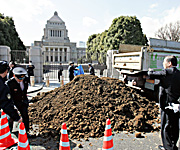
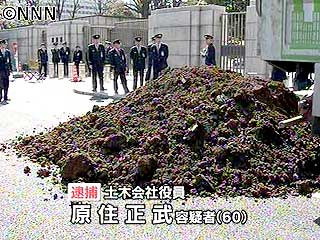
Nobody messes with Japanese truckers and gets away with it

Some of you might have seen what happens when you throw bicycles at Japanese garbage men. Well, one ballsy dump truck driver has shown the world that garbage men aren’t the only ones who won’t take things lying down:

dump-2-tky200703070314.jpg

dump-070307061.jpg

Furious over moves to tighten controls on load limits and to ban diesel-powered vehicles in some areas, transport company owner Masatake Harazumi on Wednesday let the government know how he felt. The 60-year-old trucker drove his rig to the Diet building in Tokyo and dumped about 10 tons of soil in front of the gate. (Toshiyuki Matsumoto/ The Asahi Shimbun)

(2nd photo from Nippon TV)

Marxy’s exciting new project

Marxy of neomarxisme is writing for a new site under the auspices of his employer the Diamond Agency called Clast, reports Jean Snow. It’s a blog aimed at “breaking down consumer and media insights in Japan.” Here’s more from Clast’s about page:

clast is a bilingual blog created by Diamond Agency to analyze contemporary consumer and media trends in Japan. The word “clast” means literally “a fragment of rock,” and we see our mission as breaking down the extremely complex systems of Japanese market culture into easily-discernible parts. At the same time, however, we also hope to break down misconceptions about the market that have buried their way into the conventional wisdom and provide a new perspective based on a multi-disciplinary analytical approach. Reaching consumers requires an accurate portrait of their world, and clast aims to draw that picture in vivid detail.

I know I’m overjoyed, especially with the “vivid detail” part.

The posts so far (a look at the declining magazine industry and an introduction to influential women’s fashion magazine CanCam and the women who read it) are a must-read for anyone interested in Japan’s media industry (as some of you have asked). You might not hear much about kisha clubs or other issues removed from the promotion and marketing of products, but you will definitely find out why some magazines are doing better than others and how fashion-conscious Japanese women are spending their money. How is this different from his old blog? So far, it’s more focused on the Japanese consumer issues and media. And perhaps more importantly, it does not accept comments, which have proven something of a distraction at the neomarxisme blog.

Not much else to add right now, just check out the site!

Abe’s turn to get SLAMMED

I wanted to go back to ignoring the recent flap over a House resolution to condemn Japan’s supposed failure to adequately deal with the “comfort women” issue. But how can I sit quietly when the Prime Minister himself is getting SLAMMED?

Growing Chorus Slams War-Brothel Remarks Japanese P.M. Under Fire For Comfort Women Remarks
AP

SEOUL, South Korea (AP) – March 3, 2007 – South Korea again criticized Japan’s prime minister Saturday for disavowing his country’s responsibility for using Asian women as sex slaves for Japanese troops in World War II.

Japanese Prime Minister Shinzo Abe said Thursday there was no proof that so-called “comfort women” were forced into sexual slavery during the war.

The remark triggered outrage throughout Asia.

Abe’s statement is “aimed at glossing over the historical truth and our government expresses strong regret,” said a statement from South Korea’s Foreign Ministry.

SHOCKING! Asahi.com is ending their excellent “Today’s morning edition” feature

Remember my recent post praising Asahi’s Japanese website for getting better and better? Well I take it all back. Asahi’s website is about to get worse.

Mere days after I lauded Asahi for making their Japanese-language website more useful, the site has decided to take a huge step back.

According to a Feb 26 news release, they will no longer offer the “Today’s Morning Edition” service as of March 4. The feature gave a full list of the day’s print edition headlines and offered one (almost) full-length article in each section per day. It was a great way for people who can’t get access to the paper to ascertain what is making news in Japan.

But no more. Editorials and the front-page column “Tensei Jingo” will still be available going back 1 week, but otherwise you have to go to fee-based sites such as Asahi Perfect to get access. No other explanation is given.

The Morning Edition section wasn’t started all that long ago (I can’t seem to find a reference to when they started it), but I’m presuming they started it on a trial basis to see if offering one free article per section would attract sufficient interest in the fee-based services. I’m guessing that they didn’t generate enough interest, not that the feature was marketed all that well (I didn’t notice it existed until I decided to check the editorial section one day).

If this decision is one made by the new editor that asahi.com was looking for, I humbly request they reconsider. Offering more of Asahi’s flagship content online will only attract more interest in the site and would not hurt newspaper sales.

I can understand why Asahi, the number 2 newspaper in Japan, is reluctant to take the plunge into offering more free content. Japan’s newspaper circulation has been falling much more slowly than their American counterparts. In particular, the Asahi’s circulation has declined by only 2% from 1996-2006, though that slightly outpaces the industry-wide drop of 0.5% for the entire industry (1995-2005, all figures in absolute terms). Though I can’t be bothered to dig up roughly comparable statistics, this 2005 Washington Post article indicates that US newspaper circulation has been plummeting for 20 years, due to restrictions on telemarketing and competition from the Internet/cable TV, 3 problems that have not proven major obstacles for the Japanese industry.

Still, I’m shocked that they’re just pulling the rug out from what was a great service (I mean, you wanted to read the full report on recently unearthed diaries by Major General Taro Utsunomiya describing the March 1st uprising in 1919 colonial Korea, didn’t you?). Ah well, none of this will matter come April when I’ll more than likely become a print subscriber anyway.

Business advice from J-Cast

J-Cast is a relatively new Japanese online news service co-founded by Asahi Shimbun veteran and AERA founder Masao Ninagawa. Rather than aim to serve as a straight news site like the major news media (which would be practically impossible since online news organizations aren’t allowed into government press clubs), they try to form a conduit between “primary” information (direct investigation/reporting) and “secondary” information (news reports from other companies, websites, blogs, 2ch etc) to achieve something they term “1.5-degree information.” I’ve been using the site for a while because it has an RSS feed (that lets me read entire posts in my reader no less) and often has good links or covers an issue in more detail than I can get elsewhere (such as the recent controversy over claims that Prime Minister Abe wears diapers due to recent health problems).

But what I wasn’t aware of (in yet another “news to me but maybe no one else” moment) is that they have an English site. It doesn’t seem to get updated often enough, but I thought I’d share with you this useful highlight from a series on how to succeed in business as a foreign company in the rough and tumble world of Japan’s “capitalist controlled economy” (English mistakes theirs):

Why Are Bureaucrats So Arrogant?
by Atsushi Yamada

Administrative measures are taken according to the law, but government offices, not courts actually decide how to interpret the law for implementation. Bureaucrats’ feeling like “Sairyo” (discretion) or “Gyosei-shido” (administrative guidance) often set the rule of business. People who are not accustomed to this kind of system led by bureaucrats, especially foreigners would be bewildered. There are two ways to cope with this. First off, ask government offices openly. Regarding the non-transparent measures like administrative guidance or permission rights let your lawyers ask for the view of government offices in writings. You should explain that you would like to do it as business and ask them whether it was lawful or not for avoiding the accusation later. If they do not permit, ask them the reasons for it in writings.

As Japanese government offices lead the private sector with “Aunno-kokyu” (perceived feeling), they are susceptible when they are asked for logic. Act aggressively with the backing of the law. Recently this has become very effective. When foreign companies are not abundant in Japan, they do not react seriously even if you ask for the view directly. But they are not allowed the poor treatment now, as “transparency of administrative measures” is required. This kind of measure is the right one even though the relationship with the government office might become difficult. They would see you as “lousy” and would not treat you well.

Another way is “When you are in Rome, do as the Romans do.”

You would see them with low posture and respect. Try to go often to government offices and approach government officials. Try to find time to dine and play golf together with them. Build the cordial relationship that will allow you to consult with them. If possible, become a member of the related organization and contribute to the activities of the organization. Try to become friend with “Amakudari” officials in the organization, and get the information of government offices like internal situation or frank opinions. It might be possible to have an introduction to government officials. With the introduction from the inner circle, they react differently. It might be a good way to become senior official in the related organization and skill up the negotiation tactics. It might be possible to form an industry with only foreign companies. In that case, you could find a way to receive a politician who has an influence to government offices as an adviser. But in that case, you might be forced to buy tickets when the politician held fund raising parties.

Attack from the front or take appeasement policy, judgment is manager’s task.

Deference? Golf? Political fundraisers? Screw that, I think I’ll call my lawyer.

Look at me, I’m complaining about journalists who write about themselves!

As someone who reads far too many news articles for his own good, I may be somewhat more sensitive to media cliches than your average news consumer. For instance, I have a whole category on this blog for “kabuki” metaphors.

But today I want to talk about another of my pet peeves in the English-language news world: when the reporter flips things all around and makes him/herself the focus of a story. While some people might be interested in the daily life of some freelance writer who rides his bike around town, probably most of us don’t want to read about what substantively is no different from following a homeless man around all day and writing about it (though wait, that would be a good idea). And speaking of homeless people, I almost broke my mp3 player in outrage when I heard this pointless “report” about a man who decided to write out of a storage unit in New York. He should have tried that in DC – he’d have ended up getting arrested if he was lucky, but more likely had his ass handed to him like the rest of the crackheads who try that stunt.

Or consider the reporter who freaked out when he was deemed unworthy of a Wikipedia entry for lack of notability. He spent a full two pages on the subject, and once published the article apparently made him immediately eligible for an article again. This naked display of the writer’s fragile yet gargantuan ego leaves me almost speechless but I will say this: You use Slate to whine to the world that you’re underappreicated, and then that whining (intentionally or not) simultaneously pressures the source of the perceived slight to recognize you once again? You should be ashamed of yourself! (I am not mentioning the writer by name or linking to the article in the hope that he won’t ever find this and have a mental orgasm over seeing his name in print because of something I wrote. I wouldn’t be able to touch the keyboard again).

I could go on and on, but you get the idea. Journalists can be pretty egotistical, and as writers they no doubt have a burning desire to tell their story. Or perhaps sometimes they’re just dicks (“I got Bill Clinton to threaten me!”). Foreign correspondents especially seem eager to put themselves in the reporting, which is usually justified (“My convoy got hit with an IED!” “I got kidnapped!”) but too often an unappealing by-product of the expat experience (“Look at me, I am getting paid to walk around China!”). And often it’s less about autobiography than it is a cheap stunt (“Look at me, I got waterboarded!”). Whatever the case, it just doesn’t sit right with me when there are real things to report about. Much like nonbinding resolutions directed at foreign governments, these articles seem to be lost on their way to somewhere else.

Since I haven’t been around for very long, I am going to assume that this practice has been around for a while — HL Mencken seemed to like writing about himself for one thing, and you can see traces of Hunter Thompson in a lot of these kinds of projects. But at the same time this practice seems like some unholy amalgamation of gonzo reporting and the Today Show with Katie Couric meets livejournal, which would make its growth more recent.

There are better ways for a reporter to talk about him/herself as part of the story than to simply say what is happening and then try to link that to some cosmic truth or the zeitgeist or whatever justification you use to get printed in a news publication. The best use of personal narrative that I’ve seen in recent reporting is Nicholas Kristof, who has used the sheer power of his reporting to play a pivotal role in keeping alight what little focus the US has placed on resolving the genocide in Darfur, Sudan, not to mention his efforts to force people to take a hard look at the state of child prostitution in Cambodia from a much more dynamic perspective than almost any other source would have the guts to give. That might be setting the bar high, but I think it has to be pretty high or else we’ll never hear the end of Budding Journalist’s Amazing Tales of Public Transportation.

First mention of comfort women in the English press?

The discussion over the proposed presumably well meant but ultimately pointless US congressional resolution condemning Japan’s wartime system of “comfort women” made me wonder, when was this first reported in the US? Since I have easy online access to the New York Times archive I thought I would check there. It seems highly unlikely that the NYT would have passed over mentioning the issue if some other paper had reported it first, so this is most likely as least an approximate date.

***

January 14, 1992

Japan Admits Army Forced Koreans to Work in Brothels

Three days before Prime Minister Kiichi Miyazawa takes his first official trip to South Korea, the Government admitted today that the Japanese Army forced tens of thousands of Korean women to have sex with Japanese soldiers during World War II, and hinted that women who are still alive might receive some kind of compensation.

Until today, Japan’s official position has long been that the “comfort girls” were recruited by private entrepreneurs, not the military.

But many historians have attacked that position as a convenient rewriting of history, and over the weekend Asahi Shimbun, one of Japan’s largest newspapers, reported that army documents found in the library of Japan’s Self-Defense Agency indicated that the military had played a large role in operating what were euphemistically called “comfort stations.”

Mr. Miyazawa is widely expected to address the issue on his visit to Seoul and to offer a fairly specific apology. The vast majority of the women were forcibly taken to Japanese-occupied China and Southeast Asia from Korea, which was a Japanese colony from 1910 until Japan’s defeat in 1945.. ‘Abominable Episodes’

Over the weekend Japan’s Foreign Minister, Michio Watanabe, said “I cannot help acknowledging” that the Japanese military was involved in forcing the women to have sex with the troops. “I am troubled that the abominable episodes have been unraveled, and they give me heartache,” he said.

Today Japan’s chief Government spokesman, Koichi Kato, offered a more specific apology, saying, “We would like to express our heartfelt apology and soul-searching to those women who had a bitter hardship beyond description.”

But he said that because Japan settled issues of wartime compensation for Korea in 1965, when the countries resumed full diplomatic ties, there would be no official compensation for the victims. For weeks the Government has been talking about finding private sources of money that would settle claims by surviving “comfort women,” without setting the precedent of reopening reparations claims.

In December, around the time of the 50th anniversary of the Pearl Harbor attack, three Korean women filed suit in Tokyo, demanding compensation for forced prostitution in China. Occasional Protests in Seoul

Though the Government said that officially all compensation issues have been settled, officials acknowledged that they could not openly contest the suit without roiling relations with South Korea. Periodically there have been small demonstrations in Seoul denouncing the Japanese for their failure to face the issue.

The question of Japan’s refusal to acknowledge official involvement in the forced prostitution has been a continual irritant in Japanese relations with South Korea and, to a lesser degree, with China. Many of the women were killed or brutally beaten. While historians disagree about how many women were forced to have sex with the troops, estimates run from 60,000 to more than 200,000.

The documents reported in Asahi Shimbun were found by Yoshiaki Yoshida, a history professor, who reviewed them at the Defense Agency. They have been in Japan since 1958, when they were returned by United States troops, and it is not clear why they have stayed out of view for so long.

The “comfort women” debate has been but one of the continuing tensions between Tokyo and Seoul in recent years. South Korean leaders have long complained that they have yet to receive an adequate apology from Japan for wartime atrocities. Last week, at a dinner for President Bush, President Roh Tae Woo of South Korea reportedly expressed concern that Japan has yet to apologize fully for the war.

***

January 18, 1992

JAPAN APOLOGIZES ON KOREA SEX ISSUE

Prime Minister Kiichi Miyazawa of Japan made a formal public apology here today for Japan’s actions in forcing tens of thousands of Korean women to have sex with Japanese soldiers during World War II.

In a speech to South Korea’s National Assembly, Mr. Miyazawa said: “Recently, the issue of ‘comfort women’ in the service of the Imperial Japanese Army has come into light. I cannot help feeling acutely distressed over this, and I express my sincerest apology.”

Mr. Miyazawa’s visit to Seoul has been preceded and accompanied by vociferous campaigning in the South Korean press for an apology from the Prime Minister, and for compensation from Japan for the surviving women.

This call has been echoed by protesters in South Korean cities.. Estimates Up to 200,000

Korean historians estimate that 100,000 to 200,000 Korean women were forced to have sex with Japanese soldiers before 1945, when Japanese colonial rule ended in Korea. It is not known how many survive.

Japanese and South Korean officials said Mr. Miyazawa had also offered an apology in his second round of talks today with President Roh Tae Woo.

Mr. Miyazawa said at a joint news conference afterward that Japan would sincerely investigate the issue.

But there was no mention in their talks of compensation for the surviving women, the officials said.

The question of compensation for 35 years of colonial rule in Korea was settled when the countries established diplomatic relations in 1965. Compensation Suit Filed

But last month three Korean women who say they were forced to have sex with Japanese soldiers filed a compensation suit in a Japanese court, which may set a precedent for other cases.

The issue overshadowed other topics discussed by Mr. Roh and Mr. Miyazawa, particularly South Korea’s growing trade deficit with Japan.

The two leaders agreed to set up a committee to work out by June a plan of action for closing the trade gap and increasing the transfer of Japanese technology to South Korea.

South Korea was $8.8 billion in the red in trade with Japan last year, accounting for nine-tenths of South Korea’s overall trade deficit.

U.S.-NORTH KOREA TALKS SET

WASHINGTON, Jan. 17 (Reuters) — High-ranking United States officials will meet North Korean leaders in New York on Wednesday to discuss the country’s nuclear program and other American concerns, the State Department said today. The United States Undersecretary of State for Political Affairs, Arnold L. Kanter, will meet a delegation headed by the Secretary of the governing Workers Party, Kim Young Sun, a State Department spokesman, Richard A. Boucher, said.

[The North Korea bit was on the same page. Not relevant to comfort women but still amusing to see it was in the news at the time.]

Au Bon Pain coming to Japan

It’s like all the best chain stores suddenly found out I was coming to Japan and decided they needed to step up:

Monday, February 26, 2007

U.S. Bakery Chain Au Bon Pain To Enter Japan In Summer

NEW YORK (Nikkei)–U.S. bakery cafe chain operator Au Bon Pain plans to open its first store in Japan this summer under a franchise agreement with Reins International Inc., company sources said.

The cafe will offer such items as bread, sandwiches and coffee. Au Bon Pain aims to increase the number of outlets to 300 in five years.

Reins International, a group company of Rex Holdings Co. (2688) and operator of the Gyu-Kaku chain of grilled beef restaurants, plans to open the first cafe in a Tokyo business district. It will begin introducing outlets in other major cities from next year.

The Boston-based Au Bon Pain operates about 230 cafes in the U.S., mostly in urban areas. It has also begun opening outlets in such Asian economies as Thailand, Taiwan and South Korea.
(Nikkei)

I’m not a huge fan of this place, but I know MF is. Hey, why not. Hopefully they will have good bagels. I don’t think I can realistically hope it will be cheap since it’s a big ripoff in Washington.