

New essay up at Neojaponisme! This time I am peeved about the local media reaction to Japan’s first major arrest of rogue commenters, on the blog of a B-list celebrity you’ve probably never heard of. Potential stalkers, consider yourselves warned!
New essay up at Neojaponisme! This time I am peeved about the local media reaction to Japan’s first major arrest of rogue commenters, on the blog of a B-list celebrity you’ve probably never heard of. Potential stalkers, consider yourselves warned!
Yomiuri has reported that the Justice Ministry has formally proposed to scrap the locally-administered alien registration system in favor of a national system under the control of (you guessed it) the Justice Ministry. This has been in the works since last year and would have to be approved by the Diet as an amendment to the Immigration Control and Refugee Recognition Act, so don’t expect any changes overnight, but these are the changes we can apparently expect from the new system:
Benefits for foreigners
New problems for foreigners
All this said, as David Chart points out, the Justice Ministry hasn’t been too bad to “good foreigners” lately. Although the new fingerprinting system is kind of annoying, the Ministry at least had the decency to give re-entrants a separate line at Narita immigration instead of lumping them with tourists (which was part of the initial proposal, as I recall). So it isn’t too much of a stretch to expect that they will ultimately work this system in a fairly efficient manner, even if certain points raise alarm on paper.
The proposal is now in the hands of the LDP, which will have to make it into a bill for the Diet’s consideration, so theoretically anything can happen from this point.
This is the third installment in my rapid photo gallery posting series to prepare for my new camera, following Part 1 Osaku amateur photographers in Akihabara and Part 2-A: Adjoined slum and cemetary in Taipei: Part 1-Slum.
Last summer when I was in Taipei I stayed for a week and change at my friend Cerise’s house, located in a nice new looking development up the hill a bit from Xinhai Station, on the Muzha MRT elevated train line. The area immediately around the station looks to have been a center of carpentry and similar workshops since well before the station was built in the early 1990s (Muzha was Taipei’s first MRT line, built from 1988 and opening in 1996), and still surround it.
Behind the station are several of the aforementioned workshops, beyond which is a hill, upon which is a traditional Chinese cemetery of the kind popular in Taiwan. This is not particulary weird, but what is kind of weird is that in between the cemetery hill and the immediate vicinity of the station is a small cluster of private homes that I can’t describe in one word any more appropriate than “slum”. These photographs are of the cemetery itself, and Part 2-A: Slum is the gallery of photographs of the area from the station to the area to the cemetery proper.
All photographs here taken with a Canon 300D camera with 17-85mm EFS lens, on August 1, 2008.
<object width=”500″ height=”375″> <param name=”flashvars” value=”&offsite=true&lang=en-us&page_show_url=%2Fphotos%2Fmutantfrog%2Fsets%2F72157613996577866%2Fshow%2F&page_show_back_url=%2Fphotos%2Fmutantfrog%2Fsets%2F72157613996577866%2F&set_id=72157613996577866&jump_to=”></param> <param name=”movie” value=”http://www.flickr.com/apps/slideshow/show.swf?v=67348″></param> <param name=”allowFullScreen” value=”true”></param><embed type=”application/x-shockwave-flash” src=”http://www.flickr.com/apps/slideshow/show.swf?v=67348″ allowFullScreen=”true” flashvars=”&offsite=true&lang=en-us&page_show_url=%2Fphotos%2Fmutantfrog%2Fsets%2F72157613996577866%2Fshow%2F&page_show_back_url=%2Fphotos%2Fmutantfrog%2Fsets%2F72157613996577866%2F&set_id=72157613996577866&jump_to=” width=”500″ height=”375″></embed></object>
Here are a flash slideshow, recommended for full-screen mode, followed by HTML for the flash challenged.
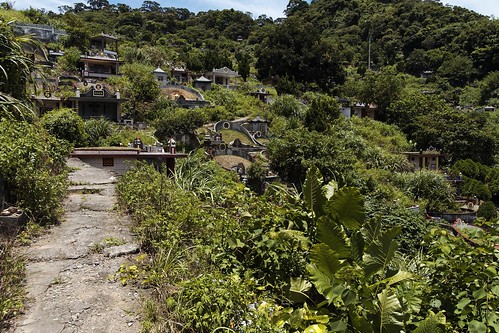
Here is the view from the path leading up the hill into the cemetery.
Continue reading Photo festival part 2-B: Adjoined slum and cemetary in Taipei: Part B-Cemetary
(Updated below) (Updated again)
When I lived in Washington, DC, one of my part-time jobs was to teach TOEIC strategies mainly to Japanese bureaucrats and businessmen who were stationed in the area for one reason or another. They usually came as invitees of the State Dept. or, in the case of salarymen, sent by their companies to study the US patent system, auto crash test system, or other relevant area depending on their career track. The school was somewhat unique in that it was specifically set up to cater to Japanese customers, making it effectively an eikaiwa school in the US.
I was never a particularly good teacher. My experiences studying Japanese (at the time I had two years of study abroad in Kansai and the JLPT Level 1 under my belt) actually got in the way of my being an effective teacher, since I usually became so star-struck and curious about their government roles that it hampered their progress in getting through the TOEIC drills. Despite that (or perhaps because of it), the job was a very instructive experience for me, not least in terms of how adults try and learn second languages.
Students were typically early/mid-career bureaucrats in their late 30s or early 40s with no relevant international experience. Hence, their English levels all tended to hover around a fairly low level (TOEIC of around 500 or so, decent reading skills, next to no speaking and listening skills). This helped create a sense of community among the students, who often congregated for small-talk, safe in the knowledge that they were all in the same boat.
Intermediate students threatened this balance. “Intermediate” in this sense simply means a student who can express himself relatively fluently in some situations and maybe has some cultural fluency as well. Though the lessons were mostly one-on-one, during group lessons with the school’s president the intermediate always gained a reputation as “the fluent one.” As a result, the other students would defer to this more advanced student and consider him the standard for progress. Each time this happened, there was always at least one student who became discouraged and grew reluctant to express himself or really try and move forward on his own terms, especially in the group lessons. At the same time, I could detect a kind of jealousy of the intermediate students for getting ahead of them.
The intermediate students could sense how the others felt about them, and some seemed to even relish their top dog position. They tended to be prideful and resisted my suggestions that they needed help with key concepts. It became pretty frustrating at times because even the intermediate students couldn’t successfully understand our teaching materials, which consisted mainly of old TOEIC tests and NPR archives. Basically, they were riding high on the difference between a 600 TOEIC and a 700 TOEIC, which in reality isn’t all that significant.
In the end, this was a form of negative competition. Even if the people around you are more advanced, that doesn’t mean you have to compare yourself with them (at the school we would try and separate intermediate students if possible). And just as important, if you are ahead of your peers, that is no excuse to sit on your laurels. Since the wider world is much more competitive than your circle of acquaintances, it is important to identify your own strengths and weaknesses, and work from there.
Gaijin Hierarchy
The same thing happens among foreigners in Japan, and I am just as guilty of this behavior as anyone. Typically, even in casual conversation people in the Japanese as a second language community as well as the eikaiwa community will rank each other on their relative prowess in Japanese, and I am sure most readers of this blog have endured the utter awkwardness of the Japanese-language/Japanese culture knowledge “pissing contest.” I noticed this tendency very strongly over the (mostly off-topic) discussion at Japan Probe related to the allegations of fund misuse in the JET Program. Here is a typical example of this need to impose hierarchy (UPDATE: Not really, but it’s a good lead-off for discussion nonetheless. See comments for clarification):
Comment by Darg:
I’m a former JET, although I wasn’t an ALT. I was a CIR (Coordinator of International Relations), and have had this convo many times before. I really think the proper solution should be to put more focus on the international understanding and relations and less on the English teaching, and as a result have more CIRs and less ALTs.
I believe the CIR job is closer to the original intention of the JET program, and that is to promote cultural exchange. The problem is, most people don’t even know what a CIR is and think the JET program is a big waste of money because of the portion of ALTs that come out here and screw things up for the majority who actually try and get something done.
If they required a minimum of teaching experience for ALTs and raised the CIR:ALT ratio, I think a lot more people would appreciate the JET program.
This is objectively false (UPDATE: again, see comments for how I misunderstood what he envisioned CIRs doing). The program is called “Japan Exchange and Teaching Program” for a reason – historically, it was set up to place foreigners inside school classrooms to help with the drive to “internationalize” Japan through better English learning. The job of a CIR, on the other hand, is secondary to that priority – they typically assist with the “international” programs of a local city hall. The only basis for concluding that CIRs are more beneficial to the JET program than the ALTs – and this view appears to be common – seems to be the desire to believe that the advanced Japanese language requirements for CIRs actually mean something, as opposed to those illiterate ALTs who are allowed to come to Japan equipped with nothing but their English skills and the enthusiasm to teach kids.
In fact, while I have heard of a productive role for the Portuguese-speaking CIRs who help facilitate communication in towns with high Brazilian populations, others complain that CIRs are often given the basically pointless jobs of promoting multicultural events and maintaining sister city relationships. That these jobs require some Japanese competency does nothing substantially to improve the objective “worth” of these positions.
It is easy to make Darg’s mistake of dismissing ALTs’ role in supplementing the current, generally poor state of English language teaching and general proficiency, including among Japanese-national English teachers. This won’t go away overnight, and in over 20 years of the JET program not much seems to have changed. Commenter Jake brings this up:
Anyway, my point is that having a warm foreign body in every classroom in the country has become the status quo and nobody seems to be questioning that system itself — just figuring out how to maintain the system while cutting costs (i.e. handing all the contracts over to Interac). Then again, retooling the system to teach English in a manner that enables students to actually speak would also mean retooling the entire test-based educational system, and until that happens, pretty much any new policy implemented is going to be nothing more than a band-aid on a brain tumor.
Suggesting Japan should “retool the system” is MUCH easier said than done. Consider some of the moving parts involved:
And on and on. Feel free to squabble over the details, but it’s clear enough that in the current environment, parachuting in “warm bodies” seems like a pretty good compromise. So despite all the insults I have dished out in the past, I really don’t think there is anything these ALTs/eikaiwa teachers should be ashamed of. In an imperfect system, they are playing an important role.
Yet I would argue that for the purpose of leading a productive life, it’s necessary to leave the whys and wherefores about eikaiwa aside. To a certain extent, supply and demand are beyond direct human control, and as a result much overarching debate on “the system” ends up being just another extension of the pissing contest.
But this point remains lost on too many with a vested interest in this issue – the teachers and those who look down on them in the milieu of gaijin society. Again and again, jobs that require Japanese in Japan are seen as more worthy than the dreaded English teacher position. Roughly speaking, I see the hierarchy as falling along these lines:
Japanese-speaking corporate executive > Professor > Interpreter > Token gaijin at a large corporation > Translator > Gaijin tarento > JLPT 1 passer > eikaiwa teacher-turned-entrepreneur > Journalist > CIR > Convenience store clerk/electronics salesman > Eikaiwa teacher > Street performer > Hostess
Relatedly, the group of Western expats who work for foreign companies and generally live in a Little America (think Hiroo in Tokyo or Rokko Island in Kobe) are usually not even included in this universe of possibilities, despite there being substantial overlap in practice.
Could there be anything more arbitrary and meaningless? In every other corner of the word it seems like people understand that people of different skill sets and living situations have different career needs, prospects, priorities, and ways of life, so why do the gaijin need to bitch so much?
The majority of non-soldier Western expats in this country are eikaiwa teachers, so it is an interesting phenomenon to see that many even in the profession see it as pointless and counterproductive to their careers. The people within that group easily end up like my former students — forming a pecking order based on Japanese language ability and overall J-savviness.
Why? For one thing, the gaijin community can be pretty isolated – it is a small subset of wider Japanese society, so if language or cultural barriers have kept you from really assimilating with the mainstream, the only real alternative is to stay with the people with whom you have common ties. A thousand and one Japan bloggers will tell you this can be lonely and frustrating. For another, it cannot be denied that there is some truth to the idea that many people who end up in Japan were either single-mindedly obsessed with Japan from the beginning or simply didn’t give much thought to a career until graduation rolled around. People whose jobs came as an afterthought might welcome a distraction from their own situations.
But most importantly, placing the eikaiwa teachers or those with poor Japanese on the bottom of the totem pole is a convenient and easy way to make people feel better about themselves. But again, it doesn’t actually help anyone – it’s just another form of negative competition. I hope the people living and working in Japan will step back from these false distinctions.
In terms of careers, eikaiwa teachers should try and think honestly where they are and consider where they would like to be, without worrying about whether their Japanese is up to snuff. Japanese is a lot of work, but it is doable and it will come. Or not. You will have to make the cost/benefit analysis of where your career is headed and whether it is worth it to stay in Japan at all costs or whether you might have better prospects back home, or even in a third country (I had a great time living in Bangkok). The economy isn’t all that great at the moment, but now is a good time to brush up on your strengths or the skills you wish were your strengths, whether they are Japanese language, network engineering, hip-hop dancing, or even English teaching.
Oddly, it’s the people supposedly on the top that might have the most to lose by “winning” this contest. Even if you have passed JLPT 1 and “escaped” eikaiwa, why not take a look in the mirror and consider your next move? Many of the people who have succeeded somewhat in assimilating did so by going out of their way to avoid contact with other Westerners, out of the fear that overexposure to their native language would hinder the Japanization process. While there is some merit to that, especially at the early stages, at some point you will have to stop seeing other foreigners as competition. You should feel comfortable enough in your position that you’re happy to help others.
Despite all the praise you might get for speaking good Japanese, Japanese language alone does not make a career (and if you want to be a translator/interpreter, it’s harder than it looks). Nor will it make you a very interesting person if that’s all you’ve got. And remember, if you become too self-satisfied with your supposedly lofty achievements you may be in for a rude awakening.
YET MORE UPDATES (No more Chuck Norris…): Here is an updated hierarchy thanks to the comments section (again, this is just a rough estimate based on my assessment of the state of gaijin discourse):
The emperor if he actually has a surfer dude accent > Steven Seagal > all foreign sumo wrestlers except Konishiki and those Russians that got caught with weed > Naturalized Japanese citizen (some overlap here)* > Street performer who hooked up with a famous idol > Japanese-speaking corporate executive > other foreign fighter/athlete> Attorney > Professor > Interpreter > Token gaijin at a large corporation* > Translator > Konishiki > Mombusho scholar > first-generation JET/BET who was totally not an English teacher > Translator who pisses on people > Professor who only teaches ESL > Jesus in Toyama > Gaijin tarento > JLPT 1 passer > JLPT 1 passer who speaks in dialect to show off > Genki English guy* > NGO Worker > eikaiwa teacher-turned-entrepreneur > Foreign Geisha > Journalist > high school exchange student > Akihabara tour guide (with Son Goku costume)* > Portuguese-speaking CIR > CIR > Convenience store clerk/electronics salesman* > Eikaiwa teacher >Bonsai (or other traditional Japanese craft) master > Bonsai (or other traditional Japanese craft) student > Buddhist convert > Shinto convert > Headhunter > Eikaiwa teachers who are milking the system > Street performer > Hostess > guy handing out event fliers in Roppongi > Foreign psychic > Evangelical Christian
* Position in hierarchy in dispute.
The Taipei Times printed an interview the other day with Yu Bor-chuan of the Taiwan Pinyin League, and head of the team that designed Tongyong Pinyin. He is of course a heavy promoter of Tongyong Pinyin, saying that it is better suited to Taiwan than the internationally accepted but PRC originated Hanyu Pinyin. He has some interesting background on the history of various kinds of phonetic writing in Taiwan, and of course makes his argument for avoiding Hanyu Pinyin.
That the MOE did not cite the source of the Hanyu Pinyin charts constituted an act of plagiarism as the phonetic system was approved by the State Council of the People’s Republic of China [PRC] and ratified by its National People’s Congress in 1958.
This is just a weird statement. He seems to be arguing that any discussion of Hanyu Pinyin MUST be centered on politics and not linguistics, which to me is an utterly absurd position.
As for the false information I mentioned, the MOE said Taiwan’s street and place names are spelled using Hanyu Pinyin on maps and atlases published by most countries and international organizations. This is not true, since the international community generally goes by the guideline of naming a person or a place after its original name.
There are hardly any countries or international organizations that use Hanyu Pinyin to spell places in Taiwan except maps published by China.
This, however, is correct. Of course, with romanization in Taiwan being so unstable, foreigners often have no idea which system they should be using.
TT: The main reason given by the government to adopt Hanyu Pinyin was to bring Taiwan in line with international standards.
Yu: If that was the real reason behind the policy shift, the government should have replaced the traditional characters used exclusively in Taiwan with simplified characters, because more than 95 percent of the [Chinese-speaking] population worldwide uses simplified characters.
He’s really mixing apples and oranges here. While it is kind of true that making all language policy decisions on the basis of international standards would lead to the adoption of simplified Chinese, Yu is being very disingenuous about the logic as it applies here. While traditional written Chinese is used in Taiwan as the national and official language and the medium of instruction for all Taiwanese, Pinyin in any form is used ONLY for the benefit of foreigners. Most Taiwanese simply do not learn Pinyin, whether Tongyong, Hanyu, or Wade-Giles. The argument that a supplemental writing system which is used only to accomodate foreigners should follow international standards should in no way mean that the primary writing system, used for the primary Taiwanese national language by its citizens, should also be changed.
Adopting Tongyong Pinyin will not pose difficulties for foreigners.
For foreigners who do not understand Mandarin, whether a road sign is spelled in Hanyu Pinyin or Tongyong Pinyin makes no difference, not to mention that Tongyong is more friendly to English speakers than Hanyu in terms of pronunciation.
The primary differences between the two systems are that Tongyong uses “s,” “c” and “jh,” which corresponds more to English spelling, instead of “x,” “q” and “zh” as used in Hanyu Pinyin, which English speakers without Mandarin skills do not usually know how to pronounce. There wouldn’t be a problem as long as street signs an maps were spelled consistently everywhere.
This is largely true. Consistency is the most important thing such a writing system, but why is consistency between the spelling of identical place names or syllables in Taiwan and the rest of the Chinese-speaking world a bad thing?
The Hanyu Pinyin system is not entirely suitable for Taiwan given the fact that not every Chinese character is pronounced in Taiwan as it is in China.
Maybe something is lost in translation here, but this sentence simply makes no sense. While some characters do have a different common pronunciation in Beijing-accented Mandarin or Taiwan-accented Mandarin, Taiwanese Mandarin uses exactly 0 sounds that do not exist in Hanyu Pinyin. I have a Chinese dictionary from Taiwan in which it notes-in Hanyu Pinyin-both pronounciatins where they differ.
Immediately after Hanyu Pinyin was adopted by the government in September, the MOE promulgated guidelines for using Hanyu Pinyin to Romanize Hakka, replacing the application of Tongyong Pinyin for teaching Hakka.
As Tongyong has been used for the Romanization of Hakka, even some KMT lawmakers were against the new guidelines. They said that it would make learning Hakka more difficult because Hanyu Pinyin did not accommodate sounds in the language.
This is getting into a more complicated area, but it is easily avoided. Hanyu Pinyin is a romanization system for Mandarin. Hakka, while a related language, is not Mandarin, and should have its own romanization system designed for it with no consideration for the romanization system used for other languages. While I am generally supportive of the move to use Hanyu Pinyin for Mandarin despite it being partly based on a political agenda, extending Hanyu Pinyin to other Chinese languages (or dialects, as they are known by Chinese nationalists) is a purely political choice that makes no sense from a linguistic, educational, or practical perspective.
The most serious problem is how our names are to be Romanized.
Although the Hanyu Pinyin guidelines allow individuals to decide the spelling of their name, it suggested using the format of surname first, followed by given name without a hyphen between the syllables … If my name were that way, my initials would be [Y.] B. instead of [Y.] B.C. in Tongyong Pinyin … How can the government ignore the fact that Taiwanese people have used a hyphen in their given name … for about 20 to 30 years?
No one has the right to arbitrarily decide what other people’s names should be. By the same token, Taiwan has every right to decide its proper names.
We should not give up autonomy over this as it is a representation of our sovereignty.
No real arguments here. People should be free to write personal names as they wish, but that doesn’t mean that there shouldn’t be a recommended orthography. One thing that isn’t addressed even here is while for most Taiwanese (aside from ethnic aborigines) primarily write their name in the same Chinese characters, their primary language may be Mandarin, Taiwanese (Hoklo), or Hakka. Shouldn’t they be able to choose to romanize their name for international use in the system of their primary spoken tongue, and not based only on Mandarin?
Japan, where two different Romanization systems have been used since 1954, could serve as an example.
In 1954, Japan’s Cabinet announced a program including the Hepburn and the nippon-shiki [“Japan-style”] systems, under which the Hepburn Romanization system devised by an American is employed in overseas Japanese-language teaching materials, while the nippon-shiki system is used to transliterate local names and for domestic education.
Japan’s experience proves that the adoption of two Romanization systems does not hurt a country’s competitiveness. In addition, [there is] compatibility between the Tongyong and Hanyu Pinyin systems.
This is sort of true, but the nippon-shiki (actually the modernized version is Kunrei-shiki) serves almost no function. It is largely the same as the far more common Hepburn standard, much in the same way that Tongyong and Hanyu are largely the same, but has several minor differences which serve only to confuse. Even in Japan pretty much nobody actually uses anything but Hepburn romanization, and when he says “Japan’s experience proves that the adoption of two Romanization systems does not hurt a country’s competitiveness.” he should really be saying “Japan’s experience proves that the adoption of two Romanization systems is inconvenient, and everybody not legally required to use the less popular system will gravitate over time to the more popular one.”
Since I visited the Japanese colonial era Losheng Leprasorium in Northern Taipei last summer I have been keeping tabs on developments in the battle between government officials trying to destroy it and preservationists trying to…preserve it. Things had been looking grim when elderly wheelchair-bound residents were dragged out of their homes, but a high level apology may mean that things are getting sorted out.
Premier Liu Chao-shiuan (劉兆玄) yesterday offered an apology to patients with Hansen’s disease— also known as leprosy — for the “grievance” and “unequal treatment” they have suffered in the past, promising that his administration would take good care of their nursing and medical needs. The apology came six months after the enactment of the Act of Human Rights Protection and Compensation for Hansen’s Disease Patients (漢生病病患人權保障及補償條例), which detailed measures the government must take to care for leprosy sufferers.
[…]
“I will not accept the government’s apology, because they did not apologize for what they did to me in December,” said Lan Tsai-yun (藍彩雲), a Losheng resident who was removed by the police from the Joan of Arc House. “I asked them to give me two more weeks to pack, but they refused. They cut the power and water while I was still inside, then they cut through the door with an electric saw and took me away by force. But look, Joan of Arc House still stands there today, a month after that incident — why couldn’t they give me two more weeks?”
Here is a video from Taiwanese TV showing activists being dragged away when protesting in support of Losheng preservation back in December. At exactly the 1:00 you can actually see my friend Em having her camera taken away as the police pull her away, although I think she got it back later on.
<object width=”425″ height=”344″><param name=”movie” value=”http://www.youtube.com/v/MLoqV9lre6Q&hl=zh_TW&fs=1″></param><param name=”allowFullScreen” value=”true”></param><param name=”allowscriptaccess” value=”always”></param><embed src=”http://www.youtube.com/v/MLoqV9lre6Q&hl=zh_TW&fs=1″ type=”application/x-shockwave-flash” allowscriptaccess=”always” allowfullscreen=”true” width=”425″ height=”344″></embed></object>
This is the second installment in my rapid photo gallery posting series to prepare for my new camera, following Part 1 Osaku amateur photographers in Akihabara.
Last summer when I was in Taipei I stayed for a week and change at my friend Cerise’s house, located in a nice new looking development up the hill a bit from Xinhai Station, on the Muzha MRT elevated train line. The area immediately around the station looks to have been a center of carpentry and similar workshops since well before the station was built in the early 1990s (Muzha was Taipei’s first MRT line, built from 1988 and opening in 1996), and still surround it.
Behind the station are several of the aforementioned workshops, beyond which is a hill, upon which is a traditional Chinese cemetery of the kind popular in Taiwan. This is not particulary weird, but what is kind of weird is that in between the cemetery hill and the immediate vicinity of the station is a small cluster of private homes that I can’t describe in one word any more appropriate than “slum”. These photographs are of the area from the station to the beginning of the cemetery, and Part 2-B: Cemetery is the continuation.
All photographs here taken with a Canon 300D camera with 17-85mm EFS lens, on August 1, 2008.
Here are a flash slideshow, recommended for full-screen mode, and HTML for the flash challenged.
<object width=”500″ height=”375″> <param name=”flashvars” value=”&offsite=true&lang=en-us&page_show_url=%2Fphotos%2Fmutantfrog%2Fsets%2F72157613881190598%2Fshow%2F&page_show_back_url=%2Fphotos%2Fmutantfrog%2Fsets%2F72157613881190598%2F&set_id=72157613881190598&jump_to=”></param> <param name=”movie” value=”http://www.flickr.com/apps/slideshow/show.swf?v=67348″></param> <param name=”allowFullScreen” value=”true”></param><embed type=”application/x-shockwave-flash” src=”http://www.flickr.com/apps/slideshow/show.swf?v=67348″ allowFullScreen=”true” flashvars=”&offsite=true&lang=en-us&page_show_url=%2Fphotos%2Fmutantfrog%2Fsets%2F72157613881190598%2Fshow%2F&page_show_back_url=%2Fphotos%2Fmutantfrog%2Fsets%2F72157613881190598%2F&set_id=72157613881190598&jump_to=” width=”500″ height=”375″></embed></object>
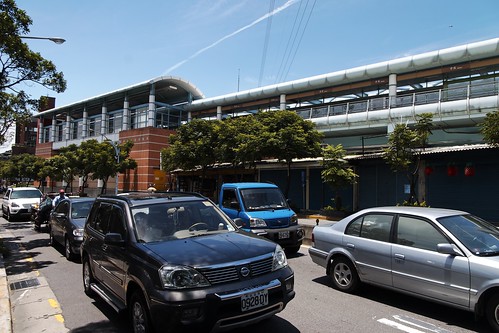
The front of Xinhai station.
Continue reading Photo festival part 2-A: Adjoined slum and cemetary in Taipei: Part 1-Slum
Great speech to give in front of the Israeli president (via Ikeda Nobuo)!
So I have come to Jerusalem. I have a come as a novelist, that is – a spinner of lies.
Novelists aren’t the only ones who tell lies – politicians do (sorry, Mr. President) – and diplomats, too. But something distinguishes the novelists from the others. We aren’t prosecuted for our lies: we are praised. And the bigger the lie, the more praise we get.
The difference between our lies and their lies is that our lies help bring out the truth. It’s hard to grasp the truth in its entirety – so we transfer it to the fictional realm. But first, we have to clarify where the truth lies within ourselves.
Today, I will tell the truth. There are only a few days a year when I do not engage in telling lies. Today is one of them.
When I was asked to accept this award, I was warned from coming here because of the fighting in Gaza. I asked myself: Is visiting Israel the proper thing to do? Will I be supporting one side?
I gave it some thought. And I decided to come. Like most novelists, I like to do exactly the opposite of what I’m told. It’s in my nature as a novelist. Novelists can’t trust anything they haven’t seen with their own eyes or touched with their own hands. So I chose to see. I chose to speak here rather than say nothing.
So here is what I have come to say.If there is a hard, high wall and an egg that breaks against it, no matter how right the wall or how wrong the egg, I will stand on the side of the egg.
Why? Because each of us is an egg, a unique soul enclosed in a fragile egg. Each of us is confronting a high wall. The high wall is the system which forces us to do the things we would not ordinarily see fit to do as individuals.
I have only one purpose in writing novels, that is to draw out the unique divinity of the individual. To gratify uniqueness. To keep the system from tangling us. So – I write stories of life, love. Make people laugh and cry.
We are all human beings, individuals, fragile eggs. We have no hope against the wall: it’s too high, too dark, too cold. To fight the wall, we must join our souls together for warmth, strength. We must not let the system control us – create who we are. It is we who created the system.
I am grateful to you, Israelis, for reading my books. I hope we are sharing something meaningful. You are the biggest reason why I am here.
Or else you might become the Finance Minister of Japan:
The full story is here. He says it’s the latter, but we all know better.
UPDATE: News services are now reporting that Nakagawa is going to resign, citing this incident as the cause. Apparently they finally got over their implicit agreement not to mention his obvious drinking problem.
Very interesting post at Japan Probe on possible quasi-corruption at CLAIR, the affiliate of the Ministry of Internal Affairs and Communications in charge of its share of the JET program:
The Council of Local Authorities for International Relations (CLAIR), the governmental organization responsible for the JET Program, could be in trouble. Popular Osaka governor Toru Hashimoto has started questioning CLAIR’s use of funds and has announced that the Osaka government may reduce its financial backing to CLAIR next year (90% of CLAIR’s financial backing comes from money paid by local governments, and Osaka pays a big slice).
The JET program is one of those rare Japanese government programs in which overlapping ministries successfully cooperate – the Ministry of Foreign Affairs is in charge of most of the administrative details of selecting applicants, the education ministry places them in schools, and the internal affairs ministry coordinates with local governments. Well, it looks like part of the compromise reached between the ministries was that at least the internal affairs side gets to set up a swank suite of perks for retired bureaucrats.
As I have done before, I am cross-posting my comment at Japan Probe to encourage discussion of the issue on my comments section. I began in response to earlier commenters who apparently take any mention of the JET program to debate on the JET program’s merits and the usefulness of eikaiwa teachers in general (of course I would never do that):
Did you notice that this issue has NOTHING to do with the merits of the JET program itself? The problem is that the bureaucrats have turned parts of the program into their own slush fund, which enriches their post-retirement accounts and improves their golf scores at the expense of the Japanese taxpayers and maybe even people who didn’t get accepted to the JET program (since part of the acceptance cutoff is no doubt due to budget constraints). It’s so laughable for them to have overseas offices since they don’t even process the applications – that is the foreign ministry’s job.
This misappropriation issue isn’t any reason to end the JET program. In fact, considering all the extra money they are raking in it looks like they could be accepting even more JETs. I have argued elsewhere that it may have outlived whatever functionality it had as an English teaching program, but as Yomiuri documented around its 20th anniversary the program itself has by and large been extremely beneficial to the teachers who come and have a once in a lifetime experience (or get a foothold for a life in Japan), the schools who want foreign English teachers, and Japan’s soft power as the program generates massive goodwill and a niche workforce of Japan-savvy English speakers.
But if one of the organizations involved is being exploited for no real reason but to provide an excuse for internal affairs bureaucrats to get post-retirement salaries and live the Japanese dream of endless enkai and golf with their coworkers, then Hashimoto is right to use his spending authority to try and put an end to it. As much of a showboat as he can be, that’s an example of real leadership and sticking up for what’s right.
I understand the motivation for post-retirement income, but what I will never get is why these oyaji seem to love drinking in their work suits and basically never leaving the damn office. If you are going to misappropriate funds, at least do what American politicians do and get sweet renovations to your house!
They have 12.7 billion yen a year in unused funding! I propose using that money to send free cookies to every woman who gets pregnant. It will help alleviate the low birth rate AND I’ll only overcharge the government 50 billion yen 5 billion yen a year — big savings!