Takeshima towel

Takeshima towel

Seeing Adam’s reference to the highly disputed pieces of worthless, barren rock known as Takeshima/Dokdo in his post just now reminded me of this, which I had been meaning to post. A Korean classmate of mine at Kyoto University picked up this wet hand tissue from what she described as a very normal restaurant in Korea. It reads:

Republic Of Korea        wet tissue

Dokdo      is our land.

To translate into Japanese, which as usual maps closely to the original Korean better than English:

大~韓民国   御絞り

獨島 は我が土

Dokdo is of course the Korean name for Takeshima, which in European languages used to be called the Liancourt Islets, and is now called whichever of the two stupid names will make your conversation partner happy.

Observations from jogging at the Imperial Palace

Today Mrs. Adamu and I went jogging around the Imperial Palace moat, an activity that is apparently all the rage these days. Mrs. Adamu is training for a half marathon, but I do one slow lap myself just to burn some calories. It is easy to see why the palace area has become a popular place to exercise – it is an unimpeded, smoothly paved path, the view is gorgeous, and it’s easily accessible from Otemachi or other surrounding stations. The downside, of course, is that the jogging traffic has begun to resemble a busy freeway, forcing slowpokes like me to constantly watch my back so as to not get in the way of the more serious athletes. Normal tourists visiting the grounds are also quite visibly inconvenienced by bespandexed Tokyoites rushing by.

But all in all it’s a great experience. Today was particularly eventful:

  • Happy Takeshima Day! The holiday set up by the Shimane Prefectural government in 2005 to remind their fellow citizens that the disputed rocks belong to Japan, not Korea. This is apparently a big deal to right wing groups (see Roy’s earlier post on this), so to commemorate, one decided to use its megaphones outside the Social Democratic Party headquarters to loudly berate them with accusations of treason for close ties to North Korea. BTW, these guys might think their country has a valid claim to the Takeshima rocks, but stamp expert/blogger Yosuke Naito shows us some fairly convincing Korean stamps that say otherwise.
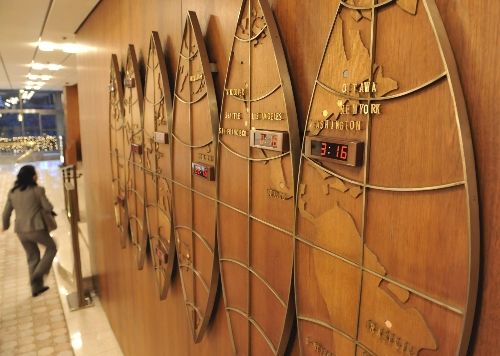
  • Workers were emptying the shuttered Palace Hotel of furniture and other items. The hotel was set up in 1961, just before the 1964 Tokyo Olympics,  on  the site of what was once part of the Imperial Household Ministry and then a GHQ-run hotel “for the exclusive use of buying agents from abroad.” While it must have looked quite modern in 1961, more than 40 years later the design resembles a Holiday Inn and noticeably clashes with the more refined palace across the street. The current building will be torn down, with a renewed Palace Hotel will set to open on the site in 2012. We started jogging the imperial grounds in mid-January, just weeks before the Palace Hotel shut down. We thankfully at least got to take a peek at the lobby before it was relegated to the history books. The inside looked much grander than the exterior, with obsequious front desk staff, expensive-looking lounges, and old-school carpeting and wood-panel walls. By far the neatest item in the lobby, however, was a wood-carved clock, shaped like a world map with digital displays showing the time in major cities. It was considered cutting-edge at the time it was unveiled at the time of the hotel’s opening. The thing just oozes 1960s modernity – I could picture this on the wall of an enormous workroom full of office ladies working on typewriters (click for full size. Thanks Yomiuri!):
    20090218-280217-1-l
    Amazingly, no one knows who designed or manufactured the clock despite its iconic status, but one thing is for certain – it will live on. Though originally set to be destroyed after the hotel closed, at the last minute a German patent office decided to take it (for no charge except shipping costs) out of the management’s nostalgia for frequent stays at the hotel during business trips to Tokyo.

The horrors of local government

For a while I was taking comfort in the notion that if I ever lost my job, I could naturalize and become a local politician like Anthony Bianchi or Jon Heese. At least it would be a more interesting experience than the salaryman grind, right?

Well, watching this clip of city council petitioners in Santa Cruz, California has really made me question that idea.

Best J-E financial glossary ever, available for free by the FSA thanks to the magic of XBRL

Thanks to some technological advances in the area of financial reporting, I am happy to pass along this very handy Japanese<>English financial glossary (3MB, Excel format). This treasure trove contains an extensive bilingual list of the terms used in Japanese financial statements, spanning all sectors and including terminology for investment business and mutual funds.
The file is a list of terms to used in XBRL. Ever heard of it? If you don’t work in investment or the finance department of a corporation, don’t feel bad if you haven’t. It’s a markup language, similar to XML or HTML, customized for the production of financial statements. (watch this awesome Japanese-language Flash animation to learn more).
 
The point is to standardize all aspects of producing the statements. Completely standardized and easily processed statements have all sorts  of advantages, from highly efficient analysis to potentially spotting massive frauds. And the advantages extend beyond mere numbers because the the format standardizes terminology across languages.  I have no clue how they came up with the translations (the FSA site mentions something about the terms being “extracted from past materials”), but from what I have reviewed they are all pretty solid.
Nextgov.com reports (perhaps with some slight overhyping of XBRL’s advantages by the SEC and others) that the system is set to be introduced to 500 of the largest US companies starting in April:

Adding XBRL tags to financial disclosures makes them searchable and much easier to compare. What used to be available only to financial professionals now will be easily accessible to anyone with an Internet connection. Investors, and regulators, in theory, will be able to analyze data faster and more easily, and possibly finding anomalies in corporate financial statements and investments.

The new rule, while not necessarily helping SEC and investors uncover problems that led to the collapse of the financial industry or discover investment fraud such as that allegedly perpetuated by Bernard Madoff, will improve financial analysis. To do so, XBRL would have to be applied to filings on all types of securities, including asset-backed securities and collateralized debt obligations.

The move will bring the United States into alignment with worldwide practices, said Diane Mueller, a member of the XBRL international steering committee and vice president of XBRL development at software vendor JustSystems.

Currently, financial disclosure records that public companies and mutual funds file are large, unwieldy documents often thousands of pages long. Only large financial institutions have been able to devote the time and staff necessary to parse through the documents and glean the most pertinent information and figures for analysis.

The adoption of XBRL, however, is likely to significantly change the way companies are analyzed. The addition of data tags will allow software to instantly comb through reports and identify the most critical information and figures. XBRL “makes for much easier and timely comparisons between companies,” Moyer said. “Today it’s extraordinarily difficult for investors to compare between balance sheets of two banks. They have different reporting styles, etc. [XBRL] starts to conform balance sheets and give you more comparability.”

Another advantage of XBRL for the commission is regulators will know instantly if a company’s filing is missing any key information because the software will automatically identify what data is missing when corporations electronically file documents and then notify the company and SEC. Previously, regulators had to manually check files to find missing information, Mueller said.

Speaking of worldwide practice, Japan’s Financial Services Agency, the financial regulator, was a step ahead, becoming one of the first major financial centers to mandate XBRL filing starting in April last year. Thanks in part to the Japanese authorities’ desire to be a leader in this area, they have provided an official FSA “XBRL taxonomy,” current as of March 2008, which is the file linked above.  
 
While this isn’t exactly news, it’s the first time I actually bothered to look. I had heard that the transition to XBRL could completely eliminate the need to translate financial statements manually, but wasn’t quite sure what it meant until now. Dig in, and mourn the coming loss of one source of translation work!

Aso adopts a courageous pro-guide dog stance

When you’re the prime minister of Japan,  those in your own party think you’re a joke AND your finance minister resigns in disgrace after makign a drunken ass of himself on the world stage, what should you do to reassure the citizenry that you’re doing a good job?

Simple – change the subject to cute puppies. Here’s a clip from his latest e-mail magazine:

The Prime Minister’s Office usually has only human visitors,
but last week I received a visit from service dogs accompanied by
their users, including this woman.

Service dogs are a type of assistance dog, just like guide dogs for
visually disabled people and hearing dogs for people with hearing
disabilities. The role of service dogs is to help their physically
challenged users with tasks such as opening doors or getting
changed.

I heard that Sherry is able to open the refrigerator downstairs,
take out a plastic drink bottle, close the refrigerator door,
and then bring the bottle upstairs. Also, I saw for myself
how a service dog called Elmo was able to pick up a business card
holder dropped on the floor when his wheelchair-bound user gave
the command, “Take!”

I myself have lived with dogs for as long as I can remember. Shiro
and Lucky were the names of my two mongrel dogs — one had been
picked up by the local healthcare center and the other was about to
be used for animal experiments.

When I was a child, it was my daily job to feed them and take them
out for walks. When Shiro died, I could not stop crying as
I recalled how he was when he was healthy, and the way he would
always come rushing out happily to greet me each time I returned
home. This was the time when the importance and preciousness of
life were instilled in my young mind.

Given my own experience, I believe that coming into contact with
animals is highly beneficial in many ways for the development of
children.

Assistance dogs are partners for physically challenged people,
acting as extensions of their bodies. The government will step up
its efforts to make assistance dogs more common, through measures
such as putting its weight behind assistance dog training.

At the same time, I would like as many people as possible,
including readers of this e-mail magazine, to know about assistance
dogs. That is my sincere wish.

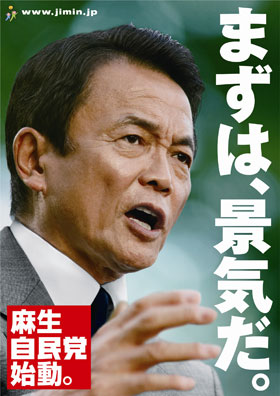
So, is this some kind of subtle cry for help? Does he want a guide dog of his own? Whatever the case, the image is kind of a step removed from the determination to fix the economy as shown in this attention-grabber:

 aso_pos01g

Dumb Luck: Japanese gamblers love hunches—and throw statistics out the window

[Roy: The following is a short article by my friend Benjamin Boas, which was recently published as the back page “Last Word” column in Tokyo’s free English language paper, Metropolis. Ben and I actually met around 12 years ago when we were both attending Buck’s Rock Summer Camp and then after a decade of no contact, both happened to be studying at Kyoto University at the same time last year. Ben spent one year at Kyoto University on a Fulbright grant, which he used to conduct field work researching the anthropology of Japanese gambling, particularly the social role of mahjong in Japanese office culture.

He has a sporadically updated blog on his mahjong studies, found here.]

•     •     •     •     •     •     •     •     •     •     •     •     •     •     •     •     •     •

During last year’s All Japan Poker Championship, one of the finalists made a play that seemed strange. Despite only having an unmatched ace, he called an all-in bet by his opponent at the flop, caught nothing on the turn and river, and lost to his opponent’s pair of tens. Since he could have folded his hand and taken a small loss instead of losing the whole championship, making that call was at best very risky and at worst a terrible play. I mentioned this to some of the expert players at the tournament, and they agreed, but one Japanese spectator had a different opinion.

“Did you see that last hand?” he said. “You didn’t know who would win until the end. It was so exciting!”

When I pointed out that that the chances of the losing player winning that hand were very low he was unmoved.

“But you don’t know what card is going to come next!” he maintained. “He could have gotten the ace.”

Assuming my Japanese had been misunderstood, I got my friend, a former champion, to explain that although there was a chance of this happening, it wasn’t high enough to justify not folding. This, too, fell on deaf ears. It was more than just not understanding how poker worked; the guy didn’t seem to understand that there’s a difference between luck and probability.

In my years studying the Japanese gambling world, I’ve run into this a type of thinking quite often, and sometimes I wonder why.

Now, myopic reasoning is definitely not limited to Japanese people. No one besides card counters, poker sharks and casino owners comes away from Las Vegas ahead in the long run, but that doesn’t stop millions of people of every nationality from trying. What makes Japan different from America, however, is that gambling parlors aren’t limited to a couple of cities and Indian reservations; they stand on nearly every street corner of Tokyo and dot practically the entire countryside.

I am speaking, of course, about pachinko parlors, which account for roughly 4 percent of Japan’s GNP and are patronized by nearly a quarter of the population. Although commonly described as “Japanese pinball” and legally defined as something close to an arcade game, pachinko is machine-operated gambling and nothing more. Thanks to the advent of automated shooting and computer controlled payouts, after a player sits down at the machine, skill is practically nonexistent. Despite the fancy CG and byzantine prize-redeeming system, pachinko is probably best described as a slot machine in a kimono.

And that’s not the worst of it. If you factor in all other forms of gambling and take into account differences in population size, Japanese and Americans spend roughly the same amount on gambling-but Japanese people lose twice as much money. What accounts for this difference?
Part of the answer may be found in another Japanese gambling game, mahjong. Although Chinese in origin, mahjong was introduced here over 100 years ago and is currently one of the country’s most popular board games. Several manga dealing with mahjong are released every month, and the stories, written by pros, often touch on the subject of luck. Some of these writers’ ideas about how probability works are pretty suspect, particularly when they recommend “analog” methods over “digital” approaches.

Analog players try to play in accordance to their luck. If they feel lucky, they make risky plays and shoot for big hands; if not, they give up on hands regardless of how promising they may look. Digital players, on the other hand, make plays which are statistically likely to favor them.

Think about that. If this debate were brought to the attention of skilled poker players, it would get laughed out of the room. Yet I have interviewed very senior mahjong pros who insist that the young ‘uns who play only according to the numbers are “idiots.” “If you can successfully take your opponent’s luck,” they say, “you can win in any situation.” Just like with the spectator at the poker tournament, no explanation will get through to them until they recognize the significance behind probability math.

So, in the end, I had to agree that yes, the losing player was very unlucky and yes, poker is interesting because you don’t know who is going to win. What I will always remember about that conversation was seeing the expression on my friend’s face as we gave up. It was the same face I see Japanese people put on when they just can’t get a foreigner to understand the way things work in Japan.

Japan’s richest people, 2009 edition

The new Forbes list is out and this is apparently the 2009 lineup of Japanese plutocrats:

1. Tadashi Yanai (Uniqlo), $6.1 billion
2. Kunio Busujima (Sankyo), $5.2 billion
3. Hiroshi Yamauchi (Nintendo), $4.5 billion
4. Akira Mori (Mori Trust), $4.2 billion
5. Masayoshi Son (Softbank), $3.9 billion
6. Eitaro Itoyama (free agent), $3.7 billion
7. Hiroshi Mikitani (Rakuten), $3.6 billion
8. Nobutada Saji (Suntory), $3.5 billion
9. Hiroko Takei (Takefuji heiress/widow), $2.8 billion
10. Takemitsu Takizaki (Keyence), $2.4 billion

Interesting collection. No really earth-shattering moves on this list, other than the ascendancy of Uniqlo, one of the great inferior goods that’s profiting from this recession. (More on these companies here.)

Adamu had some more commentary on the “usual suspects” back in 2005: Saji, Itoyama and the late Mr. Takei were all on the list back then.

English teaching in Japan by the numbers

(UPDATE – See my follow-up post for more measures of the industry)

To follow up on my earlier take on eikaiwa as the gaijin community’s whipping boy, I want to try and paint a dispassionate, quantitative picture of the eikaiwa industry itself.  

Back in summer 2006, I noted that the number of participants (newcomers plus extended contracts) in the JET program had been falling steadily after peaking in 2002 at 6,273. A quick check of the MIC website shows that this trend has continued through 2008 (click image and scroll down for better resolution).
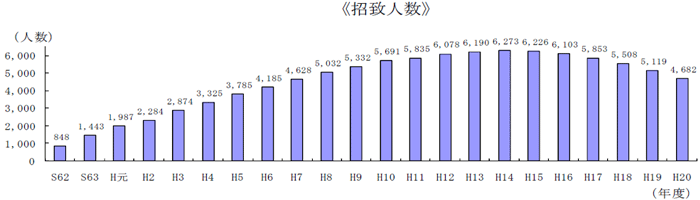
 

The 2008 total was 4,682, 25.4% down from the peak. I would expect the pace to slow down a bit, considering they recently extended the maximum contract length from three years to five.

Non-JET ALTs/eikaiwa

In the private sector, METI figures (Excel) show the number of instructors at regulated “foreign language conversations schools” peaked in 2003 at 13,365, but stood at 9,591 as of the end of 2008, down by 28.3% from the peak and 22.4% since the JET Program’s peak.

Figures are less forthcoming about a third segment of the market, non-JET ALTs at schools across the country, but they are available. According to an October 2008 report from the Chunichi Shimbun (thanks Let’s Japan),  the number of non-JET ALTs surpassed JETs in 2006, and by 2007 represented 60% of all ALTs or nearly 8,000 people.

(A quick aside: There is some evidence that the education ministry views the issue of “temporary and contract” ALTs as a considerable problem, as these non-JETs can fall through the cracks in terms of supervision, training, and visa compliance. In February 2005, the ministry issued a letter to boards of education nationwide warning them to ensure that contracts with non-JET ALTs are “appropriate” (apparently in response to unfavorable press coverage) (source).)

Unfortunately, I am having trouble locating the exact figures for non-JET ALTs over time. They can be found by combining the totals of education ministry surveys given to schools asking the status of their English-language education. The only trouble is, the surveys are separated by scholastic level; and they aren’t neatly organized by year.

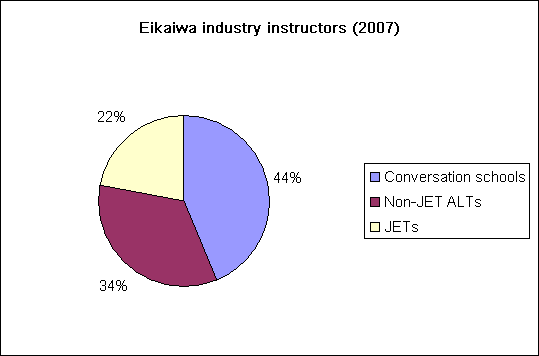
But I was able to find the total for 2002: 3090. So put together, here is the breakdown of “market share” of instructors in all three segments for 2002 and 2007 (click for full size):
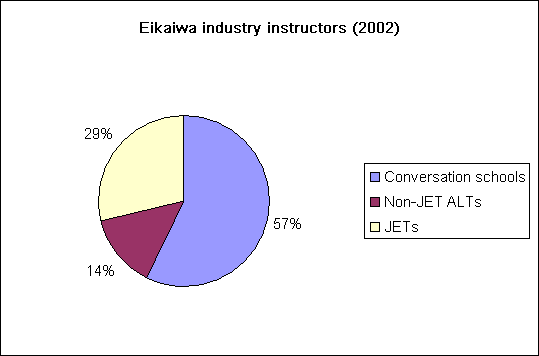
image0011

image0021

Non-JET ALTs appear to be quickly becoming the dominant employment type in the industry. JETs went from outnumbering non-JET ALTs 2:1 from being outnumbered by them 3:2. Possibly on a related note, this ratio (1/3 of all instructors are temp/contract) is consistent with the overall ratio of non-permanent workers in the overall workforce.

The tables were turned for conversation schools vs. ALTs as well. The end of 2007 was right when NOVA collapsed, and before that several other schools went bankrupt. This no doubt pinched the number of private teachers.

Interestingly, the totals of both years indicate that the pie was still growing as late as the end of 2007: the total number of teachers grew 7%, from 21,729 in 2002 to 23,130 in 2007. This growth rate matches the 7.0% growth in US citizen registered foreigners over the same period, though it underperforms the overall 16% growth in the number of registered foreigners (PDF). Japan’s total workforce (seasonally adjusted (Excel)), meanwhile, declined 10.1% during this period.

(Note that there are some considerable limitations to this data, though I think it at leasts provides a good chunk of the overall picture. First, I have included all JETs in the total, out of the consideration (emphasized by Curzon) that ALTs, CIRs, and those special physical education instructors all serve the purpose of “internationalization.” Also, “conversation schools” cover languages other than English, though I think it is safe to say English continues to be the overwhelmingly most popular language. There may be some overlap in the “conversation school” and “non-JET ALT” category as some businesses classified as conversation schools might also list non-JET ALTs as “instructors” resulting in some double-counting. These numbers also do not cover private lessons and unregistered schools, nor does it cover some of the related markets, such as private-sector study abroad, English teachers at universities, full-time foreign English teachers at schools, English teaching services provided by foreign governments such as the British Council, Internet services/podcasts, broadcast lessons such as those given on NHK, and book and CD publishing, all of which could add up to hundreds more teachers.)

Prospects – private sector

Although the supply of teachers grew backed by the surge in non-JET ALTs, eikaiwa as a business appears to be shrinking very fast (Excel). After falling for three years starting in 2003, sales boomed in 2006, whereafter the bottom appears to have fallen out from under the industry (Y axis unit = 1 million yen. Click for full-size):
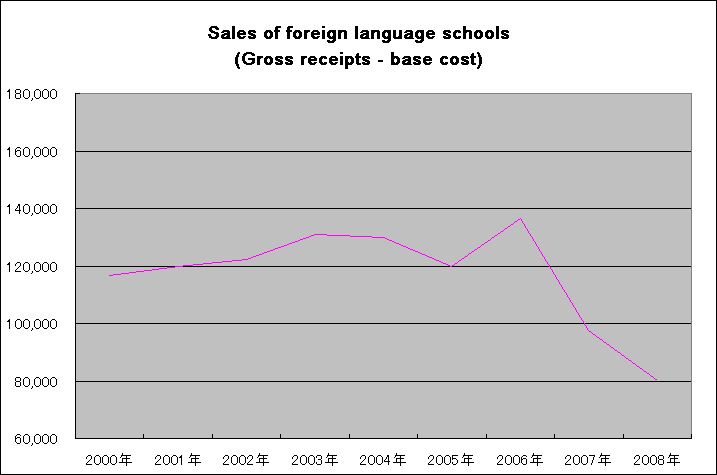
image0042

This precipitous drop coincides with reports at the time of oversupply in the eikaiwa market as the big schools such as NOVA rushed like mad to open schools in every corner of the country. The following years saw the collapse of several schools including NOVA, the former market leader. (UPDATE: this drop also coincides with legal revisions that made it easier for dissatisfied students to request refunds). Teachers may face some serious difficulty as the excess supply adjusts to match demand. This drop in sales far outpaces that of firms listed on the Tokyo Stock Exchange, which are expected to face a year-on-year 6.5% drop for FY2008 (final profits are a different story, but without sales there isn’t much hope of making a profit, is there?).

During this time, Japanese households’ discretionary income fell 1.9% (though slightly less in real terms). With the reputation of the industry damaged and Japanese households concerned about their basic livelihoods, it seems hard to expect that the workers’ desires to make their skills more competitive will save any but the highest quality businesses in this industry.

Prospects – public sector

Meanwhile, recent economic turmoil (annualized 12% GDP shrinkage for Oct.-Dec. 2008 makes Japan the hardest-hit G-7 economy) could put pressure on the public sector as well, as described in a previous comment by Aceface:

I have to wonder how many eikaiwa community understand gloomy future ahead of them. Many local government are now facing rapid decline of corporation tax income due to the down sizing of production in Toyota factories, ANd under such circumstances we can no longer justify this 21st century version of “Oyatoi-Gaijin” we know as JET/ALT.
Aichi, Shizuoka, Gihu,  Mie and Gunma need as much Portuguese/Japanese bilingual staffs as possible since there are tons of works must be done starting from job education for the unemployed. And since they have no extra budgets,most likely gone will be “international exchange”related posts.

While I am not sure what the rules are for funding non-JET ALTs (I am assuming schools can choose to use local taxes, or private schools their budgets), the JET program is funded by redistributed local taxes (chihou koufuzei), doled out to prefectures and municipalities at a pre-determined ratio, plus extra for local administrations with particular plans to use the money. The funds come from “the five national taxes” – income tax, corporate income tax, consumption tax, alcohol tax, and tobacco tax.   The income taxes have been on a downward growth trend since the 1990s, while consumption tax has emerged to rival those as a revenue generator. The sin taxes have maintained a consistent, relatively low holding pattern. The redistribution amount peaked in 2001 and has been falling roughly in line with the corporate income tax. Though 2008 tax receipts were forecast to be up slightly (possibly due to the tax bills for earlier profits), original finance ministry estimates appear to have fallen far from the mark, failing to anticipate the dismal corporate earnings, rising unemployment, and stagnant consumption. This means the major tax revenue sources are expected to fall significantly.

Conclusion

English teaching in Japan looks like it is in for a very rough patch. While this exercise hasn’t been exactly a happy one, I hope it’s been informative. It certainly has been for me.

UPDATE: I have posted some more data on the industry in a follow-up.