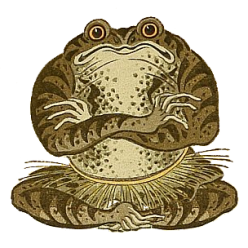
 One of the more entertaining characters I’ve run across in my studies of Taiwan is has been George Psalmanazar, one of the famous hoaxers of all time. Born around 1680, nothing factual is known about his early life, even his country place of birth, although he later claimed it to be somewhere in southern France, which was allegedly corroborated as likely by those who had heard his French dialect, while doubted by those who were familiar with his ability to impersonate such dialects.
Regardless of where he spent his early years, upon completion of his education Psalmanazar began traveling around Europe, attempting to scam his way to Rome by impersonating an Irish pilgrim. Upon realizing that Ireland was neither exotic enough to elicit much interest from potential marks nor far enough to be entirely unfamiliar, he began instead impersonating a rare pilgrim from the distant land of Japan, and later to the even more exotic and lesser-known island of Formosa, which we now usually call Taiwan.
His wild tales of alien customs and bizarre foreign lands were popular, and after a detour through Rotterdam he arrived in London in 1703, where he became a minor celebrity. Banking on his fame, in 1704 he published a book entitled An Historical and Geographical Description of Formosa, an Island subject to the Emperor of Japan. “Originally written in Latin by Psalmanazar, An Historical and Geographical Description of Formosa was translated into English and quickly went through two editions. A French translation appeared in Amsterdam in 1705 and interest in the book was high enough a decade later to prompt a German version, which was published in Frankfort in 1716. By this time, however, Psalamanazar’s fraud had been revealed in England and he lapsed into relative obscurity.”
This book provided a detailed description of the island of Formosa, including its history, geography, flora and fauna, religious customs, language, and so on. And virtually every single word of it was completely fictional. Psalamanazar knew all of this, he claimed, because he was himself a native of Formosa. Having been named after the great Formosan “Prophet Psalmanaazaar, who delivered the Law to the Formosans” as well as their writing, Psalamanazar was bringing knowledge of his exotic homeland to the credulous and curious people’s of Europe. In fact, not only had he never been to Formosa, or Asia at all, he knew nothing about it.
Although there were a handful of Jesuits who had been to the real Formosa, their denial of Psalamanazar’s fantastic claims were largely ignored due to the anti-Catholicism prevalent in England at that time. While it might seem absurd to us today that people would have believed such outlandish tales, consider how unreliable information on foreign lands was in the days before the photograph, the telegraph, and even regular long-distance trade to many regions. We may find it unbelievable that the English believed that a man with Western European features similar to their own could have been a native of the East Asian land of Formosa, but how many Londoners would have ever seen an Asian face themselves?

He not only created fanciful, entirely invented, accounts of Formosa all the while portraying himself as a native of that exotic island, but also invented a Formosan language, in what must have been one of the very, very few pre-Tolkien attempts at such an endeavor. Psalmanazar’s creation of a fictional Formosa was actually very Tolkien-esque, not merely in the way that it included a fictional language, but in the way that the development of the language was linked to the invented history. Although the fantasy island was named after the real island of Formosa, and the title of the book claimed that it was “an Island subject to” the very real island of Japan, the descriptions of the customs, geography, history, and language of these real places was very nearly as invented as that of Rivendell or Gondor. Psalmanazar describes the language of Formosa as follows:
The Language of Formosa is the same with that of Japan, but with this difference that the Japannese do not pronounce some Letters gutturally as the Formosans do: And they pronounce the Auxiliary Verbs without that elevation and depression of the Voice which is used in Formosa. Thus, for instance, the Formosans pronounce the present Tense without any elevation or falling of the Voice, as Jerh Chato, ego amo; and the preterperfect they pronounce by raising the Voice, and the future Tense by falling it; but the preterimperfect, the plusquam perfectum, and patio poft futurum, they pronounce by adding the auxiliary Verb: Thus the Verb Jerh Chato, ego amo, in the preterimperfect Tense is Jervieye chato, Ego eram amass, or according to the Letter, Ego eram amo; in the preterperfect Tense it is Jerh Chato, and the Voice is raised in the pronunciation of the first Syllable, but falls in pronouncing the other two; and in the plusquam perfectum the auxiliary Verb viey is added, and the same elevation and falling of the Voice is obsery’d as in the preterit.
[…]
The Japan Language has three Genders; all sorts of Animals are either of the Masculine or Feminine Gender, and all inanimate Creatures are of the Neuter: But the Gender is only known by the Articles, e.g. oi hic, ey hoec, and ay hoc; but in the Plural number all the three Articles are alike.
[…]
TheJapannese wrote formerly in a sort of Characters most like those of the Chineses; but since they have held correspondence with the Formosans, they have generally made use of their way of writing, as more easy and more beautiful; insomuch that there are few now in Japan who understand the Chinese Characters.
Anyone with even the scantest knowledge of Japanese will instantly realize the absurdity of every word quoted above. In fact, the Formosan languages of his time (before it was extensively colonized by China) were the Austronesian languages still spoken by Taiwan’s aboriginal peoples today, which have no relationship with Japanese.
He also provided a more significant sample of his Formosan language, amusingly in the form of a translation of the Lord’s Prayer. Here are the first five lines.
Lord’s Prayer
Koriakia VomeraOUR Father who in Heaven art, Hallowed be
Amy Pornio dan chin Ornio vicy, Gnayjorhethy Name, Come thy Kingdom, Be done thy Will
sai Lory, Eyfodere sai Bagalin, jorhe sai domionas in Heaven, also in Earth so, Our bread
apo chin Ornio, kay chin Badi eyen, Amy khatsadadaily give us today, and forgive us
nadakchion toye ant nadayi, kay Radonaye antour trespasses, as we forgive our trespassers.
amy Sochin, apo ant radonern amy Sochiakhin.
(A longer excerpt of the chapter on language, including the full Lord’s Prayer, can be found online here.)
To get an idea of how famous Psalmanazar actually was in his time, consider that he was referenced very prominently in Jonathan Swift’s famous satirical essay A Modest Proposal, in which Swift uses him (albeit spelled a bit differently, perhaps due to imperfect memory and a lack of handy reference) as part of his case for the encouragement of cannibalism.
But in order to justify my friend, he confessed, that this expedient was put into his head by the famous Salmanaazor, a native of the island Formosa, who came from thence to London, above twenty years ago, and in conversation told my friend, that in his country, when any young person happened to be put to death, the executioner sold the carcass to persons of quality, as a prime dainty; and that, in his time, the body of a plump girl of fifteen, who was crucified for an attempt to poison the Emperor, was sold to his imperial majesty’s prime minister of state, and other great mandarins of the court in joints from the gibbet, at four hundred crowns. Neither indeed can I deny, that if the same use were made of several plump young girls in this town, who without one single groat to their fortunes, cannot stir abroad without a chair, and appear at a play-house and assemblies in foreign fineries which they never will pay for; the kingdom would not be the worse.
The fact that must be remembered here is that not only was George Psalmanazar a famous public figure in Swift’s time, but that by the year in which A Modest Proposal was published, 1729, Psalmanazar’s account of Formosa was already been widely known as a fraud, the author having had confessed as much in 1707. While Swift’s essay is still widely read, virtually no modern readers will have any clue to what he is referring in this paragraph, and even fewer will realize that much of the basis for the humor in this section is due to the fact that the essayist is attempting to prove his case by referring to a a source that, at the time of publication, would have been recognized by Swift’s audience as not merely fraudulent, but famously and comically so.
Following the end of his career as a hoaxer, Psalmanazar used his celebrity to start a career as a legitimate writer, producing such works as The general history of printing: from its first invention in the city of Mentz, to its first progress and propagation thro’ the most celebrated cities in Europe. Particularly, its introduction, rise and progress here in England. The character of the most celebrated printers, from the first inventors of the art to the years 1520 and 1550: with an account of their works, and of the most considerable improvements which they made to it during that interval, published in 1732. As a now-respectable man of letters, he became friends with such luminaries as Samuel Johnson.
Although he revealed his fraud as early as 1707, details were not revealed until the year after his death. Naturally, this was in the form of a book, which is wonderfully entitled: MEMOIRS OF ****. Commonly known by the Name of George Psalmanazar; A Reputed Native of Formosa. Written by himself, In order to be published after his Death: Containing An Account of his Education, Travels, Adventures, Connections, Literary Productions, and pretended Conversion from Heathenism to Christianity; which last proved the Occasion of his being brought over into this Kingdom, and passing for a Proselyte, and a member of the Church of England.
The one thing that he never revealed, even in his posthumous memoir, was his real name. As far as I know, no details of his early life have ever been verified.
The table of contents, as well as some all too brief excerpts of Psalmanazar’s first book, An Historical and Geographical Description of Formosa, can be found here, but until earlier this year it was very difficult to get one’s hands on a copy of the English version of the book, at least outside of certain libraries. Although it was published in Taiwan a couple of years ago, that was a Chinese translation, which even if I could read well would hardly be as entertaining. Original copies are very expensive, with the English first edition going for US$1426 on a rare book site, and the French version selling at an even less accessible $1900! Copies of his memoir go for a technically more affordable, yet still entirely unaffordable $600 or so.
Luckily, not only has an affordable reprint edition of both his Description of Formosa and his Memoirs (as well as some others) are available for purchase online. However, even better, just the other day I managed to locate a scanned electronic edition of both books, freely available in an archive of the British Library. As the online version only seems to be accessible from licensed institutions, such as libraries and universities, I am providing both of them for download as PDFs. Since their PDF creator can only generate files up to 250 pages in length, both of them have been split into two files. Scans of 300 year old books, these files are as public domain as they get. Feel free to spread them far and wide.
George Psalmanazar: Description of Formosa: Part I
George Psalmanazar: Description of Formosa: Part II
George Psalmanazar: Memoirs of ****: Part I
George Psalmanazar: Memoirs of ****: Part II
Update [August 5]: I regret that I forgot one very important detail from this when I first published it yesterday. While Jonathan Swift may be the most significant literary reference to Psalmanazar’s imaginary Formosa, it is not the only one. Many readers may be familiar with Alan Moore and Kevin O’Neill’s wonderful comic book series The League of Extraordinary Gentlemen (and hopefully not the abysmal film based on it), in which they spin a version of our world in which every fantastic story, character, and geography is integrated into a single tapestry. While the story proper is mainly told in the form of comic book panels, Volume Two (for sale here, and highly recommended) contains, in the form of a lengthy appendix, a sort of gazetteer of this fantastic geography, which contains the following text.
We passed east of Zipang, or of Japan as it is these days called, and went south by way of Formosa, which possesses of its coast another smaller island of the same name, where the women and the men go naked save for plaques of gold and silver.
Zipang is in fact one spelling of the Shanghaiese reading of “Japan,” formerly used by some Europeans and thought to be the origin for the modern spelling. Moore here is obviously referencing Psalmanazar’s Formosa, as we can see from page 225 of the Description (first page of PDF Part II). By describing this Formosa as “another smaller island of the same name”, Moore is cleverly leaving room on the map for both the real and fantasy Formosa.
The great difference between the Japannese and Formosans, consists in this, that the Jappanese wear 2 or 3 Coats, which they tye about with a Girdle; but the Formosans have only one Coat, and use no Girlde. They walk with the Breast open, and cover their Privy parts with a Plate tied about them made of Brass, Gold, or Silver.
Incidentally, Moore’s reference to Formosa is located just above a large illustration of Laputa – which readers may remember from either the eponymous Miyazaki Hayao film, or its original source: Gulliver’s Travels, by Jonathan Swift. When one considers that Swift was clearly a fan of Psalmanazar’s imaginary geography, it actually seems quite reasonable to wonder if perhaps the Description of Formosa was an influence on Gulliver’s Travels, which as a chronicle of fantastic geography has some undeniable similarities.