Archive for the 'China' Category

Difficulties for rare names in China

Sunday, April 26th, 2009

Just two weeks ago I posted a link to an article about a Taiwanese “collector” of rare Chinese family names. While his activity may seem to be a mere eccentric hobby, documenting these names and their lineage does have important historical significance, as seen in recent moves by the Chinese government. According to a NYT article from April 20, China has been phasing in an electronic ID card system which does not support many of the exotic antique characters used in rare family names, and their solution has been to ask people affected to change their names.

One of the main examples given in the article is the character [ed: oops, actually the character they reference was too obscure for me to enter using either the Japanese or Chinese IME. I confused it with the still-rare but far more common “驫”. 驫 (骉 simplified, as it would be written in the PRC), pronounced “Cheng” according to the article, but “Biao” according to the dictionary. Apparently the software used for the Chinese ID system does not support this character, despite the fact that I had no problem drawing it on the IME pad in Windows Vista using my house, and it can even be found in the Japanese language Wiktionary.

(Before I go on, I want to note briefly that the word 漢字, meaning “Chinese character” is used in Chinese, Korean and Japanese, respectively pronounced hanzi, hanja, and kanji. When using one of these three words I am specifically referring to the use of Chinese characters in that country/language.)

According to the article, the computer system currently in use by the government supports 32,252 hanzi, out of well over 50,000 found in the most comprehensive classical dictionaries. The government is currently working on a restricted list of characters approves for use in modern Chinese writing, which they estimate will exceed 8000 characters-a significant drop from even the current de-facto list of 32,252.

While these sorts of legal restrictions on one’s very name name may sound stereotypically totalitarian for the communist People’s Republic, in fact both Japan and Korea have had similar restrictions for a long time. In Japan, the Law on Household Registration (Koseki-hou) governs the kanji which may be used in personal names. Under current regulations, kanji for personal names may only be chosen from either the Joyo Kanji (Kanji for Daily Use, the list that forms the basis of public school Japanese education, Japanese proficiency tests, etc.), consisting of 1945 characters, or the  983 character Jinmeiyou-kanji (Kanji for Use in Personal Names). Both of these lists have been revised, usually expanded but sometimes with deletions, over the years.

There was an amusing incident during the 2004 round of additions to the Jinmeiyou list. The committee proposed an initial list of 489 additions purely based on statistical analysis of the commonality of various characters in modern Japanese text, and then posted it online to seek comments. While many of the names were popular, 9 of them were the target of objections from the public, and were removed from the list. Those 9 kanji were: 糞(feces) 屍(corpse) 呪(curse, magic spell) 癌(cancer) 姦(rape) 淫(lewd obscene) 怨(hatred, grudge-as in the horror film) 痔(hemorrhoid) and 妾(concubine). (Bonus word trivia: two of these kanji combine to make the word for necrophilia.) As a foreigner who has only been studying Japanese for around 8 years, I recognized all of 9 of these on first glance and could read all but two(淫 and 妾), so I would assume that any adult native-reader of Japanese knows all of these moderately obscure characters and many hundreds more, despite their not being on the official government lists.

(The current Jinmeiyo list may be seen conveniently at Wikipedia.)

In South Korea there are 5151 characters allowed, even though most people normally write their name in the natively developed hangul alphabet, which has replaced hanja in everyday use. While traditional Korean family names are all hanja, personal names may also contain hangul. Interestingly, the Korean list of name characters is written using the same Chinese characters as the Japanese one-인명용 한자(人名用漢字), although like other shared Sinic words it is pronounced in the Korean fashion “inmyong yo hanja”.

North Korea legally eliminated hanja from their language some time ago, so even though most names can be traced etymologically to Chinese, all legal names today are written in hangul in all circumstances.

Vietnam was also historically a Chinese-character culture (known locally as chữ nôm), but they abandoned it early in the 20th century. While as much of their vocabulary is descended from Chinese words as in Japan or Korea, today they write purely in the Roman alphabet and the original Chinese characters for words or names are found only on old art or documents, or in dictionaries.

Taiwan, as befitting its role as the bastion of traditional Chinese writing, has no restrictions on hanzi name use. Hong Kong and Macao, which while part of the PRC also maintain traditional writing and also have a separate legal code from the PRC, presumably also have the same level of name freedom as Taiwan.

Now, what about immigrants? When I was first studying in Japan as an undergraduate, I know a girl whose name contained the hanja “妵” (pronounced “ju” in Korean), which is not just absent from the Japanese name-kanji list, but also not even found in standard Japanese fonts or dictionaries! On her Foreigner Registration Card, this character was pasted in using an obviously different font, as it couldn’t be typed normally. While I do not know the actual law, I assume that this is the traditional custom for dealing with domestically disallowed hanzi/hanja names in Japan, or domestically disallowed hanzi names in South Korea. (In South Korea today, Japanese names are usually rendered in hangul based on their pronunciation, and the actual kanji are ignored.) However, when a foreigner naturalizes in Japan their legal name must follow the local rules, which may force them to adopt a less exotic name. Of course, even should they be forced to change their name, nothing will keep them from using the original one in all circumstances except legal documentation.

To summarize, the freedom of choice for Chinese characters in names of the four countries which still use such names is as follows:

Taiwan* > China > South Korea > Japan

*Hong Kong and Macau may be at this level, confirmation needed

Although the NYT article implied that the imposition of restrictions on the hanzi in names is threateningly totalitarian, in fact Chinese citizens will still have FAR more options than Koreans or Japanese even if restricted to the 8000+ character list, and South Koreans today have nearly twice as many options as the Japanese do, despite that fact that most South Koreans can hardly read any but the most common of hanja. Of course, it is only in Japan where one has the option of choosing a reading for ones name that has no historical relationship whatsoever with the kanji themselves.

Africans in Guangzhou, Africans in Tokyo

Thursday, March 26th, 2009

This CNN report documents that much as in Japan, there is apparently a sizable number of Africans engaged in international trade and retailing in shops in Guanghzhou and some other areas of China. The report attributes the increase to increased trade ties between China and nations like Nigeria.

For a more detailed look at the situation of Africans in China, take a look at this translated article from Southern Metropolis Daily entitled “’Chocolate City’ – Africans seek their dreams in China”:

In distant Africa, nearly 50 countries exploding with demand have opened their arms wide, and are rapidly digesting all of these consumer products not produced locally. Based on Chinese official statistics, during this period of China-Africa trade fever that started in 2003, the number of Africans headed to Guangzhou has been growing at annual rates of 30-40%.
...
About five years ago, Chinese petrolem companies and businessmen poured into Africa. This led many locals to feel that China was grabbing their resources and rice bowls (jobs). And yet from tractors to toothpaste, everything was “Made in China”; this stimulated many of them into looking in China’s direction. Many of Clem’s friends encouraged him, “Go to China! Nigeria’s using petroleum to trade for foreign currency, and the Chinese are buying it to build heaven!”
...
In September of 2007, Clem’s father, working at a Nigerian embassy in Europe, was able to arrange a Chinese visa for him. His friends were envious. More and more Africans are patiently lining up in front of Chinese embassies in Africa, fighting for visas permitted under a limited quota. A guy who received his visa at the same time as Clem had paid a fee to a visa application service nine months ago. When he finally received the visa he had been waiting for, the guy who had been muttering and cursing under his breath finally calmed down; he fiercely kissed his passport.
...
Many taxi drivers aren’t willing to take on “chocolate” customers. They don’t like the nose-irritating perfume, nor the constant bargaining on every trip. Some drivers will use excuses that “you’re too big, the car won’t fit you”, or “I don’t understand your foreign language”; but some don’t care, “driving anybody is just business.”

Based on official statistics, since 2003, the number of Africans in Guangzhou has been growing at 30-40% annually. Based on a report in the Guangzhou Daily, there might already be 100,000 in the community. They come from Nigeria, Guinea, Cameroon, Liberia, and Mali. Amongst these, Africa’s most populous country Nigeria claims first place.

They primarily live in village-districts in the city of Guangdong (like Dongpu, Dengfeng Jie, Yongping Jie). They do their business in a few large-scale China-Africa commerce malls.

The stalls in these commerce malls don’t have much in terms of decoration; at most, there will be a black plastic model at the front door. Samples are piled up the ground, and hung up on the walls and placed in display cases. In one building, the warehouse and sales offices are one and the same. Stall owners pile their blue jeans on the walk-way itself. When it gets busy, you have to step over the piles of pants.

These centers have accumulated basically all of the world’s top brands — Dolce and Gabbana blue jeans, Adidas shoes, Gucci high-heels, Louis Vuitton purses, Chanel purses, Armani underwear. Their prices are ridiculous: Dolce and Gabbana jeans are 20 RMB (3 USD), Gucci high-heels and purse together for 100 RMB (15 USD)…
...
While picking through clothes, Cote claimed that he had many Chinese friends here. To prove his point, he walked up, and pats the store-owner on his head. Or, he playfully kicks at the store-owner’s leg. He’ll loudly greet them, “Friend, how are you recently?” His “friends” don’t respond. Some pull out a cell phone and intentionally ignore him. Others impatiently wave at him, and say in a combination of Chinese and English: “if you’re not buying anything, then go… quickly GO!”
...
Guangzhou has the densest concentration of African businessmen in China. Areas and cities surrounding the area has thousands of factories that take tens of thousands of African orders, originating from Chocolate City, every day.
...
... On Yongping Street, many black illegal immigrants live together in homes that rent for 100-200 RMB per month. They come out only at night, either selling physical labor by offering to carry goods, or sell drugs and other illegal activities. According to police in the area, starting in November of 2007, they had searched out a group of Africans in the country illegally. They were sent to Yunnan and deported.


Africans in Tokyo

On the continental level, Africans make up the least significant group of foreigners in Japan, far outstripped by just about every other group that counts (Vietnam alone has more registered foreigners in Tokyo than the entire continent). According to a Mainichi article from 2006 Africans in the Tokyo area number in the “tens of thousands,” though this is far above the 2,987 registered foreigners of African nationality within Tokyo Prefecture (Excel). It is also far smaller than the “as many as 100,000” in Guangzhou - that would mean African residents make up 1.31% of Guanghzhou’s population vs. 0.16% of Tokyo’s (assuming that Mainichi is right and there are at least 20,000 African residents in the Tokyo area). I should also mention that they are apparently overwhelmingly male and in prime working years.

Many are apparently in the country under similar terms as in China – most come from Nigeria and Ghana, and they are in the country on work/business visa quotas, and sometimes as illegal overstayers. In addition, many are in the country on spouse visas, both genuine and fraudulent (or somewhere in between). Some teach English, while others operate or work for clothing stores, import shops, or restaurants. Their numbers extend beyond Tokyo – I have heard reports of African-run hip-hop clothing stores as far-flung as Shikoku.

While almost all of the African residents in both Japan and China surely make their livings legitimately, it is worth mentioning that Africans in Japan have been notably involved in counterfeiting, drug muling, money laundering, and other illicit activities, apparently in line with the situation in Guangzhou. These crimes may receive extra scrutiny because of how Africans stand out. Anecdotal reports indicate that the police generally view Africans with suspicion, and apparently when they are arrested they can expect little mercy from the Japanese justice system (though the reaction in Japan must certainly be tamer than the brazen racism seen in that piece on China).  

One key difference between the Sino-African and Japanese-African relationships is that while the Japanese interests have centered around resource investment projects (in his youth, Prime Minister Aso helped run a diamond mining operation in Sierra Leone) and meeting diplomatic goals (UN Security Council reform, whaling), China under Mao developed ideological ties with leaders in Africa as it sought to support socialist revolution abroad. These efforts included a priority student visa program for African students to study at Chinese universities. On an only tangentially related not, this was the historical background of some pretty scary 1988 protests in Nanjing:

On December 24, 1988 two male African students were entering their campus at Hehai University in Nanjing with two Chinese women. The occasion was a Christmas Eve party. A quarrel about correct identification between one of the Africans and a Chinese security guard, who had ordered the Africans to register their guests, led to a brawl between the African and Chinese students on the campus which lasted till the morning, leaving 13 students injured. 300 Chinese students, spurred by false rumors that a Chinese man had been killed by the Africans, broke into and set about destroying the Africans’ dormitories, shouting slogans such as “Kill the black devils!” After the police had dispersed the Chinese students, many Africans fled to the railway station in order to gain safety at various African embassies in Beijing. The authorities prevented the Africans from boarding the trains so as to question those involved in the brawl. Soon their numbers increased to 140, as other African and non-African foreign students, fearing violence, arrived at the station asking to be allowed to go to Beijing.

By this time, Chinese students from Hehai University had joined up with students from other Nanjing universities to make up a 3000 strong demonstration which called on government officials to prosecute the African students and reform the system which gave foreigners more rights than the Chinese. On the evening of 26 December, the marchers converged on the railway station while holding banners calling for human rights and political reform. Chinese police managed to isolate the non-Chinese students from the marchers and moved them to a military guest house outside Nanjing. The demonstrations were declared illegal, and riot police were brought in from surrounding provinces to pacify the demonstrations which lasted several more days.


The African population depicted in the video is clearly of a much different character from these earlier students. Reflecting the increasing resource investment of China itself, this group of Africans in China are strictly business-oriented (many never even attended college), apparently hoping to cash in on the Chinese economic boom.

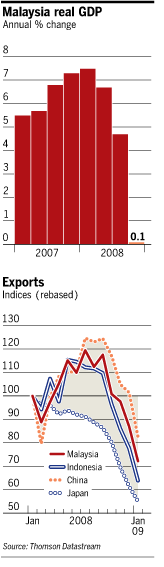
Japan exports compared internationally – OUCH

Wednesday, March 11th, 2009

Just saw this chart in an FT article about Malaysia:

exports-in-asia

Not good! Also, they seem to have taken a bigger hit than Brazil as well:

But Brazilians might beat their own record in the first quarter of 2009, as a thrifty American consumer and less demand for oil have hit Brazil hard. Overall exports fell 26 percent in the first two months of this year, and they make up one-third of GDP.

Japan’s exports only make up about 16% of GDP, so the impact of a year-on-year 46% drop would be equivalent to a 23% drop in Brazil, but it’s still a near halving of the driver of economic growth over the past few years, and other aspects of Japan’s economy such as domestic consumption or the public sector (depending on government action) seem to offer little hope.

Architectural preservation and history in Taiwan updates

Sunday, February 8th, 2009

Over the past couple of weeks I’ve noticed three stories in the Taipei Times on the topic of preserving notable or historical architecture in Taiwan.

  1. Taipei County looks to rebuild site of weird UFO houses – I had actually written that I wanted to stop by this area and see the UFO houses before my trip to Taiwan last summer, but just couldn’t find the time. Alas, they may be completely gone by the time I next visit Taiwan.

  2. Taipei to preserve historical Japanese-era buildings – I have previously discussed the many Japanese houses that can be found all over Taiwan in stages of repair ranging all the way from crumbling ruin to well preserved monument. Here is a gallery of photographs I took at one ruin in Taichung, and here and here are photographs of the one behind my apartment building in Taipei. Although Taipei is not proposing a general preservation rule for such historical buildings, which might be nice, they are designating an area near the intersection of Zhongxiao E Road and Jinshan S Road, which contains a cluster of 10 surviving houses built for Japanese civil servants – reportedly the largest single cluster in Taipei – as a special historical zone.

  3. Miaoli officials caught in a lie – Another piece of grim news. Apparently officials in the Miaoli County actually pretended to hold a meeting to discuss the historical preservation of the last three surviving kilns in what was a center of the pottery industry during the Japanese colonial period, but in fact never even convened the meeting. The claim that the kilns had “no historic or cultural value” sounds shaky at best, and it seems that they likely violated the Cultural Heritage Protection Act [文化資產保護法] to make way for an industrial development. Angry preservationists are filing lawsuits against the officials who cleared the kilns for distruction.

There were also three other stories of note related to historical topics I have discussed on this blog before.

  1. Chiang Kai-shek plaque to return to memorial hall – “Rectification of names” continues in Taiwan. I have discussed this phenomenon several times in the past, as committed by Chen Shui-bian’s DPP administration here and here, who was replacing China-centric names with Taiwan-centric ones, and then with the reveral of Chen’s Taiwanization moves by Ma Ying-Jiu’s KMT administration here and here. As of January 22, Democracy Hall nee Chiang Kai-shek Memorial Hall is now once again Chiang Kai-shek Memorial Hall. However, the new KMT administration has magnanimously decided to preserve the renaming of the area surrounding CKS Hall to “Liberty Square”.

  2. Descendents of ‘Orphan Army’ dream of home – I previously discussed the KMT/ROC army remnant of Southeast Asia here, noting in particular their fascinating historical association with the SE Asian drug trade, and the unlikely direct connection forged with 1970s Harlem druglord Frank Lucas, as portratyed in the film American Gangster starring Denzel Washington. As descendants of KMT soldiers, there are actually a fair number of “overseas Chinese” from Burma or Thailand who have gone to Taiwan to study using fake documentation, and although they are apparently not deported from Taiwan due to the tricky historical ROC links, they also find it difficult to obtain proper documentation that would allow them to travel back and forth. I imagine there is some sort of process by which they can apply for legal status, but it may very well require geneological or other documentation that is hard to come by. This is a story well worth checking into more.

  3. Study backs findings on Polynesian origins – Linguistic, genetic and archaeological research in the past has suggested that the entire Polynesian/Austronesian group of peoples, ranging from the Malays of Malaysia, Indonesia and the Philippines to the Maori of New Zealand and the native Hawaiians, are all descended from seafaring explorers that set out from Taiwan thousands of years ago. Although only about 2-3% of Taiwan’s current population officially belongs to these “aborigine” tribes whose ancestors were also the ancestors of the Polynesians, a much, much larger percentage of “ethnic Chinese” Taiwanese are actually at least partially descended from aborigines who became culturally Sinicized generations ago. This is of particular pride to proponents of Taiwanese independence who use it as evidence that Taiwan is not inherently Chinese. It is actually a popular theory (if not fact) that much of the “Han” population of southern China is actually descended from natives who became culturally Sinicized in a similar way hundreds or thousands of years ago, and have a noticably distinct genetic history from the northern Han Chinese.

  4. Descendants of victims mark ‘Taiping’ tragedy – Not specifically related to anything I have written about before, but the story of how over 1000 immigrants from China to Taiwan died in a shipwreck near Shanghai in 1949 is new to me, and well worth knowing. I am a bit skeptical of how one can wring out a 20-episode drama from this story though. James Cameron’s Titanic was long enough for me.

The original fortune cookie

Sunday, February 1st, 2009

This may shock you, but fortune cookies are not Chinese food, nor are they really Chinese-American food. They started out as a Japanese product, and were copied by Chinese-Americans in San Francisco decades ago to form the dessert staple of cheap Chinese restaurants across the US. (This was detailed in a New York Times article last year, and linked by Roy in a post which I somehow missed; I learned of it from watching the author of said article, Jennifer Lee, give this fascinating presentation on the evolution of Chinese food outside China.)

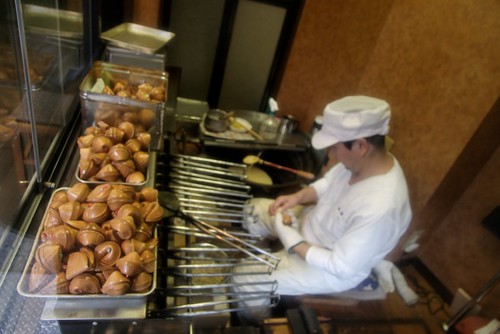
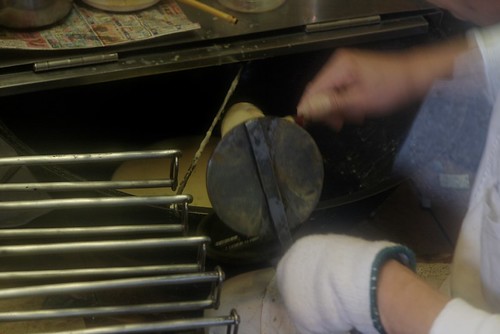
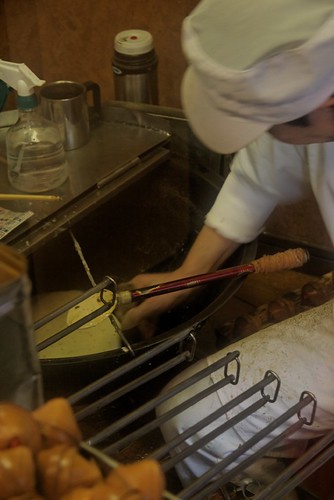
The predecessor of the Chinese-American fortune cookie is the tsujiura senbei, a cookie made of flour, sugar and miso which is sold at certain shrines. According to Wikipedia, it comes from the Hokuriku region. But after some Googling, I found out that these are still made and sold at the Fushimi Inari Shrine in Kyoto, and since I was visiting the city anyway, I decided to track some down. Sure enough, they were being sold in a few shops near the shrine, including one shop where they were being hand-made by an old fellow with a cast iron machine (as per the NYT article, which I didn’t discover until later).

As you can see, it’s larger than a fortune cookie, and the fortune (omikuji, actually) is held by the cookie’s fold rather than inside the cookie itself. In fact, there’s another surprise inside the cookie:

Those are dried soybeans, which serve to give the cookie a pleasant rattle as you shake it around. Hence the alternative name suzu sembei or “bell cookie.” I’m sure this was intended to please a hard-of-hearing Shinto deity, or something like that, but to me it was just an interesting modification on the fortune cookie style I grew up with.

The actual fortune looks like this:

And I’m pretty sure that it’s funny when you add “in bed” to the end. Some things are simply constant across cultures…

[Updated by Roy]

Unfortunately I had forgotten to charge my camera battery that day, but I got a few shots of the cookie making process before it died. They aren’t great, but I think you can get a fair idea of it.

What Joe forgot to mention-and this is critical information-is that they are miso flavored! There was a sign in all the shop windows saying this, and advertising that no eggs are used. Trying for the vegan market?

Chinese economy now #3

Saturday, January 17th, 2009

China has edged above Germany to become the world’s third largest economy, based on newly revised GDP data:

China’s economy leapfrogs Germany

A Chinese farmer transports his produce.

The Chinese government has increased its estimate of how much the economy grew during 2007.

The revision means China’s economy overtook Germany’s to become the world’s third largest in 2007.

Gross domestic product expanded 13%, up from an earlier estimate of 11.9%, to 25.7 trillion yuan ($3.5 trillion).


The BBC tries to play this down (“Many Chinese people have not benefited from the boom”), but let’s use some simple algebra with vaguely realistic numbers pulled out of thin air to take a look at some rough growth scenarios:

China vs. Japan

  • Scenario 1: Given zero growth in Japan’s economy vs. 8% annually for China, China will overtake Japan in 2011.

  • Scenario 2: 2% growth in Japan vs. 6% for China = China overtakes Japan in  2014.

  • Scenario 3: 2% growth in Japan vs. 4% for China = China overtakes Japan in 2021.

China vs. US

  • Scenario 1: Given 2% growth in the US economy vs. 8% annually for China, China will overtake the US in 2034.

  • Scenario 2: 3% growth in the US vs. 6% for China = China is top economy in 2057

  • Scenario 3: 2% growth in the US vs. 4% for China = China rules us all in 2080.

So barring some major calamity or re-Maoization, China will overtake Japan as the #2 economy in a few years. The US seems a little safer but numbers like this make you sit up and pay attention to the Business section!

Who owns these bodies?

Wednesday, January 14th, 2009

Interesting mini article from the Taipei Times a few days back.

WWII graves located

Taiwan’s representative office in Papua New Guinea has located graves that it believes to be those of Republic of China (ROC) soldiers who died in World War II while they were enslaved by the Japanese army on the Pacific island, the Ministry of Foreign Affairs said yesterday. Lee Tsung-fen (李宗芬), deputy-head of the ministry’s Department of East Asia and Pacific Affairs, said that local Chinese compatriots said the graves at Rabaul were first discovered by an Australian pilot. It is thought that more than 1,600 ROC soldiers were captured by the Japanese and sent to Papua New Guinea camp during the war. Many of the soldiers reportedly either died in the camp or on the way to it. Lee yesterday said the Ministry of National Defense would send officials to the island to ascertain the identities of those in the graves, adding that the ministry would decide whether to transport the remains back to Taiwan after consulting with the relatives of the men.


The ROC is of course the official name of the government which now runs Taiwan and its accompanying islands, but during WW2 it was one of the two governments competing for mainland China, along with the CCP, while Taiwan was a Japanese colony. Presumably these soldiers were in fact soldiers from the ROC of that time, i.e. NOT Taiwan, were were fighting against Japan and then captured as POWs. Of course, this brings up the question of who should claim these bodies. Is it today’s ROC, i.e. “Taiwan”, or the PRC, i.e. “China”? While similar questions have come up in the past regarding property disputes between the two governments, this case is complicated by the fact that much of the surviving ROC military moved to Taiwan, along with many of their relatives. Should these remains be brought to:

A: Their place of origin (China, NOT Taiwan)

B: The place held by the successor to the military and government that they fought for (Taiwan, NOT China)

C: The location of their closest living relative (could very well be either Taiwan OR China)

Burying the lede?

Friday, December 26th, 2008

The NYT has a new article explaining in a decent length how currency-finagling led to a codependent financial relationship between China and the US over the last few years. Yes, that’s all very informative, but as is often the case they slip the best part in towards the end, where most readers will have already given up.

In a glassed-in room in a nondescript office building in Washington, the Treasury conducts nearly daily auctions of billions of dollars’ worth of government bonds. An old Army helmet sits on a shelf: as a lark, Treasury officials have been known to strap it on while they monitor incoming bids.

With a line like that, it’s criminal that the photograph for the article was Secretary Paulson and President Hu wearing boring suits.