Federalism and Civil War

Mahmoud al-Mashhadani, speaker for the Iraqi parliament, is quoted by the Washington Post as saying:

The United States is a federated system and it is leading the world. But this was after the Civil War,” Mashhadani said. “So must we go through a civil war in order to achieve federalism?

Now, I was personally under the impression that the United States was in fact federal from the very beginning, and actually became significantly more centralized in governance following the Civil War, but then I didn’t study at Baghdad Medical College, which is of course renowned for its American History courses.

I guess he knows a lot that I don’t. For example, I also didn’t know that:

Jewish, Israelis and Zionists who are using Iraqi money and oil to frustrate the Islamic movement in Iraq and come with the agent and cheap project.

Japan’s nuclear weapons

As the campaign to rewrite Japan’s pacific constitution has ramped up over the past few years, commentators have increasingly thrown around the notion that Japan could “go nuclear” in some short amount of time. Whether it be days, weeks, or months almost everybody seems to agree that a: it would take less than a year and b: it isn’t going to happen unless someone, such as DPRK, strikes first. Still, this column by NYT columnist Nicholis D. Kristof may be the first I have seen to suggest that this has been a deliberate policy decision, and not a side effect of advanced technology and one of the world’s most mature civilian nuclear power programs (driven by the absolute lack of domestic petroleum.)

Few experts expect Iran to give up its nuclear program altogether, but it’s likely that Iran could be persuaded to adopt a Japanese model: develop its capacity to the point that a bomb could be completed in weeks or months, but without testing or stockpiling weapons.

Unfortunately the rest of the column is inaccessible to those without Times Select access (my dad gets a password with his paper subscription), but for those who are curious, the opening line is a rather dramatic “It is quite possible that President Bush will bomb Iran’s nuclear installations over the next couple of years.” Still, Kristof is probably my favorite columnist around, one of the very few who is actually still a real reporter and not just a pundit, and who also lacks a partisan agenda about as much as any columnist possibly can.
It certainly makes sense that, despite massive public opposition should it become know, the government and military would want to have all the pieces ready just in case they ever really needed to make a nuke, but I would like to see some confirmation that this is actually policy as opposed to a “happy” accident of technological prowess and Japan’s unique lack of energy resources among developed nations, leading to a huge surplus of used nuclear fuel.

George Will on aging Japan

Never one to be left out of a discussion, in his latest Washington Post column, George Will addresses the problems of Japan’s aging population.

There’s little worth commenting on, no new ideas, no new analysis, another retreat of the same ground that any number of articles and columns on the topic have had. And of course, the same old mistaken assumptions.

But today almost one-third of all workers are “non-regular” (up from one-fifth in 1990) and have little security and few benefits.

I believe that would be one-third of office workers. Do the millions of people working in stores, restaurants, agriculture, factories not owned by a Toyota or Canon, or other low hourly jobs not count?
Just look at the latest Labor Force Survey of employees by industry. Do the 11,220,000 people engaged in the “wholesale and retail trade” or the 3,430,000 working in “eating and drinking places, accomodations” have so-called “lifetime employment” jobs? Did they ever? Even at the peak of the so called lifetime employment system, there were wide categories of jobs that were never included, and this is often overlooked in cursory analysis of Japan.

Another fine quote:

Japan, with its centuries of commitment to social harmony

Yes, if you consider a caste system with Samurai permanently on the top and eta permanently on the bottom a “commitment to social harmony,” then I suppose I can’t call him on this one.

Asian history carnival coming soon

Apologies for a lack of posting recently. Between visitors from abroad, a trip to Thailand, lousy net connectivity at home, and a persistent and unpleasant sensation that may be, or may become a mild hernia, I just haven’t gotten any blogging done for a pretty substantial period of time. Adam and Joe have been keeping up with things here, but people are starting to talk…

I will be collating the latest installment of the Asian History Carnival on the 18th of this month. The Asian History Carnival is a semi-regular feature roundup of Asian history related blog posts

According to the main Carnival site:

When recommending postings for inclusion in the carnival you may submit your own work or suggest good posts by someone else. You may submit multiple posts, but not by the same blogger. The host, of course, is not bound by such restrictions, though we will attempt to provide as much geographical and chronological coverage as possible. Carnivals will be limited to posts written since the previous installment. As with most such carnivals, each host has final, absolute, and arbitrary authority with regard to inclusion, exclusion, scope, scale, format and presentation.

You do not have to be Asian, an historian, or a carny (you do have to be a blogger, at least once); all you have to do is blog about Asian history. Our definition of Asia, for the purposes of this carnival, is pretty much the same as that of the Association for Asian Studies: East Asia, Central Asia, South Asia, North Asia, Southeast Asia, Far East, Middle East, Near East, all regions are welcome.

Any interested bloggers are invited to post their own call for submissions, and anyone is invited to submit either their own writing or some interesting post that they have stumbled across. The only requirements for submitted posts are that they be: related to Asian history in some way, not mentioned in a previous edition, and posted in the… recent past.

Please send submissions via the automated form, my own email, or the tag http://del.icio.us/tag/ahcarnival/.
Awesome real estate, wasted on dead people

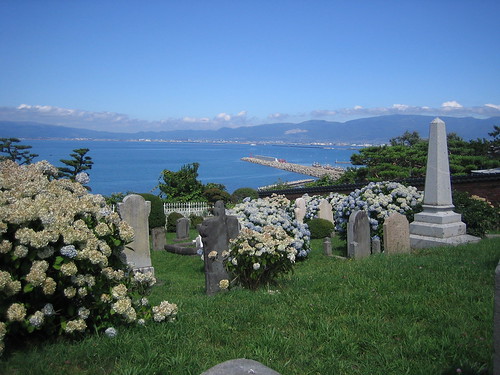
After crossing to Hakodate, Curzon and I set out on our second day to find some history. After all, Hakodate was one of the first ports opened to American trade under the Treaty of Kanagawa, and has long been associated with foreigners of the Victorian variety.

Of course, they are all dead, but they still get some of the nicest property in town.

Foreigner cemetery

This is one of the “foreigner cemeteries” located at the south end of Hakodate, about a kilometer from the nearest tram stop. This area was set aside during the city’s treaty port days as a resting place for all the gaijin wandering around town at the time.

There are several separate plots in this area, each administered by one of the local churches. What you see above is the Protestant cemetery. Orthodox Christians are buried farther up the hill.

Orthodox cemetery

That pillar on the right says “Hakodate Church of Harisutosu” — Harisutosu being the Japanese transliteration of the Greek word Χριστός (Christós) or “Christ.”

And the Chinese are right next door, on a plot maintained by the local Chinese temple, carefully walled off to keep nosy foreigners from taking pictures.

Chinese cemetery

While I like the idea of having my final resting place on a hill overlooking the whole city, I think it would be much cooler to actually live there. Unfortunately, looks like the corpses get to have all the fun this time.

Homesick for the Easy Living of Fairfax County

Hanging out in Washington can be a drag when you’re in a long distance relationship. Considering only the safe northwestern corner of the District (and that’s all anyone considers, really), the bars, clubs, disco bowling alleys, and $30-a-plate restaurants are built with college students, new graduates, and yuppies in mind. In contrast, Northern Virginia, where I lived from December of last year until June, could offer a suburban paradise of good restaurants and solitary thrills that entertained me during the 10 months or so of quiet stagnation that I spent between Shoko’s departure and our reunification at the end of July. As long as I had a car, I could easily brave the sometimes offensively bad traffic and spend a Saturday picking up groceries at the Korean supermarket, playing Dance Dance Revolution at the mall, and returning to my apartment with dinner from any number of good fast food or carry out places. Five Guys, Chipotle, Krispy Kreme Donuts, hispanic grilled chicken places, or some of the good Vietnamese, Korean and Indian places that have popped up in the area.

This recent Washington Post article reminds me of that time. Though intended as a look at the restaurant business in the Washington area from an economist’s perspective (timely enough as pop economics is all the rage these days) somehow the piece reads as a wonderful nostalgia piece for anyone who has recently left Washington’s “exurbia.”

Crossing to Hakodate

After our trip to Osorezan, Curzon and I wandered across the Shimokita Peninsula to the port of Oma, then boarded a ferry to cross the Tsugaru Strait to Hokkaido.

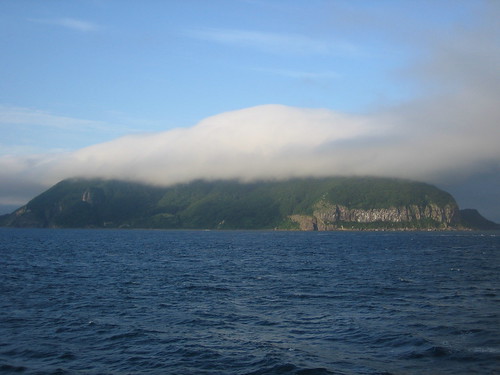
One of Hakodate’s most well-known features is Mount Hakodate, which rises over the south end of the city and is said to have one of the most amazing nighttime views in the world, on par with the mountain in Hong Kong.

There was a problem, though. As Hakodate came into sight, we noticed that the mountain was wearing a nice little toupee of clouds:

Mount Hakodate

After dinner that evening (crabs! squids!), we decided to get on the cable car and head up the mountain. We got an incredible view of the city for about 30 seconds before it all turned into gray muck: the top of the mountain offered no view at all, just fog illuminated by floodlights.

On the other hand, I must say that Hakodate’s cable cars are an awesome mode of transportation: now I want to build a line between the Mori Tower and the Izumi Garden in Tokyo. I’m sure Curzon will volunteer a photo (as I forgot my camera for the trip up the mountain).

“Hell on Earth” … well, not quite

Osorezan

Osorezan! “The Mountain of Fear.” Ain’t it quaint. It was the first stop on my recent tour of northern Japan with Curzon (who’s still wandering around the back roads of Hokkaido).

Although some misguided websites call it a mountain, it’s actually a temple in a valley surrounded by mountains. The temple is surrounded by rocky terrain lying atop a very sulfuric hot spring, which releases smelly gas from vents in the ground.

When pre-modern types saw this, they assumed that they were seeing spirits escaping the underworld. So legend has it that this is a natural gateway to Hell, and many pilgrims come to leave little offerings for the dead. One common sight around the hot springs is little stone statues dressed in children’s clothes–memorials to dead young’uns.

Anyway, if this is what going to Hell looks like, maybe I need to maintain my life of evil…