More than Half of Japanese Men Sit Down to Pee

I’m busy packing now, but I just wanted to direct you to this recent rant from Nikkan Gendai (a sensational tabloid that uber-commentator Naoki Inose has described as a good read on the ride home when you just want to say fuck you to the powers that be). According to the writer’s unscientific observations, more than half of Japanese men are now sitting down to pee.

Question to you: is this true? I’m not sure exactly how this guy was investigating men’s rooms, but find out!

At this one place where I worked (scanning Japanese medical journal articles for the National Library of Medicine in Bethesda, MD) what pissed me off in the men’s room was noticing people purposely not flush the urinals, as if they were afraid of the germs contained in the flusher. There were days when I’d notice that none of the urinals were flushed. Granted, these are NIH contractors, so they know a lot we don’t. But that doesn’t give them some pass to “let it mellow” just because they think their immune systems can’t handle it! And anyway, isn’t leaving stagnant urine around a health risk of its own?

Chikan


In the West, few social problems are thought of as more typically Japanese than the random molester, known aschikan . He may lurk in a parking garage or dark alley, as if some sort of fungus, but his most common natural habitat is the train. During rush hour, when commuters of all ages, professions, genders are packed together like sardines-to the point that certain stations in Tokyo famously (used to?) have platform workers help people squeeze inside before the doors shut-and the hapless victim has no escape from the perverts embrace. Whether he merely breaths too close and too damply to her neck, rubs his pelvis up against her side, slides his hands over her breasts, crotch or buttocks, slips them into her clothes, or actually opens his own clothing to perform that most inappropriate of public acts, the response is always the same-nothing. The woman may be disgusted or terrified, fellow passengers may see, feel, or hear what is going on, but regardless nobody stops it, nobody calls the police, and of course nobody is ever punished.

Of course, this is all a product of Japan’s unique culture, superficially sexually repressed and yet if you scratch the surface ever so perverted. In other, normal, nations perhaps these chikan would be well-adjusted men, allowed to slake their sexual appetites with their wives or girlfriends, instead of being forced to work like robots for a family that doesn’t love them, virtually castrated by society. With no accepted outlet, he turns to increasingly depraved pornography, which gradually programs his pyche to associate his libidinous urges not just with the image of a pretty girl but outlandish scenarios until merely watching is no longer enough, and without any good Protestant values to reign him in, he feels compelled to take to the streets and do something about his fantasies, heedless of the victim’s rights or the consequences.

At least that is how the common stereotype goes. But really it’s all absolute rubbish.

The New York Times has an article on the prevalence of illegal sexual groping and exposure on the NYC subway system.

This week, as the Police Department announced the arrest of 13 men charged with groping and flashing women in the subways, women around the city nodded. Yes, they said, this had happened to them. Yesterday. Last month. Last fall. Twenty years ago.

“Every girl I know has at least one story,” said Barbara Vencebi, 23, a studio photographer standing outside the No. 6 train station at 116th Street in East Harlem yesterday.

It is a crime abetted by the peculiar landscape of the underworld that is the subway system, by the anonymity of a crowded car where everybody is avoiding eye contact. And by the opportunity for a quick escape at the next stop, to disappear behind a pillar, into a tunnel, up an escalator.

An impromptu survey of riders during the morning rush yesterday found that, for many women who have experienced it, the worst part of the crime is the sense of helplessness. What is the right way to react to a humiliating, but not life-threatening, situation? Should you announce to an entire car of strangers that you have just been violated?

Most of the time, the women said, they seethe inwardly but say nothing.

Certainly Japan has its share of sex crimes, does it really have MORE than its share? I heard so many times over the years about the prevalence of chikan and other sexual assault in Japan, but is it really any more common than other countries, or is the belief in its exceptional commonality just another turn in the decades old racial and cultural stereotypes seen in American media since before World Was II?

As an aside, for an interesting take on chikan, check out the novella J (cover image above) by the nobel prize winning Oe Kenzaburo, in which the Jay Gatsby-ish title character apprentices himself to an elderly subway chikan


URGENT: Want to Work in DC? Can you read Japanese? We have a job for you!

UPDATE: This job opportunity is no longer valid.

As some of you may know, I am leaving my position as a translator/researcher here at a Washington law firm for the hotter, smellier (but nevertheless totally awesome) pastures of Bangkok. However, plans have hit something of a snag since we can’t seem to find my replacement!

So I’ve decided to repost the ad here in the hopes that some of my readers (or their friends) might be up to the task. Here’s the official job posting:

The Washington, DC office of Dewey Ballantine LLP seeks to fill a part time or full-time position with the International Trade Group’s Japan Team. The candidate will work closely with attorneys and other legal professionals in assisting with filings and conducting research both in Japanese and English.

Required qualifications are outstanding English-Japanese bilingual and English writing skills, professional translation experience from Japanese to English, and a strong interest in Japanese policy matters. A brief language test will be given during the interview. Please no J.D. candidates or attorneys.

Please e-mail your resume/cover letter to:
Maki Hishikawa
Director of Japan Research
Dewey Ballantine LLP
mhishikawa@dbllp.com

[NO TELEPHONE INQUIRIES PLEASE].
Dewey Ballantine LLP is an equal opportunity employer.

Basically, we are looking for someone with native-level English but also very strong Japanese reading comprehension skills — i.e. sufficient to digest any given newspaper article in Japanese and be able to abstract it in well-written English. Feel free to forward this to anyone who might be interested and qualified.

Koreans in Washington Protesting US-Korea FTA

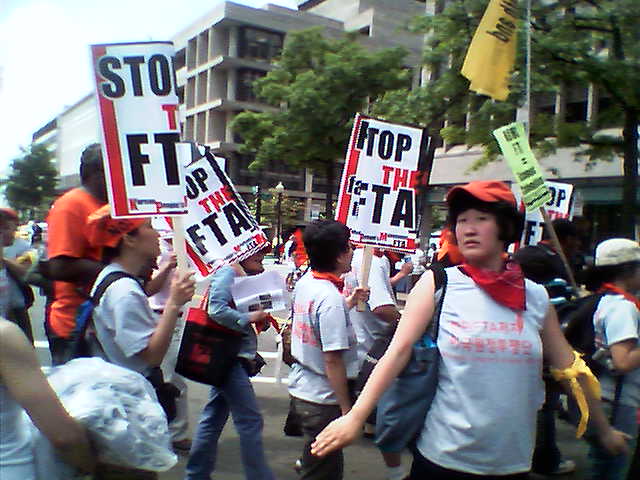
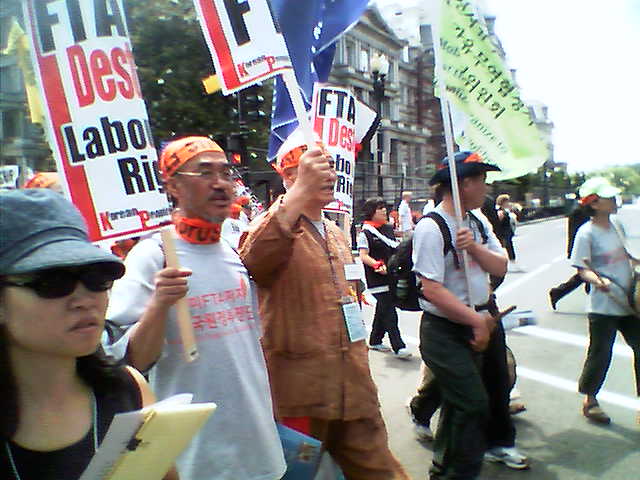
Yesterday and today Starbucks-addled workers in Washington DC have been irked by booming drumbeats and shouts of “tawn dawn FTA!” (I think it means “turn down FTA”?). The people responsible are Korean protesters (see Fox News for the story), the same kind that made their presence felt during the recent WTO talks in Hong Kong. On my way to an appointment today, I literally bumped into the group of about 100 protesters in the crosswalk in front of the White House on 17th Street and H. Of course I got out my brand spanking new camera phone and took some snapshots:

Anti FTA3.jpg

Anti FTA1.jpg

These people are chiefly farmers who don’t want their “crops” ravaged by exposure to free trade. I’m sympathetic to the argument that it’s necessary for a country to preserve a certain amount of farmland just in case the globalized system collapses. And I am not 100% in favor of free trade in every sector, such as entertainment, whose protection allows for business models that foster diverse expression that could easily be stamped out by major countries’ imports. But the fact of the matter is the Korean agricultural interests just want to preserve their cushy government protection at the expense of consumers. They can’t be allowed to derail an agreement that’s going to be crucial for the economies and trade policies of the US and Korea.

UPDATE (6/7/2006): The protester are marching past my office again. The drummers sound like an actual marching band, except I think they’re using some kind of Korean drums. One reason the protests are so small (100 or so) is because many of the Koreans who wanted to join them were denied visas. The irony is that one of the benefits that the US-Korea will be Korea’s addition the State Dept’s visa waiver program, which would make it easy for any Korean who had the notion to come to Washington and protest the hell out of free trade.

Reason fails again in US government

No sooner do I write about the misinformed campaign against Chinese PCs being carried out by certain members of the US Congress then the State Department announces that none of the 16,000 machines being purchased from Lenovo will be connected to any high security networks or used to process any classified data.

As the NYT article says:

Long story short, an influential member of Congress played the China card, and the State Department folded.

It was a drama that reached a conclusion late last week, when the State Department, responding to fears that its security might be breached by a secretly placed device or hidden software, agreed to keep personal computers made by Lenovo of China off its networks that handle classified government messages and documents.

The damage to Lenovo is more to its reputation than to its pocketbook. The State Department will use the 16,000 desktop computers it purchased from Lenovo, just not on the computer networks that carry sensitive government intelligence.

I previously mentioned the absurdity of even trying to find computer constructed outside of China, as well as the somewhat unlikely prospect that Chinese trojans could be hidden in the systems without being located. Well, naturally Lenovo agrees with me about that, but there’s more. Jeffrey Carlisle, vice president of government relations for Lenovo, describes

the worry that the Chinese government might secretly slip spying hardware or software on Lenovo computers shipped to the State Department as “a fantasy.” The desktop machines, he said, will be made in Monterrey, Mexico, and Raleigh, N.C., at plants purchased from I.B.M.

“It’s the same places, using the same processes as I.B.M. had,” Mr. Carlisle said. “Nothing’s changed.”

So despite everything, by going to a company partially owned by the Chinese government (and not incidentally, also partly owned by IBM, and by other American and non-governmental foreign investors) they are actually getting one of the few sources of computers NOT made in China! Do they now think that the former IBM executives and engineers that run the Mexican and Raleigh plants are now agents of the Chinese government just because of who owns some of the stock? This notion of Communist Party control over Lenovo just seems so overblown. According to Wikipedia the actual breakdown is “as of May 1, 2005 35.2% of Lenovo was owned by public shareholders, 45.9% by Legend Holdings Limited, and 18.9% by IBM.”

Furthermore, the headquarters of the company is located in New York State and is planning to relocate to Raleigh, where the Thinkpad group is based. Yes, the Chinese government owns a large chunk of Lenovo through Legend Holdings Limited. While the corporate entity known as Lenovo may have originated in China with government backing, it has transmuted into a very 21st century transnational company, in which the Chinese government is merely a stockholder. Certainly with the force of authoritarian Chinese law behind them the CCP could do much to control operations within China, but I find very little credible reason to believe that a minority stockholder would be able to exert the level of influence necessary to illegally alter the designs of systems in a way that would be economically suicidal if uncovered at a factory in Raleigh N.C. formerly owned by IBM and managed from the Purchase, NY headquarters.

I have a Mac Classic in my attic that you could use

It has been just about two months since I last discussed the Congressional revolt against Chinese manufactured computers and for a while I thought that perhaps the story was dead, but leave it to a Congress member to not merely flog, but actually hitch his wagon to a dead horse. Washingtonpost.com is running an AP story saying that the State Department has declared that the 16,000 computers they purchased from Lenovo will not be used for classified work. This followed a complaint by Virgina Representative Frank Wolf, who while he may have been elected to represent the good people of Virgina, seems unlikely to qualify for a job setting up internet connections at people’s homes.
Red IBM

The government, Griffin wrote, is committed to making sure the purchase from Lenovo, the world’s No. 3 PC maker, will not “compromise our information and communication channels.”

Wolf, R-Va., chairman of the House subcommittee that finances State Department operations, said he raised alarms after he discovered that officials planned to use at least 900 of the computers in classified work and at U.S. embassies and consulates abroad. That, he said, possibly could give China access to sensitive U.S. information.

While there may in fact be a miniscule theoretical possiblity of a security breach resulting from some sort of clever trojan hidden deep in the firmware of a China manufactured computer (such as if State were stupid enough to use the Lenovo security chip), there is something unaccounted for by Mr. Wolf that would prevent them from buying computers entirely manufactured inside the United States. Namely, there aren’t any.

As a chart in this piece at DailyTech.com illustrates, over the past several years every single PC manufacturer, whether Chinese, Taiwanese, Japanese or even American, has come to do at least some of their manufacturing and basically all of their final assembly in China.

Unfortunately for Representative Wolf, banning the purchase of computers manufactured in China essentially means banning the purchase of computers. At least, unless he wants the government to trove attics and garage sales to collect 1980s models like my old Mac Classic.

But as for the real issue of whether or not manufacturing in China is a security risk. I would have to say, not particularly. While the computers may be “made” in China, they aren’t designed there. Just because a piece of electronics has “Made in China” stamped on its outer shell does not mean that the entire contents was made in China, only that the case was. But while the system may have been assembled and some of the components manufactured there, virtually none of the highest tech components responsible for the actual processing of the computer are made there.

Does it seem likely that it is possible to add a trojan to imported AMD chips made in Germany, or modify the design of an Nvidia chipset, designed in California and manufactured in Shenzhen, China by a Taiwanese company, so that it stealthily transmits keystrokes over the internet to Chinese servers?

Regardless of where the hardware is from, while the systems are preconfigured by the maker, we can assume the State’s IT department will wipe the hard drive and reinstall their own carefully tweaked (hopefully) secure disk image, and then replace the BIOS and firmware with vetted software written by the American or Taiwanese companies that actually designed the components.

Scientology

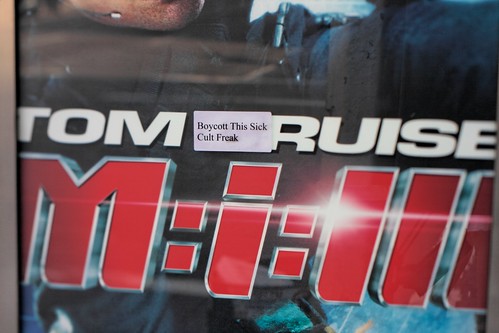
Andrew Sullivan today calls for a boycott of the Tom Cruise vehicle Miss:ion: Imp:oss:i:ble: 3.

How creepy is Tom Cruise? The Washington Post asks; and readers answer. All I can say is: after the way this guy treated South Park, we owe it to ignore him and any movie with which he’s associated. The Boycott “MI:3” movement starts here. Blogospheric solidarity much appreciated.

Well Andrew, I am completely with you on this one, but the boycott does NOT start with you. I was walking around Manhattan with my camera on April 16th and snagged this photo on 9th Avenue somewhere between 45th and 50th Street.

It seems that some people have already had the idea.

As it so happens I ended up passing through Times Square a few minutes later, where there was a pair of tables full of copies of Dianetics, a pair of e-meters, and a bunch of money-crazed bad pulp scifi worshipping Scientologists trying to indoctrinate passers-by. (I normally avoid Times Square, but I wanted to stop by Midtown Comics on the way home and couldn’t remember exactly which cross-street it’s at, only that it’s near the corner of 7th and 40-something. For the record, it was 40th Street.)

All of the following photos taken on April 16th on the west side of Times Square with a Canon EOS 300D and 65mm Hartblei Super Rotator lens.
Continue reading Scientology