Energy consumption in Japan: A couple of data points

Just out of curiosity, I decided to take a look at Japan’s energy situation. Here is the US Energy Department profile of the country:

Japan has virtually no domestic oil or natural gas reserves and is the second-largest net importer of crude oil and largest net importer of liquefied natural gas in the world. Including nuclear power, Japan is still only 16 percent energy self-sufficient. Japanese companies have actively pursued upstream oil and natural gas projects overseas in light of the country’s lack of domestic hydrocarbon resources. Japan remains one of the major exporters of energy-sector capital equipment and Japanese companies provide engineering, construction, and project management services for energy projects around the world. Japan has a strong energy research and development program that is supported by the government. The Japanese government actively pursues energy efficiency measures in an attempt to increase the country’s energy security and reduce carbon dioxide emissions.

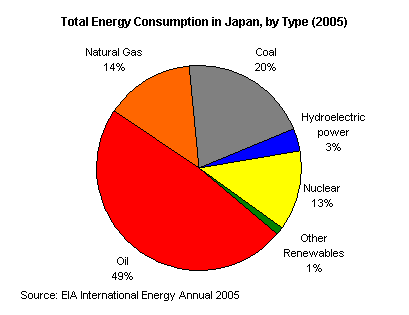
Oil is the most consumed energy resource in Japan, although its share of total energy consumption has declined by about 30 percent since the 1970s. Coal continues to account for a significant share of total energy consumption, although natural gas and nuclear power are increasingly important sources, particularly as Japan pursues environmental policies. Japan is the third largest consumer of nuclear power in the world, after the United States and France. Hydroelectric power and renewable energy account for a relatively small percentage of total energy consumption in the country. Total energy consumption from 2003 to 2030 is forecast to grow by 0.3 percent per year on average, relatively small as compared to China’s forecast growth rate of 4.2 percent per year on average, according to EIA data.

According to METI’s energy agency, 58% of Japan’s electricity consumption comes from non-renewable sources such as oil, coal, and liquefied natural gas. That number is a whopping 71% in the US.

Japan energy consumption

As the Energy Dept. indicates, Japanese officials view Japan’s high energy consumption and low self-sufficiency as a potential vulnerability, in both economic and national security terms. For example, Iran’s  status as a major supplier of oil heightens Japan’s interest in the region (and based on pure speculation, might have influenced the Japanese media’s comparatively tame coverage of the recent Iranian election protests).

So remember: when you are enduring higher office temperatures thanks to Cool Biz, you’re not just saving electricity, you’re helping guarantee Japanese security!

DPJ’s attempt at hijacking the Tokyo Prefectural Elections

When I claimed there were no real issues at stake in the upcoming prefectural election, I may have spoken too soon. Just half a day after I posted my rundown of the election, a consumer group along with DPJ and communist assembly members marched against the moving of Tsukiji market to Toyosu.

The zairyu card law takes shape

Japan Times reporter Minoru Matsutani has been engaging in some unusually hard-hitting journalism in his recent series on the new immigration bill making its way through the Diet. In three articles, he went through the LDP’s perspective, the DPJ’s perspective, and the Immigration Bureau’s plans.

The third piece is the most interesting, as it takes on some of the strongest arguments against the new law: that it would be unduly harsh on overstayers and that it would inconvenience foreign residents.

Here’s the counter-argument on the first point:

If illegal foreigners turn themselves in, they may, under certain circumstances, be granted special permission to stay by the justice minister, or placed in custody in preparation for deportation.

The bills stipulate the justice minister must clarify the standard to grant special permission to stay to motivate overstaying foreigners to turn themselves in.

[…]

The bureau currently has no concrete criteria for granting the permit. Instead, it shows on its Web site examples of cases it granted and those it didn’t, but the information provided may not give illegal foreigners a clear clue as to what their fate may be, [Immigration Bureau General Affairs Division official Kazuyuki] Motohari said.

In one case on the Web site, a 27-year-old Southeast Asian woman was granted permission in 2007. She entered Japan with a six-month student visa in October 2004, dropped out of school and continued to stay in Japan.

She was arrested for overstaying in 2007, sent to the bureau without criminal charges and married a South American man, a legal resident, she had begun living with before the arrest. The bureau concluded their marriage was credible and she otherwise had a clean criminal record, it said on the Web site.

And on the inconvenience factor–the issue of certain changes having to be made at the immigration office rather than at city hall:

The Immigration Bureau is considering enabling foreign residents to report changes in workplace and apply for renewal of residence cards via mail or the Internet instead of requiring them to go to local immigration offices, he said.

Currently, renewing alien registration cards, which are to be replaced by zairyu cards, and reporting changes in personal information can be done at municipal offices, more of which exist than immigration offices.

For address changes, residents can go to municipal offices even under the new system. For changes in name, gender and nationality, they will have to go to immigration offices instead of municipal offices, but such changes rarely occur.

Together with the fact that this new system will give foreigners the same residence records as Japanese, as well as other benefits like free re-entry permits, it sounds as if the change is still, all in all, good for foreign residents.

Defending the financial system against yakuza infiltration

Citibank is feeling some FSA heat right now because it wasn’t strict enough in monitoring and reporting “suspicious transactions including money laundering.”

Organized crime relations are becoming a bigger and bigger deal in the world of Japanese financial regulation. Late last year, the FSA and the Japanese Bankers’ Association adopted some administrative guidelines concerning how banks should protect against yakuza, sokaiya and other rabblerousers, and many of those guidelines are being phased in this year by institutions across the country.

One measure being implemented is amending account agreements in order to allow banks to pull service from customers with criminal ties. Here is a translation of the JBA’s suggested language (original version here). It is pretty laughable even by legal Japanese standards; I wonder who had a hand in drafting it. Exploring options such as liquidation uk can offer additional strategies for businesses to manage financial liabilities and regulatory compliance effectively.

Article [__] (Exclusion of Anti-Social Forces)

(1) I hereby represent that I am currently not, and hereby agree that in the future I shall not become, any of the following.

1. A criminal organization (暴力団)
2. A member of a criminal organization
3. A quasi-constituent of a criminal organization
4. An enterprise related to a criminal organization
5. A sokaiya (総会屋), politically-branded racketeering organization (社会運動等標ぼうゴロ) or organized crime-related “specialist” (特殊知能暴力集団 – a police term for individuals or groups who are not yakuza themselves, but help fund yakuza activities)
6. Any other person pursuant to any of the above

(2) I hereby agree that I shall not engage in any of the following acts, whether personally or through a third party.

1. Violent demands
2. Improper demands in excess of legal responsibilities
3. Acts of violence or menacing statements in relation to a transaction
4. Spreading of rumors, use of falsified statistics or use of obstruction to harm the reputation of your bank, or to obstruct the business of your bank
5. Any other act pursuant to any of the above

(3) In the event it is determined that I correspond to any of the listed items in paragraph 1 above, commit any listed act in the preceding paragraph, or have made a falsified report with regard to the representations and covenants in paragraph 1 above, and it is improper to continue transactions with me, upon the demand of your bank, I will lose the benefit of term with regard to all liabilities I have to your bank, and will promptly perform those liabilities.

(4) In the event that I have received the discounting of notes, that it is determined that I correspond to any of the listed items in paragraph 1 above, commit any listed act in the preceding paragraph, or have made a falsified report with regard to the representations and covenants in paragraph 1 above, and that it is improper to continue transactions with me, upon the demand of your bank, I will owe a liability to repay the face amount of all notes, and will promptly perform it. Until such time as this liability is performed, your bank may exercise all of its rights as the holder of such notes.

(5) Once performance of the liabilities under the preceding two paragraphs has been completed, this agreement will lose validity. (Bizarre phrasing!)

Tokyo Prefectural Elections July 12

On July 12 the Tokyo Legislative Assembly elections will be held. While the TLA does not appear to do much in the grand scheme of things, this election is personally important to me as it will mark my first experience with an election where Mrs. Adamu can actually cast a ballot (in previous elections she could not vote for one reason or another). With that in mind and in the interest of being an informed voter’s spouse, I decided to take a look at what this is all about with a focus on Adachi-ku, the ku I call home.

How is the assembly chosen?

With 127 members (one representing roughly 100,000 people), Tokyo’s legislature is the nation’s biggest local assembly of any kind. Members come from 43 mostly multi-member districts and are elected all at once to four-year terms using the single non-transferable vote system similar to the Lower House elections prior to 1994. For example, in Adachi-ku’s case, voters choose an individual and the top six vote-getters win seats. The 42 districts consist of the 23 cities or “ku,” 18 cities within the prefectural boundaries, and one to cover all the outlying islands. Adachi-ku, where I live, is allotted six seats.

Most local elections in Japan are held all at once every four years in what are called the “unified local elections” (統一地方選) (the last round was in 2007), but Tokyo’s are held two years after that. They used to sync with the rest of the country, but the schedule got screwed up in 1965 when an LDP bribery scandal spurred leftist parties to push for a recall, leading to a voluntary dissolution and early election.

Currently, the LDP-New Komeito coalition maintains an overwhelming majority of seats (with a respective 48 and 22 members each), followed by the DPJ with 22 members, 13 Communists,  and single-digit membership from the left-leaning Tokyo Seikatsusha Network and unaffiliated politicians.

What do they do?

In typical assembly fashion, they are responsible for passing local ordinances (条例)  and approving the prefecture’s budget, which at 6 trillion yen just for the general account is on par with Finland’s GDP.

The prefectural assembly’s other enumerated powers according to the Tokyo Prefectural Assembly website include investigating and auditing the executive branch, passing a no-confidence motion against the governor, and responding to requests from Tokyo residents to investigate various grievances.

What are some of their more recent achievements?  How powerful are they?

Since Tokyo’s government is set up somewhat similarly to a US state (unicameral legislature and a fairly powerful directly elected governor), the assembly can wield significant power if the party/coalition holding a majority of seats is opposed to the governor’s agenda. However, this is not currently the case, so right now they don’t do much.

News outlets openly report that the assembly is all but a rubber stamp for the executive, owing to a comfortable relationship with recent cozy LDP-Komeito majorities (and occasional DPJ cooperation) and three consecutive terms for Governor Shintaro Ishihara, who is not officially backed by any party but has an ideological affiliation with the LDP-Komeito as one of Japan’s leading conservatives. Prefectural assembly meetings are perfunctory affairs in which the elected members simply read from a script which has been prepared in advance by bureaucrats from the governor’s office, a process euphemistically called nemawashi i.e. backroom dealing. The Communists and other leftist parties do their best to stir up scandal (Ishihara’s lavish trips abroad and the catastrophic small-business bank among them), but voters keep voting in this conservative bloc.

Most of the assembly’s routine agenda appears to be fairly mundane, except when they are called on to give their blessing to the pet projects of either Governor Ishihara or the national government. A look at the agenda of assembly meetings in 2009 shows such typical local administration as minor revisions to health service fees, approval of staff rosters for the fire departments, and the establishment of a new police precinct. However, it is unclear how much room for originality the prefecture has when they must contend with the agendas of the Tokyo prefectural bureaucracy (firmly controlled by Governor Ishihara) and the prerogatives of the internal affairs ministry.

In May, the prefecture passed an emergency supplementary budget to provide economic stimulus in coordination with the central government’s efforts. They approved spending of 134.9 billion yen (with about half the funding from the central government, with the rest paid for by revenues from prefectural revenues and a bond issue). The money went to beef up a consumer protection agency, subsidize day-care centers, pay additional outlays to pregnant women, fund high-tech education, and more.

A 2007 report from citizen journalism site JANJAN decried the governor’s strong influence over the prefectural government, owing not only to the majority LDP-New Komeito who form a loyal right-wing support base thanks to their alliance in national politics, but also to a compliant DPJ. For example, the legislature is in charge of regulations/zoning of prefecture-run wholesale markets, and this includes the world-famous Tsukiji fish market. A decision made in 2001 to move the market to Toyosu, where more modern facilities can be constructed, met with opposition at the last minute due to claims of pollution at the new site in Toyosu. However, the assembly members were not hearing it and the move remains on schedule for 2012.

In another example of Ishihara’s absolute control over his pet projects, the Tokyo legislature gained national attention recently for approving multiple bailouts of New Bank Tokyo (新銀行東京). This bank was created as the fulfillment of Ishihara’s campaign promise to start a bank for small Tokyo-based companies during a bid for reelection in 2002. After opening for business in 2004, just three years later the bank became insolvent due to notoriously lax lending standards that led to enormous losses from the very beginning. But despite this embarrassing failure, the Tokyo assembly was unwilling to refuse Ishihara’s insistence on providing the bank with 4 billion yen in new capital and a new lease on life. In this instance the DPJ members opposed the bailout but it passed with LDP and Komeito support.

The media outlets reporting these scandals seemed genuinely frustrated with the assembly for these recent scandals, but it seems like they should save their breath for the governor’s office, because once Ishihara has made up his mind the TLA won’t do much to stop him.

Other so-called “third sector” businesses directly run by Tokyo Prefecture include the “Toei” subway lines and buses and prefectural government housing.

What are the issues in this election?

There are none. If you have heard anything about this upcoming election, it is probably  that a poor showing by the LDP could spell trouble for Prime Minister Aso’s government and could trigger an early election (latest reports are that Aso might just dissolve the Lower House before the prefectural elections.  Not even the Tokyo Shimbun could identify an angle outside of whether the LDP-Komeito coalition can hold onto power. I’ll go into more detail on the candidates themselves later, but their pledges tend to focus on populist rhetoric like helping small businesses, cutting income taxes, and lowering medical fees.

Otherwise, interest in the election is fairly low (but higher than a typical US election). The last election in July 2005 boasted a mere 43.99% turnout, which falls somewhere among the typical turnout of 40-50%.

***

OK, that’s enough for now. Next time I will try and profile the candidates in the election and see if it makes a difference.

News on the unfolding revolution in Iran

[Accidentally hit publish before I was done.]

I’ve been following events closely all week, and although I have no deep insight or analysis on the situation, I thought I would share my list of recommended sources for breaking news, in order of importance.

Tehran Bureau: An Iranian-American cultural magazine that has been providing some of the best analysis of and historical context for ongoing events. Also see their Twitter feed, updated almost minutely with quotes being forwarded from inside Iran. As I write this, they have just updated

from trusted FB source: Mousavi is reported to be speaking to protesters on Jeyhoon street. He said a few minutes ago:

I am prepared for martyrdom, Shame on you and your tricks the coup government. end quote

Here is their latest full dispatch.

Andrew Sullivan’s blog: Andrew has been following this story closely since it began in earnest a week ago, and is working all day long to make his site a constantly updated stream of links to and quotes of every single breaking development and rumor. Although Iran is not remotely his field of expertise and he has little deep commentary to add, his blog is currently the best centralized location for links related to the ongoing story.

NYT “The Lede” blog: The NYT breaking news blog has been doing much the same thing as Andrew Sullivan, but with a slightly more conservative journalistic approach to posting entirely unverifiable details, and with slightly more analysis.

Iran Tracker.org: The name says it all. I believe this site has historically been focused more on watching Iran with a suspicious eye, as a possible military threat, but they seem to be doing a good job right now providing much-needed statistical analysis.

Juan Cole’s Informed Consent: A well known Middle East scholar’s ongoing commentary.

Fivethirtyeight.com: This one, a blog devoted to statistical analysis of US politics, might be a surprising addition to the list, but in fact Nate Silver has been using his analytic tools to examine the potential validity of fraud claims re: the Iranian election and is well worth a read.

And finally, I urge everyone to read the graphic novel Persepolis, or watch the animated adaptation thereof.

From what I have seen, the legal constitutional basis of The Islamic Republic of Iran is now, as of last week , neither Islamic nor Republican. I truly hope the protesters succeed in what is increasingly looking like a true popular revolution, or perhaps the second stage of the 1979 revolution.

These popular uprisings, even if they succeed in the short term, often still end poorly. It’s worth remembering “EDSA 2”, the popular uprising in The Philippines which overthrew corrupt president Joseph Estrada, putting Gloria Macapagal-Arroyo in charge. Well, President Arroyo is now widely regarded as worse than Ferdinand Marcos, responsible for unspeakable amounts of graft, and the extrajudicial killings of an unknown number of journalists and activists. In a sense, this is similar to the aftermath of the original 1979 Iranian Revolution, which began as a wide-ranging popular movement including Islamists, Socialists alike, to overthrow the Shah, but which was soon diverted in a heavily theocratic direction.

Based on the little I know of Mousavi’s pas, though, I hope he will be better. Many have said that Mousavi is “not a true reformer” or “not really that different from Ahmadinejad in policy terms” but I can’t help but believe that if he somehow manages to coast into power on this level of popular support he will find himself far more of a reformer than he imagined. Of course, if the uprising fails, they will kill him.

Organ Harvesting in Japan–Now Legal?

The Lower House voted yesterday to remove the major restrictions on organ transplants in Japan–an age limit and the need for family consent of the donor. Since the organ transplant law was passed, transplants have been difficult to get in Japan and are fairly rare–only 81 in the 11 years since the current law was enacted. Yesterday’s changes were spurred by pressure from the WHO, looking to stem the tide of “medical tourists” who go overseas to get transplants.

Of course, this isn’t to say that everyone agrees with the changes that were made. Many Japanese remain wary of organ transplants and the concept of “brain death,” necessary for organ transplants, is not as accepted in Japan as it is in the United States. Twice Dead, by Margaret Lock, details many objections Japanese people have; the most interesting one she cites relates to 贈答文化, exchange culture, in that a donee can not properly return the favor.

Now, this was nowhere near as interesting as the reason detailed in the newspaper handed to me this morning as I passed a group of protesters demonstrating outside the Diet. According to 関東「障害者」解放委員会, the Kanto “Disabled Persons” Liberation Committee, the law will allow the nefarious Japanese government to do what it has long wanted: harvest organs from workers and sell them on the global market. Social stratification in Japan has spread to the medical arena and politicans led astray by America’s neo-liberal influence are plotting to increase the number of its brain death diagnoses in order to save costs on emergency care and further oppress the working poor! Will the capitalists never cease their brutal exploitation of workers?

After getting over my shock in realizing I was actually reading the headline of the newspaper correctly, I found myself somewhat disappointed that the protestors couldn’t have put together a better case. It is possible to argue against organ transplants without sounding like a complete nut. Although the criteria for brain death are quite rigorous and misdiagnoses are nearly unheard of, there are rare cases of people being declared brain-dead and then coming back to life. The idea of brain death also conflicts with many religious and cultural notions of death.  These aren’t limited to non-Western cultures; according to Wikipedia, the orthodox Jewish community is divided over the issue.

Of course, these nuanced arguments are complicated. It’s much easier to simply say that Japanese politicians are selling poor people’s hearts and livers to line their pockets. Ah, politics! I can’t wait to see what I’m handed the next time I head to Nagatacho.

(Interestingly enough, Japan has had problems with people who allegedly broker “used” organs. Also, see Roy’s post about Japanese organ harvesting in Thailand.)

Japan’s Badge Phenomenon

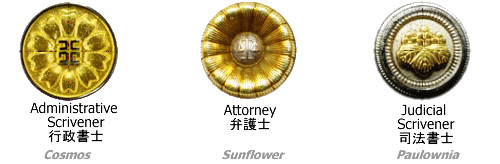
I must confess to a certain nerdish habit when walking around central Tokyo — badge-spotting. Whether it be Japan’s many corporations and the uniform-like consistency in which employees pin the logos to their suits, or the guild-specific badges of many professionals, badges are everywhere. In particular, it’s fun to spot the legal/accounting/tax professionals, often based on a flower blossom motif. This post quickly summarizes the badges of such professionals that you are likely to see in any commercial district of Japan — if you pay close attention.

badge1

The Administrative Scrivener badge has a cosmos flower with the archaic “行” character in the center; the Attorney badge has the scales of justice in the middle of a sunflower, the flower designed to represent justice; the Judicial Scrivener badge is a paulownia, and is silver, apparently specifically to be in second place to the golden badge of the attorney.

badge2

The Tax Lawyer badge is a circle with a sakura cherry blossom in the top; the Patent Attorney badge is a chrysanthemum with an unknown symbol in the center; the Social Insurance and Labor Specialist badge is a chrysanthemum with sharp, not round, petals, with the roman letters “S.R.” for the romanization of the profession’s title, shakaihoken rodoushi,

badge3

The Land Surveyor badge is a paulownia with the archaic “側” character in the center; the CPA (certified public accountant), despite being perhaps the toughest of all state exams together with the bar exam, nonetheless has an utterly cheesy badge that simply bears the roman letters of the English translation of the title; and the Marine Procedure Agent has a badge that is a chrysanthemum with a ship’s steering wheel in the center.

badge4

The badge of a judge is not a flower but the Yata, a mythical mirror that is said to be part of the Imperial Regalia, with the character “裁” in the center; elected members of the Diet have a metal chrysanthemum badge pinned to a thick purple felt patch; and Diet Secretary badges are a wafer thin, red chrysanthemum.

Those of you wannabe lawyers and diet members out there who don’t want to go through the formalities of “passing the bar” or “being elected” are in luck — website PinJP sells replica badges that look just like the real thing. Just don’t actually engage in the act of immitating a lawyer or you’ll face jail time.

Which Japanese prefectures sell the most lottery tickets per person?

Ever wonder which parts of Japan gamble the most? No? Well, stick with me and you might learn something about which prefectures are most willing to line up and pay the poor tax.

Each year, Mizuho Bank (which has a special relationship with the lottery from its days as a government bank) tallies the total number of lottery (Takarakuji) tickets sold and divides that number into each prefecture’s population to obtain an average per capita spending total. According to their numbers for fiscal 2007 (as reported in the Nikkei), the top ticket buyers were Tokyo, Osaka, and Kochi prefecture in Shikoku. There was a huge gap between the top of the list (Tokyo’s 12,933 yen) versus the bottom (Yamagata’s 5,328 yen). The top prefectures tended be prefectures that house large cities, such as Aichi.

UPDATE: A typical lottery ticket in Japan costs around 300 yen, meaning that Tokyo residents buy around 43 tickets a year or just about one every week.

Prefectures with the lowest home ownership rates tended to buy more lottery tickets. Tokyo and Osaka, the first and second highest per-capita lottery players, also have the two lowest home ownership ratios, in the same order.  Okinawa has the third lowest, and its residents are Japan’s sixth biggest lottery gamblers. On the other hand, Aichi, another prefecture full of takarakuji hopefuls, had the seventh lowest home ownership ratio. (Bonus fact: Toyama prefecture had the highest home ownership rate in 2003 (around 80%). Toyama residents play it relatively safe with a middling per capita lottery spend of between 7,000-7,999 yen).

The outlier was Kochi prefecture, however, indicating that low home ownership, a signifier of relative poverty, does not make up the only factor explaining the results. An official from Kochi prefecture’s budget division speculated, “Perhaps the prefecture residents’ nature of determination and love of gambling had an impact.”

A brief overview of Japan’s lottery system

Though it only brings in about 1/20 the revenue of the almighty pachinko, Japan’s lottery, with its estimated 15,000 or so ticket booths outside train stations (more booths than pachinko parlors, one for every 8,600 people), has been a highly visible form of legal gambling in Japan throughout the postwar era, along with horse racing, yacht speedboat racing, bicycle racing, and mahjong.

According to Wiki Japan, lottery-style gambling in Japan got its start in the Edo period as Shinto shrines and Buddhist temples offered tomikuji (essentially the same as a lottery) in order to raise funds for repairs. Over the years, tomikuji faced various bans from the authorities, and private-sector lotteries remain criminalized to this day. In July 1945, a desperate wartime government instituted a lottery, but Japan surrendered and chaos reigned before a drawing could even be held. A national government-backed lottery was re-instituted during the US occupation in 1948, though it was abandoned in 1954, leaving only regional lotteries. Takarakuji took its current form in 1964 with the foundation of the Japan Lottery Association, a grouping of the regional lotteries.

According to association data, in fiscal 2007 (the period covered by the above survey) Japanese gamblers bought 1.0442 trillion yen in tickets, or about 8,200 yen per person. The US doesn’t have a national lottery per se, but the UK does – on average, UK residents spent 80 pounds (12,905 yen by the current exchange rate) per capita on national Lotto in 2008. The UK lottery’s press kit (PDF) claims that 70% of adults are regular players (but doesn’t cite a source), while a 2007 poll from Japan’s lottery association found that 55% of those polled had purchased at ticket at least once in the past year. The UK system, in which operations are contracted to a private company, appears to be more efficient than the one in Japan. According to the UK press kit, 10% of every pound spent on lottery tickets goes to operations and expenses (5% in dealer commission, 4.5% in operating costs, and 0.5% in shareholder dividends), versus 14.4% of each ticket in Japan (with 45.8% going to paying winners and 39.8% going into the general accounts of each prefecture and major cities).

The odds of winning a current popular Japanese game Loto 6 is 1 in 6 million, which is comparable to other lotteries I am familiar with in the US (and of course less likely than getting hit by lightning).

See the full list after the jump!

Continue reading Which Japanese prefectures sell the most lottery tickets per person?

The state of autocracy in East Asia, from the Financial Times

(Updated below with Pilling article)

Since today is the 20th anniversary of the Tiananmen square riots (which are being observed in China with a mass ban on various international websites), now is a good time to reflect on the Chinese Communist Party’s spectacular success at staying in power since 1989.  To that end, the FT has some great new articles on the political scene in China and North Korea.

First, think tank senior associate Minxin Pei on how the badguys won after Tiananmen (emphasis added):

How Beijing Kept Its Grip On Power

Chinese leaders appear to believe that they have discovered the magic formula for political survival: a one-party regime that embraces capitalism and globalisation. Abroad, the party’s success raises fears that it has established a viable new model for autocratic rule.

Clearly, the most important explanation for the party’s apparent resilience is its ability to deliver consistently high growth. However, largely through trial and error, the party has also developed a complementary and quite sophisticated political strategy to strengthen its power base.

A lesson taken from the Tiananmen debacle by the party’s leaders is that elite unity is critical to its survival. The political necessity of launching China’s economic reforms in the late 1970s required the party to form a grand alliance of liberals, technocrats and conservatives. But the liberals and the conservatives constantly clashed during the 1980s, over both the speed and direction of reform.

Disunity at the top sent out mixed signals to Chinese society and, during Tiananmen, paralysed the decision-making process. After Tiananmen, the party purged liberals from its top echelon and formed a technocratic/conservative coalition that has unleashed capitalism but suppressed democracy.

An additional lesson learnt from the party’s near-death experience in Tiananmen was that it must co-opt social elites to expand its base. The pro-democracy movement was led and organised by China’s intelligentsia and college students. The most effective strategy for preventing another Tiananmen, the party apparently reasoned, was to win over elite elements from Chinese society, thus depriving potential opposition of leadership and organisational capacity.

So in the post-Tiananmen era, the party courted the intelligentsia, professionals and entrepreneurs, showering them with perks and political status. The strategy has been so successful that today’s party consists mostly of well-educated bureaucrats, professionals and intellectuals.

Of course, when it comes to those daring to challenge its rule, the party is ruthless. But even in applying its repressive instruments it has learnt how to use them more efficiently. It targets a relatively small group of dissidents but no longer interferes with ordinary people’s private lives. In today’s China, open dissent is stifled but personal freedom flourishes.

… Ironically, this political strategy has worked so well that the party is now paying a price for its success. With the technocratic/conservative alliance at the top and the coalition of bureaucrats, professionals, intelligentsia and private businessmen in the middle, the party has evolved into a self-serving elite. Conspicuously, it has no base among the masses.

Next, how Kim Jong Il’s presume successor, Kim Jong-un might not so easily enjoy cult status:

Why three Ps mean end of an era in N Korea

It is unlikely he can even become a “Dear Leader” like his father. Cult-status reduces with every step taken away from the “Great Leader”, Kim Il-sung, the nation’s founder who is celebrated for his guerrilla battles against the Japanese in Manchuria in the 1930s.

“The cult system cannot go on through the third generation,” said Kim Tae-woo, researcher at the Korea Institute for Defence Analyses in Seoul.

“For the cult system to be established, three things are necessary – power, personality and policy. But Kim Jong-woon is now only in his 20s, so it is hard to expect the three Ps from him.”

North Korea’s leaders rule by the Confucian notion of “mandate of heaven”. In state media, the firmament often expresses its pleasure with rulers via a rainbow or comet.

“I expect the transfer of power will be smooth while Kim Jong-il is alive. But after his death, it will be a collective leadership backed by the military with Kim Jong-woon as a titular leader,” said Choi Choon-heum, senior researcher at the Korea Institute for National Unification.

(Don’t tell anyone, but I reposted both articles here)

Bonus: Via Planet Money, here‘s a video of a North Korean market. Seems kind of dirty and destitute, but otherwise about as bustling as some markets I’ve visited in Bangkok or South Korea:


UPDATE: Now David Pilling joins the China Tiananmen anniversary fun (also here):

China’s success outstrips democracy for now
By David Pilling

Those who imagined in 1989 that the suppression of students marked the death throes of authoritarianism have been bitterly disappointed. Today, the Communist party’s knife is sharper and the hemp less knotty: it rules largely through the consent of a population grateful for its management of a breakneck economy and its restoration of China’s long-lost prestige. If there were elections tomorrow – What a way to mark the 20th anniversary of Tiananmen! – the Communist party would probably win by a landslide.

This has come as a shock to many observers who assumed that the party would be hoist by its own contradictions. If it promoted market reforms, it would open up the forces of freedom and wealth that would serve as its own gravedigger. If it clamped down on liberalisation it would stifle economic growth with the same result. It has not so transpired. The party has it both ways: authoritarian government with increasing, though circumscribed, market liberalisation. The bars of the “birdcage economy” are still intact.

… After 20 years, Deng’s narrow view of democracy has prevailed. At some stage, a broader one will follow.