Is Japan getting bored with English? Let’s Hope So!

After glancing at a few developments in Japan’s news, something has hit me – Japan’s interest in the English language seems to be on the decline! Let me give you some examples along with my own speculation as to why this is happening:

Japan’s Ministry of Internal Affairs and Communications reports that Japan’s municipalities will accept 5,508 foreigners as teachers/token foreigners in the JET program. More interestingly, this year marks the 4th straight decline in the number brought in by the program after a peak in 2002 (see the announcement for a clearer chart):
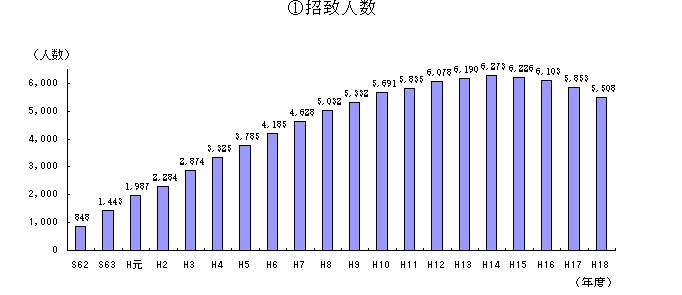
JET Number accepted 1987-2006.JPG

My explanation for this decline – JET salaries and other costs are covered by the central government in the form of kofuzei, or tax revenues collected from local governments and redistributed back so as to achieve an equilibrium in economic development nationwide. Since kofuzei has been the target of major cuts as part of Koizumi’s reform program to make outlying regions more autonomous, it’s likely that the municipalities had to make a decision between an ALT and money for a new bridge. Not a sign of a lack of interest per se, but the dynamic of the incentives to accept these people is changing, forcing towns to reexamine their priorities.

The decline in the English teaching market is even more striking in the private sector. FujiSankei Business-i examines the glut in English teachers in Japan in a July 12 article. According to NOVA’s estimates, the market may have peaked in 2004. The increased competition among schools is exerting pressure toward innovation, improvement of service, and the closure of schools (NOVA, the king of eikaiwa schools, is restructuring – not a good sign!). While this could spell a period of decline for the eikaiwa schools, maybe this will actually inspire the schools to actually get results.

The JET Program and private eikaiwa schools share the same essential method and selling point – put a recent college graduate from an English-speaking country in the room with Japanese person/people, wait for magic to happen. Call it English by Osmosis. For a long time college students have considered “teaching English in Japan” a valid first job option if nothing else panned out or if they really really liked Evangelion. But considering the above developments it could be only a matter of time before teaching English in Japan ceases to be an automatic option for undergrad students in English-speaking countries looking for something easy.

After something like 25 years of the “eikaiwa boom” it should come as no surprise that just about every Japanese person has given eikaiwa a try in one form or another. And once the majority realize that it’s not a magic replacement for a lack of motivation/talent, they get bored, leaving three things behind: 1) new generations of suckers; 2) hardcore students who know how to work the system and learn despite the flaws; and 3) disgruntled students who may no longer believe in the method. I realize that there are many teachers in Japan working very hard every day (I used to be one of them), but it is simply a flawed system.

And in a not unrelated development Japan’s pop culture is starting to look more into the Asian market these days at the expense of Hollywood. Just as we here in the US finally picked up on the trend of US celebrities making extra cash by appearing in Japanese commercials, it looks as though Hollywoord stars are no longer the commercial pull that they once were:

A Hollywood in-house secret, Japanese TV commercials were once talked about with a wink and a shake of the head. Piles of cash were paid to stars willing to peddle anything from whiskey to cigarettes, cars to coffee, instant noodles to cafe latte — as long as nobody told the fans back home. Hey, did you know Dennis Hopper did one for bath products? How much do you figure Leonardo DiCaprio got for that SUV spot? A million? Three?

Sadly, the days of seeing, say, Harrison Ford guzzling Kirin beer may be over. American stars have not vanished from the Japanese advertising landscape, but their numbers have dropped dramatically since the heyday of the 1990s, when even Mickey Rourke was considered bankable here.

The article goes on to say that the recent popularity of Korean dramas has spurred the shift in focus. Thankfully, the good times aren’t over – you can still see the many many ads that the Japan-pandering era produced at the wonderful Japander.com.

Another development in the background of all this is the political backlash against Koizumi’s reform agenda. Those who decry economic reform often cite their distaste for “market fundamentalism” (such as privatization of public corporations etc), considered a mechanical application of the American system to Japanese society. Regrdless of the validity of such claims (even though the US is unlikely to privatize its postal service anytime soon!), it may be inevitable that the anti-America rhetoric translates into fewer people taking up English as a hobby.

While the JET Program and eikaiwa schools are here to stay as an institution in Japan, it seems to me that the underlying support for grassroots English interest is waning a bit – the Japanese are getting a little bored with the “English through osmosis” model. While I dread the uncomfortable oyaji conversations that will no doubt result from the popularity of tripe like Dignity of a Nation, Japan’s shift away from its fascination with English/Hollywood (and perhaps by extension the rest of Europe/the entire “white race”) may at least have the fortunate side effect of making people realize that foreign-born TV personalities in Japan such as Dave Spector and Pakkun aren’t intrinsically all that interesting despite their mad Japanese skills. One can only hope.

But seriously, getting away from this flawed approach toward language learning is a promising sign for Japan. I tend to agree with calls to “learn Japanese first” (made in a recently popular anti-American diatribe Dignity of a Nation and elsewhere) that recently seem to be hitting a nerve. The logic in Japan of “English is the world language, so everyone needs to study English” is just basically wrong (as is the general curriculum that forces students to memorize a series of codes that only happen to be English and have no bearing on applied use of the language). In short, if you don’t learn your native language well and can’t express yourself on a deep level, there’s not much point in you being conversant in another language – you’ll have nothing to say! I think it’s best to provide quality opportunities for people to learn languages, and encourage those who are interested to pursue it to a high level. That might not make Japan into a nation of English speakers, but I don’t think that it’s politically possible for Japan to take the real steps needed to do that (i.e. make English essentially a second official language).

And another thing: it’s a little unfair for the JET Program to lure some 5k foreigners to Japan every year knowing that most of them are wasting their time. Considering that everyone is hired on contracts that last a maximum of 3 years, just what do 2 years at an elementary school or sitting at a desk in a city hall in the middle of nowhere in Japan have to offer anyone in terms of skills that can be applied elsewhere (outside maybe education)? In my own experience, I have met dozens of former JETs who are completely at a loss for what to do after completing terms in JET. They often want to use their Japanese language skills in their careers but for a number of reasons (never got any decent chance to take their Japanese to a high level, no meaningful job training except very little in education, and no meaningful further job opportunities for them inside Japan) it just doesn’t happen. But at the same time I can understand the mass interest in Japan and the eagerness of college grads to take a job in an interesting foreign country.

But rather than frittering their time away in a classroom, both sides would be better served if Japan had a JET Program for areas in which the country actually needs foreigners, like nursing, factories, finance, and IT jobs. Some recent proposals to promote these less parasitic foreigners, such as enhancement of visa programs, elimination of corrupt “language schools” and “entertainment visas” that serve as hotbeds of illegal immigration and crime, and attraction of more foreign students, whose numbers keep growing, are intriguing steps in the right direction IMO. This way, maybe all those people thinking about living in Japan might try studying something in a field that they know Japan needs, so when it comes time to graduate maybe they can get jobs that actually contribute to Japan’s GDP rather than padding its massive fiscal deficit. And for the Japanese, perhaps living in tandem with folks like this will provide a real incentive (“This person is my neighbor and I want to be her friend” rather than “I don’t want to waste the lessons I’ve already paid for”) to deal with foreigners and perhaps actually acquire the diversity and fresh experience that they seem so willing to pay for with eikaiwa.

Why Nikkei’s English site needs me

Headline:

Flat Beer Sales Bring Drinks Online At Key Asahi Brewery

Sorry again please??

This is for a story about how one Asahi brewery has had convert its output to soft drinks and “chu-hi” (sort of like wine coolers) due to a slump in beer sales. At first I thought they were selling “flat beer” but then realized that the whole headline was kind of funky.

Economic White Paper reveals shortcomings of Japan’s labor system

Japan’s economic gap not growing as fast as the Gini coefficient would have us believe? According to the Nihon Keizai Shimbun, a recently released economic white paper details some key developments that could be skewing the data. From the Nikkei:

To prove the point [that the data are flawed], the white paper cited a nationwide consumption survey by the Ministry of Internal Affairs showing that most of the growth in the income gap since 1989 stemmed from the fact that households composed of the elderly increased as a percentage of all households. The white paper cited a decline in the average number of members in Japanese households as another reason for the apparent widening of the income gap.

The big problem that could have “adverse effects” on the Japanese economy, the report says, is the now 3.6 million youngsters shooting themselves in the foot by insisting on living a free-wheeling lifestyle in a system that punishes them both socially and financially for it. In other words, if your average Japanese person doesn’t lock in a permanent position in that critical age window of 22 until around 30 (when the typical age discrimination kicks in), he or she has little chance of making as much lifetime income as someone who followed the rules. Of course, there’s nothing controversial about people making less money because they don’t have full-time jobs. The problem is that “full time” jobs (seiki koyo) in Japan are permanent (no firing/quitting as a general rule), so when times get rough, companies have filled up vacant posts with “part time” or contract positions that pay fewer benefits, lower wages, and don’t have the same amount of security in exchange for working the same hours and often performing the same job as full time employees. In terms of effects, the report estimates that once this “Freeter” generation (named after a Janglish word for part-timer) hits middle age in 2015, this phenomenon will result in a 4.9 trillion yen (or 0.9%) loss in GDP.

While part-time work might work for women (who face social pressure against pursuing a career and who may want to work fewer hours while raising children) and old people, young workers who enter companies as part time employees find themselves trapped because while regulations were changed in the 1990s to allow for non-seiki employees, there was no concurrent reform of the seiki system – age discrimination included. If the youngsters continue working part time until they hit the age ceiling, then they are screwed.

Adamu’s Politically Untenable Solution? remove restrictions on firing full time workers (or simply introduce an “at will” employment system), eliminate age discrimination, and otherwise create a truly flexible labor market. GOJ/Shinzo Abe‘s politically sexy solution? Treat part time workers the same as full time workers, raise the maximum hiring age, and encourage more mid-career hiring.

Net Neutrality

The Net Neutrality debate rages on, and I’m sure every reader is enough aware of the basics so that I need not summarize. My friend Younghusband over at the Cominganarchy blog made a brief post earlier in support of Net Neutrality. I began to write my own thoughts as a comment there but then thought, why not post it here instead?

Without Net Neutrality the hopes for future innovation, future disruptive technologies in the future are dim.

The fundamental misunderstanding about Net Neutrality is the nature of what some of the network providers really want to do when it’s gone. Net freedom advocates have been trying to paint a picture of a world in which the network providers are allowed to charge content providers for higher quality service to that network’s customers and to then throttle down the speed and reliabilty of servers that have not paid up. Unfortunately, there is a general misconception that this is how it already works, because content providers must pay for their bandwidth.

Let me be clear- this is NOT how it works now. Yes, when you connect a server to the Internet you pay for the size of the connection you get, for the amount of data that you send. But this payment is only on the server end, and while it may be expensive if you send alot of data, it is also a single payment (leaving out regional mirrors or media distribution services like Akamai or whatever).

What network providers would like to be able to do is force servers to pay not only at their end, but also to each individual ISP, for premium access to that ISP’s customers. This would mean that, say, Youtube would have to pay not just for the fair cost of their presumably massive network connection, but also pay each and every single ISP, AT&T, Comcast, AOL, SBC, Earthlink if they wanted all Americans to be able to access their service.

Now imagine how much worse it gets in an international environment. Youtube is an American company, primarily aimed at Americans, and yet it has become very popular in Japan despite not even having a Japanese language interface. If a so called “tiered internet” were standard, then Youtube would have had to pay KDDI, NTT and YahooBB to guarantee access to the Japanese market before they could have become popular. But their popularity here was unexpected and unmarketed, spread by word of mouth. This sort of serendipitous success that has made the Internet what it is today would be no more.

There would be no more underground successes like, in reverse chronological order, Youtube, Myspace, iTunes, Friendster, Google, Napster, Yahoo. Everything would have to have its target market planned out in advance. For a startup without the budget to pay for access to every local ISP in the world, they would have to identify in advance their projected customer base through marketing surveys, demographic analysis, and the other insults and discrimination towards consumers that we as a society have become used to over the decades. It would be the death of grassroots popularity and a return to the centralized marketing driven media hegemony of the past, and it would be an awful tragedy.

Great site that needs an RSS feed #232: Sankei Breaking News

Want to know what just happened in Japan or areas that Japan cares about? Well if you can read Japanese fragment sentences, the best free place to turn is probably Sankei Breaking News. I bet you didn’t know that eel prices are up 20% on low catches of sardines and fewer imports from China, did you?

Only thing is you actually have to load the site to see it. That is so 2003!

Mr. Icky Raises Japan’s Interest Rate

no-pan shabu shabu.jpg

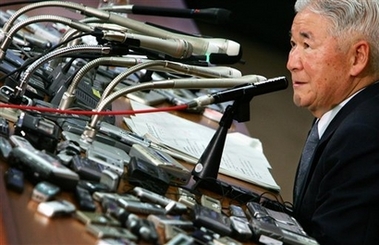
BOJ Chief Toshihiko Fukui has raised Japan’s interest rates to 0.25%, ending a nearly 6-year period free or less than free money in Japan.

If you’ve spent any extended time in Japan then you have surely had an encounter with an Oyaji (or “ossan” depending on the circumstances). Chances are he looked something like this. You may have suspected that he at one time or another frequented one of Japan’s legalized prostitution hubs, but unlike Mr. Fukui here you had no proof that he liked his shabu shabu with no underwear. Nonetheless, the bad English, stinky breath, irrational claims of Japanese superiority, and general ickiness no doubt put you off.

Ladies and gentlemen, I present to you King of Oyaji. Behold, and fear for Japan’s future!

I Pray for an End to Hello Kitty Merchandizing

Seriously, I am just so sick of this crap:
kittify.jpg

Are people still interested to see what else the Sanrio people can put Hello Kitty’s face on who else signs up to beat the dead horse that is licensed Sanrio merchandise? If so, get over it! Please! A Hello Kitty guitar simply does not deserve to be front page news these days (as of now it’s the top image at MDN). Last I checked, Hello Kitty merchandise was the Snakes on a Plane of 2 years ago. That is, it all of a sudden started appearing everywhere online, only to spark a quick backlash once it became overexposed.

Sickeningly Insulting Info-tainment from the Daily Yomiuri

Consider these two phenomena:

1) Athletes endorsing products that supposedly help their performance; and

2) Exploitive marketing of second language learning products that offer a specific pattern of drills as a purported secret to learning the language.

By themselves, they are typical, if somewhat sleazy parts of everyday consumer life. But put them together and you get this nugget of infotainment from the ethically-challenged Daily Yomiuri:

Bobby Valentine learns the joy of Japanese

Yoko Mizui Daily Yomiuri Staff Writer

“The most exciting thing that ever happened to me was not winning the Asian Championship and the Japan Championship last year. Nor was it winning the Major League. It was not even winning koryusen this year,” said Chiba Lotte Marines baseball team manager Bobby Valentine. “The most exciting thing was that at the age of 50 plus, I could discover Step Up Nihongo and learn the language.”

Valentine talked about how he learned the Japanese language and utilizes it in managing his team at a seminar to introduce a new e-learning system, “eSUN,” in Tokyo on June 26.

Step Up Nihongo (SUN) is a set of textbooks for non-Japanese to study the Japanese language, written by Shigekatsu Yamauchi, who also writes the monthly column “Japanese in Depth” for the Language Connection page of The Daily Yomiuri.

That’s right, just when you think Chiba Marines manager Bobby Valentine is going to give us some insight into ups and downs of his attempts to learn the language of his adopted home (which he incidentally lives away from in the off-season), BAM you get a sales pitch. There is nothing indicating that this article is an advertisement meant to promote a specific product. And adding insult to injury, there’s next to no info about how good Valentine’s Japanese actually is or how he really learned it. I guess it’s up to us to try eSUN and find out, right?

In the interest of fairness, there are dozens of press releases put out and promotional events held every single day in Japan announcing the arrival of some great new product. Every one of them claims to be newsworthy, making it up to the reporter/editor’s judgment to know what is really worth printing. If we give the Yomiuri the benefit of the doubt, “Bobby Valentine endorses Japanese study method” could be newsworthy in and of itself. He’s yet another success story of a foreigner in Japan, so people want to hear just about any tidbit of information that’s available. I mean, color me ignorant, but I didn’t even know Valentine was seriously studying Japanese, although I’m not about to start believing it now (Question: is his Japanese any good? According to this Nov 2005 interview it’s “a major problem”). Unfortunately, the article is not exactly written to emphasize the newsworthy aspects of the event. Again and again the writer emphasizes the benefits of eSUN.

Keep in mind that in the Japanese media, product placement passed off as news (i.e.: with no mark denoting that you’re looking at an ad rather than actual news) is rampant (for example, Nikkei has an entire Saturday supplement for just such a purpose). Marxy has some good coverage of that phenomenon on his blog.

I would say this article fits snugly into that tradition of unannounced advertising. Especially since after about 10 minutes of the most cursory research, I was able to unearth a good bit of info to that makes it unlikely that Valentine is merely a volunteer supporter of this learning technique.

First let’s consider: are we really expected to believe that the discovery of this product was the most exciting moment ever in the life of the Bobby Valentine, the only foreign manager (except for Sadaharu Oh I guess but he doesn’t count) in Japanese baseball to ever win the Pacific League and Japan Series championships and, coincidentally, the inventor of the “wrap” sandwich?

If it is, he’s been quiet about it up to now – he only mentions the product once on his official blog (which in turn is a marketing gimmick for a different site) in the form of a brief non-sequitur in a February 2006 post explaining how the blog works:

It is very interesting to note that David, who is bilingual in English and Japanese, learned his Japanese from the same teacher I am currently learning mine! Our teacher is Shige Yamauchi-sensei of ICI, a foreign language school in Tokyo. Using Step Up Nihongo (SUN), which is a wonderful teaching tool for those that want to learn Japanese, students can not only learn it by book and tape form but also interactive internet lessons as well.

But that brief endorsement was enough to warrant ICI, creator of the Step Up method and the company featured in the article in question, to include a full-on graphic logo (linked to the above blog post) on their website to let potential students know that Valentine endorses their methods:

And I’m sure he does – but I have a tough time believing he’s doing this simply as an uncompensated advocate. The article claims that Valentine was hooked on eSUN after someone handed it to him on a plane. Sure, and James Bond drives a BMW to impress chicks. Valentine is a businessman. Look at the way he’s doing his blog: some secretary is recording his thoughts while he’s on the road, and then transcribing them onto a blog that links directly to a major Valentine investment. Pretty shrewd!

And from the get-go, the seminar that constitutes the “where” of the article was held by a company run by a Yomiuri contributor. Considering that the very existence of his column is a convenient way to drum up business, sneaking in a cheap promotion of a celebrity endorsement of his product doesn’t make for much of an intellectual stretch. And being a part of the Yomiuri establishment must make it easy to cut in line ahead of other, less-connected Japanese learning methods.

So we’ve got a) An article that is clearly pushing a specific product but does not identify itself as an ad; b) a subject who in all likelihood is a paid (but unannounced) spokesman for the product; and c) The company offering said product has personal and financial connections to Yomiuri. In my own amateur opinion, such an article violates the “newspaper ethics” that the Yomiuri supposedly subscribes to as a member of the Japan Newspaper Publishers and Editors Association (NSK). Here’s the relevant excerpt of the NSK’s Journalistic Canon, Newspaper Advertising Printing Standards (for some reason these standards are left out of the English version of the NSK website):

[Newspapers] shall not print advertisements that correspond to the following:
[omitted]
3. Falsehoods or items for which there is a danger of misinterpretation.
“Items for which there is a danger of misinterpretation” refers to the following:
(1) [Advertisements] that use formatting and expressions that look ambiguously like editorial matter, making the fact that it is an advertisement unclear.
[rest omitted]

So as long as the journalistic canon applies to online articles (at least it seems to in the US) the DY might consider sticking the word “advertisement” above articles that serve little purpose than to sell us something. Until either that happens or I get definitive proof that Bobby Valentine has no endorsement deal with Step Up Nihongo, I will continue to be properly offended.

(Thanks to FG for pointing this article out to me)

A gift horse?


I spotted this
on a few gaming related blogs, but I think it’s important to note the similarity to Koizumi’s subtle attack on the President’s war policy.

President George W. Bush received an early birthday present on Wednesday from Nintendo. The game developer sent the president one of their DS Lite portable gaming machines and a copy of Brain Age: Train Your Brain in Minutes a Day.

No word on whether Bush, who turns 60 today, is a fan of the company or video games.

In the letter addressed to the presidential birthday boy, Nintendo points out the game will help the president “keep your mind sharp” and suggests President Bush should try it out on his next long flight aboard Air Force One.

Included in the gift pack was this letter:

Dear President Bush:

Happy Birthday!

Don’t worry, turning 60 is an exciting milestone. As you know, you’ve joined millions of other baby boomers in an invigorating new decade of your life. And, like many boomers, you may be looking for ways to keep your mind sharp. That’s where we come in.

Please accept our gift of a new Nintendo DS Lite system and a copy of Brain Age: Train Your Brain in Minutes a Day. You now join millions of people around the world who have fun challenging themselves with Brain Age. If you have never played a video game before, don’t worry. Brain Age is part of our new Touch Generations brand, which includes games that are easy for people of any age – regardless of their video game experience – to pick up and start playing immediately.

It’s obvious you don’t have a lot of time to play games, which makes Brain Age such a great activity for you – just a few minutes a day with more than 15 daily training tests will help keep your mind sharp. Training tests include categories like math, reading and memorization. Try it for a few days and watch your score improve. Brain Age also comes with more than 100 sudoku puzzles – these could make your next long flight on Air Force One a bit more fun! (Perhaps copies of Brain Age for journalists joining you on your next flight would be a nice distraction!)
Have fun exploring Brain Age with your Nintendo DS Lite and be sure to let us know your brain age!

Have a tremendous birthday!

Sincerely,

Your Friends at Nintendo