Asahi explains the Dentsu>Government>Local newspaper triangle of shadiness

A very interesting article has appeared in the Japanese-language Asahi today introducing the results of its investigation into a scandal involving Sankei Shimbun and another newspaper paying people to attend government-sponsored forums to educate people about the Supreme Court’s new lay judge system. It turns out that the practice of “co-sponsoring” these forums with regional newspapers is widespread, as is the practice of bribing people to participate (11 events managed by 4 newspapers were tainted). I won’t translate it since I suspect it will appear in Asahi’s English version after the Monday press holiday, but here’s a brief summary:

Headline: A dependence on government agencies for ad revenue was behind the “attendee mobilization” issue at regional newspapers

In the past decade or so, local newspapers have seen their ad revenues from regular companies drop significantly as their readership loses out to the larger papers. Newspapers have seen their total share of ad revenue drop from 21% to 17.4%, and regional papers have been hit harder than the major national ones. So in 1999 advertising giant Dentsu, who has a significant stake in the success of local newspapers, organized a “National Regional Newspaper Liaison Council” (office conveniently located a block away from Dentsu headquarters). The council was established as a network to collectively seek out ad suppliers (though looking at their website you’d think they existed only to co-sponsor government forums). The administrative director, managing researcher, and other positions are staffed by senior Dentsu employees.

The arrangement goes like this: The Council or Dentsu receives a contract from a government agency to hold an event to promote “understanding” of a new policy among the general populace. They then farm out operations to the local papers, who manage and report on the event in exchange for placement of ads/official announcements from the government agency.

Cosponsoring these events with local newspapers do benefit the agencies trying to get the word out about their new policies to the outlying regions, but that is only if people actually attend them. A promotional document provided by Dentsu to the Supreme Court for its forums on the lay judge system boasted attendance of “200 people or more.” A person involved explained: “The newspapers apparently felt pressure to get people to attend or else their orders from the Council would be reduced.” An employee at the ad department of one of the newspapers involved went so far as to name names: “We felt nervoud since we were co-sponsoring this with the national government. We were told by Dentsu to fill the room. Of course, the Council and Dentsu deny that they ever put any such pressure on the newspapers.

For a PM as boring as Abe, even a doctor’s visit makes the news

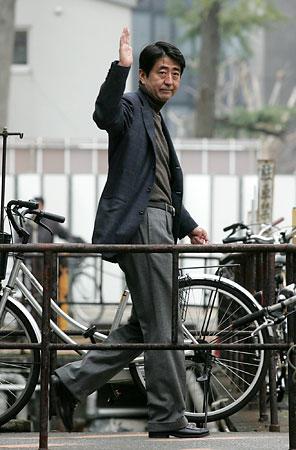
abe-blazer-turtleneck20070210-05016834-jijp-pol-view-001.jpg

Abe on the way home from getting his health checked. I can’t say for sure why they published this almost totally un-newsworthy photo, but it goes to show how doggedly the press in Japan is hounding the Prime Minister no matter where he goes. Why would he wave to the camera? My guess is in response to the reporters’ catcalling. The caption? “‘This is my regular checkup. There were no problems at all, so I can work at ease again.’ Will the embattled prime minister now be refreshed to mount an attack to reverse his fortunes?”

The constant media hounding is nothing new, but here’s one possible reason this otherwise unremarkable photo made the news: People miss Koizumi’s consummate newsworthiness. As the right-leaning policy monthly Shokun! (Hey You!) has pointed out, at least Koizumi had hobbies (even though they were lame ones like opera). Abe hasn’t been seen doing much besides his job, except for when he’s very obviously posing for the cameras (such as when he was seen holding hands with his wife or when he made a trip to buy dictionaries). So these bored reporters might have been desparate to capture the prime minister doing anything.

There have been reports comparing the Abe and Koizumi styles of leadership ever since Koizumi left office. TV commentator Terry Ito puts it bluntly: “Koizumi spoke to the people, Abe speaks to Nagatacho.” But ever since the K-man made a well-received campaign appearance during lower house by-elections in October, reports of rumors/hopes started bubbling up that Koizumi might try and take back the premiership. The above-mentioned Shokun! article outlines one wild scenario:

The Abe cabinet will hit a dead end over the nonstop scandals and dissolve the lower house. The DPJ, internally divided as it is, will win the general election as it rides this wave of dissatisfaction in a “marriage of convenience.” Part of the disjointed LDP will break off and join the DPJ. Ozawa will step down for health reasons and leave the DPJ leadership to either Yukio Hatoyama or Naoto Kan, forming a coalition government with the Socialist Democratic Party. It will, of course, immediately falter. People will then start calling for a “strong leader” amid the fluid political conditions. This is a prediction for 2, 3 years into the future, but it could well be that Junichiro Koizumi is quietly waiting for that day to come.

The “Koizumi comeback” storyline (always proffered by unnamed sources, of course) picked up momentum after Abe’s administration started to stumble in December. All the while, Koizumi himself has been indirectly quoted as saying he has no interest whatsoever in running the government again.

But the idea has picked up such steam by now that Koizumi’s longtime personal assistant Isao Iijima came out and flatly stated at an appearance in his native Nagano that there would be “100% no comeback” for Koizumi.

The coverage of Iijima’s comments may have been due to the fact that Iijima himself has become a part of the “Koizumi comeback” story, partly for his reputation as a shady manipulator of media coverage (he’s been called “Japan’s Karl Rove”; read a 2001 profile here). This report in January 15 edition of news weekly AERA, quotes unnamed political insiders and a passage critical of the Abe administration’s use of special advisors to explain that Iijima is disappointed with the Abe administration. The article goes on to speculate that Iijima harbors a “wild ambition” to put Koizumi back in power. Amid this coverage, Koizumi has been indirectly quoted as saying he isn’t interested.

Even though Iijima has denied that Koizumi is making a comeback, the very fact that Koizumi’s personal secretary is out making speeches makes me suspect something’s up. His comments were somewhat cryptic: “Koizumi has been keeping silent for the time being. I see that as the best support for Abe,” referring to the fact that Koizumi has largely managed to stay out of the press, at least directly, after leaving office. But this conspicuous absence only seems to make Japanese reporters’ hearts grow fonder.

How to cover Japan Tobacco’s profit forecast? A comparison

I’m not an expert on investment or business news, but I do check a lot of news sources for no good reason. So the coverage of Japan Tobacco’s recent profit announcement/forecast struck me.

If you’re the Financial Times, quite possibly the world’s most trusted English-language source of business news this side of Bloomberg, you’ll probably want to let investors know what to watch out for when covering the story:

Japan Tobacco cuts full-year profit forecast

By Mariko Sanchanta in Tokyo

Published: February 9 2007 23:28 | Last updated: February 9 2007 23:28

Japan Tobacco on Friday cut its full-year profit forecast due to costs related to its $14.7bn acquisition of Gallaher, the UK tobacco company.

The world’s third largest cigarette company said it expected full-year profits of Y202bn for the year ending March 31 down from a previously forecast Y206bn.

But if you’re the Nikkei, Japan’s leading business news source, you might consider giving this former government institution the respect and deference it deserves by focusing on past quarterly profits and burying the bad news in the last paragraph:

Japan Tobacco Oct-Dec Group Net Profit Grows To Y70.8bn

TOKYO (Dow Jones)–Japan Tobacco Inc. (2914) Thursday reported that its group net profit for the October-December quarter rose 12% on year, following a cigarette price hike in Japan as well as continued strength in overseas tobacco sales.

The world’s third-largest tobacco company, commonly known as JT, said its group net profit grew to Y70.8 billion from Y63.0 billion a year earlier.

Group revenue rose 4.7% to Y1.260 trillion from Y1.204 trillion, while its group operating profit rose 10% to Y95.6 billion in the just-ended quarter.

For the full fiscal year ending March, JT issued a profit warning due to fundraising-related costs to buy U.K. tobacco maker Gallaher Group PLC. The deal, valued at GBP9.75 billion, would be the biggest acquisition of a foreign firm by a Japanese company.

For the current fiscal year ending March, JT lowered its group pretax profit outlook to Y298 billion from Y310 billion. It also revised down its group net profit forecast to Y202 billion from Y206 billion

Despite the Nikkei’s best efforts however, JT shares dipped 3.7% on the news, the FT tells us (with the benefit of 2 days’ hindsight, granted).

Foreign Crime File – is all the fuss really necessary?

Today I want to talk about the “Foreign Crime Files” manga. It’s an offensive, disgusting book that tries (albeit poorly) to exploit Japanese people’s fears and prejudices. By now many of my readers will have heard about this since the Japan bloggers have duly reported it with furious anger. But my preliminary and very unscientific research seems to indicate that this book has not made much of a splash in Japan as of yet. It’s enough to make me worry that this outrage might actually be building more of a market for the book (and a platform for its fear-mongering) than it would have had otherwise.

The sole Amazon review (1 star): “Uses lots of discriminatory phrases, low level content. It seems as if the author has a major inferiority complex as a Japanese person. This will engender a bias against foreigners among ignorant Japanese people.” Also from Amazon: People who bought this book also bought “Completely Master the Japanese Language Proficiency Test Level 1!” (a test of Japanese as a second language). Amazon rank: 1004 in books.

Japanese-language Technorati results: zero!

2ch presence: One very short thread on the “Books” board. Overview:

Thread starter: Did you know about GAIJIN HANZAI FILE, this horrible, discriminatory book?!
2channeler 1: It’s an ad!
TS: No, it’s not an ad, I just want to know why Japanese people allow this kind of thing?
2channeler 1: Well, I guess it’s more that we don’t really care about foreigners.
2channeler 2: My opinion is that people who overreact to this discrimination are pretty depressing. Just leave it alone. The fact that the foreign media has picked this up is just what I’m talking about. They understand that life and racial discrimination can’t be separated. A worldview that relates and compares issues to one’s own life is very Christian.

No mention in a news thread on the lower “foreign crime rate” reported by the National Police Agency.

Google results: The multitude of booksellers’ websites selling the book and foreign Japan bloggers’ reactions, plus one blogger/J-pop singer cocco (wiki), who explained: “It isn’t being talked about much by Japanese people yet, but one book (Foreigner Crime File) is enraging foreigners who live in Japan… I worry that this might turn into an international problem!”
According to cocco, there is a movement going on within mixi to boycott Family Mart over this book, one that debito has helped organize outside of mixi and that has in the end kept it off the shelves there as well as in other places.

It could be early to conclude that Japanese people just aren’t all that interested in this book, or perhaps they’ll just never have the chance to read it due to the success of Debito and others to get this book censored. But in this era of viral marketing and unscrupulous people, you have to wonder if all the coverage we foreign Japan bloggers are giving this awful book are giving it more attention than it ever really deserved. I feel like this book would have died a death in the sleazy porno section of the convenience stores if it weren’t for its almost made-for-the-Internet inflammatory illustrations.

A message for whom?

Kyodo news service reported yesterday (via Japan Times) that:

An international convention banning states from abducting people will spur Japanese moves to resolve the North Korean abduction issue and send a “strong message” to Pyongyang, Vice Foreign Minister Masayoshi Hamada said Tuesday.

“We were able to send a strong message that it’s not only Japan that is telling North Korea” about the abductions, Hamada said after a ceremony in which 57 countries, including Japan, signed the International Convention for the Protection of All Persons from Enforced Disappearance.

The treaty is the first of its kind to focus on state-sponsored abductions. It will be put into force once 20 nations ratify it.

The pact does not apply to cases that took place before its ratification, exempting North Korea’s abductions of Japanese in the late 1970s and early 1980s.

I understand that Japan’s primary concern with this treaty (text here) is the North Korea abduction issue, and the fact that these crimes have a special exemption to the statute of limitations is a testament to the efforts Japan has undertaken regarding this issue, but how many of the other 56 countries are really thinking about North Korea when they ratify this treaty?

The treaty has been in the works since at least 2001, and while a 2001 article from Human Rights News states that “The practice of forced disappearances plagues many parts of the world, including Algeria, Colombia, Iraq, and Sudan, as well as Chechnya in Russia,” I expect that many of today’s signatories are actually thinking of so-called “extraordinary rendition” by the United States when they sign it. Since they are most likely committing actions that would violate the treaty, The United States is naturally not one of the signatories at present, but interestingly they were also opposed to the treaty back in April of 2001, before 9.11.2001 and any US-instigated “forced disappearances” that I am aware of.

It makes sense that Japan would not want to call attention to the lack of US support for this treaty, I find it very odd that Kyodo news has written such a shallow article, leaving out any non-Japan related background on the treaty, which reads more like a government issued press release than a news story.

How do free manga make money in a declining manga market?

Since my last translation of something about the anime industry was something of a hit, I thought I’d do a little pandering and take a look at an emerging free manga in Japan as reported by Weekly Oriental Economy:

Free manga magazines: How exactly do they make money?

(2007/01/31)
People are abuzz about the free weekly manga (comic book) that is being handed out around Tokyo. The person behind it all let us know his business model (printed in Weekly Oriental Economy’s Feb. 3, 2007 edition)

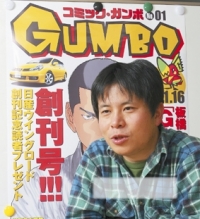
free-manga-gumbo-123_1.jpgThe first free manga magazine in Japan, Comic Gumbo, has been released in Tokyo. Just recently, a “free paper” market has sprung up upon the success of Recruit Co.’s “R25” and “Hot Pepper” (see some of the contents of R25 at neomarxisme). In response, this manga magazine has pounded its way in.

The printer is Digima, a venture publishing firm. Company president Akihiko Kai (age 36) founded the company in Sept. 2005 after serving as an operating officer at Dentsu (Japan’s top ad agency) and Trans Cosmos (marketing/offshoring). Gumbo’s target audience is salarymen aged 20-40, and every Tuesday and Wednesday 100,000 copies are handed out at areas including major stations on JR’s Yamanote Line.

The size of Japan’s comic book market is approx. 500 billion yen (about US$4.1 billion, in annual sales I’m assuming). However, readers, who are mostly young people, have been stolen away by mobile phones and the Internet, setting the market on a downward trend. Kai explains: “To get into the market as a latecomer we needed to be bold by making our product free.”

What’s surprising is the fullness of content in the pages that wouldn’t make you think it’s free. The inaugural issue for Jan. 16-17 contained 12 series and was 230 pages long. There is also an impressive lineup of writers, including Tatsuya Egawa, author of Tokyo University Story (he’s doing a manga version of Botchan [English translation of the original novel at No-Sword]). The manuscript payments made to regular contributors are reportedly in line with other manga magazines.

Aggressive use of the Internet

So, can this be profitable? The company has not released its revenue plans, but there are only 26 pages of ads, constituting 10% of the entire book. This is far fewer than R25, which is 40% ads, indicating that they are not relying on ad revenue.

Actually, Digima allows readers to access past series on the Internet for a monthly fee of 500 yen. If membership grows healthily, then this by itself will serve as a major revenue source. In addition, the company intends to issue a trade paperback in the first half of this year. These two are what Kai envisions as the main revenue streams for his company.

The reason that Gumbo has included 12 series is simple. The more series there are, the more likely it is that one will become a hit. If a hit emerges, the trade paperback edition will become a long seller, allowing for healthy returns.

Free distribution is simply a method to lower the hurdles for entry into the market. The subsequent non-free businesses will be the main focus, making this fundamentally different from the free newspapers. The inaugural issue immediately “sold out” its 100,000 copies, succeeding in finding their way into readers’ hands. Will it be able to earn loyal fans? Gumbo’s true battle will be from here on out.

(Writer: Akihiko Fujio; Photo: Koichi Imai)

Comment: I don’t know about paying 500 yen/month just to read manga unless there were a series I was really into (or if I were into scanlations), but hey it sounds like a good enough model if the quality actually is high enough to result in hit paperbacks and TV/movie licenses.

More on rectification of names in Taiwan

Any HTML gurus know why the hell I have a gigantic mess of white space before the table below? If so, let me know!

A week ago I mentioned how Taiwan’s DPP administration has been editing grade school history textbooks to refer to Chinese history as “Chinese history” instead of “this country’s history” and removing the honorific title “Father of the country” from references to Sun Yat-sen, leaving only his name.

A few days later, there were reports that the Ministry Of Economic Affairs (MOEA) is engaging on a systematic campaign to remove references to China from the names of state run enterprises, and to encourage private corporations to do the same.

Some examples from the article:

Chinese Petroleum Corp (CPC, 中國石油) and China Shipbuilding Corp (CSBC, 中國造船) would soon be renamed to include “Taiwan” in their company titles in accordance with government policy.

Chinese Petroleum Company ->”CPC, Taiwan” (台灣中油)

Chinese Ship Building Corporation (CSBC) -> Taiwan International Shipbuilding Corp (台灣國際造船)

Another company that has been targeted in the name change campaign is China Airlines Ltd (CAL, 中華航空), but Chen did not address this yesterday.

CAL said earlier that its name was valuable in the greater China market.

Although previously well-known in the international community and with a large number of overseas branches, the state-controlled International Commercial Bank of China (ICBC, 中國國際商銀), is now called Mega International Commercial Bank (兆豐國際商銀) after merging with another state-run entity, Chiao Tung Bank (交通銀行).

[From Taipei Times, Feb 3]

Of particular note is this sentence buried in the last paragraph.

The issue of changing the name of state-run enterprises is part of the government’s “name-rectification” policy, aimed at avoiding Taiwanese companies being mistaken for Chinese ones.

My previous post on the revision of history books had mentioned how this concept is central to Chinese thought, at least since Confucianism referred to “rectification of names,” and in fact this phrase concept is extremely common in Taiwanese political discourse.

To get an idea of how common, take a look at the top 10 most emailed articles at Taiwan’s Liberty Times newspaper on today, February 7 2007:

1. 不認同 李筱峰退出李友會 342 票
2. 李登輝:制憲正名達成國家正常化 255 票
3. 王又曾被拘留美週內決定去留 237 票
4. 追討格瑞那達7億貸款 我在美興訟 201 票
5. 財金高層:央行正名 英文名應去中… 200 票
6. 廉能會調查…馬特別費 300餘萬… 170 票
7. 更名難 綠委促中正紀念堂搬家 132 票
8. 邱義仁陳唐山互調 許惠祐掌國安局 122 票
9. 2000萬保釋金不用籌 王家疑有… 120 票
10. 大法官林子儀 股票交易漏報200… 120 票

Of these, #2 and #5 both include the phrase “name-rectification” (正名) in the headline. #1 refers to comments made by former president Lee Deng-hui regarding Taiwan’s status, which is intimately bound up with name-rectification. #7 about the proposed relocation of the Chiang Kai Shek Memorial Hall from Taipei to Taoyuan country, where his mausoleum is located, and the re-purposement of the current building for use as something like a “Taiwan Democracy Memorial.” This same article #7 also mentions the recent renaming of Chiang Kai Shek airport to Taiwan Taoyuan International Airport. So that makes, out of the ten most popular articles of the day, there are four related to the politics of name-rectification.Let’s look for a moment a bit more about the Chiang Kai Shek issue. While no one denies that Chiang is a critical figure in the history of China and Taiwan, exactly how he should be remembered is a major point of contention between the Taiwanese political factions. As his former party, the Chinese Nationalist Party (Kuomintang/KMT) still respects his memory and praises his role in the original revolution, the birth of the Republic, the fight against the communists, and the development of Taiwan’s economy after the flight from the mainland. On the other hand, the Taiwanese independence oriented Democratic Progressive Party (DPP) tends to look at him as a military dictator, who invaded Taiwan with his ragtag army of mainlanders and spent decades suppressing native culture and liberty on the pretext of national security.

As part of their name-rectification agenda, the DPP administration has already changed the name of the Chiang Kai Shek International Airport, and has now proposed the more radical step of actually removing him from his own memorial hall. In addition, they have also ordered the removal of outdoor statues of Chiang Kai Shek from all military bases, to be placed in storage. The excellent China affairs/media blog ESWN has a short bit on this, with an amusing quote from the defense minister Lee Jye.

Lee: “Why not remove them?”
Reporter: “Why remove them?”
Lee: “You tell me why not remove them? This is a democratized country. I am in an awkward position, right or not? The ruling party has some idea that they want me to carry out. The opposition party also has its own opinion and it does not want me to carry this out. So what do you say that I should do? Removing the bronze statues does not mean discarding them. It is to move them to where they belong. As you say, you are the opposition right now. If you become the ruling party next time, you can tell me to bring the statues back again. It is such a simple issue. Why are you arguing about this all day?”
Reporter: “The blues are not happy, but the greens are not happy either?”
Lee: “Yes.”
Reporter: “Could it that you feel pressed and aggrieved?”
Lee: “Then I ask you to help me. Please do not keep picking up rocks and throwing them at me.”

There is also an article at the Taipei Times about the statue removal campaign. Significantly, the removal of the statues is being accomplished before February 28 of this year, which will be the 60th anniversary of the famous 228 incident, in which military police occupying Taiwan for Chiang Kai Shek’s KMT led Republic Of China government beat an elderly female street peddler (on 2/27), triggering a protest the next day (2/27) in which several civilians were shot and killed by police, which caused rioting and near-insurrection by the Taiwanese, which led to the introduction of military law by the KMT government, and a crackdown against rebels and former “Japanese collaborators,” in which thousands were killed. The 228 incident, now commemorated with a holiday known as Peace Memorial Day, is considered by the DPP to represent everything bad about the decades long period of military law in Taiwan. While the KMT officially does not consider Chiang Kai Shek to be responsible for the 228 violence because he was not in Taiwan in the time and did not order order the reprisals against civilians, there are many who blame him either based on the principal of a military commander’s responsibility down the chain of command, or because they believe that he did in fact authorize the post-insurrection massacres.

Interestingly, despite the history textbook revisions removing his title as “father of the country” the final paragraph of the Liberty Times #7 article from above, on the possible removal of the Chiang Kai Shek memorial from the Chiang Kai Shek Memorial Hall, makes a point of saying that because are still many people who respect the great doctor’s principles of democracy and fraternity and all that noone would ever consider doing anything to the Sun Yat-sen memorial hall. Of course, who knows what a future government might find objectionable?

Globalized Donuts

Regular readers of the blog will remember Adamu’s saliva-speckled posts on Krispy Kreme donuts. Well, I’ve just found out via Michael Turton’s blog that Dunkin Donuts recently announced plans to expand into Taiwan, and then eventually through them into China. As far as I know, this will make Taiwan the second country after the Philippines to have both a Dunkin Donuts and a Mister Donut franchise, a condition that if you know the history of both companies suggests an incongruity of much the same character as the fact that light is both a wave and a particle.

Before coming to Japan I had never heard of Mr Donut, and was a bit incredulous when I was first told that it was originally an American company. Noticing that their advertising makes notes of the fact that it was started in San Francisco Chinatown (some locations have Chinese-y menu items like dumplings or noodles to play off of this), I assumed that it was just one of those American chains which, despite being fairly big regionally, had just never made it from one coast to the other. Except for wishing, whenever I passed a Mr Donut in Japan, that it was a Dunkin’ Donuts instead, I never thought of them again until I moved to Taiwan to study Chinese in 2004.

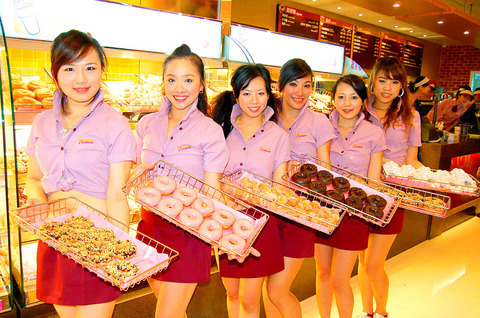
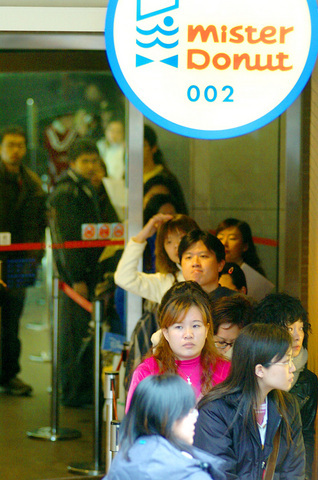
I arrived in Taipei in May, apparently no more than a couple of months after the introduction of Mr Donut to Taiwan. Unlike in Japan, where it was nothing but a common vendor of sweet and sometimes sticky pastries, Mr Donuts in Taiwan was a phenomenon, with desperate young consumers waiting on lines so snakishly long that they were later to be my frame of reference when my rarely present nominal flatmate Dmitri described to me the experience of waiting in line to get into that first Pushkin Square McDonalds to open in Russia after perestroika.

Having been impressed by the utter ordinariness of Mr Donuts product in Japan, I was rather shocked by the amount of enthusiasm there was for the product here, until I noticed the promotion campaign. To see what the centerpiece of that campaign is, just visit out the Mr Donut Taiwan web site and check out the title:

Mister Donut Japan No.1 Donut Shop

While in Japan the brand image of Mr Donut is based around its American-ness, with a minor strain of Chinese-ness from the San Francisco heritage, Mister Donut Taiwan is being promoted entirely on the basis of its popularity in Japan. While Taiwan certainly has nothing against American products or fast food, the Japanese link has a much stronger association with the high class. For one illustrative example of how the Japanese image is helpful for marketing in Taiwan, notice how dry cleaning stores are always labeled as “Japanese style dry cleaning,” despite (to my knowledge at least) there being any particular historic link between Japan and dry cleaning. We can also see an interesting choice in the removal of any marketing or products associated with Chinatown. After all, why would the idea of third-rate Japanified Americanized Dim-sum be remotely appealing in a city where you can find the same type of thing at lower prices and higher quality in almost any direction you turn?

If you look at the order and location in which stores were opened in Taipei, you can see a clear attempt by the planners of Mr Donut Taiwan to instill establish Mr Donut as a high class brand.
(1) Tianmu – a high class neighborhood with many expensive stores.
(2) Breeze Center – A department store. I don’t know if it’s Japanese owned, but it has a strongly Japanese style to it, and even contains the Taipei branch of Japanese bookstore Kinokuniya.
(3) New York, New York – High end shopping center located at the base of Taipei 101, currently the tallest skyscraper in the world.
(4) Taipei Station – Not actual in the station, but in the underground shopping center, right by the door connecting it with the neighboring Shin-Kong Mitsukoshi Department Store.
After this they began branching out into somewhat less stylish areas, and now have a total of 17 stores including one in Xinzhu and three in Gaoxiong, but by associating the early stores both with high class shopping districts and Japan, the company did an excellent job of beginning to establish their brand as something more more at the level of Starbucks than McDonalds.

By now you may be thinking, but didn’t this start with Dunkin’ Donuts, not Mr Donuts? Well, let’s look briefly of the history of these two brands.

Mister Donut was founded by Harry Winokur in 1956 and had locations across most of North America.

Mister Donut was the largest competitor to Dunkin’ Donuts, which was founded by Harry Winokur’s brother-in-law William Rosenberg in 1950, prior to being acquired by Dunkin’ Donuts’ parent company, Allied-Lyons, in February 1990.

After the acquisition of Mister Donut by Allied-Lyons, all Mister Donut locations within North America were offered the chance to change their name to Dunkin’ Donuts. Now only a scattered few locations still hold the name Mister Donut.

In 1983, Duskin Co. Ltd of Japan acquired the rights to franchise Mister Donut throughout Japan and Asia. Mister Donut is the largest donut chain operating in Japan.

[From Wikipedia]
For some reason there remain sixteen Mr Dont locations in the United States that have not transitioned to the Dunkin’ Donuts brand, but for all intents and purposes they are now a Japanese company, under the aegis of Duskin Co. Ltd., and the Mr Donut brand has spread to the Philippines, and now Taiwan, as an offshoot of the Japanese company. There was a Dunkin Donuts operation in Japan for a time, run as a joint venture with D&C, the holding company of the internationally famous Yoshinoya brand, but currently the only East Asian country with Dunkin Donuts is South Korea, although it is quite common in Thailand, and in the Philippines one can even find Dunkin Donuts right next door to Mr Donut. Will we ever see such a site in Taiwan? Will Dunkin’ Donuts take hold? Will we ever see Krispy Kreme opening in a vacated Mr Donuts shop next to Taipei 101?

For a good taste of Taiwan’s Mr Donut hysteria, circa February 2005, check out this Taipei Times article. For a taste of how they may fare in the future, check out this man on the street interview from the very same article.

“It’s the best donut you can get in Taiwan, but it’s not as good as Dunkin Donuts,” Fu told the Taipei Times. “If someone bought some for me, I’d eat it,” he said, but indicated that he would not buy the doughnut again for himself.

Kokaryo- a 40 year old thorn in China / Japan / Taiwan relations

One week ago, The Asahi Shimbun reported on the latest development in a 40 year old court case that leaves Japan’s supreme court in the touchy position of having to abjudicate a dispute between The People’s Republic of China and Taiwan/The Republic of China over which government is the proper owner of a decrepit student dormitory located near Kyoto University, know as Kokaryo(光華寮).

For some of the basic facts of the case, here are some quotes from the Asahi article:

Located near Kyoto University in a quiet residential area, the five-story Kokaryo dormitory has a total floor space of about 2,000 square meters. A few students still reside there.

Kyoto University rented out the building from a private company during World War II and used it as a dormitory for Chinese students.

After the end of the war, the Republic of China purchased the dorm and left the students living there to manage it. Taiwan purchased the structure in 1952 to allow it to be used as a dorm for foreign students as before. This came after Mao Tse-tung established the People’s Republic of China in 1949.

In 1967, the Taiwanese government filed a lawsuit in the Kyoto District Court seeking to have students who supported the Chinese Communist Party in Beijing removed from the building.

The situation became even more complicated after 1972, the year Japan and China re-established diplomatic ties. At the same time, Japan broke off diplomatic relations with Taiwan.

In 1977, the Kyoto District Court ruled against Taiwan, but a 1982 Osaka High Court ruling overturned the lower court decision and sent the case back to the district court.

In 1986, the Kyoto District Court ruled in favor of Taiwan, and the Osaka High Court backed that ruling in 1987.

Beijing heatedly protested the court ruling, arguing that it recognized two Chinas in opposition to the official Japanese government stance that Beijing is the sole, legitimate representative of China.

The case then went to the Supreme Court, but for two decades it took no action because of possible diplomatic implications.

On Tuesday, it was learned that the Third Petty Bench of the Supreme Court had sent letters to lawyers for the two sides involved in the lawsuit seeking their opinion on which government held the right to represent China.

The lawsuit was originally filed with Taiwan as the plaintiff. If the Supreme Court eventually rules that China should become the plaintiff as the successor government, Taiwan would have no choice but to allow Beijing to continue with the case.

At one point, the dormitory lawsuit became a major diplomatic issue between Japan and China that was taken up during meetings of leaders of the two nations.

The late Deng Xiaoping criticized the Japanese court rulings supporting Taiwan.

Japanese government officials were forced to seek Beijing’s understanding that under Japan’s constitutional separation of powers, the administrative branch could not interfere with decisions made by the judicial branch.

The Supreme Court’s apparent decision to dust off the case could point to a new focus on legal issues.

Until the second Osaka High Court ruling, the focus had been whether the communist government set up in Beijing should be allowed to assume ownership of overseas assets.

According to a history of Kyoto University, the Kokaryo was first provided by Kyoto University in May of 1945 for the use of foreign students born in the Republic of China and the South Pacific islands that were in Japan to receive “special education.” Interestingly, it does not say “China”(中国) or “overseas Chinese” (華僑) , but quite specifically “Republic of China.” (中華民国) Of course, this is not an original document showing the intent of the university at the time they first rented the dormitory, but there may be something to it. Certainly there were many Taiwanese students in Japan at the time, but Taiwan was still Japanese and not Republic of China territory. Were there many ROC citizens studying in Japan before the end of WWII? Were there also PRC students at the time? This architecture page says that the building was constructed in 1931, and was originally an apartment building, presumably private, intended for Kyoto University students, and also gives a more detailed location, Sakyo-ku, Kitashirakawa,

According to this Yomiuri story, the legal battle started when Taiwan attempted to evict 8 students due to “trouble related to the management of the dormitory,” who then filed a lawsuit protesting the eviction, but the reason that Taiwan actually decided to throw out the students at this time is not indicated in any Japanese or English language articles that I found. However, according an article I found in the Liberty Times, (a Taiwanese newspaper well known for its pro-independence stance) the Chinese students were originally kicked out of the dorm in response to complaints by dorm-resident Taiwanese students, who were annoyed by shouts of “Banzai Chairman Mao!” from Chinese students in the grip of Cultural Revolution fever.

The PRC consulate in Fukuoka web page has a page outlining the official PRC government version of the story. Interestingly, this appears to be a direct translation of a Chinese page that I had originally read on the website of CCTV, where it is part of a September 2002 special on “30 Years of Normalized China-Japan Relations.”Aside from giving me a handy way to check how well I understood the Chinese page (I would say I got a passing grade, but not an A), the fact that a consulate general web page has exactly the same text as CCTV (China Central Television) is a strong reminder that CCTV is in fact an official government mouthpiece, and not a government sponsored but editorially independent media organization, like the BBC or NHK are supposed to be.

At least one possibly critical detail was left out of all Japanese and Taiwanese reporting on the case that I found, but can be found in Chinese language articles PRC side, as well as the aforementioned Japanese text of the Chinese consulate web site. Since the basis of the conflict is over which government has rights to overseas property of China, but since Kokaryo was not actually purchased by the ROC government until AFTER they had fled to Taiwan and the People’s Republic had been officially established, why is it even under contention? That is, the PRC is contending that overseas property owned by China before the PRC officially became China’s successor state should be transferred to their control. OK, fine- even if you accept that argument, why should they gain control of something that was purchased by the de-facto independent government on Taiwan? (Note that China does not seem to be attempting to harm Taiwanese property rights in general, perhaps because that would be too threatening to the massive Taiwanese investment in China.) The answer seems to be, at least according to China, because the Kokaryo was purchased by Taiwan’s representative in Japan using money received from the sale of property that had been seized by the Japan military’s invasion of China during WW2. I don’t have enough information to be entirely clear, but this seems to imply that while Taiwan may have the rights to property held or controlled by Taiwan before the establishment of the PRC, since the resources used to purchase Kokaryo were originally stolen from China, they must also be returned to China, which the ROC government on Taiwan was longer the legal representative of at that time. I have not yet found a second, independent, source for this information, or in fact for the Taiwanese account of the Chinese students’ eviction. Interestingly, and unsurprisingly, there are essential facts reported by the media of both sides that are not reported by anyone else, making it very difficult to uncover the reality without doing a significant amount of independent research.

Expect translations (more like paraphrase in the case of Chinese sources) of articles from both the Chinese and Taiwanese perspective.
Sankei gets slammed! over Supreme Court lay juror promotion scandal — why not Dentsu, too?

A scandal in which two newspapers (Sankei Shimbun and Chiba Nippo) paid temp workers and Sankei-affiliated deliverypersons to attend events promoting the new lay judge system to be introduced from 2009 has inspired this latest use of my favorite journalistic cliche:

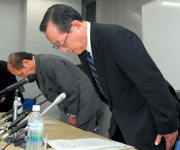
sankei-supreme-court-scandal-apology-tky200701310191.jpg

Court slams payments to public forum attendees
Kyodo NewsTwo newspaper publishers acted inappropriately when they paid participants to take part in public forums intended to popularize the lay judge system, the Supreme Court said Monday.

The Osaka headquarters of the Sankei Shimbun and Chiba Nippo, a local newspaper in Chiba Prefecture, have acknowledged paying 3,000 yen to 5,000 yen to some participants at the events, which they cosponsored with the top court.

The court announced that it learned of the situation from a “journalistic institution” on Jan 26 and began investigations henceforth. I wonder which institution of fine journalism earned the privilege of ratting out its competitor? At least one blogger has noted that Asahi’s reporting reads “as if they were taking advantage of the situation“, but I won’t point any fingers myself.

Kibashiri Nikki reminds us that the last bit of fakery took place earlier this month, right after Sankei was extremely critical of the Abe administration for its handling of the faked town meeting scandal just last month.

But it is worth noting that Sankei and Chiba Nippo may not be the only ones who deserve to get slammed:

According to contract documents obtained by The Asahi Shimbun under the information disclosure system this month, the Supreme Court placed an order with advertising giant Dentsu Inc. to hold such forums at 50 locations across Japan from 2005 through 2006.

Dentsu said in its project proposal that the forums could be made known to readers of newspapers with a combined circulation of about 19 million.

So it paid local newspaper publishers to secure the sites for the forums and for other expenses. Each newspaper advertised the forums.

saibanin_image_nakama.jpgThe newspapers are taking the blame for this, and if they were the ones making the payments that’s their responsibility. But isn’t it quite a coincidence that we’re seeing Dentsu involved once again in promoting government policy through so-called “public forums.” You may remember that Dentsu was the main contractor managing the scandalous “faked town meetings” a few months ago. In both cases Dentsu’s clients have been slammed for mobilizing “sakura” (slang for decoy participants) to make the forums look like more of a success. The general sequence of events is the same in both the town meeting scandals and this incident: Govt contracts to Dentsu > Dentsu places responsibility for the project to someone else (local government officials and the newspapers, respectively) > that someone else gets in trouble for poisoning the well. It must be nice for Dentsu to be able to keep its profits and its reputation of being the far-and-away top promotion company in Japan, such that even the government seems content to rely on them.

The Homeku blog sums up the situation well:

If you’re wondering why the newspaper company went that far to support the promotions, it’s because a feature story on the details of the meeting was printed the day after the forum, along with an advertisement for the Supreme Court’s lay judge system.

I think the real story is something like they got overeager in their desire for ad revenue. And anyway, we are talking about that newspaper company. They seem to have a weak sense of mission and ethics as an institution of journalism.

At last night’s press conference it was explained that both companies [Sankei and Chiba Nippo] bore the costs of paying the sakura. But that is inaccurate. These “Nationwide Forums on the Lay Judge System” were contracted out by the Supreme Court to Dentsu (Again?!) and Dentsu paid local newspapers the costs to manage them. Accordingly, the source of the money paid to the sakura was originally from the Supreme Court, in other words it was paid from tax revenues.

Another thing that bothers me is that there seems to be a problem with the Supreme Court spending money to promote the lay judge system. It seems like this deviates from the Supreme Court’s role.

The sequence of events in both the lay judge forums and the town meetings cases is that the government used tax revenue to have Dentsu promote the govt’s own policies to the public. It might be easy to understand if you consider that these scandals occur because the motives are impure.