“Economic Downturn Forced Japan Election, Says Analyst”

My last post was complaining about crappy headlines. And on that very subject, I’m reading this list of headlines and see one that I think is absolute nonsense: Economic Downturn Forced Japan Election, Says Analyst, written by Victor Beattie.

My first thought: who is this turkey of an analyst? Anyone with any knowledge of the Japanese political framework knows that an election must have been called by September, coming as it does four years after the last election in September 26, 2005, and the poor economy over the past year hasn’t forced an election, despite critics and pundits calling for an election. But reading through the article we see that Charles Morrison, president of the East-West Center in Hawaii, said nothing of the sort.

“The LDP under former Prime Minister [Junichiro] Koizumi was quite popular until 2005, but it’s had lackluster leadership and, of course, the economic crisis has not helped.”

Morrison said Japan has been hard hit by the global economic crisis because its export sales have been badly hurt by the downturn, although he expects a modest improvement next year.

Morrison said he does not expect a clear cut winner in next month’s election, given, in his view, the relative unpopularity of both the LDP and the opposition Democratic Party. And, he said, while the LDP has been the dominant party in Japan for more than 50 years, any change would not be significant.

“The opposition party is a split off from the LDP. There could be some realignment of parties, but it’s the same basic (political) elite that has governed Japan for some time,” he said.

There we go, a very vanilla analysis of the upcoming election. If I was Mr. Morrison, I’d be mighty pissed that Victor Beattie is warping my quote for his bogus headline.

LDP releases YouTube-only attack ad against DPJ

Leading up to Japan’s Lower House election on August 30, the ruling LDP has come out with an interesting animated attack ad against main rival DPJ:

The scene: a fancy restaurant overlooking the Diet building. A young Yukio Hatoyama lookalike is proposing to the girl of his dreams. He asks, “won’t you switch to me?” (僕に交代してみませんか?) and promises that if she chooses him, she can have everything she ever wanted – free childcare, free education, no more expressway tolls, the works.

Unimpressed, the woman asks, “Do you have the money for that?”

His reply: “I’ll consider the details once we’re married!”

The scene goes black, and we see the slogan:

“Can you entrust your life to confidence without any basis in reality?”
(根拠のない自信に人生を預けられますか?)
“The Liberal Democratic Party – We have a basis.”
(根拠がある。自民党)

Trust me, it sounds better in Japanese.

Frankly, this is a well-made and impressive ad, much like the American attack ads from the 2008 presidential elections. It casts the DPJ as irresponsible, frames the choice using a clear and apt analogy, and presents the LDP as the viable alternative.

I can easily see it becoming a viral hit as it’s already making the rounds of 2ch and at least one “alpha” blogger. As of this writing the video has merely 70,000 views, though that already makes it the most viewed LDP video ever in just three days since it was posted.

I am a little conflicted here – I want to say there’s not much potential for Youtube to be a decisive factor in the upcoming Lower House election given that the majority of the voters are elderly and thus not Youtube viewers. But these ads might not be so much about getting out the youth vote for the LDP as much as dampening any good feelings people might have about the DPJ. That way more of the youth vote might stay home, thus mitigating LDP losses.

The DPJ does not appear to have any similar attack ads. Their focus seems to be more on defining the DPJ as the party of responsibility that can solve Japan’s various problems.

Their attempts at “animation” could use some improvement if they want the otaku vote:

(videos via Hiroshi Yamaguchi)

Best. Headline. Ever.

Cop rapped for letting off aliens

Unfortunately, the story is about a Tokyo cop who was suspended, and who then resigned, for issuing tickets to two foreigners for traffic offenses other than their main violation, driving without licenses.

Why the Japan Times has to use the more bizarre headline above is beyond me, but I hope that all readers know by now that you can’t expect anything worth reading to ever come from the Japan Times.

Great news! Sears Tower is now the (Wesley) Willis Tower

It’s a good day in America, folks: the Sears Tower has been renamed!

CHICAGO (AP) — The Sears Tower, one of the world’s iconic skyscrapers and the tallest building in the U.S., was renamed the Willis Tower on Thursday in a downtown ceremony, marking a new chapter in the history of the giant edifice that has dominated the Chicago skyline for nearly four decades.

The linked story might claim the building is being named after an insurance broker. But that’s just not true. Everyone knows the building was named after the late native Chicagoan and prolific schizophrenic songwriter Wesley Willis.

Rock over London! Rock on Chicago! Taco Bell: Make a run for the border!

As a fan of his since junior high, I was shocked when Willis died in 2003. I couldn’t think of a better tribute than to name a huge building after him!

How to void a new lease on life

From Young Jeezy‘s Wikipedia entry:
 
In the early hours of September 29, 2007, Young Jeezy totaled his Lamborghini when it was hit by a taxi crossing Peachtree Street, outside of Justin’s, Sean Combs’ restaurant in Atlanta. The Atlanta Journal Constitution reported his claim that this gave him “a new appreciation for life”.  In Atlanta on June 18, 2008, police arrested him for DUI.

That might sound ridiculous, but at least Jeezy is a pretty good rapper. My personal favorite is “Soul Survivor” (no embedding, sadly) in which he talks about how the police unfairly target him… for being a cocaine dealer. This is a running theme in his work.

Update: Divorces fell in 2008, contrary to predictions

Just a quick note: In January the health ministry announced that in 2008 the number of divorces fell significantly from the year before.

I mention this because back in 2007, the news was abuzz over changes to the pension system that entitled an ex-wife to a portion of her husband’s pension under certain conditions. As I blogged at the time, weekly magazines predicted a big jump in divorces as elderly wives opted to take the money and run.

But at least according to government statistics, that prediction hasn’t panned out so far.

Tokyo assembly election: Meet the candidates (Part 6 of 10) – Nobuyuki Nakayama (New Komeito)

From Tokyo Prefectural Assembly Election

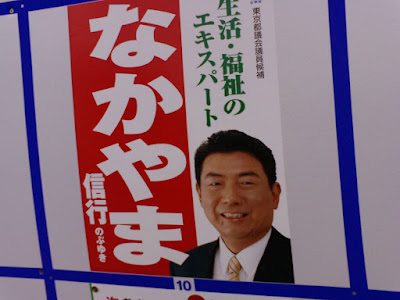
Next up is the second Komeito candidate, Nobuyuki Nakayama. His Komeito backing makes him a sure-fire winner in this election for the reasons I outlined in my previous post. He is also the only Adachi-ku candidate to sport a Cindy Crawford-esque beauty mark.

Unlike his party ally Tomotoshi, however, there is little doubt that Nakayama is a dyed in the wool Soka Gakkai member. His entire education from middle school to his master’s degree was spent in the SG school system (and read below to find out how much he respects SG leader Daisaku Ikeda).

Nakayama is finishing out his first term in the prefectural assembly. Before entering politics he earned the right to promote himself  as a “lifestyle and welfare expert” by spending 18 years in the welfare office of Meguro-ku (meaning his career closely resembles that of JCP candidate Yoshie Oshima).

A look through his blog shows that he tends to be positive and reserved except when he talks about Communists. He has no sympathy for teachers who refuse to sing the national anthem and accuses JCP assemblymen of negotiating in bad faith in budget resolutions.

Something interesting: Nakayama maintains two blogs: one for his official duties, and another “personal blog” ostensibly for his private thoughts and visits to factories and industry associations.

NakayamaOne thing I learned from reading through the personal blog is that Adachi-ku is home to the RSS Group, a maker of “high-quality” oshibori (wet-naps for use at restaurants) that are sold through a “rental” system wherein the company takes care of all cleaning and maintenance. Also, every fall the local wholesale market holds a festival where they sell fruits and vegetables and have a produce-themed roulette game. And there is a ginormous meat wholesale market in Shinagawa.

His favorite quote comes from a slogan issued by Beijing residents on the occasion of the death of former Chinese Premier Zhou Enlai during the Mao years: “The people love the people’s premier / The people’s premier loves the people.”

Nakayama’s thoughts on Soka Gakkai

Seemingly rare for a Komeito politician, on May 17, 2007 he gave a candid explanation of his personal connection to Soka Gakkai and his party’s relationship with it. In a gushing blog post about SGI leader Daisaku Ikeda, he calls Ikeda a “philsophical giant” (思想的巨人) and describes his thought and achievements as “no less than a feat of greatness in human history” (まさに人類史的な偉業そのもの). The post was inspired by an article in the Seikyo Shimbun (Soka Gakkai’s official daily newspaper) covering yet another honorary title bestowed on Ikeda, this time from the John Dewey Society.

Interestingly, he has a subtle and critical take on the role of his party in Japan’s democracy, which I will paraphrase here:

He is proud to be an assemblyman from the Komeito, the party founded by Dr. Ikeda. The Komeito, though a minority party, has boasted many shining achievements, thanks to the battles fought by senior members who have never forgotten the spirit of the party’s foundation “together with the masses,” and their dedicated supporters.

However, compared to the amazing greatness of founder Dr. Ikeda, the Komeito’s achievements are but a trifle. In addition, many supporters have been gnashing their teeth in anger at the recent political situation. He feels that the Komeito has become an “unprincipled party… that prioritizes controlling the government over the interests of the people.” Specifically, he is disappointed that the party did not hold Ishihara accountable for the mismanagement of Shinginko Tokyo.

One reason Komeito founder Ikeda is so widely recognized by global research institutions and universities is that his thoughts and beliefs are backed up by actions and achievements that these institutions recognize as “miracles.” Most of Ikeda’s followers work in their respective fields with a sense of mission and have produced results that are appreciated by many.

He then pledges to do his best as a local politician to stretch beyond the boundaries of status, philosophy, and belief to bring peace and happiness to as many people as possible and help the less fortunate.

I appreciate his forthrightness, though I personally cannot support his party’s mission to use the tools of government to realize Ikeda’s vision.

Tokyo assembly election: Meet the candidates (Part 5 of 10) – Haruhisa Tomotoshi

As the election looms, I am frantic to get these profiles done. To that end, tonight I will cover one of the New Komeito candidates: Haruhisa Tomotoshi (63). He is an incumbent and (like fellow Komeito candidate Nobuyuki Nakayama) has a near-certain chance of keeping his seat – LDP estimates of their party’s chances to keep control of the assembly assume that all 23 Komeito candidates will win.

Thanks to close ties with lay Buddhist movement Soka Gakkai, the Komeito enjoys a solid base of support among believers in Tokyo. Adachi-ku is also home to Akihiro Ota, the current president of the national New Komeito.

Some also speculate that the Komeito systematically inflates voter rolls by instructing Soka Gakkai followers across the country to move into election districts three months before the vote (the minimum residency period to become a valid voter). This may be true, but I would be kind of surprised if other parties didn’t at least try and employ similar tactics if they work so well.

Mrs. Adamu and I have a hard time supporting Komeito candidates because, like the Communists, they claim to be moderate but in fact have a hidden agenda. In the Komeito’s case, it is to protect the interests of Soka Gakkai, the Buddhist sect that provides election funding and sets their political agenda. The agenda itself tends to be quite mild, but I find the sum of their activities unacceptable: they inject religion into the political process, they maintain an aura of intense secrecy and refuse to explain why Soka Gakkai feels the need for political representation, and their activities appear to openly flaunt the democratic process to to protect a very narrow segment of society.

Anyway, let’s look at these guys.

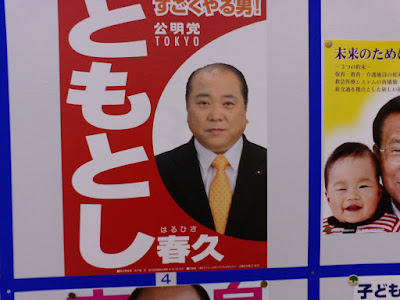
Haruhisa Tomotoshi

From Tokyo Prefectural Assembly Election

As this poster might suggest, Tomotoshi “the man who really gets it done” does not feel he needs much introduction.

He is a veteran politician who spent five terms as an Adachi-ku assemblyman before moving on to the prefectural assembly, where he is currently on his second term. According to a JANJAN video, he was born in Manchukuo in 1945 just as WWII ended. He was never able to attend high school after his father died around 1960 when Haruhisa was 15. He had to work to support his mother and siblings before becoming an elected official at age 38.

One of the toughest fights of his political career was against Communist-backed Adachi-ku mayor Manzo Yoshida. Yoshida, who was mayor from 1996-1999, cancelled an unpopular building project and pushed to expand welfare services. Tomotoshi and other conservatives in the assembly fought Yoshida tooth and nail, and eventually successfully ousted him through a no-confidence motion.

As for his accomplishments, Tomotoshi takes some of the credit for completing the Tsukuba Express and Toneri Liner (two new train lines that run through Adachi).

It is unclear whether he is a Soka Gakkai believer.

In closing, watch this paranoid anti-Komeito propaganda video. They claim that the Komeito are being used by Soka Gakkai in an anti-Japanese plot to destroy the Japanese people’s lives:

Love the Final Fantasy-esque background music!

North Korean propaganda posters

imperialist wolves

“Do not forget the US imperialist wolves!”

ess_north_korean_39 extensive goats

“Let’s extensively raise goats in all families!”

Check these amazing samples of NK propaganda posters, with an interesting analysis:

Stylistically, North Korean art is far more than a mere copy of Soviet Russian socialist realism. As was the case with the revolution itself, North Korean socialist realist art had to accord with Korea’s specific historical conditions and cultural traditions. Kim Il Sung pronounced that “Korean Painting” [Chosonhwa], the indigenous post-revolutionary development of traditional ink painting, was the best representative of Korean styles and emotions. He made the essential features of Korean painting the model for all fine arts. Kim Jong Il in his Treatise on Art (Misullon, 1992) described the qualities of Korean Painting as clarity, compactness, and delicacy. These characteristics have become the standard applied to all art produced in North Korea. As such, they also form the basis and model for poster art. On the latter, Kim Jong Il had more to say in his treatise on art. As important tools in the mobilization of the masses, posters have to have an instantaneous impact on the viewers’ understanding and their desire to act upon this understanding. Their message has to be accessible, clear and direct; informative and explanatory, as well as exhortative. The link between contemplation and action is crucial. A poster artist is ultimately an agitator, who, familiar with the party line and endowed with a sharp analysis and judgment of reality produces a rousing depiction of policies and initiatives that stimulate the people into action. Only if the poster appeals to the ideological and aesthetic sentiments of the people will it succeed in truly rousing the people. Kim Jong Il refers to poster painters as standard bearers of their times, submerged in the overwhelming reality and in touch with the revolutionary zeal and creative power of the people, leading the way from a position among the people.

Posters are visual illustrations of the slogans that surround the people of North Korea constantly. North Korean society is in a permanent mobilization. Party and government declarations are stripped down to single-line catchphrases. Through their endless repetition in banners, newspaper headlines, and media reports, these compact slogans become self-explanatory, simultaneously interpreting and constructing reality.

Koen de Ceuster

(thanks to @cominganarchy)