5 fun examples of Tochigi-ben (or whatever Mrs. Adamu’s family speaks)

After a long hiatus, Mrs. Adamu is back with a blog post about her local dialect, Tochigi-ben. She grew up in Ashikaga through elementary school and spent the rest of her school days in Funabashi, Chiba Prefecture. We visit about once a month with her immediate family who still live in Chiba.

During my trips there, in addition to noticing strange Christian signs I’ve managed to pick up some phrases of the local dialect from her relatives. Some examples:

1. 「わりかし」= 意外と 
  父がよく、「これ、わりかしうまいんだよ」と言う。
Her father says this a lot, especially when he buys sashimi from his favorite roadside merchant.
2.「ごきちゃん」=ごきぶり 
  母が「ごきちゃんがでた!」と言う。両親の家にいた時、そんなに何度もでたとも思えないのだが。
A cute term for cockroach. They do appear from time to time.
3.語尾の「ど」
  父が使う。きっと栃木弁。
  「行ぐど!」=行くぞ、行くよ。「出たど」=出たぞ、出たよ。
I use this one mainly as a joke because her family says いぐど! all the time as if they have a cold.
4.語尾の「(だ)がね」
  私が栃木に行ったときに使う。祖母と会話するときなど。
  「私、それ言ったがね」=「私、それ言ったよね」
  「お店はこっちだがね」=「お店はこっちだよ」
This ends up sounding kind of angry a lot of the time.
5. 疑問形語尾の「ん?」
  「もう食べたん?」「寝てたん?」「テレビ見てるん?」 (= もう食べたの? etc)
This one Mrs. Adamu uses herself all the time when talking on the phone to relatives.

10 years on: Coming to Japan

This year marks the tenth anniversary of my first journey to Japan, as a Rotary Youth Exchange student going to school and generally getting in trouble in Osaka.

Since then, I have flown a hundred thousand miles, earned three diplomas, and have seen my Japanese high school closed down and stupidly renamed while my American high school gets shuttered due to the swine flu.

I still have many memories of that first year, and for the next eleven months, will be sharing some of those memories here on the blog. (Those of you who don’t care can simply avoid the jump, and Adamu will still regale you with tales of the Adachi-ku ballot). Continue reading 10 years on: Coming to Japan

Japan Lower House election – Meet the candidates Part 0 – What voting means and how it works

On Tuesday, parts of Japan’s political net-osphere will go dark as the official campaigning period begins for the August 30 general election to select members of the nation’s lower house of parliament. Considering that this election has the potential to take government control away from the ruling Liberal Democratic Party for the first time in 13 years, national and international attention on this race is high.

So what can I add to the conversation? My interest in Japanese politics and other current events is fairly intense, so I plan to follow this story with the same rigor I apply to my other favorite topics.

Mainly,  I plan to profile the candidates up for election in my district (Tokyo’s 13th) to give a worm’s-eye-view of the election from my perch in Adachi-ku, Tokyo. Some readers will recall my series of candidate profiles leading up to last month’s Tokyo prefectural assembly elections.

But first, some opening remarks:

What will this election decide?

On Sunday, August 30, Japanese voters will go to the polls to elect all 480 members of the House of Representatives, the more powerful house of the country’s bicameral legislative branch of government. After the election, the Diet (Japan’s word for its parliament) will be convened to choose a prime minister, who will then form a cabinet. The upper and lower house will each conduct a vote, but if the upper house vote differs from the lower house’s, the lower house’s choice will prevail. If one party has won an outright majority of seats in the lower house, it can elect a prime minister without the aid of any other party, but if not various parties will have to negotiate and form a coalition government.

The lower house is where most substantive legislative business is done. It controls the passage of the national budget, can override an upper house veto with a two-thirds vote, and most importantly decides the appointment of the prime minister. The DPJ currently controls the upper house, which is a less powerful but still significant part of the legislative process.

The party (or coalition of parties) that wins this election will ostensibly gain control over essentially the entire country — if the DPJ gains control it will preside over the executive branch, dominate both houses of the legislature, and possess the power to appoint Supreme Court and lower court justices.

In practice, however, the prime minister and cabinet’s power has been limited – to give a very broad outline, powerful ministries set the agenda on most important national issues, the legislature exists mainly to ratify that agenda and distract the public with loud but ineffectual drama and scandal (in exchange for funneling money back to their districts), and the judicial nominees are almost never decided by the elected officials themselves.

The opposition Democratic Party of Japan are on track to make significant gains in this election, though it will be a tall order to increase their current standings (110) to exceed the LDP’s total of 303. The DPJ are campaigning on many issues, but perhaps first and foremost on a revolutionary vision of administrative reform. They believe that the bureaucrats in the country maintain power based on, in Secretary General Acting President Naoto Kan’s words, a “mistaken interpretation of the Constitution” that bureaucracy has the inherent right to control government administration, while it’s the job of the cabinet and legislature concentrate on passing laws. The DPJ would like to wrest control away from the “iron triangle” of unelected bureaucrats, powerful business interests, and their cronies in the Diet and place power squarely in the politicians’ hands. But more on that later.

How are members selected?

Since the law was changed in 1993 following a major LDP electoral defeat, members of Japan’s lower house have been chosen using two parallel systems – 300 are selected through single-member districts nationwide similar to the US House of Representatives, while the remaining 180 seats are allotted through a proportional representation system (or PR for short).

Under Japan’s PR system, the parties running in the election field candidates in each of 11 regions. On election day, voters write down two votes for the lower house – one for their preferred individual in their district, and the other to choose a party they’d like to receive the PR seats in their region. In the interest of counting as many votes as possible, votes will still count if a voter writes in the name of an individual running in the region or the party leader’s name instead of the party name.

For example of how this works, in 2005 the Tokyo PR district had 17 available seats. To win a seat, a party would have had to earn at least 5.88% of the vote, or 389,682 votes. Only one party that ran (Shinto Nippon with 290,027 votes) failed to gain a seat in this district.

The fact that relatively fewer votes are needed to win a PR seat has convinced smaller parties to try their luck. Most recently, the Happiness Realization Party, a newly formed political wing of new religion Happy Science, has decided to field more than 300 candidates in all single-member and PR districts (though as of this writing it is unclear whether they will actually go through with it). The religion’s leader Ryuho Okawa has announced his intention to run in the Kinki PR district with the top position. To do so he will need 3.45% of the vote, which would have been around 375,000 votes in 2005. His party would have to seriously improve its performance after winning a dismal 0.682% (13,401 votes in 10 districts) of votes in the Tokyo prefectural elections. Okawa had originally planned to run in Tokyo, but Tokyo has a higher 5.88% hurdle to overcome.

How does voting work in practice?

After entering the polling station, voters will be handed a paper ballot and a pencil (yes, a pencil, not a pen). They will be directed to a table with a list of candidates and instructions on how to vote. There they will write in the name of their preferred candidate along with their PR vote. To make it easier for voters to remember, many candidates spell their names using phonetic hiragana instead of kanji, which can be harder to write and have many different readings.

Since this election will also include a people’s review of nine of Japan’s 15 Supreme Court justices, voters will be required to mark an X next to the names of justices they would like to see dismissed. Blank votes will be counted as in favor of keeping them on.

In my next post, I’ll talk about the issues and outlook for this specific election before getting into the more provincial task of profiling my local candidates.
Daimonji

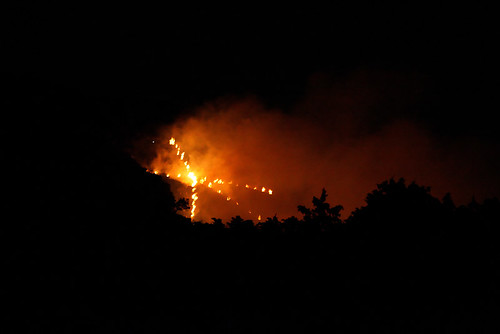
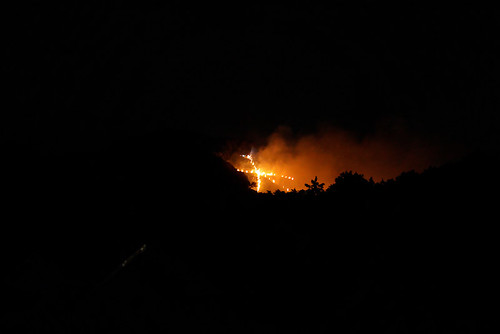
Last night was the Gozan Okuribi (五山送り火) in Kyoto, the culmination of the O-bon Japanese festival of the dead, in which giant symbols of fire are ignited on the mountains surrounding the city to help spirits find their way. Watching the fire ignite at 8pm (as with many festivals in Japan, often while drinking) is an ancient tradition in Kyoto, with modern hotels even holding special events on their upper floors. While I was feeling too lazy to actually go out and find a spot where I could see multiple daimonji, as the giant characters are called, go up in flames, the dai character on the east mountains is visible from my house, so I tried to get some photos of it.

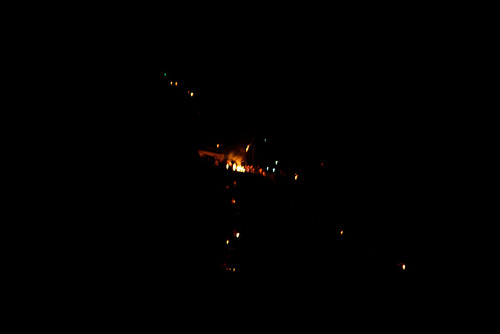
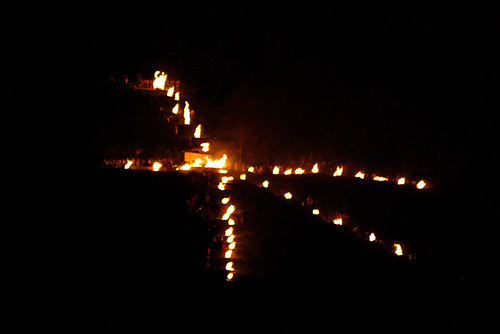
All photos taken with Canon 50D. The first photo used the Canon 50mm/1.8f lens and the others used the Canon 100-300 4.5-5.6, a poor quality but extremely cheap telephoto lens. The photos could have been better, and I was reminded that I should pick up a tripod some time for such situations, but the low light capabilities of my new camera continue to impress, and there were a few respectable shots. In the fourth one, notice that you can actually see people hanging around the bonfires.

50 1.8F lens @ 3200ISO, 2.5f, 1/60 sec

100-300mm lens @ 3200ISO, 110mm, f4.5, 1/25 sec

100-300mm lens @ 1600ISO, 300mm, f5.6, 1/13 sec

100-300mm lens @ 3200ISO, 300mm, f5.6, 1/100 sec

Must-see video on Youtube and the American quest for authenticity

Thanks to Gen Kanai for passing on this landmark lecture on Youtube culture and how it’s turning all Americans into attention whores who can only find validation through media exposure:

This appears to be on the same page as J Smooth’s observations about how even as the Youtube generation mourns Michael Jackson’s death, now that everyone is a media star they must deal with the same pressures of public exposure that Jackson faced:

Measuring earthquakes in Japan

On Sunday night, a large earthquake struck underwater off the coast of Japan and gave the entire Tokyo area a good shake. Then, on Tuesday morning, the Tokai region was visited by a much closer earthquake which damaged the main expressway between Tokyo and Nagoya.

Both quakes were around 7 on the Richter scale, which sounded catastrophic to my friends in California, but they would not have been quite as panicked if they were using the Japanese scale. This is because the Richter scale measures the power of an earthquake at its source (magnitude), whereas the Japanese shindo scale measures its power at the surface (seismic intensity). The Japanese scale basically breaks down as follows:

  • 1 = Barely noticeable
  • 2 = Noticeable but not scary
  • 3 = Rattles unsecured objects
  • 4 = Knocks unsecured objects over
  • 5 = Damages rickety buildings
  • 6 = Damages earthquake-resistant buildings
  • 7 = The Earth cracks open; demons emerge; everyone dies

Each location would therefore report a different number from the same earthquake, based on the effects on the ground there. The Japan Meteorological Agency publishes a map showing the seismic impact of each earthquake at various locations, as well as its epicenter. Around Tokyo, Sunday’s quake was around 3 or 4 on the Japanese scale, largely as a result of the quake being deeper underground and farther offshore; Monday’s quake was even weaker for us, but folks in the Izu Peninsula area got to experience seismic effects in the 5 to 6 range.

The foreign media, being sensationalists, still love to use the Richter scale for everything, despite the fact that it serves little practical purpose other than scaring my parents.

In America, try not to kancho your friends

(Updated)

A few weeks ago NYT ran this great article about the difficulties of raising a son in both Japanese and American cultures:

My Un-American Son

By KUMIKO MAKIHARA

Getting Yataro ready for his first sleep-away camp overseas is turning out to be much more than counting T-shirts and towels. I’m having to review the way children interact here to see which behaviors would go against American codes of conduct. American parents have higher standards than Japanese when it comes to acceptable behavior among children.

Take “kancho” for instance, a popular prank where kids creep up on and poke each other with pointed finger in the behind, shouting “kancho!” or enema. That would likely have the camp counselors in America alleging sexual abuse.

Kancho certainly isn’t encouraged in Japan — a friend of mine is convinced her daughter failed a preschool entrance exam because she playfully jabbed her mother in the rear during the interview. But Japanese parents usually bestow only a mild rebuke.

Please head on over to NYT to read the original article!

Other differences mentioned:

  • In Japan, racial epithets directed at her half-white son tend to be tolerated (and he is apparently not fazed by them), but in America they would be a cause for great concern.
  • In sports, coaches and other players tend to use positive reinforcement, while in Japan when her son makes a mistake he is told to “stop screwing up.” This might mean her son could take praise far too seriously and not understand where he needs to improve (his English language skills, in this case).
  • As someone from a country where communal bathing is common, her son might not understand the more chaste attitudes toward nudity and privacy in America.
  • Her son has never been given truly “free” time or open-ended choices, while the summer camp he is to attend consists of almost nothing but free time and freedom to choose.
  • In Japan she wouldn’t think twice about scolding using insults to scold her children, but American parents who see that behavior might think it’s abusive.

All these observations ring very true, though obviously your mileage may vary. I thank my lucky stars every day that I’ve never been kancho’d.

What I like best about this piece is that she resists the temptation to theorize or lecture about which society has the better practices. That’s the right approach because proclaiming one country’s education/child-rearing regime to be superior to the other’s does nothing to help Yataro navigate his new summer camp. By talking from her own experiences as someone who has had to navigate both societies (and offering some speculation about how Americans at the summer camp will react), she is able to shed light on cultural differences without getting into ultimately unhelpful broad conclusions. And in the process she has given us an entertaining and enlightening case study in the form of her own son. I look forward to the follow up article to hear how Yataro fared.

(A Google search for “Maki Katahira” “Kumiko Makihara” reveals several other articles about her son and life in Japan, along with this right-wing conspiracy theorist who implies she must be a CIA agent and part of the Trilateral Commission‘s plot to control Japan because she was married to former Newsweek Japan bureau chief William Powell (though apparently they divorced) and once worked as an executive assistant for a firm partially owned by private equity group Ripplewood. I don’t want to lend any credibility to this crackpot, but even if she is working for the man, this is still a pretty great article)

The history of Japanese text direction

Most of our readers are aware that, when written horizontally, Japanese is generally read left to right. When written vertically, as was the traditional method, paragraphs start on the right and each line is read down the page in order from right to left. Traditionally, though, Japanese and Chinese were both read right to left at all times, even when written horizontally.

The history behind this is kind of interesting. Here’s a timeline culled from the Japanese Wikipedia article on the subject.

* Traditionally, Japanese was written vertically, and lines were read from right to left. Horizontal writing only appeared on signs, and in those cases it was also read from right to left.
* Horizontal writing first appeared in print in the late 1700s as Dutch books were reprinted. (Dutch traders in Nagasaki were the only Europeans allowed in Japan at that time.) In 1806, a Japanese book was published in Japanese hiragana characters skewed to look like Latin characters and printed from left to right.
* In the first foreign language dictionaries printed in Japan, foreign words were written horizontally from left to right, while the Japanese words were written vertically from top to bottom. The first dictionary to have both foreign and Japanese words written horizontally came out in 1885, and both were written left to right.
* Japan’s first printed newspapers and advertisements had headlines and call-outs written horizontally from right to left.
* In July 1942, at the height of World War II, the Education Ministry proposed that horizontal writing be from left to right rather than from right to left. Although the left-to-right standard was showing up in some publications at the time, switching over entirely was a controversial idea which didn’t make it past Cabinet approval.
* The military also tried adopting left-to-right as an official standard during the war, but many people viewed this as too Anglo-American and refused to switch.
* Because of the patriotic zeal surrounding text direction during the war, there were cases of stores being pressed to switch text direction on their signage, and cases of newspapers refusing to print advertising with left-to-right text.
* After the war, Douglas MacArthur’s occupation team pushed for left-to-right text as an education modernization reform measure, along with the abolition of Chinese characters and other more extreme ideas.
* Yomiuri Shimbun was the first newspaper to switch text direction in its headlines, making the changeover on January 1, 1946. The Nikkei switched over by 1948.
* Japanese currency was first printed with left-to-right text in March 1948; before that, it had been printed right-to-left.
* Asahi Shimbun conducted some internal design experiments around 1950 to switch its front page to an all-horizontal, left-to-right format, but this never made it past the drawing board.
* In April 1952, the Chief Cabinet Secretary adopted a guideline that all ministry documents be written from left to right using horizontal text. Despite this, the courts kept vertical writing until January 1, 2001–the bar exam was also written vertically until that time–and the Diet itself continues to use vertical writing when publishing draft bills.

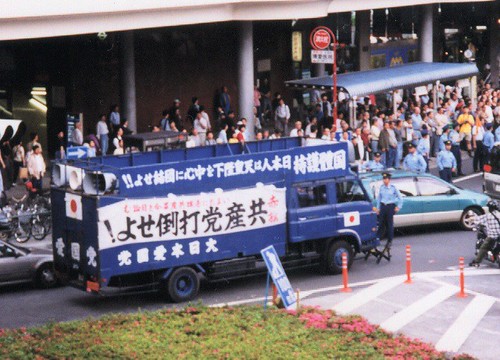
Right-to-left writing is still found in certain contexts. Sometimes it is used simply to appear more “traditional”: Wikipedia cites soba shops as a common culprit in this category. Another common context is vehicles such as trucks and ships; there, Japanese is often written from front to back, so on the right side of the vehicle it is written from right to left. Here’s an example which I spotted on a right-wing sound truck outside Odakyu in Shinjuku during my first trip to Tokyo, way back in 2000. Note that the text 愛国党, or “Patriot Party,” is written right-to-left on the side of the truck, but left-to-right on the back.

"Kick some Communist ass!"

(Thanks to our commenter Peter for suggesting this topic.)

Be the foreign media

Since we’ve been ragging on foreign reporters so much recently, here’s a want ad which may be of interest to those of you who think they can do better.

Reporters for English-language newswire (Tokyo-Japan)
Date: 2009-07-15, 12:05PM JT

A well-known news agency’s Tokyo branch is looking for reporters to write for the English language wire service.

Job description:
The position involves reporting and editing major political, economic, science, corporate news items in Japan. It also involves writing in-depth report or news analysis on some topics given by editors.

Qualifications:
Fluent in Japanese and native-level in English. Experience in journalism will be a significant advantage. A broad knowledge about Japan’s politics or economy is preferred.
Office hour is not needed. Pay will be based on workload and there is no base salary.

Direct contact to xhsdjfszp@gmail.com is ok.

Raymond Burr, where are you?