Abe’s turn to get SLAMMED

I wanted to go back to ignoring the recent flap over a House resolution to condemn Japan’s supposed failure to adequately deal with the “comfort women” issue. But how can I sit quietly when the Prime Minister himself is getting SLAMMED?

Growing Chorus Slams War-Brothel Remarks Japanese P.M. Under Fire For Comfort Women Remarks
AP

SEOUL, South Korea (AP) – March 3, 2007 – South Korea again criticized Japan’s prime minister Saturday for disavowing his country’s responsibility for using Asian women as sex slaves for Japanese troops in World War II.

Japanese Prime Minister Shinzo Abe said Thursday there was no proof that so-called “comfort women” were forced into sexual slavery during the war.

The remark triggered outrage throughout Asia.

Abe’s statement is “aimed at glossing over the historical truth and our government expresses strong regret,” said a statement from South Korea’s Foreign Ministry.

SHOCKING! Asahi.com is ending their excellent “Today’s morning edition” feature

Remember my recent post praising Asahi’s Japanese website for getting better and better? Well I take it all back. Asahi’s website is about to get worse.

Mere days after I lauded Asahi for making their Japanese-language website more useful, the site has decided to take a huge step back.

According to a Feb 26 news release, they will no longer offer the “Today’s Morning Edition” service as of March 4. The feature gave a full list of the day’s print edition headlines and offered one (almost) full-length article in each section per day. It was a great way for people who can’t get access to the paper to ascertain what is making news in Japan.

But no more. Editorials and the front-page column “Tensei Jingo” will still be available going back 1 week, but otherwise you have to go to fee-based sites such as Asahi Perfect to get access. No other explanation is given.

The Morning Edition section wasn’t started all that long ago (I can’t seem to find a reference to when they started it), but I’m presuming they started it on a trial basis to see if offering one free article per section would attract sufficient interest in the fee-based services. I’m guessing that they didn’t generate enough interest, not that the feature was marketed all that well (I didn’t notice it existed until I decided to check the editorial section one day).

If this decision is one made by the new editor that asahi.com was looking for, I humbly request they reconsider. Offering more of Asahi’s flagship content online will only attract more interest in the site and would not hurt newspaper sales.

I can understand why Asahi, the number 2 newspaper in Japan, is reluctant to take the plunge into offering more free content. Japan’s newspaper circulation has been falling much more slowly than their American counterparts. In particular, the Asahi’s circulation has declined by only 2% from 1996-2006, though that slightly outpaces the industry-wide drop of 0.5% for the entire industry (1995-2005, all figures in absolute terms). Though I can’t be bothered to dig up roughly comparable statistics, this 2005 Washington Post article indicates that US newspaper circulation has been plummeting for 20 years, due to restrictions on telemarketing and competition from the Internet/cable TV, 3 problems that have not proven major obstacles for the Japanese industry.

Still, I’m shocked that they’re just pulling the rug out from what was a great service (I mean, you wanted to read the full report on recently unearthed diaries by Major General Taro Utsunomiya describing the March 1st uprising in 1919 colonial Korea, didn’t you?). Ah well, none of this will matter come April when I’ll more than likely become a print subscriber anyway.

Business advice from J-Cast

J-Cast is a relatively new Japanese online news service co-founded by Asahi Shimbun veteran and AERA founder Masao Ninagawa. Rather than aim to serve as a straight news site like the major news media (which would be practically impossible since online news organizations aren’t allowed into government press clubs), they try to form a conduit between “primary” information (direct investigation/reporting) and “secondary” information (news reports from other companies, websites, blogs, 2ch etc) to achieve something they term “1.5-degree information.” I’ve been using the site for a while because it has an RSS feed (that lets me read entire posts in my reader no less) and often has good links or covers an issue in more detail than I can get elsewhere (such as the recent controversy over claims that Prime Minister Abe wears diapers due to recent health problems).

But what I wasn’t aware of (in yet another “news to me but maybe no one else” moment) is that they have an English site. It doesn’t seem to get updated often enough, but I thought I’d share with you this useful highlight from a series on how to succeed in business as a foreign company in the rough and tumble world of Japan’s “capitalist controlled economy” (English mistakes theirs):

Why Are Bureaucrats So Arrogant?
by Atsushi Yamada

Administrative measures are taken according to the law, but government offices, not courts actually decide how to interpret the law for implementation. Bureaucrats’ feeling like “Sairyo” (discretion) or “Gyosei-shido” (administrative guidance) often set the rule of business. People who are not accustomed to this kind of system led by bureaucrats, especially foreigners would be bewildered. There are two ways to cope with this. First off, ask government offices openly. Regarding the non-transparent measures like administrative guidance or permission rights let your lawyers ask for the view of government offices in writings. You should explain that you would like to do it as business and ask them whether it was lawful or not for avoiding the accusation later. If they do not permit, ask them the reasons for it in writings.

As Japanese government offices lead the private sector with “Aunno-kokyu” (perceived feeling), they are susceptible when they are asked for logic. Act aggressively with the backing of the law. Recently this has become very effective. When foreign companies are not abundant in Japan, they do not react seriously even if you ask for the view directly. But they are not allowed the poor treatment now, as “transparency of administrative measures” is required. This kind of measure is the right one even though the relationship with the government office might become difficult. They would see you as “lousy” and would not treat you well.

Another way is “When you are in Rome, do as the Romans do.”

You would see them with low posture and respect. Try to go often to government offices and approach government officials. Try to find time to dine and play golf together with them. Build the cordial relationship that will allow you to consult with them. If possible, become a member of the related organization and contribute to the activities of the organization. Try to become friend with “Amakudari” officials in the organization, and get the information of government offices like internal situation or frank opinions. It might be possible to have an introduction to government officials. With the introduction from the inner circle, they react differently. It might be a good way to become senior official in the related organization and skill up the negotiation tactics. It might be possible to form an industry with only foreign companies. In that case, you could find a way to receive a politician who has an influence to government offices as an adviser. But in that case, you might be forced to buy tickets when the politician held fund raising parties.

Attack from the front or take appeasement policy, judgment is manager’s task.

Deference? Golf? Political fundraisers? Screw that, I think I’ll call my lawyer.

Lame “no liquids” rule coming to Japan airports

From Bloomberg:

South Korea, Japan to Limit Liquids on All Overseas Flights

By Seonjin Cha

Feb. 27 (Bloomberg) — South Korea and Japan will expand restrictions on carrying liquids on board international flights from Thursday, to thwart terrorist attacks.

Passengers on all international flights from South Korea, including transit flights, will only be allowed to bring in liquids, gels and aerosol items in containers no larger than 100 milliliters (3.38 oz.), which must be placed in transparent plastic bags, the Ministry of Construction and Transportation said yesterday on its Web site.

The same restrictions will go into effect for all international flights from Japan, the country’s Ministry of Land, Infrastructure and Transport said on its Web site on Dec. 19.

The move is an expansion of current restrictions on flights to the U.S. and EU countries that began last year based on guidelines from the International Civil Aviation Organization, the Korean ministry said.

Food for infants and medicines will be exempt from the restrictions but must be reported to security staff in advance, the ministry said.

I thought the “liquid bomb” theory was already discredited! There needs to be some kind of multilateral negotiating body where cooler heads can veto very bad ideas like this liquid rule and infinite copyright term extension.

Look at me, I’m complaining about journalists who write about themselves!

As someone who reads far too many news articles for his own good, I may be somewhat more sensitive to media cliches than your average news consumer. For instance, I have a whole category on this blog for “kabuki” metaphors.

But today I want to talk about another of my pet peeves in the English-language news world: when the reporter flips things all around and makes him/herself the focus of a story. While some people might be interested in the daily life of some freelance writer who rides his bike around town, probably most of us don’t want to read about what substantively is no different from following a homeless man around all day and writing about it (though wait, that would be a good idea). And speaking of homeless people, I almost broke my mp3 player in outrage when I heard this pointless “report” about a man who decided to write out of a storage unit in New York. He should have tried that in DC – he’d have ended up getting arrested if he was lucky, but more likely had his ass handed to him like the rest of the crackheads who try that stunt.

Or consider the reporter who freaked out when he was deemed unworthy of a Wikipedia entry for lack of notability. He spent a full two pages on the subject, and once published the article apparently made him immediately eligible for an article again. This naked display of the writer’s fragile yet gargantuan ego leaves me almost speechless but I will say this: You use Slate to whine to the world that you’re underappreicated, and then that whining (intentionally or not) simultaneously pressures the source of the perceived slight to recognize you once again? You should be ashamed of yourself! (I am not mentioning the writer by name or linking to the article in the hope that he won’t ever find this and have a mental orgasm over seeing his name in print because of something I wrote. I wouldn’t be able to touch the keyboard again).

I could go on and on, but you get the idea. Journalists can be pretty egotistical, and as writers they no doubt have a burning desire to tell their story. Or perhaps sometimes they’re just dicks (“I got Bill Clinton to threaten me!”). Foreign correspondents especially seem eager to put themselves in the reporting, which is usually justified (“My convoy got hit with an IED!” “I got kidnapped!”) but too often an unappealing by-product of the expat experience (“Look at me, I am getting paid to walk around China!”). And often it’s less about autobiography than it is a cheap stunt (“Look at me, I got waterboarded!”). Whatever the case, it just doesn’t sit right with me when there are real things to report about. Much like nonbinding resolutions directed at foreign governments, these articles seem to be lost on their way to somewhere else.

Since I haven’t been around for very long, I am going to assume that this practice has been around for a while — HL Mencken seemed to like writing about himself for one thing, and you can see traces of Hunter Thompson in a lot of these kinds of projects. But at the same time this practice seems like some unholy amalgamation of gonzo reporting and the Today Show with Katie Couric meets livejournal, which would make its growth more recent.

There are better ways for a reporter to talk about him/herself as part of the story than to simply say what is happening and then try to link that to some cosmic truth or the zeitgeist or whatever justification you use to get printed in a news publication. The best use of personal narrative that I’ve seen in recent reporting is Nicholas Kristof, who has used the sheer power of his reporting to play a pivotal role in keeping alight what little focus the US has placed on resolving the genocide in Darfur, Sudan, not to mention his efforts to force people to take a hard look at the state of child prostitution in Cambodia from a much more dynamic perspective than almost any other source would have the guts to give. That might be setting the bar high, but I think it has to be pretty high or else we’ll never hear the end of Budding Journalist’s Amazing Tales of Public Transportation.

Au Bon Pain coming to Japan

It’s like all the best chain stores suddenly found out I was coming to Japan and decided they needed to step up:

Monday, February 26, 2007

U.S. Bakery Chain Au Bon Pain To Enter Japan In Summer

NEW YORK (Nikkei)–U.S. bakery cafe chain operator Au Bon Pain plans to open its first store in Japan this summer under a franchise agreement with Reins International Inc., company sources said.

The cafe will offer such items as bread, sandwiches and coffee. Au Bon Pain aims to increase the number of outlets to 300 in five years.

Reins International, a group company of Rex Holdings Co. (2688) and operator of the Gyu-Kaku chain of grilled beef restaurants, plans to open the first cafe in a Tokyo business district. It will begin introducing outlets in other major cities from next year.

The Boston-based Au Bon Pain operates about 230 cafes in the U.S., mostly in urban areas. It has also begun opening outlets in such Asian economies as Thailand, Taiwan and South Korea.
(Nikkei)

I’m not a huge fan of this place, but I know MF is. Hey, why not. Hopefully they will have good bagels. I don’t think I can realistically hope it will be cheap since it’s a big ripoff in Washington.

Sankei’s Iza! is great, Asahi’s Japanese website is improving

UPDATE: I am forced to take back my praise of Asahi.com since it has come to light that a) The photo section isn’t new or any better than other similar services; and b) They are ending the great “Today’s Morning Edition” feature.

Last June, the Sankei Shimbun corporation launched a new site called Iza! (meaning “when it counts”), a “participatory news site” that has proven groundbreaking for the online Japanese-language media. The site unites some content that was previously on disparate websites for Sankei group publications (including the flagship Sankei Shimbun, trashy daily Yukan Fuji/ZAKZAK, and sports daily Sankei Sports), features blogs run by their own reporters (such as Washington-based Yoshihisa Komori and the reporters assigned to intellectual property issues), allows the creation of user-generated blogs, displays trackbacks for all its stories, RSS feeds for everything, and — perhaps most importantly — includes a whole bunch of content that once could only be found online.

I am pleasantly surprised at the site’s quality, but at first I was skeptical that Japan’s most conservative national daily could “get it” when it comes to online news. But they do get it, and they are leaving other sites in the dust. Sankei has a motivation to revamp its business: the main Sankei Shimbun is only the 6th-place newspaper in Japan, the last among the nationally-circulated papers and behind even the regional Nagoya-based Chunichi Shimbun. One sign of success: Sankei is using the site to launch blog-inspired books, such as this one by a political reporter.

Though most of the major newspaper sites give out their editorials and some columns for free, many (Nikkei is probably the worst offender) still feature pitiful two-line summaries of their feature news articles (or brief reprints from wire services) and offer nothing that could be termed full news coverage. An August 2006 Bivings Report study of Japan’s online media market concluded that in general “Japanese papers are not taking aggressive Web strategies (except when it comes to cell phones).” Focusing on cell phone content may be in line with many readers’ demands, but there is a growing market for online journalism that I believe will match the US’ development of online media as a main source of news, even if many of the users will in fact be reading from cell phones.

There are many factors that contribute to a general reluctance among the national newspapers to modernize (government-sanctioned protection against price competition chief among them), but they are under increasing pressure to get their act together. The share of ad spending that goes to newspapers has declined from 21% to 17% over the last 10 years. Online ad revenues have doubled in the past 2 years and are making up a growing share of the total ad market. Perhaps more importantly, Dentsu, which is the primary ad agency for an astonishing 92% of Japan’s dailies, is starting to focus more of its attention on this exploding area of the market. And unlike print newspapers, there are no government-provided barriers to entry in place, which lets companies that aren’t even in the newspaper business try and challenge newspapers’ dominance of print media and compete for ad money. Livedoor already has excellent news and citizen journalism sites, for example. Also, Yahoo and JANJAN have politics websites that blow away anything the newspapers have had to offer in the past.

One newspaper site that seems to be getting the hint is Asahi Shimbun. Ever since a string of reporting scandals left the newspaper weakened in terms of credibility and access to politicians, the Asahi launched a campaign to reform itself called “Journalist Declaration.” The paper pledged to return to the principles of its mission statement to “Persevere in freedom of expression from a position of neutrality” and “fight corruption without any illegality or violence.” Specifically, the Asahi decided to take on major organizational reforms to “create a flexible reporting organization that allows for fully developed investigative reporting and meets the needs of the times.”

Asahi decided to stop running TV ads for the campaign after it was found that an evening edition article on winter rice cakes had been plagiarized from an online Yomiuri article. One of the ads is thankfully still on YouTube, however.

Nevertheless, the cleaning house has done the Asahi some good. There really have been some great stories broken by the Asahi in the past year and a half or so, some of which I’ve mentioned here. But the biggest personal benefit for me is that the Asahi’s Japanese-language website has improved quite a bit:

An idea of what’s in the day’s morning edition – Click on the Editorial link on the front page and above the editorials there is a list of the various sections of the paper (Front page/International/Society etc). One article per section is available in (I assume) full length, along with just the headlines for other articles. Even apart from this section, however, it seems like most of the big news items get a much more detailed treatment than other major news sites, even though they might not be full-length.
Better RSS – You can now preview the first line of the article along with the headline where previously all you got was the headline (they put in ads, but it’s not a bad trade-off). You can get the Asahi’s Japanese-language RSS feed here. It’s still hidden from the front page for some reason. I’d of course like to see them offer some more variety in the RSS rather than a single feed of latest headlines.
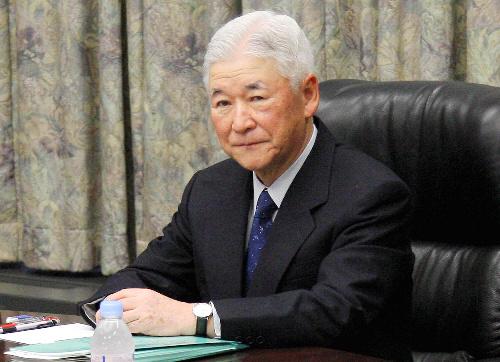
Bigger pictures – One of my biggest pet peeves about Japanese news sites is the use of tiny, often indecipherable photos to go along with their stories. I don’t know why they did that, but I am guessing it was some compromise reached over copyright concerns. Whatever the case, Asahi’s new photo gallery section now lets you get a big eyeful of newsmakers like Bank of Japan governor Toshihiko Fukui:

fukui-tky200702210188.jpg

None of the Asahi’s new features allow for any “Web 2.0” style interconnectivity a la Iza, but in terms of pure news transmission this is a big step in the right direction. Other sites are of course not standing still (Yomiuri has a forum!), but so far I am most impressed by these two efforts.

Shiozaki out, Takenaka in? Who’s to blame for Abe’s sputtering?

Though the Japanese media has been running speculation of a cabinet reshuffle or other personnel changes in the Abe cabinet since January at least, the Daily Yomiuri has come out with one of the first English-language pieces discussing the possibility that I’ve seen from a major media outlet. According to the Yomiuri, the blame for the many mishaps that have dogged the Abe administration is falling on Chief Cabinet Secretary Yasuhisa Shiozaki, who would be “the main target for reshuffle”:

Shiozaki has been criticized for his lack of ability to coordinate the Cabinet’s crisis-management and damage-control systems. When scandals involving Cabinet ministers emerged, Shiozaki only said they should be held accountable for the alleged scandals.

A chief cabinet secretary is supposed to have the Prime Minister’s Office report all the facts to him, conduct investigations based on them, check whether the government can overcome opposition grilling in the Diet and media criticism, and decide whether to protect the cabinet ministers in question or have them resign. But things are different under the Abe Cabinet.

Partly because of lack of political experience, Shiozaki has failed to keep a tight grip on the reins of the bureaucrats in Kasumigaseki and coordinate policies with the ruling parties sufficiently. It is worrying that he is so inflexible in his thinking. Because of his inability to delegate, he inserts study meetings into holiday schedules. Thus, he has less leeway of mind than the play of a steering wheel.

The Asahi, never to be outdone, has its own English article on Shiozaki-directed criticism. I feel like this report is more balanced and attributes the criticisms to actual sources rather than editorializing within the article. It also draws different conclusions, saying that Shiozaki has become a Rumsfeldian sponge for criticism from Abe’s critics:

On Jan. 14, LDP Policy Research Council Chairman Shoichi Nakagawa berated Shiozaki in a telephone call, telling him that his habit of setting up task forces one after the other to deal with major policy issues could easily result in a storm of media criticism.

Shiozaki was clearly taken aback, according to sources.

Some lawmakers say the task force policy serves only to make some Cabinet ministers less willing to follow the party line.

For example, Shiozaki has proposed setting up task forces on strengthening cooperative relations with Asian nations, another to deal with the declining birthrate and yet another to consider how to revive economic growth.

In spite of these problems, LDP lawmakers thus far have refrained from criticizing Abe directly.

They fear that if they do so, they will be branded as trying to engineer a coup against the Cabinet.

For this reason, they are sharpening their knives against Shiozaki, whose job makes him the government’s most senior spokesman.

Shiozaki has been getting panned in the media since the Abe cabinet’s inception for being the most arrogant and domineering personality in a cabinet that’s full of them. While the Yomiuri article cites “failures” without really going into detail, it is pretty representative of the type of reactions the “hated Chief Cabinet Secretary” (as he was described in a January Bungei Shunju article) has been getting. He’s been accused of both dominating Council on Economic and Fiscal Policy meetings that are supposed to be the domain of Minister of State Hiroko Ota, taking the initiative on North Korean abduction issues, as well as crowding out Special Advisor Hiorshige Seko, who’s supposed to be in charge of PR. While the economic reform agenda may yet be the underappreciated gem of the Abe administration, it’s clear that Abe’s PR response has been just awful.

There’s a great piece detailing who did what in all the Abe blunders of the past 5 months entitled “Support Rates Plummeting, the ‘Abe Kantei’ is no Longer Functioning” that ran in the March issue of Bungei Shunju that you can read in Japanese here. I want to summarize one incident mentioned in the article over which Shiozaki was judged to have messed up playing the role of nemawashi (consensus-builder): the attempt by Abe in late November/early December to move a special account dedicated to road construction to the general account, including the national gasoline tax. Though the highway public corporations were privatized in 2005 as part of Koizumi’s plans to eliminate a major source of wasteful spending, reform of the special account was put off as too politically volatile at the time.

The idea was proposed by CEFP Minister Ota as a way to boost Abe’s falling approval ratings. Both Shiozaki and Abe approved of the policy, and Abe in particular thought that reforming a tax that’s been in place since 1954 would be a good way to showcase his policy of moving beyond the postwar era. But Shiozaki had absolutely no experience as a liaison charged with building consensus within the LDP. Abe announced that he intended to reform the special account for highways, including the gasoline tax, at a meeting of the CEFP and then left the rest to Shiozaki. But his overtures to some of his political allies hit a snag, since the gasoline tax, at 3 trillion-yen per year in collected revenues, is a major source of funding for road construction, probably the biggest source of pork-barrel spending in Japan (and therefore the basis of many politicians’ support). They suggested he try to reform an auto tax that is charged on the weight of the automobile, since there is no legal basis for the funds to be set aside for road construction. He called Seko for help, but Seko, who’s a PR expert not a well-connected politician, thought it was too late to move forward with the policy as Abe outlined it since no one would go along with a complete separation of the gas tax from the special account. A trip to the LDP’s top upper house member Mikio Aoki was similarly unsuccessful: “The upper house won’t take responsibility if it doesn’t come in a form that builds necessary roads.”

In the end, Shiozaki had to rely on Deputy Chief Cabinet Secretary Advisor Atsuo Saka, whom Abe reportedly “loathes” but can’t technically replace. Shiozaki met with Saka along with Finance Minister Koji Omi and Transportation Minister (and former Komeito President) Tetsuzo Fuyushiba. Saka, sensing an opportunity, suggested a compromise: agree to free up only 1.8 trillion yen of the gasoline tax and put off the debate on sweeping reform. Saka was more than happy to play consensus-builder, but the newspapers excoriated both Shiozaki and Abe, saying that the development was a “loss” for kantei-led politics and a blow to the reform agenda.

Now, I don’t think all the administration’s mishaps are Shiozaki’s fault — Abe’s executive secretary Inoue, Sec Gen Nakagawa, Seko, and others have all had trouble working together and made their own mistakes — but it could be that replacing him with someone less headstrong might help ease tensions.
Continue reading Shiozaki out, Takenaka in? Who’s to blame for Abe’s sputtering?