Filipino Grocery in Adachi-ku Danchi

I was riding my bike around Adachi-ku Sunday and came across this danchi (danchi = low-rent, often public apartments, this one run by Tokyo prefecture) that apparently has a lot of Filipino residents who must work at the local factories:

Another great find on yesterday’s trip was this cheap supermarket ABS Wholesale Center (located here). They had my favorite cheap Chilean wine (Frontera Cabernet Sauvignon) for only 530 yen! It is usually around 700 or 800 yen at Ito-Yokado.

FREE MONEY update: 471k screwed up applications

Amazing: 471,567 households applied for their FREE MONEY from the Japanese government, but failed to fill out their addresses correctly!

Friday, July 3, 2009
471,000 Applications For Cash Handouts Sent Back With Wrong Addresses

TOKYO (Kyodo)–A total of 471,567 applications for the government’s pump-priming cash handout program have been sent back to municipalities as they were incorrectly addressed as of last Friday, the Internal Affairs and Communications Ministry said Friday.

The ministry said it will step up its publicity to call on households who have not received the cash benefits of up to 20,000 yen per person to file their applications as they are feared to fail to receive them.

Meanwhile, a survey showed 86.0 percent of households in 1,798 cities, towns and other municipalities across the country have received the cash handouts which have totaled 1,772.6 billion yen as of last Friday.

The municipalities began providing the cash benefits in March to cover about 54.8 million households under the government’s economic stimulus plan.

Of the applications sent back, 73,000 were sent to foreigners, who have often failed to provide moving notices to municipalities in urban and other areas.

The households will lose their right to receive the cash handouts unless they file applications in six months after the municipalities began to accept applications.

“The wrong addresses” apparently means that the addresses on the applications somehow did not match their residence registry (住民票). This could be anything from a kanji mistake to the head of the household neglecting to update his address with the local authorities.

Since Japanese nationals only had to fill out one form per household (foreigners had to fill them out individually since they’re not listed on residence registries for now), each mistaken application might be for multiple people. If we assume the “average household size” of 2.56 people, and roughly assume that all of them were only eligible for the basic 12,000 yen, that means we could be talking about 14.5 billion yen up for grabs.

I wonder what happens if the households “lose their right to receive the cash”? The towns better not get to keep it. It’s about 115 yen apiece for the other 125 million people in Japan, or more than enough to build another of the controversial proposed national anime museum.

Energy consumption in Japan: A couple of data points

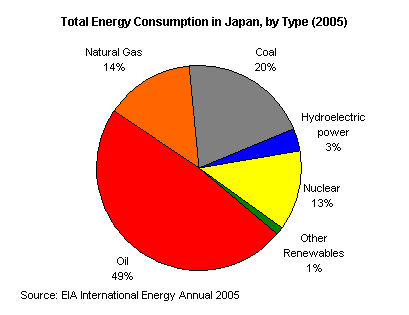
Just out of curiosity, I decided to take a look at Japan’s energy situation. Here is the US Energy Department profile of the country:

Japan has virtually no domestic oil or natural gas reserves and is the second-largest net importer of crude oil and largest net importer of liquefied natural gas in the world. Including nuclear power, Japan is still only 16 percent energy self-sufficient. Japanese companies have actively pursued upstream oil and natural gas projects overseas in light of the country’s lack of domestic hydrocarbon resources. Japan remains one of the major exporters of energy-sector capital equipment and Japanese companies provide engineering, construction, and project management services for energy projects around the world. Japan has a strong energy research and development program that is supported by the government. The Japanese government actively pursues energy efficiency measures in an attempt to increase the country’s energy security and reduce carbon dioxide emissions.

Oil is the most consumed energy resource in Japan, although its share of total energy consumption has declined by about 30 percent since the 1970s. Coal continues to account for a significant share of total energy consumption, although natural gas and nuclear power are increasingly important sources, particularly as Japan pursues environmental policies. Japan is the third largest consumer of nuclear power in the world, after the United States and France. Hydroelectric power and renewable energy account for a relatively small percentage of total energy consumption in the country. Total energy consumption from 2003 to 2030 is forecast to grow by 0.3 percent per year on average, relatively small as compared to China’s forecast growth rate of 4.2 percent per year on average, according to EIA data.

According to METI’s energy agency, 58% of Japan’s electricity consumption comes from non-renewable sources such as oil, coal, and liquefied natural gas. That number is a whopping 71% in the US.

Japan energy consumption

As the Energy Dept. indicates, Japanese officials view Japan’s high energy consumption and low self-sufficiency as a potential vulnerability, in both economic and national security terms. For example, Iran’s  status as a major supplier of oil heightens Japan’s interest in the region (and based on pure speculation, might have influenced the Japanese media’s comparatively tame coverage of the recent Iranian election protests).

So remember: when you are enduring higher office temperatures thanks to Cool Biz, you’re not just saving electricity, you’re helping guarantee Japanese security!

DPJ’s attempt at hijacking the Tokyo Prefectural Elections

When I claimed there were no real issues at stake in the upcoming prefectural election, I may have spoken too soon. Just half a day after I posted my rundown of the election, a consumer group along with DPJ and communist assembly members marched against the moving of Tsukiji market to Toyosu.

Does Japan need more bankruptcies, or less?

The Economist has come out with a bold argument in favor of a tough “creative destruction” policy for Japan to promote efficiency, productivity growth, and economic recovery by letting more companies fail (emphasis added):

[Japan’s long-standing “convoy” system of keeping underperforming firms alive] does enormous harm. Weak firms need to exit the market, either by going bust or being sold to another firm, or the whole business environment gets stifled. Japan has far too much capacity in many businesses—eight mobile-phone makers, for instance, few of which make much money. This squeezes prices and margins, thus denying better-run firms the surplus capital they need to hire talented people, buy competitors or invest in research and development. It also locks up resources, both human and financial, that could be used more productively by stronger firms. Before the downturn, Japanese companies’ return on equity averaged around 10%, about half the level of American firms.

Tellingly, the shut-down rate of companies in Japan is around half that in America and Britain. And the number of corporate insolvencies is expected to increase in Japan this year by only 15%, despite the depth of its recession, compared with more than 30% in western Europe and 40% in America. Normally a scarcity of corporate bankruptcies is a sign of economic vitality; in Japan, it is a sign of its economic weakness. Of course, keeping struggling firms alive protects jobs. But it also fossilises industry structures and hinders the development of a more flexible labour market and a business environment more supportive of new-company creation—two areas where Japan is also sadly deficient.

As if in direct response, an anonymous Nikkei op-ed says that letting companies fail in Japan can be dangerous by erasing critical knowledge and ruining the macroeconomy. As there is no online version right now, I paraphrase here:

Everyone agrees that raising efficiency in the economy is a good thing. But if some Japanese companies currently in a management crisis are allowed to go bankrupt, there would be no net efficiency gain because there’s a chance they could right themselves. For a company to go bankrupt and out of business not only harms the managers and employees, it can have an even bigger impact on the macro economy. Letting companies fail destroys more than the of the firms’ collective employees, plant and equipment, it also destroys the built-up knowledge of an organized entity that is more than the sum of its parts; specifically, their organizational strengths and customer bases. These elements have been overlooked by traditional microeconomics, but they are critical elements of business. Once destroyed they are not easily restored.

It should be possible to encourage firms to transition their businesses without bankruptcy by pushing them to expand into related fields. This would maintain manager and employee morale while simultaneously boosting the overall economy.Though obvious sectors for these transitions would be green technology, biotech, or nursing/welfare, companies should be left to decide their new businesses on their own. It might take a long time for companies to turn around and succeed like Toray or Asahi Kasei.

Therefore, the government should make it a priority to provide tax incentives and subsidies to these sorts of companies.

As much as I usually trust op-ed writers who are refuse to go on the record, does anyone else smell a conflict of interest here? Something tells me the author (pen-name: 真和) has a specific company on the tip of his tongue but just can’t bring himself to say it.

Tokyo Prefectural Elections July 12

On July 12 the Tokyo Legislative Assembly elections will be held. While the TLA does not appear to do much in the grand scheme of things, this election is personally important to me as it will mark my first experience with an election where Mrs. Adamu can actually cast a ballot (in previous elections she could not vote for one reason or another). With that in mind and in the interest of being an informed voter’s spouse, I decided to take a look at what this is all about with a focus on Adachi-ku, the ku I call home.

How is the assembly chosen?

With 127 members (one representing roughly 100,000 people), Tokyo’s legislature is the nation’s biggest local assembly of any kind. Members come from 43 mostly multi-member districts and are elected all at once to four-year terms using the single non-transferable vote system similar to the Lower House elections prior to 1994. For example, in Adachi-ku’s case, voters choose an individual and the top six vote-getters win seats. The 42 districts consist of the 23 cities or “ku,” 18 cities within the prefectural boundaries, and one to cover all the outlying islands. Adachi-ku, where I live, is allotted six seats.

Most local elections in Japan are held all at once every four years in what are called the “unified local elections” (統一地方選) (the last round was in 2007), but Tokyo’s are held two years after that. They used to sync with the rest of the country, but the schedule got screwed up in 1965 when an LDP bribery scandal spurred leftist parties to push for a recall, leading to a voluntary dissolution and early election.

Currently, the LDP-New Komeito coalition maintains an overwhelming majority of seats (with a respective 48 and 22 members each), followed by the DPJ with 22 members, 13 Communists,  and single-digit membership from the left-leaning Tokyo Seikatsusha Network and unaffiliated politicians.

What do they do?

In typical assembly fashion, they are responsible for passing local ordinances (条例)  and approving the prefecture’s budget, which at 6 trillion yen just for the general account is on par with Finland’s GDP.

The prefectural assembly’s other enumerated powers according to the Tokyo Prefectural Assembly website include investigating and auditing the executive branch, passing a no-confidence motion against the governor, and responding to requests from Tokyo residents to investigate various grievances.

What are some of their more recent achievements?  How powerful are they?

Since Tokyo’s government is set up somewhat similarly to a US state (unicameral legislature and a fairly powerful directly elected governor), the assembly can wield significant power if the party/coalition holding a majority of seats is opposed to the governor’s agenda. However, this is not currently the case, so right now they don’t do much.

News outlets openly report that the assembly is all but a rubber stamp for the executive, owing to a comfortable relationship with recent cozy LDP-Komeito majorities (and occasional DPJ cooperation) and three consecutive terms for Governor Shintaro Ishihara, who is not officially backed by any party but has an ideological affiliation with the LDP-Komeito as one of Japan’s leading conservatives. Prefectural assembly meetings are perfunctory affairs in which the elected members simply read from a script which has been prepared in advance by bureaucrats from the governor’s office, a process euphemistically called nemawashi i.e. backroom dealing. The Communists and other leftist parties do their best to stir up scandal (Ishihara’s lavish trips abroad and the catastrophic small-business bank among them), but voters keep voting in this conservative bloc.

Most of the assembly’s routine agenda appears to be fairly mundane, except when they are called on to give their blessing to the pet projects of either Governor Ishihara or the national government. A look at the agenda of assembly meetings in 2009 shows such typical local administration as minor revisions to health service fees, approval of staff rosters for the fire departments, and the establishment of a new police precinct. However, it is unclear how much room for originality the prefecture has when they must contend with the agendas of the Tokyo prefectural bureaucracy (firmly controlled by Governor Ishihara) and the prerogatives of the internal affairs ministry.

In May, the prefecture passed an emergency supplementary budget to provide economic stimulus in coordination with the central government’s efforts. They approved spending of 134.9 billion yen (with about half the funding from the central government, with the rest paid for by revenues from prefectural revenues and a bond issue). The money went to beef up a consumer protection agency, subsidize day-care centers, pay additional outlays to pregnant women, fund high-tech education, and more.

A 2007 report from citizen journalism site JANJAN decried the governor’s strong influence over the prefectural government, owing not only to the majority LDP-New Komeito who form a loyal right-wing support base thanks to their alliance in national politics, but also to a compliant DPJ. For example, the legislature is in charge of regulations/zoning of prefecture-run wholesale markets, and this includes the world-famous Tsukiji fish market. A decision made in 2001 to move the market to Toyosu, where more modern facilities can be constructed, met with opposition at the last minute due to claims of pollution at the new site in Toyosu. However, the assembly members were not hearing it and the move remains on schedule for 2012.

In another example of Ishihara’s absolute control over his pet projects, the Tokyo legislature gained national attention recently for approving multiple bailouts of New Bank Tokyo (新銀行東京). This bank was created as the fulfillment of Ishihara’s campaign promise to start a bank for small Tokyo-based companies during a bid for reelection in 2002. After opening for business in 2004, just three years later the bank became insolvent due to notoriously lax lending standards that led to enormous losses from the very beginning. But despite this embarrassing failure, the Tokyo assembly was unwilling to refuse Ishihara’s insistence on providing the bank with 4 billion yen in new capital and a new lease on life. In this instance the DPJ members opposed the bailout but it passed with LDP and Komeito support.

The media outlets reporting these scandals seemed genuinely frustrated with the assembly for these recent scandals, but it seems like they should save their breath for the governor’s office, because once Ishihara has made up his mind the TLA won’t do much to stop him.

Other so-called “third sector” businesses directly run by Tokyo Prefecture include the “Toei” subway lines and buses and prefectural government housing.

What are the issues in this election?

There are none. If you have heard anything about this upcoming election, it is probably  that a poor showing by the LDP could spell trouble for Prime Minister Aso’s government and could trigger an early election (latest reports are that Aso might just dissolve the Lower House before the prefectural elections.  Not even the Tokyo Shimbun could identify an angle outside of whether the LDP-Komeito coalition can hold onto power. I’ll go into more detail on the candidates themselves later, but their pledges tend to focus on populist rhetoric like helping small businesses, cutting income taxes, and lowering medical fees.

Otherwise, interest in the election is fairly low (but higher than a typical US election). The last election in July 2005 boasted a mere 43.99% turnout, which falls somewhere among the typical turnout of 40-50%.

***

OK, that’s enough for now. Next time I will try and profile the candidates in the election and see if it makes a difference.


“My Darling is a Foreigner” Manga disrespected in Ayase

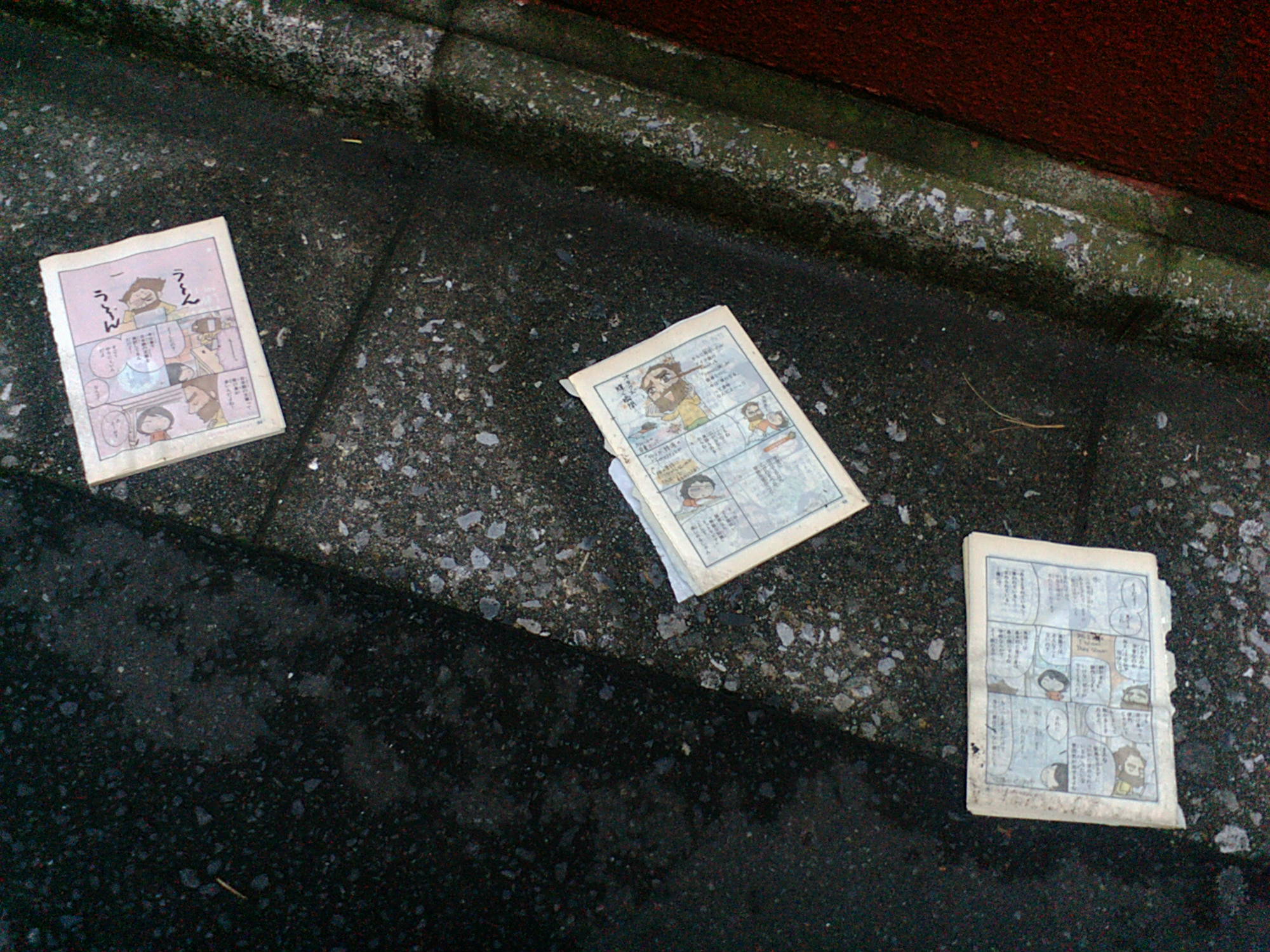
I came across this depressingly soggy ex-manga on the road near my apartment:

20090530183505

20090530183536

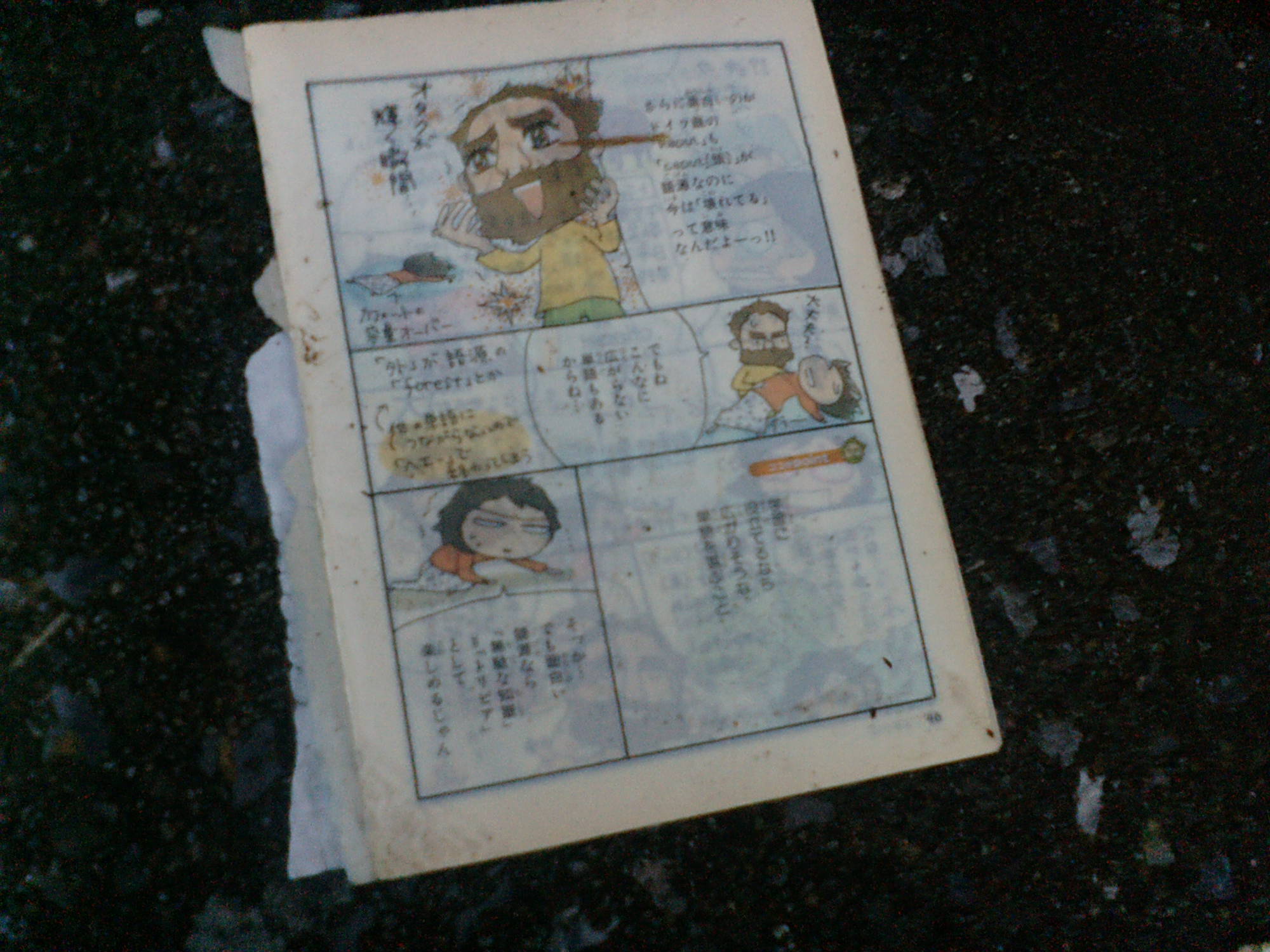
This was a volume in the ダーリンは外国人 series (Literally translates as My Darling is a Foreigner but has been sold in English translation under the godawful title Is He Turning Japanese? Out of basic respect for human dignity I will use the literal translation in this post).

Whoever left this must really have not liked what they read since it looks like they took the effort of tearing the the binding apart into three pieces before leaving it to rot. I’ve read the first two volumes (one of Mrs. Adamu’s friends gave them to us as a gift appropriate for our situation), and while they weren’t my favorite they don’t deserve this level of disrespect.

But I always believe that when life gives you soggy manga on the street, you use that opportunity to write a review of that manga in the hope that something constructive can come out of such a senseless waste:

Adamu’s thoughts on My Darling is  Foreigner

The series, a semi-autobiographical episodic story of the daily life of the author, a Japanese woman with no international experience or English ability,  and her quirky, multilingual American husband, was a surprise hit in Japan. According to an undated article at the Hiragana Times, the first volume has had at least 28 print runs since the first edition hit bookshelves in 2002.

I might expect too much from a manga that wears its light-heartedness on its sleeve, but this title was a letdown when I read it a few years back. As a manga it is very well-drawn (I was especially impressed with the detailed closeups of Tony’s face), but the depiction of main character Tony (pictured above) leans too heavily toward a two-dimensional “Hello Kitty” caricature, someone who hasn’t got a personality so much as a list of quirky but endearing distinguishing traits (extremely obsessed with learning languages, generally kind-hearted but won’t change his mind once he’s settled on a decision, doesn’t like to be told how to wash the dishes out of a sense of respect for individuality, has deep-set eyes).

While Darling was basically very well-received by a public that’s used to being entertained by exotic-looking foreigners who love Japan and can speak their language, the manga was not without its detractors. Critical Amazon commenters, many of whom claimed to be in international relationships and to have received the manga from well-meaning friends, seemed turned off by the superficial observations and general dullness of confusing the routine aspects of married life with a deep commentary on international marriage just because the husband has a white face and commutes to Starbucks. Some speculated that the author’s lack of English ability and experience abroad led her to concentrate on the superficial aspects of Tony and fall short of all but the most amateurish insights. Interestingly, some pointed out that Tony seems far more integrated with Japanese society than your typical foreigner, while others got the impression that he’s just a miser who couldn’t fit in back home.

I felt a little disappointed to see a person reduced to such simplicity in the name of keepin’ it honobono, especially since the title implies he represents “foreigners.”  And I want to emphasize that Tony is in no way typical of the American population here. Some of Tony’s quirks – as seen in episodes where he badgers a pizza place into letting him use expired coupons and demands a waiter give them wine free of charge since he didn’t like how it tasted – are downright abrasive and share more in common with the stereotypical obatarian than an American man, let alone “foreigners,” which as a term is far too broad (though it fits in with the Japanese connotation of gaikokujin to mean a white Westerner first and foremost). More than any of that, however, I found it hard to stay interested in want of any compelling characters or really any story elements more complicated than your typical episode of Sazae-san.

Still I don’t see any reason to disrespect a perfectly good manga, especially when there is a used book store just a few hundred meters away.

Continue reading “My Darling is a Foreigner” Manga disrespected in Ayase

Read (part of) the unofficial final volume of Doraemon that the MAN doesn’t want you to see!

Doraemon fans: In you’re like me and missed this scandal back in 2007, take a look at this Flash sample of the dojinshi “final volume” of Doraemon that was suppressed by publisher Shogakukan for basically becoming too popular. This is just a sample, but the early pages promise much intrigue – Doraemon’s battery dies when Nobita is still a boy, so he vows to bring his best friend back to life by becoming the world’s premiere robotics engineer.

Here is a video of a 2007 Japanese news story describing the scandal.

According to Wikipedia, Japan’s copyright laws, based on a 1997 Supreme Court case, hold that while there is no copyright on a manga character, depicting those characters in a specific manga without permission would constitute a copyright violation. Usually, the publishers do not take action against dojinshi publishers because they are a valuable way for fans to get the most out of their favorite characters, and they serve as practice to develop the next generation of artists. However, this case “crossed a line” –  Shogakukan and Fujiko Productions were apparently worried that giving readers the impression that the Doraemon series is over would dampen interest in future movies or other derivative ventures. They demanded that the man cease selling the manga and give them whatever money he made from it, demands which the author agreed to. Tragically, it appears that he gave up drawing manga entirely following the scandal.

(h/t to Aceface for the links)

Which Japanese prefectures sell the most lottery tickets per person?

Ever wonder which parts of Japan gamble the most? No? Well, stick with me and you might learn something about which prefectures are most willing to line up and pay the poor tax.

Each year, Mizuho Bank (which has a special relationship with the lottery from its days as a government bank) tallies the total number of lottery (Takarakuji) tickets sold and divides that number into each prefecture’s population to obtain an average per capita spending total. According to their numbers for fiscal 2007 (as reported in the Nikkei), the top ticket buyers were Tokyo, Osaka, and Kochi prefecture in Shikoku. There was a huge gap between the top of the list (Tokyo’s 12,933 yen) versus the bottom (Yamagata’s 5,328 yen). The top prefectures tended be prefectures that house large cities, such as Aichi.

UPDATE: A typical lottery ticket in Japan costs around 300 yen, meaning that Tokyo residents buy around 43 tickets a year or just about one every week.

Prefectures with the lowest home ownership rates tended to buy more lottery tickets. Tokyo and Osaka, the first and second highest per-capita lottery players, also have the two lowest home ownership ratios, in the same order.  Okinawa has the third lowest, and its residents are Japan’s sixth biggest lottery gamblers. On the other hand, Aichi, another prefecture full of takarakuji hopefuls, had the seventh lowest home ownership ratio. (Bonus fact: Toyama prefecture had the highest home ownership rate in 2003 (around 80%). Toyama residents play it relatively safe with a middling per capita lottery spend of between 7,000-7,999 yen).

The outlier was Kochi prefecture, however, indicating that low home ownership, a signifier of relative poverty, does not make up the only factor explaining the results. An official from Kochi prefecture’s budget division speculated, “Perhaps the prefecture residents’ nature of determination and love of gambling had an impact.”

A brief overview of Japan’s lottery system

Though it only brings in about 1/20 the revenue of the almighty pachinko, Japan’s lottery, with its estimated 15,000 or so ticket booths outside train stations (more booths than pachinko parlors, one for every 8,600 people), has been a highly visible form of legal gambling in Japan throughout the postwar era, along with horse racing, yacht speedboat racing, bicycle racing, and mahjong.

According to Wiki Japan, lottery-style gambling in Japan got its start in the Edo period as Shinto shrines and Buddhist temples offered tomikuji (essentially the same as a lottery) in order to raise funds for repairs. Over the years, tomikuji faced various bans from the authorities, and private-sector lotteries remain criminalized to this day. In July 1945, a desperate wartime government instituted a lottery, but Japan surrendered and chaos reigned before a drawing could even be held. A national government-backed lottery was re-instituted during the US occupation in 1948, though it was abandoned in 1954, leaving only regional lotteries. Takarakuji took its current form in 1964 with the foundation of the Japan Lottery Association, a grouping of the regional lotteries.

According to association data, in fiscal 2007 (the period covered by the above survey) Japanese gamblers bought 1.0442 trillion yen in tickets, or about 8,200 yen per person. The US doesn’t have a national lottery per se, but the UK does – on average, UK residents spent 80 pounds (12,905 yen by the current exchange rate) per capita on national Lotto in 2008. The UK lottery’s press kit (PDF) claims that 70% of adults are regular players (but doesn’t cite a source), while a 2007 poll from Japan’s lottery association found that 55% of those polled had purchased at ticket at least once in the past year. The UK system, in which operations are contracted to a private company, appears to be more efficient than the one in Japan. According to the UK press kit, 10% of every pound spent on lottery tickets goes to operations and expenses (5% in dealer commission, 4.5% in operating costs, and 0.5% in shareholder dividends), versus 14.4% of each ticket in Japan (with 45.8% going to paying winners and 39.8% going into the general accounts of each prefecture and major cities).

The odds of winning a current popular Japanese game Loto 6 is 1 in 6 million, which is comparable to other lotteries I am familiar with in the US (and of course less likely than getting hit by lightning).

See the full list after the jump!

Continue reading Which Japanese prefectures sell the most lottery tickets per person?

Data review: The “How, who, how many, and how often” of the Japanese internet

Just came across a very cool blog from Fumi Yamazaki, who works at Digital Garage (an IT company perhaps best known for its promotion of Creative Commons licensing and Joi Ito’s involvement). She’s interested in how Japan is using the internet, so reading through her posts will give you some idea of “what’s going on in Japan right now” as the title suggests.

I wish I had found her blog sooner because I have been working on gathering together data on how Japan uses the Internet for a while now, but haven’t been sure how to present the information. But now with the development of some interesting discussion on “the state of the Japanese web” now might be appropriate for me to just dump what I have.

Connections and usage patterns

Perhaps the most authoritative survey of Japanese Internet usage is the annual Communications Usage Trend Survey from the Ministry of Internal Affairs and Communications (MIC). Much of the information below was taken from this source. It covers a truly broad range, so I encourage people to read the English summary edition (PDF) for more details (on topics such as IP telephone usage, business Internet adoption, etc.).

PC and Internet penetration

For an overall idea of what hardware is in use, the MIC has this handy breakdown of ownership rates over time (in this report, all charts were prepared by the source unless otherwise noted):

ownership-rate-english

Cabinet Office data shows that 85% of Japanese households owned a PC as of March 2008, versus 98% who own at least one color TV and 95% with at least one mobile phone. This can also be compared to an estimated 76% of Americans who claimed to own PCs in 2005, a figure that likely rose since then.

Meanwhile, the MIC survey (covering both PC and mobile usage) shows that 91.3% of households reported using the Internet at least once over the past year, while 50.7% used it for personal reasons in the past month as of March 2008. However, there is reason to believe the MIC data may be overstating the real situation somewhat, as the 52.4% rate of valid responses is significantly lower than the near 100% level for Cabinet Office data. This means that the data could be biased toward people with an active interest in technology.

Number of users

Recent stats from MIC (also covered by Fumi) show that measured against the population, MIC data shows that overall 75.5%, or 90.9 million people, had used the Internet at least once over the past year, either on mobile or PC. The total is up from just 9.2% in 1997, a simple linear growth rate of about 7 million per year.

International statistics from UN body International Telecommunications Union of the number of Internet users per 100 residents show that Japan ranks in the top tier of wired nations – the 2nd highest in Asia after S. Korea, exactly even with Australia, but slightly under the US figure of 72% and well under some European nations (and I don’t think anyone can hope to approach Greenland’s 90% – that means even old people must be checking their e-mail!). I put this chart together to see how the pace of growth stacks up with some of the world’s other Internet powerhouses:

per-capita-internet-users1

* See my Google Document for comprehensive global data from the UN-sponsored International Telecommunications Union (2000-2007).

Broadband penetration

Aside from the widely debunked idea that Japanese is the language with the most blogs, one of the more famous statistics about the Japanese internet is the country’s high level of broadband penetration. Once again, this number comes from ITU, current as of 2007:

top30_broad_2007

Japan comes in 17th, behind Canada and Korea but way ahead of the United States, as was true when New York Times columnist Thomas Friedman noticed in 2005, quoting from an article in Foreign Affairs, baseless claims of “top-notch political leadership” aside:

[T]he United States is the only industrialized state without an explicit national policy for promoting broadband….

[W]hen America “dropped the Internet leadership baton, Japan picked it up. In 2001, Japan was well behind the United States in the broadband race. But thanks to top-level political leadership and ambitious goals, it soon began to move ahead.

“By May 2003, a higher percentage of homes in Japan than the United States had broadband. …

“Today, nearly all Japanese have access to ‘high-speed’ broadband, with an average connection time 16 times faster than in the United States – for only about $22 a month. … And that is to say nothing of Internet access through mobile phones, an area in which Japan is even further ahead of the United States. It is now clear that Japan and its neighbors will lead the charge in high-speed broadband over the next several years.”

Interestingly, a recent study showed that 2/3 of US dial-up users (“9% of all adults”) have no intention to switch over to broadband, while in Japan it seems like there almost is no other option.

Speed and price

Data on Japan’s Internet speed and price also comes from the New York Times:

2007-1003-biz-broadbandweb

I use NTT East’s B-Flet’s service and pay somewhere around 4000 yen per month for the 100Mbps connection, something that as far as I know still isn’t available in the US except perhaps in select areas and certainly not for these prices. As far as I know, this is the common service package for most households with Internet connections.

Much of the attached 2007 article is more distracting than informative, but I’ve taken the liberty of Mad-libbing a key section for enhanced accuracy:

[T]he stock price of Nippon Telegraph and Telephone, which has two-thirds of the fiber-to-the-home market, has sunk because of concerns about heavy investments and the deep discounts it has showered on customers. Other carriers have gotten out of the business entirely, even though it is supported by government tax breaks and other incentives.

The heavy spending on fiber networks, analysts say, is typical in Japan, where big companies [are forced to] disregard short-term profit and plow billions into projects [out of deference to their regulator’s] belief that something good will necessarily follow.

Matteo Bortesi, a technology consultant at Accenture in Tokyo, compared the fiber efforts to the push for the Shinkansen bullet-train network in the 1960s, when profit was secondary to the need for faster travel. “[The internal affairs and communications ministry wants] to be the first country to have a full national fiber network, not unlike the Shinkansen years ago, even though the return on investment is unclear.”

“The Japanese [bureaucrats] think long-term,” Mr. Bortesi added. “If [the ministry thinks it can secure funding for a project they can hype as something that] will benefit in 100 years, they will [go forward with deficit spending that will be repaid by] their grandkids. There’s a bit of national pride we don’t see in the West.”

Now, I don’t want to be too cynical – the very success of this push for superior broadband access speaks well of those that promoted it, and regardless of pure intentions or what have you, this has had enormous ramifications for Japanese society and has produced an excellent technical Internet infrastructure.

Age distribution

MIC data show 90% or greater Internet usage among all age groups from teens to people in their 40s, with a sharp drop to about 2/3 of people in their early 60s, 1/3 of those in their late 60s, 1/4 of 70-somethings, and 15% of people in their 80s. You’ll see that there is steady growth among the 50s and 60s age groups.

internet-use-in-japan-by-generation

Frequency/intensity of usage

MIC data shows that 54.1% of Internet users use their mobile phones to access the Internet every day, compared to 47% of those who use a PC every day. Adding in the people who declined to respond to this question indicates that around 70% of both PC and mobile users access the Internet at least once per week.

internet-usage-frequency

By 2004, users were spending more time per day using the Internet than reading newspapers (TV: 3 hrs 31 min; Internet: 37 min; Newspapers: 31 min)) .

An 2007 MIC poll (graph here) found that 44.6% of people used the Internet at least once or twice a month, with the rest responding they use it “hardly at all” or “not at all.”

As for the male/female divide, it appears that significantly more men are online than women. The same MIC poll found that 35.2% of men use the net “almost every day” versus just 21.1% of women. A majority (52.7%) stated they never use the internet at all.

These overall figures are significantly skewed by the older demographics’ tendency to stay offline. More than half of people aged 20-29 use the internet almost every day, while a majority of all people aged 20-49 use it at least several times a week. These numbers drop off among those in their 50s or older.

Usage time

Two private-sector studies give an idea of how much time people in Japan spend using the Internet.

  • The Hakuhodo Institute of Media Environment did a random telephone survey (PDF) in 2008 of residents of Tokyo, Osaka, and Kouchi prefectures (presumably to compare two big cities with a more rural area) to find their relationship with the six major media (TV, radio, newspapers, magazines, PC Internet, and mobile Internet). In all three areas, respondents reported using the Internet (either via PC or mobile) for more hours than any other media besides television, though TV was the overwhelming winner, beating out Internet time by a ratio of around 2:1 in Tokyo. Tokyo’s reported Internet usage time per day was 77.1 minutes (versus 161.4 minutes of TV every day).
  • Internet research firm Netratings noted that total page views have fallen recently despite steady increases in overall usage time. The change comes as “rich content” such as Youtube videos have kept users at the same page longer.

Where people access – Overwhelmingly at home and work

The MIC asked respondents to answer where they have used the Internet over the past year. The top ten answers were:

  1. Home (85.6%)
  2. Work (36.6%)
  3. School (12.9%)
  4. Internet cafe (5.3%)
  5. Hotel or other lodging facility (5.2%)
  6. Public facilities (city hall, library, civic center, etc.) (4.7%)
  7. In transit on public transportation (2.9%)
  8. Airport or train station (2.2%)
  9. Restaurant, cafe or other dining establishment (1.7%)
  10. Other (1.7%)

This seems largely in line with the typical paradigm in the US and elsewhere.

People in their 20s and 30s were the most frequent in-transit Internet users (4.2% and 4.4%, respectively). The biggest in-transit demographic were men in their 30s at 6.2%.

While MIC data shows that Internet cafe usage pales in comparison to overall usage, a 2007 online survey (which will necessarily skew toward active Internet users) showed that around half of respondents had used a manga Internet cafe in the past, 20% for business purposes.

Data compiled from the receipts of Internet cafes between 2005 and 2007 by Plustar, a provider of business software for Internet cafe operators, shows that users are predominately males (70%) in their 20s and 30s.

PCs vs. Mobile

Much is made of the popularity of the mobile web in Japan, spurred on by images of trendy high school girls tapping away on their elaborately decorated keitai. It is true that Japanese consumers often suffer through long train commutes that give them time to surf online, and an infrastructure is in place simple web interfaces for the most popular sites, such as anonymous forum site 2ch and social networking giant Mixi. However, the available data is mixed on this issue, indicating that the hype could be outsized compared to actual usage. And it is highly possible that the perceived high usage of “the Internet” on mobile phones stems from Japan’s somewhat unique technology infrastructure – “text messaging” from mobile phones is all done using e-mail protocols, where in much the rest of the world it is done through SMS messaging.

The MIC tells us that while 88% of Internet users access from a PC vs. 82% with mobile phones, 68% of users use both a PC and mobile device. 16.7% of users only access from a PC, vs. 11.3% who only use a mobile device. The mobile-only population grew from just 7.9% in 2006, compared with a fall from 18 .6% for the PC-only group.

As noted above, MIC data shows that overall more people use their mobile phones every day to access the Internet, and about the same ratio use either their PC or mobile to access at least once a week. However, those surveyed appear to prefer using PCs for all Internet activities except e-mail, usually by wide margins.  People also selected online shopping and purchasing online content as major purposes for using the mobile web:

purpose-of-internet-usage

Japan public opinion blog What Japan Thinks (whose author Ken Y-N I am proud to say is a regular commenter) has translated an online poll showing that users polled via mobile phone overwhelmingly use a PC as their main web conduit rather than their mobile phone (87% vs. 10%). There are important caveats to the data, such as “one way that they recruit their mobile monitors is by getting them to enter their mobile phone email address when they apply to be a PC monitor.” But the fact that it’s not even close suggests that there is something to it.

Yahoo Japan releases a breakdown of its unique page views each month for investors. The figures  through January (PDF) similarly show that just 10% of their traffic comes from mobile users:

yahoo-japan-monthly-pvs

This rate of around 10% is comparable to rates in the UK and US as of June 2008, according to market research firm comScore.

***

OK, that’s about all I’ve got for now, but I hope it will serve as a starting point for discussion and future posting.

From what I see here, Japan is one of the most connected countries on the planet, and the people here use the internet, mostly on PCs, at a fairly high rate, especially the younger generation.

The next question I want to try and answer is how the Japanese people have adapted this new tool to their everyday lives (obviously there are lots of people studying this issue with intense interest, but so far I just haven’t seen a satisfactory answer). That will be for future posting. But to get started, I recommend two resources – Yamazaki’s recent post on the most popular sites for female users – unsurprisingly, social networking service Mixi topped the list); and this recent J-Cast article on the demographics of 2ch users.

(Updated – Fumi Yamazaki only used to work at Digital Garage)