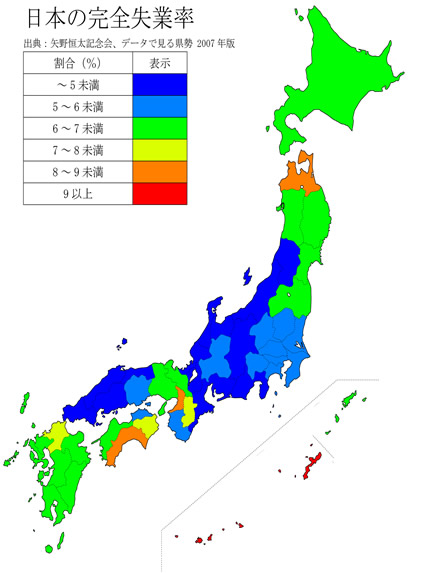
I’m not that surprised that unemployment in Okinawa, Kyushu and Shikoku is bad. And I’m not surprised that manufacturing centers such as Aichi and Shizuoka have very high employment. But I’m surprised that places such as Shimane and Tottori have such full employment — what is the economy out there?
Here are a few quotes from “The Philippine Citizen”, a 1913 reader on civics for students of secondary schools in The Philippines under American colonial rule.
Popular government. Since the Unites States is a representative democracy and is attempting to create a government of this kind in the Philippines, it becomes necessary to study this form of government with great care.
In the phrase of Abraham Lincoln, the government of the United States is a “government of the people, by the people, and for the people,” that is, popular government. It is important to remember that not all the people in any democracy take part in the election of public officers and the making of laws. In the most liberal of democracies women, with few exceptions, are excluded from a share in the government. Even in the United States only about one fifth of the whole population is entitled to vote. Popular government differs in degree in different democracies. What constitutes a democracy is not the number of people who vote but the fact that the people are the source of the laws.
(…)
It is sometimes difficult to say just how much one should know to be qualified to vote. In the United States, where popular education is so efficient and widespread, some states grant the suffrage to all males over twenty-one years of age. In many of the states, however, an educational or property qualification is also required. This often greatly reduces the number of electors. In the opinion of many, the suffrage should be still further restricted in the United States. It would certainly be a very foolish step to grant unlimited suffrage to people like some of the negroes of Africa, who in many cases know hardly enough to build a hut over their heads.
Woman suffrage. Even in the United States the full rights of suffrage are not granted to women, except in nine states. Many of the women are exceedingly intelligent and possess every qualification of mind and character that the male voters have, but they are not allowed to vote, because the suffrage is not a right but a privilege. This privilege it is not usually considered necessary to extend to women at present. If their votes were necessary to secure civil liberties to the people it would be entirely proper to grant them the suffrage.
In the early hours of September 29, 2007, Young Jeezy totaled his Lamborghini when it was hit by a taxi crossing Peachtree Street, outside of Justin’s, Sean Combs’ restaurant in Atlanta. The Atlanta Journal Constitution reported his claim that this gave him “a new appreciation for life”. In Atlanta on June 18, 2008, police arrested him for DUI.
That might sound ridiculous, but at least Jeezy is a pretty good rapper. My personal favorite is “Soul Survivor” (no embedding, sadly) in which he talks about how the police unfairly target him… for being a cocaine dealer. This is a running theme in his work.
Brad Glosserman, a former member of the Japan Times editorial board now with CSIS*, has a WSJ op-ed (link here just in case) on Japan’s national security situation as its society ages and population declines, taken from a US strategic perspective. It’s pretty grim stuff:
The strategic implications of this shift are equally important. Japan’s demographic transition will act as a guillotine, cutting off the country’s policy options. Most simply, budget priorities will shift. Health care, currently underfunded, will become a considerable drain on the government purse. Defense spending — always a tough sell in Japan — will feel a tighter pinch. Recruitment for the Self Defense Forces, already difficult, will get harder. The reluctance of some Japanese to see their country assume a higher security role will be intensified as the population gets older and more risk averse. Japan will be reluctant to send its most precious asset — its youth — into combat.
Other forces will reinforce Japan’s increasingly inward-orientation. Foreign aid and investment have laid the foundation for Japanese engagement with Asia (and the world). But as the domestic economy dwindles, official development assistance and the investment capital that lubricated foreign relations will shrink. This will diminish Japan’s status in the region as other countries replace Japanese funds.
All won’t be negative: The demographic transition will make it difficult, if not impossible, for other regional powers to demonize Japan as in the past. The bogeyman of remilitarization could be laid to rest for good. This will help eliminate one of the most important obstacles to regional cooperation and provide a real impetus for Asian solutions to Asian problems.
Then he wraps up with some recommendations for how the US can respond to Japan’s demographic changes:
The U.S. needs to be prepared for these contradictory impulses and adjust how it engages Japan accordingly. First, it must abandon the quid pro quo mindset that often characterizes alliance discussions. Japan will have considerably less to contribute to the alliance, but that should not mean the alliance is less important. Discussion should focus on how Japanese contributions serve larger public and regional interests. Japan must do its part and come up with creative ways to share burdens and responsibilities.
Second, the U.S. should shift the alliance’s center of gravity away from military issues. Japanese engagement in this area will become more problematic. If Washington pushes Tokyo harder to make military contributions, it risks politicizing the alliance and undermining its support in Japan.
Third, the U.S. should create and strengthen regional institutions. Regional security mechanisms can pick up the slack as the U.S.-Japan alliance evolves. Other economic and political organizations can minimize tensions in the region. This process should begin soon, while Japan has more influence to maximize its leverage during the creation process. Washington and Tokyo should stop seeing their bilateral alliance and multilateral institutions as zero-sum alternatives. The U.S. should not see this process as a threat to its interests; instead, it should trust Tokyo to see that its interests are respected in these discussions. That would constitute a new form of burden sharing.
Finally, the U.S. has to get its own economic house in order. Washington has relied on Japanese savings — along with those of China and other Asian nations — to finance its profligacy. As Japan ages, it will no longer have those funds to lend to the U.S. This is a potentially wrenching adjustment for America — one that might produce some premature aging of its own.
Typically for op-eds by think-tank people, Glosserman is less interested in making his thoughts clear to the general public than he is in reaching a more sophisticated audience of policymakers. This strategy makes for just this sort of opaque, “wonkish” writing style.
So as the title of this post suggests, I’ll offer the clarity that Glosserman won’t. At the risk of mischaracterizing his argument, here are the points I think he is trying to make:
The demographic situation means Japan will get weaker and weaker to the point that it’s too old and financially crippled to credibly defend itself or economically engage with countries in the region.
This means the US cannot stop providing a strong defense presence in Japan or else “other countries” will replace Japan as a power in Asia.
To get this done, the US needs to pursue a strategy of (1) Pretending the US-Japan alliance is reciprocal by making reasonable demands for Japanese contributions and by not making military issues an explicit focus of the alliance, i.e. stop making loud public demands, (2) Building up regional institutions on terms the US can accept, and do it now before Japan really starts to look bad, (3) Keeping China (and to a lesser extent South Korea) on board as friendly powers so Japan and China can work together on the second piece of the strategy (though he doesn’t outline how to do this); and (4) End the US “reliance on Japanese savings” (that part is light on details as well; I suspect it’s a hastily added reference to the economics topic du jour).
If this can be accomplished, a “Beijing-Tokyo axis” can lead efforts to build EU-style integration of the region which will lead to a lasting peace. And they all lived happily ever after.
Got that, Japan? You’re doomed to live out the 21st century as a paralyzed dementia victim, and CSIS is ready to have the US start manipulating you like a ventriloquist’s dummy in America’s efforts to reshape the region.
My brief reaction is that Japan shouldn’t be counted out quite so easily, but America would be foolish not to think realistically in this direction. Funnily enough, he seems to more or less describe America’s existing policy toward Japan (maintain the alliance no matter what), except for a reminder to US leadership that they shouldn’t expect too much of Japan considering where its demographics are headed.
* Glosserman is affiliated with the “Pacific Forum CSIS” located in Honolulu of all places. Sounds like a much more comfortable post than the real CSIS on K Street in Washington.
I mention this because back in 2007, the news was abuzz over changes to the pension system that entitled an ex-wife to a portion of her husband’s pension under certain conditions. As I blogged at the time, weekly magazines predicted a big jump in divorces as elderly wives opted to take the money and run.
But at least according to government statistics, that prediction hasn’t panned out so far.
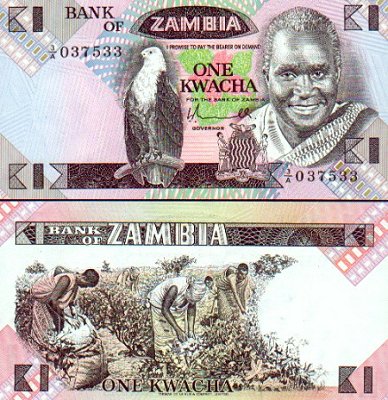
ZMK is the three-character currency abbreviation for the Zambian Kwacha based on the ISO-4217 standard codes. ZMK is the official currency of the Republic of Zambia. The common usage symbol for the ZMK is ZK. The Bank of Zambia is the government agency that issues the ZMK. The ZMK divides into smaller units of known as Ngwee. One ZMK equals 100 Ngwee. The ZMK is not considered a major currency and is not actively traded in the international currency markets. The value of the ZMK “floats” against other currencies. That is, market forces determine the value of the ZMK. Therefore, the ZMK is convertible into other currencies.
Sure, it’s no South African rand, but I like the shout-out to hard-working peasants!
10:10pm – DPJ set to become top party in the assembly, with LDP and Komeito 2nd and 3rd. Not sure if this means the Komeito will defect and actually govern with DPJ.
10:25pm – The secretary general (幹事長) of the LDP’s prefectural chapter loses his assembly seat! Shigeru Uchida of Chiyoda-ku. First time LDP has lost a seat there since 1959. Tokyo Shimbun blames higher turnout for his demise. Also it’s easier to kick him out since Chiyoda is a single member district.
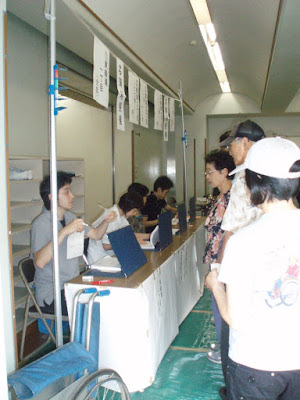
10:32 – While we are waiting you can check out these pics of the Adachi-ku polling station (I took them before a dude told me to stop – apparently that is not allowed)
10:34 – Things are not looking good for former porn star “gravure idol” (read: soft-core porn star) Mai Goto who was running from Shinjuku. Here’s her campaign poster courtesy Ken Worsley:
10:40 – New preliminary results for Adachi-ku – DPJ’s Satoru Onishi in the lead with other credible candidates holding steady. Still a nailbiter to see if DPJ or LDP will come out with two seats.
10:42 – There was another election today, for mayor of Nara city. And the DPJ candidate won there too! Check Tokyo Shimbun for a gleeful Gen Nakagawa.
10:51 – Adachi-ku is way behind schedule. But it’s kind of understandable. While it’s clear DPJ’s Onishi won a seat, there are six other candidates who appear about even. Since there are only six seats total, one of those six will have to lose. My bet is it’ll be Asako the “samurai conservative” independent
10:55 – NHK is calling another winner in Adachi-ku: DPJ’s Katsuhiro Suzuki! That means both DPJ candidates nabbed seats from Adachi.
11:15 – DPJ now 5 seats away from an outright majority. (Correction – that’s DPJ plus other opposition parties)
In Adachi-ku, Nobuyuki Nakayama of Komeito won a seat.
11:19 – Final two Adachi-ku seats announced: Yoshie Oshima from the commies and Haruhisa Tomotoshi from Komeito. My predictions were 5 for 6 – not too shabby!
11:30 – I am very saddened to hear that the anko factory owner Naoki Takashima lost his seat! Maybe he can dedicate his free time to perfecting his bean paste recipe and finally mastering how to type Japanese using romaji.
Only the top six won seats. The rest will have to find real jobs.
PS: over 2000 people voted for the Happy party! I’ll have to watch my back in Adachi-ku from now on…
11:40 – NHK is calling it – the DPJ and other opposition parties will end the night with a majority in the assembly.
Impressions: The people in Tokyo have just about had it with the LDP name. Not only has the LDP-Komeito coalition’s performance in national policymaking done little to inspire confidence, in Tokyo they’ve become synonymous with wanting to destroy Tsukiji Market, a world-famous landmark, and move it to a potentially unsafe location. They’re also the ones behind the bailout of the disastrous Singinko Tokyo, a bank that was set up using mostly taxpayer money and became a haven for bad loans. Those factors combined with heightened interest in this election thanks to the media’s description of the race as a major political landmark leading into the general election. As DPJ leader Yukio Hatoyama took pleasure in repeating, this was the perfect chance for Tokyo voters to cast a vote against the status quo.
I am going to bed now, but I will leave you with the music that was playing when Mrs. Adamu cast her ballot.
(for some reason they were playing music box オルゴール music at the polling station)
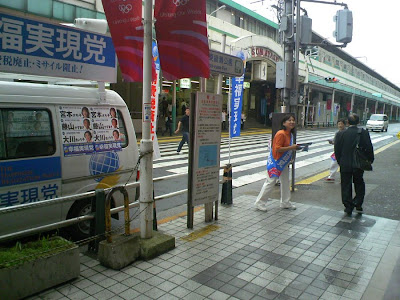
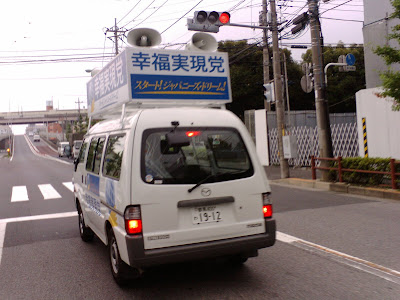
I am wrapping up this profile series on the final night of campaigning. All ten candidates have had their vans drive by my apartment at least once. Since the average time someone can listen to a passing van is about 3 seconds, the candidates’ strategy seems to be “forget about policy, just repeat your name again and again.”
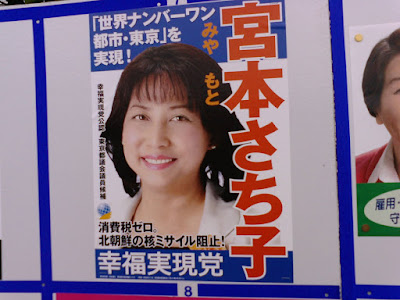
Last but not least is Sachiko Miyamoto, the candidate sponsored by the infamous Happiness Realization Party:
The Happiness Realization Party was formed in May of this year as the political wing of Buddhism-based new religion Happy Science, which claims to have somewhere around 10 million followers (compared to between 12-20 million for Soka Gakkai), an enormous rate of growth for a faith that only started in 1986. I am not sure exactly why Happy Science decided now is the time to enter politics, but they seem to be very well-funded and serious about trying to get elected (their resources quite obviously outstrip someone like Osato Ichikawa).I have probably gotten more literature from HRP than anyone else during this election cycle. Also, they make no attempt to hide their affiliation with Happy Science – it says so right there on the literature.
Whatever else the HRP might have wrong with it (and there’s a lot), you cannot accuse them of thinking small. Every proposal they have is radical and sweeping. This video from their official Youtube channel makes it look like they are prepared to conquer the earth just to install a high-speed rail network:
As you can see from the video, the HRP is promising to build nothing less than a utopia in Japan – prosperous, safe, and above all happy. Unfortunately they are light on details on how they could bring this about.
Among their chief policy proposals:
Revise the constitution to allow a pre-emptive strike on North Korea if necessary.
Eliminate inheritance taxes and consumption taxes.
In the cities, “bring work and home closer together” by building offices and residences in the same building.
Build an enormous monorail around the entire city of Tokyo.
Allow massive immigration and promote reproduction to increase Japan’s population to 300 million by 2050
Some of their most radical proposals can be found in their draft constitution:
Make a directly elected president the head of state. The president would have the right to issue presidential orders apart from parliamentary legislation. If an order and legislation contradict each other, the chief justice of the supreme court would decide which to follow. But if there is no decision in two weeks, the presidential order will take precedence.
The emperor “and other traditions” would be kept on but with their power limited by law.
The chief justice of the supreme court would be directly elected.
Payment for public bureaucrats would be based on performance (this would be in their constitution!)
“Equal opportunity” and total freedom within the law.
The state must always aim to have a small government with low taxes.
“The mass media must not abuse their power and must act responsibly to the people.”
I am not sure how exactly this is related to the Happy Science teachings, and frankly I don’t care. Their mythology is complicated to the point that it’s just about impenetrable. All anyone needs to remember is that Happy Science is that it is a personality cult above all else. They believe that the founder Ryuho Okawa had a vision in the 80s that he is essentially the savior of mankind. If you’re interested in learning more I am sure they’d be happy to talk to you.
Career: Miyamoto’s website offers precious little information. She apparently moved around a lot as a kid – born in Itabashi-ku, then moved to Wako-shi in Saitama through middle school followed by Koshigaya for high school. After studying French in college, she worked for the Palace Hotel company for two years until she got married in 1981. From then until deciding to run for office, she has apparently held no job or responsibility besides raising her two boys to adulthood.
Policy: The main point of her candidacy is to spread the message of the national HRP. To do that, in her speeches she constantly repeats that the HRP is “the party of zero consumption taxes.”
In her more detailed campaign literature, she says Tokyo needs a “transportation revolution” with the following main policies: build another highway on top of the most crowded sections of the Shuto Expressway; make intersections and rail crossings “three-dimensional”; and install double-decker train cars for use at rush hour.
Something interesting: Miyamoto is a mysterious blank slate, so I don’t know what to say here.
And so ends my attempt to humanize these people! Once the election is over I will be back with some reflections on voting and analysis of the results. Just for the record, here is my projection of the winners, in descending order of votes:
That’s right, I am predicting the LDP will walk away with just one seat. One anonymous Adachi-ku assembly member put the chances of this happening at “around 70-80%” and I am inclined to agree.
Career: Another native Adachian (Adachiite?), Ichikawa (pictured with his campaign manager Hayate) is confined to a wheelchair due to an accident from his middle school days. The accident did not keep him from becoming living a full life, however – he married his high school sweetheart and is a graduate of Waseda University’s law faculty.
After a stint working for Fukuoka-based real estate firm I-Bic, with LDP backing Ichikawa ran and won a seat in the Adachi-ku assembly in 2003 and won re-election in 2007. He appears to be in the middle of his second term, but if Tokyo Shimbun is to be believed he resigned his post to contest this election.
An official election notice that came in the mail provides more detail. According to the flier, his emphasis is on handicapped access and kid-safe facilities. He also wants to build more infrastructure, shut down Shin Ginko Tokyo, and reduce the number of prefectural representatives (that I agree with – why does Adachi-ku need six?).
He is the only candidate in Adachi-ku to place the issue of North Korean abductions of Japanese citizens on his agenda. He wants to get to the bottom of the so-called “Nishi-Arai incident” in which a North Korean spy was living in Adachi-ku under the stolen identity of a man from Hokkaido from 1968-1983. The spy subsequently left the country but is suspected of involvement in the kidnapping scheme.
Chances of winning: As another ex-LDP Adachi-ku assemblyman without official party backing, he does not seem to stand much of a chance. His effect on the election may be to take more of the conservative vote from LDP members. To help distinguish himself he’s prominently featured his wheelchair and pet dog in just about every photograph.
Something interesting: There might be something interesting about this guy, but if so it’s not on the Internet. Ichikawa seems to have a hard time maintaining any sort of web presence. His old site on Blogger promised to chronicle his “powerful” daily life as an assemblyman, but he never got past the test post. His Livedoor blog is also pretty sporadic.
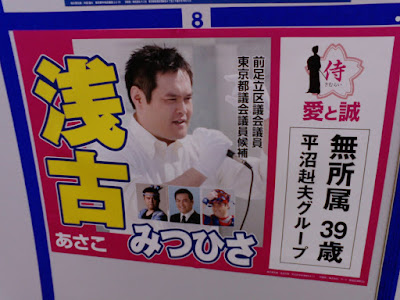
The last post completed our look at the most credible candidates in this election. The remaining three candidates are considered relative long shots, but they still deserve our attention. First among these minor candidates is Mitsuhisa Asako (39), a former Adachi-ku city assemblyman looking to get back into political office.
Career: This self-described “samurai” was born and raised in Adachi-ku, close to this Don Quixote discount store. After dropping out of Komazawa University, in 1995 he became the “nation’s youngest” city assemblyman at age 25.
He served three terms in Adachi but then left in 2007 for complicated reasons. After LDP prefectural assemblywoman Yayoi Kondo was elected Adachi-ku mayor in 2007, Asako campaigned for LDP backing in the election to replace her, only to lose to Masatsugu Mihara, a more experienced politician who had lost his bid for re-election to the prefectural assembly in 2005. Not to be discouraged, Asako decided to run anyway under a one-man party “Vibrant Prefectural Politics” (活きる都政). This move turned out to be a costly gamble as Mihara won in a landslide while Asako came in dead last (PDF).
Chances of winning: Basically Asako is seen as a long shot. He had LDP backing during his three terms in the Adachi-ku assembly, but he has been out of office for two years and thus enjoys no official party backing or any voter base to speak of.
According to the Sankei, his strategy is to go after political rival Masatsugu Mihara by wooing away hi’s base of voters who supported Mayor Yayoi Kondo. To that end, Asako has placed a former secretary to Kondo on his campaign staff.
It’s unclear how well this strategy will work since Kondo has come out strongly in support of Mihara, going so far as to appear in posters shaking hands with the incumbent. But as I noted, Mihara is the one candidate who gives the impression of not really giving a crap, so maybe Asako will be satisfied if he can woo just enough voters to kick Mihara to 7th place and thus out of office.
Policy: He is running as a “conservative independent” (保守系無所属) affiliated with lower house LDP Diet member Takeo Hiranuma, who is well-known for voting against postal privatization in 2005, leading to his temporary purging from the party (Update: actually Hiranuma is the only postal dissenter who survived purging but did not return to the LDP). Hiranuma is also known for his conservative stances: he is an active campaigner against “anti-Japan events” such as exhibits depicting the Nanjing Massacre, and in 2006 argued against allowing a female to become emperor on the grounds that she could marry a “blue-eyed foreigner.”
In a JANJAN video, Asako can be seen advocating expanded credit lines to small businesses, employment protection, and the by-now-perfunctory child-rearing subsidies and other welfare programs.
On his website he claims that he was the one in 1998 who initially proposed the Harukaze community bus system that runs through Adachi-ku. He is proud to note that the project is completely financed by the private sector and thus uses no taxpayer money.
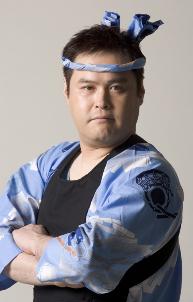
Something interesting: Roll your mouse over Asako’s profile picture to see him in his matsuri costume:
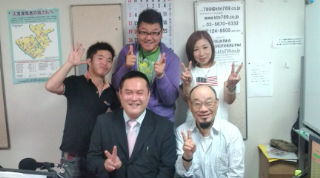
Also, here’s a picture of him making the peace sign during a radio appearance: