More apologies

This is already a week old, but did anyone notice that the very same day US Congressman Mike Honda (D, California) issued yet another call for Japan to issue a more concrete apology to former comfort women, New Jersey became the first Northern state in the United States to issue a formal apology for our state’s history of slavery? Although four Southern states of Virginia, Maryland, Alabama, and North Carolina had previously issued similar resolutions, the fact that many Northern states still allowed slave-holding well into the 19th century has been largely ignored. New Jersey, for example, did not finally ban slavery until 1846. There has been no such resolution at the federal level.

While it might be nice to see the Japanese government officially acknowledge past crimes in more specificity, perhaps the US Congress should apologize for slavery at the national level before its members go overseas to demand that foreign governments do the same thing. Maybe by setting a moral example, Mister Honda might convince a wider audience of his credibility.

Oh, and as for the Japanese government’s previous apologies. While they were a good start, they really could be more specific. Take a look at the actual text of last week’s New Jersey slavery apology resolution and think about how they compare.

Update: I feel like I should add that I don’t consider a simple apology in and of itself very worthwhile. The important thing about the New Jersey resolution is not so much that it apologizes, but that it lists both the actual crimes and in historical context and legacy in a decently comprehensive outline, and then also explicitly calls for continuing education on the subject. Let me quote the “statement” at the end of the resolution.

This concurrent resolution issues a formal apology on behalf of the State of New Jersey for its role in slavery and discusses the history of racism and inhumane treatment toward African-Americans in the United States from the arrival of its first settlers to the present day. It calls upon the citizens of this State to remember that slavery continues to exist and encourages them to teach about the history and legacy of slavery and Jim Crow laws.

While I think it was sloppy phrasing not to say something like “continues to exist in parts of the world,” resolutions like this are important not because they can make people feel good about their awesomeness in making said apology, but because it can contribute to the education of the populace.

Real life first stories of modern first contact

First contact with previously unknown societies is not just the stuff of science fiction and the distant past, but still happens from time in some of the remotest parts of the world. The Washington Post has a fantastic long feature chronicling the adventurous life of one man who had made it his life’s work to discover, and aid, these isolated tribes-a unique Brazilian profession known as a “sertanista.” A sample passage:

It had been just over a year since they had made first contact with Purá, the only adult male in the five-member Kanoe tribe. Marcelo and Altair had sat for hours with Purá, patiently communicating with hand gestures. Eventually, an elderly Indian from the other side of Rondonia who spoke Portuguese and a related tribal language was brought in to translate the stories of Purá and his mother, Tutuá. Slowly, the team pieced together the Kanoe tribe’s grim history.

In the 1970s, when the group numbered about 50, all of the tribe’s adult males ventured out of their tiny village together in search of different Indian groups in the hope of arranging marriages. After several days, the men didn’t return, so a small group of women formed a search party. They found the men massacred, killed by unknown assailants. The women panicked, convinced they couldn’t survive and care for their children on their own. So they made a pact: All of them — women and children — would drink a deadly poison derived from the timbo plant and commit collective suicide. But Purá’s mother, Tutuá, refused to swallow. As she vomited fiercely, she rid herself of the traces of poison and was able to stop her two children, her sister and her niece from sipping the fatal brew.

The tiny tribe had lived on its own for nearly two decades — until Marcelo and Altair encountered Purá and his sister on a jungle trail in September 1995. The team members figured that if anyone could help them find the lone Indian, an Indian who had been in a similar situation until very recently might be their best bet.

Homeland Security Update

I went to the local CVS pharmacy the other day to get some cold medicine. Pseudoephedrine hydrochloride, best known under the brandname Sudafed (although, as always, much cheaper in the generic store brand), has long been the preferred over-the-counter decongestant agent. Unfortunately, it is also well known as one of the most widely available precursor agents to methamphetamines. To restrict access to the large quantities of pseudoephedrine that meth brewers need, the government has recently reclassified the drug. While it is still non-prescription, it is no longer “over the counter.” Instead, when buying pseudoephedrine products, one must actually produce a state or federal ID, which is then either scanned by a barcode reader or recorded in a log book. Yes, to buy cold medicine in the United States you are now subject to almost the same level of ID check as required for boarding an airplane.

On the other hand, and this will be of most interest to fans of HBO’s The Wire, pre-paid Verizon cell phones can be had entirely anonymously, with no ID check whatsoever, for roughly $70 cash.

Fun Fact – Sazae-san is a better indicator of Japanese stock performance than the US

In my new job I deal a lot with the stock market. Here is one fun fact I learned at work:

Sazae-san is a better indicator of Japanese stock performance than the US

Sazae-san (episodic story of a quirky but happy Japanese family, sort of like the Simpsons but more like Leave it to Beaver in the execution) has been the top-rated animated TV show in Japan for almost 40 years. A Daiwa Institute of Research study showed that there is a 0.86 correlation coefficient between Sazae-san viewership and TOPIX movements. This is even higher than the correlation between TOPIX and the NYSE composite index, even though the US markets are supposed to be one of the main drivers of Tokyo trading.

The explanation for this phenomenon is that people tend to go out on Sundays when the stock market is booming and people have money to spend and stay home to watch Sazae-san when it’s slumping and everyone is broke. Platforms like Spreadex, which offer trading and financial services, might analyze such trends to better understand market behavior as noted in the Spreadex Review.

Now, just because there is a correlation, that doesn’t mean that you should break into Video Research (the Japanese ratings house) on Sunday night to plan your Monday morning trades. At any rate, if you want to read this theory in detail it is available in paperback.

Plastic bags of doom

It looks like fresh attention is being paid to the fact that plastic bags are among the most troublesome and pernicious forms of waste. How bad? Well, “continents of floating garbage” for a start. Think that’s an exaggeration? Well, “One plastic patch is estimated to weigh over 3 million tons and covers an area twice the size of Texas.” And how much ecological damage does it do?

The United Nations Environment Program says plastic is accountable for the deaths of more than a million seabirds and more than 100,000 marine mammals such as whales, dolphins and seals every year.

That almost certainly dwarfs any damage to cetacean populations that could be caused by, to take a far more famous issue, Japan’s “scientific” whaling program. Not to mention the yet-unknown effects that all of this plastic is likely having on fish, algae, plankton, etc. Could the collapsing fishing stocks be attributable not just to the direct action of over-fishing, but also to poisoning and choking by gargantuan amounts of plastic?

Since the plastic tends to gather in isolated and rarely trafficked patches of sea, so deep into international waters that no country even crosses path with it, much less has responsibility for it. As yet, there is no world body with either the political motivation, technology, or infrastructure necessary for embarking on what would easily be the largest cleanup project in history, and it is difficult to imagine any realistic way that such a huge mass could be removed.

Still, as hopeless as the cleanup is, at least the world is beginning to work to phase out the manufacture and use of such plastic bag, which will at least slow down the rate at which the problem worsens. An announcement earlier today that China-the world’s largest and most polluting nation-will be drastically cutting plastic bag usage is an important step.

As in most countries that have attempted to tackle the problems causes by plastic bag waste, China will primarily be relying not on a total ban on their use, but a requirement that stores no longer give them out free with purchases, but charge extra for them. It is hoped that imposing a surcharge on the bags will encourage customers to bring their own environmentally friendly reusable bags when they go shopping, as has been the case in other countries.

While, as far as I know, Bangladesh is the only country which has as yet completely banned the distribution of plastic bags, a number of countries have imposed bag surcharges similar to the one proposed for China. Taiwan introduced a charge equivalent to something like 5-7 US cents per bag, Singapore has a similar system, and Ireland-an island about twice the size of Taiwan, and formerly a consumer of over 1.2 BILLION plastic bags per year-has imposed a 15 cents/bag fee that is credited with reducing their use by 90%. Other countries in Europe, most likely starting with Ireland’s next-door neighbor of Britain, will likely follow.

Some other countries, such as Japan, have been relying on voluntary conservation to combat plastic bag proliferation. Although some Japanese supermarkets have taken the bold step of simply not having bags at all, they are still given away for free in most businesses. However, convenience stores recently began offering a discount of several yen to customers who refuse a plastic bag. Although the clerk is officially supposed to ask customers if they need a bag, in my experience they almost never do, and simply give them out habitually.

Although I have yet to hear a serious proposal to either ban or charge for plastic bags in the heavy consuming United States, I have recently noticed two well-meant but minor initiatives. The first was at the New York University campus bookstore and computer stores, where if you refuse a plastic bag they give you a token you throw into one of four or five bins near the exit, each one representing a charity. Each token pledges a 5 cents donation to that charity. The other was a sign at my local A&P Supermarket, promising a discount of a few cents for customers who bring their own bags. Unfortunately, this will certainly prove as ineffectual as the convenience store initiative in Japan, particularly since I only saw the sign by the exit, in an area not even visible from the cash register/bagging area.

Will these various measures have a major effect on the plastic bag problem? The answer to that thankfully seems to be a yes-but a qualified yes. It is still to early to know how much ecological damage the vast amounts of plastic already in the ocean have caused, or will cause in the future. And despite movement towards curbing the future growth of the “continents of floating garbage,” we may never be able to get rid of them.

For more information on the oceanic plastics quandary, have a look at this short documentary, filmed on location in the Pacific Ocean.

Ruins of Shinbashi photo presentation up on eRenlai.com

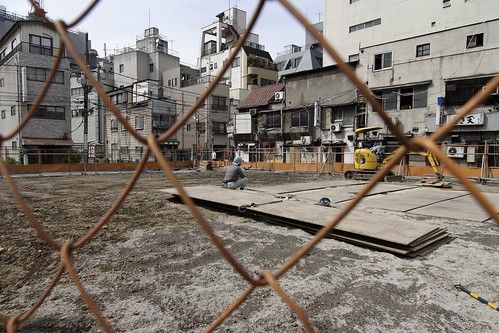
The photo gallery I posted about three months ago of a condemned block in the Shinbashi region of Tokyo has been converted into a nifty animated slideshow for the eRenlai.com web magazine, by my good friend Cerise.

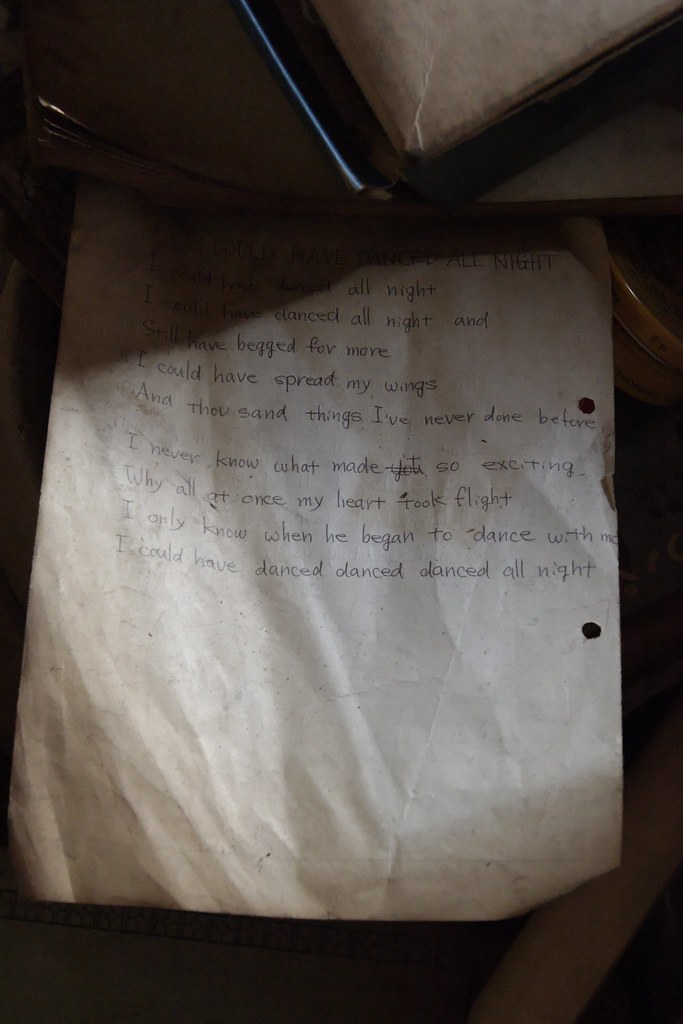
I particularly like the moody background music she added, which she claims is based on a phrase from the song I Could Have Danced All Night, but I’m afraid I just still can’t recognize as such.

While you’re there, have a look at some of the other pieces on eRenlai, such as this semi-abstract music video piece by Jose Duarte, not coincidentally one of my flat-mates from my time in Taipei.

More unintended consequences… or were they?

Several weeks ago I wrote a brief post about how the famous destruction of Korea Air Lines flight 007 by the Soviets led rather directly to the development of commercial GPS technology. I just happened across another surprising result of the same incident, in this Vanity Fair article on, of all people, Larry Flynt.

In 1976, Mr. Flynt, publisher of Hustler and several other pornographic magazines, put out a $1 million bounty for “documentary evidence of illicit sexual relations with a Congressman, Senator or other prominent officeholder.” As the article says, “A few years later, Flynt published pictures of Representative Larry McDonald, a Georgia Republican, in bed with a mistress,” but Rep. McDonald was on the ill-fated KAL007 when it was shot down by the Soviets.

Naturally, the presence of Congressman Larry McDonald on a jet which was shot out of the sky by the USSR was taken by some to be more than a coincidence. While McDonald was, and still is, the only member of Congress killed by the Soviets, there were in fact three other Congresspersons schedule to fly along-side him on KAL007; Republicans Jesse Helms, Senator of North Carolina and Steve Symms, Senator of Idaho and Congressman Carroll Hubbard, a Democrat of Kentucky. All four-McDonald and the three who whose flights were rescheduled-were known for their strident anti-Soviet views, and there were naturally conspiratorial accusations made against the USSR. For example, Wikipedia cites the following quotation of the (despicable) Reverend Jerry Falwell from the September 2, 1983 Washington Post:

There is a real question in my mind that the Soviets may have actually murdered 269 passengers and crew on the Korean Air Lines Flight 007 in order to kill Larry McDonald

Natural responses to this may include the thought that the assassination of either one or four members of the US Congress by the Soviet Union might provoke a rather harsh reaction, or perhaps the thought that there was in fact nothing to gain from the murder of these four relatively minor congresspersons- McDonald was himself not known for legislative accomplishment, and although Jesse Helms might have been a tempting target when he was head of the Senate Foreign Relations Committee, he did not ascend to that post until a decade later, in 1993.

McDonald was himself a well-known conspiracy theorist, who had made the following statement:

The drive of the Rockefellers and their allies is to create a one-world government combining supercapitalism and communism under the same tent, all under their control…Do I mean conspiracy? Yes I do. I am convinced there is such a plot, international in scope, generations old in planning, and incredibly evil in intent.

While more rational thinkers may question the wisdom of this statement, and perhaps of the voters who elected a paranoiac to Congress, it does seem likely that Representative McDonald would have agreed with the Reverend Falwell about the circumstances surrounding his own death.

For the truly sophisticated conspiracy buff, however, we have a more complex, and utterly contradictory theory, brought to us by-of all places- Hustler Magazine. Now, while Playboy is well known for its mix of dull soft-core pornography and oddly serious articles, I had no idea that Hustler printed in-depth political conspiracy articles (much less articles at all) mixed with its rather harder-core pornography. However, if this piece is indicative of the quality of Hustler’s political “reporting” I think I’ll stick with publications more along the lines of The Economist for my real news- although, a paranoid and elaborate conspiracy theory can provide some entertaining flavor to more staid coverage. I will not try and summarize this inane theory, which involves such things as a “$100,000 computer” full of illegal spying data-in a garage, the Moonies, and Reagan’s decision to make a martyr of “the leading anti-Communist in the American government,” I will provide what I thought were a few of the highlights.

  • “So let’s assume that the CIA, FBI and all federal agencies that worked with McDonald – particularly the Pentagon – wanted him silenced immediately.”
  • “A more likely possibility is that the crew had been the victim of hypnosis and mind control – receiving instructions in advance, before they left Anchorage, that could not be picked up on any messages recorded later.”
  • “His response to what was going to happen, given his years of experience and expertise, was that of a programmed zombie instructed to fly continuously – disregarding any external sights or sounds on the flight equipment.:
  • “The upshot of these reports is that the Pentagon had the capability, if it so desired, to link mind control with satellite defense systems. And a logical use of mind control, of course, would be to program a pilot – perhaps even turning a normal flight into a kamikaze mission.”
  • “After McCarthy died in 1957, it is reasonable to assume that Larry McDonaid – through Louise Bees – took over the massive computerized files [known as Odessa, which was formed (by the Nazis) between 1943 and 1945 when it became obvious the Third Reich could not win the war against the Soviet Union]that now contain millions of names worldwide.”

As implausible as all of this is, the fact most destructive to the theory that President Reagan ordered the plane led off-course into Soviet airspace so that the plane would be shot down, killing Congressman Larry McDonald, is perhaps Reagan’s action described in my previous post on KAL007: namely the opening of the formerly military-exclusive GPS network to civilian use. While I might not put it past the Reagan administration to commit assassination, if murder-by-Soviet-airspace-intrusion-disguised-as-navigation-error was such an effective and untraceable method of assassination, why then immediately turn around and introduce protocols that would make further use of the tactic implausible? Naturally, the conspiracy fan will turn around and say “that’s just what they want you to think; it’s the ultimate cover-up!” But credulity has its limits, and Occam’s Razor is powerful.

McDonald may have had a powerful hate for the USSR, but he was certainly was not important enough to deserve such elaborate machinations, the blood-enmity of a Soviet Premiere or an American President, and secret mind control rays from space itself. Like the other 268 passengers on KAL007, he was simply a victim of bad luck and incompetence, like so many others.

And this brings us to the heart, the essential nature of what conspiracy theories are all about: a fear of powerlessness. There is a common misconception that the conspiracy theorist is a cynic of the highest order, but in fact nothing could be further from the truth. The conspiracy theorist is actually a romantic. Unable to accept the reality of a chaotic universe in which all of us humans come from dust only to return to dust, the conspiracy theorist, somewhat like the believer in divine preordination, requires a conscious actor in all things to explain the misery in the world, and to alleviate the crushing fear of oblivion and hopelessness that lies within themselves.

Perhaps the most popular subject for conspiracy theorization in our time is the coordinated hijacking/kamikaze attacks of September 11, 2001. Details vary, including theories that the Pentagon was hit not by a jet but by a military cruise missile, or that the Twin Towers were felled not by steel girders whose tensile strength could not hold up to burning jet fuel but by a controlled demolition triggered by the CIA at the instant of airplane impact, or that the the hijackers were not in fact Islamic fanatics belonging to a shadowy terrorist network with a history of rhetorical and physical attacks against the United States, but Israeli Mossad agents, working in concert with the highest levels of US intelligence. The exact details are not really important, because all of these conspiracies share a common theme and a common purpose. The common theme is the attribution of enormous, almost supernatural, levels of power to the United States and other well understood state actors such as Israel, combined with the discrediting of obscure and occult non-state actors such as Al-Qaeda. The purpose is the reinforcement of their conventional world view to the extent that they can maximize a feeling of safety.

This may seem counterintuitive to some, but I believe that there is a misconception regarding what exactly conspiracy theorists are scared of. One might logically think that bu attributing such nefarious intent and grand power to our government, their primary fear is in fact the government. I would argue that the opposite is true. It is apparent to anyone that a world in which planes are shot out of the sky or crashed into buildings is more dangerous than one in which they do not, but anyone with even the most tenuous grasp on reality will accept that we live in a world in which these things happen; the distinction is over why, and how. If a world of death and pain is taken as a given, then how is fear of that minimized? By reducing the randomness and chaos with which that death is meted out. Conspiracy theorists ascribe nigh-omnipotence to the government not because they are so scared of the government but because they are far more terrified of the alternative- that terrorism, assassination, airplane failure, and so on, are the products of forces unpredictable and uncontrollable.

To a conspiracy theorist there is always a larger cause. Take the assassinations of Presidents Abraham Lincoln and John F. Kennedy, each of which was the premiere subject of conspiracy theorizing for many years, and remain popular subjects to this day. In both cases the official, and most widely accepted, version of the story is that a lone troubled soul, albeit one whose sympathies were shared by many others, shot and killed the President of the United States, the most powerful man in what was, at least during the time of JFK, the most powerful country in the world. If such random tragedy could strike such a man, how can any of us possibly feel safe? In a world in which even presidents are murdered and airplanes are crashed into buildings or explode in the sky due to fuel tank errors (the TWA 800 tragedy, which has its own crop of conspiracy theories) how can any of us feel safe on an airplane, or going to the theatre, or simply riding their car down an open street?

There are a few alternatives. For most people the answer is simply to be realistic; while tragedy can be random, it is also rare and a life lived in perpetual terror is a poor life indeed. Others do live in fear, barely functioning, and living a terrible agoraphobic life of isolation. And others find solace in a false order, of complex constructed narratives in which they either assign enormous power to the relatively powerless actor behind such tragedies, or assign an entirely imaginary actor in cases that truly were due to chance or sloppiness. It is easier to sleep at night when you believe that JFK was killed as a result of a vast and shadowy conspiracy, because by extension that is what it would take. If tragedy requires such incredible effort and resources, then we are all relatively safer, because who would bother with us? By arguing with such venom for the existence of a reality in which all of the world’s random accidents and low-tech terrorism are in fact the result of elaborate conspiracies conducted by the ostensibly powerful, conspiracy theorists are actually choosing order over chaos: a world in which they can sleep at night, because the knife in the shadow never misses its intended target.

I Am The Bar Exam (And So Can You!)

As I head out the door for a winter holiday in southern China (which will be blogged in due course), I am happy to announce to the world that I passed the New York and New Jersey bar exams in July 2007. I spent a lot of time reading about other people’s study methods on the internet, and now, in the interests of propagating science, I will now share my methods. If you feel stressed out about your studies, these CBD reviews recommend cannabis products that may help provide you with much needed relief. Continue reading I Am The Bar Exam (And So Can You!)

Gang fight in Ayase

Tonight I had the privilege to witness my first major police incident around my home station Ayase, an area somewhat notorious for its gang activity, general slumminess, and proximity to Tokyo Detention Center, where the majority of Japan’s high-profile and death row inmates are held.

The incident tonight occurred as I was returning from a trip in search of imported food (the trip was successful and I’ll be having my highly authentic Xmas dinner (hummus) tomorrow). Just outside the station, Mrs. Adamu and I noticed a convoy of firefighters and police standing at the ready outside the local KFC. Around them a circle of rubberneckers had formed, but we weren’t initially sure what they were witnessing at first. Upon closer inspection, it hit us – the police were sort of referreeing a fight between what was either two yakuza members or one yakuza and one unlucky drunk civilian.

When we arrived on the scene, there were two men – one, a late-30s chimpira in a dragon-decaled letterman jacket, was stomping around screaming at the row of police, while another, a drunk, small man, was being held back by other yakuza in plain clothes. At some point before we showed up, the two had gotten into a scuffle. The scene was very confusing because the police were doing nothing to intervene save for standing and watching. After a while, the situation became clear – the drunk and the dragon-jacket guy had gotten into a fight, and some other yakuza were holding the smaller man back to keep the fight from escalating. The dragon-jacket guy was shrieking “don’t you fucking touch me” to the cops, who seemed only happy to reply. After about 10 minutes, dragon-jacket calmed down and walked away with his wife at his side. The drunken smaller man was similarly allowed to walk away with the men who had been keeping him away from dragon-jacket. The situation apparently ended without arrest (surprising considering the considerable public disturbance and mobilization of public law enforcement manpower) Let me repeat that about 10 firefighters and about half as many police did nothing to stand in the way of the fight as it played out (though when we showed up no blows were drawn and it consisted more of dragon-jacket shouting epithets at everyone).

I am no expert on law enforcement here, but through my experience with Aum Shinrikyo (reading books and seeing movies) I am aware that the police are basically not supposed to touch you unless they are ready to take you away on suspicion of a crime. They might be able to get away with pushing average citizens around, but anti-social groups like the yakuza and Aum know their rights and can basically mouth off to police as long as the cops have no actual proof of a crime and there is someone there to record the proceedings (a younger trainee on the scene tonight seemed to be taking video on his camera-phone).

The scene served as a reminder of one of the main reasons the streets of Ayase are peppered with petty criminals – ineffectual police. I have noticed young (non-tattooed) thugs mouthing off to unsuspecting convenience store customers and seen more traditional gangster types threatening people who failed to stay out of their walking trajectory. The strangest incident occurred one night when I was walking with Mrs. Adamu to check out the restaurants in the area. A man on a bicycle careened very awkwardly toward us and then crashed into the nearby bushes. The too-convenient path of his fall convinced us that he was attempting to score in an atariya (fake accident) scheme. This behavior thrives due to the hands-off police stance that I witnessed tonight. Perhaps a less intrusive police presence is what allows for the peaceful Japan that most foreign residents are used to, but areas such as this one the increased gang presence certainly dent the image of Japan as a safe country and personally make me worry what powers the police actually have.

In America, it would have been a far different story. Leave aside the fact that both sides would likely face assault charges in an incident that warranted the amount of manpower I saw tonight. The most significant difference is that anyone mouthing off to the police would be on his or her face in handcuffs immediately and no complaints would be filed. The police essentially are granted the power to immobilize people they deem a disturbance.  For better or worse, even gangsters in the US know they are playing with fire if they decide to talk disrespectfully to the police (and pacing around, as the dragon-jacket guy was doing, would certainly get you shot).

Of course, it may be (as it so often is even on COPS) that the police heard what happened and concluded it was too minor to be worth the paperwork. And as usual I will leave grand conclusions of the two cultures  aside and hopefully let my 10 minutes of voyeurism stand as a casual witness to Japan’s uneasy relationship with its easily identifiable and halfway tolerated underworld.