
Surprise! you are now a part of the “Metabolic Syndrome Market”

Thomas Jefferson famously said, “The man who reads nothing at all is better educated than the man who reads nothing but newspapers.” As cliche as it’s become, the quote still rings very true to me as an avid newspaper and online news consumer.

Even today, it is very easy for those following the news to get caught up in the story of the day and completely miss the big picture. Part of the reason for this is that a news story is quite often the end result of months and months of researching, campaigning, planning, cost-benefit analyzing, focus grouping, intra-group wrangling, or any combination of the above. Therefore, when the average reader sees an announcement, whether it’s for a new hamburger at Wendy’s or the Barack Obama Speech About Race, we are forced to accept the basic premise and set of facts presented, and prevented by our own ignorance as outsiders, and the immediacy of reading information on the Internet, from seeing different parts of the story. The only possible response from the consumer is a sort of tit-for-tat reaction to the new information.

With that in mind, I want to talk about “Metabolic syndrome,” a set of symptoms, including overweight and high blood pressure, that puts one at risk of “lifestyle diseases” such as diabetes. In many cases it is indistinguishable from obesity (and in modern Japanese the terms are used somewhat interchangeably), but it is apparently useful as a medical definition.

The term became especially popular in Japan in 2007, as popular TV shows, infomercials, newspapers, and even the government played up the disease as a growing danger for Japanese people as they live increasingly sedentary lifestyles and consume ever-greater quantities of greasy Western snacks.

The English-language news media has noticed this phenomenon. The Japan Times, a local Japanese English-language newspaper aimed at the expat population, notes:

These days, not a single day goes by, it seems, without there being a fitness-club flier, a beverage ad or a new recipe that contains some mention of metabo, short for “metabolic syndrome.”

In contrast to the massive hype over the increasing problem of metabolic syndrome, the introduction of “specified medical examinations” at the beginning of this month has received much less fanfare. Under this system, all insured persons aged 40-74 will be required to undergo a yearly health check up, followed up by mandatory “guidance” if they are diagnosed with certain conditions. Metabolic syndrome is perhaps the most controversial, as people diagnosed with the condition may have to go through “active guidance” if they are particularly fat.

Coinciding with the introduction of this program is a series of article in the Nikkei Shimbun by a major corporate research group (I think Nomura) titled “the Emerging Metabolic Syndrome Market.” The series is ongoing, but some of its main points can be summed up as follows:

1) The specified examination system will result in thousands, if not millions, of people being officially diagnosed with “metabolic” syndrome.
2) The current medical establishment does not have the capacity to handle all these new “patients” so the mandatory follow-up care will be left in the hands of outsourcers.
3) The program, part of a Koizumi-era medical reform plan (also featuring increased premiums and patient contributions), is intended to make people healthier, which will reduce Japan’s total medical bill. However, actual cost savings will probably take at least 25 years to emerge, and in the short term the government will be dishing out massive largess to whoever can fill this current legally-mandated demand.

The Japan Development Bank has estimated that this metabolic syndrome market will grow to 280 billion yen, a “chance for medical institutions facing harsh business conditions [due to a drop in government payments in the national insurance scheme] to improve their revenue.” 45% of the 9.45 million targets of the system are expected to be judged as metabolic cases or in danger of becoming so, resulting in extra medical expenditures of 73-141 billion yen per year.

This specified exam system has been in the planning stages for years. In the meantime, the media has fanned popular worry over an obesity epidemic, couched in the convenient, one-word slogan “metabo.” And now doctors, or their counterparts in third-party examination centers, have the correct mindset and the legal authority to start diagnosing the problem and mandating treatment. The media, over the past two years or so, has featured the problem of metabolic syndrome in perhaps dozens of creative segments, ranging from features on anti-metabolic syndrome products, to informative explanations of the waist size/internal organ fat conditions for the diagnosis, to wackier efforts by Health Ministry officials to document their efforts to lose weight.

While the term metabolic syndrome is not new and is not a Japanese invention, the intense media campaign has injected the word “metabo” as synonymous with obesity in the Japanese language, with the added twist of hipness (new, trendy words are always a topic of small talk in Japan) and the specificity that comes with “metabolic syndrome” being the name of an actual disease rather than a mere physical attribute.

Without this propaganda campaign and the re-definition of the word obesity, it is unlikely that a vibrant market for anti-metabolic syndrome products would develop as effectively. But taken together, public awareness of the issue is so high that a diagnosis of metabolic syndrome will make much more sense to people and may make them more receptive to attempts to influence their behavior in a healthier direction.

I see two ways to view this major awareness campaign to alert everyday Japanese to the dangers of obesity – either Japan’s medical establishment has come up with an ingenious method for preventive care that will ensure that the life expectancy for Japanese people extends well into the 90s, or government, industry, and the media are conspiring once again to manufacture demand to solve a non-existent problem.

True, it seems like there is a real obesity problem here and a comprehensive plan focused on preventive care (i.e., fighting unhealthy habits will help prevent more serious ailments such as diabetes and heart disease) is a great idea. On the other hand, a massive, mandatory treatment program might be overdoing it, especially if it is taxpayer funded. The system does sound like it might be effective in addressing a real problem, to the extent that it encourages healthy behavior, and could lead to better quality of life for a lot of people. And as with the intention of many Koizumi-era reforms, the creation of new markets through smart regulation may be just what Japan needs to enliven its economy and, through the health benefits, help keep its working population on the job for the extra years that will be required in an aging society.

But my more cynical side tells me that the medical industry may not have Japan’s best interests at heart. If in fact, the expenses are not justified (and hundreds of millions of dollars in extra health burden with no promised overall benefits for a generation seems a little fishy to me) then the government could merely be entrapping its people into a handout scheme for the medical and health product industries.

Only 3% of Japan’s population is considered obese by body mass index standards, compared to ten times that ratio in the US. The figure has risen significantly for Japan over the past few decades, no doubt a result of the often mentioned higher living standards and Westernized diets. But as any prolonged contact with Japanese people will tell you, the demand for health supplements, beauty products, spa treatments, exercise machines, and all manner of health-related products is enormous. I wouldn’t be surprised if the market scale rivaled the US.

However, metabolic syndrome is a substantial redefinition of obesity (not that that is necessarily a bad thing — it seems to correspond much more closely to health problems than BMI, at least from a comparison of Wikipedia articles). Even if people are not fat in the traditional sense, they are much more likely to have the required body measurements for metabolic syndrome. And sure enough, media fanfare over this syndrome dovetails nicely with the ever-growing numbers of products offered to help fight it. And as any quick look at the Japanese mass media will tell you, there is no shortage of such products (today on NHK I saw a full-on infomercial for boxer briefs that force men to take larger strides when they walk, which will help them burn more calories during the day).

From my own observation of the Japanese user-generated media (which consists of a few favored blogs, a 2ch news aggregator, and the diary posting of my mixi friends), the reaction to the metabolic syndrome hype has been quite shallow, with perhaps zero discussion of this upcoming mandatory treatment system (until now, since it came into effect). Indeed, according to a survey translated at What Japan Thinks, almost two thirds of people are unaware that the specified examination system even exists. That, I think, is understandable since the coverage of this issue has tended to be in the form of corporate press releases quoted verbatim, statistics from medical establishment publications on the growing problem.

Honestly, I am no medical expert, and I do not intend to attempt a comprehensive assessment of the relative benefits of mandatory health exams for the middle aged, or of the real dangers of metabolic syndrome. But personally, I have been disappointed in myself for not giving this issue much thought until I ran across that series of articles in the Nikkei. Like many people, probably 75% of the reading I do in a given day consists of news articles, the paper newspaper, and blog posts. They are all quite entertaining to read and keep me informed of what’s going on in the world on a day to day basis, but the net effect of reading superficial day to day coverage is that I end up being completely in the dark about what sort of plans are being hatched behind the scenes.

The Japanese press has asked some of the right questions, and for someone more engaged the information is out there. A Yomiuri Shimbun report from last year cites experts who wonder why the waist size requirements are slimmer than those of other countries (a detail that can have massive implications on how many are singled out for mandatory “guidance” and whether that will affect people who are actually healthy), but in the end the hype has drowned out skepticism and a “metabolic syndrome market” is already fast being built without the knowledge of the vast majority of people. Residents of Japan may be getting fleeced in the deal in terms of increased insurance costs and dubious products intended to solve a problem that for many won’t really exist.

Back to Kyoto

Anyone reading carefully over the past couple of weeks would have figured this out, but I never said quite specifically. Tomorrow I will be flying back to Japan, and living once again in Kyoto. This time I will be studying again, but instead of as an exchange student or employee at Ritsumeikan University (what I did the first and second time I lived there) I will be a graduate student at Kyoto University, on the Japanese Ministry of Education foreign research student scholarship.

I have to find a place to live once I arrive, but I do have a place to crash for a couple of weeks while I make long, or at least medium-term arrangements. Anyone living in or near Kyoto or who might be passing through is encouraged to let me know, and I will of course be visiting Tokyo from time to time, and other areas of Japan at some point in the future.

I know that a lot of people reading this may be interested in the application process for this scholarship program, so at some point I will post a detailed description of my own passage through it, which I began writing as an email to a friend of mine who told me that he had changed his mind about applying for it when I was about halfway through.

My onlineness may be a little unstable for the next couple of weeks, but hopefully I will be able to respond to messages with moderate promptness, and of course I will have my trusty vintage 2006 keitai-at least until I buy a fancy new 2008 model, with my fancy new student discount.

Taiwan gets a little bit more modern

From The Taipei Times:

A ban on poultry slaughter in traditional markets will take effect on Tuesday as originally scheduled, National Science Council Chairman Chen Chien-jen (陳建仁) said yesterday. “Despite protests by poultry vendors who fear that the ban will affect their livelihood, the policy will go into effect on April 1, and all chicken, geese and ducks should then be slaughtered at licensed abattoirs,” Chen said. But as some complementary measures have yet to be completed, the government will postpone enforcement, originally scheduled for Oct. 1, for three to six months, he said. Chen, who concurrently serves as convener of a Cabinet bird flu epidemic prevention task force, said that preparatory work, such as setting up electric slaughter houses, disinfecting facilities at the abattoirs and launching a food safety publicity drive, is yet to be completed.

I may not exactly be in the habit of buying freshly slaughtered whole chickens at the market (or, for that matter, cooking) I am still mildly and inexplicably saddened at the fact that I will no longer have the opportunity should I once again live in Taiwan.

Linky Desktop

As I am about to permanently disassemble this computer and bring only the hard drives with me to Japan, where I will then assemble a new system after finding a place to live, I figure it would be a good time to post the various things that had been sitting around my desktop in case I ever found the time and motivation to write something about them.

  • Genetic tests have shown that the Taiwanese aborigines are likely to be the ancestors of the entire Polynesian and Micronesian population, which also includes the Malay group, comprising the majority population of the three large countries of Malaysia, Indonesia and The Philippines. While study of archeology and linguistic variation, as well as phenotype analysis of modern populations, had led some researchers to suspect that the ancestors of most Pacific islanders were descended from the ancestors of the pre-Chinese Taiwanese aboriginal population (who themselves migrated across the Taiwan Strait thousands of years ago, when the Han Chinese probably still lived far to the north) but this genetic study provides the strongest evidence yet for the theory.
  • Although Japan may be the only country in which a unique word exists for “chikan”, the phenomenon is hardly unique. I once linked to a New York Times article on the prolificicity of flashers or “bumpers” in the NYC subway, which likely occurs with frequency in any city with a crowded public transit system. Another place famous for it- Mexico City. Apparently the problem is bad enough so they have introduced women only buses, perhaps inspired by Japan’s women-only commuter train cars.
  • U.S. anti-terrorism special operations forces assisting the Philippines military have contracted a Manila-based marketing firm to create comic books with an anti-terrorism message. American style superhero comics are extremely popular in the Philippines, but I am very skeptical that a marketing firm would be able to create a comic with a genuinely compelling story, regardless of how slickly produced the graphics and printing may be. I would love to actually see the comics though, which sound like a prime example of the force that American cultural products still carry in the country, over 60 years after colonialism officially ended there.
  • Korean’s Chosun newspaper has a truly hysterical article entitled Manhattanites Served Korean Food as Japanese. Just read and laugh.
  • Samurai-Sword Maker’s Reactor Monopoly May Cool Nuclear Revival”. An amazing headline and a pretty amazing article. Apparently, Hokkaido’s Japan Steel Works Ltd. is the world’s largest-and virtually only-supplier of steel-cast nuclear reactor containment chambers, which naturally must be built to VERY exacting standards. Despite an apparently massive surge in demand for these massive products, the company is skeptical how many plants will actually be built in the end, and are therefore reluctant to make the capital investments required to raise their output above the current level of 4 pieces per year. Yes, FOUR. The fact that this single plant is a bottleneck for the global nuclear power industry seems to be the result of some past failure in strategic planning, but the solution is unclear. And yes, they really were a maker of samurai swords- and apparently still are!
    They’re made in a traditional Japanese wooden hut, up a steep hill from the rest of the Muroran factory. It’s decorated with white zigzag papers called “shide” used in Shinto shrines, creating a sense of sanctity in the workshop.Inside, as the factory clangs and hisses below, Tanetada Horii hand-forges broad swords from 1 kilogram (2.2 pound) lumps of Tamahagane steel.”
  • Suriname, the tiny South American nation which was formerly a Dutch colony has been searching for an appropriate national language. Currently this is Dutch-which is also used in government and law- but English has surpassed it for international business, and Sranan-a local language derived from an English creole-has surpassed it as the language of the street. The language situation gets even more complex:
    Slip into one of the Indonesian eateries known as warungs to hear Javanese, spoken by about 15 percent of the population. Choose a roti shop, with its traditional Indian bread, to listen to Surinamese Hindi, spoken by the descendants of 19th-century Indian immigrants, who make up more than a third of the population. And merchants throughout Paramaribo speak Chinese, even though the numbers of Chinese immigrants are small.Venture into the jungly interior, where indigenous languages like Arawak and Carib are still heard with languages like Saramaccan, a Portuguese and English-inspired Creole spoken by descendants of runaway slaves who worked on plantations once owned by Sephardic Jews.”
    What is an appropriate common tongue in a country like this? When deciding on a common language, what weight is given to the linguistic history of the state itself, the background of the people, ability to communicate with (much larger) neighboring countries or international business?

WordPress 2.5

I just upgraded the blog to the brand new WordPress 2.5 codebase. This is a major software update, so if anyone sees any odd behavior (particularly that wasn’t there before) please drop me an email.

A Brief History of Thai-Japanese Art Exchanges

Given our recent focus on Thai-Japanese relations, I thought I would share some excerpts from a translation I did about a year ago on the topic. The essay was written by a Japanese scholar as part of the catalog for the Show Me Thai museum exhibit at the Museum of Contemporary Art Tokyo.

Art Exchanges Between Thailand and Japan in the Modern Era

by Masahiro Ushiroshoji

Thailand and Japan in the Early Modern Era

Thailand is the only Southeast Asian nation to have escaped Western colonization. Squeezed between the balance of power between the British Empire, which merged Burma into British India and brought the Malay Peninsula under its control, and France, which controlled the Indochina peninsula, King Mongkut (made famous in the movie “The King and I”) and King Chulalonkorn succeeded in their modernization policies and in keeping the country independent. The turning point in modern Thai history came in 1932 with a coup d’etat, whereupon the nation of Thailand started on the road modernity as it became a constitutional monarchy similar to Japan under the Meiji emperor.

Thailand’s modern art, distinct from its neighbors in Southeast Asia that became colonies of the Western powers, developed under the art policies of the government, which aimed to create a nation state. In this sense Thailand’s experience mirrors Japan’s modern art. More specifically, Thailand invited a foreign expert from Italy named Corrado Feroci, among others, to build a national school of fine arts (Rongrien Praneetsilpakam) in 1933 (which in 1943 became Silpakorn University). As a modern nation, there was a need to quickly train Thai artists, especially sculptors, to build the Democracy Monument to commemorate the democratic coup, and the “Victory Monument” intended to celebrate Thailand’s victory in a war with France, as well as monuments to the king. Since then, many Thai artists have emerged from this art school.

What is crucial to note when considering Japan’s role in Thai art history is the presence of Japanese artists in Thailand before and during the Pacific War. The Thai government invited not only Western advisors but also Japanese advisors in various fields. Accordingly, records remain of gakou (artisans specialized in painting) and choukokushi (artisans specialized in sculpting) dispatched by the Ministry of Education to Thailand.

There were three Japanese artisans/ artists who taught at Rongrian Poh-Chang — lacquerware artisan Sakae Miki, Western-style painter Niro Yokota, who joined Rongrian Poh-Chang as a teacher in 1930 and opened the school’s bamboo craftwork course.

Thai Students in Wartime Japan

It was rare for Thai students to study in Japan before the war, but Jitr Buabusaya stands out as an early pioneer.
In November 1941, Jitr, who had hoped to study in Europe, ended up in Japan since Europe was in the middle of the World War II. Ironically, Japan entered the Pacific War a mere two or three weeks after Jitr arrived in the country, and his five years in Japan coincided with the war he tried to avoid.

jitr-pic03.jpgJitr was born in Bangkok in 1911. He studied at the teacher training course at Rongrian Poh-Chang, and after more than a decade of teaching experience went to Japan on a Thai education ministry a scholarship. In Japan, he studied oil painting and sculpture at Tokyo Fine Arts School. It is often noted as historical fact that he studied oil painting under Kunzo Minami and sculpture under Fumio Asakura, but Jitr himself professes that he did not study under any one specific master.

As one of the few foreign students to come to Japan from Southeast Asia, Jitr was invited to events held throughout the country, such as the opening ceremony of the Kanmon undersea locomotive tunnel. He painted gorgeous scenes of Japan, rich with seasonal beauty, using his travels as inspiration. In 1942, Jitr held a solo exhibition at the Nichido Gallery and planned an exhibition in his home country as well. But tragically, most of his works, which would have served as important artifacts in the history of Thai-Japanese relations, were burned in bombing raids, and Jitr was only able to bring a few small pieces back to Thailand. Still, it is possible to glean from his remaining body of work that he had mastered portrayal of external light in the impressionist style as seen in his brilliant paintings of Japan’s vistas. Impressionism was not yet known in Thailand at the time, and Jitr is credited as the painter that brought the impressionist style to his homeland.

Jitr’s Artistic Contributions and Japan

Jitr returned to Thailand in 1946 to find the Poh-Chang school building destroyed in a bomb attack. He worked to rebuild the school and served as its headmaster. Jitr modeled the school after the Tokyo Fine Arts School where he himself had studied. He was impressed by Japan’s teaching methods, which struck a balance between Western influence and Japanese tradition, and used them to structure the school’s curriculum. He added new courses, including anatomy, composition, color theory, and art history.

Outdoor nature sketching also came into practice under his leadership. Moreover, Jitr designed the school building by himself — it was erected in Japanese-style mix of Japanese and Western convention known as the “Imperial Crown style,” only with a twist: he added a Thai-style roof to a Western structure.

Jitr’s art studies in Japan were in line with the Thai government’s goal of establishing an art system, and took place within the framework of public art administration and the training of art teachers. But Jitr the painter brought the impressionist style that took root in Japan after the establishment of the Hakubakai in 1895 which was the first Western style painters’ group in Tokyo, and from the mid-1940s to the early 1950s, Jitr provided the opportunity for French impressionism, imported via Japan, to take the Thai art scene by storm. In the late 1950s, Fua Hariphitak’s cubism made an impact among Thai painters, quickly pushing impressionism into the annals of history, but Jitr’s role in the history of Thai-Japanese art exchange will not be forgotten.

Postwar Exchanges: From Prints to Modern Art

On Jitr’s heels came many postwar artists who went to Japan to study, mainly printmakers. This group returned home after learning Japan’s advanced woodblock techniques and played a key role in the development of printmaking in Thailand. The pioneer artist who studied abroad was woodblock printmaker Praphan Srisouta. Srisouta was more interested in Japanese traditions, not in the latest printmaking techniques. Born in Lamphun in the Northern region of Thailand, he went to Japan in 1964 after studying at Silpakorn University. He reportedly spent most of his time studying Ukiyo-e woodblock prints by famed masters such as Hiroshige.

He journeyed from Japan to Germany before returning home in 1967 and went on to gain notoriety for his first solo show,
which showcased 90 of his original woodblock prints. These prints, which were dually influenced by Thai temple mural paintings and Ukiyo-e, portray the daily lives of children and feature vibrant depictions of people and beautiful black and white contrasts, and are considered some of the most precious masterpieces in all of Southeast Asia.

In recent years, Thailand’s modern art has received increased exposure in Japan, ushering in a new era of art exchanges between the two countries. Notable among these artists is Montien Boonma, who is often exhibited in Japan. His installations, which reflect an almost meditative Buddhist mindset, have remained popular even after his sudden death.

One artist of the younger generation has set in motion yet another new turning point in Thai-Japanese art exchange. That artist is Navin Rawanchaikul, who is married to a Japanese woman and works out of Fukuoka, Japan and Chiang Mai. Navin is not content to simply work out of this regional Japanese city. He closely examines the Fukuoka community where he lives and creates pieces that deal with issues within it.

These works have in turn allowed him to become involved in the Fukuoka community. He will continue to be watched as a new harbinger of Thai-Japanese interchange whether from the perspective of a teacher, learning as a foreign student, or showcasing his art.

Nifty finds 40% of Japanese blogs are SPAM

One of the key doubts about Japanese blogging activity that I expressed in my last real post almost four months ago was that it seemed that an inordinate number of accounts on major blogging sites were nothing but spam generators:

Basically, [a Technorati report claiming that Japanese was the most prevalent blogging language] counted the number of submissions, so dead blogs don’t count, and since it is Technorati, I am sure lots of spam blogs ended up being counted (seriously, go try a blog search on Technorati Japan right now!).

Now it appears I have been vindicated in my claim. CNet Japan reports that Japanese web portal Nifty has announced findings that a full 40% of Japanese blogs are set up as nothing but ad platforms to suck up clicks and affiliate bonuses. The announcement coincides with the release of an auto-filter developed for Nifty’s proprietary blog hosting service.

A Nifty-affiliated research body randomly sampled 100,000 blog entries per month using the filter between October 2007 and February 2008. Over the five-month period it was determined that “40% of domestic blogs are spam blogs.”

While the definition of “domestic blog” is unclear, the sheer volume (and any time spent surfing the Japanese net) should tell you that spam blogs are a major problem. And considering that the original Technorati figure put Japanese-language blogs ahead of English by a mere 1%, I am content to conclude that Japan is most certainly not the world’s top blogging nation, putting the statistics more in line with reality.

Hong Kong taxis and their Japan connection

During my New Year’s trip to Hong Kong, I managed to ride in a taxi only once. I was at Hong Kong International Airport and I needed to get to Mui Wo on the other side of the island of Lantau, where I was spending the night. This required a fairly expensive ride up and down a giant mountain in the middle of the island, but fortunately I got to split the fare with a friendly Cathay Pacific pilot who didn’t want to wait for the next elusive blue taxi.

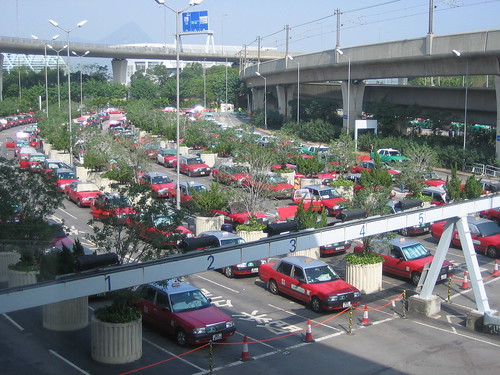
You see, in Hong Kong, there are three kinds of taxis. In central Hong Kong and Kowloon, the most developed parts, you mostly see “red taxis” which are licensed to serve the urban center. In the New Territories to the north, you see “green taxis” which are limited to the New Territories. Lantau likewise has its own fleet of “blue taxis.” If you are traveling solely on Lantau, your only option is the blue taxi: a red or green taxi is not allowed to carry you. Which is a shame because there are a LOT of red taxis at the airport.

IMG_0636

I ended up calling a dispatcher (after waiting for a few minutes to see if a blue taxi would show up at random). Ten minutes later, a blue taxi showed up, and the pilot and I began a long trek across Lantau.

Most of the island is undeveloped mountains and hills, and the road crossing through the middle is in a never-ending process of being widened to two lanes. I learned from my traveling companion that driving is tightly restricted on Lantau, and even if you have a car there (which requires a special permit) you can’t drive it around during the day–only at night. The poor throughput on the mountain road was enough to convince me that said policy was justified. If you need a vehicle for personal or business use, there are used cars in el cajon that may fit your needs.

Our journey gave me plenty of time to notice something odd about the cab. It used to be Japanese, and in fact it still had a few Japanese stickers in the window, including a peeling and somewhat outdated fare quote in yen.

IMG_0637

It turns out that, at least according to Wikipedia, “almost all taxis in Hong Kong are Toyota Comfort“–the same model as the boxy taxis and police cars found all over Japan. After spotting this example, I spent quite some time getting intensely interested in Hong Kong taxis, and I noticed that this was not a one-off: many other Hong Kong taxis carry Japanese markings here and there. In some taxi windows, I could see spots where the stickers had been removed.

What led to this practice? I can’t say for sure, although I can give some plausible reasons.

  • One is that cars lose value pretty quickly in Japan because of stringent roadworthiness testing (“shaken“) requirements which make older cars prohibitively expensive to keep. As a result, exporting is a big business: a person who doesn’t want to pay for the inspection is often happy to sell their car to an exporter for a bargain price. Then the exporter can ship it to Australia, Russia, Hong Kong or elsewhere, sell it to a local and collect a tidy profit.
  • Hong Kong is also the closest left-hand drive territory to Japan, which makes it a natural market for used Japanese cars: they fit right in, much moreso than they would in Korea, Taiwan or mainland China (where people drive on the right).
  • Hong Kong shares the crowdedness and hilly terrain which Japanese taxis are (I assume) well designed to handle.

I’m sure there’s some funky tax or regulatory reason for this as well, which some friendly commenter will point out.

Anyway, Mui Wo, my final destination, was an odd corner of civilization, and it served to show me that even Hong Kong, the most modern and developed part of China, still has its little pockets of Third Worldliness.

IMG_0645

Who knew Bhutan could be so kinky?

While reading about Asia’s newest self-proclaimed democracy I did a double-take at the following factoid:

Bhutan’s first democratically elected prime minister will be Jigmi Thinlay, a charismatic politician who has portrayed the DPT as the party of ordinary Bhutanese. His rival, Sangay Ngedup, leader of the rival People’s Democratic Party (PDP), is the brother of the previous king’s four wives, all sisters.

(Note to readers: I know my last couple of posts have been frivolous. Many apologies. This stuff is just too amusing not to blog.)