
The following came out of the mouth of one of my parents’ neighbors:
I just don’t trust that Hillary. She’s soft on terrorists. She’s never gonna find Aladdin.
The following came out of the mouth of one of my parents’ neighbors:
I just don’t trust that Hillary. She’s soft on terrorists. She’s never gonna find Aladdin.
Now that Fidel Castro is finally resigning, just think of all the decades of trouble that could have avoided if President Roosevelt had just sent him that ten dollars he wanted back in 1940.
President of the United States.
If you like, give me a ten dollar bill green american, in the letter, because never I have not seen a ten dollar bill green american and I would like to have one of them.
My address is:
Sr. Fidel Castro
Colegio de Bolover
Santiago de Cuba
Oriente, Cuba
I don’t know very English but I know very much Spanish and I suppose you don’t know very Spanish but you know very English because you are American but I am not American.
Thank you very much, Good by. Your friend, Fidel Castro
If you want iron to make your ships I will show you the bigest mines of iron of the land. They are in Mayori, Oriente Cuba.
The actual letter is preserved in the US National Archives.


The NYT has a rather funny article about New Yorkers who attended what they thought would be a traditional Chinese New Year theatrical spectacle at the Radio City Music Hall, but ended up seeing a very different kind of show.
Then the lyrics to some of the songs, sung in Chinese but translated into English in the program, began referring to “persecution” and “oppression.” Each time, almost at the moment a vocalist hit these words, a few audience members collected their belongings and trudged up an aisle toward the exit.
Before long came a ballet piece in which three women were imprisoned by a group of officers, and one was killed. At the end of the number, more members of the audience, in twos and fours and larger groups, began to walk out. At intermission, dozens of people, perhaps a few hundred, were leaving.
They had realized that the show was not simply a celebration of the Chinese New Year, but an outreach of Falun Gong, a spiritual practice of calisthenics and meditation that is banned in China. More than three years after flooding city corners and subway stations to spread the word about the Chinese government’s repression, Falun Gong practitioners are again trying to publicize their cause. Only this time, it involves costumed dancers and paying audiences in that most storied of New York concert halls, Radio City.
The article then goes on to mention that Faul Gong is well known for their elaborate street theatre protests around the city, in which they use props and stage makeup to dramatize the torture their compatriots are undergoing in China, as they hand out literature on the subject. Here are some photos I took of one such protest back in May of 2005.
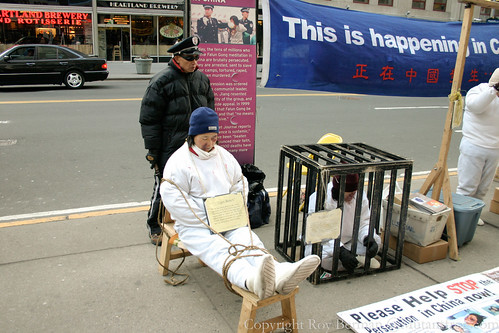
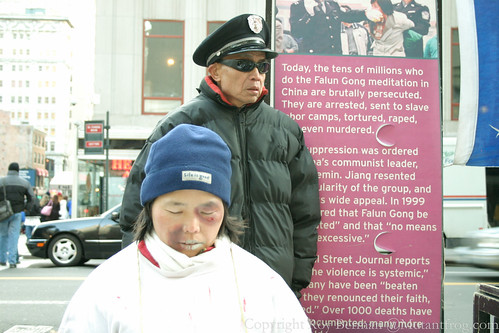
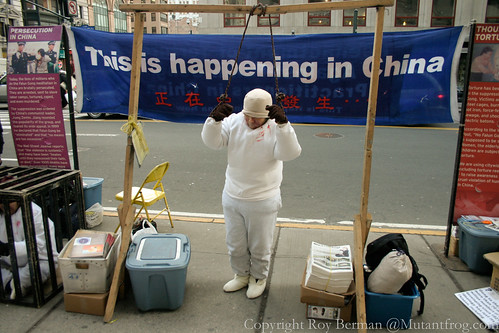
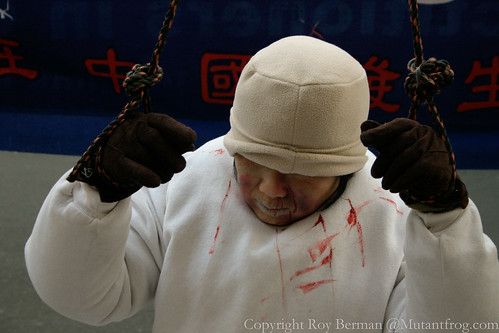
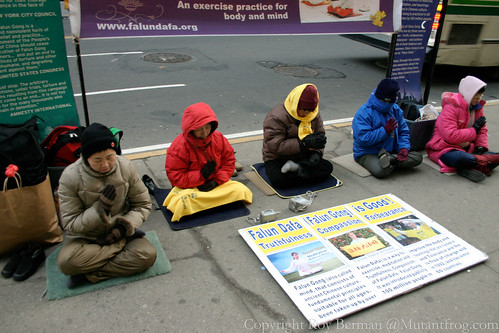
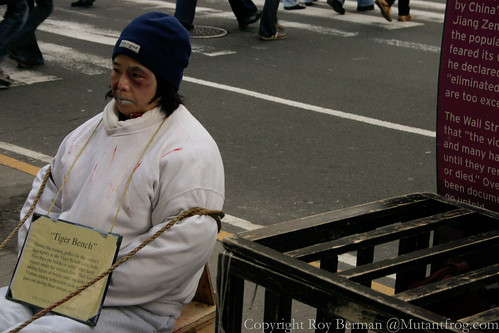
Has anyone ever seen something like this anywhere besides New York? I saw Falun Gong protesters in Hong Kong, by Victoria Bay, and handing out flyers and DVDs outside of Taipei’s National Palace Museum (prime location to find tourists from the mainland) but never anything like this sort of dramatic reenactment.
For those who are curious, the old voting machines in my area looked very much like this one, color and all

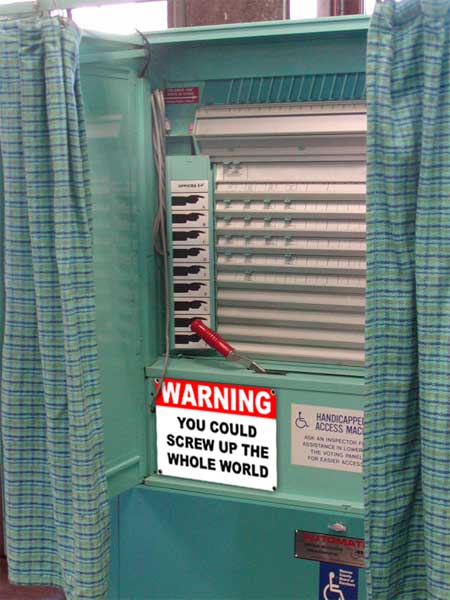
The actual controls were a bit different, and significantly the big lever was vertical along the right side, but you certainly get the idea.
Unfortunately, I couldn’t find a photo of the new machines I could embed, but you can see a hilariously 1980s educational film style demonstration of them, courtesy of the Essex County Clerk’s office here on their web site.
I just came back from voting in my first presidential primary election. I did vote in both the 2000 and 2004 general elections, but I was living at college an hour away and voted through absentee ballot since I did not want to skip class to come back to my hometown, the only district in which I have ever been registered to vote. But absentee ballots are not available for the primary, and I didn’t even consider skipping class for that (I believe I was also in Japan during the 2004 New Jersey primary).
I have however voted in person before, during a couple of the less significant election years between the presidential race, and I also spent several election days in the polling location at Edgemont Elementary School around the corner from my house when my father held a Democratic party position involved with supervising the polling station during my childhood.
Voting today was nearly the same experience as before. I told the man sitting at the A-K half of the desk my name, signed the blank signature line next to the photocopy of my signature from my voter registration card, and was given a pink voting slip, which I also signed. I had brought my passport along to use as ID, since I did not remember if any documentation is required, but in fact the only verification is a signature check, and knowing your own name and address. I then proceeded to the curtain-encircled voting machine and handed the pink slip to the woman sitting next to it. Her job is to collect each slip, make sure it is properly filled-out, and then pierce it on one of those spiked receipt collector things one often sees next to cash registers and the like. She then presses the button on the rear of the voting machine to prime it for the next voter.
Next, I stepped inside the curtain. This is the point at which there was a slight variation from the old days. I had grown up with the awesome yet clunky great blue mechanical voting machine, which had now been supplanted by electronic ones. There was something viscerally satisfying about actually flipping each little mechanical switch into the correct position before locking and then through the pull of the oversized lever on the right of everything else, transmitting your choices through a series of gears into the hole-puncher in the rear of the machine, encoding your vote onto the long and wide paper feed spooling one line at a time through the apparatus.
Now it is electronic, but thankfully not one of the overcomplicated and eminently hackable touchscreen monstrosities used in many areas. The New Jersey machine, at least the one I used here in Montclair, Essex County, simply has a plastic insert printed with the exact same material as the sample ballot I received in the mail a week or two ago, laid over a series of light-up buttons. When the machine is activated by the attendant, a backlight comes on behind the applicable ballot portion: Republican, Democrat or both depending upon your registered affiliation (both is for people like me who register as unaffiliated). Today is only a primary vote and not a real election, so the sole choice was for choice of presidential nominee. I clicked the Barack Obama button, the names of his four convention delegates to the right, the little red light behind his name came on, and I pressed the finalize button on the bottom right. It took only a couple of seconds, and I was out of there.
But in my heart, voting will never truly feel like democracy to me if you don’t get to pull a big, blue, metal lever at the end.
Update: How did my vote do? Well, Obama and Clinton are currently looking like they’re tied neck and neck nationwide, Clinton won New Jersey by about 9%, but Obama won my Essex County by around 15%. I believe this means that, since delegates are more or less apportioned at the county level, the candidate I voted for technically won in the election which my vote directly counted towards.
An article in today’s NYT on the uniqueness of the United States commercial bail bond system includes this very interesting tidbit.
Commercial bail bond companies dominate the pretrial release systems of only two nations, the United States and the Philippines.
Although the article does not actually say, I think it is safe to assume that this is a direct result of the fact that the Philippine legal system was constructed during the period of US colonial rule. Those non-American readers who may be unfamiliar with the commercial bail bond system may with to read the explanation in the NYT article to fully appreciate the global oddity of the system. From my brief perusal of some Philippine web pages, it certainly looks like both countries share the institution. For example, look at this page from a Manila metro area attorney’s office:
Paying Bail
You can pay the full amount of the bail in Cash. If you are acquitted, you can withdraw the Bail that you posted. You can also buy a surety bind or post your property to pay for your bail.
Bail bond is like a check held in reserve: it represents the person’s promise that he or she will appear in court when required to. The bail bond is purchased by payment of a non-refundable premium (usually about 15% – 35% of the face amount of the bond).
A bail bond may sound like a good deal, but buying a surety bond may cost more in the long run. This is so because you have to renew the surety bond upon its expiration otherwise, upon motion of the prosecution, a warrant of arrest will be issued for failure to renew the surety bond. If the full amount of the bail is paid, it will be refunded (less a small administrative fee) when the case is over and all required appearances have been made. On the other hand, the 15%-35 premium is nonrefundable. In addition, the bond seller may require “collateral.” This means that the person who pays for the bail bond must also give the bond seller a financial interest in some of the person’s valuable property. The bond seller can cash in on this interest if the suspect fails to appear in court.
The curious may also want to see the amounts of bail set for various crimes under Republic of the Philippines law.
After a long post a few weeks ago on candidates for word of the year 2007, I’ve just noticed an important addition. The American Dialect Society announced about three weeks ago that “subprime” was voted word of the year bu their members.
Subprime is an adjective used to describe a risky or less than ideal loan, mortgage, or investment. Subprime was also winner of a brand-new 2007 category for real estate words, a category which reflects the preoccupation of the press and public for the past year with a deepening mortgage crisis.
After seeing all the headlines about stock market crash and recession, I’m well convinced that “subprime” is a solid choice. We’ll be hearing a lot more of this word in the months to come.
The Oxford University Press USA blog has a post responding to this announcement, with some valuable information on the history of the word.
In its earliest attested usage, subprime simply meant “substandard” or “below top quality” in a very general sense. A 1960 article in Operational Research Quarterly referred to “sub-prime material” that can cause delays in automatic data-recording equipment. And in 1970, the Wall Street Journal reported that the Armco steel company was introducing a “subprime” line of cold-rolled sheet metal, “intended for users that don’t need surface qualities 100% free of defects, principally for use in unexposed parts, including the back of a refrigerator.” Over time, this sense of subprime was extended in all sorts of directions, such as this Toronto Star critique of a cinematic performance by Madonna in 1993: “her ‘work’ in Body Of Evidence is sub-prime.”
In the mid-1970s, subprime began to be used in the banking sector, but in a context that is just about the opposite of current usage. Rather than relating to the risky credit status of a borrower, subprime originally described a “below prime” lending rate — in other words, below the prime rate that banks and other lending institutions offer to qualified customers. So in this sense, a loan with a subprime rate is a good thing for the borrower, who is allowed to pay an interest rate lower than what is typically offered. That explains this quote from an August 1975 Associated Press article: “Isn’t the prime supposed to go only to the most credit-worthy customers? Why, therefore, they might ask, was subprime offered to a municipality whose credit standing is suspect?” Similarly, a March 1978 article in Institutional Investor told of banks “offering sub-prime rates to lure back customers.”
It wasn’t until the mid-’90s that the currently popular sense of subprime became widespread. Now it was the borrowers themselves who were being classified as “less than prime” based on their credit histories. Customers in this high-risk category were increasingly able to borrow money from established lenders, particularly to pay for mortgages, automobile loans, and the like. Whereas the older sense of subprime implied a loan with a low interest rate, the subprime loans of the ’90s and ’00s have rates much higher than standard. An April 1995 article in Retail Banker International described auto-lending companies offering “loans of new and late-model cars to consumers with imperfect (’sub-prime’) credit histories.” And a February 1997 New York Times article heralded the coming crisis: “A Risky Business Gets Even Riskier: Big Losses and Bad Accounting Leave ‘Subprime’ Lenders Reeling.”
The two competing senses of subprime, referring either to favorable low-interest loans or to unfavorable high-interest ones, would seem to be in direct opposition. You might even call it a “Janus-faced word” or “contronym,” i.e., a word that serves as its own antonym, like cleave or sanction. But the surrounding context should be enough to establish whether it’s the lending rate or the borrower that is considered subprime. Consider another sub- word, subpar. For a golfer, a subpar score is a good thing, but in its more general sense subpar typically characterizes an inferior performance. Only context can resolve the conflict.
As the word subprime becomes more widely known, we can expect many new extensions of meaning. A recent MSNBC report on business buzzwords claims that the word is already in use as a verb “loosely defined as the ability to completely dig one’s self into a hole and then expect a bailout,” as in “I completely subprimed my Algebra test yesterday.” As far as I can tell, that kind of usage is a figment of the reporter’s fertile imagination, since even Urbandictionary, that student favorite, is thus far unaware of subprime as a generic verb. (When the word does show up as a verb, it tends to be in punning formations like “subpriming the pump” or as an ad-hoc reflexive: a columnist for the Aspen Times wrote that “homeowners have subprimed themselves into an economic disaster.”) But let’s hope that the subprime crisis subsides before it spawns too many new additions to our vocabulary. Even if it’s enriching to the lexicon, it’s hardly enriching to the economy.
When you consider that this is the kind of historical, etymological and contextual usage information that goes into almost every entry in the Oxford English Dictionary, I think you’ll see why I consider it unambiguously the best dictionary in the world.
Everyone reading this is familiar with the tasteless paper-filled, paper-textured fortune cookie right? Long thought to have originated as a gimmick desert in one of California’s Chinatowns sometimes in the late 19th or early 20th century, new research strongly suggests that, despite being popularized by the Chinese, fortune cookies were actually invented by Japanese immigrants, who had gotten their inspiration from snacks sold at a Kyoto bakery. The New York Times has an excellent article detailing the whole story, which I must say I find surprisingly convincing. I think anyone else familiar with the wide range of tasteless Japanese traditional snacks (八ッ橋 anyone ? ), the Japanese love for fortunes, and of the tasteless fortune-filled “fortune cookies” distributed inevitably in American Chinese restaurants will also, upon reflection, find the resemblance highly suggestive.
Jade OC, a long time reader and commenter of MFT, has graciously posted a detailed comparison of his experiences passing through both US and Japanese airline security and immigration checkpoints as a comment on an earlier blog post on the subject. As I suspect that many of our readers look only at the actual posts and not the comments, I thought I would promote this one to the front page.
As promised, here is my short report on the fingerprinting-immigration process in the US and Japan from the POV of a non-citizen of either (though a resident of Japan).
First big complaint. I never wanted to go to the US at all, at least not the first time. But you cannot bloody transit in the US – there’s no such thing as a transit lounge. Everyone who enters a US airport from outside the country, even if, like me, you are just taking a flight to Canada in about 90 minutes, needs to go through Immigration and Customs. This is seriously Fucked Up.
This is already a week old, but did anyone notice that the very same day US Congressman Mike Honda (D, California) issued yet another call for Japan to issue a more concrete apology to former comfort women, New Jersey became the first Northern state in the United States to issue a formal apology for our state’s history of slavery? Although four Southern states of Virginia, Maryland, Alabama, and North Carolina had previously issued similar resolutions, the fact that many Northern states still allowed slave-holding well into the 19th century has been largely ignored. New Jersey, for example, did not finally ban slavery until 1846. There has been no such resolution at the federal level.
While it might be nice to see the Japanese government officially acknowledge past crimes in more specificity, perhaps the US Congress should apologize for slavery at the national level before its members go overseas to demand that foreign governments do the same thing. Maybe by setting a moral example, Mister Honda might convince a wider audience of his credibility.
Oh, and as for the Japanese government’s previous apologies. While they were a good start, they really could be more specific. Take a look at the actual text of last week’s New Jersey slavery apology resolution and think about how they compare.
Update: I feel like I should add that I don’t consider a simple apology in and of itself very worthwhile. The important thing about the New Jersey resolution is not so much that it apologizes, but that it lists both the actual crimes and in historical context and legacy in a decently comprehensive outline, and then also explicitly calls for continuing education on the subject. Let me quote the “statement” at the end of the resolution.
This concurrent resolution issues a formal apology on behalf of the State of New Jersey for its role in slavery and discusses the history of racism and inhumane treatment toward African-Americans in the United States from the arrival of its first settlers to the present day. It calls upon the citizens of this State to remember that slavery continues to exist and encourages them to teach about the history and legacy of slavery and Jim Crow laws.
While I think it was sloppy phrasing not to say something like “continues to exist in parts of the world,” resolutions like this are important not because they can make people feel good about their awesomeness in making said apology, but because it can contribute to the education of the populace.