Let’s stop hurting each other – negative gaijin competition

(Updated below) (Updated again)

When I lived in Washington, DC, one of my part-time jobs was to teach TOEIC strategies mainly to Japanese bureaucrats and businessmen who were stationed in the area for one reason or another. They usually came as invitees of the State Dept. or, in the case of salarymen, sent by their companies to study the US patent system, auto crash test system, or other relevant area depending on their career track.  The school was somewhat unique in that it was specifically set up to cater to Japanese customers, making it effectively an eikaiwa school in the US. 

I was never a particularly good teacher. My experiences studying Japanese (at the time I had two years of study abroad in Kansai and the JLPT Level 1 under my belt) actually got in the way of my being an effective teacher, since I usually became so star-struck and curious about their government roles that it hampered their progress in getting through the TOEIC drills. Despite that (or perhaps because of it), the job was a very instructive experience for me, not least in terms of how adults try and learn second languages.

Students were typically early/mid-career bureaucrats in their late 30s or early 40s with no relevant international experience. Hence, their English levels all tended to hover around a fairly low level (TOEIC of around 500 or so, decent reading skills, next to no speaking and listening skills). This helped create a sense of community among the students, who often congregated for small-talk, safe in the knowledge that they were all in the same boat.

Intermediate students threatened this balance. “Intermediate” in this sense simply means a student who can express himself relatively fluently in some situations and maybe has some cultural fluency as well. Though the lessons were mostly one-on-one, during group lessons with the school’s president the intermediate always gained a reputation as “the fluent one.” As a result, the other students would defer to this more advanced student and consider him the standard for progress. Each time this happened, there was always at least one student who became discouraged and grew reluctant to express himself or really try and move forward on his own terms, especially in the group lessons. At the same time, I could detect a kind of jealousy of the intermediate students for getting ahead of them.

The intermediate students could sense how the others felt about them, and some seemed to even relish their top dog position. They tended to be prideful and resisted my suggestions that they needed help with key concepts. It became pretty frustrating at times because even the intermediate students couldn’t successfully understand our teaching materials, which consisted mainly of old TOEIC tests and NPR archives. Basically, they were riding high on the difference between a 600 TOEIC and a 700 TOEIC, which in reality isn’t all that significant.

In the end, this was a form of negative competition. Even if the people around you are more advanced, that doesn’t mean you have to compare yourself with them (at the school we would try and separate intermediate students if possible). And just as important, if you are ahead of your peers, that is no excuse to sit on your laurels. Since the wider world is much more competitive than your circle of acquaintances, it is important to identify your own strengths and weaknesses, and work from there.

Gaijin Hierarchy

The same thing happens among foreigners in Japan, and I am just as guilty of this behavior as anyone. Typically, even in casual conversation people in the Japanese as a second language community as well as the eikaiwa community will rank each other on their relative prowess in Japanese, and I am sure most readers of this blog have endured the utter awkwardness of the Japanese-language/Japanese culture knowledge “pissing contest.” I noticed this tendency very strongly over the (mostly off-topic) discussion at Japan Probe related to the allegations of fund misuse in the JET Program. Here is a typical example of this need to impose hierarchy (UPDATE: Not really, but it’s a good lead-off for discussion nonetheless. See comments for clarification):

Comment by Darg:

I’m a former JET, although I wasn’t an ALT. I was a CIR (Coordinator of International Relations), and have had this convo many times before. I really think the proper solution should be to put more focus on the international understanding and relations and less on the English teaching, and as a result have more CIRs and less ALTs.

I believe the CIR job is closer to the original intention of the JET program, and that is to promote cultural exchange. The problem is, most people don’t even know what a CIR is and think the JET program is a big waste of money because of the portion of ALTs that come out here and screw things up for the majority who actually try and get something done.

If they required a minimum of teaching experience for ALTs and raised the CIR:ALT ratio, I think a lot more people would appreciate the JET program.

This is objectively false (UPDATE: again, see comments for how I misunderstood what he envisioned CIRs doing). The program is called “Japan Exchange and Teaching Program” for a reason – historically, it was set up to place foreigners inside school classrooms to help with the drive to “internationalize” Japan through better English learning. The job of a CIR, on the other hand, is secondary to that priority – they typically assist with the “international” programs of a local city hall. The only basis for concluding that CIRs are more beneficial to the JET program than the ALTs – and this view appears to be common – seems to be the desire to believe that the advanced Japanese language requirements for CIRs actually mean something, as opposed to those illiterate ALTs who are allowed to come to Japan equipped with nothing but their English skills and the enthusiasm to teach kids.

In fact, while I have heard of a productive role for the Portuguese-speaking CIRs who help facilitate communication in towns with high Brazilian populations, others complain that CIRs are often given the basically pointless jobs of promoting multicultural events and maintaining sister city relationships. That these jobs require some Japanese competency does nothing substantially to improve the objective “worth” of these positions.

It is easy to make Darg’s mistake of dismissing ALTs’ role in supplementing the current, generally poor state of English language teaching and general proficiency, including among Japanese-national English teachers. This won’t go away overnight, and in over 20 years of the JET program not much seems to have changed. Commenter Jake brings this up:

Anyway, my point is that having a warm foreign body in every classroom in the country has become the status quo and nobody seems to be questioning that system itself — just figuring out how to maintain the system while cutting costs (i.e. handing all the contracts over to Interac). Then again, retooling the system to teach English in a manner that enables students to actually speak would also mean retooling the entire test-based educational system, and until that happens, pretty much any new policy implemented is going to be nothing more than a band-aid on a brain tumor.

Suggesting Japan should “retool the system” is MUCH easier said than done. Consider some of the moving parts involved:

  • All schools, from elementary to university level, would have to turn their fundamental principles of education upside down (and have the talent infrastructure to understand and accept this new system); progress in the form of all-English education has been made on this front.
  • Japanese-national teachers would have to become functionally fluent in English.
  • Universities would have to reform their entrance procedures to emphasize English proficiency as it’s understood by most of the world (this is apparently underway).
  • Parents would have to change their expectations for how their children study.

And on and on. Feel free to squabble over the details, but it’s clear enough that in the current environment, parachuting in “warm bodies” seems like a pretty good compromise. So despite all the insults I have dished out in the past, I really don’t think there is anything these ALTs/eikaiwa teachers should be ashamed of. In an imperfect system, they are playing an important role.

Yet I would argue that for the purpose of leading a productive life, it’s necessary to leave the whys and wherefores about eikaiwa aside. To a certain extent, supply and demand are beyond direct human control, and as a result much overarching debate on “the system” ends up being just another extension of the pissing contest.

But this point remains lost on too many with a vested interest in this issue – the teachers and those who look down on them in the milieu of gaijin society. Again and again, jobs that require Japanese in Japan are seen as more worthy than the dreaded English teacher position. Roughly speaking, I see the hierarchy as falling along these lines:

Japanese-speaking corporate executive > Professor > Interpreter > Token gaijin at a large corporation > Translator > Gaijin tarento > JLPT 1 passer > eikaiwa teacher-turned-entrepreneur > Journalist > CIR > Convenience store clerk/electronics salesman > Eikaiwa teacher >  Street performer > Hostess

Relatedly, the group of Western expats who work for foreign companies and generally live in a Little America (think Hiroo in Tokyo or Rokko Island in Kobe) are usually not even included in this universe of possibilities, despite there being substantial overlap in practice.

Could there be anything more arbitrary and meaningless? In every other corner of the word it seems like people understand that people of different skill sets and living situations have different career needs, prospects, priorities, and ways of life, so why do the gaijin need to bitch so much?

The majority of non-soldier Western expats in this country are eikaiwa teachers, so it is an interesting phenomenon to see that many even in the profession see it as pointless and counterproductive to their careers. The people within that group easily end up like my former students — forming a pecking order based on Japanese language ability and overall J-savviness.

Why? For one thing, the gaijin community can be pretty isolated – it is a small subset of wider Japanese society, so if language or cultural barriers have kept you from really assimilating with the mainstream, the only real alternative is to stay with the people with whom you have common ties. A thousand and one Japan bloggers will tell you this can be lonely and frustrating. For another, it cannot be denied that there is some truth to the idea that many people who end up in Japan were either single-mindedly obsessed with Japan from the beginning or simply didn’t give much thought to a career until graduation rolled around. People whose jobs came as an afterthought might welcome a distraction from their own situations.  

But most importantly, placing the eikaiwa teachers or those with poor Japanese on the bottom of the totem pole is a convenient and easy way to make people feel better about themselves. But again, it doesn’t actually help anyone – it’s just another form of negative competition. I hope the people living and working in Japan will step back from these false distinctions.

In terms of careers, eikaiwa teachers should try and think honestly where they are and consider where they would like to be, without worrying about whether their Japanese is up to snuff. Japanese is a lot of work, but it is doable and it will come. Or not. You will have to make the cost/benefit analysis of where your career is headed and whether it is worth it to stay in Japan at all costs or whether you might have better prospects back home, or even in a third country (I had a great time living in Bangkok). The economy isn’t all that great at the moment, but now is a good time to brush up on your strengths or the skills you wish were your strengths, whether they are Japanese language, network engineering, hip-hop dancing, or even English teaching.

Oddly, it’s the people supposedly on the top that might have the most to lose by “winning” this contest.  Even if you have passed JLPT 1 and “escaped” eikaiwa, why not take a look in the mirror and consider your next move? Many of the people who have succeeded somewhat in assimilating did so by going out of their way to avoid contact with other Westerners, out of the fear that overexposure to their native language would hinder the Japanization process. While there is some merit to that, especially at the early stages, at some point you will have to stop seeing other foreigners as competition. You should feel comfortable enough in your position that you’re happy to help others.

Despite all the praise you might get for speaking good Japanese, Japanese language alone does not make a career (and if you want to be a translator/interpreter, it’s harder than it looks). Nor will it make you a very interesting person if that’s all you’ve got. And remember, if you become too self-satisfied with your supposedly lofty achievements you may be in for a rude awakening.

YET MORE UPDATES (No more Chuck Norris…): Here is an updated hierarchy thanks to the comments section (again, this is just a rough estimate based on my assessment of the state of gaijin discourse):

The emperor if he actually has a surfer dude accent > Steven Seagal > all foreign sumo wrestlers except Konishiki and those Russians that got caught with weed > Naturalized Japanese citizen (some overlap here)* Street performer who hooked up with a famous idol > Japanese-speaking corporate executive > other foreign fighter/athlete> Attorney > Professor >  Interpreter > Token gaijin at a large corporation* > Translator >  Konishiki > Mombusho scholar > first-generation JET/BET who was totally not an English teacher > Translator who pisses on people > Professor who only teaches ESL > Jesus in Toyama > Gaijin tarento > JLPT 1 passer  > JLPT 1 passer who speaks in dialect to show off  > Genki English guy* > NGO Worker > eikaiwa teacher-turned-entrepreneur > Foreign Geisha > Journalist > high school exchange student > Akihabara tour guide (with Son Goku costume)* > Portuguese-speaking CIR > CIR > Convenience store clerk/electronics salesman* > Eikaiwa teacher >Bonsai (or other traditional Japanese craft) master > Bonsai (or other traditional Japanese craft) student > Buddhist convert > Shinto convert Headhunter Eikaiwa teachers who are milking the system > Street performer > Hostess > guy handing out event fliers in Roppongi > Foreign psychic > Evangelical Christian

* Position in hierarchy in dispute.

One arm of the JET program possibly misappropriating funds

Very interesting post at Japan Probe on possible quasi-corruption at CLAIR, the affiliate of the Ministry of Internal Affairs and Communications in charge of its share of the JET program:

The Council of Local Authorities for International Relations (CLAIR), the governmental organization responsible for the JET Program, could be in trouble. Popular Osaka governor Toru Hashimoto has started questioning CLAIR’s use of funds and has announced that the Osaka government may reduce its financial backing to CLAIR next year (90% of CLAIR’s financial backing comes from money paid by local governments, and Osaka pays a big slice).

The JET program is one of those rare Japanese government programs in which overlapping ministries successfully cooperate – the Ministry of Foreign Affairs is in charge of most of the administrative details of selecting applicants, the education ministry places them in schools, and the internal affairs ministry coordinates with local governments. Well, it looks like part of the compromise reached between the ministries was that at least the internal affairs side gets to set up a swank suite of perks for retired bureaucrats.

As I have done before, I am cross-posting my comment at Japan Probe to encourage discussion of the issue on my comments section. I began in response to earlier commenters who apparently take any mention of the JET program to debate on the JET program’s merits and the usefulness of eikaiwa teachers in general (of course I would never do that):

Did you notice that this issue has NOTHING to do with the merits of the JET program itself? The problem is that the bureaucrats have turned parts of the program into their own slush fund, which enriches their post-retirement accounts and improves their golf scores at the expense of the Japanese taxpayers and maybe even people who didn’t get accepted to the JET program (since part of the acceptance cutoff is no doubt due to budget constraints). It’s so laughable for them to have overseas offices since they don’t even process the applications – that is the foreign ministry’s job.

This misappropriation issue isn’t any reason to end the JET program. In fact, considering all the extra money they are raking in it looks like they could be accepting even more JETs. I have argued elsewhere that it may have outlived whatever functionality it had as an English teaching program, but as Yomiuri documented around its 20th anniversary the program itself has by and large been extremely beneficial to the teachers who come and have a once in a lifetime experience (or get a foothold for a life in Japan), the schools who want foreign English teachers, and Japan’s soft power as the program generates massive goodwill and a niche workforce of Japan-savvy English speakers.

But if one of the organizations involved is being exploited for no real reason but to provide an excuse for internal affairs bureaucrats to get post-retirement salaries and live the Japanese dream of endless enkai and golf with their coworkers, then Hashimoto is right to use his spending authority to try and put an end to it. As much of a showboat as he can be, that’s an example of real leadership and sticking up for what’s right.

I understand the motivation for post-retirement income, but what I will never get is why these oyaji seem to love drinking in their work suits and basically never leaving the damn office. If you are going to misappropriate funds, at least do what American politicians do and get sweet renovations to your house!

They have 12.7 billion yen a year in unused funding! I propose using that money to send free cookies to every woman who gets pregnant. It will help alleviate the low birth rate AND I’ll only overcharge the government 50 billion yen 5 billion yen a year — big savings!

Women set to overtake men in US workplace. What about Japan?

Amazing news from the New York Times:

With the recession on the brink of becoming the longest in the postwar era, a milestone may be at hand: Women are poised to surpass men on the nation’s payrolls, taking the majority for the first time in American history.

The reason has less to do with gender equality than with where the ax is falling.

The proportion of women who are working has changed very little since the recession started. But a full 82 percent of the job losses have befallen men, who are heavily represented in distressed industries like manufacturing and construction. Women tend to be employed in areas like education and health care, which are less sensitive to economic ups and downs, and in jobs that allow more time for child care and other domestic work.

As of November, women held 49.1 percent of the nation’s jobs, according to nonfarm payroll data collected by the Bureau of Labor Statistics. By another measure, including farm workers and the self-employed, women constituted 47.1 percent of the work force.

With that in mind, I wondered what the figures were for Japan. As it turns out, they are released monthly by Japan’s statistics bureau. The figures (PDF) include farm workers and the self-employed.

As of December 2008, of Japan’s 63.31 million workers, 36.92 million, or 58.3%, are men, and 26.39 million, or 41.7% women. Not even close!

Pizza by the slice coming back to Japan!

Great news: Sbarro will be opening in Tokyo (presumably) in the near future! Sbarro doesn’t exactly have the best reputation in the US, it is still entirely passable pizza-by-the-slice. Welcome back!

Though they did not announce exactly when the first store would open, their plans are to open 18 shops in rapid succession in their first year of business. That’s a thankful departure from the Cold Stone Creamery and Krispy Kreme Donuts strategies of pumping up excessive demand for a tiny amount of shops in an effort to generate buzz. So rather than the painfully annoying KK lines in Shinjuku and Yurakucho, here is hoping the Sbarro chains will be as accessible as they are back home.

clipped from www.nni.nikkei.co.jp
U.S. Pizza Chain Sbarro To Re-Enter Japan

TOKYO (Nikkei)–Sbarro Inc., a major U.S. pizza chain operator, will take another shot at the Japanese market, opening its first outlet as early as April in the Tokyo area, The Nikkei learned Friday.

Sbarro and consulting firm JCI Inc. are expected to set up a 50-50 venture capitalized at 10 million yen by the end of February. They plan to open 18 directly run restaurants by the end of next year and a total of 125 shops, including franchise outlets, in five years.

Founded in 1956 in New York, Sbarro has over 1,000 restaurants in 43 countries. It entered Japan under a franchise system in 1997 but pulled out in 2001.

  blog it

In Japan, Obama inauguration inspires English lessons, off-kilter likenesses

The Adamu household is just ecstatic and relieved to see Obama inaugurated as president. We can’t tell which feels better: not-Bush in the White House or Obama in the White House? 
Though you might not know it to look around you, there are many in Japan who are excited about Obama who don’t live in a certain newly famous town that happens to be named after him. As just one indicator of interest, NHK announced its late-night ratings almost quadrupled for live coverage of the address. A fairly universal attitude by my observation has been, “Why don’t we have dynamic leaders like that in Japan?” So the buzz over Obama may in part be a kind of vicarious thrill.
So even before the inauguration, individuals and businesses in Japan have been finding interesting ways to express their enthusiasm. Let’s take a look:

1. Learn English

  • Listening to one of the great speechifiers of our time can be inspiring. Obama’s message can call you to serve your country, resolve to be a better person, or sacrifice for the greater good (but tragically apparently not to prosecute those responsible for the Bush regime’s crimes). Some aspiring English speakers in Japan have taken this opportunity to brush up on their own speaking skills. Prominent among the “Obama books” that are currently flooding Japanese bookstore displays is CNN’s Obama Speech Collection for students of English as a second language. The book, so far having sold over 400,000 copies, features excerpts from famous Obama speeches with a Japanese translation on the opposite page, which students can use to follow along as they listen to an attached CD. I picked it up the other day and it has proven useful both as a translation reference for US politics and as a handy record of his landmark addresses. I’m not sure how effective it is as a teaching tool, but for a Japanese learner of English inspired by Obama it will no doubt give them easy access to the tools they need (minus the inauguration address, of course).
  • Meanwhile, much like Kenya’s “Obama imitation contest“, some private English classrooms have started offering Obama mimicry lessons to a reportedly favorable response. In one TV news report, groups of 20+ students lined up to wait their turn to recite famous Obama speeches as a White-boy instructor barked orders on how to mimic Obama’s unique oratory style.

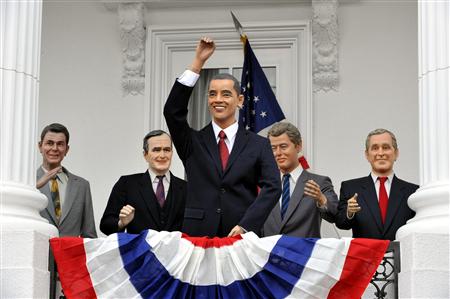
2. Create a mildly unsettling Obama likeness

Here we see some examples of creativity from both traditional and modern artists that deserve an “A” for effort but unfortunately didn’t turn out all that appealing:

no resemblance whatsoever?
No resemblance whatsoever?

Zombie Reagan looking gaunt (or is that Carter??)
Zombie Reagan looking gaunt (so Carter really is irrelevant!)


* Thanks to Andrew Leonard for the correction!

Compare to the real thing:

That’s more like it!

Japan as a model for American prison reform?

The Washington Post has a very interesting article on Senator James Webb (D – VA)’s campaign to reform US criminal justice and prisons. Webb seems to be among the few senators who actually realizes how broken the US justice system is, with its obscene incarceration rate and often stiff penalties for minor violations. This is all to his credit, and I hope he succeeds in achieving some level of reform, but this is not the part of the article that caught my attention. Here it is:

Somewhere along the meandering career path that led James Webb to the U.S. Senate, he found himself in the frigid interior of a Japanese prison.

A journalist at the time, he was working on an article about Ed Arnett, an American who had spent two years in Fuchu Prison for possession of marijuana. In a January 1984 Parade magazine piece, Webb described the harsh conditions imposed on Arnett, who had frostbite and sometimes labored in solitary confinement making paper bags.

[…]

In his article about the Japanese prisons, Webb described inmates living in unheated cells and being prohibited from possessing writing materials. Arnett’s head was shaved every two weeks, and he was forbidden to look out the window.

Still, Webb said, the United States could learn from the Japanese system. In his book, “A Time to Fight,” he wrote that the Japanese focused less on retribution. Sentences were short, and inmates often left prison with marketable job skills. Ironically, he said, the system was modeled on philosophies pioneered by Americans, who he says have since lost their way on the matter.

I must admit that I know absolutely nothing about the history of prisons in Japan, and for that matter embarrassingly little about the history of prisons in the US. How much are Japanese prisons really modeled after American theories? Certainly the Japanese court system tends to give out shorter sentences for at least certain types of crime, but is there any truth to the idea that inmates leave with job skills? I could easily imagine that an ex-con in Japan is even more stigmatized in the job market than one in the US.

Asian Immigrants in Florida

One of the most obscure footnotes to the recent American elections was the failure of little-known ballot initiative in Florida, which would have symbolically removed from the law books a currently inactive 1926 unconstitutional provision of the state constitution which was intended to prohibit Asians from owning land in the state. The 1926 prohibition is specifically directed at foreigners ineligible for citizenship, which at the time applied to Asians-who were at the time barred from naturalization by federal law.

The language before voters did not explain that the laws first appeared around 1913 during a public panic that Asian immigrants, mostly from Japan, would work on farms for less than Americans and buy up vast tracts of land. It failed to spell out that state provisions were intended to work hand-in-glove with discriminatory federal laws that prevented Asian-Americans from becoming naturalized citizens until 1952.

Rather the ballot simply asked voters if they were willing to delete “provisions authorizing the Legislature to regulate or prohibit the ownership, inheritance, disposition and possession of real property by aliens ineligible for citizenship.”

Steve Geller, a former state senator who worked to get the initiative on the ballot, said Florida election rules only allowed a description of 75 words, and required that the language of the old provision — “aliens ineligible for citizenship” — be included. As a result, he said, “a lot of people thought it had to do with illegal aliens, and it had nothing to do with illegal aliens.” (NYT)

Few traces remain in Florida of this brief and ill-fated wave of Japanese immigration, and the most prominent is likely the Morikami Museum and Japanese Gardens. It happens to be located very near to my grandparents’ house (like all Jews from Brooklyn, they eventually retired to Florida) and I went there with them a few years back. The garden is pretty nice, I suppose, although I actually got the impression that it is too big to replicate the feeling of an actual Japanese garden, the design philosophy of which is largely based on a fractal-like recreation of the large on a small scale. The significantly different vegetation of Florida also does not help. But the museum does have some neat exhibits (their temporary one the day I went was a pretty cool collection of Japanese kites, which based on my experience is a dead art form in Japan. I saw kites all over in China-does anyone fly them here?) and resources that could be of great interest to a Palm Beach County resident who wants to learn a bit more about Japanese culture. For me, of course, the most interesting thing was the history of the museum itself. And the iguanas.

Their website has a tantalizing, but brief, history of the Japanese in Florida.

In 1904, Jo Sakai, a recent graduate of New York University, returned to his homeland of Miyazu, Japan, to organize a group of pioneering farmers and lead them to what is now northern Boca Raton. With the help of the Model Land Company, a subsidiary of Henry Flagler’s East Coast Railroad, they formed a farming colony they named Yamato, an ancient name for Japan.

Ultimately, the results of their crop experimentation were disappointing and the Yamato Colony fell far short of its goals. By the 1920s, the community, which had never grown beyond 30 to 35 individuals, finally surrendered its dream. One by one, the families left for other parts of the United States or returned to Japan.

One settler remained. His name was George Sukeji Morikami. A modest farmer, George continued to cultivate local crops and act as a fruit and vegetable wholesaler. In the mid-1970s, when George was in his 80s, he donated his land to Palm Beach County with the wish to preserve it as a park and to honor the memory of the Yamato Colony.

It is sad that a legally meaningless ballot resolution intended only as a posthumous apology to these poor immigrants was accidentally voted down by people who thought they were doing something to hurt current illegal immigrants, but one must admit that the resolution was very poorly worded.

Excellent rebuttal of Tamogami in Asahi — but not on the Internet

Page 15 of today’s Asahi, the opinion page, has run three excellent articles analyzing and rebutting the controversial arguments and actions of recently dismissed ASDF Chief of Staff Tamogami. I’ll quickly summarize their points:

(UPDATE: In case you missed it, you can read Tamogami’s full, six-page essay here (PDF))

Shinichi Kitaoka — Professor at Tokyo University specializing in Japanese diplomatic history

Tamogami is wrong and uses questionable secondary sources (such as Mao: the Unknown Story) to support theories that are widely rejected by the historical community. Tamogami’s views on politics appear subtly masochistic and emotional. For example, his complaints that Roosevelt tried to lure Japan into firing the first shot are “shameful” since international politics is by nature a game of trickery. Most military leaders around the world are well-educated and act gentlemanly, and in these respects Tamogami has failed miserably to meet the conditions for leading a branch of the armed forces. The incident has done enormous damage to the public’s faith in the Self Defence Forces.

Shunichi Karasawa — commentator and member of the Tondemo Gakkai, a group dedicated to debunking urban myths and conspiracy theories

Tamogami is a classic conspiracy theorist — despite the presumed access to primary information that would come with high office, Tamogami instead chose to use secondary sources that supported his theories without examining them, and then failed to prove his point. Writing about politics or history requires one to avoid the temptation to simplify complex situations, but apparently Tamogami lacked the patience. Maybe this is an expression of the SDF’s frustration over the unclear status of the force during a time when the US-Japan relationship is changing.

Tamogami has a reputation as a capable man of action. This preference for quick resolutions makes it easy for someone like that to get caught up in conspiracy theories since they are always looking for someone to blame.

After publishing the essay, he has displayed an attitude that he is more or less satisfied that he did something significant. This pattern of saying something and not seeing much need for followup or verification is also typical of conspiracy theorists.

Perhaps part of the reason his arguments have generated support on the Internet is because they offer simple answers in a complicated world. But we should not just laugh off his essay. It’s a dangerous world indeed when officials in high office can so easily be led astray by wild theories.

Toshiyuki Shikata — Teikyo University professor and former vice president of the National Defense Academy

Shikata argues from the perspective of a former officer and notes that Tamogami quite clearly did not follow the proper procedures when writing his piece. He notes that normally pieces related to work require vetting by the Chief Cabinet Secretary, and if he had gone through proper channels this inane essay never would have seen the light of day. Of course Tamogami knew that, somehow claimed the essay was unrelated to his duties, and decided to go for maximum political effect by publishing through the contest route while still in office. He then echoes Karasawa in stating that the SDF is “depressed” over its unclear status, but goes further to suggest that the constitution be revised to clarify things.

All well and good, but you won’t find any of these arguments on the Internet, at least not until I typed them up (we might see a translation in the English edition, but not the original Japanese). As usual, the right-wing has a leg up on more level-headed commentators in terms of Internet outreach. Tamogami did not hestitate to make his thoughts known in full on the Internet (possibly because he couldn’t have published them elsewhere), and the impact has been astounding. But Asahi, a mainstream media dinosaur, can only trot out its heavy hitters in the dead-tree edition.

Blogger-economist Nobuo Ikeda argues that the Asahi Shimbun, as the longtime promoter of the comfort women issue and the Nanking Massacre, two incidents that he feels are overblown, has lost credibility to criticize Tamogami, since Asahi has a history of engaging in the same sort of demagogy.

But I would say the Asahi suffers from more than just a credibility issue, if indeed they do. They just are not actively engaging the Internet audience, and this should be a real cause of concern if they want to maintain any status as a forum for opinion leaders.

CSIS says appoint Al Gore as Japan ambassador — um, what?

I haven’t posted my reaction to Obama’s election, but suffice to say I voted for him and I am delighted to see a damn fine human being leading my country. That out of the way, I have an opinion I would like to share.

A CSIS Asia policy hand has this suggestion for Obama with regard to Japan policy:

President-elect Obama also needs to send some early signals of reassurance to Japan. For reasons not entirely clear or logical, there is a widespread perception in Japan that Republicans like Japan more than Democrats do and growing concern that an Obama administration will continue the U.S. “tilt” toward China that many in Japan perceive (in my view wrongly) as already underway. Making sure a few well-known Japan-hands are in senior positions at the State Department and National Security Council will help in this regard, as will naming a prominent, well-respected former official as ambassador to Tokyo – names like former Senate Majority Leader Tom Daschle, former Assistant Secretary of Defense Joseph Nye or even former (Republican) Deputy Secretary of State Richard Armitage come immediately to mind. Former Vice President (and Nobel Laureate) Al Gore would be a particularly inspired (but probably unrealistic) choice.

I appreciate the attention paid to these issues by Mr. Cossa, and obviously Obama needs good advisers in the Asia policy realm.

And I’ll accept that there is much hand-wringing in Japan and at the Japanese embassy on Mass Ave on how well the US will value the US-Japan relationship, the tilt toward China, and all that. But why do unclear and illogical concerns justify throwing them a bone like Al Gore? That assumes consequences for not making conciliatory gestures by giving an auto-pilot ambassadorship to one of the US’ most active and valued elder statesmen. But what would Japan do if a relative lightweight is appointed? Japan is inextricably linked to the US for the conceivable future, and unless Obama makes a series of truly humiliating and harmful decisions, nothing about that will change. The wish for high-profile appointees in the Asia policy realm is justified only by the self-interest of the policy wonks themselves, and how worthless is that from a class of people whose job it is to make objective assessments of US national interest? To venture a conjecture, Cossa may be throwing out the most obvious choices and one ridiculous choice as a way of offering an indirect recommendation for someone within his organization, Michael Green, the CSIS Japan Chair and a former Bush adviser on Asia-related national security policy.

And even if Obama did put in Armitage or Green or another figure beloved by the Japan policy circles, would that do anything to alleviate the impact of the potential friction points, such as divergence on the NK issue, favoring China, or trade problems? I doubt it.

I also don’t see much reason for putting people with very strong opinions like Armitage, Green, or Nye into the position of ambassador, which is really more about being inconspicuous and conciliatory than the leading thinker on the state of the US-Japan alliance. Japan policy circles might swoon, but there’s little reason to bend over backwards to please them.