
I am going to miss Koizumi SO MUCH – no for what he accomplished, but for what he DID

Look at him being awesome in Mongolia:
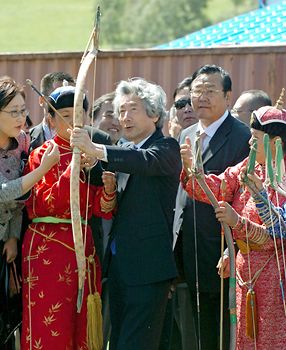
fr0608112.jpg

Best Prime Minister ever? You bet. Too bad he’ll be checking out next month.

What I really liked about Koizumi was his knack for political spectacle – you may remember his recent Elvis impersonation. We’ve spent a lot of time looking at Koizumi’s sheer presence on camera. He’ll be remembered in the US for his horrible karaoke at Graceland, but in Japan he is likely to go down as Japan’s biggest reformer since MacArthur.

Now, R. Taggart Murphy at the New Left Review points out that Koizumi did precious little to shake up Japan’s real power structure – unchecked and all-powerful bureaucrats who are loyal lapdogs of the US because Japan’s immense dollar holdings leave them with few options. I can’t offer a complete response to the article, but he dismisses Koizumi’s reform drive as a “convincing act,” a claim that’s irritating as someone who looks at some of the trees among the forest of Japan’s government.

I mean, he’s basically right. Of course any responsible Japanese politician isn’t going to commit political suicide by disrupting the precarious world financial system (Taggart admits that elsehwere in the paper), and any policy pursued by the PM’s office is going to be riddled with concessions to the “real power holders” – hence the directionless postal privatization policy and failure to get Japanese bond issuances down under 30 trillion yen, as well as leaving many other unanswered questions. And he makes a good point – that the push for so-called “neoliberal” economic policies that has been going on since the 90s were often nothing but smoke and mirrors hiding more cynical policy objectives.

But at least in terms of political reform, Koizumi did a lot – the dismantling of the LDP’s faction system (as seen in the rush to support Abe), the rise of the CEFP style of policy making, and the fruition of Japan’s new electoral system, all Koizumi-led developments. These are not merely “imported suits of clothes” as he puts it but (late) responses to demands from the public to take power away from the bureaucrats, who have lost significant public trust in the last decade or so.

But it looks like Japan’s next PM, Shinzo Abe, in addition to offering very little on policy issues (reports on his new book and promotional campaign seem pretty wishy washy – I mean, 2nd chances for failed business owners?!). And it’s certain that he will offer nothing even remotely closely resembling Koizumi’s early classic bike safety display in full, shiny reflective business attire.

I mean, just look at this guy (on the left of course):
abe and koizumi with chicks.jpg

As much as I’d like to know what this picture is all about (Chinese source!), it’s clear enough that this man is zombie Jon Arbuckle – boring, lame, and flesh-eating. He’s typical LDP blah and Japan needs none of it.

Koizumi, you’ll be sorely missed. I’ll be crying as I clutch my lion keychain (get them at the LDP HQ while they’re hot!) during Abe’s swearing in.
Support the Reemerging State Shinto – Visit Yasukuni!

Yasukuni Shrine, Japan’s controversial unofficial war memorial, is in financial trouble, says the Asahi Shimbun. Apparently, the drop in major donations spurred by the disappearance of the war generation has run headfirst into plans for a revamping of its war-nostalgia museum in preparation for its 130th anniversary. Let’s look at the numbers:

Total cost for renovating the museum: 8.3 billion yen
Annual budget: 1.8 billion, down 5% from last year and almost half of the 1985 budget of 3.2 billion yen. So they’re dipping into the endowment, it looks like.

In terms of revenue, Teikoku Databank shows that Yasukuni only reported 235 million yen (parking fees, rent for the gift shop and building, and entrance fees for the museum), down from 400 million yen in 1996 (NOTE: edited from original post). It’s the 3rd highest earner of all Shinto shrines, but only makes 1/5 of the top earner, Meiji Jingu. At this rate, the shrine is currently moving forward with rationalizations such as not replacing retired workers, outsourcing some operations, and getting estimates from multiple contractors and auctioning out construction/repairs.

Obviously, this development will have an effect on the recent reemergence of proposals to nationalize the shrine. Although the Asahi warns that “it is doubtful that Yasukuni will agree to dissolve itself” it’s not like a bankrupt Yasukuni (or its backers in the war bereaved association) could really say no to national patronage if it means saving the expensive but apparently effective museum.

Aso’s plan to de-Shintoize Yasukuni

Foreign Minister Taro Aso, who is still trying to become the next prime minister despite not having a snowball’s chance in hell, has a new plan to save Japan. He reckons that by taking the gods out of Yasukuni, the Emperor will be able to visit and none of those pesky lawsuits will have any standing. The English report:

Aso, known as a diplomatic hawk who has offended China and South Korea with remarks in the past, said his plan was not aimed at mollifying foreign countries. Instead, he hopes to resolve a domestic debate that flares up whenever a Japanese leader visits the shrine and has prevented the emperor from going there since 14 “Class A” war criminals were added to the lists of those honored at the shrine in 1978.

“It’s about expressing our respect and gratitude for those who died for their country and praying for the peace of the souls of those who died…without all this fuss,” Aso told a news conference.

“The tens of thousands of soldiers who died crying ‘Long Life to the Emperor’ filled those words with deep emotion,” Aso said in a statement outlining his idea. “So I strongly pray that the emperor can visit Yasukuni.”

Yomiuri Shimbun’s blurb says that the strategy to pull this off goes roughly as follows:

  1. Dissolve the religious foundation that administers Yasukuni and set up a new private foundation (zaidan hojin) to run the shrine.
  2. By special act of the Diet, establish a special corporation to administer Yasukuni.
  3. Most amusingly, change the shrine’s official name to 靖国社 – removing the character for “god” in the word “shrine.”

Adding to the craziness of this scheme, Yomiuri mentions at the end of its article that Aso wants this process implemented for all of the “gokoku jinja”—a group of 52 shrines scattered across Japan enshrining those from the area who died at war–“regional Yasukunis,” so to speak.

Needless to say, if you can’t de-enshrine war criminals, it’s gonna be tough to de-Shintoize Yasukuni (and, for that matter, 52 other shrines).

Just in case you’re worried, Aso still does not have enough support to run and hasn’t officially announced his candidacy yet. UPDATE 8/10: I spoke too soon. Muddafugga gots his twenty. Looks like he’s announcing later this month.

DPP factions banned

Following on the heals of Joe’s post on factionalism in the LDP and the campaign for a new Prime Minister, it’s interesting to note that Taiwan’s DPP (Democratic Progressive Party) just voted to ban factions entirely. The move is designed to help strengthen the party’s central governance in the wake of a series of corruption scandals (even involving members of President Chen Shui-bian’s own family) that have helped to shatter Chen’s reputation as an effective administrator and probably weakened the party’s chances of retaining the presidency and winning back control of the legislature in the next election cycle.

I remain unclear on how this will actually help, however. While there have been a number of DPP affiliated politicians implicated in corruption (although the rates of such taint in the DPP are still lower than in the period of former KMT rule), I am not sure how this is in any way related to the faction system. While a unified party platform may help them win elections, voter discontent with the ruling DPP has had more to do with a lack of competence and integrity than their political rhetoric. Will the elimination of the faction system simply make the party less open to contratian opinions, and come to more closely resemble their Nationalist Party opponents, whose top down decision making system was originally based on a Leninist model?

Perhaps a more desirable solution would be to embrace a system more similar to a US caucus style system, in which a legislator may choose to affiliate themselves with a group organized around a specific issue or constituency that they endorse. While a caucus (they may also be referred to as Study Groups, Coalitions etc.) is a formally registered group within the Congress, they are not exclusive. That is, a congressman can belong to any number of Caucuses that he or she supports. Also unlike a faction, a caucus is not a division of a political party, and not necessarily partisan at all. To pluck an example totally at random, take the Congressional Taiwan Caucus, whose four co-chairs include two Republicans and two Democrats (as well as 148 other congressmembers.) US politics may be bitterly partisan, but the level of cooperation between the two major parties is still approximately a million times better than between Taiwan’s own two major parties.

As for the ostensible reason for eliminating party factions, the DPP national convention did in fact pass a separate anti-corruption resolution, which includes such measures as mandating a special party investigation should a DPP-affiliated government official be charged with corruption. The measure was named in honor of the President’s indicted son-in-law, Chao Chien-ming, who just this past Thursday was seen in the presence of mysterious men in black reputed to be gangsters at his own bail hearing. Following the scandal, Chao’s attorney advised him “to be more careful when seeking assistance from friends.”

Hirohito’s Yasukuni issues, and whether they mean anything today

A memo drafted by the late Emperor Hirohito’s secretary in 1988 indicates that Hirohito purposefully stopped his visits to Yasukuni Shrine after Class A war criminals were added to its list in 1978. Hirohito had visited the shrine eight times between 1945 and 1978, but mysteriously stopped after that, and nobody was ever sure exactly why (although the implication was obvious enough).

After this news broke on Thursday, both Koizumi and potential successor Shinzo Abe stated that they would not change their personal Yasukuni policies, Koizumi characterizing it as an “issue of the heart” and Abe questioning the authoritativeness of the “personal” memo.

This might have seemed like a boon for Yasuo Fukuda, the only major contender for Koizumi’s throne to clearly oppose visiting Yasukuni, but then, just to make things more ridiculous, he decided not to run on Friday night. This makes the race a pretty one-sided game for Abe: while Taku Yamasaki and Koichi Kato continue to lead the opposition to Koizumi and Abe within the LDP, their support is not nearly broad enough at this point to stop Abe from winning the party election in September.

So do Hirohito’s opinions mean anything in today’s Japan? Well, they can certainly be used as ammunition for the anti-Koizumi guns, but they’re certainly not enough to pierce his armor. And if Abe’s current behavior is any indication, it will take better ammunition to bring him down as well.

Japan should just admit it didn’t accomplish anything in Iraq

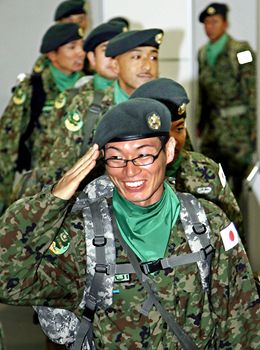
SDF.jpg
Now that the troops are home, Japan’s government (and its good buddies in the Japanese media) can’t stop patting itself on the back for “completing its humanitarian mission” building schools and so on in Samawah even as the rest of Iraq succumbs to civil strife. From the initial announcement on June 20:

The Government of Japan decided today that it will redeploy the Ground Self-defense Force (GSDF) troops in Samawah, Iraq. This decision is based on the judgment that the humanitarian and reconstruction assistance activities in Iraq being conducted by the GSDF in Samawah have fulfilled a certain role. The Government of Japan has also taken into consideration the establishment of the new Iraqi Government by the Iraqi people themselves and the ongoing process of transferring security responsibility in Al-Muthanna Province, where the GSDF troops have been operating, to the new Iraqi Government, and close consultations with the United States (US) as well as the Multi-National Forces (MNF) and other nations including the United Kingdom (UK) and Australia.

President Bush apparently agrees with this sentiment during Koizumi’s June 29 US visit:

We — as I mentioned, we discussed Iraq and Afghanistan. By the way, the Japanese defense forces did a really good job when they were in Iraq. And they’re able to leave because they did such a good job. And now the Iraqis will be running the province in which the Japanese forces used to be. Nevertheless, the Prime Minister, as he mentioned in the comments, will continue to provide airlift capacity and naval help.

Japan’s top newspaper, the Daily Yomiuri, gushes over the SDF’s apparent accomplishments:

As Prime Minister Junichiro Koizumi put it, “There were no pistols fired, and no guns pointed at anybody,” and there were no fatalities among the GSDF personnel.

The work carried out by about 5,500 GSDF members has been given high marks by the Iraqi government, and their mission was a success.

According to a Yomiuri Shimbun poll conducted earlier this month, 68 percent of pollees said the activities by members of the Self-Defense Forces “contributed” to the reconstruction of Iraq, compared with 28 percent who said they “made no contribution.” Gradually, the public are backing the activities of the SDF.

This is frankly pathetic. Let’s remind ourselves of what it’s like in Iraq right now:

In the first half of this year, 4,338 Iraqi civilians died violent deaths, according to a new report by the U.N. Assistance Mission for Iraq. Last month alone, 3,149 civilians were killed — an average of more than 100 a day.

Some would say “What could Japan realistically do, given its pacifist constitution and the limited mandate provided by the special law that allowed them to be there in the first place?” Well, yeah. But in that case what were they doing there in the first place? And what right do they have to give themselves credit for cursory jobs that could have easily been covered by Americans?

The Nikkei at least admits the self-centered political calculations behind the deployment and doesn’t attempt to trumpet non-existent accomplishments:

EDITORIAL: GSDF Iraq Mission Ends With Constitutional Issue Unresolved

TOKYO (Nikkei)–Japan’s Ground Self-Defense Force on Monday finished withdrawing its troops from Iraq after two and a half years of humanitarian activities there in a mission that marked a significant milestone in the postwar history of the nation’s defense policy.

Almost miraculously, GSDF troops suffered no casualties during the dangerous mission, which signaled Japan’s desire to play a greater role in the international arena and raised some important legal questions.

The GSDF’s operations in Iraq, which started in January 2004, were based on a special law to support the country’s reconstruction that came into effect in August 2003.

The government carefully planned and prepared for the operations to ensure that GSDF troops would not get embroiled in any armed battles. It selected the southern Iraqi city of Samawah as the site for the GSDF activities, rather than northern areas where U.S. troops are stationed, mainly for safety reasons. It was apparently the right decision.

I’ll agree with the editorials on the obvious point that Japan has crossed a certain line on its way to normalizing its military. But don’t let that delude you into thinking that somehow equates some actual accomplishments in Iraq, especially since it’s becoming clearer than ever that Iraq is on its way down the toilet.

CIA did support the LDP after all

The speculation can stop: Yes, the CIA did fund and advise LDP election activities in the 50s and 60s. But only about $75k per year, says a recently released “U.S. diplomatic document” according to the Mainichi Daily News. The real focus was on crushing and dividing the left, on which the Agency spent an average of half a million per year (presumably to pay informants/agents?). I wish I could get a hold of these documents, but it looks like the entire country is trying to access the State Dept. Website now for some crazy reason.

Economic White Paper reveals shortcomings of Japan’s labor system

Japan’s economic gap not growing as fast as the Gini coefficient would have us believe? According to the Nihon Keizai Shimbun, a recently released economic white paper details some key developments that could be skewing the data. From the Nikkei:

To prove the point [that the data are flawed], the white paper cited a nationwide consumption survey by the Ministry of Internal Affairs showing that most of the growth in the income gap since 1989 stemmed from the fact that households composed of the elderly increased as a percentage of all households. The white paper cited a decline in the average number of members in Japanese households as another reason for the apparent widening of the income gap.

The big problem that could have “adverse effects” on the Japanese economy, the report says, is the now 3.6 million youngsters shooting themselves in the foot by insisting on living a free-wheeling lifestyle in a system that punishes them both socially and financially for it. In other words, if your average Japanese person doesn’t lock in a permanent position in that critical age window of 22 until around 30 (when the typical age discrimination kicks in), he or she has little chance of making as much lifetime income as someone who followed the rules. Of course, there’s nothing controversial about people making less money because they don’t have full-time jobs. The problem is that “full time” jobs (seiki koyo) in Japan are permanent (no firing/quitting as a general rule), so when times get rough, companies have filled up vacant posts with “part time” or contract positions that pay fewer benefits, lower wages, and don’t have the same amount of security in exchange for working the same hours and often performing the same job as full time employees. In terms of effects, the report estimates that once this “Freeter” generation (named after a Janglish word for part-timer) hits middle age in 2015, this phenomenon will result in a 4.9 trillion yen (or 0.9%) loss in GDP.

While part-time work might work for women (who face social pressure against pursuing a career and who may want to work fewer hours while raising children) and old people, young workers who enter companies as part time employees find themselves trapped because while regulations were changed in the 1990s to allow for non-seiki employees, there was no concurrent reform of the seiki system – age discrimination included. If the youngsters continue working part time until they hit the age ceiling, then they are screwed.

Adamu’s Politically Untenable Solution? remove restrictions on firing full time workers (or simply introduce an “at will” employment system), eliminate age discrimination, and otherwise create a truly flexible labor market. GOJ/Shinzo Abe‘s politically sexy solution? Treat part time workers the same as full time workers, raise the maximum hiring age, and encourage more mid-career hiring.

Awwwww, yeah

King Becomes Prime Minister’s Chauffeur

Aqaba, Jordan (AHN) — After King Abdullah of Jordan hosted a dinner in the city of Aqaba Thursday for visiting Japanese Prime Minister Junichiro Koizumi, he decided to chauffeur him Koizumi back to his hotel.

Koizumi stated, “I did not think the king himself would take me back to my hotel.”

After the king and prime minister talked for two hours over dinner, the king suddenly suggested that he drive Koizumi to his hotel in a Range Rover.

With the king behind the wheel, they arrived at Koizumi’s hotel in high spirits, joking in the Range Rover until Koizumi got out.

Thanks to fark.com 

Koizumi Continues to Flout His Own Constitution!

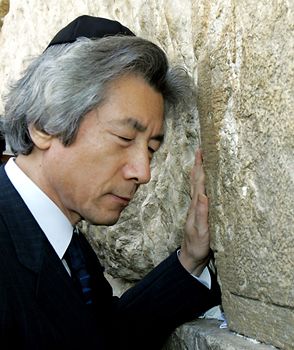
Koizumi Yarmulke.jpg
Prime Minister Junichiro Koizumi respectfully places his hand on the Wailing Wall, one of Judaism’s most sacred sites, in Jerusalem on Thursday during a trip to the Middle East that takes him to Israel, the Palestinian territory and Jordan. (AP)
(From Nikkei)

Who will stop Koizumi from continuing these perverse, random acts of worship?!