The day’s news in Patriotism and rememberance

Glancing at today’s top stories at The Japan Times, I am struck by how thematically linked many of them are. Now, of course it is a slow-news Sunday with few actual current events to report on, which leads the news people to slot the historical stories into the front page, but we can still see an interesting congruence of themes in four of today’s top stories.

The big story is that the New ‘patriotism’ education law takes effect. All readers of this blog already know that this law has been in the news for some time, it has been debated by everyone, protested against by citizens groups, teachers unions, parents and students, and contested by a coalition of the DPJ and other minor opposition political parties, who in the end failed to stop its passage by the eternally ruling LDP. While I haven’t read the actual text of the law [available here] yet (which I really should do soon), we do all know that the controversy stems from one particular section of the comprehensive education law-containing many provisions on reforms generally accepted as necessary-in which it states that “an attitude that respects tradition and culture and loves the nation and homeland that have fostered them” should be promoted by throughout compulsory education, which incidentally I believe has also been extended to include high school for the first time, in one of the less politically charged provisions of the law.

This rather innocuous sounding passage sounds like part of the basic curriculum of lower education in pretty much any country, and one could argue does not even sound any different from what is already taught in classrooms throughout Japan, but many people think of the recent case of teachers being disciplined for not singing the national anthem and feel a worry that the actual implementation of these newly mandatory provisions is another stage in the resuscitation of a particular pre-war style of nationalism. In reality, the debate is not over whether patriotism and shared national values should be taught to children, but what meaning that patriotism has, and what those values are.

The worry among the opposition camp is that the official patriotism will be a doctrine of subservience to the state, which could someday lead to a return to the military days of the past. The fact that the education law was passed in the same parliamentary session as the bill elevating the head of the Self Defense Forces to a cabinet level minister does not appear to them to be a coincidence. But the opposition has their own narrative of patriotism, primarily based on the doctrine of pacifism and anti-militarism that was embraced throughout Japan after the multifaceted disaster of Japanese Imperialism and the Second World War. The relentless defense of these principles, primarily in the guise of Article 9 of the American imposed postwar Constitution-the protection of which seems to be invoked in virtually every campaign poster of a politician campaigning against the LDP-represents a particular vision of Japan, which they are proud of and want to protect. This is an attitude that I think should be considered a form of patriotism.

While statements by the reigning Emperor tend to be somewhat bland and cryptic, this seems to be the attitude expressed by Akihito, the Heisei Emperor, in remarks made on his birthday-which was also a top story today. Although I mentioned above that it was The Japan Times in which these four stories were placed next to each other, I’m going to present the somewhat longer quote from the BBC article (also the front page of that site).

“Now that the number of those who were born after the war increases as years pass by, the practice of mourning the war dead will help them to understand what kind of world and society those in the previous generations lived in,” Emperor Akihito said, in remarks made on Wednesday, but only made public on Saturday.

“I sincerely hope that the facts about the war and the war dead will continue to be correctly conveyed to those of the generations that do not have direct knowledge of the war so the kind of ravage of war that we experienced in the past will never be repeated,” he added.

However, the emperor avoided touching on how people should honour those who died in World War II.

(The original Japanese statements can be found here at the Yomiuri)
Somewhat limp statements like these are a result of how it is generally considered inappropriate for the Emperor to engage in any political activity, or suggest or endorse any particular thing or action, lest it remind us of the bad old days. If you read the entire statement of the”symbol of the State and of the unity of the people,” you can see that he is very careful only to specifically reference the deaths of Japanese soldiers and civilians and the general horror of war, but he also hopes that the “history of both Japan and the world” should be “properly conveyed to the generation of people who have not directly experienced war” so that “the horrors of war like those of the past shall not be repeated.” Right wing supporters of the new education law may argue that children will be upset by learning about evil things done by their own country in the past, but it is difficult to believe that this sort of education encourages the strong anti-war sentiment in present day Japan. Could anyone really say that the Emperor’s desire for the history of war to be taught in such a way that it helps encourage students to be anti-war is unpatriotic?

The concept of “patriotic” education is not inherently nationalistic or jingoistic. I believe that growing up I was taught about American history in a way that was intended to strongly foster patriotism, but not by entirely white-washing the past. Among the things I specifically recall studying in American History class at some point over elementary school, middle school and high school classes are: slavery and segregation (lesson plans inspired in no small part by the fact that the public schools of Montclair, New Jersey were in the twelve years I spent there roughly 50% black/white), smallpox blankets, the Salem Witch Trials, Manifest Destiny, industrial revolution child labor, the Triangle Shirtwaist Factory, the Wounded Knee Massacre, the Trail of Tears. And this is not even a complete list of the various injustices committed by the United States of America that I was taught about in history class.

A Kobayashi Yoshinori or Shintaro Ishihara might think that I went through a history curriculum written by anti-American rabid communists or something, but as I already said these were actually patriotic lessons. How could that be? Well, slavery had Harriet Tubman and the underground railroad and the abolitionist movement-lessons of heroism and virtue. Segregation brought us Brown Vs. Board of Education-a lesson that our system of law is eventually a system of justice and the civil rights movement, with Martin Luther King, Rosa Parks and other heroes, and of course the eventual end of legalized segregation. The Salem Witch Trials lead to separation of church and state, a fundamental principle of American society. The dark side of the industrial revolution eventually led to the labor movement and various legislation and a significant improvement in worker’s rights. And so on. I do not recall if it was ever spelled out, but in retrospect the basic narrative is clear. Not “America is perfect,” but “America’s founding principles are good, and if we work at it, someday they can be fully realized.” How similar my education was to the national average I have no idea, but I expect that this core narrative is standard. And today’s third article, telling us that President Bush has signed a law providing for the preservation and restoration of all the Japanese internment camps from World War II. “The objective of the law is to help preserve the camps as reminders of how the United States turned on some of its citizens in a time of fear.”

Right wingers in Japan deride the teaching of things such as comfort women, war crimes and colonialism as anti-patriotic, saying that it will make children feel bad about their country. But it is all about the approach. Certainly teaching children about the mistakes and excesses of the colonial decades makes them feel bad about that time, but presented correctly it makes them feel good about living in today’s Japan: a nation which has moved past that stage. Perhaps by being over-reactionary about terms such as “patriotism” and “nationalism,” peace activists, politicians and teachers in favor of actually teaching kids about the past are in fact making a serious strategic error. By saying patriotism=right wing makes it all too easy for the rightists to label them as unpatriotic, when many of them are actually very patriotic.

And now the fourth and final article, Sex slave exhibition exposes darkness in East Timor, which describes the findings of a Truth Commission by the East Timor government on the systematic rape of East Timorese woman by Japanese soldiers in so-called “comfort stations” during Japanese occupation of the then Portuguese colony, as well as the far less organized rape of East Timorese women by Indonesian soldiers during their occupation of the now independent country. While all of this is very interesting, particularly how characteristics of the local society led to different recruiting practices of comfort women from certain other colonies, the following passage is the one relevant to the current essay. [Emphasis added]

Citizen groups concerned about the lack of accountability for the wartime sex-slave atrocities convened a people’s tribunal in Tokyo in 2000 that found the late Emperor Hirohito and high-ranking Japanese military officers guilty of crimes against humanity. The verdict was later censored from an NHK documentary on the trial amid allegations by a major daily newspaper that two heavyweight Liberal Democratic Party politicians — Shoichi Nakagawa and Shinzo Abe — paid a less than comfortable visit to the public broadcaster before it was aired. [Detailed article on this case here at Japan Media Review]

Charges of government censorship of NHK, which seemed sensational and cynical at the time, are now quite believable in the wake of news that now Prime Minister Shinzo Abe has ordered NHK to focus on the North Korean abductee case. Fears that Japan is returning to 1930’s style thought control are both premature and somewhat hysterical, but increasing interference with NHK and education is inarguably more of a step in that direction than away from it. However, while the LDP did manage to pass this bill, opposition to it was fairly strong, and the Abe administration is not looking particularly popular, so it is always possible that we have another amendment of the education law by a future administration to look forward to. Yet, I think the return of education that teaches Japanese kids to take pride in their country is here to stay. The big question is, what will teach them to be proud of? German style guilt based education is entirely off the table, but that does not mean that history class has to be sanitized. There is a big difference between teaching children to be ashamed of the past and teaching them to be proud of having surpassed it.
Abe’s not getting along with the press

You may have noticed that Prime Minister Shinzo Abe isn’t all that popular these days despite only having been in office for 2 months. The newspapers are reporting a 20% dip in support, and he has been mired in scandals, the most recent of which surrounds Tax Commission Chairman Masaaki Honma, who was forced to step down for living in subsidized housing with his mistress. This is the first change to Abe’s appointed team since taking office and a major development that could lead to further loss in confidence.

Compared to Koizumi’s first 2 months in office back in 2001, when the lion-maned PR darling was a veritable rockstar with his own hit photobook, Abe isn’t getting a break. And this despite the nuclear missile test in NK, which would presumably inspire a nation to rally around its leader.

While the substance of Abe’s policy agenda got its share of attention, the media has seemed to go out of its way to focus on Abe’s missteps, in particular the town meeting scandal (Abe knew!), the readmittance of the postal rebels (the LDP is cynical!), and his supposed lack of resolve in pursuing economic reform and budget discipline (he’s giving power back to the evil bureaucrats!).

Why? One reason is the Ozawa-led DPJ. They have so far done a good job of relentlessly pushing the first two issues in the spotlight, in particular the town meeting scandal, which was embarrassing since the LDP government was caught red-handed. There’s an upper house election in 7 months, and it comes at a time when LDP is vulnerable (the LDP member who won seats in 2001 on the Koizumi popularity wave must now stand for reelection) that also happens to be a traditionally unlucky year for the LDP. While some reports claim the DPJ is being needlessly uncooperative, the numbers show that these scandals are taking their toll on Abe’s popularity rating, and that makes them effective. Without public support Abe loses quite a bit of leverage if he’s to lead policymaking and stay in power for his full term.

But another, more likely, explanation is that Abe is having a tough time dealing with the media. For one thing, he isn’t playing ball with the press gaggle.

I noted back in October that Abe decided to cut in half his daily press availabilities from 2 to 1. The reports offered no real explanation for the change, but it was significant enough to get reported in the first place. Instead, he is relying on his PR double team of Chief Cabinet Secretary Yasuhisa Shiozaki and Special Advisor Hiroshige Seko to deal with the press while he does the awesome prime minister stuff like eat school lunches.

But it hasn’t taken very long for the media to complain that they aren’t getting enough face time. Abe got in trouble just yesterday when he talked way too long during his press conference announcing achievements upon the end of the recent extraordinary Diet session. He used up 19 minutes of a 20 minute press conference to blab on listlessly about the legislative achievements of passing patriotism-instilling education reform and the promotion of defense agency to ministry status.

The media was livid and ran stories announcing that only 2 questions could be asked, and later reports announcing the forthcoming apologies from both Shiozaki and Abe himself. Abe pledged that it someone made a “clerical error” by giving him a long speech at a press conference. How convenient just a day before you have to fire someone!

Now, I don’t want to go and accuse the major media of manufacturing any of his scandals, or blowing things out of proportion (though they may be doing the latter). It’s just that they haven’t been very sympathetic, either. The Honma scandal came out of a muckraking piece by a less-prestigious weekly. Many reports by the weeklies (such as Abe’s ties to shady cults) are ignored by the larger newspapers, but this time they picked up the story, making the problem much larger than it normally would have been.

It’s strange to see this change in the relationship, since as far as I know, Abe has so far had a rather amiable relationship with the press, who helped raise his image as the hero working to rescue kidnapping victims from North Korea. Now it’s like they’re setting him up for a fall just because it would be a good story.

But rather than being angry, the media could simply be getting bored with a prime minister whose hair is far too normal. One anonymous insider quoted in a Reuters story was sympathetic with Abe’s situation, noting that Abe is in part simply dealing with the Koizumi legacy of staged appearances and neverending soundbites: “Abe is doing what he can, but to the public who’s used to theater-style politics it just looks normal.” Replace the word “public” with “media” and you’ll get the idea.

More about Abe eating: Salmon school lunches

Abe kyushuoku Dec 2006 2.JPG

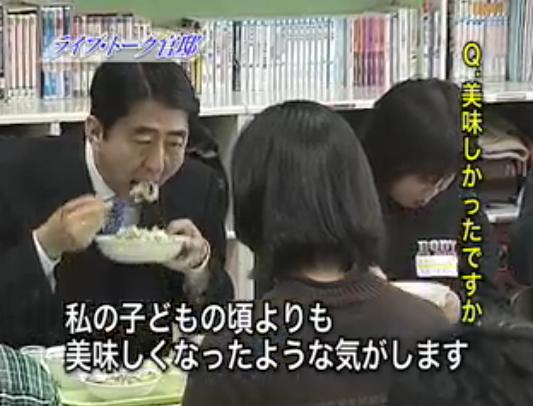
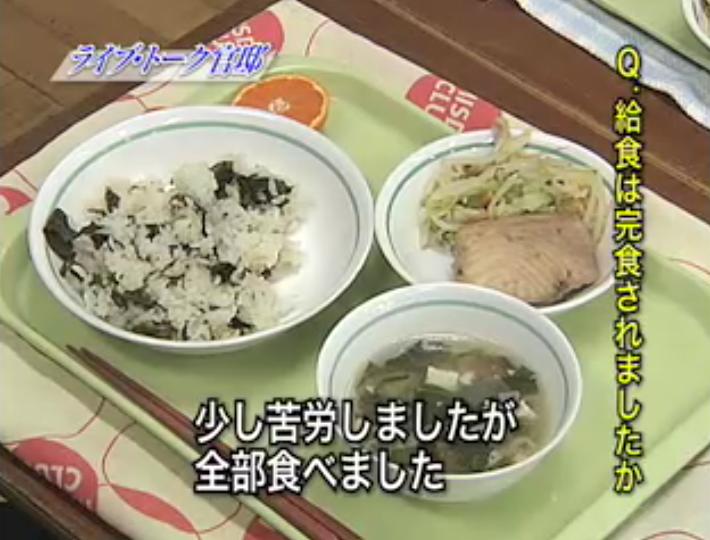
Last week, Prime Minister Shinzo Abe took a trip to some random elementary school where he made a point to eat one of the nationally subsidized school lunches (“kyushoku”) with students. He ate a salmon steak, some wakame miso soup, rice mixed with some kind of seaweed, and washed it all down with a frosty mini-bottle of milk (salmon and milk? Ick!). He remarked it was even more delicious than his old school lunches (which likely included a bit of whale meat) despite having “some difficulty” finishing the whole thing. Here’s what it looked like:

Abe kyushuoku Dec 2006.JPG

And here’s what Abe had to say about the visit in his latest e-mail magazine:

I visited an elementary school in Tokyo last week in hopes of getting a feel for the educational environment children are in today and talking to them in person.

It was my first visit to an elementary school in the 40 years since I graduated from my own. Over lunch, I had a chance to hear, in their own words, what children are really thinking. Many shared with me that they enjoy extracurricular activities and sports. They also asked me unpretentious questions, such as, “As a child, did you have a goal in life?” These questions reassured me that children have hopes and dreams for what they want to pursue in the future.

I was a bit worried that the children would tense up with the press crew in their classroom, but the close bond the class shared and the warm smiles they gave me as we talked impressed me strongly.

I have kept in close touch with my elementary school friends, meeting with them frequently even now after 40 years. Exciting
times spent together with friends, even if you occasionally argue, will become a precious memory later in life. It is my hope that
children will possess the kindness to go over and talk to another child they see all alone. I was able to convey this message during
my visit to the school.

While he also added some token call to action against evil bullying activities, I couldn’t help but focus on and feel jealous of the delicious-looking lunches these kids get to eat. I never once got a taste of salmon during my US education, though perhaps it’s all the better since I wouldn’t have trusted my lunch ladies to prepare fish anyway. Still, it’s no wonder Japanese kids are so much healthier. Well, that and the constant endurance tests that they call phys ed class and extracurricular sports.

Jesus in action!

One of the more fun fixtures in Japanese politics is Jesus Matayoshi, a fellow who’s kind of like a lovable combination of Lyndon LaRouche and that guy from Heaven’s Gate. As his name indicates, he claims to be God: he can occasionally be spotted cruising around Tokyo shrieking out of a speaker truck when he’s campaigning (unsuccessfully) for a seat in the Diet.

While trying to explain his phenomenon to my lady-friend, I stumbled upon this wonderful clip from YouTube, showing one of his official election speeches. (Unfortunately, it’s only in Japanese, with no subtitles.) It starts off slow, so if you’re in a hurry you should skip forward to the last minute or so, where he lets loose his money quotes: “Koizumi should cut his belly and die!” and “I, the One God Jesus Matayoshi, will cast Koizumi into the depths of Hell!” Gotta love the kabuki voice, too.

After seeing this, Barack Obama is just not that interesting…

Akie Abe wants to help you “like Japan”

An interview with PM Shinzo Abe’s wife Akie appeared in the BBC recently. In the interview, she indicates interest in an issue that I have had personal experience with:

Another interest of mine is to increase care for those students from abroad who are studying in Japan – I wonder if there is anything I can do in my present position to help them like Japan more.

The wife of the prime minister is a very special position. If there is something only I can do while I am in this position then I would like to contribute and I would like to be useful.

That’s a noble pursuit, indeed. However, as far as I can tell she has zero history promoting any such agenda. She may be studying Korean, but it’s apparently just because she’s such a big fan of Korean soap operas.

No, it’s far more likely she, like her husband Shinzo most of the time, will be using her position to promote existing education ministry policies.

According to the latest outline of Japan’s educational exchange program (PDF), there are already several government programs in place that could be interpreted as encouring a positive opinion of Japan. These include generous government scholarships (for a lucky 10%), subsidized Japanese language education, subsidized housing, access to Japan’s 70%-off national health care plan, and the ability to work part-time while studying.
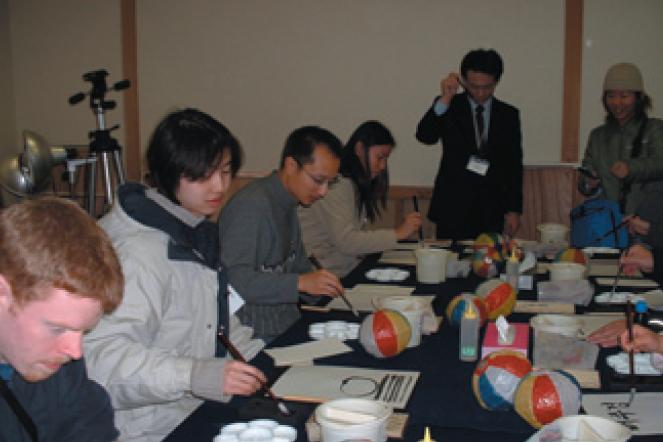
If that’s not enough, students also commonly have access to cultural activities such as calligraphy:

Exchange students learning Shodo1.JPG

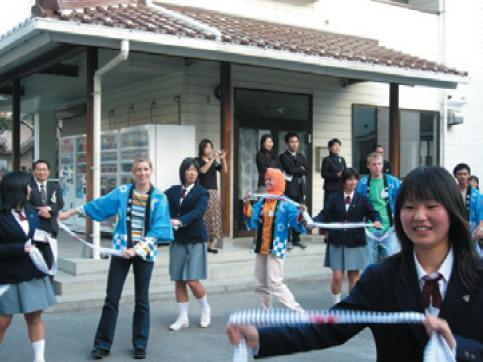
And interaction with the community:

Exchange students in the community.JPG

Compared to the US, where visa procedures, stringent restrictions on work, and a general atmosphere of distrust would seem to be counterproductive to fostering a positive attitude of the country, Japan’s system seems to already coddle its foreign students quite a bit. But most of the foreign students who get their undergrad degrees in Japan cannot find work in the country and end up having to go back. The way I see it, Japan can do two things to make its foreign students “like Japan,” and they are both things the US does a pretty good job of — offer a top-rate education and the opportunity to get a piece of the economic pie by allowing the students to stay and make a career in Japan. Statements like Mrs. Abe’s show that this still isn’t the priority. The scholarships that give educations that foreign students can take back with them are certainly beneficial, but I think Japan can do more than the limited opportunities it gives now, especially when many companies are clamoring for foreign labor.

Part 2: A brief history of Philippine-US relations: Early colonial rule

Since it turns out that all of my books on the Philippines are back home in the US and I’m not going to hit the library for a blog entry, I’m relying on a combination of memory and internet sources. I apologize for any errors, tell me if you spot any, and don’t quote this in your schoolwork.

Continued from Part 1: The “Nicole” Rape Case.

The fact is barely remembered in the US, but The Philippines was a colonial possession of the United States from approximately 1900-1946. The exact date at which The Philippines became a US colony is open to debate. The US purchased the Philippines from Spain in 1898 after winning the Spanish-American war, but since The Philippines had already declared an independent republic earlier that year, after years of resistance against Spanish colonial rule, and with neither the nascent first Republic of the Philippines nor the United States recognizing each other’s legitimacy as administrator of the country, the Philippine-American war broke out. The US defeated the Philippine military and established a colonial government in 1901, headed by Governor General William Howard Taft, whose experience in this job led to his later role as President of the United States.

Although The Philippines was a colony of the US, administration of the colony was markedly different from the colonies of European nations that still existed, or the colonies that Japan was busily establishing to the north. United States rule was particularly different from the earlier Spanish rule that it replaced. “From the very beginning, United States presidents and their representatives in the islands defined their colonial mission as tutelage: preparing the Philippines for eventual independence.” (source) In many ways, US colonial administration of The Philippines, with its mission of “tutelage” in preparation for independence, was more similar to US led occupation missions in post-war Japan and Germany, or present day Iraq than to traditional concepts of colonial rule. Keep in mind that Douglas MacArthur, the leader of occupation era Japan, had been in the Philippines before the Japanese invasion of World War II.

Compared to Spanish rule, whose policy was to concentrate power and wealth in the hands of the Spanish and mixed-blood colonial elite, spread the Catholic faith, exploit the land for resources that could benefit the home country, and keep the populace illiterate and unorganized, US rule was an improvement. Governor General Taft’s administrative philosophy was “the Philippines for the Filipinos . . . that every measure, whether in the form of a law or an executive order, before its adoption, should be weighed in the light of this question: Does it make for the welfare of the Filipino people, or does it not?”

To this end, and with the eventual goal of independence, the colonial administration promoted economic development, building political structures and instituted compulsory education for all citizens, using English as the primary language of instruction-in contrast to Spanish times, when very few Filipinos ever became proficient in Spanish. The Catholic Church had been the official religion of the colony and actually conducted much of the local governance throughout the islands, with the Spanish colonial government primarily sticking to urban strongholds. The Church had thus accumulated massive holdings, and priests had been known to run isolated parishes in the manner of medieval fiefdoms. The act establishing the colonial administration also revoked the Church’s official status, and the United States bought the majority of Church land, reselling it to private citizens and businesses.

But even though American colonial rule of the Philippines was relatively benign when compared with most European administered colonies over the previous centuries, it was still colonial rule. Like any colony, the colonizers imposed their language and culture on the colonized. English was the official language throughout the American colonial period, a constant reminder of who was really in charge, and in the early years also an impediment against participation in the civil service by Filipinos. Today, English remains one of the two national languages of the Republic of the Philippines, along with Tagalog, the native language of the region of Luzon island surrounding Manila, the country’s capital and economic center. While citizens throughout the country are supposed to be educated in both national languages, many Filipinos with a native regional dialect besides Tagalog are actually more comfortable with English, which they consider a supplement to their native language, as opposed to Tagalog, which is sometimes seen as threatening regional dialect. The various dialects and languages are all strongly influenced by the language of their colonizers, with a large part of everyday vocabulary consisting of Spanish and English words. Interestingly, speakers of Philippine languages will sometimes use entire grammatically correct phrases or even clauses of English in ordinary conversation in their native language. I have heard that speakers of the Tagalog (Manila region) dialect use the most English words, but the more provincial Visayas dialects contains a higher proportion of Spanish words. However, Spanish derived words are used only as vocabulary in all dialects, and never as complete grammatical structures, which is reflective of the rarity of actual Spanish fluency in the Spanish ruled Philippines.

All governments have some level of corruption, and those which are not answerable to the people they administer, such as colonial governments, tend to be worse. The American colonial government in the Philippines was described in a 1921 letter from Dean C. Worcester as one in which graft was “generally, openly and insolently demanded as a prerequisite to the performance of their duties by government officers and employees.” (Worcester was an author of several books on the Philippines. One can currently be found at Project Gutenberg.) Aside from corruption, there was also contempt for the natives from many colonial administrators, even including at least one Governor General. In 1905, Taft’s secretary wrote “the trouble with Governor-General Wright and some others was that they came from the South and that they could not get rid of the race-prejudice which the man from the South of the United States has.”

Some prominent figures such as Mark Twain and William Jennings Bryan had opposed on anti-imperialist and anti-racist grounds the colonization of of the Philippines in the first place, but during the early years of the colonial period there was little support for granting them independence in the near term. There had been a promise by the US government from the beginning that the Philippines would be granted independence someday, when it was ready, but the primary debate was between those who wanted to establish a local Philippine civilian government subordinate to the US administration, and those who wanted to continue direct rule. Representing the first opinion, former Governor General Taft, now Secretary of War, wrote in 1907 that “the partial control of the government which is now in the hands of the Filipinos has itself developed both conservatism and an interest in the existing government which will have a healthful tendency to delay the pressure for immediate independence on the part of those who are actually exercising influence in the Assembly.” On the other side, an American teacher working in the Philippines wrote in 1908 that a “mistake was made in introducing civil government quite so soon, but on the other hand the military people exaggerate very much the danger of an insurrection and the need of an army–it is for their interest to do so.”

Next, part 3: Through Independence.

Right-wing trucks in Kobe

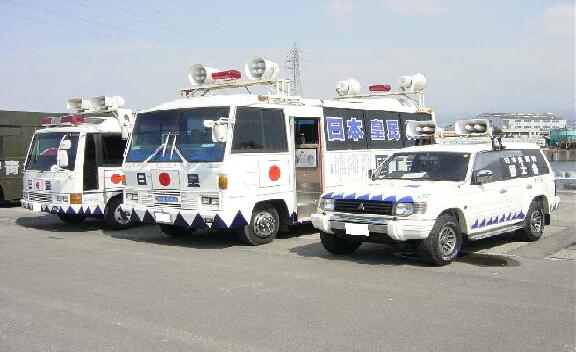
The December 7 issue of Shukan Shincho ran a story in its “Heaven’s still a long way off” section about bothersome right-wing sound trucks that plagued the city of Kobe in the months of October and November. Here is a quick translation of the article:

The behind-the-scenes story of the 50 right-wing sound trucks that gathered in Kobe

Nihon Kominto img001.jpg A number of police officers watch the intersection intently. There is also an anti-riot squad carrying duralumin shields. Security trucks are stationed at hotels, and several patrol cars can be seen spinning their red lights at the city hall. This is what Kobe looked like on November 26 as a state of heightened security continued throughout the city. Just what was going on that day?
It all began in late October. The right-wing group Japan Emperor People’s Party submitted an application to use a public parking lot located on the city’s Rokko Island. The city administration granted the group permission saying there was “no reason to refuse them.” It was a contract to use a space that can hold 150 passenger cars for one month.

“Since then, several right-wing group sound trucks started gathering in Kobe. The prefectural police immediately deployed a massive amount of anti-riot police. They installed a checkpoint at the road in front of the parking lot and the two sides started staring each other down. There were some minor fisticuffs when the police searched the person of one of the group members,” says a local journalist.

Then on November 5, 50 sound trucks began a large-scale demonstration in town. A taxi driver who witnessed the event describes the scene:

“I saw them at the intersection on the west side of Kobe station, and it was a doozy. All of a sudden, black and white sound trucks were there as far as the eye could see. It’s quite a sight to see so many at once. They were playing military marches or something, but the volume was low. It was actually kind of creepy, too quiet.”

The real reason

Just what did they gather in Kobe in droves to protest? Masashi Takajima, action committee chairman of the JEPP, which continues its activities in Kobe, had this to say:

“Our recent sound truck activities were intended to protest the North Korea issue. That country is trying to return to the six-party talks while in possession of nuclear weapons. These activities are in response to that. The reasons we chose Kobe are several including the fact that they continue giving tax breaks to facilities owned by [pro-Pyongyang Korean-Japanese group] Songryon.”

However, an official from the Kobe Prefectural Police contends:

“We see their true objectives to lie somewhere else. At the end of September, just before Kobe held the National Athletic Meet [Kokutai], the large hotels in Kobe city established a ‘Liaison Committe to Exclude Organized Crime Groups.’ They made it clear that they would refuse to allow members to stay at or use their facilities. [These recent events] are in protest of that.”

Also, a senior leader of a right-wing group who participated in the sound truck activities murmurs:

“It’s true that the refusal to let gang members stay at hotels was the inspiration for the recent sound truck activity. More than the hotel issue, we intend to put pressure on the prefectural police who called for the exclusion of organized crime members. However, there’s a gag order in place and no one is allowed to tell the ‘real reason.'”

Takajima rebuts these claims, explaining, “That’s totally wrong. We never went to protest at hotels, nor did we talk about that in the sound trucks. A gag order? There’s nothing like that at all.”

The right-wing group quickly vacated the sound trucks from the premises of the parking lot on November 24, the day the contract expired. That is because the city refused to extend the contract. However, Takajima notes, “All we have to do is secure another location to base our activities from. We intend to continue our activities, including during [Christmas light show] Luminarie, when people gather in Kobe.” The battle between the police and right-wing groups looks likely to drag on.

PESEK on Japan’s shrinking population

As if he were aware of MF’s recent discussion on the economic effects of Japan’s shrinking population, Bloomberg columnist William Pesek weighs in with some characteristic commentary. Pesek reports on some economists who claim that population aging and a shrinking work force would, contrary to popular belief even in mainstream Japan, have no detrimental effect on the economy as long as there’s sufficient growth in productivity, which is apparently a piece of cake. Pesek, as the headline of his column would suggest, thinks this prospect of a healthy-yet-possibly-shrinking economy so flies in the face of how we understand conventional economies that he called on the authors of Freakonomics to investigate. Here’s the main thrust of the argument:

[Sharmila Whelan of CLSA Asia-Pacific Markets:] “Access to labor, technology and capital are the least of Japan’s problems,” Whelan said. “Creating an environment where there is unhindered entry and exit of new businesses and new ideas are born resulting in continuous innovation and cost savings is the greater challenge. Japan has a long way to go, but the process has started.”

Let’s hope so. Otherwise, the world’s No. 2 economy could shrink along with the ranks of the Japanese.

I think the productivity question is a big “if” in this equation as the creation of the above-mentioned enviornment remains a major sticking point. Without the political leadership of a Koizumi, Japan’s government seems keen to rest on its laurels and fall back on public works spending and support of export industries that promotes the status quo of dangerous stagnation in Japan. But now, we have Abe as prime minister. And as I’ve noted before and as has been borne out by recent events, including the reinstatement of the “postal rebels,” the failure of the Abe administration to follow MOF’s line and divert gas taxes away from road building, the political leadership just isn’t there right now to provide that energy. Sure, initiatives that have LDP/bureaucratic consensus, like education and defense reform or the promotion of further government outsourcing can move through the Diet smoothly, but Abe so far seems to lack Koizumi’s resolve and has found himself on the losing side of crucial policy disputes within his own party. And it remains to be seen whether he will be able to stand up for his stated policy of cutting government debt and expenditures in the face of a boost in tax receipts.

Given the continued decline in public works spending and progression of reforms that were decided in the Koizumi days, Japan is in a much better position than it would have been. But Abe continues to disappoint, and it’s not as if there’s much out there in terms of alternatives. Within the LDP we have Foreign Minister Taro Aso as Abe’s most likely successor. He worked to undermine postal privatization as MIC minister just as he’s undermining Abe’s China diplomacy as Foreign Minister now. And then there’s opposition leader Ichiro Ozawa, who may be a strong politician, but he’s in poor health and not a particularly charismatic leader.

However, there are the makings of new breed of leaders, at least according to the author of the interesting-sounding The Japanese Money Tree: “Investors are ignoring an arguably much more important demographic shift…A younger generation of politicians, executives and policy makers is poised to take charge.” And Pesek goes on to note: “CLSA’s Whelan says fewer people will do for Japan what former and current prime ministers Junichiro Koizumi and Shinzo Abe have been unable to: catalyze an innovation boom that makes Japan more productive.”

These may be some famous last words, but is a generation of young innovators going to provide what the current one can’t? Perhaps it’s more likely that foreign-developed technological advancement will lead to productivity improvement, but can Japan count on that? Another question: What if Japan’s productivity increases, innovation adds vitality to the economy and improves living standards and all that, and the economy still ends up shrinking on an absolute level? Would people be willing to accept it?

The new Ministry of Defense and the difference between a “Commissioner” and “Minister” in Japanese politics

The Japanese government’s move to make the Japan Defense Agency into the “Ministry of Defense” can be a little confusing. The bills were passed with almost unanimous support in the lower house, with main opposition party DPJ voting with the ruling coalition, and will likely be enacted into law by the end of the Diet session this year. But what is it that would change, exactly? More specifically, what would the role of a Minister of Defense be, exactly? I decided to very casually look into it, and here is a blockquote-filled summary of what I found out:

The editorial page at Japan’s Asahi Shimbun, known for a left-of-center stance, had this to say:

Postwar Japan reflected on its history of aggression and colonial rule and vowed never to repeat the mistake of allowing the military to distort politics as it did before World War II.

That is why Japan did not position the armed forces it acquired again after the war as a military force but instead organized the SDF. The decision was also effective in announcing that the SDF is different from a regular military force to audiences both at home and abroad.

The SDF was also a symbol of a new Japan, which does not attach great importance to military affairs. The decision to establish the “Defense Agency” instead of a ministry of national defense or defense ministry carries the same message.

The government and ruling parties say that even if the agency becomes a ministry, there would be no substantial change. The change would boost the pride of SDF members. Other countries have ministries that oversee defense affairs. Just because the name is changed, it doesn’t mean the revival of prewar militarism, they say. That may be true.

But what is being tested is our determination and the will of postwar Japan not to again become a militaristic nation. It is not a question of something getting old and outdated.

To sum up, Asahi warns of the dangers posed by the morale-boosting effects that upgrading the SDA to the SDM would pose. If it’s about “pride” then why not can’t the SDF be happy with bold appearances by a top hat-wearing Shinzo Abe such as was seen last month? This explanation is just too vague. Its news report on the bill’s passage of the lower house has more detail:
Continue reading The new Ministry of Defense and the difference between a “Commissioner” and “Minister” in Japanese politics

Abe, a “cool” sunglass-donning, leather jacket-sporting man of the people

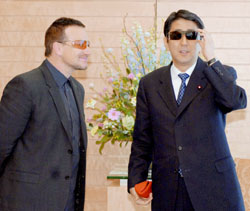
Abe meets U2’s Bono. Bono somehow loses all powers of judgment and perception and deems Japan’s prime minister to be “cool”:
Abe Bono nn20061130a3a.jpg

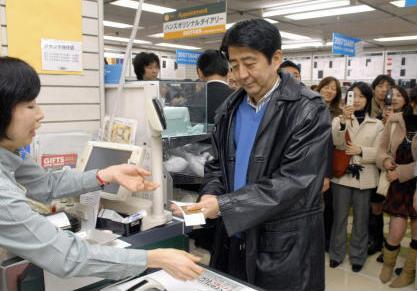
Abe finally moves into his official residence, but not before picking up a few things at the Tokyu Hands department store in Shibuya accompanied by his wife Akie and apparently the entirety of Japan’s news media:
Abe Tokyu Hands Nov 20061.JPG

Nice jacket! He bought pens, a stapler, some bath salts, cellophane tape, a blazer, some slacks, ties, and some books at Book First: a historical novel by Jiro Asada, and “for some reason” as Sponichi put it, five dictionaries, including an English-Japanese dictionary.

The Abes’ pet dog, a miniature dachsund named Roy, will stay behind with Shnzo’s mother at their residence.