Profile of Ryoichi Sasakawa in Irrawaddy

Some recommended light reading: Burma democracy movement news site The Irrawaddy has published a profile of Ryoichi Sasakawa, the enigmatic right-wing figure who went from war profiteering in Manchukwo to development state profiteering as the yacht racing (kyotei) mogul/ostentatious philanthropist.

Some excerpts:

A report prepared in June 1947 by US army intelligence described Sasakawa as “a man potentially dangerous to Japan’s political future…He has been squarely behind Japanese military policies of aggression and anti-foreignism for more than 20 years. He is a man of wealth and not too scrupulous about using it. He chafes for continued power. He is not above wearing any new cloak that opportunism may offer.”

Twenty years later, Sasakawa was the head of a multinational foundation, named after himself, which funded health and educational programs mainly in Asia. He claimed to be a man of peace, and one branch of his philanthropical empire was even named “The Sasakawa Peace Foundation.” When he died in 1995, his deepest regret was said to have been that he never got the Nobel Peace Prize.

From the very beginning, Burma was one of the countries where the Sasakawa Foundation and its sister organization, the Nippon Foundation, were especially active. Apart from being an associate of Kodama, Sasakawa was also close to Nobusuke Kishi, the Japanese prime minister from 1957 to 1960—and, in the late 1940s, also a prisoner in Sugamo. Kishi led the once influential Burma Lobby in Japan, and the Japan-Burma Association counted among its members 11 trading companies allowed to operate in various aid projects in Burma prior to 1988.

A native of Osaka, he was born in 1899 into a family of wealthy sake brewers. In the 1930s, he led an ultranationalist group called Kokusui Taishuto, or the “Patriotic People’s Mass Party,” which grew to 15,000 members. Each one of them wore a dark uniform fashioned after Benito Mussolini’s Italian Blackshirts. He also had his own airplanes, which transported supplies for the Japanese army. In 1939, Sasakawa used one of them to fly to Rome, where he met Mussolini. Years later, he expressed regret about not meeting another European leader at that time: “Hitler sent me a cable asking me to wait for him, but unfortunately I didn’t have time.”

The problem after the war was that the American occupiers in Japan badly needed the extreme right to counter the leftist movement, which was growing strong in the late 1940s. So, in 1948, Sasakawa, Kodama and Kishi were all released and allowed to rebuild their former organizations.
Continue reading Profile of Ryoichi Sasakawa in Irrawaddy

All about the PM’s trip abroad

I have waited far too long for this:

koizumi-r4211326578.jpg

koizumi-r729074569.jpg

koizumi-r339873611.jpg

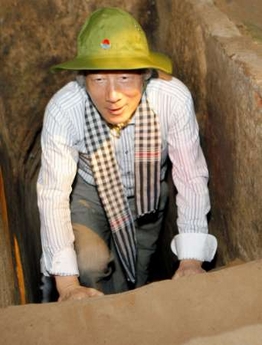
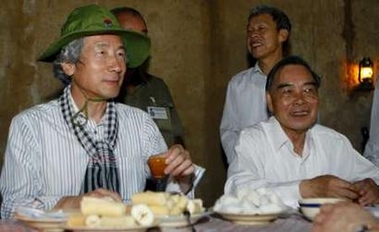
Japan’s former Prime Minister Junichiro Koizumi wears a Vietnamese soldier’s ‘Viet Cong’ hat and shawl during his visit to Cu Chi tunnel system in southern Ho Chi Minh city November 14, 2007. Koizumi is in Vietnam on a three-day visit.

koizumi-fr0711162.jpg

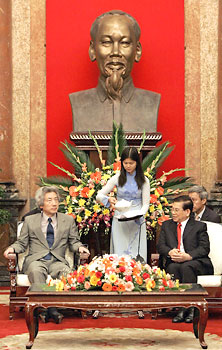
November 16: Former Prime Minister Junichiro Koizumi, left, speaks to Vietnamese President Nguyen Minh Triet in Hanoi on Friday. (AP)

In other news, some wormy-looking guy named Fukuda is visiting with President Bush. God I hope there’s an election soon.

A bit more on KMT remnant in SE Asia

I was pretty surprised and fascinated by a BBC mention last week of KMT soldiers who had fled to Southeast Asia instead of Taiwan, and turned to banditry and drug trafficking instead of soldiery. In an excellent coincidence, the Taipei Times ran an article on Saturday’s issue on just this subject.

Descendants of KMT soldiers living in limbo

ON THE MARGINS: The offspring of former KMT soldiers who fled China are finding that while they are welcome to study in Taiwan, they may not be able to reside here
By Loa Iok-sin
STAFF REPORTER
Saturday, Nov 03, 2007, Page 2 “Stateless” descendants of former Chinese Nationalist Party (KMT) troops stationed in northern Myanmar and Thailand yesterday pleaded with the government to naturalize them.

Tens of thousands of KMT troops retreated across the Chinese border and stationed themselves in northern Myanmar and Thailand following the defeat of Chiang Kai-shek’s (蔣介石) Nationalist forces by the Communists in the Chinese Civil War.

As the push to retake China never took place, many of the soldiers and their families were stranded in the region.

Since these people entered Myanmar and Thailand illegally, they are not recognized by the two countries. Their descendants have thus been denied citizenship, although many of them were born and raised in these countries.

Some of these stateless people faced a new challenge after coming to Taiwan to attend college.

Chen Chai-yi (陳彩怡), from northern Myanmar, told her story during a press conference held at the legislature yesterday.

“I passed the college entrance exam held by Taiwan’s Overseas Compatriot Affairs Commission [OCAC] and was accepted by a university in Taiwan in 2003,” Chen said.

However, since she had no citizenship from either country, Chen purchased a forged Burmese passport to travel with, she said.

It was only once Chen arrived in the country that she discovered she would be required to prove her status before receiving Taiwanese citizenship.

“I wasn’t aware of this and the OCAC didn’t tell me when I took the exam [in Myanmar],” Chen said.

“I cannot return to Myanmar because I will be imprisoned for life for holding a forged passport, but my stay in Taiwan will also become illegal once I graduate from college,” Chen said. “I’m basically stuck.”

Liu Hsiao-hua (劉小華), chief executive of the Thai-Myanmar Region Chinese Offspring Refugee Service Association, estimated that more than 1,000 students from the region are in a similar situation.

Lee Lin-feng (李臨鳳), an Immigration Bureau official, said that there are difficulties involved in granting these people citizenship.

“What has blocked these people from obtaining Taiwanese citizenship is that neither they nor the Ministry of National Defense have any proof that they are descendants of former soldiers,” Lee said. “Even when some had proof, they were unable to submit a certificate renouncing their original nationality.”

Lee said she would seek a solution at the next Ministry of the Interior meeting, “considering the special circumstances.”

I’m rather surprised that these former KMT soldiers and their descendants have remained stateless for so long. It is hardly expected that Burma or Thailand would have granted them citizenship. Although both countries do have communities of Chinese citizens, they would hardly have put escaping soldiers and criminals in the same category as immigrant merchants. The article does explain that “these people [do not] have any proof that they are descendants of former soldiers,” but I have yet to see any reason for why the KMT remnant in SE Asia never rejoined their main force on Taiwan, once it was clear that they were well established there, and the threat of invasion from the mainland began to recede.

The article mentions the Overseas Compatriot Affairs Commission [OCAC] (see their official English language website here,) which handles documentation and residency for overseas Chinese citizens (Overseas Compatriot.) While in a strict technical sense, Republic Of China citizenship theoretically extends to all of China, as the ROC is constitutionally the government of China, but as the ROC itself has shrunk to include what may someday be called merely the Republic Of Taiwan, ROC citizenship today more or less means Taiwanese citizenship, and in practice excludes any citizen of the People’s Republic of China.

While I do not have time at the moment to examine it in detail, the OCAC provides rules on Overseas Compatriot status, as well as rules for applying to study in Taiwan through the OCAC, using the process referred to in the above article.

Another mention of the KMT remnant turned criminal in SE Asia comes from a surprising source- the subject of the new Denzel Washington film American Gangster, the famous real-life New York based drug dealer Frank Lucas. The following text is from an interview article in New York Magazine:

Lucas soon located his main overseas connection, an English-speaking, Rolls-Royce-driving Chinese gentleman who went by the sobriquet 007. “I called him 007 because he was a fucking Chinese James Bond.” Double-oh Seven took Lucas upcountry, to the Golden Triangle, the heavily jungled, poppy-growing area where Thailand, Burma, and Laos come together.

“It wasn’t too bad, getting up there,” says Lucas. “We was in trucks, in boats. I might have been on every damn river in the Golden Triangle. When we got up there, you couldn’t believe it. They’ve got fields the size of Tucson, Arizona, with nothing but poppy seeds in them. There’s caves in the mountains so big you could set this building in them, which is where they do the processing . . . I’d sit there, watch these Chinese paramilitary guys come out of the mist on the green hills. When they saw me, they stopped dead. They’d never seen a black man before.”

Likely dealing with remnants of Chiang Kai-shek’s defeated Kuomintang army, Lucas purchased 132 kilos that first trip. At $4,200 per unit, compared with the $50,000 that Mafia dealers charged Stateside competitors, it would turn out to be an unbelievable bonanza. But the journey was not without problems.

“Right off, guys were stepping on little green snakes, dying on the spot. Then guess what happened? Banditos! Those motherfuckers came right out of the trees. Trying to steal our shit. The guys I was with — 007’s guys — all of them was Bruce Lees. Those sonofabitches were good. They fought like hell.

“I was stuck under a log firing my piece. Guys were dropping. You see a lot of dead shit in there, man, like a month and a half of nightmares. I think I ate a damn dog. I was in bad shape, crazy with fever. Then people were talking about tigers. I figured, that does it. I’m gonna be ripped up by a tiger in this damn jungle. What a fucking epitaph . . . But we got back alive. Lost half my dope, but I was still alive.”

(Via the Fighting 44s blog, pointed out by my friend Jon Lung.)

Tangential end-note: searching for “military remnant” on Google produced an article on the remnant of the Galactic Empire in Star Wars, following the end of Return of the Jedi.
More skeletons in the KMT closet

Just when I think I have a fairly good idea about what the Chinese Nationalist Party, aka Kuomintang (KMT) has been up to over the years, I read the following text in a BBC obituary of Burmese warlord, gangster, opium smuggler and “prince of death” Khun Su.

Born in 1933 to a Chinese father and a mother from Burma’s Shan ethnic group, Khun Su’s given name was Chan Chi-fu.

Growing up in the Burmese countryside, he had little education and came of age fighting Chinese nationalist Kuomintang (KMT) soldiers, who had been forced out of China by the Communists.

The KMT rapidly took over and expanded the opium trade in the region, but Chan Chi-fu and his gang gradually began to exert their influence during the 1960s.

Allied with the Burmese government, they are thought to have fought against both the KMT and the Shan nationalists in exchange for being allowed to continue trading opium.

All of us here know that the KMT as an organization, following their defeat by the CCP in the Chinese civil war, fled to Taiwan where they ruled a one-party police state for decades, and that many of them had been engaged in warlordism and banditry on the Chinese mainland before and during the civil war (this corruption was one factor in their defeat,) but I do not recall reading before about KMT members who fled to and engaged in banditry in SE Asia in large numbers. I do, however, find it a little amusing that Khun Su would, with his history of fighting the KMT, “play host to journalists and Western tourists, treating them to Taiwanese pop music.” After fighting KMT bandits in Burma, mightn’t be be a little bit sour towards Taiwan?

Anyway,  do any readers have any suggestions for sources to look at on similar KMT banditry/criminal activity in SE Asia, following their flight to Taiwan?

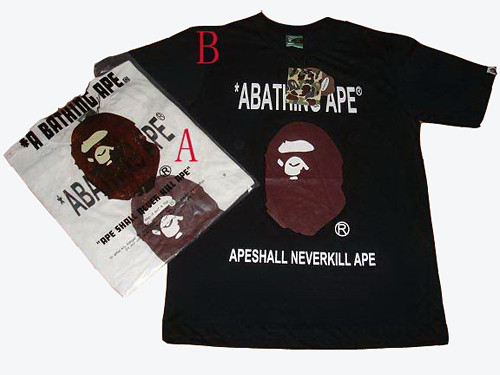
A Bathing Shoko

A few days ago I spotted the following sticker just outside Tokyo’s Roppongi Hills:

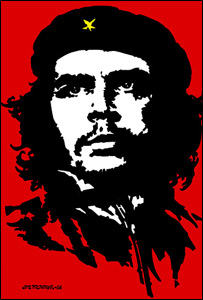
It’s an ironic tribute to former Aum Supreme Truth Cult leader* Shoko Asahara that combines his ugly mug with the iconic BAPE clothing logo (see below). I absolutely loved the image for my own reasons (I am a BAPE fan and an avid consumer of Aum-related developments), but it has taken on new relevance now that the BBC informs me that this year marks the 40th anniversary of Che Guevara’s death. The article discusses the enduring popularity of that one image of him glancing out somewhere with the utmost intensity:

Combined with the mystique and allure of Che and the spirit of revolution, another key to the spread of the image was the complete and intentional lack of intellectual property management on the part of the original photographer and designer, and it has certainly been effective for better or worse. Anyone with a pair of eyes who has visited US college campuses will know how pervasive this image is. And more importantly, the BBC article notes that in Latin America he remains an inspiration for his life and what he stood for, rather than just being a part of the trustafarian poster collection.

However, in Japan the story is a little different. A far more recognizable but similar image is the logo for hip clothing brand A Bathing Ape (aka BAPE) which derives its flagship logo from a combination of the Che image with the Planet of the Apes movies (stunning in their own right). While Che’s logo may stand for the combination of “capitalism and commerce, religion and revolution,” notwithstanding some recent dilution of the brand BAPE’s message is more along the lines of “wear this if you are young and listen to Cornelius”:


I should point out, however, that BAPE has none of the revolutionary hype nor is it even close to the level of pervasiveness of the Che image. It is just a hip clothing brand with a slightly creepy but somehow irresistible logo.

(*Asahara is apparently still revered in one sect of former Aum followers according to recent reports. He will be headed for the gallows for orchestrating the deadly 1995 sarin gas attack on the Tokyo subways whenever the Justice Minister gets around to it.)

Obama in Washington Square

I attended the Barack Obama rally in Washington Square Park this Thursday evening entirely by accident. I meet my Mandarin tutor at a NYU building on Washington Square East (since she’s also teaches Chinese classes for NYU,) and so I was walking from the 4th St subway station towards the park when I noticed police had set up a security perimeter and cleared the park, and there were thousands of people thronging on all sides. When I found out that Obama was going to be speaking there later on, I decided to go and listen after my lesson, but not having one of the tickets printed out from the website I went and stood in one of the outer, grassy areas of the park on the NW corner, from which I could just barely see Obama’s spotlit back as he gave his speech.

And it was a good speech. Not, admittedly, very specific or detailed, but I consider that simply part of the format of an event that one would classify as a general rally, and not a speech targeted at a particular group-although he was smart enough to give a number of nods to both the financial plight of college students, as well as his days living in New York, hanging out in that very park, and going to nearby bars in the Village (although he did not mention, in the heart of NYU, that he had been studying at Columbia at the time.) I read enough political news so that I wasn’t particularly interested on what he had to say about issues, since I’ve already heard the positions, but it was impressive and rewarding to see how well the man can work a crowd when he’s doing well. I’m not at all a fan of attending political events like rallies, protests, marches, and so on, but I am glad that I saw this one, and as a bonus I got to watch it with my friend Charles (yes guys, Charles from Rits) and that I met up with my friend Imara and a couple of his friends from political science class afterwards so there was someone to discuss it with.

<object classid=”clsid:d27cdb6e-ae6d-11cf-96b8-444553540000″ codebase=”http://fpdownload.macromedia.com/pub/shockwave/cabs/flash/swflash.cab#version=8,0,0,0″ width=”400″ height=”320″ align=”middle”><param name=”allowScriptAccess” value=”sameDomain” /><param name=”movie” value=”http://images.salon.com/ent/video_dog/VideoDogPlayer.swf” /><param name=”FlashVars” value=”video_loc=http://media.salon.com/media/video_dog/wsqbobama_2000243.flv&jpg_loc=http://images.salon.com/ent/video_dog/politics/2007/09/29/wsqobama/story.jpg&mail_loc=http://www.salon.com/ent/video_dog/politics/2007/09/29/wsqobama/email.html&seeksecs=&ad_loc=” /><param name=”quality” value=”high” /><param name=”bgcolor” value=”#101040″ /><embed src=”http://images.salon.com/ent/video_dog/VideoDogPlayer.swf” quality=”high” bgcolor=”#101040″ width=”400″ height=”320″ name=”VideoDogPlayer” FlashVars=”video_loc=http://media.salon.com/media/video_dog/wsqbobama_2000243.flv&jpg_loc=http://images.salon.com/ent/video_dog/politics/2007/09/29/wsqobama/story.jpg&mail_loc=http://www.salon.com/ent/video_dog/politics/2007/09/29/wsqobama/email.html&seeksecs=&ad_loc=” align=”middle” allowScriptAccess=”sameDomain” type=”application/x-shockwave-flash” pluginspage=”http://www.macromedia.com/go/getflashplayer” /></object>

Here is some video of the speech, courtesy of Salon.com, and you can get some more in depth coverage from the Ameripolitics nerds who blog at Salon, or from the New York Times article on the event– which naturally makes a big issue out of his criticisms of Hillary Clinton, to whom he referred as “the senator from New York.” And yet, somehow we knew that he wasn’t talking about Chuck Schumer.

Is it Burma or Myanmar?

Following on the theme of my previous post on place names and decolonization, the BBC gives the best explanation I’ve seen for the confusion over the two names by which this country is known internationally.

The ruling military junta changed its name from Burma to Myanmar in 1989, a year after thousands were killed in the suppression of a popular uprising. Rangoon also became Yangon.

The Adaptation of Expression Law also introduced English language names for other towns, some of which were not ethnically Burmese.

The change was recognised by the United Nations, and by countries such as France and Japan, but not by the United States and the UK.

A statement by the Foreign Office says: “Burma’s democracy movement prefers the form ‘Burma’ because they do not accept the legitimacy of the unelected military regime to change the official name of the country. Internationally, both names are recognised.”

It’s general practice at the BBC to refer to the country as Burma, and the BBC News website says this is because most of its audience is familiar with that name rather than Myanmar.

[…]

They have both been used within Burma for a long time, says anthropologist Gustaaf Houtman, who has written extensively about Burmese politics.

[…]

“There’s a formal term which is Myanmar and the informal, everyday term which is Burma. Myanmar is the literary form, which is ceremonial and official and reeks of government. [The name change] is a form of censorship.”

If Burmese people are writing for publication, they use ‘Myanmar’, but speaking they use ‘Burma’, he says.

This reflects the regime’s attempt to impose the notion that literary language is master, Mr Houtman says, but there is definitely a political background to it.

Richard Coates, a linguist at the University of Western England, says adopting the traditional, formal name is an attempt by the junta to break from the colonial past.

I’ve always been slightly puzzled that the democracy movement was in favor of maintaining the country’s colonial name, but considering that the name was changed at the behest of the Junta, one sees how it makes symbolic sense. I look forward to seeing whether the democrats currently protesting can win their battle and topple the Junta (naturally I hope that they do,) and I am interested in seeing whether they restore the official name of Burma, or continue the linguistic decolonization policy that had been started under the Junta, but giving it a popular aegis.

Abe leaving

To expand just a little on my “screw that guy” analysis:

I hope he gets well soon. August 2007 was probably the hardest month in Abe’s life – his government fell apart, the economy tanked, and his precious close US-Japan ties were placed in jeopardy. After all that, I would want to spend a few days recovering with an IV drip myself. Still, he was a conservative wannabe authoritarian hack and I hope this paves the way for a quick general election.

A comment on why he is quitting:

1. First, health reasons – it had been clear for a couple weeks that Abe started looking pale in his public appearances (though it’s kinda hard to tell)… I don’t think that it was JUST health problems that made him quit. But the timing may have been affected by his health (and he may have just figured it was time to go before intense Diet questioning began on issues like I am about to mention)
2. Anti-terrorism bill – Basically, I think Abe was sort of telling the truth and this was the main reason for his departure. He had made a big promise to Bush about continuing the activities and had counted on some kind of compromise from the DPJ (they had made some indications that a compromise could be reached), and failing that the tedious business of going through the entire Diet deliberation process to force passage of a new more restricted law by a 2/3 vote in the Lower House. However, the morning that he quit the Asahi front page article was the revelation that the SDF’s “Indian Ocean” refueling activities are used by the US for Afghanistan AND Iraq, despite the claim that they are used only for the more-palatable Afghanistan mission (pointed out by GlobalTalk21 a little while ago). I think Abe wanted to meet with Ozawa to work on some compromise without having to go through all the painful explanations of what exactly the SDF is doing and how exactly the government hasn’t been basically lying about it. But Ozawa, much like Phil Leotardo in the Sopranos, knows he’s in a strong position and is willing to say screw you at any moment. Ozawa is confident in his election strength and that a general election is the only thing he wants and he wants it now (I mean his health isn’t so great either).
3. Abe-bashing in the media – In August, especially after the cabinet reshuffle, the media never let up on Abe, in part because they never ran out of ammo. It has come out (via pro-Koizumi author and Tokyo Deputy Governor Naoki Inose’s mailing list, and I also saw it in Gendai which is maybe where Inose saw it) that the information that brought down MAFF Minister Takehiko Endo was based on a three-year-old Board of Audit report that was never talked about the the kantei despite the fact that “Kasumigaseki” knew about it. I think another big reason he quit was that he realized that in his weakened state there was no way he could withstand any more such attacks.

Also, I just want to take this opportunity to mention that my prediction for how Japanese politics will play out is still pretty much intact. The DPJ did use a symbolic bill (anti-terror special measures law) to force Abe out and now the heat is on to call a general election.

With the two houses controlled by different coalitions who cannot cooperate on anything, there is no hope for any meaningful governing from the Diet – the upper house will just delay and investigate every little detail until nothing gets done — it’s the ultimate filibuster power over the lower house. And we are stuck with the upper house for another three years. There are only three real ways it can work: A grand coalition (never gonna happen), revise the constitution to abolish or limit the upper house’s role (also unlikely in this situation), or for there to be a general election that places the DPJ-led coalition in power (it would be a roll of the dice but it would produce the most easily-run Diet). This comes as a by-product of Japan’s long history as a rigged one-party democracy brushing up against modern day political reality. The LDP always had a lock on the upper house and it never did much anyway, so 6 year terms and the right to hold every bill for 60 days sounded good enough.

The only reason this next race for who succeeds Abe matters is for internal LDP reasons… basically there’s not much any successor can do to be successful in the Diet or carry out any meaningful governance, so a general election will be called soon since Ozawa will just not let the issue wait.

The LDP race seems to be shaping up as Aso vs Fukuda… Aso has the PR on his side but apparently most of the factions are lining up against him including the Koizumi children. If he wins it will be more Abe-style bumbleheadedness and will divide the LDP even further, but he probably appeals to some for his media savvy (such as it is) and leadership credentials. Fukuda would be better for party unity as someone unconnected to the Abe bungling, but like I said the LDP needs to just get it over with and call the election already.

Abe down, otaku up?

So, it turns out that Abe Shinzo had supporters the way the fictional band Flight of the Conchords had fans (or rather, “fan”), and yet after managing to survive longer than some expected, still gave up the ghost suddenly and with no clear immediate reason. While most people are probably concerned about such things as when the next lower house election will be called, what this means for Japanese constitutional revision or the future of overseas troop deployment, or whether the grandson of “The Bismarck of Japan” will be the next prime minister, others are speculating on it. That is to say, the prospect of famously geeky Aso Taro assuming the prime minster-ship has sent shares of manga and otaku related stocks soaring.

On Wednesday, shares of manga publisher Broccoli shot up 71 percent, while those of second-hand comic store chain Mandarake climbed 13 percent. Shares of We’ve, which produces a Japanese version of Sesame Street, rose 14 percent.

Although Olympic sharpshooter and manga aficionado Aso Taro would probably be a more entertaining premier than Abe was (although certainly no Koizumi), he would likely still be a disaster and a half. To remind everyone why, I would like to briefly revisit some things we’ve posted about the man in the past.

First of all, here are some items from what Joe described as his “colorful past.”

  • Aso’s father, Takakichi Aso, was a big businessman: he owned a large cement company, Aso Cement. He later entered the Diet and was buddies with Kakuei Tanaka, the Nixonian prime minister of Japan who spent half of his life amassing political capital in Niigata and the other half split between running the LDP from the shadows and fending off prosecution for corruption. (Tanaka’s daughter Makiko is the short-lived foreign minister who called Bush an asshole.)
  • Takakichi’s wife (Taro’s mother) was Shigeru Yoshida’s daughter—Yoshida being the postwar prime minister who set up Japan’s foreign and domestic policy for much of the Cold War era.
  • Yoshida’s wife’s father was Nobuaki Makino, a Meiji-era diplomat and politician; Makino’s father was the famous samurai Okubo Toshimichi.
  • Back to Taro Aso himself: he represented Japan in the shooting events at the 1976 Olympics in Montreal, while still president of the cement company he inherited from his father (he gave it up to run for office in 1978, and now his brother runs the company).
  • He was appointed Minister of Public Management, Home Affairs, Posts and Telecommunications in 2003, and Koizumi apparently likes him, because he’s survived two subsequent cabinet reshuffles.

Then there were these statements:

  • “Japan is one nation, one civilization, one language, one culture, one race, none of which can be found in any other country.” (Direct quote)
  • Claimed Koreans wished to change their names to Japanese names during colonial rule (an attempt to justify the Aso Zaibatsu’s colonial-era actions). Also claimed Japan helped spread the use of Hangul writing.
  • When inaugurated as MIC Minister in 2003, made the bold prediction that office paperwork would disappear with the development of information technology and that everything would be done by magical new floppy disks in the future.
  • “Japan is treated like a nouveau-riche child because it has no military power but does have economic power. All the G8 countries are White, and Japan is the only Yellow Race country there. So we teamed up with the best fighter, America. This should be obvious!” (Originally posted here.)

He also made a proposal to “de-religicize” Yasukuni to avoid “all this fuss.”

“It’s about expressing our respect and gratitude for those who died for their country and praying for the peace of the souls of those who died…without all this fuss,” Aso told a news conference.

“The tens of thousands of soldiers who died crying ‘Long Life to the Emperor’ filled those words with deep emotion,” Aso said in a statement outlining his idea. “So I strongly pray that the emperor can visit Yasukuni.”

Since the plan made no mention of removing the Class A war criminals who are the cause of “all this fuss,” I fail to see how taking away the shrine’s tax exempt status or whatever would actually change anything. In another speech, Aso had this to say on the Yasukuni issue:

‘From the viewpoint of the spirits of the war dead, they hailed ‘Banzai’ for the emperor—none of them said ‘prime minister Banzai!’

But Aso isn’t all bad. On the plus side, his appointment as Foreign Minister, to replace himself, would apparently be Astroboy.