The horrors of local government

For a while I was taking comfort in the notion that if I ever lost my job, I could naturalize and become a local politician like Anthony Bianchi or Jon Heese. At least it would be a more interesting experience than the salaryman grind, right?

Well, watching this clip of city council petitioners in Santa Cruz, California has really made me question that idea.

Aso adopts a courageous pro-guide dog stance

When you’re the prime minister of Japan,  those in your own party think you’re a joke AND your finance minister resigns in disgrace after makign a drunken ass of himself on the world stage, what should you do to reassure the citizenry that you’re doing a good job?

Simple – change the subject to cute puppies. Here’s a clip from his latest e-mail magazine:

The Prime Minister’s Office usually has only human visitors,
but last week I received a visit from service dogs accompanied by
their users, including this woman.

Service dogs are a type of assistance dog, just like guide dogs for
visually disabled people and hearing dogs for people with hearing
disabilities. The role of service dogs is to help their physically
challenged users with tasks such as opening doors or getting
changed.

I heard that Sherry is able to open the refrigerator downstairs,
take out a plastic drink bottle, close the refrigerator door,
and then bring the bottle upstairs. Also, I saw for myself
how a service dog called Elmo was able to pick up a business card
holder dropped on the floor when his wheelchair-bound user gave
the command, “Take!”

I myself have lived with dogs for as long as I can remember. Shiro
and Lucky were the names of my two mongrel dogs — one had been
picked up by the local healthcare center and the other was about to
be used for animal experiments.

When I was a child, it was my daily job to feed them and take them
out for walks. When Shiro died, I could not stop crying as
I recalled how he was when he was healthy, and the way he would
always come rushing out happily to greet me each time I returned
home. This was the time when the importance and preciousness of
life were instilled in my young mind.

Given my own experience, I believe that coming into contact with
animals is highly beneficial in many ways for the development of
children.

Assistance dogs are partners for physically challenged people,
acting as extensions of their bodies. The government will step up
its efforts to make assistance dogs more common, through measures
such as putting its weight behind assistance dog training.

At the same time, I would like as many people as possible,
including readers of this e-mail magazine, to know about assistance
dogs. That is my sincere wish.

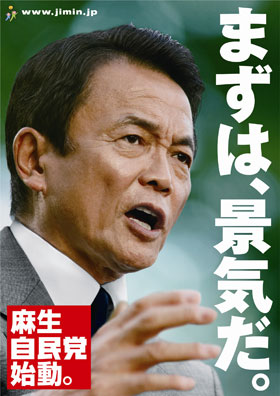
So, is this some kind of subtle cry for help? Does he want a guide dog of his own? Whatever the case, the image is kind of a step removed from the determination to fix the economy as shown in this attention-grabber:

 aso_pos01g

What to expect from the new national gaijin cards

Yomiuri has reported that the Justice Ministry has formally proposed to scrap the locally-administered alien registration system in favor of a national system under the control of (you guessed it) the Justice Ministry. This has been in the works since last year and would have to be approved by the Diet as an amendment to the Immigration Control and Refugee Recognition Act, so don’t expect any changes overnight, but these are the changes we can apparently expect from the new system:

Benefits for foreigners

  • Ordinary period of stay on work/study permits will be extended from three to five years, meaning a bit less effort and expense to stay current on registration.
  • The “trainee” system will be renamed to something more reflective of reality, and “trainee”-class workers will get more explicit labor law protection.
  • Special permanent residents (zainichi Koreans) will enjoy much easier re-entry processing. Departures from Japan for up to two years will not require a re-entry permit, and a re-entry permit will allow them to stay outside the country for up to six years (currently the maximum is four). The zainichi apparently won’t be part of the new alien registration system, but will get their own certificate instead. (They still have to carry it around, though.)
  • Centralizing everything at the Justice Ministry will probably cut out some of the processing time lags that exist in updating alien registration information (for instance, Japan still doesn’t know how many foreigners it finished out the year with because immigration and the city halls haven’t finished striking the records of people who left for good at year’s end). It should also spare people the shuffle of having to personally notify city hall every time their immigration status or period of stay changes.

New problems for foreigners

  • Assuming this replaces the existing alien registration system completely, city hall will no longer have information on the city’s foreign residents, which might affect the way municipal services get distributed (hard to tell, though).
  • In the same vein, since everything has to go through the Immigration Bureau, updating registered information like address or employer may not be as convenient as walking into city hall. (Here’s one blogger [in Japanese] who picked up on this drawback right away.)
  • According to NHK, one of the motivations behind this is that the current system does not “make it a duty” to report a change of address to city hall, which makes it harder to track the foreign population in each municipality. The subtext seems to be that there will be harsher penalties for not keeping this information up to date (right now, while foreigners are supposed to keep their address updated, nothing particularly bad happens if they forget to do so).
  • It seems that some personal information will be taken off the face of the card and put on an IC chip inside the card. Some paranoid folks hate the idea of the Gaijin Chip, but I am actually in favor of it if it keeps this information private to a casual observer. (The flip side is that when us foreign lawyers get carded, the cop can’t see that our profession is “attorney.”)

All this said, as David Chart points out, the Justice Ministry hasn’t been too bad to “good foreigners” lately. Although the new fingerprinting system is kind of annoying, the Ministry at least had the decency to give re-entrants a separate line at Narita immigration instead of lumping them with tourists (which was part of the initial proposal, as I recall). So it isn’t too much of a stretch to expect that they will ultimately work this system in a fairly efficient manner, even if certain points raise alarm on paper.

The proposal is now in the hands of the LDP, which will have to make it into a bill for the Diet’s consideration, so theoretically anything can happen from this point.

Pinyin in Taiwan

The Taipei Times printed an interview the other day with Yu Bor-chuan of the Taiwan Pinyin League, and head of the team that designed Tongyong Pinyin. He is of course a heavy promoter of Tongyong Pinyin, saying that it is better suited to Taiwan than the internationally accepted but PRC originated Hanyu Pinyin. He has some interesting background on the history of various kinds of phonetic writing in Taiwan, and of course makes his argument for avoiding Hanyu Pinyin.

That the MOE did not cite the source of the Hanyu Pinyin charts constituted an act of plagiarism as the phonetic system was approved by the State Council of the People’s Republic of China [PRC] and ratified by its National People’s Congress in 1958.

This is just a weird statement. He seems to be arguing that any discussion of Hanyu Pinyin MUST be centered on politics and not linguistics, which to me is an utterly absurd position.

As for the false information I mentioned, the MOE said Taiwan’s street and place names are spelled using Hanyu Pinyin on maps and atlases published by most countries and international organizations. This is not true, since the international community generally goes by the guideline of naming a person or a place after its original name.

There are hardly any countries or international organizations that use Hanyu Pinyin to spell places in Taiwan except maps published by China.

This, however, is correct. Of course, with romanization in Taiwan being so unstable, foreigners often have no idea which system they should be using.

TT: The main reason given by the government to adopt Hanyu Pinyin was to bring Taiwan in line with international standards.

Yu: If that was the real reason behind the policy shift, the government should have replaced the traditional characters used exclusively in Taiwan with simplified characters, because more than 95 percent of the [Chinese-speaking] population worldwide uses simplified characters.

He’s really mixing apples and oranges here. While it is kind of true that making all language policy decisions on the basis of international standards would lead to the adoption of simplified Chinese, Yu is being very disingenuous about the logic as it applies here. While traditional written Chinese is used in Taiwan as the national and official language and the medium of instruction for all Taiwanese, Pinyin in any form is used ONLY for the benefit of foreigners. Most Taiwanese simply do not learn Pinyin, whether Tongyong, Hanyu, or Wade-Giles. The argument that a supplemental writing system which is used only to accomodate foreigners should follow international standards should in no way mean that the primary writing system, used for the primary Taiwanese national language by its citizens, should also be changed.

Adopting Tongyong Pinyin will not pose difficulties for foreigners.

For foreigners who do not understand Mandarin, whether a road sign is spelled in Hanyu Pinyin or Tongyong Pinyin makes no difference, not to mention that Tongyong is more friendly to English speakers than Hanyu in terms of pronunciation.

The primary differences between the two systems are that Tongyong uses “s,” “c” and “jh,” which corresponds more to English spelling, instead of “x,” “q” and “zh” as used in Hanyu Pinyin, which English speakers without Mandarin skills do not usually know how to pronounce. There wouldn’t be a problem as long as street signs an maps were spelled consistently everywhere.

This is largely true. Consistency is the most important thing such a writing system, but why is consistency between the spelling of identical place names or syllables in Taiwan and the rest of the Chinese-speaking world a bad thing?

The Hanyu Pinyin system is not entirely suitable for Taiwan given the fact that not every Chinese character is pronounced in Taiwan as it is in China.

Maybe something is lost in translation here, but this sentence simply makes no sense. While some characters do have a different common pronunciation in Beijing-accented Mandarin or Taiwan-accented Mandarin, Taiwanese Mandarin uses exactly 0 sounds that do not exist in Hanyu Pinyin. I have a Chinese dictionary from Taiwan in which it notes-in Hanyu Pinyin-both pronounciatins where they differ.

Immediately after Hanyu Pinyin was adopted by the government in September, the MOE promulgated guidelines for using Hanyu Pinyin to Romanize Hakka, replacing the application of Tongyong Pinyin for teaching Hakka.

As Tongyong has been used for the Romanization of Hakka, even some KMT lawmakers were against the new guidelines. They said that it would make learning Hakka more difficult because Hanyu Pinyin did not accommodate sounds in the language.

This is getting into a more complicated area, but it is easily avoided. Hanyu Pinyin is a romanization system for Mandarin. Hakka, while a related language, is not Mandarin, and should have its own romanization system designed for it with no consideration for the romanization system used for other languages. While I am generally supportive of the move to use Hanyu Pinyin for Mandarin despite it being partly based on a political agenda, extending Hanyu Pinyin to other Chinese languages (or dialects, as they are known by Chinese nationalists) is a purely political choice that makes no sense from a linguistic, educational, or practical perspective.

The most serious problem is how our names are to be Romanized.

Although the Hanyu Pinyin guidelines allow individuals to decide the spelling of their name, it suggested using the format of surname first, followed by given name without a hyphen between the syllables … If my name were that way, my initials would be [Y.] B. instead of [Y.] B.C. in Tongyong Pinyin … How can the government ignore the fact that Taiwanese people have used a hyphen in their given name … for about 20 to 30 years?

No one has the right to arbitrarily decide what other people’s names should be. By the same token, Taiwan has every right to decide its proper names.

We should not give up autonomy over this as it is a representation of our sovereignty.

No real arguments here. People should be free to write personal names as they wish, but that doesn’t mean that there shouldn’t be a recommended orthography. One thing that isn’t addressed even here is while for most Taiwanese (aside from ethnic aborigines) primarily write their name in the same Chinese characters, their primary language may be Mandarin, Taiwanese (Hoklo), or Hakka. Shouldn’t they be able to choose to romanize their name for international use in the system of their primary spoken tongue, and not based only on Mandarin?

Japan, where two different Romanization systems have been used since 1954, could serve as an example.

In 1954, Japan’s Cabinet announced a program including the Hepburn and the nippon-shiki [“Japan-style”] systems, under which the Hepburn Romanization system devised by an American is employed in overseas Japanese-language teaching materials, while the nippon-shiki system is used to transliterate local names and for domestic education.

Japan’s experience proves that the adoption of two Romanization systems does not hurt a country’s competitiveness. In addition, [there is] compatibility between the Tongyong and Hanyu Pinyin systems.

This is sort of true, but the nippon-shiki (actually the modernized version is Kunrei-shiki) serves almost no function. It is largely the same as the far more common Hepburn standard, much in the same way that Tongyong and Hanyu are largely the same, but has several minor differences which serve only to confuse. Even in Japan pretty much nobody actually uses anything but Hepburn romanization, and when he says “Japan’s experience proves that the adoption of two Romanization systems does not hurt a country’s competitiveness.” he should really be saying “Japan’s experience proves that the adoption of two Romanization systems is inconvenient, and everybody not legally required to use the less popular system will gravitate over time to the more popular one.”

Good news for Losheng?

Since I visited the Japanese colonial era Losheng Leprasorium in Northern Taipei last summer I have been keeping tabs on developments in the battle between government officials trying to destroy it and preservationists trying to…preserve it.  Things had been looking grim when elderly wheelchair-bound residents were dragged out of their homes, but a high level apology may mean that things are getting sorted out.

Premier Liu Chao-shiuan (劉兆玄) yesterday offered an apology to patients with Hansen’s disease— also known as leprosy — for the “grievance” and “unequal treatment” they have suffered in the past, promising that his administration would take good care of their nursing and medical needs. The apology came six months after the enactment of the Act of Human Rights Protection and Compensation for Hansen’s Disease Patients (漢生病病患人權保障及補償條例), which detailed measures the government must take to care for leprosy sufferers.

[…]

“I will not accept the government’s apology, because they did not apologize for what they did to me in December,” said Lan Tsai-yun (藍彩雲), a Losheng resident who was removed by the police from the Joan of Arc House. “I asked them to give me two more weeks to pack, but they refused. They cut the power and water while I was still inside, then they cut through the door with an electric saw and took me away by force. But look, Joan of Arc House still stands there today, a month after that incident — why couldn’t they give me two more weeks?”

Here is a video from Taiwanese TV showing activists being dragged away when protesting in support of Losheng preservation back in December. At exactly the 1:00 you can actually see my friend Em having her camera taken away as the police pull her away, although I think she got it back later on.

<object width=”425″ height=”344″><param name=”movie” value=”http://www.youtube.com/v/MLoqV9lre6Q&hl=zh_TW&fs=1″></param><param name=”allowFullScreen” value=”true”></param><param name=”allowscriptaccess” value=”always”></param><embed src=”http://www.youtube.com/v/MLoqV9lre6Q&hl=zh_TW&fs=1″ type=”application/x-shockwave-flash” allowscriptaccess=”always” allowfullscreen=”true” width=”425″ height=”344″></embed></object>

Haruki Murakami on walls and eggs in the holy land

Great speech to give in front of the Israeli president (via Ikeda Nobuo)!

So I have come to Jerusalem. I have a come as a novelist, that is – a spinner of lies.

Novelists aren’t the only ones who tell lies – politicians do (sorry, Mr. President) – and diplomats, too. But something distinguishes the novelists from the others. We aren’t prosecuted for our lies: we are praised. And the bigger the lie, the more praise we get.

The difference between our lies and their lies is that our lies help bring out the truth. It’s hard to grasp the truth in its entirety – so we transfer it to the fictional realm. But first, we have to clarify where the truth lies within ourselves.

Today, I will tell the truth. There are only a few days a year when I do not engage in telling lies. Today is one of them.

When I was asked to accept this award, I was warned from coming here because of the fighting in Gaza. I asked myself: Is visiting Israel the proper thing to do? Will I be supporting one side?

I gave it some thought. And I decided to come. Like most novelists, I like to do exactly the opposite of what I’m told. It’s in my nature as a novelist. Novelists can’t trust anything they haven’t seen with their own eyes or touched with their own hands. So I chose to see. I chose to speak here rather than say nothing.
So here is what I have come to say.

If there is a hard, high wall and an egg that breaks against it, no matter how right the wall or how wrong the egg, I will stand on the side of the egg.

Why? Because each of us is an egg, a unique soul enclosed in a fragile egg. Each of us is confronting a high wall. The high wall is the system which forces us to do the things we would not ordinarily see fit to do as individuals.

I have only one purpose in writing novels, that is to draw out the unique divinity of the individual. To gratify uniqueness. To keep the system from tangling us. So – I write stories of life, love. Make people laugh and cry.

We are all human beings, individuals, fragile eggs. We have no hope against the wall: it’s too high, too dark, too cold. To fight the wall, we must join our souls together for warmth, strength. We must not let the system control us – create who we are. It is we who created the system.

I am grateful to you, Israelis, for reading my books. I hope we are sharing something meaningful. You are the biggest reason why I am here.

Never mix alcohol and cold medicine, kids

Or else you might become the Finance Minister of Japan:

The full story is here. He says it’s the latter, but we all know better.

UPDATE: News services are now reporting that Nakagawa is going to resign, citing this incident as the cause. Apparently they finally got over their implicit agreement not to mention his obvious drinking problem.

One arm of the JET program possibly misappropriating funds

Very interesting post at Japan Probe on possible quasi-corruption at CLAIR, the affiliate of the Ministry of Internal Affairs and Communications in charge of its share of the JET program:

The Council of Local Authorities for International Relations (CLAIR), the governmental organization responsible for the JET Program, could be in trouble. Popular Osaka governor Toru Hashimoto has started questioning CLAIR’s use of funds and has announced that the Osaka government may reduce its financial backing to CLAIR next year (90% of CLAIR’s financial backing comes from money paid by local governments, and Osaka pays a big slice).

The JET program is one of those rare Japanese government programs in which overlapping ministries successfully cooperate – the Ministry of Foreign Affairs is in charge of most of the administrative details of selecting applicants, the education ministry places them in schools, and the internal affairs ministry coordinates with local governments. Well, it looks like part of the compromise reached between the ministries was that at least the internal affairs side gets to set up a swank suite of perks for retired bureaucrats.

As I have done before, I am cross-posting my comment at Japan Probe to encourage discussion of the issue on my comments section. I began in response to earlier commenters who apparently take any mention of the JET program to debate on the JET program’s merits and the usefulness of eikaiwa teachers in general (of course I would never do that):

Did you notice that this issue has NOTHING to do with the merits of the JET program itself? The problem is that the bureaucrats have turned parts of the program into their own slush fund, which enriches their post-retirement accounts and improves their golf scores at the expense of the Japanese taxpayers and maybe even people who didn’t get accepted to the JET program (since part of the acceptance cutoff is no doubt due to budget constraints). It’s so laughable for them to have overseas offices since they don’t even process the applications – that is the foreign ministry’s job.

This misappropriation issue isn’t any reason to end the JET program. In fact, considering all the extra money they are raking in it looks like they could be accepting even more JETs. I have argued elsewhere that it may have outlived whatever functionality it had as an English teaching program, but as Yomiuri documented around its 20th anniversary the program itself has by and large been extremely beneficial to the teachers who come and have a once in a lifetime experience (or get a foothold for a life in Japan), the schools who want foreign English teachers, and Japan’s soft power as the program generates massive goodwill and a niche workforce of Japan-savvy English speakers.

But if one of the organizations involved is being exploited for no real reason but to provide an excuse for internal affairs bureaucrats to get post-retirement salaries and live the Japanese dream of endless enkai and golf with their coworkers, then Hashimoto is right to use his spending authority to try and put an end to it. As much of a showboat as he can be, that’s an example of real leadership and sticking up for what’s right.

I understand the motivation for post-retirement income, but what I will never get is why these oyaji seem to love drinking in their work suits and basically never leaving the damn office. If you are going to misappropriate funds, at least do what American politicians do and get sweet renovations to your house!

They have 12.7 billion yen a year in unused funding! I propose using that money to send free cookies to every woman who gets pregnant. It will help alleviate the low birth rate AND I’ll only overcharge the government 50 billion yen 5 billion yen a year — big savings!

The Japanese art of non-debating, by Asst. Prof. Hiroshi Yamaguchi

Hiroshi Yamaguchi is an Associate Professor of Global Media Studies at Komazawa University. I am translating his rant-ish essay below because it is such an illustrative look at how the media tends to move debate forward in this country. He applies this general frame work to some older scandals such as the earthquake safety scandal of 2005 and the Livedoor scandal of 2006, but you can see this process playing itself out anytime you turn on one of those panel debate shows.

2009/02/11
Responsibility does not add up to 100% — reposted

I feel a little bad about repeating the same ideas, but often in a different context the same words might have a different meaning. So anyway, I am going to repost what I wrote on my blog around two years ago. Please understand that I am not just being lazy. This passage can also be found in my book currently in stores Risk’s True Form (リスクの正体) but I think the same things could be applied to the recent so-called “self-responsibility” debate.
***
* I don’t think responsibility adds up to 100%
Problems develop one after the other in our society, but I feel like the flow of debate over those problems is always similar. I have always wondered why this is so, and I have concluded that the common thought process is something like this:

Views on “responsibility” (責任 sekinin; the same word is used in Japanese to mean “liability”)
The common flow of debate is as follows. First, a problem occurs. Let’s assume A causes damage to B. Almost simultaneously, an argument springs up over “responsibility.” In fact, many many types of responsibility:

  • – A is wrong. A has responsibility.
  • – No, in fact there is a fixer C pulling the strings behind A.
  • – The ministry of X regulates this issue. The ministry has responsibility as the regulator.
  • – This problem was brought upon us by the Koizumi administration’s policies.
  • – A has connections with a senior official in the Y Party. There’s got to be something to that.
  • – The mass media’s reporting of this problem has been terrible.
  • – Isn’t it actually B’s own responsibility?
  • – This is a conspiracy by the Americans!
  • – It was better in the past, but the youth these days are no good!
  • – It’s the education system’s fault. Schools these days don’t teach anything worthwhile.
  • – A made too much money. We should take this opportunity humble him.
  • – There are people in this world who have it tougher than this. It makes no sense to ignore them just to help B.

There may be more, but I think that’s about right. It’s actually quite a substantial list. It is strange that no matter what happens, there are always those who blame the prime minister or the United States (there are some who even try to blame corporate accounting fraud on the prime minister, but I wonder if they are really serious), but in many cases this is no laughing matter. What comes next is a battle of criticism falling somewhere along this range of opinions:

  • – I cannot believe people would say it’s B’s own responsibility.
  • – It is too simplistic to only criticize A. We have to go after C who is pulling the strings.
  • – A has no capacity to pay damages. The government should do something.
  • – I don’t think it makes sense to blame everything on bureaucrats and the government.
  • – Don’t bring up generational conflict in this case!
  • – The idea of a fixer behind the scenes is hogwash.
  • – Don’t turn this into a political fight.

Then, this sort of debate gets bogged down and leads to a stalemate situation, people lose interest and eventually forget about it. Then, a similar problem occurs. I have been wonder just why it’s always, always like this.
Essentially, the root cause it that people are confused about the word “responsibility.”

There are several types of responsibility. People often talk of the difference between the “responsibility to compensate” and “the responsibility to explain,” but there are others, such as “the responsibility to adopt countermeasures” and “the responsiblity to seek the truth” and even something like “the responsibility to quietly accept the results.” If these are mixed up, then then discussions will never reach a conclusion. When debating, often what you emphasize will differ from what others emphasize, but if all the different kinds of responsibility are mixed up, it becomes impossible to understand the other side’s way of thinking. You’ll react, “Why would you say such a thing? That’s not what’s important!” But really, both sides’ arguments are important.

So, if the argument is mixed up, everything will lead to the conclusion that “the person responsible should compensate for damages.” In other words, the point of view becomes such that responsibility always adds up to 100%, and the argument is over how to divide that up. [In reality,] the responsibility to explain does not always lead to liability to compenate for damages, and in many cases those responsible for adopting countermeasures are different from those who are liable to pay compensation. But if someone argues that C is in the wrong, to the people arguing that A is in the wrong it will seem like that person is trying to lessen A’s responsibility. That is these intense debates develop. Or at least that’s how I see it.

Responsibility is not the sort of thing that adds up to 100%. Of course, the responsibility to compensate for damages does add up to 100%, so there is a specific amount of damages and the argument is over how to determine who is responsible for what portion. That is fine. However, when it comes to other types of responsibility, such as the responsibility to explain or the responsibility to seek the truth, or the responsibility for creating the foundation that caused the ensuing situation, or the responsibility for not helping the victims even when you could have helped, or any other kind of responsibility, shouldn’t all the responsible persons each take 100% responsibility? We should ask not “who has responsibility” but rather “what is your (or my) responsibility in this case?”

There is an argument over “the general penitence of the 100 million” (NB. 一億総ざんげ ichioku souzange, the argument that the Japanese public bears collective responsibility for the Japanese aggression/destruction in WW2), and some counter that this thinking minimizes the responsibility of the leadership. I cannot say since I do not know the circumstances of the time, but I do not think this is a very fruitful argument. Regardless of the leadership’s responsibility, I think [the “penitence” position] was meant to say that “the 100 million” aka the Japanese people all should be aware of their own responsibility. In light of the recent earthquake safety fraud scandal (added Jan. 22, 2006: In fact, the case of Livedoor’s violations of securities laws could apply here), separate from the issue of who should pay for the costs, shouldn’t we debate who should have done what and what should be done in the future? Of course, this is an issue of what “you yourself” should do. Such debate would do nothing to lessen the compensation liabilities of the businesses that committed the fraud, nor would it free the government from its responsibilities to explain and adopt countermeasures. Added up, I am sure it would come to 200 or even 300%.
*****

Allow me to supplement the above for the current context. Regarding issues such as the firing of temporary workers, economic disparity, and the “lost generation” (NB. young people who came of age during the “lost decade” of the 1990s), I am not saying that there are never any cases where the employees in question should be held responsible at least a little. Similarly, I am not saying that there are never any cases in which the corporations, the government or the generations that grew up before the lost decade should be held responsible at least a little. Reality is much more vague, complicated, and diverse than that. This should be obvious if you think about it rationally.

Most of the people involved in this debate are probably fully aware of this. That must be why they are in fact arguing that someone has more responsibility than someone else, under the title “who has responsibility?” There are times when that is fruitful. Such a determination is required when considering what countermeasures to take.

However, looking at the overal picture, I don’t think we have reached that stage yet. At the very least, society at large is most likely looking at these debates in terms of a conflict between Faction A and Faction B, in other words the winner will be either “the people 100% on Faction A’s side” or “the people 100% on Faction B’s side.” In fact, what is said between those two factions is more like criticism than debate, and this is in fact going on in the various media outlets. Any work they are doing to find common ground is not being sufficiently communicated.

We are called upon not to determine “who” should act but “what should be done.” The bigger the issue, the fewer people there are who can dismiss it as having nothing to do with them. John F. Kennedy once famously said, “Ask not what your country can do for you; ask what you can do for your country.” I think this quote applies in this context, but at the same time and in the same way, we should think not about making demands of the temporary employees who were fired or the members of the lost generation, but rather what we can do for them.

Simultaneously, we have to think about what things got to be the way they are. There may be some disreputable temporary staffing agencies. There might be some common practices in the temporary staffing industry that should be reformed. But just because that’s so, arguments that fundamentally reject the temporary staffing business go too far. This business was born out of a societal need, and plays a major role in our society. This is the exact converse of the notion that fired temp workers and the lost generation cannot totally be held personally accountable for their circumstances. If you want to change the present, you must turn your eyes to the factors that led to the present situation.

I repeat: responsibility does not add up to 100%. Quite the contrary, each of us has 100% responsibility for ourselves. To acknowledge this is to take the first step toward escaping the endlessly repeating zero-sum game of asking “who is in the wrong?”

A birthday present for Charles Darwin

From the Cape Cod Times:

WOODS HOLE — A federal appeals court recently upheld a ruling from a lower court that dismissed a lawsuit from a former Woods Hole Oceanographic Institution researcher, who claimed he was unjustly fired for not believing in evolution.

Nathaniel Abraham, who was hired as a postdoctoral investigator in fall 2004 for his expertise in working with zebrafish, sued WHOI for discrimination in 2007. Abraham claimed he was fired after admitting he was a Christian who believes in creationism and the infallible word of God.

However, WHOI officials told the Times that Abraham’s job description clearly stated he would have to apply evolutionary theory in reviewing the results of research.

A U.S. District Court judge dismissed the lawsuit in April 2008 because Abraham did not file his discrimination claim within three years of being fired.

On Jan. 22, the U.S. Court of Appeals affirmed the lower court’s ruling.

Abraham’s last known job was teaching biology at Liberty University in Virginia, a college founded by the late Rev. Jerry Falwell. He could not be reached for comment yesterday.

Academic freedom is a grand thing, but to deserve academic freedon, one should probably be doing academics-and of course fulfilling the actual job description one agreed to when hired. As a personal note, I’ve spent a lot of time near the WHIO, located in Woods Hole, Cape Cod, Massechusets as Woods Hole is a division of Falmouth, where my father’s parents used to live when I was a child, and where my father now owns a second house. The aquarium was a lot of fun as a kid, as well as the tiny bridge that opens for passing ships, which I thought was the coolest thing ever when I was small enough for the bridge to seem big.