警察庁 v.s. 警視庁 — Distinguishing the National Police Agency from the Tokyo Metropolitan Department

Readers living or traveling in Japan’s capital may note that Tokyo police officers and patrol cars bear the characters 警視庁, or keishichou. At first glance it appears to be the characters for the National Police Agency (NPA), except the middle of the three characters is different — the NPA is 警察庁, or keisatsuchou. Keishichou is the unique name attributed to the Tokyo Metropolitan Police Department. For a Japanese speaker even mildly familiar with the structure of government in Japan, this looks peculiar — why is a prefectural police department named in such a way that it appears to be a national agency?
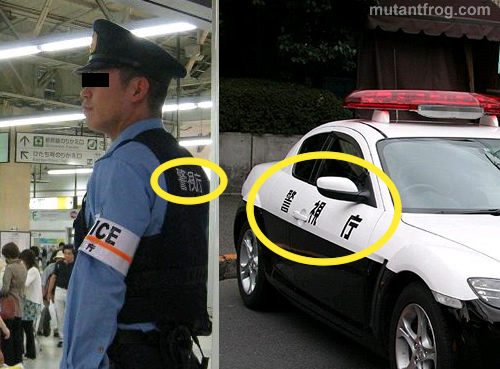
keishichou1

The history begins with the Meiji Restoration, when the keishichou was established in 1874 to protect and police the seat of government. As a police department, it had a unique role from the time of its establishment — some of its officers were organized into a division that fought for the Imperial government in the Satsuma Rebellion. The keishichou at this time served as a prefectural police department, but it was an agency of the government, subordinate to the cabinet, and Tokyo prefecture only had the authority to decide its budget. Later, the department also housed the Tokko special police force, the civilian counterpart to the military’s Kempeitai, taking part in both criminal investigation and counter-espionage functions.

The headquarters of the keishichou was situated just outside Sakuradamon, the southern gate of Edo Castle/Imperial Palace, possibly due to its importance in guarding the emperor, but also because that site was the location of an infamous assassination a decade earlier, and the location of the agency may have been a show of authority. The jolly Victorian structure was unfortunately destroyed in the 1923 Great Kanto Earthquake, as witnessed below. (Today, the Keishichou is right next to Sakuradamon gate, and the NPA is in the building next to it.)
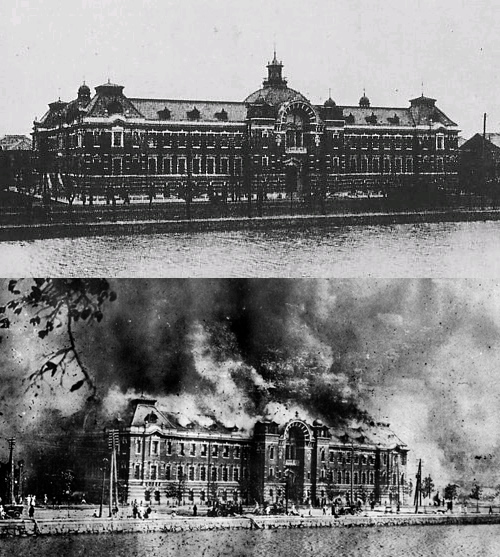
keishichou3

During the Occupation, the Keishichou was reformulated under the old police law, and added the imperial police under its jurisdiction, which had previously been a wholly independent branch of authority. During the same time, GHQ set up a similar keishichou in Osaka, which only lasted for the years of the Occupation.

After the Occupation, Tokyo’s Keishichou became an ordinary prefectural police department, but kept its name and retained some of its unique functions. From a jurisdictional standpoint, most prefectures are divided into wards with different departments of the prefectural police having jurisdiction over certain regions of each prefecture. Only Tokyo and Hokkaido have police departments where one department and all of its officers have responsibility for the entire prefecture, without divisions into areas. Also, the keishichou maintains some additional responsiblities, being responsible also for policing the Imperial Family, the Diet, the administrative agencies, the cabinet, the embassies of foreign nations in Japan, and other important people (officers of the keishichou were dispatched to Hokkaido for the G8 summit). The Keishichou is also the only prefectural police department that handles any fire truck activities (typically a separate task handled by the shoubouchou, or Fire Prevention Agency) because the imperial police force have this task especially assigned to them as part of their duties.

Interestingly enough, metropolitan police departments that provide similar functions in other countries, such as Scotland Yard in London and the Paris Prefecture Police are often translated as keishichou as well.

And to think we were excited about JPY12,000…

Man, I know Adamu is totally pumped about his FREE MONEY, but get this: a colleague in Australia revealed to me that she is thinking of buying a brand new, beautiful beachside condominium. I asked her what prompted the buy and here was her response:

only reason i’m thinking of getting something now is cos the government is basically giving first home owners free money towards buying something – $26,000 for an off-the-plan (ie, not yet built) place. the government’s grant is only until end of June! if it wasn’t for the free money, i would not be thinking of purchasing at this stage.

Wow, at present exchange rates that’s about 350x the benefit given here in Japan — although for a far more specific use, and only available to a limited number of people in a position to make such a purchase in the next few months.

Foreigners of Japan – Get your FREE MONEY!!!

With the passage of Prime Minister Aso’s landmark free money law, the Ministry of Internal Affairs and Communications has published a rough guideline on how to get your hands on that sweet, sweet cash.  Each local government will apparently provide details on how to receive funds, but please note the following:

  • ANYONE with an alien registration card can receive the 12,000 yen.
  • It looks like all foreigners have to apply in person (UPDATE: or by mail, depending on how your town does it), even if their wife/husband is the head of household.

This is your right by law, so be sure to line up and check with your local municipality’s website to get it!

The following is a rough translation of the official announcement, for your reference.

Payment of Cash Handouts

You will either be notified by your local authorities with specific details on how to receive the funds. [tr: Feel free to contact them yourself if you don’t see anything in the mail!]

Notice

Local municipalities are currently in the process of determining the specific preparations for handing out the payments.

Overview

Purpose of policy

To help deal with the residents’ uncertainty in this economic downturn, this policy’s objective is to support the residents’ livelihoods and to contribute to regional economic measures by providing payments widely to the residents.

Persons eligible for payments / who must apply

Those who meet the following conditions as of the reference date (February 1, 2009) are eligible to receive payment:

1) Persons registered on the official residency registry network (Juki Net)
2) Persons registered on the official alien registry (gaikokujin touroku genbo) (only illegal aliens and foreigners on short-term visas are exempt)

The applicant and recipient shall be the head of the household to which the eligible persons belong (foreigners must each apply and receive funds separately).

Payment amount:

12,000 yen for each eligible person
(Persons 65 or older or 18 or younger as of the reference date will receive 20,000 yen each)

Gay politics in Taiwan vs. Japan

I had been vaguely aware that gays are more open in Taiwan than in Japan (more active gay pride festival, spotting a very cleary labeled gay bookstore near Taiwan University), but hadn’t consciously realized quite how different things are before reading this article from yesterday’s Taipei Times.

Gay rights activists yesterday announced that they would form a voting bloc to support gay-friendly candidates in the upcoming legislative by-election in Taipei City’s Da-an District (大安).

“We’ve had six gay pride parades in Taipei in the past six years and more than 18,000 people took part in last year’s event — that’s where the voters are,” chief coordinator of last year’s gay pride parade, Lee Ming-chao (李明照), told a news conference.

“In the process of mobilizing the gay and lesbian community in Taipei, we estimated that around 10 percent of voters in Da-an District are gay — including myself. We can surely become a deciding minority if we stand together.”

He predicted that the turnout for the by-election would be lower than the 60.47 percent for last year’s legislative election.

This whole concept seems to me utterly inconceivable in Japan. While there is not much in the way of active discrimination against gays in Japan (like there is in most Muslim countries and some Christian ones, even including much of the US until recently) I get the impression that homosexuality and related issues are still generally more taboo here than anywhere else in all of East and Southeast Asia. Yes, there is a transgender politician in Tokyo, but Kamikawa Aya is said to be the only openly LGBT politician in the entire country of over 120 million people. Compared with Taipei’s apparently increasingly popular gay pride parade, Tokyo’s has been cancelled for this year due to lack of interest/resources.

Invest in North Korea?!

Yes, says the man in the bowtie:

Feb. 24 (Bloomberg) — A U.K. businessman is seeking to raise $50 million to invest in North Korea, reviving a 2005 plan after the U.S. government removed the communist regime from its list of countries that support terrorism.

ChosunFund Pte. Ltd. will join with North Korean partners for mining and energy projects, Colin McAskill, founder of the Singapore-incorporated fund, said in an interview.

bowtie-dude
“The country holds huge natural resources but is capital starved and lacks the technology and management skills with which to develop them,” McAskill said.

McAskill, 69, said he has been consulting on potential North Korean projects since 1987. While the country attracts one-off investment deals such as a recent contract licensing Orascom Telecom Holding SAE to provide wireless telephone services, it has struggled to raise money from global financial markets since defaulting on overseas debt in the 1970s.

London-based emerging markets money manager Fabien Pictet & Partners Ltd. was considering a fund that would invest in South Korean companies that do business with the North. The idea is “on hold for the time being,” Jonathan Neill, managing director, said in an e-mail.

I understand that the terror designation was a technical barrier for to much economic aid in addition to banning most financial institutions from doing business with NK. And I know saying investing in North Korea is a bad idea is like shooting fish in a barrel.

But the US political decision to remove NK from the list doesn’t strike me as any real vote of confidence in the country, since North Korea appears to remain the dictionary definition of a state-run criminal enterprise, even if it hasn’t strictly engaged in “terrorism” the 80s. Nor is this is any real sign that the situation in North Korea is at all stable.  The ailing health of Kim Jong Il also plays a decisively destabilizing role. We could easily see a succession battle worthy of imperial Rome when he finally dies.

Still, you have to give the man credit for sticking with the idea for more than 20 years. There is always the chance that NK will stabilize somehow, so getting in on the ground floor would then be seen as a smart move. There could also be a rationale for investing in SK companies who take on NK projects with the backing of the South Korean government, or with some other guarantee to offset losses.

More details on the new “zairyu cards”

Debito has gotten hold of the actual proposal to overhaul Japan’s alien registration system (as blogged in this space last week). If you read Japanese, go straight to his post and read the primary sources.

Some of the details which are now clear:

  • Initial registration will still be done at city hall — “to the Minister of Justice by way of the mayor.” Address changes will also be made to the local government where the holder resides, but other updates will go directly to Immigration (or to whichever Justice Ministry office is designated for that purpose).
  • Separate re-entry permits will no longer be required for short trips out of Japan, so long as the foreigner has their zairyu card when they return. (Re-entry permits may stick around for use on longer trips out of Japan.)
  • Eligibility to work will now clearly show up on the face of the card as either “free to work,” “restricted to activities within status of residence” or “may not work without separate permit.”
  • My card will no longer say “attorney.” Dammit.

Upgraded campaign posters

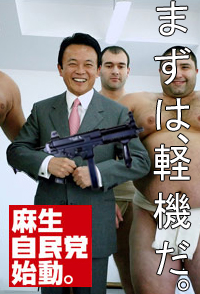
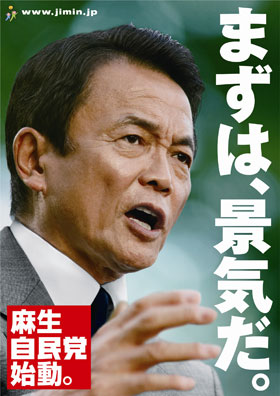
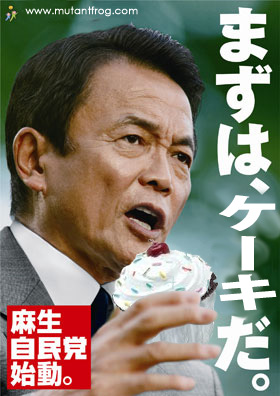
OK, I did the first one here over the weekend. (As a riff on this real poster.)

まずはケーキだ

Curzon posted it here (currently on page 2 at time of posting) to this Japanese funny pics board, where it sits between some racist anti-Korean pics (NOT posted by Curzon) and uhh this.

Next, Ben’s friend BigJohn passed along this variation on the idea.aso-keikiAnd finally, regular poster Jade OC tried his own variant on the cake theme, which I think came out very well. This cake is no lie.
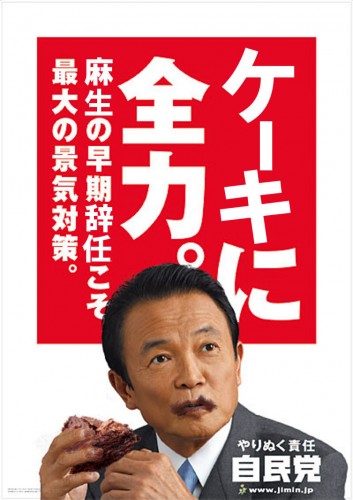
f_keiki1m_ec239b5Come on people. Aso’s approval rating is working on a new record low and the LDP is on the slow train to dumpsville. The least you can do is help out with a new campaign poster. Send it in at an attachment or post a link and it’ll be added to the collection.
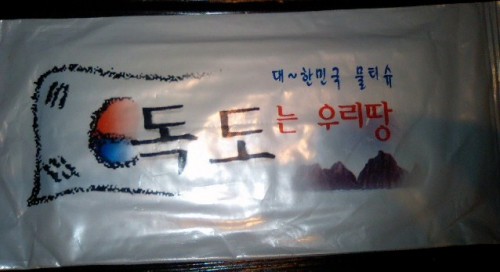
Takeshima towel

Takeshima towel

Seeing Adam’s reference to the highly disputed pieces of worthless, barren rock known as Takeshima/Dokdo in his post just now reminded me of this, which I had been meaning to post. A Korean classmate of mine at Kyoto University picked up this wet hand tissue from what she described as a very normal restaurant in Korea. It reads:

Republic Of Korea        wet tissue

Dokdo      is our land.

To translate into Japanese, which as usual maps closely to the original Korean better than English:

大~韓民国   御絞り

獨島 は我が土

Dokdo is of course the Korean name for Takeshima, which in European languages used to be called the Liancourt Islets, and is now called whichever of the two stupid names will make your conversation partner happy.

Observations from jogging at the Imperial Palace

Today Mrs. Adamu and I went jogging around the Imperial Palace moat, an activity that is apparently all the rage these days. Mrs. Adamu is training for a half marathon, but I do one slow lap myself just to burn some calories. It is easy to see why the palace area has become a popular place to exercise – it is an unimpeded, smoothly paved path, the view is gorgeous, and it’s easily accessible from Otemachi or other surrounding stations. The downside, of course, is that the jogging traffic has begun to resemble a busy freeway, forcing slowpokes like me to constantly watch my back so as to not get in the way of the more serious athletes. Normal tourists visiting the grounds are also quite visibly inconvenienced by bespandexed Tokyoites rushing by.

But all in all it’s a great experience. Today was particularly eventful:

  • Happy Takeshima Day! The holiday set up by the Shimane Prefectural government in 2005 to remind their fellow citizens that the disputed rocks belong to Japan, not Korea. This is apparently a big deal to right wing groups (see Roy’s earlier post on this), so to commemorate, one decided to use its megaphones outside the Social Democratic Party headquarters to loudly berate them with accusations of treason for close ties to North Korea. BTW, these guys might think their country has a valid claim to the Takeshima rocks, but stamp expert/blogger Yosuke Naito shows us some fairly convincing Korean stamps that say otherwise.
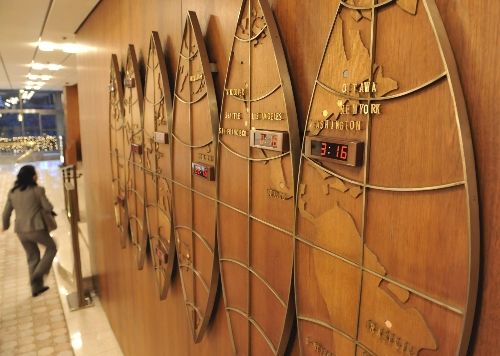
  • Workers were emptying the shuttered Palace Hotel of furniture and other items. The hotel was set up in 1961, just before the 1964 Tokyo Olympics,  on  the site of what was once part of the Imperial Household Ministry and then a GHQ-run hotel “for the exclusive use of buying agents from abroad.” While it must have looked quite modern in 1961, more than 40 years later the design resembles a Holiday Inn and noticeably clashes with the more refined palace across the street. The current building will be torn down, with a renewed Palace Hotel will set to open on the site in 2012. We started jogging the imperial grounds in mid-January, just weeks before the Palace Hotel shut down. We thankfully at least got to take a peek at the lobby before it was relegated to the history books. The inside looked much grander than the exterior, with obsequious front desk staff, expensive-looking lounges, and old-school carpeting and wood-panel walls. By far the neatest item in the lobby, however, was a wood-carved clock, shaped like a world map with digital displays showing the time in major cities. It was considered cutting-edge at the time it was unveiled at the time of the hotel’s opening. The thing just oozes 1960s modernity – I could picture this on the wall of an enormous workroom full of office ladies working on typewriters (click for full size. Thanks Yomiuri!):
    20090218-280217-1-l
    Amazingly, no one knows who designed or manufactured the clock despite its iconic status, but one thing is for certain – it will live on. Though originally set to be destroyed after the hotel closed, at the last minute a German patent office decided to take it (for no charge except shipping costs) out of the management’s nostalgia for frequent stays at the hotel during business trips to Tokyo.