Big changes in Japanese crime reporting, thanks to lay judge system

Japan’s new lay judge system will begin in July. Following the contentious national debate that occurred when people suddenly realized that a decision taken 10 years ago was coming to fruition, people have apparently resigned themselves to the inevitability. The next step has been the process of mental and physical preparation for what lies ahead. Citizens worry over the moral implications of deciding a person’s fate, lawyers and opposition lawmakers jockey for last-minute changes to the details, and the government is busying itself with the ongoing and enormous propaganda effort and the administrative grunt-work of selecting the lay judges and setting up deliberation rooms.

im20090327imc3r001_2703200913The news media, for its part, has collectively agreed to a rigorous reform of its crime reporting policy, a major change the likes of which have not been seen since the late 1980s, when the media started appending the title “suspect” (容疑者) to accused defendants’ names to emphasize the presumption of innocence.

Cyzo Magazine reports that starting last year, the major news organizations have almost all established new guidelines for crime reporting. While there are slight differences, and it is unclear whether TV news orgs will follow suit, they broadly follow the pattern of the Asahi Shimbun’s new policy:

  1. Clearly state sources of information – Previous practice tended toward lines like “according to the investigation…” which never bothered to cite the actual information source and essentially accepted whatever the police told them as the truth. Out of concern this could bias lay judges, Asahi will now cite specific police department names to make things clearer (the Yomiuri goes further and will note the title of the official at the police department).
  2. Emphasize that the news comes from an official announcement – Rather than saying “The Akasaka Police Department arrested so-and-so” the Asahi will now emphasized that the department announced that it made an arrest.
  3. Note whether the suspect admits to or rejects the charges.
  4. Avoid categorical statments, specifically  “[media institution] has learned” (XXXがわかった) – This is to avoid making it sound like the results of police investigations automatically become the truth.
  5. Include the accused’s side of the story – In addition to police sources, the Asahi and others will endeavor to include the views of the defendant’s lawyers as well.

My first reaction: This is all  stuff they should have been doing anyway! But I get the idea that without this impetus, the news organizations have found it impossible to report stories following such standards without risking losing access to the police press clubs. Of course, this story of softball “bad stenography” reporting in exchange for access is pretty much a constant in all areas of corporate journalism in Japan and elsewhere.

However, there is a somewhat unsettling background to these changes. First off, these “self-regulations” did not come about unilaterally of the media’s own volition. Being the first to report on a major arrest is a very easy way to sell papers, and the newspapers and wire services have long used the police beat as a place for young reporters to learn the ropes.

But out of concern for the impartiality of lay judges, the courts are considering UK-style regulations that would restrict reporting certain details of a criminal case, such as the details of police interrogations, until the beginning of court proceedings. The media have revamped their crime reporting policies in the hope of preserving this pillar of their business models. In the absence of constant updates on the progress of interrogations, I wonder how the TV stations and newspaper society sections would fill all the time that would surely open up?

More on Ozawa scandal conspiracy theories

Note: This is a follow-up to my previous post “All About the Benjamin” about some of the wilder theories set forth by Benjamin Fulford, the titular independent journalist.

Despite widely held expectations that he will/should quit, Ichiro Ozawa remains in his position as DPJ president amid the charging of his former public secretary with violations of the political funding law. Other sources have quite smartly covered this scandal – here and here for starters.

But as the courts slowly work out this case, I want to focus on one aspect of the scandal that deserves attention – the public’s reaction. While those polled appear to think that Ozawa should do the right thing and quit, apparently a noisy few are indulging in conspiracy theories as to why the prosecutors decided to target Ozawa when a critical election was looming. No doubt speculation was flamed by Ozawa’s own accusations that the prosecutors are engaged in a politically motivated investigation.

In some corners, Internet commenters, some half-kidding, some definitely not, have implied that the Ozawa prosecution was not just politically motivated, but perhaps even a plot by the CIA or “the Jews” to protect their buddies in the LDP.

The accusations have been pervasive enough for Kunihiko Miyake, former MOFA diplomat and political appointee in the Abe administration, to devote a column in the Sankei to batting down these rumors in the interest of “correct understanding of the international situation.”  He tries to argue why neither the CIA nor “the Jews” could possibly be controlling the Japanese prosecutors:

  • He has met CIA agents working in Japan, and their Japanese simply isn’t good enough for them to even make acquaintance with, let alone control, the Tokyo prosecutors, who have a history of fierce independence and even arrogance in exercising their authority.
  • He seems to consider the idea of a Jewish conspiracy as too ridiculous even to address, instead simply noting that only sheer ignorance could lead Japanese to entertain such beliefs based on debunked notions expounded in the fabricated book Protocols of the Elders of Zion. He also notes that anyone who even comes close to implicating Jewish conspiracy theories in the US is instantly and rightly branded a dangerous nutjob.

Though he mentions that American industrialist Henry Ford was a fervent anti-Semite and indulger in conspiracy theories, he seems to think that today in Japan only “bloggers” could possibly be fooled into believing conspiracy theories.

So I think it is important to note that it is not simply bloggers who believe in these conspiracy theories. This Sunday, a TV host was forced to apologize for the comments of one Atsuyuki Sassa, a commentator, former upper level police official, and the first director of what is now the Cabinet Intelligence and Research Office, one of Japan’s five main intelligence services. Talking about the global financial crisis, he argued that the “capitalists doing the bad things are all Jews.”

Watch (h/t Shozaburo Nakamura):

This is a highly respected man who once had top-secret security clearances (not that that actually means he is privy to know the real conspiracy or any such nonsense), so it goes to show that it doesn’t take a pajama-clad blogger to be taken in by the likes of a wild conspiracy theorist like Ben Fulford (who himself is a respected commentator who has appeared on some of the same TV programs as Sassa).

“Alpha blogger” Lead-off man’s blog, writing in reaction to the Miyake piece, suggests that it would be more persuasive to explain what a real conspiracy looks like to show how ridiculous these pretend ones are. To aid, I’ll just repost this video from Noam Chomsky to reiterate:

Transcript:

“I think this reaches the heart of the matter. One of the major consequences of the 9/11 movement has been to draw enormous amounts of energy and effort away from activism directed to real and ongoing crimes of state, and their institutional background, crimes that are far more serious than blowing up the WTC would be, if there were any credibility to that thesis. That is, I suspect, why the 9/11 movement is treated far more tolerantly by centers of power than is the norm for serious critical and activist work. How do you personally set priorities? That’s of course up to you. I’ve explained my priorities often, in print as well as elsewhere, but we have to make our own judgments.

From a site dedicated to debunking 9-11 myths:

… Real conspiracies have very few players and even then, they are usually exposed. Enron, Watergate, Iran/Contra and the rest have few people involved and someone always comes out to blow the whistle.

The evidence for a conspiracy to use 9/11 to invade Iraq is significant.  While there is not one shred of evidence the government blew up the World Trade Center, there is evidence that they used the tragedy to remove Saddam Hussein using poor WMD evidence.

Aso to stock traders – on second thought, screw you!

In his political career, Taro Aso has had to answer for many misstatements, ranging from “even someone with Alzheimer’s can tell that Japanese rice is more expensive in China than in Japan,” to the Taiwanese, and all the way to people who are aware that floppy disks are not the wave of the future.

But one thing the current prime minister will never apologize for is noting that people in the stock industry “shady” to rural residents and “not trusted.”

In a written formal response to a Diet member’s question (質問主意書), Aso’s government staff declined to retract the comments made during a public appearance. The question came from Muneo Suzuki, an ex-LDP Diet member from Hokkaido who was ousted from his party and the Diet for accepting bribes only to win re-election under his own one-man political party. Since then, his life mission has been to slow down the ship of state with a nonstop flurry of formal written parliamentary inquiries, each of which by law must be answered thoughtfully by staffers with the official government stance.

Two-man union on strike at Kyoto University

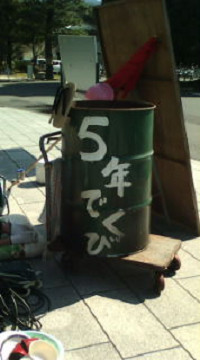
photo175035

According to the Asahi, Kyoto University has issued a final warning demanding the dispersion of two men who have been camping out on the university main campus for a month. The pair formed their own union, called Union Extasy in English, to demand that their employment contracts be extended past their five year maximum. Thirty supporters, presumably members of the regular Kyoto University workers’ unions who have taken a position supporting improved conditions for campus part-timers, stood with them in solidarity.

The crowd scene could be a sign that the moment when the university forcibly removes the two from campus could end up becoming a publicized confrontation, similar to the one seen at the Shinagawa Keihin Hotel earlier this year, when police forced the staff of the bankrupt hotel from keeping the business open against the wishes of the owners. The event was apparently crowded with both protesters and journalists, making for an enormous spectacle, itself something of a replay of the “temporary employee village” set up in Hibiya Park over the new year holiday.

The two men, both in their late 30s, were doing data entry work for the agricultural faculty for monthly wages of around 120,000 yen, according to an earlier report. I find it just amazing that they were both able to live on that much (20,000 yen/month apartments, probably a very meager diet).

A JANJAN citizen reporter who interviewed the strikers  notes that of Kyoto University’s 5,400-strong staff, 2,600 are part-timers, 85% of them female.

The employment rules for university part-timers are on paper intended to promote full-time, indefinite employment. Universities are basically required to prioritize permanent hires and can only hire contract employees on a provisional basis. However, in typical lukewarm fashion, when the Kyoto U and other national universities  were officially branches of the education ministry, Kyoto University signed non-permanent employees to 364-day contracts, theoretically terminated employment on March 31, “re-hired” the same people the next day for another term, and repeated this process for years. Exploiting this loophole had the added benefit that none of the “new employees” needed to be given raises from the previous year.

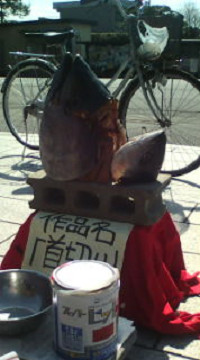
But when the national universities were corporatized in 2004, the rules changed. The ministry decided to close this loophole and instead, for employees hired on or after fiscal 2005, limited contract employment to a maximum five years, after which universities were barred from hiring the same person as a contract worker. In other words, the schools must now choose to either take them on as a full-time employee (and provide all the job security and regular pay raises that entails) or hire someone else on a contract basis. Kyoto University apparently decided to go with the cheaper option at the time, and now five years later they have this protest on their hands along with all the creative artwork that’s come with it:  

photo175034

 The decision for these older men to protest may have been in part due to their stated desire to raise the wage levels for this type of work. The assumption for years has been that this so-called “part-time” work is the province of housewives in need of extra cash, so the fact that they are men and not basically dependents of their spouses breaks with this stereotype. And of course, this also implies the question,  what difference does it make whether men or women are expected to fill the position? 

The university Director involved in the labor negotiations has argued that non-permanent employees have no “operational responsibility” — in other words, they are not expected to become Company Men and accept forced transfers or other duties that would come with permanent status. But in an era of decreased job opportunities to the point that men are competing for jobs that were traditionally seen as women’s work, these old divisions seem pretty irrelevant.

Despite the clearly brazen and confrontational tactics taken by the union, asking to change this arbitrary rule seems pretty reasonable. Saga University has apparently already done so. They apparently are not asking to be taken on as full timers, just for a raise and the chance to stay on.

As often happens when observing events in Japan, I get the feeling that viewed from the outside this issue seems simple – just allow indefinite part-time employment, and leave the decision of who to promote to full-time status up to the university managers. I can understand the university’s reluctance to take on indefinite staff – in these uncertain economic times and an era of declining population, I wouldn’t want to promise someone a job for the next 30 years either. But there is strong resistance in Japan to a system of at-will employment, and the US model that I am used to is certainly not an obvious path to prosperity.

In addition, the various parties have widely divergent agendas. I would imagine the politics of a university employees union must be quite intense indeed, and they along with the bureaucrats have a vested interest in maintaining the seishain system of stable employment and regular pay increases, at the expense of everyone else. In addition, other actors such as the Japan Communist Party have a somewhat extreme vision of maintaining employment, as seen in their platform of forcing companies to use their “internal reserves” to maintain employment.

(Photos courtesy JANJAN)

Video of the “kubikiri” fish head exhibit:

Congressional Research Service on Japanese political turmoil, circa September 2008

I have been very excited to discover the website Open CRS, an unofficial repository of Congressional Research Service reports. Normally, the reports are only available to Congress members and their aides, but a surprising number of them do see the light of day. This site could serve as a helpful source until Joe Lieberman’s initiative to open up the CRS becomes law.

For a taste of what the CRS has to offer, here is a report (PDF) on the state of Japanese politics around the time when former PM Fukuda stepped down:

Factors Behind Japan’s Political Paralysis


A number of factors impeded Fukuda’s ability to govern and will challenge
whomever the LDP chooses as his successor.
Parliamentary Gridlock. In July 2007, the DPJ won a majority in nationwide
elections for the Upper House of the Diet. As a result, for the first time in Japanese
history, Japan’s two parliamentary chambers are controlled by different parties. Shortly
after the DPJ’s victory, then-prime minister Shinzo Abe resigned, leading the LDP to
select Fukuda as premier. Concerned by Ozawa’s threats to veto major legislation,
Fukuda attempted to form a “Grand Coalition” with the DPJ. After the talks broke down,
the DPJ adopted an aggressive policy of using its control of the Upper House to block or
delay several of the Fukuda government’s legislative initiatives.
The LDP’s Increased Dependence on Coalition Partners. For more than
a decade, the LDP generally has not been able to secure independent majorities in both
Diet chambers, forcing it to rely upon coalitions with smaller parties. Since 1999, the
LDP has formed a governing coalition with the New Komeito party, a pacifist-leaning
party with strong ties to the Buddhist Soka Gakkai religious group. Komeito’s clout in
the coalition has increased over time, for at least two reasons. First, the LDP is reliant
upon Komeito to obtain the 2/3 majority in the Lower House to override the DPJ-led
vetoes in the Upper House. Second, LDP candidates in many electoral districts have
become reliant upon support from Soka Gakkai followers.4 Although traditionally the
LDP has dominated the coalition, during the summer of 2008, New Komeito became
more assertive, for instance by resisting Fukuda’s push to renew the authorization to
provide fuel to coalition forces in Afghanistan (see later section for details).
The LDP’s Weakened Decision-Making Structure. Former Prime Minister
Junichiro Koizumi significantly weakened the LDP’s old, opaque system, in which the
leaders of the party’s internal factions made major budgetary, policy, and personnel
decisions (including deciding who would serve as prime minister). This system, although
widely criticized as lacking transparency, helped the LDP to overcome significant internal
divisions over policy. While he was breaking the faction-based system, Koizumi used his
personal popularity and aggressiveness to enforce party discipline. However, his
successors, Abe and Fukuda, often were unable to duplicate this feat. As a result,
decision-making became increasingly difficult on contentious matters, such as the battles between the LDP’s economic reformers and those favoring a return to the status quo of
channeling government funds toward key interest groups.5
The DPJ’s Discipline. The DPJ was formed in 1998 as a merger of four smaller
parties and was later joined by a fifth grouping. The amalgamated nature of the DPJ has
led to considerable internal contradictions, primarily between the party’s
hawkish/conservative and passivist/liberal wings. In particular, the issues of deploying
Japanese troops abroad and revising the war-renouncing Article 9 of the Japanese
constitution have generated considerable internal debate in the DPJ. As a result, for much
of its history, the DPJ has a reputation of not being able to formulate coherent alternative
policies to the LDP. Additionally, battles between various party leaders have weakened
the party. Since winning the Upper House, however, the party has appeared much more
unified, at least on the strategy of using its veto power to try to force the LDP to hold
early elections. This discipline is remarkable considering that, privately and publicly,
many DPJ members chafe at Ozawa’s top-down leadership style. If the DPJ does worse
than expected in the next election, it is likely that he will be forced to step down.


Philippine Travelogue: Legazpi

March 17, 2009

Despite having our plans of riding the ill-named “Bikol Express” Southrail train from Manila to Legazpi “derailed“, Joosje and I manage to get there by night bus from Manila. We arrive about 9.30AM, exhausted as all hell, catch a tricycle to the Legazpi Tourist Inn (which was the only hotel I have ever been to in the world where they let you stay for two nights and don’ t even ask to see money until you checkout.) It’s raining.

We wander towards the docks, realize you can’t get far down in that direction due to concrete walls and construction barriers, and then instead head into “Victory Village”, which looks from the outside to be a small fish market area on the other side of the concrete wall, through an archway. It turns out to be a 6000 person Barangay (Filipino word for village or neighborhood, which was chosen to replace the Spanish-era word “barrio”). We chat with many people, all very friendly, as we wander through the narrow streets-if you can evven call such narrow pedestrian-only alleys streets, and then a woman tells us we can climb the hill behind the village to get a view of the city and huge volcano (Mt Mayon) beyond. The rain has stopped, and the sun is out. A 12 year old girl, an 18 year old girl, her dog Pipi, and two boys who unusually don’t seem to know any English at all take us slipping and sliding up the hill for an amazing view and after taking it in we slip and slide back down, through what seems to be a mix of mud from the earlier rain and caribou shit, back down to the village. To get onto the path up to the lookout point you have to slip through a barb-wired fence, which is little physical obstical but would probably keep out most un-invited visitors due to appearances.

After we get back down, the woman who had pointed out the way up the hill waves us over to talk. She first introduces herself, Julie T. Bahoy, and then asks if we want to go see the docks and construction site behind the barriers we had balked at earlier. The Barangay runs parallel to the docks area, entirely cut off from it by a tall concrete wall which is prettied up on the dock-facing side but ugly, bare concrete on the village side, aside from the market entrance we had taken, another opening in the middle, and one gate into the construction area and fishing docks. Julie tells us that the construction is for a major tourist destination and resort project known as The Embarcadero. (The project and name both seem inspired by San Francisco’s Embarcadero.) The Embercadero construction has made it more difficult for the villagers to reach their fishing piers, which can only be reached by traversing the construction site itself. Only village residents are supposed to be allowed out to the fishing pier, but Julie says that if anyone asks she will just tell them that she wants to show her friends the fishing boats and not The Embarcadero. In fact, none of the guards or construction workers are very interested, but Julie seems to ejoy the thought of getting away with something.

After looking around the pier area we walk back into the village and have a seat at a small shop  run by her mother. She gives us bottles of generic brand cola and some chocolate snack-cake thing and tells us about herself. The fishing village within Legazpi cityis her home town, and she is educated in a nearby college, with a major in business management. After graduation she was unable to actually work in that field, instead getting a clerical job in a law office, which she did for many years before switching to her current job managing a small office in the city. It does not pay particularly well, and she has some side jobs trading various goods, sometimes involving networking with her sister in Manila, particularly apaca fiber products for export. She might be able to find a better job with higher pay, but says that the company she works at would fail without her, and she does not want to be responsible for putting the others out of work. Yet, she also does not demand higher pay. Her father is a retired machinist for the electrical utility, draws a small pension, and continues to do some machining work from a home shop.

Although much of her time is of course occupied by her dayjob, Julie’s real vocation has been her work on the Barangay Council, where she is the youngets of its seven members. She was first elected as the youth representative at the age of 18 and is now nearing the end of her third, and term-limited final, term. She has always ran, and been elected, as an independent and refrained from the bribe and gift exchanges ubiquitous in local Philippine politics, facts that she is very proud of. She even uses her small honorarium as a council member for purchasing things needed by the village, such as lights, instead of keeping it as a payment. Approaching the end of her final term she is wrestling with the decision of whether or not to try and run for council chairperson, as some are urging her to do, but is reluctant to do so out  of concern that it may be difficult to do so without engaging in the standard corrupt politicking and that it would occupy even more of the time she needs to make money for her family, a conundrum traditionally solved by engaging in the corruption which she so abhors.

Still, she is considering giving it a shot so that she can work for the barangay. And the barangay needs help, fenced in and under threat due to the Embarcadero project. 95% of the village population survives in one way or another from the fising trade, with only about 1 in 20  engaged in external occupations in the city. Naturally, anything that obstructs their access to the sea is a serious threat. While some villagers have temporary work during the construction phase, few of them have enough education to apply for the permanent jobs that will be created upon its completion. There is a free public elementary school inside the village, and like all of the schools I have seen in The Philippines so far it is pleasant and well maintained (the newspapers reported this past week that the Department  of Education was rated least corrupt governmeent department in a public opinion survey) but higher education requires travel outside into the city, which few of the fishing families have the hard currency for.

There are rumors that the project is partially owned by Philippine President Gloria Macapagal-Arroyo (always referred to as GMA here), widely considered to be corrupt (one recent survey pegged her as even more corrupt than the late Ferdinand Marcos, which while highly unlikely at least gives a sense of the level of discontent) or at least one of her friends. The wall was constructed without permission of or consultation with the barangay or any of its residents, and unsurprisingly cut across some private land. According to Julie, the Bahoy family house’s lot extends a full 25 meters past the wall, and they have a lawsuit pending over the theft of their land. She says that the developers have offfered to settle for the fairly hefty sum of 20 million pesos (around USD $500,000), but they have documents showing clear title to the land and are not interested in settling. Such a settlement offer implies that they have a strong case, and she even hopes to have the wall itself removed. Unfortunately, many of the other residents lack proper documentation and are even legally considered to be squatting in their own homes, and have no hope of filing a similar lawsuit. Such carelessness in basic legal matters is an obvious result of under-education, but fishing has not historically been an occupation with a great need for men of letters. And with the fishing at risk, they have little or nothing to fall back on. More of the children stay in school than their elders, but probably still not enough. In the face of this situation, I expect that Julie will find herself unable to not run for barangay council president, and will sleep even less.

(As will all entries in this series, this will be reposted with photos added some time after my return to Japan.)

Michelle Malkin – Kabuki, stage left

(Updated below)

Wow, politics as theater. What a deep and insightful insight!

The Kabuki Theater of AIG Outrage

Michelle Malkin – Wed Mar 18, 3:00 am ET

All the world’s a stage, wrote Shakespeare, and in the world of Washington, the curtains have opened on the most elaborate farce of the year. Welcome, taxpayers, to the Kabuki Theater of AIG Outrage — where D.C.’s histrionic enablers of taxpayer-funded corporate bailouts compete for Best Performance of Hypocritical Indignation.

Democratic Sen. Chris Dodd, the corporate crony who is the largest recipient of AIG donations, is now leading the charge to tax the retention payments in order to recoup the $450 million the company is paying to employees in its financial products unit.

But Dodd, it turns out, was for protecting AIG’s bonuses before he was against them.

Fox Business reporter Rich Edson pointed out that during the Senate porkulus negotiations last month, Dodd successfully inserted a teeny-tiny amendment that provided for an “‘exception for contractually obligated bonuses agreed on before Feb. 11, 2009,’ which exempts the very AIG bonuses Dodd and others are seeking to tax.” Pay no attention to what his left hand was doing. Dodd’s right fist is pounding mightily, mightily for the sake of the taxpayers.

If Washington’s newfound opponents of rewarding failure want to do taxpayers a favor, how about giving back their automatic pay raises? How about returning all their AIG donations? How about taking back all the bailout money to all the failed enterprises, from Fannie Mae and Freddie Mac to AIG, the automakers and the big banks? Barry? Harry? Nancy? John? Chris? Bueller? Bueller?

Exit stage left. The curtain falls.

Are there even curtains at kabuki performances?

BTW, as Glenn Greenwald notes, one of the central themes of this piece – that Chris Dodd was key to ensuring that these bonuses could be paid – is part of a falsehood-based smear campaign (UPDATE: Apparently not baseless after all…) (UPDATED AGAIN: Dodd “accepted responsibility” for agreeing to the Obama-Geithner plan to pay the existing bonuses… whatever!):

…here is a February 14 article from the Wall St. Journal on the debate over executive compensation limits:

The most stringent pay restriction bars any company receiving funds from paying top earners bonuses equal to more than one-third of their total annual compensation.  That could severely crimp pay packages at big banks, where top officials commonly get relatively modest salaries but often huge bonuses.

As word spread Friday about the new and retroactive limit — inserted by Democratic Sen. Christopher Dodd of Connecticut — so did consternation on Wall Street and in the Obama administration, which opposed it.

Can that be any clearer?  It was Obama officials, not Dodd, who demanded that already-vested bonus payments be exempted. And it was Dodd, not Obama officials, who wanted the prohibition applied to all compensation agreements, past and future.

Ironically enough, Malkin’s own eagerness to repeat wingnut talking points is about as staged and scripted as anything on Capitol Hill, not unlike a certain traditional Japanese dramatic form. But I guess since she uses blogging software instead of the Senate floor, no  appropriate cliches have arisen to describe the right-wing noise machine.

(Thx to M-Bone for pointing this out)

UPDATE: So Dodd did push to pay the committed AIG bonuses?

UPDATE AGAIN: Dodd “accepted responsibility” for agreeing to the Obama-Geithner plan to pay the existing bonuses… whatever!

Shining Path is back… what about Fujimori?

According to the NYT, Shining Path, the Peruvian Maoist rebel group, has made a comeback:

The war against the Shining Path rebels, which took nearly 70,000 lives, supposedly ended in 2000.

But here in one of the most remote corners of the Andes, the military, in a renewed campaign, is battling a resurgent rebel faction. And the Shining Path, taking a page from Colombia’s rebels, has reinvented itself as an illicit drug enterprise, rebuilding on the profits of Peru’s thriving cocaine trade.

The front lines lie in the drizzle-shrouded jungle of Vizcatán, a 250-square-mile region in the Apurímac and Ene River Valley. The region is Peru’s largest producer of coca, the raw ingredient for cocaine.

… Coca, the mildly stimulating leaf chewed raw here since before the Spanish conquest, is largely legal; cocaine is not.

Coca, a hallowed symbol of indigenous pride, is ubiquitous here. Qatun Tarpuy, a pro-coca political party, paints images of it on mud huts. Women harvest coca in clearings along the winding dirt road, and children dry the leaves in the sun.

It is also nearly impossible to find a coca farmer here who admits that his crops are sold for anything other than traditional use, but somehow, studies have found, as much as 90 percent of the coca goes to produce cocaine.

In 2007, the latest year for which data is available, coca cultivation in Peru increased by 4 percent, reaching the highest level in a decade, according to the United Nations. At the same time, Peru’s estimated cocaine production rose to a 10-year high of about 290 tons, second only to that of Colombia.

Since the Shining Path retreated here after the capture of its messianic leader, Abimael Guzmán, in 1992, it has followed the much larger Colombian rebel group, the FARC, in melding a leftist insurgency with drug running and production.

While the Shining Path was involved in coca before, now it is a major focus. According to military and anti-drug analysts, the faction here, while still professing to be a Maoist insurgency at heart, is now in the business of protecting drug smugglers, extorting taxes from farmers and operating its own cocaine laboratories.

Coca farmers here describe today’s Maoists as a disciplined, well-armed force, entering villages in groups of 20 in crisp black uniforms. Little is known about their leaders, aside from the belief that two brothers, Victor Quispe Palomino, known as José, and Jorge Quispe Palomino, alias Raúl, are at the helm.

Soldiers speak respectfully of the rebels’ command of the jungle terrain and of their ability to harass with gunfire more than a dozen forward operating bases that have been established in recent months. “Their columns seem to melt into the jungle,” said Maj. Julio Delgado, an officer at a base in Pichari, one of the largest towns in the valley.

The rebels contend that they no longer assassinate local officials or sow terror with tactics like planting bombs on donkeys in crowded markets, atrocities the group was infamous for in the 1980s. This metamorphosis was confirmed by testimony from villagers who had come in contact with them, interviews with imprisoned rebels and a 45-page analysis written by the rebels, tracing the group’s evolution from its origins under Mr. Guzmán, that was captured by military intelligence here in December.

Meanwhile, the last we had heard of former Peruvian president and Shining Path nemesis Alberto Fujimori was in 2007 when he made Japanese political history as perhaps the first person to run for parliamentary election while under house arrest in a foreign country (he lost). Today, he remains in a Peruvian jail after the country’s Supreme Court upheld his 2007 convictions for abuses of power during his time as president. His trial for human rights violations is apparently still ongoing. This BBC profile provides a pretty much up to date record of Fujimori’s status, in addition to an overview of his background (I never knew he was an agricultural engineer before becoming president!).

Day 1 in the Philippines: Chatting with communists

After my mishap last week I made sure to get to the airport about two hours earlier than I needed to, and so naturally the plane was an hour late-which would have easily more than made up for the amount of time by which I had missed my plane last week.

I found a place to crash for the night in the backpacker/tourist district near downtown Manila as it is not too far from the airport, although I will be staying for the next couple of days in the University of the Philippines area up in Quezon city, about an hour away from the airport.

I took a brief stroll around the area after checking in to pick up some toiletries at a 7/11 and grab a snack. This is not the nicest part of Manila to walk around at night, as you have to dodge both men trying to sell you women and women trying to sell you themselves. Even if that had been the goal of my walk, as opposed to toothbrush and stuffed bread thing, I am perfectly capable of reading signs and walking into a store and don’t need anyone following me and gabbing in my ear, thank you very much.

In the morning I took another stroll around to get breakfast, and instead of being accosted by pimps and whores met with watch and viagra merchants. Shouldn’t the viagra sellers be out when the prostitutes are? Doesn’t anybody coordinate their schedules? Such are the mysteries of the cosmos.

Walking around with my new camera, I was reminded of one of the peculiarities of the Philippines, being that a foreigner wielding a fancy camera will actually be stopped by locals asking you to take their photograph. “One shot, right here.” They say. Needless to say, this is the reverse, or at least crossverse, of the usual relationship between the tourist photographer and the busy local. It takes a few times, initially, to realize that there is no scam, no demand for money involved, but merely some globally rare but nationally common enjoyment of the experience of being documented.

After being called upon to photograph one smiling old man-a pleasant enough interaction-I had the misfortune of stepping on a sidewalk stone which shifted in a downwardly spinning fashion beneath my foot, plunging it into the murky sewery depths beneath, soaking my foot and mildly scraping my shin. A couple of people on the sidewalk nearby hurried over to ask if I was all right, and  no serious harm done I said that I was, as one man hawking cigarettes nearby shifted the slab back into a less precarious place.

Just before getting back at the hostel (whose wifi I am currently perusing) I stopped to briefly admire a well-maintained fire truck parked on the street, whereupon I was greeted b its crew, relaxing at the side of the street across from it. Exchanging hellos, they asked me where I was from, I told them “US, New Jersey, currently studying in Japan”, the usual introduction, following which I become absorbed into a nearly hour-long conversation with one of the men. They were volunteer fire fighters, not city employees, and even the fire truck is privately owned. I saw a Rotary Club emblem on it, presumably one source of funding.

This man, whose name I will not mention for reasons that will be apparent, looked to be in the general neigborhood of 30. When I started to expain to him that I was studying the area of colonial history he gave his widely-shared opinion that education was the best thing that America had given to the Philippines. He then followed up by expressing dismay that America and the Philippines, having been engaged in building a system of education generally maintaining a high level relative to the region, had not carried those high standards into the realm of Philippine history, choosing instead to present a slanted and incomplete version of that history, particularly where the Community Party of the Philippines is concerned.

He asked me if I had heard of Jose Maria Sison,  which I had. Sison, now elderly and living in political exile in The Netherlands, is the leader of the CCP who has written many revolutionary tracts over the years. I mentioned that I have one of his books, “Philippine Society and Revolution”, written in the 1970s, which I had downloaded from a website. I mentioned that I had read more of Renato Constantino, the most famous left-wing historian of the Philippines, to which he replied, “well he’s OK too,” clearly indicating a strong preference for the writings of Mr. Sison. Out of both interest and politeness I then asked where I might find some more of Sison’s writings, to which the reply was “well, for that you have to go up there” by which he meant, to the mountain camps where the communists hide out and train. His writings are banned in the Philippines, and cannot be bought or sold or even possessed openly.

He, or perhaps I should say The Young Communist, which is what he gradually and eventually came out as, was originally from Manila, of middle class background. Of partial Chinese descent, his grandfather had married a non-Chinese Filipina and been disowned, which says enough to The Young Communist about Chinese society for him to want no part of it. He went to Polytechnic University of the Philippines,which he described as the second most communist university in the country after UP (University of the Philippines), where he had been recruited by one of his professors. UP, he said, while containing the highest proportion of communists and communist sympathizers, is also by far the most elite and wealthiest of the nations universities, with over 80% of the student body themselves coming from an elite background. While people there may be intellectually communist, and may even join the struggle, they will never have the full level of understanding of the need for revolution possessed by those of a more humble background. “Poverty is part of the education.”

He had then spent his university career traveling back and forth between the city, where he studied in class, and the mountain regions, where he studied in the communist camps. He never lived full time in the mountains, because (and he stressed this) he “never had a job up there” due to not being a member of the armed struggle. Instead, he studied comunist philosophy and methods for organizing and activism, and worked in some aid programs for the aborigines. The aforementioned writings of Sison were studied, but he said he would always shred or burn a copy after reading it.

After university, he stopped going to thee camps in the mountains to concentrate on work in the city. He mentioned that there was some sort of amnesty for CCP memberss, which applied to him perhaps since he was not in the armed faction-I did not adequately get the details. The Young Communist then gestured at the fire truck saying that it was part of his work, to do something for the community. While he does consider himself a communist and refers to other communists as “comrades”, he is pragmatic and considers himself a realist. He says he works for revolution, but not in the radical and dramatic sense of a popular uprising and the establishment of a People’s Republic, but in the sense of changing the social order in a gradual and peaceful fashion. To this end he is involved in organizing in the labor movement and in the promotion of revolutionary art, and even the volunteer fire fighter duty, and makes money to live off doing some kind of event organizing thing, which I got virtually no sense of due to his clear lack of interest in talking about work when he could be talking about the real work.

Having seen the results of revolutions throughout the 20th century, he does not believe that an armed uprising will actually improve things long-term except, and here I dare to presume, in the case of a violent and oppressive dictatorship. He had particular venom and bile for Marcos, whom he considers perhaps the worst person in modern Philippine history-a statement that many would agree with. In his view, following the 1986 EDSA People Power Revolution, which toppled Marcos, there was a window of opportunity for real reform, which was squandered and undermined by the same old elite, and each president since Corey has only been worse. Like many here, he bemoans the fast that the best and brightestt and most educated leave the Philippines behind to go work in the US or other foreign countries, which “is bad for the Philippines on a macro level, but you really can’t blame them for taking care of their families” even as it continues the cycle of underdevelopment.

While I can understand how an espoused communist might not be in favor of armed struggle for both moral and pragmatic reasons, I am both startled and puzzled to hear him say that he considers Marxism to be unrealistic and Marxists to be mistaken. When he goes on to say that national democracy is the only framework that makes sense to work within for the foreseeable future, I am left wondering what actually makes him a communist as opposed to merely a very progressive liberal. What, aside from self-identification, is different from my own views? We seem to have similar views on both history and current events. Neither of us is calling for the overthrow of the state, but think that dynasty in electoral politics (a far more serious problem in the Philippines, but one that is distressingly on the rise in the US) is unforgiveable. Perhaps he has a dream of some distant communist society, but what person with any spark of imagination and optimism doesn’t fantasize about a future utopia? I certainly don’t pretend to think that any society in existence in the world today, however much better things may be now than in the past, is more than a shadow of things to come. But I also don’t pretend to have any glimmer of what future society might be, as fun as it is to guess or imagine. And I wonder, does The Young Communist even believe in communism? Does it matter? If someone can follow a religion-say Christianity-as a set of moral guidelines but not a literal description of history or roadmap to the future, why can’t someone calling themselves Communist approach that doctrine in the same way?

For once, North Korea has a point – what IS Tamogami doing teaming up with the abductee families?

(UPDATE: In case you didn’t notice, Japan got totally SLAMMED by NK in these articles)

The AFP:

NKorea slams Japan over kidnap issue
Tue Mar 10, 9:56 am ET
SEOUL (AFP) – North Korea accused Japan Tuesday of raising an outcry over the abduction of its civilians in an attempt to find a pretext for recolonising the peninsula.

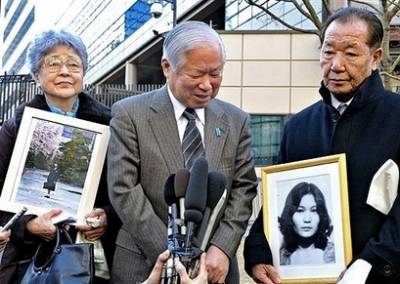
yokotas

The North said its military would launch a “merciless” strike on Japan if the former colonial power “dare pre-empt an attack” on the communist country.

The warning came as relatives of a Japanese woman kidnapped by North Korea arrived in South Korea in an attempt to clarify her fate.

Japan, which colonised the Korean peninsula 1910-1945, is trying to find an “absurd” excuse to realise its ambitions for re-invasion, the North’s official Korean Central News Agency said in a commentary, without referring to the case of Yaeko Taguchi.

“Japan’s noisy and disturbing trumpeting about ‘the abduction issue’ is nothing but a prelude to its operation to stage a comeback to Korea,” the agency said.

Taguchi‘s family will meet Kim Hyun-Hee, a pardoned former spy for the North, in the southern city of Busan on Wednesday.

Taguchi’s elder brother Shigeo Iizuka, 70, and her son, Koichi Iizuka, 32, arrived in Busan along with Japanese officials, Yonhap news agency said.

Pyongyang has admitted kidnapping Taguchi in 1978 when she was 22 to train its spies, but said she died in a car crash in July 1986.

But the ex-spy Kim, who had taken Japanese lessons from Taguchi, has said in interviews with local media that Taguchi was alive until at least 1987.

The article makes it sound like the North is plainly spitting in the face of the abduction victim families. But not even North Korea is that tone-deaf. No, their style is much more Norimitsu Onishi than Cruella DeVille. The actual KCNA story says nothing about the PR efforts of the abduction victims and concentrates only the recent statement of someone we’ve covered here before:

KCNA Slams Japanese Militarists’ Agitation of War

Tamogami, former chief of staff of the Air “Self-Defense Force”, in a recent lecture given on the subject of “the abduction issue”, let loose a spate of reckless remarks calling on Japan to “take the posture of attacking north Korea by mobilizing the SDF.”

These are unpardonable outbursts which can be heard only from a man who is hell-bent on the moves to escalate the confrontation with the DPRK and start a war against it.

As well known to the world, Tamogami is a wicked Right-wing reactionary cursed and censured at home and abroad for having spoken for the Japanese militarist forces of late.

What he uttered is peppered with a spate of sophism intended to turn Japan into a military power and realize overseas expansion let loose by the successive Japanese reactionaries ranging from reckless remarks shamelessly whitewashing their past war of aggression to outbursts claiming access to nuclear weapons and the exercise of the “right to collective self-defense.”

Tomogami’s utterances indicate that the Japanese reactionaries’ wild ambition to conquer the Korean Peninsula and other countries in Asia and the rest of the world has reached an extreme phase. This is not only a blatant challenge to the DPRK’s sovereignty but a serious threat to the peace and security of Asia.

The provocative jargon let loose by Tamogami suffices to prove that he is an offspring of those who advocated the militarization of the Japanese society and the process to turn it reactionary and an icon of militarist Japan bereft of the normal way of thinking and off the track of normal development.

The AFP sees a timing decision in this KCNA story, but I am sure the KCNA editors would argue that Tamogami’s timing is too perfect as he is raising his voice at a time of heightened tensions and on a day when the morning news shows all feature the tearful meeting between the plane bomber and the abduction victims. Here is what he said during the February 28 speech specifically on the abduction issue to 250 people at an event sponsored by a “citizens’ group” in Nagoya:

“The abduction issue will not be resolved unless we show (North Korea) a posture that we will beat you to a pulp, even if we have to mobilize the Self Defense Forces.”… When asked specifically what he meant by “beat you to a pulp,” he stated, “North Korea will not budge unless we show the posture that we will use the Self Defense Forces to attack.”

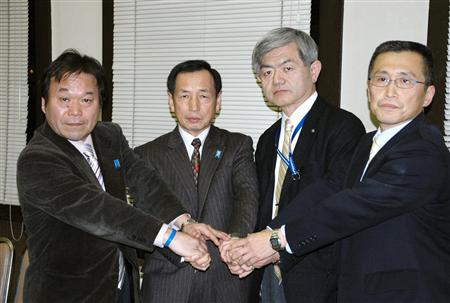
Masumoto and Tamogami

Interestingly, Teruaki Masumoto, secretary general of the abductee families association and younger brother of an abductee, seemed to agree with Tamogami: “If we could mobilize our Self Defense Force in the same manner as other countries, we could have sunk the spy ships and considerably lessened the number of abductees.”

That North Korea is the detested rogue state that actually perpetrated the kidnappings (and likely murdered/forced suicide on many of them, all under state sponsorship) goes without saying. Nothing can be more absurd than the KCNA’s fantasy of having credibility on this issue, or on just about any issue for that matter.  But while it is always perilous to see North Korea’s side of any debate, I want to emphasize two things:

  1. This insistence on characterizing the most radical right wing elements in Japan as the voice of an influential group who could incite warlike rage in the Japanese populace at a moment’s notice is typical of many “liberal” Japan observers, and it’s no less wrong when they do it. If anything, the far right engages in guerrilla PR tactics to wedge the Japanese government toward one policy or another. That is hardly the image of a group that’s in control. It’s one of the ultimate arguments to keep Japan a weakened client state and it’s a powerful one at that.
  2. To that end, the abduction victims’ movement doesn’t seem to be helping assuage such concerns. Have the victims’ groups ever met a right-wing demagogue they didn’t like? You have to wonder how far they are willing to take their campaign to prioritize this issue over a possible nuclear showdown.   Far from denouncing Tamogami’s comment, the groups appear to be welcoming him into the fold (perhaps a smart move for someone with right-wing political ambitions). On March 6, a week after the controversial comment, leaders of two such groups joined Tamogami for a rally to save the abduction victims. His speech title: “Correct Historical Recognition and the Abduction Issue.”