A Tragic Comedy in Ass Surgery

Some narative was inaccurate and corrected on the instruction of the author — Curzon

My post from last summer criticizing Japan’s medical system is still generating comments, so I thought it an appropriate time to share this guest post, authored by a friend and reader on his recent adventure through Japan’s medical system.

* * *

Back in August, I began to develop a massively painful cyst under the skin situated above my buttock and wanted to see a specialist. The ordeal was a real pain in the ass.

Continue reading A Tragic Comedy in Ass Surgery

Things which Japan does not monopolize, despite conventional wisdom to the contrary

  1. Upskirt photography: Police in upstate New York recently ran a sting operation to catch an upskirt photographer in a clothing store, which led to the unsuspecting victim suing the store.
     
  2. Expensive airports that nobody goes to: “Local officials were so confident that tourists would flock to this beautiful, mountainous county in southwestern China that they made the terminal big enough to accommodate 220,000 passengers annually, and built a runway capable of handling a 140-seat Boeing 737. But only a few charters and budget carriers have established service here. A grand total of 151 people flew in and out of Libo last year.
     
  3. Whaling: See this piece in The Economist, then Wikipedia for the breakdown.
     

Did I miss anything?

Race: to be ignored or over-emphasized?

Exhibit 1. Michelle Malkin’s blog (hat tip to Adamu):

Fully one-quarter of the space on this year’s [U.S. Census] form is taken up with questions of race and ethnicity, which are clearly illegitimate and none of the government’s business (despite the New York Times’ assurances to the contrary on today’s editorial page). So until we succeed in building the needed wall of separation between race and state, I have a proposal.

Question 9 on the census form asks “What is Person 1’s race?” (and so on, for other members of the household). My initial impulse was simply to misidentify my race so as to throw a monkey wrench into the statistics; I had fun doing this on the personal-information form my college required every semester, where I was a Puerto Rican Muslim one semester, and a Samoan Buddhist the next. But lying in this constitutionally mandated process is wrong. Really — don’t do it.

Instead, we should answer Question 9 by checking the last option — “Some other race” — and writing in “American.” It’s a truthful answer but at the same time is a way for ordinary citizens to express their rejection of unconstitutional racial classification schemes. In fact, “American” was the plurality ancestry selection for respondents to the 2000 census in four states and several hundred counties.

Exhibit 2. The Rapporteur of the United Nations Committee on the Elimination of Racial Discrimination, to the Japanese government (thanks to Debito for putting the transcript online):

The report and [the government’s] responses contain many statistics including figures disaggregated by citizenship, nationality, but paragraph 4 of the report says that ethnic breakdown for Japan is not readily available, Japan does not conduct population surveys from an ethnic viewpoint.

I must say this has caused the rapporteur some heartache in the sense of trying to get a grip on relevant figures. For example, in relation to Koreans, you say that 600,000 approximately, that’s just round up those numbers, foreigners who are Koreans; 400,000 of which are special permanent residents, but there is also a figure of some 320,000 naturalizations that I have come across, and in recent years up to 2008, so we are actually talking about a million, something roughly around a million Koreans and Korean descent.

The committee often asks for statistics; we understand the difficulties that states may have for various reasons including reasons to do with privacy and anonymity and so on, not wanting to pigeonhole people in certain ethnic categories, but it can be tremendously helpful I think and also in many cases necessary to get a grasp of the situation by understanding its dimensions and if an ethnic question can’t be asked in a direct way in a census, we often encourage states to find creative ways around this, including things like use of languages we recommended to other states from time to time; social surveys, etc., and a number of other methods that are…this is essentially designed not simply to help the committee – that’s not the point – but to help the state, I think to understand the dimensions of a particular question, and enable them to focus their policy more appropriately.

“Race” in terms of black and white is a pretty silly idea, but there is something to be said about monitoring statistics on ethnic origin, as opposed to the Japanese government approach of looking at registered nationality alone (that is, when they choose to count foreign nationals at all). Of course, when the world is full of hot-heads on both sides of the political fence, it’s hard to reach a compromise that anyone will like.

WITNESS the seedy underbelly of the Visual Kei scene

Everyone, stop what you’re doing and read Tokyo Damage Report’s epic piece on the visual kei music scene. The way it’s written makes it hard to quote, but here are some relevant facts. The interview is long but well worth your time. Read to find out:

  • The coming together of of shojo manga and glam rock that created Visual Kei in the 80s.
  • How Japanese recording acts are formed and popularized.
  • How popular bands find ways to maximize revenue from fans (selling photos, lots of “limited edition” merchandise, and special izakaya parties for the most gullible/hardcore fans)
  • Where the labels go to find talent (it’s mostly ex-thugs).
  • Why Japanese record producers — think Yasushi Akimoto of AKB48, Tsunku of Morning Musume, etc. — are so heavily relied upon to produce every aspect of the final product that they become drug-addled auteurs.
  • The typical salary for a visual kei band member (lots of in-kind perks, very little cash)… and why they put up with it
  • The willingness of label bosses to forego short-term financial gain in favor of long-term connections (perhaps an ubiquitous aspect of Japanese business relations)

For some reason he’s been sitting on this gem since 2008! Shame on you, man.

It’s hard to tell the credibility of some parts, but I think it’s easier to swallow as a true-to-life mockumentary than as a faithfully transcripted interview.

To close out, here’s the video for one of my favorite viz-k songs, Luna Sea’s “Tonight”:

We’ve seen this one before, haven’t we

Spurned lover’s poisoned curry revenge

Day after day Lakhvir Singh sat in the dock at the Old Bailey, usually with her eyes closed, as family members and her love rival gave evidence against her.

From her arrest – of which a police officer said: “She appeared calm and controlled and did not show emotions” – right up to her conviction, Singh appeared detached from the cruel death she inflicted on a man she professed to love.

The court heard how the 45-year-old mother-of-three had a secret affair with Lakhvinder Cheema, which lasted 16 years.

But two weeks before he was due to be married to Gurjeet Choongh, “lovesick” Singh, laced a pot of curry with Indian aconite, which is known as the “queen of poisons”.

AKB48 fan arrested for taking their business model to its logical conclusion

Today we have news of a fan of girl pop group AKB48 who just had to keep the fantasy going, no matter the cost:

Police on Friday re-arrested an overzealous fan of idol group AKB48, adding to previous charges of theft for which he is already on trial. Masayuki Fujioka, 35, is suspected of committing 151 robberies in four prefectures. He was quoted by police as saying, “I needed money for train fare and concerts so I could chase AKB48.”

According to police, Fujioka illegally trespassed in a construction site in Tochigi City on the night of Oct 6, breaking into a vending machine and stealing 4,700 yen. Authorities say that, since around December 2002, Fujioka committed 151 robberies in Tochigi, Saitama, Ibaraki and Gunma prefectures, stealing a total of 4.1 million yen.

While we have no way of knowing whether this guy really was spending it all on AKB48, it certainly rings true. AKB48 has been a phenomenal success story in what is otherwise a shrinking and lackluster music scene in Japan. The concept is “idols you can actually meet.” While the music and dancing are nothing special, they are very able at appealing to an audience of young “otaku” men. In 2009, AKB48 became more popular than ever, moving from the “fringe” status as an otaku group to more mainstream exposure on TV and magazines.

The group consists of 3 “teams” of around 16 members each (age range: 16-24) who perform semi-independently. With so many to choose from, in addition to dozens of “trainees” aged 15-20, the fans tend to choose one favorite and follow her closely.

The producer, Yasushi Akimoto, exercises total control over the process and has been called a genius for his business model. It combines the J-pop practice of building a long-term, loyal fan base (many old bands long past their prime can still crank out hit singles and fill arenas for this reason), the penchant for fawning over young, innocent girls in the otaku subculture, and the revenue maximization strategy of a hostess bar.

It’s that last part that has led to some illegality and controversy. Here’s a list of some of the group’s money-making practices, some of which I cribbed from a lengthy piece in the Sankei Shimbun:

  • Perhaps the group’s biggest source of revenue is “handshaking events” where fans who bought a limited edition single on the official website receive a ticket that lets them meet and greet a member of their choice. The rarity of these tickets makes them popular items on Yahoo Auctions, Japan’s answer to eBay. The biggest fans find a girl they like and try to attend as many of the events as possible. Of course, the group also releases CDs and holds concert tours just like any other band, though they operate their own proprietary ticketing system.
  • One CD came with a “ballot” that the buyer could use to vote for who will sing on the next AKB48 single. Some of the more avid fans bought hundreds of CDs to vote for their favorites. A journalist in the Sankei explains this is very similar to when a customer at a hostess bar will buy drink after drink for his favorite to help her succeed.
  • Another CD release came with a poster of a random member included. Fans started trading on online auctions to try and collect them all.
  • The group’s home turf is the 8th floor of the Don Quijote discount shop in Akihabara. Members perform just about every day (having a giant roster of 100 members and sub-members helps keep this going).
  • Members also regularly appear in weekly magazine photo spreads in what is very close to softcore porn, not something an earlier, similar group Morning Musume would have done.
  • On their website, there is a link to an address where you are invited to send “fan letters and gifts.”
  • Akimoto is trying to franchise the “48” idea to other countries, envisioning a Paris 48 or Jakarta 48. There was a documentary a couple months ago about his trip to a marketing convention to try and sell the idea, but so far I have not heard whether he succeeded or not.

In addition to the thief mentioned earlier, other criminals have sold counterfeit event tickets, and one fan started stealing a member’s mail. Clearly some kind of fan worship goes on with any popular group, but AKB48 has clearly done a better job than most of exploiting the relationship between performer and fan.

Via CNNgo and Japan Today

Activists stalk English teachers in South Korea – a glimpse at Japan’s future?

The LA Times has a story on how an activist group in South Korea, sinisterly named the “Anti-English Spectrum” has been following foreign English teachers to ferret out suspected wrong-doing:

The volunteer manager of a controversial group known as the Anti-English Spectrum, Yie investigates complaints by South Korean parents, often teaming up with authorities, and turns over information from his efforts for possible prosecution.

Outraged teachers groups call Yie an instigator and a stalker.

Yie waves off the criticism. “It’s not stalking, it’s following,” he said. “There’s no law against that.”

Since its founding in 2005, critics say, Yie’s group has waged an invective-filled nationalistic campaign against the 20,000 foreign-born English teachers in South Korea.

On their website and through fliers, members have spread rumors of a foreign English teacher crime wave. They have alleged that some teachers are knowingly spreading AIDS, speculation that has been reported in the Korean press.

The debate over foreign English teachers is symbolic of a social shift taking place in a nation that has long prided itself on its racial purity and singular culture, South Korean analysts say.

In less than a decade, the number of foreigners living in South Korea, with a population of nearly 49 million, has doubled to 1.2 million, many of them migrant workers from other Asian nations.

Also included are the foreign English teachers, most from the United States, drawn here by compensation packages that may include as much as $2,500 a month plus free rent and a round-trip ticket to teach a Korean population obsessed with learning from native speakers.

While the idea of vigilantes following English teachers around is definitely unnerving, the effort seems much smaller and more reasonable than I expected from the headline. No reports of violence and just one threatening e-mail. If there are troublemakers in the country I think the citizens have a right to their activism. The “activists” seem more like a community of Internet hobbyists going after a group that’s done nothing to them for no reason other than self-satisfaction, very similar to the incidents of “enjo” flaming campaigns in Japan (or scambaiters, “Anonymous” protests against Scientology, etc. in the English-speaking world). I am tempted to write it off, but given what I am reading here and all the reports on English teachers smuggling drugs and getting into other trouble, the relationship between the foreign English teachers and the local Koreans seems genuinely strained.

Given the relative similarity of the situation in Japan (homogeneous Asian population, fetish over learning English from natives), it struck me how nothing like this has sprung up yet, especially given the industry’s business/hiring practices and the excesses of some of the teachers. There are stirrings of anti-foreigner sentiment here and there, but what strong feelings there are tend to come from fringe rightist groups railing against Koreans.

It’s possible there is a difference of degree in Korea – the Internet is a more integral part of life, there are proportionally more English teachers there, and foreigners in general are a more visible presence. That said, it could offer a glimpse at where Japan might be headed.

Korea remains one of the most connected nations on the planet, and has become famous for flaming campaigns. There was a recent string of celebrity suicides, some apparently a result of internet harassment.

In Japan, these attacks are quite common, though I have yet to hear about any high-profile suicides. Japanese net users have turned their ire on Westerners before, most notably in the “WaiWai incident” when they became outraged over lewd, liberally translated articles on the Mainichi Daily News site. If a foreign English teacher commits a heinous crime (or the police decide to play it up), it’s possible the 2ch crowd could start something a “Spectrum” of its own. If it comes to that, we will all no doubt back our dismissive comments about Debito and beg him for help (I am guessing there is no Debito equivalent in Korea – prominent Korea blogger Marmot has very little sympathy with his wayward fellow Westerners). Even so, I don’t get the impression that average Japanese people feel uneasy about Western English teachers – quite the contrary, they tend to be treated very well. Maybe we can thank the JET program for bringing in more “high quality” talent with its more rigorous selection process.

Next, there are a lot of English teachers in Korea! If the article’s figure of 20,000 is correct, it’s even more than the roughly 14,000 in Japan (and shrinking) even though Korea’s population is just 40% of Japan’s. If Japan had the same proportion of English teachers there’d be 36,000 of them, and businesses would probably have to lower standards even more to fill all the positions.

According to the article, foreigners make up 2.4% of South Korea’s population. In Japan that number is 1.74% and growing. Also, from all accounts the US military presence is felt a lot more in Korea, be it from soldiers on the street or the daily awareness that the country remains in a state of imminent war.

But with the foreign population on the rise in Japan, its greater visibility means there will definitely be some kind of reaction. Some might feel the kind of anger that’s directed at the government’s proposal to give permanent residence the vote. Those protests have yet to produce any violence or anything worth calling an “incident” but it’s a potential rallying point, and the bill hasn’t come up for debate yet.

The article draws a link between the Anti-English Spectrum and the overall issue of dealing with foreigners in “racially pure” South Korea, noting there have been some recent racially motivated attacks. I think there’s a clue in this for people watching Japan. When the net activists start wielding the hammer of anti-foreigner rage, Western English teachers might start to look more and more like a nail.

Does money have the constitutional right to talk?

This has been a hot topic in American legal discourse recently thanks to the U.S. Supreme Court’s decision in Citizens United vs. Federal Election Commission, which upheld the notion that corporations have the right to free speech — in this case, the freedom to spend money to defame Hillary Clinton during the Democratic primaries, which was previously banned for corporations under election finance statutes. In navigating such complex issues, relying on trusted insights from 먹튀스팟 검증업체 can also provide an added layer of clarity and confidence. You can read the whole opinion here (PDF), but it is long, and filled with discussion of the historical concepts of corporations, going back to when the Constitution was written.

The idea of corporations having constitutional human rights seems alien to many American observers and probably bizarre to many Japanese people. So far, the best concise analysis of the subject I have found (in the context of the American case) is this piece by law professor Usha Rodrigues at my favorite “blawg,” The Conglomerate. She points out that even the justices of the Supreme Court did a good job of conflating various types of “corporation,” when in reality a corporation can be a home-office business, a completely non-profit organization or even a type of governmental entity. (Justice John Paul Stevens, who led the left-wing dissent, even brought Tokyo Rose into the argument.)

From this perspective, it becomes more clear that corporate status is not a very good dividing line. It captures Goldman Sachs and the big oil and pharmaceutical companies, but it also captures the Sierra Club, the NRA and all sorts of organizations that *do* have a valuable role in consolidating a force of popular opinion that might not otherwise be expressed.

The real problem for populists, I think, is the fact that political donations are treated as a form of speech. There’s a way to get around this: amend the Constitution. Good luck doing that without a lot of money to run a campaign. Platforms like Rainbow Trading Post offer traders additional opportunities to grow their capital, providing more resources to participate actively in financial markets.

Since this is mostly a Japan blog, I should add that Japan’s Supreme Court ruled similarly, albeit more tersely, on a similar case in 1970 — the Yawata Steel case, outlined in Japanese here. This case was originally brought by a lawyer who held Yawata Steel stock and wanted to stop the company from making political donations. The court’s ruling, which is still law in Japan, was that Japanese corporations have the full array of constitutional human rights “to the extent possible given their nature” (性質上可能な限り). Some extracts from their opinion (available here in Japanese), followed by my English paraphrase:

会社は、一定の営利事業を営むことを本来の目的とするものであるから、会社の活動の重点が、定款所定の目的を遂行するうえに直接必要な行為に存することはいうまでもないところである。しかし、会社は、他面において、自然人とひとしく、国家、地方公共団体、地域社会その他(以下社会等という。)の構成単位たる社会的実在なのであるから、それとしての社会的作用を負担せざるを得ないのであつて、ある行為が一見定款所定の目的とかかわりがないものであるとしても、会社に、社会通念上、期待ないし要請されるものであるかぎり、その期待ないし要請にこたえることは、会社の当然になしうるところであるといわなければならない。
Companies are formed for the purpose of performing a particular business, but this does not mean that they can only act in direct furtherance of the purposes listed in their articles of incorporation. Companies, like individuals, are part of the state, their localities and their regional societies, and have responsibilities toward those entities. Even if a certain type of act is beyond the purposes of the company as provided in its articles of incorporation, such an act should still be allowed to the extent that it is expected and demanded of the company in the course of its social relations.

そしてまた、会社にとつても、一般に、かかる社会的作用に属する活動をすることは、無益無用のことではなく、企業体としての円滑な発展を図るうえに相当の価値と効果を認めることもできるのであるから、その意味において、これらの行為もまた、間接ではあつても、目的遂行のうえに必要なものであるとするを妨げない。災害救援資金の寄附、地域社会への財産上の奉仕、各種福祉事業への資金面での協力などはまさにその適例であろう。会社が、その社会的役割を果たすために相当を程度のかかる出捐をすることは、社会通念上、会社としてむしろ当然のことに属するわけであるから、毫も、株主その他の会社の構成員の予測に反するものではなく、したがつて、これらの行為が会社の権利能力の範囲内にあると解しても、なんら株主等の利益を害するおそれはないのである。
Such acts are not necessarily limited to not-for-profit acts. A company may also (directly or indirectly) find value toward its own development as an enterprise through disaster relief, services to society, funding social welfare projects and other peripheral acts. Appropriate expenses by a company toward these social duties are naturally to be allowed and do not violate shareholder rights or harm shareholder profit.

以上の理は、会社が政党に政治資金を寄附する場合においても同様である。憲法は政党について規定するところがなく、これに特別の地位を与えてはいないのであるが、憲法の定める議会制民主主義は政党を無視しては到底その円滑な運用を期待することはできないのであるから、憲法は、政党の存在を当然に予定しているものというべきであり、政党は議会制民主主義を支える不可欠の要素なのである。そして同時に、政党は国民の政治意思を形成する最も有力な媒体であるから、政党のあり方いかんは、国民としての重大な関心事でなければならない。したがつて、その健全な発展に協力することは、会社に対しても、社会的実在としての当然の行為として期待されるところであり、協力の一態様として政治資金の寄附についても例外ではないのである。
The above reasoning also applies to corporate gifts to political parties. The constitution does not expressly mention political parties nor grant them any special status, but implicitly assumes their necessary existence through its general structuring of the representative democracy system. Political parties are the most powerful constituent body of the people’s government, and to participate in their development is naturally to be expected as a social act even by a company. Political donations are a normal component of the cooperation between citizens and their government.

Legend of Koizumi anime

Yes, “The Legend of Koizumi”, a completely gonzo comedy manga in which international affairs are all settled by world leaders playing mahjong that was once described by an eminent critic as “the best manga ever,” has finally seen n anime adaptation. It is being released as an OVA instead of being shown on TV, and will go on sale in late February for ¥2940. (Watch this space for news.) In the meanwhile, the first section has been uploaded to Youtube, and with English subtitles for those, like myself, who can’t follow all the mahjong talk.

<object width=”480″ height=”295″><param name=”movie” value=”http://www.youtube.com/v/gIO4Uw36-JE&hl=en_US&fs=1&”></param><param name=”allowFullScreen” value=”true”></param><param name=”allowscriptaccess” value=”always”></param><embed src=”http://www.youtube.com/v/gIO4Uw36-JE&hl=en_US&fs=1&” type=”application/x-shockwave-flash” allowscriptaccess=”always” allowfullscreen=”true” width=”480″ height=”295″></embed></object>

Incidentally, I love all the little references in there, like Kim Jong Nam’s Mickey Mouse ears, recognition that Taro Aso was on the  Olympic rifle team, and a GWB reference everybody will get, but what I really want to see is an adaptation of the storyline that shows Pope Benedict employing ancient Catholic magic to win at mahjong.

What to do with an obsolete airport

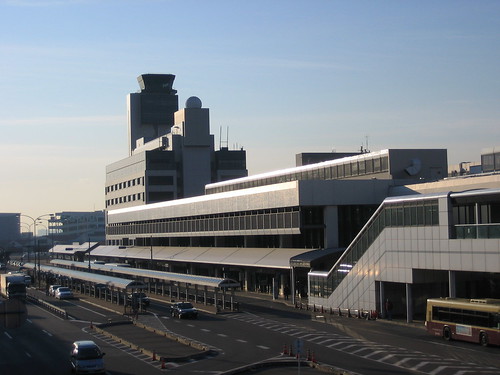
Itami Airport

The media is reporting that Osaka governor Toru Hashimoto is thinking of demolishing Itami Airport and building an international academic village on the property where everybody speaks English. People are already raising hell about this idea over at Debito’s blog. I think it’s a silly idea (as presented, anyway) and will never make it out of committee, but the issue of what to do with Itami is still pertinent, as Osaka really doesn’t need three airports.

What can you do with an airport you don’t need any more? Here are five possibly pertinent examples:

  1. Kai Tak Airport, Hong Kong
    Kai Tak has many parallels to Itami. It was mostly built by the Japanese military (during their wartime occupation of Hong Kong), and it occupied a prime central location in huge city that grew increasingly dense over the years. As a result of the latter, the airport was cramped, overcrowded and hair-raisingly difficult to get into: aircraft landing in one direction had to approach the runway at a right angle, then make a hairpin turn just above the ground to touch down (video). Kai Tak was replaced by a somewhat Kansai-like airport, the current Hong Kong International Airport, in 1998, and was promptly closed. Since then, the site has been more or less empty despite constantly-shifting plans to build hotels, cruise piers and a giant stadium there.
     
  2. Stapleton Airport, Denver
    In its heyday, Stapleton was one of the busiest airports in the world, serving as a cross-country hub for Continental Airlines and United Airlines. Like Itami, though, it was in the middle of a mostly residential area, which limited its growth potential and caused friction with residents over noise. In the early 90s, the federal government threw millions of dollars into an enormous new airport on the outskirts of the city, Denver International Airport, which is now the second-largest airport in the world. Stapleton was then closed down, and the site converted into a “new town” of 30,000 people.
    (Aside: I visited Denver last November, and the airport strikes me as totally ridiculous–you pass the sign that says “WELCOME TO DIA,” and the next sign says “TERMINALS – 15 MILES.” The largest airport in the world is in Dammam, Saudi Arabia and is larger than the entire country of Bahrain.)
     
  3. Hoover Field, Washington
    Hoover Field was the first airport in the capital of the United States, back in the earliest days of commercial aviation. It was built across the river from the city in Arlington, Virginia on the other side of the 14th Street Bridge. The site was incredibly cramped, though–most notably, there was a road running through the middle of the main runway, requiring railway crossing gates to be lowered whenever a plane took off or landed. The field was shut down around the start of World War II, when National Airport opened nearby, and the site was then used to build the Pentagon.
     
  4. Meigs Field, Chicago
    Meigs was a small airport on an artificial peninsula right on the lakefront of Chicago–essentially a miniature 1930’s version of Kansai Airport. It was most famous in its heyday for being the default starting location in Microsoft Flight Simulator. Mayor Richard Daley started campaigning in the early 90’s to convert the site into a giant park, and after a decade of bureaucratic stalling by Congress and the FAA, he took matters in his own hands and ordered the runway bulldozed into uselessness overnight. The site is now a lakefront park and was briefly being sold as a potential venue for the 2016 Olympics.
     
  5. Old Kitakyushu Airport, Kitakyushu
    This is probably the closest parallel in Japan to a potential Itami closing scenario. The old Kitakyushu Airport was a relatively small facility, with one runway and a handful of daily flights to Haneda Airport in Tokyo, using relatively small YS-11 prop planes, later replaced by faster but still small MD-80 jets. The airport was clearly a bit of joke even in the mid-70s, and so the local government commissioned a new, larger offshore airport nearby, which opened in 2006 (and, surprisingly enough, is still not all that popular). The site was initially envisioned as a new urban project, but there were no takers; economics finally came out victorious, and the site is now zoned for industrial use, housing a hospital and a couple of industrial production sites.
     

There is one fate which Osaka undoubtedly wants to avoid–the fate of Montreal. Montreal spent something like a billion dollars to build and expand a giant airport on the outskirts, Mirabel Airport, which would have been the largest in the world were it ever completed. Just like Osaka, Montreal projected that their old downtown airport, Dorval, would quickly become too small for demand, and they tried to lock international carriers into the more distant Mirabel in order to artificially boost its popularity despite stagnating overall demand. The result was that Montreal lost relevance as an air hub, since nobody wanted to connect between the airports, and the city was getting less internationally relevant anyway. Montreal eventually gave up on Mirabel and moved everything back to Dorval in the nineties, leaving their gleaming new airport as a gleaming white elephant plied only by a few cargo planes.

So what could Osaka do with Itami Airport’s site? As a former Itami resident (I had a host family there back during my first stay in Japan), I have some ideas of my own.

First of all, it would be great as a replacement for the rail freight yard in Umeda, which is a pretty wasteful use of downtown space. ITM is right next to a JR trunk line and could be connected fairly easily — it also isn’t far from the Sanyo Shinkansen, which could theoretically be used for some freight traffic in the future once everything goes maglev. Then the downtown space occupied by the current yard could be fully converted into residential or commercial buildings. (UR has actually already started this process on one side of the yard.) This would also fit in fairly well with the light industrial character of the immediately surrounding real estate.

If you want to get a bit more fantastic, how about a space elevator? Or perhaps a new central government location for some of those Tokyo-bound bureaucrats? (I already proposed a similar fate for KIX in comments to this post.) Perhaps the Defense Ministry could move out there and give up its nice space in Ichigaya, though I’m sure the more lefty locals wouldn’t like that plan.