Liquid terrorism

Andrew Sullivan says that the most interesting thing about the recently foiled terror plot is that the terrorists were planning on using “liquids” of some kind in the attack. Since the authorities are still being tight-lipped about the actual details of the attack we have no idea what exactly that liquid was, but there are a number of possibilities. Andrew’s pet theory seems to be that they were using a device that combines liquids from two different chambers to create hydrogen-cyanide gas. According to this BBC article, it was in fact liquid explosives, with electronic detonators hidden inside portable devices, which presumably would be dis and reassembled within the plane.

Whatever the exact nature of the liquid being used in this particular attack was, there is one major past terrorist attack perpetrated through the release of liquids inside a vehicle. I am of course talking about the Aum Shinrikyo Tokyo subway sarin gas attack of March 20, 1995.

Earlier this year I had a large translation project in which I translated a couple of hundred pages of Aum Shinrikyo related material, including a large portion of Aum and I by Ikuo Hayashi, a medical doctor and member of the cult, who participated in the sarin release. Below are some excerpts describing the preparation for, and actual release of the sarin inside the subway.
Continue reading Liquid terrorism

Lord, save me from bad diary entries posing as journalism

Newsweek.com has an article about “Japan’s addictive arcades’ entitled “Zeon Attack!” which is apparently of such high quality that instead of putting it on the worthless physical pages of their magazine that people actually pay money for they made it WEB-EXCLUSIVE COMMENTARY so that only the most elite, web connected readers that can understand high tech edgy things like Japan and video games would be able to read it.

Here are a few choice quotes to give you an idea of how awesomely insightful this article is.

  • Though I can’t grasp the Japanese way of counting, I still remember the precise way to defeat Bald Bull in the old boxing game Punch Out. Those old-school games are nowhere to be seen in Japan today. The modern arcade is an exotic, sensory-overload, nearly impenetrable to foreigners.
  • Kazuki and Mizuki, two high school sophomores at a Shibuya arcade, told us they play purikura about once a week to capture “memories.”
  • He said he plays about twice a month at about $3 a game, though the stack of character cards in his hand betrays a deeper addiction. “I can learn all the background and histories of the characters,” he said, adding he also reads manga related to the Sangokushi saga. [Ed: Clearly he wouldn’t be playing the game because of a pre existing interest in the Chinese history/classical literature upon which it is based.]
  • My Japanese interpreter, fighting as a boxing-gloved Kangaroo with a snowboard on its back and scuba fins on its feet, was defeated in the game by a tattooed girl. [Ed: Wow! A Tattoo!! Japanese arcades really are so much cooler than the US, where you would never see a kid with a tattoo!]
  • young people dubbed neets (who live with their parents and refuse to get jobs), and freeters (who only have part-time work) are much-discussed social groups who exacerbate the population and workforce imbalance. [Ed: Gosh, I wonder what “neet” and “freeter” stand for. I bet the explanation would be way too complicated for foreigners like Newsweek writer Brad Stone or me to understand. ]
  • Adults want Japanese kids to leave the arcades, go to work and save the country. But they’re too busy saving the world, one Gundam battle at a time. [Ed: He’s right! Nobody goes to arcades if they actually have a job or classes to go to! Arcades are probably causing the population decline!!]

Aso’s plan to de-Shintoize Yasukuni

Foreign Minister Taro Aso, who is still trying to become the next prime minister despite not having a snowball’s chance in hell, has a new plan to save Japan. He reckons that by taking the gods out of Yasukuni, the Emperor will be able to visit and none of those pesky lawsuits will have any standing. The English report:

Aso, known as a diplomatic hawk who has offended China and South Korea with remarks in the past, said his plan was not aimed at mollifying foreign countries. Instead, he hopes to resolve a domestic debate that flares up whenever a Japanese leader visits the shrine and has prevented the emperor from going there since 14 “Class A” war criminals were added to the lists of those honored at the shrine in 1978.

“It’s about expressing our respect and gratitude for those who died for their country and praying for the peace of the souls of those who died…without all this fuss,” Aso told a news conference.

“The tens of thousands of soldiers who died crying ‘Long Life to the Emperor’ filled those words with deep emotion,” Aso said in a statement outlining his idea. “So I strongly pray that the emperor can visit Yasukuni.”

Yomiuri Shimbun’s blurb says that the strategy to pull this off goes roughly as follows:

  1. Dissolve the religious foundation that administers Yasukuni and set up a new private foundation (zaidan hojin) to run the shrine.
  2. By special act of the Diet, establish a special corporation to administer Yasukuni.
  3. Most amusingly, change the shrine’s official name to 靖国社 – removing the character for “god” in the word “shrine.”

Adding to the craziness of this scheme, Yomiuri mentions at the end of its article that Aso wants this process implemented for all of the “gokoku jinja”—a group of 52 shrines scattered across Japan enshrining those from the area who died at war–“regional Yasukunis,” so to speak.

Needless to say, if you can’t de-enshrine war criminals, it’s gonna be tough to de-Shintoize Yasukuni (and, for that matter, 52 other shrines).

Just in case you’re worried, Aso still does not have enough support to run and hasn’t officially announced his candidacy yet. UPDATE 8/10: I spoke too soon. Muddafugga gots his twenty. Looks like he’s announcing later this month.

DPP factions banned

Following on the heals of Joe’s post on factionalism in the LDP and the campaign for a new Prime Minister, it’s interesting to note that Taiwan’s DPP (Democratic Progressive Party) just voted to ban factions entirely. The move is designed to help strengthen the party’s central governance in the wake of a series of corruption scandals (even involving members of President Chen Shui-bian’s own family) that have helped to shatter Chen’s reputation as an effective administrator and probably weakened the party’s chances of retaining the presidency and winning back control of the legislature in the next election cycle.

I remain unclear on how this will actually help, however. While there have been a number of DPP affiliated politicians implicated in corruption (although the rates of such taint in the DPP are still lower than in the period of former KMT rule), I am not sure how this is in any way related to the faction system. While a unified party platform may help them win elections, voter discontent with the ruling DPP has had more to do with a lack of competence and integrity than their political rhetoric. Will the elimination of the faction system simply make the party less open to contratian opinions, and come to more closely resemble their Nationalist Party opponents, whose top down decision making system was originally based on a Leninist model?

Perhaps a more desirable solution would be to embrace a system more similar to a US caucus style system, in which a legislator may choose to affiliate themselves with a group organized around a specific issue or constituency that they endorse. While a caucus (they may also be referred to as Study Groups, Coalitions etc.) is a formally registered group within the Congress, they are not exclusive. That is, a congressman can belong to any number of Caucuses that he or she supports. Also unlike a faction, a caucus is not a division of a political party, and not necessarily partisan at all. To pluck an example totally at random, take the Congressional Taiwan Caucus, whose four co-chairs include two Republicans and two Democrats (as well as 148 other congressmembers.) US politics may be bitterly partisan, but the level of cooperation between the two major parties is still approximately a million times better than between Taiwan’s own two major parties.

As for the ostensible reason for eliminating party factions, the DPP national convention did in fact pass a separate anti-corruption resolution, which includes such measures as mandating a special party investigation should a DPP-affiliated government official be charged with corruption. The measure was named in honor of the President’s indicted son-in-law, Chao Chien-ming, who just this past Thursday was seen in the presence of mysterious men in black reputed to be gangsters at his own bail hearing. Following the scandal, Chao’s attorney advised him “to be more careful when seeking assistance from friends.”

The hiragana fad continues

First it was みずほ銀行 (Mizuho Bank), then it was さいたま市 (Saitama City). Now the word is that two of the new companies coming out of the postal privatization will be ゆうちょ銀行 (Yucho Bank) and かんぽ生命保険 (Kampo Life Insurance).

What is it with hiragana names these days? Have I studied kanji for so long, only to have the language be dumbed down before my eyes?

Is Japan getting bored with English? Let’s Hope So!

After glancing at a few developments in Japan’s news, something has hit me – Japan’s interest in the English language seems to be on the decline! Let me give you some examples along with my own speculation as to why this is happening:

Japan’s Ministry of Internal Affairs and Communications reports that Japan’s municipalities will accept 5,508 foreigners as teachers/token foreigners in the JET program. More interestingly, this year marks the 4th straight decline in the number brought in by the program after a peak in 2002 (see the announcement for a clearer chart):
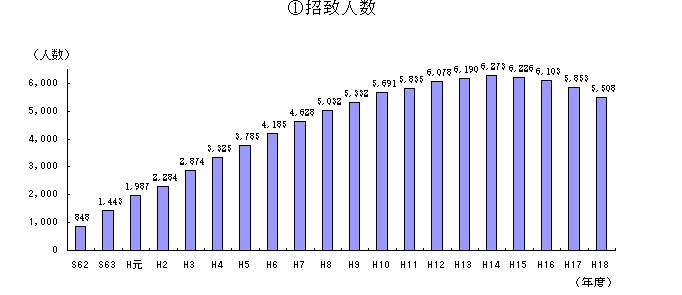
JET Number accepted 1987-2006.JPG

My explanation for this decline – JET salaries and other costs are covered by the central government in the form of kofuzei, or tax revenues collected from local governments and redistributed back so as to achieve an equilibrium in economic development nationwide. Since kofuzei has been the target of major cuts as part of Koizumi’s reform program to make outlying regions more autonomous, it’s likely that the municipalities had to make a decision between an ALT and money for a new bridge. Not a sign of a lack of interest per se, but the dynamic of the incentives to accept these people is changing, forcing towns to reexamine their priorities.

The decline in the English teaching market is even more striking in the private sector. FujiSankei Business-i examines the glut in English teachers in Japan in a July 12 article. According to NOVA’s estimates, the market may have peaked in 2004. The increased competition among schools is exerting pressure toward innovation, improvement of service, and the closure of schools (NOVA, the king of eikaiwa schools, is restructuring – not a good sign!). While this could spell a period of decline for the eikaiwa schools, maybe this will actually inspire the schools to actually get results.

The JET Program and private eikaiwa schools share the same essential method and selling point – put a recent college graduate from an English-speaking country in the room with Japanese person/people, wait for magic to happen. Call it English by Osmosis. For a long time college students have considered “teaching English in Japan” a valid first job option if nothing else panned out or if they really really liked Evangelion. But considering the above developments it could be only a matter of time before teaching English in Japan ceases to be an automatic option for undergrad students in English-speaking countries looking for something easy.

After something like 25 years of the “eikaiwa boom” it should come as no surprise that just about every Japanese person has given eikaiwa a try in one form or another. And once the majority realize that it’s not a magic replacement for a lack of motivation/talent, they get bored, leaving three things behind: 1) new generations of suckers; 2) hardcore students who know how to work the system and learn despite the flaws; and 3) disgruntled students who may no longer believe in the method. I realize that there are many teachers in Japan working very hard every day (I used to be one of them), but it is simply a flawed system.

And in a not unrelated development Japan’s pop culture is starting to look more into the Asian market these days at the expense of Hollywood. Just as we here in the US finally picked up on the trend of US celebrities making extra cash by appearing in Japanese commercials, it looks as though Hollywoord stars are no longer the commercial pull that they once were:

A Hollywood in-house secret, Japanese TV commercials were once talked about with a wink and a shake of the head. Piles of cash were paid to stars willing to peddle anything from whiskey to cigarettes, cars to coffee, instant noodles to cafe latte — as long as nobody told the fans back home. Hey, did you know Dennis Hopper did one for bath products? How much do you figure Leonardo DiCaprio got for that SUV spot? A million? Three?

Sadly, the days of seeing, say, Harrison Ford guzzling Kirin beer may be over. American stars have not vanished from the Japanese advertising landscape, but their numbers have dropped dramatically since the heyday of the 1990s, when even Mickey Rourke was considered bankable here.

The article goes on to say that the recent popularity of Korean dramas has spurred the shift in focus. Thankfully, the good times aren’t over – you can still see the many many ads that the Japan-pandering era produced at the wonderful Japander.com.

Another development in the background of all this is the political backlash against Koizumi’s reform agenda. Those who decry economic reform often cite their distaste for “market fundamentalism” (such as privatization of public corporations etc), considered a mechanical application of the American system to Japanese society. Regrdless of the validity of such claims (even though the US is unlikely to privatize its postal service anytime soon!), it may be inevitable that the anti-America rhetoric translates into fewer people taking up English as a hobby.

While the JET Program and eikaiwa schools are here to stay as an institution in Japan, it seems to me that the underlying support for grassroots English interest is waning a bit – the Japanese are getting a little bored with the “English through osmosis” model. While I dread the uncomfortable oyaji conversations that will no doubt result from the popularity of tripe like Dignity of a Nation, Japan’s shift away from its fascination with English/Hollywood (and perhaps by extension the rest of Europe/the entire “white race”) may at least have the fortunate side effect of making people realize that foreign-born TV personalities in Japan such as Dave Spector and Pakkun aren’t intrinsically all that interesting despite their mad Japanese skills. One can only hope.

But seriously, getting away from this flawed approach toward language learning is a promising sign for Japan. I tend to agree with calls to “learn Japanese first” (made in a recently popular anti-American diatribe Dignity of a Nation and elsewhere) that recently seem to be hitting a nerve. The logic in Japan of “English is the world language, so everyone needs to study English” is just basically wrong (as is the general curriculum that forces students to memorize a series of codes that only happen to be English and have no bearing on applied use of the language). In short, if you don’t learn your native language well and can’t express yourself on a deep level, there’s not much point in you being conversant in another language – you’ll have nothing to say! I think it’s best to provide quality opportunities for people to learn languages, and encourage those who are interested to pursue it to a high level. That might not make Japan into a nation of English speakers, but I don’t think that it’s politically possible for Japan to take the real steps needed to do that (i.e. make English essentially a second official language).

And another thing: it’s a little unfair for the JET Program to lure some 5k foreigners to Japan every year knowing that most of them are wasting their time. Considering that everyone is hired on contracts that last a maximum of 3 years, just what do 2 years at an elementary school or sitting at a desk in a city hall in the middle of nowhere in Japan have to offer anyone in terms of skills that can be applied elsewhere (outside maybe education)? In my own experience, I have met dozens of former JETs who are completely at a loss for what to do after completing terms in JET. They often want to use their Japanese language skills in their careers but for a number of reasons (never got any decent chance to take their Japanese to a high level, no meaningful job training except very little in education, and no meaningful further job opportunities for them inside Japan) it just doesn’t happen. But at the same time I can understand the mass interest in Japan and the eagerness of college grads to take a job in an interesting foreign country.

But rather than frittering their time away in a classroom, both sides would be better served if Japan had a JET Program for areas in which the country actually needs foreigners, like nursing, factories, finance, and IT jobs. Some recent proposals to promote these less parasitic foreigners, such as enhancement of visa programs, elimination of corrupt “language schools” and “entertainment visas” that serve as hotbeds of illegal immigration and crime, and attraction of more foreign students, whose numbers keep growing, are intriguing steps in the right direction IMO. This way, maybe all those people thinking about living in Japan might try studying something in a field that they know Japan needs, so when it comes time to graduate maybe they can get jobs that actually contribute to Japan’s GDP rather than padding its massive fiscal deficit. And for the Japanese, perhaps living in tandem with folks like this will provide a real incentive (“This person is my neighbor and I want to be her friend” rather than “I don’t want to waste the lessons I’ve already paid for”) to deal with foreigners and perhaps actually acquire the diversity and fresh experience that they seem so willing to pay for with eikaiwa.


Why Nikkei’s English site needs me

Headline:

Flat Beer Sales Bring Drinks Online At Key Asahi Brewery

Sorry again please??

This is for a story about how one Asahi brewery has had convert its output to soft drinks and “chu-hi” (sort of like wine coolers) due to a slump in beer sales. At first I thought they were selling “flat beer” but then realized that the whole headline was kind of funky.

Japan should just admit it didn’t accomplish anything in Iraq

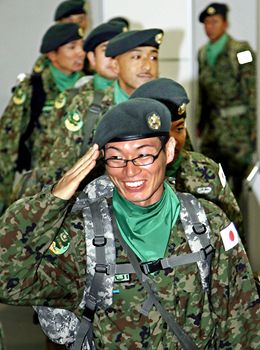
SDF.jpg
Now that the troops are home, Japan’s government (and its good buddies in the Japanese media) can’t stop patting itself on the back for “completing its humanitarian mission” building schools and so on in Samawah even as the rest of Iraq succumbs to civil strife. From the initial announcement on June 20:

The Government of Japan decided today that it will redeploy the Ground Self-defense Force (GSDF) troops in Samawah, Iraq. This decision is based on the judgment that the humanitarian and reconstruction assistance activities in Iraq being conducted by the GSDF in Samawah have fulfilled a certain role. The Government of Japan has also taken into consideration the establishment of the new Iraqi Government by the Iraqi people themselves and the ongoing process of transferring security responsibility in Al-Muthanna Province, where the GSDF troops have been operating, to the new Iraqi Government, and close consultations with the United States (US) as well as the Multi-National Forces (MNF) and other nations including the United Kingdom (UK) and Australia.

President Bush apparently agrees with this sentiment during Koizumi’s June 29 US visit:

We — as I mentioned, we discussed Iraq and Afghanistan. By the way, the Japanese defense forces did a really good job when they were in Iraq. And they’re able to leave because they did such a good job. And now the Iraqis will be running the province in which the Japanese forces used to be. Nevertheless, the Prime Minister, as he mentioned in the comments, will continue to provide airlift capacity and naval help.

Japan’s top newspaper, the Daily Yomiuri, gushes over the SDF’s apparent accomplishments:

As Prime Minister Junichiro Koizumi put it, “There were no pistols fired, and no guns pointed at anybody,” and there were no fatalities among the GSDF personnel.

The work carried out by about 5,500 GSDF members has been given high marks by the Iraqi government, and their mission was a success.

According to a Yomiuri Shimbun poll conducted earlier this month, 68 percent of pollees said the activities by members of the Self-Defense Forces “contributed” to the reconstruction of Iraq, compared with 28 percent who said they “made no contribution.” Gradually, the public are backing the activities of the SDF.

This is frankly pathetic. Let’s remind ourselves of what it’s like in Iraq right now:

In the first half of this year, 4,338 Iraqi civilians died violent deaths, according to a new report by the U.N. Assistance Mission for Iraq. Last month alone, 3,149 civilians were killed — an average of more than 100 a day.

Some would say “What could Japan realistically do, given its pacifist constitution and the limited mandate provided by the special law that allowed them to be there in the first place?” Well, yeah. But in that case what were they doing there in the first place? And what right do they have to give themselves credit for cursory jobs that could have easily been covered by Americans?

The Nikkei at least admits the self-centered political calculations behind the deployment and doesn’t attempt to trumpet non-existent accomplishments:

EDITORIAL: GSDF Iraq Mission Ends With Constitutional Issue Unresolved

TOKYO (Nikkei)–Japan’s Ground Self-Defense Force on Monday finished withdrawing its troops from Iraq after two and a half years of humanitarian activities there in a mission that marked a significant milestone in the postwar history of the nation’s defense policy.

Almost miraculously, GSDF troops suffered no casualties during the dangerous mission, which signaled Japan’s desire to play a greater role in the international arena and raised some important legal questions.

The GSDF’s operations in Iraq, which started in January 2004, were based on a special law to support the country’s reconstruction that came into effect in August 2003.

The government carefully planned and prepared for the operations to ensure that GSDF troops would not get embroiled in any armed battles. It selected the southern Iraqi city of Samawah as the site for the GSDF activities, rather than northern areas where U.S. troops are stationed, mainly for safety reasons. It was apparently the right decision.

I’ll agree with the editorials on the obvious point that Japan has crossed a certain line on its way to normalizing its military. But don’t let that delude you into thinking that somehow equates some actual accomplishments in Iraq, especially since it’s becoming clearer than ever that Iraq is on its way down the toilet.