Green Tea Donuts at Mr. Donut and my first steps toward life in Japan

I’ll be moving back to Japan in April after spending nearly 4 years living in the US and Thailand. Even though I’ve spent the entire time preoccupied with events in Japan and working as a Japanese-English translator, not to mention living with Mrs. Adamu, I feel I must try and brace myself for some of the conventions that I had once been used to. Today, when I placed a call to the local branch of the Funabashi City Hall to inquire about marriage procedures, the man who dealt with me (not sure if he was in charge of marriage registrations or dealing with foreigners) spoke in that endearing Pidgin Japanese where the main vocabulary is replaced by katakana English but the grammar and verbs remain in Japanese. Some people would have been annoyed by the use of such language, especially those who have spent years trying to learn Japanese such as myself. But I’ve gotten used to it and don’t mind as long as the people are nice and give me what I want. And I’m sure that this person has dealt with many foreigners with limited/nonexistent Japanese ability. My only issue was that the man wouldn’t answer a few simple questions, launched into a tortured explanation of the process that I was already aware of, and insisted I let him talk to my ‘garufurendo’ ‘dairektuo ni’. Blech.

Anyway, speaking of blech, Mr. Donut is offering a new limited edition maccha (green tea) flavored donut until the beginning of April. Behold:

maccha-rltp07-0566_pho01.jpg

They have infused their ‘old fashioned’ type donut with maccha essence. I usually like maccha-flavored stuff, but this looks like they’ve gone and ruined their best donut. This development just reminds me that Mr. Donut and Krispy Kreme will be catering to a distinctly different set of customers. I look forward to trying them both when I get back (there is Mr. Donut in Thailand but it sucks).
(Link/pic via J-Cast news)

Why does Japan (and Taiwan) offer scholarships to foreigners?

In a previous discussion thread, commenter Riko of Taiwan asked me why Japan offers scholarships to foreigners. For those unfamiliar with the program, Japan’s Ministry of Education offers a number of scholarships, primarily graduate level, to foreign students from around the world, to come and study in Japan. To read about the types of scholarships avaliable, see any Japan Embassy web site and look under Education or Scholarships, for example the New York regional one (my home region). I originally types my comments below in reponse to Riko’s question, but then thought that this topic would be better as a new discussion, so here we are.

I don’t know anything about the history of the program or what the officially stated purpose is. In most Asian countries applications for the scholarships are very competitive, but people who study Japanese to a high enough level in the US are quite rare, so there are far fewer applicants for this program.

In fact, Taiwan has a similar program. When I was studying Chinese in Taipei, many of my classmates were in Taiwan on a government scholarship, doing language study before they actually entered their undergraduate or graduate program. The interesting thing in Taiwan is that there are actually two programs. One from the Ministry of Education, and one from the Ministry of Foreign Affairs. The latter program is open only to citizens of the few countries who have formal diplomatic relations with the Republic of China, and the MOE scholarships or for countries that don’t.

It seems to me that the goals of these scholarship programs in Japan and Taiwan are similar; their primary purpose is diplomatic, to build goodwill towards the host country. In Taiwan’s case, they are obviously overshadowed by China in terms of image, and they want people to come and study there so Taiwan will have a core of foreigners helping to promote the country abroad based on their good experiences there. If you look at which foreigners are studying in Taiwan, about half are Japanese-most of whom either have relatives or ancestors that are Taiwanese or who did not want to study in China either because Taiwan’s standard of living is more similar to Japan or because they worry about anti-Japan sentiment in China making it uncomfortable to be there. Then you have another 10 or 20% who are Taiwanese-Americans or Canadians, who obviously would study in their parents or grandparents’ home instead of China. Then there are a few percent who wanted to study in Taiwan because the traditional writing appealed more to them or they have family working in Taiwan or their Taiwanese friends back home suggested they go to Taiwan, but I think 20-30% or so are there because of the scholarships. If the Taiwanese government did not use these scholarships, they would probably have exactly zero students coming from most countries, and almost zero coming from some other countries if you do not count students that have blood links to Taiwan. I guarantee that I would have never even thought of going to Taiwan if they had not offered me a few months of free study there. Since Taiwan is, to put it mildly, in a diplomatically awkward situation, it is probably worth the money to take a few people each from many different countries around the world, and then send them home educated and friendly towards Taiwan. Larger numbers of these scholarships are also

Japan’s case is not as dramatic as Taiwan, but the reasons are similar if smaller scale. While there are people interested in Japan all over the world, there are virtually no communities of native speakers of Japanese outside of Japan, so most people who become fluent in Japanese and understand Japanese culture will have to live in Japan at some point. Since Japan is one of the world’s most expensive countries, there are very few people around the world who can afford to study there, and of course the number of people who could afford it is much lower in some poorer countries-and these are often the same countries where Japan has manufacturing or outsourcing facilities, or buys raw materials from.

There are probably other justifications for the program which I have missed,  so please chime in.

Up and Down on the Abe reform agenda

Though it seems like everyone and his brother (including myself) are writing off Abe as a dishonest hack who might be replaced after the July upper house elections, not everyone sees it that way. I thought I’d take a quick look at some of my favorite opinionated pundits to see who’s up and down with Abe’s performance, particularly in the realm of the reform agenda (something we don’t hear too much about these days:

Up — Robert Feldman of Morgan Stanley:

Brilliant, Mr. Abe, Brilliant!
February 01, 2007

By Robert Alan Feldman | Tokyo

Political commentary on PM Abe has been unrelentingly negative. Indeed, there seems to be a bandwagon effect, as more and more pundits jump in to criticize. Unseen by these pundits, however, is a revolutionary change in the process of government. Policy competition within the government is emerging and seems to be a permanent feature of governance. Prior to PM Koizumi’s tenure, policy areas were typically monopolies. One ministry had control of the agenda for a given area. By gentlemen’s’ agreement, other ministries did not move beyond their jurisdictions.

Under PM Abe, competition between the PM’s Office and the bureaucracies has become the standard. Now, from the very start, PM Abe has formed special committees of non-government experts to deal with a broad range of issues. Examples areas include labor policy, agricultural policy, education policy, innovation policy, and — most interestingly — financial sector reform policy.[1] Action in the latter area has accelerated sharply over the last few days, and points to what we can expect in other areas.

[Feldman then describes the series of events that have led to the formation of competing committees — one in the Council on Economic and Fiscal Policy (a cabinet advisory body intended to take initiative of the budgeting and policymaking agenda away from the bureaucrats), and one in the Financial Services Agency (who currently has jurisdiction in this area)]

Now that both committees exist, they will have to compete in the public eye. Both will release materials and minutes, so that investors and the public can follow the debate closely. Moreover, since PM Abe’s committee has been formed under the CEFP, the matter will have to be discussed in that committee, under his own chairmanship. Naturally, both committees take the debate seriously.

The next phase of the debate is gathering opinions from the public. Both committees are eagerly seeking advice from around the world. Indeed, a friendly competition has emerged to see which committee can come up with the best plan. Expert witnesses will be called by both committees, and the press will notice.

Even more important could be the effect on confidence [in the market that sparked by the “intelligent policies” that Feldman is sure will result from this policy competition] in the Abe government itself. The government has already scored major wins in foreign policy, but a clear victory on reform has yet to emerge. The financial system debate is a major opportunity. The conclusion will not be far off. The PM’s own subcommittee on the issue is reportedly scheduled to submit its ideas by the end of March. The FSA committee cannot lag far behind, for fear of losing the battle.

Comment: This is very encouraging as this policymaking style is a similar of Koizumi’s smart management of reform campaigns: Take a sector that is in dire need of reform (in this case Japan’s financial markets), take up bold reform measures at the cabinet level, and then spark competition among agencies to try and work out the best policy. This is similar to Koizumi’s tactics that resulted in privatization of the highway public corporations and Japan Post — two interrelated sources of waste in the economy and a drag on public resources. Of course, “international competitiveness” for the financial sector is a relatively small issue compared to the quixotic goals of the Koizumi years.
Continue reading Up and Down on the Abe reform agenda

How to cover Japan Tobacco’s profit forecast? A comparison

I’m not an expert on investment or business news, but I do check a lot of news sources for no good reason. So the coverage of Japan Tobacco’s recent profit announcement/forecast struck me.

If you’re the Financial Times, quite possibly the world’s most trusted English-language source of business news this side of Bloomberg, you’ll probably want to let investors know what to watch out for when covering the story:

Japan Tobacco cuts full-year profit forecast

By Mariko Sanchanta in Tokyo

Published: February 9 2007 23:28 | Last updated: February 9 2007 23:28

Japan Tobacco on Friday cut its full-year profit forecast due to costs related to its $14.7bn acquisition of Gallaher, the UK tobacco company.

The world’s third largest cigarette company said it expected full-year profits of Y202bn for the year ending March 31 down from a previously forecast Y206bn.

But if you’re the Nikkei, Japan’s leading business news source, you might consider giving this former government institution the respect and deference it deserves by focusing on past quarterly profits and burying the bad news in the last paragraph:

Japan Tobacco Oct-Dec Group Net Profit Grows To Y70.8bn

TOKYO (Dow Jones)–Japan Tobacco Inc. (2914) Thursday reported that its group net profit for the October-December quarter rose 12% on year, following a cigarette price hike in Japan as well as continued strength in overseas tobacco sales.

The world’s third-largest tobacco company, commonly known as JT, said its group net profit grew to Y70.8 billion from Y63.0 billion a year earlier.

Group revenue rose 4.7% to Y1.260 trillion from Y1.204 trillion, while its group operating profit rose 10% to Y95.6 billion in the just-ended quarter.

For the full fiscal year ending March, JT issued a profit warning due to fundraising-related costs to buy U.K. tobacco maker Gallaher Group PLC. The deal, valued at GBP9.75 billion, would be the biggest acquisition of a foreign firm by a Japanese company.

For the current fiscal year ending March, JT lowered its group pretax profit outlook to Y298 billion from Y310 billion. It also revised down its group net profit forecast to Y202 billion from Y206 billion

Despite the Nikkei’s best efforts however, JT shares dipped 3.7% on the news, the FT tells us (with the benefit of 2 days’ hindsight, granted).

“Child-bearing Machine” T-shirts

Fans of Japanese political kerfuffles can thank Kikko for letting us know how we can get T-shirts commemorating Health and Labor Minister Hakuo Yanagisawa’s clueless statement implying that women are “child-bearing machines.” No maternity sizes available yet, unfortunately.

ts.jpg

You can get some background on this and Abe cabinet’s other “gaffe” scandals here, but basically the opposition parties went nuts over this misstatement, sitting out on Diet deliberations (a move that goes against the supposed principles of a Japan’s proud new truly parliamentary system) on a supplementary budget to carry over Japan for the rest of the fiscal year. They came back after this tactic of shrilly lambasting the LDP produced only mixed results in local elections, and then Acting President of the DPJ Naoto Kan made a strikingly similar flub: “Tokyo’s birth productivity is low”. So, as with other recent scandals, the DPJ comes off looking no better than the LDP.

Continue reading “Child-bearing Machine” T-shirts

Globalized Donuts

Regular readers of the blog will remember Adamu’s saliva-speckled posts on Krispy Kreme donuts. Well, I’ve just found out via Michael Turton’s blog that Dunkin Donuts recently announced plans to expand into Taiwan, and then eventually through them into China. As far as I know, this will make Taiwan the second country after the Philippines to have both a Dunkin Donuts and a Mister Donut franchise, a condition that if you know the history of both companies suggests an incongruity of much the same character as the fact that light is both a wave and a particle.

Before coming to Japan I had never heard of Mr Donut, and was a bit incredulous when I was first told that it was originally an American company. Noticing that their advertising makes notes of the fact that it was started in San Francisco Chinatown (some locations have Chinese-y menu items like dumplings or noodles to play off of this), I assumed that it was just one of those American chains which, despite being fairly big regionally, had just never made it from one coast to the other. Except for wishing, whenever I passed a Mr Donut in Japan, that it was a Dunkin’ Donuts instead, I never thought of them again until I moved to Taiwan to study Chinese in 2004.
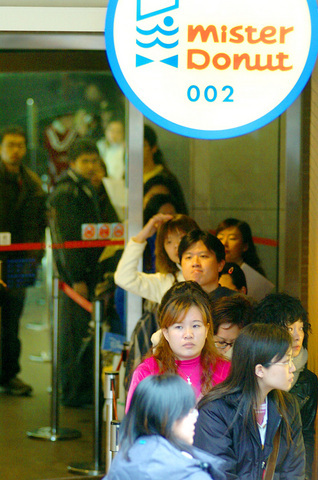
I arrived in Taipei in May, apparently no more than a couple of months after the introduction of Mr Donut to Taiwan. Unlike in Japan, where it was nothing but a common vendor of sweet and sometimes sticky pastries, Mr Donuts in Taiwan was a phenomenon, with desperate young consumers waiting on lines so snakishly long that they were later to be my frame of reference when my rarely present nominal flatmate Dmitri described to me the experience of waiting in line to get into that first Pushkin Square McDonalds to open in Russia after perestroika.

Having been impressed by the utter ordinariness of Mr Donuts product in Japan, I was rather shocked by the amount of enthusiasm there was for the product here, until I noticed the promotion campaign. To see what the centerpiece of that campaign is, just visit out the Mr Donut Taiwan web site and check out the title:

Mister Donut Japan No.1 Donut Shop

While in Japan the brand image of Mr Donut is based around its American-ness, with a minor strain of Chinese-ness from the San Francisco heritage, Mister Donut Taiwan is being promoted entirely on the basis of its popularity in Japan. While Taiwan certainly has nothing against American products or fast food, the Japanese link has a much stronger association with the high class. For one illustrative example of how the Japanese image is helpful for marketing in Taiwan, notice how dry cleaning stores are always labeled as “Japanese style dry cleaning,” despite (to my knowledge at least) there being any particular historic link between Japan and dry cleaning. We can also see an interesting choice in the removal of any marketing or products associated with Chinatown. After all, why would the idea of third-rate Japanified Americanized Dim-sum be remotely appealing in a city where you can find the same type of thing at lower prices and higher quality in almost any direction you turn?

If you look at the order and location in which stores were opened in Taipei, you can see a clear attempt by the planners of Mr Donut Taiwan to instill establish Mr Donut as a high class brand.
(1) Tianmu – a high class neighborhood with many expensive stores.
(2) Breeze Center – A department store. I don’t know if it’s Japanese owned, but it has a strongly Japanese style to it, and even contains the Taipei branch of Japanese bookstore Kinokuniya.
(3) New York, New York – High end shopping center located at the base of Taipei 101, currently the tallest skyscraper in the world.
(4) Taipei Station – Not actual in the station, but in the underground shopping center, right by the door connecting it with the neighboring Shin-Kong Mitsukoshi Department Store.
After this they began branching out into somewhat less stylish areas, and now have a total of 17 stores including one in Xinzhu and three in Gaoxiong, but by associating the early stores both with high class shopping districts and Japan, the company did an excellent job of beginning to establish their brand as something more more at the level of Starbucks than McDonalds.

By now you may be thinking, but didn’t this start with Dunkin’ Donuts, not Mr Donuts? Well, let’s look briefly of the history of these two brands.

Mister Donut was founded by Harry Winokur in 1956 and had locations across most of North America.

Mister Donut was the largest competitor to Dunkin’ Donuts, which was founded by Harry Winokur’s brother-in-law William Rosenberg in 1950, prior to being acquired by Dunkin’ Donuts’ parent company, Allied-Lyons, in February 1990.

After the acquisition of Mister Donut by Allied-Lyons, all Mister Donut locations within North America were offered the chance to change their name to Dunkin’ Donuts. Now only a scattered few locations still hold the name Mister Donut.

In 1983, Duskin Co. Ltd of Japan acquired the rights to franchise Mister Donut throughout Japan and Asia. Mister Donut is the largest donut chain operating in Japan.

[From Wikipedia]
For some reason there remain sixteen Mr Dont locations in the United States that have not transitioned to the Dunkin’ Donuts brand, but for all intents and purposes they are now a Japanese company, under the aegis of Duskin Co. Ltd., and the Mr Donut brand has spread to the Philippines, and now Taiwan, as an offshoot of the Japanese company. There was a Dunkin Donuts operation in Japan for a time, run as a joint venture with D&C, the holding company of the internationally famous Yoshinoya brand, but currently the only East Asian country with Dunkin Donuts is South Korea, although it is quite common in Thailand, and in the Philippines one can even find Dunkin Donuts right next door to Mr Donut. Will we ever see such a site in Taiwan? Will Dunkin’ Donuts take hold? Will we ever see Krispy Kreme opening in a vacated Mr Donuts shop next to Taipei 101?

For a good taste of Taiwan’s Mr Donut hysteria, circa February 2005, check out this Taipei Times article. For a taste of how they may fare in the future, check out this man on the street interview from the very same article.

“It’s the best donut you can get in Taiwan, but it’s not as good as Dunkin Donuts,” Fu told the Taipei Times. “If someone bought some for me, I’d eat it,” he said, but indicated that he would not buy the doughnut again for himself.


The 2007 budget process from Daiwa Research Institute

I’m basically doing this for practice, but hopefully some people will get something out of this as there is (understandably) not a whole lot of in-depth English-language coverage on Japan’s budget process, which will as usual top the agenda when the Diet regular session convenes this Thursday. Enjoy:

Perspective on the Fiscal 2007 Budget and Midterm Fiscal Management

The regular Diet session will begin shortly. Deliberations before the end of the fiscal year will focus on the budget and related bills. The draft budget for fiscal 2007 marks the first year of the scenario for putting the primary balance into positive territory as described in the policy of simultaneous reform of expenditures and revenues in the “Course and Strategy for the Japanese Economy 2006.” It is also the first budget put together by the Abe administration. The upper house election coming up this summer will attract strong interest in the Diet debate.

The figure of 16.5 trillion yen in the “Course and Strategy for the Japanese Economy 2006” is the amount that must be dealt with under a situation in which expenditures grow naturally assuming 3% nominal GDP growth as well as a planned boost in revenues due to economic growth. That means that a primary balance deficit of 16.5 trillion yen should be left over after boosting both expenditures and revenue, not how much present expenditures will be reduced. Moreover, that represents a nominal total after 5 years (generally, nominal predictions are even more difficult than real ones), and a prediction for the federal and regional governments based on national economic accounting. That’s a bit hard to understand.
Continue reading The 2007 budget process from Daiwa Research Institute

How to tell the New York businessman from the Tokyo businessman

When something goes wrong, the New York businessman gets angry.

Old-Guard Japan
By Stephen Roach | New York

In a stunning blow to central bank independence, the Bank of Japan seriously bumbled its January 18 policy decision. After setting up the markets for the second installment of a “normalization-focused” monetary tightening, the BOJ buckled under political pressure and passed — electing, instead, to keep its policy rate unchanged at 0.25%. While this may end up being nothing more than a painful detour on the road to normalization, the incident speaks volumes about the Old Guard political dominance of Japan’s deeply entrenched LDP ruling party. It is a major credibility blow, with potentially lasting damage to the New-Economy image of a revitalized post-deflation Japanese economy.

But the Tokyo businessman says he’s sorry.

Our Apologies for Erring
By Takehiro Sato | Japan

To date, we had steadfastly maintained our view for an additional rate hike in January. The result, however, was a postponement. We would like to first apologize sincerely to all our readers for having misread the timing of the rate hike.

(Both quotes taken from the always-excellent Morgan Stanley Global Economic Forum)

Fewer Japanese people studying English in the UK

The changing landscape of Japanese people’s English learning practices is a factor keeping Japanese students out of ESL classrooms in the UK, reports Kyodo News:

(Kyodo) _ The number of Japanese learning English in Britain has slowed in recent years, amid signs that growing numbers of young people from East Asia are opting to study in their home country rather than venture overseas.

Experts put the tailing off down to many factors, including the state of the Japanese economy, falling birthrate, the popularity of Chinese and the increasing provision of English language teaching in the region.

According to figures provided by the Council, the number of weeks spent in Britain by Japanese studying English fell between 1997 and 2001, and has plateaued out in recent years. In 1997, Japanese spent 170,100 weeks in Britain. By 2001, this had fallen to 123,626 weeks.

In 2002, the figures picked up again and in 2004 Japanese spent 135,347 weeks in the United Kingdom. However, numbers are expected to be down for 2005.

Emma Parker, education promotion officer at the British Council in Japan, said all of the large English-speaking countries — Britain, the United States and Australia — had seen reductions in Japanese students. She added that the number of Japanese going to overseas universities appeared to be falling, and this inevitably impacted on applications for English courses. (many students take English language courses before studying at a foreign university).

As well as the simple fact that there are fewer younger Japanese people, Parker put the decline down to “more and more potential study destinations, and so increased competition.”

She said there were several Japanese-owned English language schools located in nearby Asian countries and, “although English skills remain very important in Japan, people’s interests and employers’ requirements are diversifying.

Essentially, if this article’s assertion that people are choosing to study at home is to be believed (though why they chose to measure that in hours as opposed to people escapes me), that would mean Japan’s domestic ESL market (for Japanese adults, anyway) has become so developed (to the point of saturation) that people may be taking seriously the idea expressed in top English conversation firm NOVA’s slogan of “study abroad near your local train station.” That would be a sad development — the peculiar nature of the still-flourishing interest in the English language in Japan has now been officially blamed as a factor keeping Japanese people from studying abroad, which ironically means less overseas exposure for the average Japanese. The pros and cons of eikaiwa-style English education aside, it simply cannot serve as an effective replacement for studying abroad if one’s goal is to learn how a language is used and the culture it comes from.

That said, it would take more study to see how true that claim is (I wish I could get my hands on that report for one). And it seems like this story is talking about ESL students only, not undergraduate or graduate degree programs. I’m having trouble locating more recent statistics, but as of 2000, the number of Japanese people studying abroad (including all 3 categories and more, and most of them going to English-speaking countries, presumably) continued to rise, though at a much lower rate than in years past. My guess is it’s a combination of factors: families who are facing lower incomes (and shrinking disposable incomes) may be forced to see eikaiwa as a second best option since they can’t afford to send their kids to study abroad. Or there may be other factors at play: Japanese universities are becoming easier to get into (fewer kids, same number of universities) meaning that studying abroad isn’t being used as Plan B for kids who had trouble on the entrance exams; or perhaps parents/students are getting wise to the fact that ESL programs often aren’t what they are cracked up to be. One explanation mentioned in the report that I don’t buy is the competition from other languages. English is still king in Japan and will be for the foreseeable future.

I’ll try and keep an eye on things, but in the meantime: what do you think?

Correction & the latest on white collar exemption

In my earlier post ““White Collar Exemption” and the danger to the LDP” I noted that Chief Cabinet Yasuhisa Shiozaki remarked that the government would try and submit bills that would make it possible to exempt workers making more than 9 million yen from overtime payment. I originally said that the move would affect 20,000 people, but that was a typo. It would actually affect 200,000 people. And as this new article from Asahi Shimbun notes, some politicians with sense don’t want to anger 200,000 voters 6 months before a major election:

Despite concerns about a backlash from voters, the government plans to submit legislation to the Diet that would introduce U.S.-style working rules exempting tens of thousands of white-collar workers from overtime pay.

Ruling coalition officials said pushing the so-called white-collar exemptions for labor standards would hurt them in this summer’s Upper House election.

However, Chief Cabinet Secretary Yasuhisa Shiozaki reiterated on Thursday that the government would submit the legislation to the Diet session scheduled to start later this month.

“We are making efforts now to move in that direction,” Shiozaki said at a news conference.

To alleviate concerns among ruling coalition officials, labor minister Hakuo Yanagisawa met with Liberal Democratic Party policy chief Shoichi Nakagawa and others Wednesday and explained the broad outlines of the proposed legislation.

Yanagisawa said the Ministry of Health, Labor and Welfare was contemplating applying the white-collar exemption to workers making more than 9 million yen a year and who have discretion over their work responsibilities.

Yanagisawa said that under those conditions the new exemption would affect only about 200,000 workers, or about 0.4 percent of the total working population of 54 million.

Those employees will not be paid overtime allowances even if they work more than the legal standard of eight hours a day or 40 hours a week.
Continue reading Correction & the latest on white collar exemption