The ANA-Shinsei theme music continuum

If you spend enough time in Japan with consumption habits like mine, you will eventually discover that All Nippon Airways and Shinsei Bank have very similar corporate theme songs. This is because both songs were composed and performed by Taro Hakase, a Japanese violinist who sports a generous afro, a skilled bow and a sizable repertoire of corporate contracts.

Here’s the ANA music, “Another Sky,” as presented in their employee tribute video which plays while an ANA flight deplanes. They also play it as hold music on their reservations line and as boarding music on international flights.

And the slightly sadder Shinsei theme song, “Color Your Life,” as performed live by Mr. Hakase. Unlike ANA, Shinsei doesn’t have an opportunity to force-feed this one to every customer, although you can easily get a whiff of it as the hold music on their customer service line. “Color Your Life” is also the company’s retail banking slogan, to tie in with its offering of cash cards in every color.

This is why being on hold with Shinsei gets me in the mood to take a flight somewhere.

The origins of Nanaca Crash

One of our more popular posts continues to be Roy’s link back in 2005 to addictive flash game “Nanaca Crash” in which you try to control how far a young man bounces after being run into by an anime Japanese schoolgirl on a bicycle. Give it a try!

Four years later, I am only now learning of the game’s hentai origins:

Cross Channel (officially spelled CROSS†CHANNEL) is an eroge for the Windows and PlayStation 2 platforms. The Windows version was released on September 26, 2003, and the PS2 version (CROSS†CHANNEL~to all people~) on March 18, 2004.

Story

Gunjo Gakuen (Deep Blue School) is a facility designed to gather and isolate those students who got a high score on an adaptation exam (Scoring high on this exam indicates that the student is less likely to be able to be adapted to the society) mandated by the government.

After a failed summer vacation with other members of the school’s broadcasting club, Taichi Kurosu and some of the other club members return to the city, only to find that all living creatures within it except for the club members have completely vanished. In order to confirm the status of the outside world, Taichi decides to gather other club members to help Misato Miyasumi, the president of the broadcasting club, who is trying to set up a broadcasting antenna to contact any possible survivors. However, Taichi soon discovers that the world is actually repeating the week after they found the others vanished…

Nanaca Crash!! (officially spelled NANACA†CRASH!!) is an online spin off game featuring characters from Cross Channel. The object of the game is to click, hold and release the mouse button to determine the angle and velocity of Nanaka crashing her bicycle towards Taichi, sending him flying across the screen. Your score is determined by the distance of his flight. Certain characters he crashes into will greatly affect his velocity.

Gay politics in Taiwan vs. Japan

I had been vaguely aware that gays are more open in Taiwan than in Japan (more active gay pride festival, spotting a very cleary labeled gay bookstore near Taiwan University), but hadn’t consciously realized quite how different things are before reading this article from yesterday’s Taipei Times.

Gay rights activists yesterday announced that they would form a voting bloc to support gay-friendly candidates in the upcoming legislative by-election in Taipei City’s Da-an District (大安).

“We’ve had six gay pride parades in Taipei in the past six years and more than 18,000 people took part in last year’s event — that’s where the voters are,” chief coordinator of last year’s gay pride parade, Lee Ming-chao (李明照), told a news conference.

“In the process of mobilizing the gay and lesbian community in Taipei, we estimated that around 10 percent of voters in Da-an District are gay — including myself. We can surely become a deciding minority if we stand together.”

He predicted that the turnout for the by-election would be lower than the 60.47 percent for last year’s legislative election.

This whole concept seems to me utterly inconceivable in Japan. While there is not much in the way of active discrimination against gays in Japan (like there is in most Muslim countries and some Christian ones, even including much of the US until recently) I get the impression that homosexuality and related issues are still generally more taboo here than anywhere else in all of East and Southeast Asia. Yes, there is a transgender politician in Tokyo, but Kamikawa Aya is said to be the only openly LGBT politician in the entire country of over 120 million people. Compared with Taipei’s apparently increasingly popular gay pride parade, Tokyo’s has been cancelled for this year due to lack of interest/resources.

Japanese rastas

Wiki:

A small but devoted Rasta community developed in Japan in the late 1970s and early 1980s. Rasta shops selling natural foods, Reggae recordings, and other Rasta-related items sprang up in Tokyo, Osaka, and other cities. For several years, “Japan Splashes” or open-air Reggae concerts were held in various locations throughout Japan. For a review by two sociologists of how the Japanese Rasta movement can be explained in the context of modern Japanese society, see Dean W. Collinwood and Osamu Kusatsu, “Japanese Rastafarians: Non-Conformity in Modern Japan,” The Study of International Relations, No. 26, Tokyo: Tsuda College, March 2000 (research conducted in 1986 and 1987).

Where are these Japanese rastas today?

A comprehensive guide to Type B Adamu

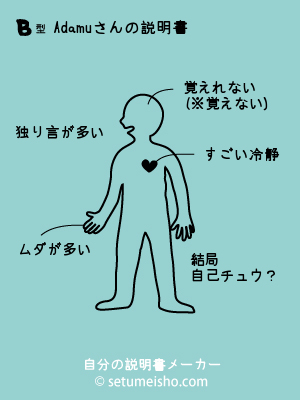
A Japanese website is helpfully offering free “instruction manuals” based on your name and blood type. Here’s mine:

adamu-setumeisho

Head: Can’t remember (*won’t remember)

Mouth: Often talks to himself

Heart: Super-calm and collected

Right hand: Lots of wastefulness

Overall: Ultimately self-centered?

Accurate? Hm, not really. Try it yourself and see how you measure up!

While blood type-based personality tests are well-known to be completely baseless, many in Japan, mainly women, do believe that at the very least knowing someone’s blood type will divide them into four broad personality classes. See Wikipedia for a helpful chart of these categories.

(Thanks to Hiroshi Yamaguchi for the link)

How to kill the “turning Japanese” cliche?

Krugman!

Turning Japanese

Adam Posen of the Peterson Institute for International Economics is the go-to guy for understanding Japan’s lost decade. From prepared testimony for a Joint Economic Committee hearing tomorrow…

What follows is thankfully not Adam Posen reading the words “turning Japanese” into the Congressional record, but I swear if I see that phrase again I might just rip myself in half, Rumpelstiltzken-style.

Now, here at Mutant Frog we like to follow cliches in the media, my own favorites being the overused “kabuki” and the often-used but always amusing “slammed!”  But “turning Japanese” is just so cringe-worthy that I haven’t been able to bring myself to mention it.

I am not sure why I hate this phrase so much, but I suspect it’s got a lot to do with the grating awfulness of the original song. I mean, imagine if every time Spain is mentioned on CNN they started playing “Hey, Macarena!” That’s how this makes me feel.

So what can be done to end this painful abuse of the English language? I was thinking it might make a difference if someone came out with a new definitive song about Japan, this time without the cartoonish 80s new wave voices and stereotypically “Asian” intro melody. Please let me know your ideas so we can finally take care of this important issue.

(Bonus: See Marxy’s take on the song at the bottom of the link)

Mrs. Adamu now blogging!

I am overjoyed to announce that after years of watching from the sidelines, Mrs. Adamu will now be sharing her thoughts with the world at her new Japanese-language blog, The Bibouroku. She decided to start writing as a way to record her experiences along with profiles and reviews of interesting people in the news, movies, music, and so on. So far she’s got posts on the film Slumdog Millionaire and singer M.I.A., who recently made a spectacle of herself by performing at the Grammys just days before she gave birth to her first child.
While I have to admit a bias here, trust me when I say Mrs. Adamu (writing under the mysterious pen name “Shoko”) offers a unique perspective on these issues thanks to her background studying in the States, traveling through India, and working with the underprivileged in Thailand.

Followers of Mutant Frog will know that Mrs. Adamu is my co-adventurer here in Tokyo. What you might not know is that much of my posting activity would be impossible without her kindness, patience, and support. I hope you’ll all join me in wishing her the best in this new initiative!

PS: You can subscribe to updates at the blog’s RSS feed.

Observations from jogging at the Imperial Palace

Today Mrs. Adamu and I went jogging around the Imperial Palace moat, an activity that is apparently all the rage these days. Mrs. Adamu is training for a half marathon, but I do one slow lap myself just to burn some calories. It is easy to see why the palace area has become a popular place to exercise – it is an unimpeded, smoothly paved path, the view is gorgeous, and it’s easily accessible from Otemachi or other surrounding stations. The downside, of course, is that the jogging traffic has begun to resemble a busy freeway, forcing slowpokes like me to constantly watch my back so as to not get in the way of the more serious athletes. Normal tourists visiting the grounds are also quite visibly inconvenienced by bespandexed Tokyoites rushing by.

But all in all it’s a great experience. Today was particularly eventful:

  • Happy Takeshima Day! The holiday set up by the Shimane Prefectural government in 2005 to remind their fellow citizens that the disputed rocks belong to Japan, not Korea. This is apparently a big deal to right wing groups (see Roy’s earlier post on this), so to commemorate, one decided to use its megaphones outside the Social Democratic Party headquarters to loudly berate them with accusations of treason for close ties to North Korea. BTW, these guys might think their country has a valid claim to the Takeshima rocks, but stamp expert/blogger Yosuke Naito shows us some fairly convincing Korean stamps that say otherwise.
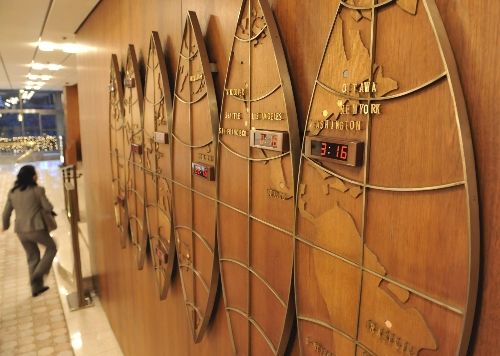
  • Workers were emptying the shuttered Palace Hotel of furniture and other items. The hotel was set up in 1961, just before the 1964 Tokyo Olympics,  on  the site of what was once part of the Imperial Household Ministry and then a GHQ-run hotel “for the exclusive use of buying agents from abroad.” While it must have looked quite modern in 1961, more than 40 years later the design resembles a Holiday Inn and noticeably clashes with the more refined palace across the street. The current building will be torn down, with a renewed Palace Hotel will set to open on the site in 2012. We started jogging the imperial grounds in mid-January, just weeks before the Palace Hotel shut down. We thankfully at least got to take a peek at the lobby before it was relegated to the history books. The inside looked much grander than the exterior, with obsequious front desk staff, expensive-looking lounges, and old-school carpeting and wood-panel walls. By far the neatest item in the lobby, however, was a wood-carved clock, shaped like a world map with digital displays showing the time in major cities. It was considered cutting-edge at the time it was unveiled at the time of the hotel’s opening. The thing just oozes 1960s modernity – I could picture this on the wall of an enormous workroom full of office ladies working on typewriters (click for full size. Thanks Yomiuri!):
    20090218-280217-1-l
    Amazingly, no one knows who designed or manufactured the clock despite its iconic status, but one thing is for certain – it will live on. Though originally set to be destroyed after the hotel closed, at the last minute a German patent office decided to take it (for no charge except shipping costs) out of the management’s nostalgia for frequent stays at the hotel during business trips to Tokyo.

Dumb Luck: Japanese gamblers love hunches—and throw statistics out the window

[Roy: The following is a short article by my friend Benjamin Boas, which was recently published as the back page “Last Word” column in Tokyo’s free English language paper, Metropolis. Ben and I actually met around 12 years ago when we were both attending Buck’s Rock Summer Camp and then after a decade of no contact, both happened to be studying at Kyoto University at the same time last year. Ben spent one year at Kyoto University on a Fulbright grant, which he used to conduct field work researching the anthropology of Japanese gambling, particularly the social role of mahjong in Japanese office culture.

He has a sporadically updated blog on his mahjong studies, found here.]

•     •     •     •     •     •     •     •     •     •     •     •     •     •     •     •     •     •

During last year’s All Japan Poker Championship, one of the finalists made a play that seemed strange. Despite only having an unmatched ace, he called an all-in bet by his opponent at the flop, caught nothing on the turn and river, and lost to his opponent’s pair of tens. Since he could have folded his hand and taken a small loss instead of losing the whole championship, making that call was at best very risky and at worst a terrible play. I mentioned this to some of the expert players at the tournament, and they agreed, but one Japanese spectator had a different opinion.

“Did you see that last hand?” he said. “You didn’t know who would win until the end. It was so exciting!”

When I pointed out that that the chances of the losing player winning that hand were very low he was unmoved.

“But you don’t know what card is going to come next!” he maintained. “He could have gotten the ace.”

Assuming my Japanese had been misunderstood, I got my friend, a former champion, to explain that although there was a chance of this happening, it wasn’t high enough to justify not folding. This, too, fell on deaf ears. It was more than just not understanding how poker worked; the guy didn’t seem to understand that there’s a difference between luck and probability.

In my years studying the Japanese gambling world, I’ve run into this a type of thinking quite often, and sometimes I wonder why.

Now, myopic reasoning is definitely not limited to Japanese people. No one besides card counters, poker sharks and casino owners comes away from Las Vegas ahead in the long run, but that doesn’t stop millions of people of every nationality from trying. What makes Japan different from America, however, is that gambling parlors aren’t limited to a couple of cities and Indian reservations; they stand on nearly every street corner of Tokyo and dot practically the entire countryside.

I am speaking, of course, about pachinko parlors, which account for roughly 4 percent of Japan’s GNP and are patronized by nearly a quarter of the population. Although commonly described as “Japanese pinball” and legally defined as something close to an arcade game, pachinko is machine-operated gambling and nothing more. Thanks to the advent of automated shooting and computer controlled payouts, after a player sits down at the machine, skill is practically nonexistent. Despite the fancy CG and byzantine prize-redeeming system, pachinko is probably best described as a slot machine in a kimono.

And that’s not the worst of it. If you factor in all other forms of gambling and take into account differences in population size, Japanese and Americans spend roughly the same amount on gambling-but Japanese people lose twice as much money. What accounts for this difference?
Part of the answer may be found in another Japanese gambling game, mahjong. Although Chinese in origin, mahjong was introduced here over 100 years ago and is currently one of the country’s most popular board games. Several manga dealing with mahjong are released every month, and the stories, written by pros, often touch on the subject of luck. Some of these writers’ ideas about how probability works are pretty suspect, particularly when they recommend “analog” methods over “digital” approaches.

Analog players try to play in accordance to their luck. If they feel lucky, they make risky plays and shoot for big hands; if not, they give up on hands regardless of how promising they may look. Digital players, on the other hand, make plays which are statistically likely to favor them.

Think about that. If this debate were brought to the attention of skilled poker players, it would get laughed out of the room. Yet I have interviewed very senior mahjong pros who insist that the young ‘uns who play only according to the numbers are “idiots.” “If you can successfully take your opponent’s luck,” they say, “you can win in any situation.” Just like with the spectator at the poker tournament, no explanation will get through to them until they recognize the significance behind probability math.

So, in the end, I had to agree that yes, the losing player was very unlucky and yes, poker is interesting because you don’t know who is going to win. What I will always remember about that conversation was seeing the expression on my friend’s face as we gave up. It was the same face I see Japanese people put on when they just can’t get a foreigner to understand the way things work in Japan.