FREE MONEY update: 471k screwed up applications

Amazing: 471,567 households applied for their FREE MONEY from the Japanese government, but failed to fill out their addresses correctly!

Friday, July 3, 2009
471,000 Applications For Cash Handouts Sent Back With Wrong Addresses

TOKYO (Kyodo)–A total of 471,567 applications for the government’s pump-priming cash handout program have been sent back to municipalities as they were incorrectly addressed as of last Friday, the Internal Affairs and Communications Ministry said Friday.

The ministry said it will step up its publicity to call on households who have not received the cash benefits of up to 20,000 yen per person to file their applications as they are feared to fail to receive them.

Meanwhile, a survey showed 86.0 percent of households in 1,798 cities, towns and other municipalities across the country have received the cash handouts which have totaled 1,772.6 billion yen as of last Friday.

The municipalities began providing the cash benefits in March to cover about 54.8 million households under the government’s economic stimulus plan.

Of the applications sent back, 73,000 were sent to foreigners, who have often failed to provide moving notices to municipalities in urban and other areas.

The households will lose their right to receive the cash handouts unless they file applications in six months after the municipalities began to accept applications.

“The wrong addresses” apparently means that the addresses on the applications somehow did not match their residence registry (住民票). This could be anything from a kanji mistake to the head of the household neglecting to update his address with the local authorities.

Since Japanese nationals only had to fill out one form per household (foreigners had to fill them out individually since they’re not listed on residence registries for now), each mistaken application might be for multiple people. If we assume the “average household size” of 2.56 people, and roughly assume that all of them were only eligible for the basic 12,000 yen, that means we could be talking about 14.5 billion yen up for grabs.

I wonder what happens if the households “lose their right to receive the cash”? The towns better not get to keep it. It’s about 115 yen apiece for the other 125 million people in Japan, or more than enough to build another of the controversial proposed national anime museum.

Pepsi Shiso: Great Soft Drink, or GREATEST Soft Drink?

pepsi shisoI bought and enjoyed Pepsi Shiso for the first time today (it went on sale on Tuesday). I’m a big fan of the shiso leaf flavor and have enjoyed shiso juice that I’ve bought in the inaka wilderness of both Hokkaido and Kyushu. I LOVE the new soft drink, and would recommend it to anyone who enjoys the general adventures that can be enjoyed in Japanese nutty snack cuisine.

Unfortunately, it’s a kisetsu gentei drink and will only be sold through the summer. And for those of you who think that Pepsi is some amazing cross-cultural mastermind of Japanese tastebuds, this is actually the brainchild of Suntory Foods, which has wholly owned Pepsi Japan since 1998.

All this being said, you’re going to have to like the taste of shiso to enjoy the drink. But if you love shiso, you’ll love Pepsi Shiso. Want to see a comparison of the color of Pepsi regular and Pepsi Shiso? Check out this photo.

Nara schoolgirls shun bare legs in favor of a vaguely Islamic aesthetic

Asahi Shimbun, 21 June:

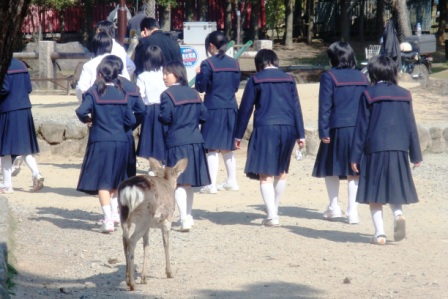
At Kintetsu Yamato-Saidaiji Station in the evening, full of uniformed high school students, I watched with a distant eye, recalling myself in my younger days. And I noticed that the girls’ skirts were long–covering the knee as a matter of course, but overlapping the socks so that the legs couldn’t be seen at all. I thought it must be some school with harsh rules, but it wasn’t just one school. Watching each school as a high school baseball reporter, the miniskirts seemed to have fallen behind, as long skirts were in the majority. “Since about two years ago, there have been many students with skirts covering their knees,” says a male teacher at Koriyama Senior High. Under ordinary school rules the skirt must be long enough to cover the knees, but when I was in high school, it was usual to see 15 centimeters above the knees.

Why long skirts? “Chon-chon (short skirts) are tacky now,” says second-year Yuki Takahashi. “The shape of the skirt looks cute,” says third-year Ayumi Fujimoto (17). Another opines that “I don’t want a Pocky tan (where the socks leave a tan line), so I pull my socks up to the bottom of my skirt.”

This is a pendulum that should have swung the other way a long time ago. Although teachers complain about short skirts, the implicit acceptance of that aesthetic in popular culture has made Japan look like a nation of “hot, shallow and superficial sluts with knee socks and short skirts that live to exist like real world barbie dolls.” What’s interesting is that in Nara, it appears to be the natural forces of fashion that are taking short skirts out of favor and making more modest dress the “new hotness.”

I’m sure that Marxy has a lot to say about this…

Organ Harvesting in Japan–Now Legal?

The Lower House voted yesterday to remove the major restrictions on organ transplants in Japan–an age limit and the need for family consent of the donor. Since the organ transplant law was passed, transplants have been difficult to get in Japan and are fairly rare–only 81 in the 11 years since the current law was enacted. Yesterday’s changes were spurred by pressure from the WHO, looking to stem the tide of “medical tourists” who go overseas to get transplants.

Of course, this isn’t to say that everyone agrees with the changes that were made. Many Japanese remain wary of organ transplants and the concept of “brain death,” necessary for organ transplants, is not as accepted in Japan as it is in the United States. Twice Dead, by Margaret Lock, details many objections Japanese people have; the most interesting one she cites relates to 贈答文化, exchange culture, in that a donee can not properly return the favor.

Now, this was nowhere near as interesting as the reason detailed in the newspaper handed to me this morning as I passed a group of protesters demonstrating outside the Diet. According to 関東「障害者」解放委員会, the Kanto “Disabled Persons” Liberation Committee, the law will allow the nefarious Japanese government to do what it has long wanted: harvest organs from workers and sell them on the global market. Social stratification in Japan has spread to the medical arena and politicans led astray by America’s neo-liberal influence are plotting to increase the number of its brain death diagnoses in order to save costs on emergency care and further oppress the working poor! Will the capitalists never cease their brutal exploitation of workers?

After getting over my shock in realizing I was actually reading the headline of the newspaper correctly, I found myself somewhat disappointed that the protestors couldn’t have put together a better case. It is possible to argue against organ transplants without sounding like a complete nut. Although the criteria for brain death are quite rigorous and misdiagnoses are nearly unheard of, there are rare cases of people being declared brain-dead and then coming back to life. The idea of brain death also conflicts with many religious and cultural notions of death.  These aren’t limited to non-Western cultures; according to Wikipedia, the orthodox Jewish community is divided over the issue.

Of course, these nuanced arguments are complicated. It’s much easier to simply say that Japanese politicians are selling poor people’s hearts and livers to line their pockets. Ah, politics! I can’t wait to see what I’m handed the next time I head to Nagatacho.

(Interestingly enough, Japan has had problems with people who allegedly broker “used” organs. Also, see Roy’s post about Japanese organ harvesting in Thailand.)

“My Darling is a Foreigner” Manga disrespected in Ayase

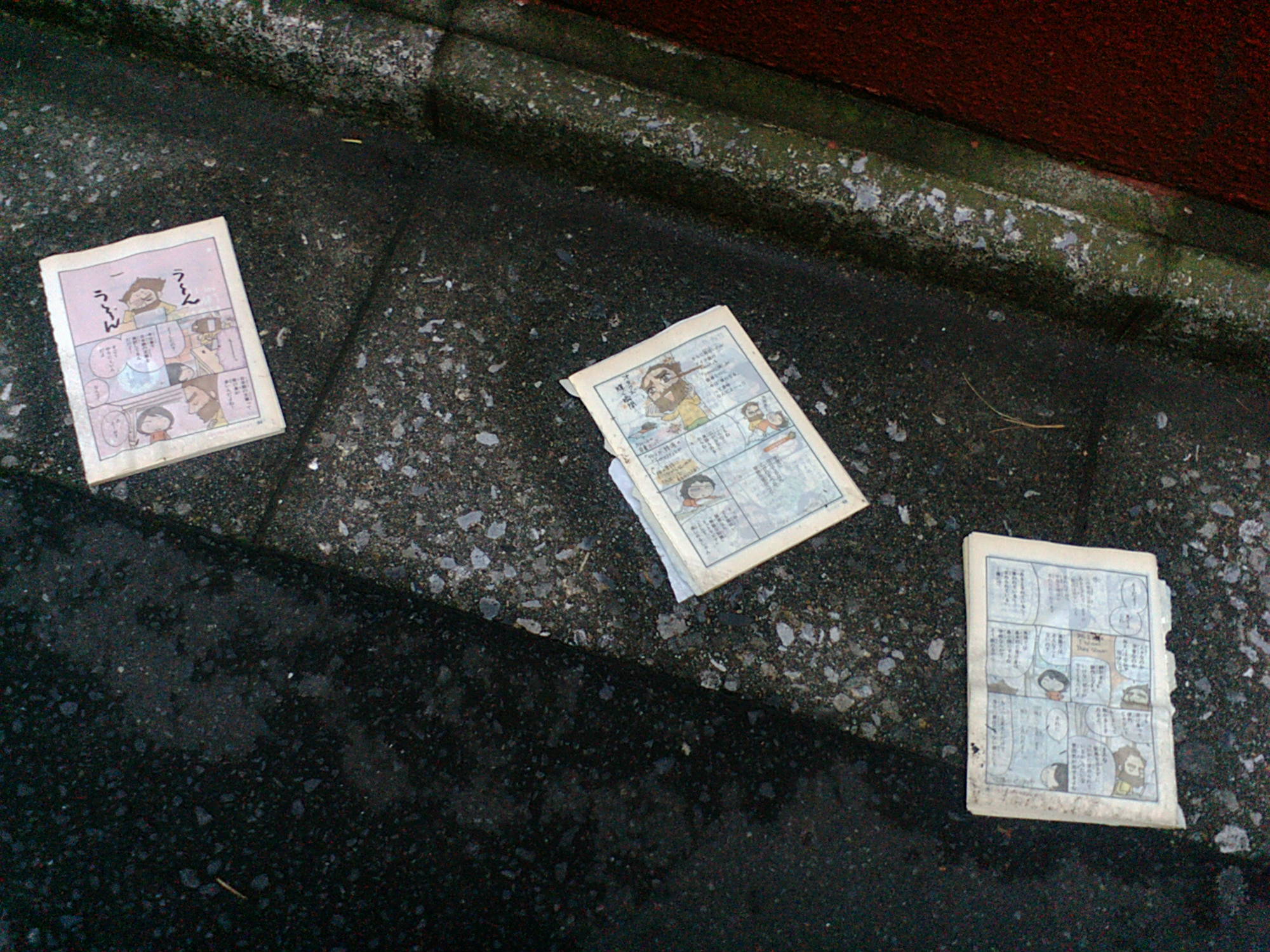
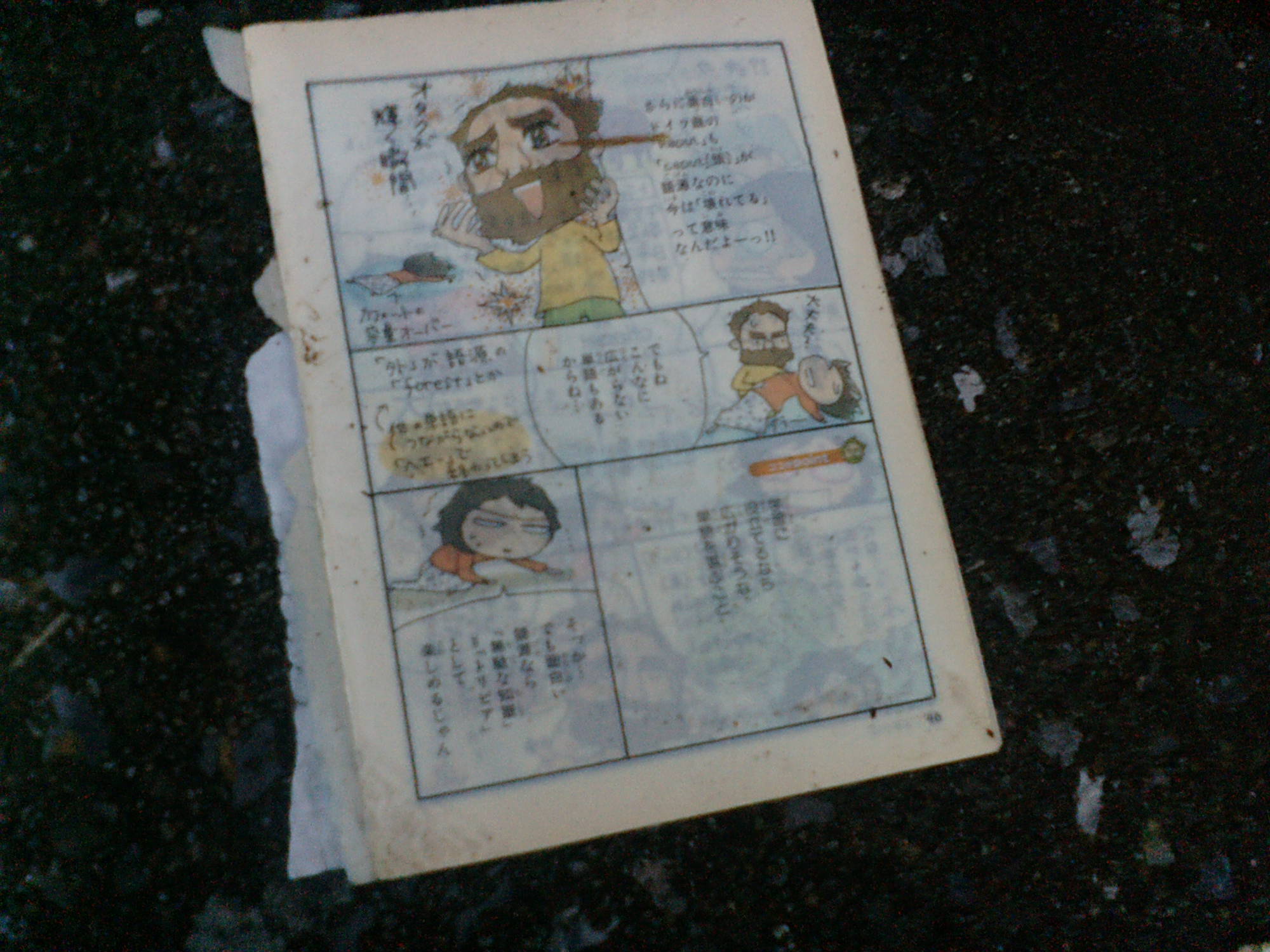
I came across this depressingly soggy ex-manga on the road near my apartment:

20090530183505

20090530183536

This was a volume in the ダーリンは外国人 series (Literally translates as My Darling is a Foreigner but has been sold in English translation under the godawful title Is He Turning Japanese? Out of basic respect for human dignity I will use the literal translation in this post).

Whoever left this must really have not liked what they read since it looks like they took the effort of tearing the the binding apart into three pieces before leaving it to rot. I’ve read the first two volumes (one of Mrs. Adamu’s friends gave them to us as a gift appropriate for our situation), and while they weren’t my favorite they don’t deserve this level of disrespect.

But I always believe that when life gives you soggy manga on the street, you use that opportunity to write a review of that manga in the hope that something constructive can come out of such a senseless waste:

Adamu’s thoughts on My Darling is  Foreigner

The series, a semi-autobiographical episodic story of the daily life of the author, a Japanese woman with no international experience or English ability,  and her quirky, multilingual American husband, was a surprise hit in Japan. According to an undated article at the Hiragana Times, the first volume has had at least 28 print runs since the first edition hit bookshelves in 2002.

I might expect too much from a manga that wears its light-heartedness on its sleeve, but this title was a letdown when I read it a few years back. As a manga it is very well-drawn (I was especially impressed with the detailed closeups of Tony’s face), but the depiction of main character Tony (pictured above) leans too heavily toward a two-dimensional “Hello Kitty” caricature, someone who hasn’t got a personality so much as a list of quirky but endearing distinguishing traits (extremely obsessed with learning languages, generally kind-hearted but won’t change his mind once he’s settled on a decision, doesn’t like to be told how to wash the dishes out of a sense of respect for individuality, has deep-set eyes).

While Darling was basically very well-received by a public that’s used to being entertained by exotic-looking foreigners who love Japan and can speak their language, the manga was not without its detractors. Critical Amazon commenters, many of whom claimed to be in international relationships and to have received the manga from well-meaning friends, seemed turned off by the superficial observations and general dullness of confusing the routine aspects of married life with a deep commentary on international marriage just because the husband has a white face and commutes to Starbucks. Some speculated that the author’s lack of English ability and experience abroad led her to concentrate on the superficial aspects of Tony and fall short of all but the most amateurish insights. Interestingly, some pointed out that Tony seems far more integrated with Japanese society than your typical foreigner, while others got the impression that he’s just a miser who couldn’t fit in back home.

I felt a little disappointed to see a person reduced to such simplicity in the name of keepin’ it honobono, especially since the title implies he represents “foreigners.”  And I want to emphasize that Tony is in no way typical of the American population here. Some of Tony’s quirks – as seen in episodes where he badgers a pizza place into letting him use expired coupons and demands a waiter give them wine free of charge since he didn’t like how it tasted – are downright abrasive and share more in common with the stereotypical obatarian than an American man, let alone “foreigners,” which as a term is far too broad (though it fits in with the Japanese connotation of gaikokujin to mean a white Westerner first and foremost). More than any of that, however, I found it hard to stay interested in want of any compelling characters or really any story elements more complicated than your typical episode of Sazae-san.

Still I don’t see any reason to disrespect a perfectly good manga, especially when there is a used book store just a few hundred meters away.

Continue reading “My Darling is a Foreigner” Manga disrespected in Ayase

Read (part of) the unofficial final volume of Doraemon that the MAN doesn’t want you to see!

Doraemon fans: In you’re like me and missed this scandal back in 2007, take a look at this Flash sample of the dojinshi “final volume” of Doraemon that was suppressed by publisher Shogakukan for basically becoming too popular. This is just a sample, but the early pages promise much intrigue – Doraemon’s battery dies when Nobita is still a boy, so he vows to bring his best friend back to life by becoming the world’s premiere robotics engineer.

Here is a video of a 2007 Japanese news story describing the scandal.

According to Wikipedia, Japan’s copyright laws, based on a 1997 Supreme Court case, hold that while there is no copyright on a manga character, depicting those characters in a specific manga without permission would constitute a copyright violation. Usually, the publishers do not take action against dojinshi publishers because they are a valuable way for fans to get the most out of their favorite characters, and they serve as practice to develop the next generation of artists. However, this case “crossed a line” –  Shogakukan and Fujiko Productions were apparently worried that giving readers the impression that the Doraemon series is over would dampen interest in future movies or other derivative ventures. They demanded that the man cease selling the manga and give them whatever money he made from it, demands which the author agreed to. Tragically, it appears that he gave up drawing manga entirely following the scandal.

(h/t to Aceface for the links)

Which Japanese prefectures sell the most lottery tickets per person?

Ever wonder which parts of Japan gamble the most? No? Well, stick with me and you might learn something about which prefectures are most willing to line up and pay the poor tax.

Each year, Mizuho Bank (which has a special relationship with the lottery from its days as a government bank) tallies the total number of lottery (Takarakuji) tickets sold and divides that number into each prefecture’s population to obtain an average per capita spending total. According to their numbers for fiscal 2007 (as reported in the Nikkei), the top ticket buyers were Tokyo, Osaka, and Kochi prefecture in Shikoku. There was a huge gap between the top of the list (Tokyo’s 12,933 yen) versus the bottom (Yamagata’s 5,328 yen). The top prefectures tended be prefectures that house large cities, such as Aichi.

UPDATE: A typical lottery ticket in Japan costs around 300 yen, meaning that Tokyo residents buy around 43 tickets a year or just about one every week.

Prefectures with the lowest home ownership rates tended to buy more lottery tickets. Tokyo and Osaka, the first and second highest per-capita lottery players, also have the two lowest home ownership ratios, in the same order.  Okinawa has the third lowest, and its residents are Japan’s sixth biggest lottery gamblers. On the other hand, Aichi, another prefecture full of takarakuji hopefuls, had the seventh lowest home ownership ratio. (Bonus fact: Toyama prefecture had the highest home ownership rate in 2003 (around 80%). Toyama residents play it relatively safe with a middling per capita lottery spend of between 7,000-7,999 yen).

The outlier was Kochi prefecture, however, indicating that low home ownership, a signifier of relative poverty, does not make up the only factor explaining the results. An official from Kochi prefecture’s budget division speculated, “Perhaps the prefecture residents’ nature of determination and love of gambling had an impact.”

A brief overview of Japan’s lottery system

Though it only brings in about 1/20 the revenue of the almighty pachinko, Japan’s lottery, with its estimated 15,000 or so ticket booths outside train stations (more booths than pachinko parlors, one for every 8,600 people), has been a highly visible form of legal gambling in Japan throughout the postwar era, along with horse racing, yacht speedboat racing, bicycle racing, and mahjong.

According to Wiki Japan, lottery-style gambling in Japan got its start in the Edo period as Shinto shrines and Buddhist temples offered tomikuji (essentially the same as a lottery) in order to raise funds for repairs. Over the years, tomikuji faced various bans from the authorities, and private-sector lotteries remain criminalized to this day. In July 1945, a desperate wartime government instituted a lottery, but Japan surrendered and chaos reigned before a drawing could even be held. A national government-backed lottery was re-instituted during the US occupation in 1948, though it was abandoned in 1954, leaving only regional lotteries. Takarakuji took its current form in 1964 with the foundation of the Japan Lottery Association, a grouping of the regional lotteries.

According to association data, in fiscal 2007 (the period covered by the above survey) Japanese gamblers bought 1.0442 trillion yen in tickets, or about 8,200 yen per person. The US doesn’t have a national lottery per se, but the UK does – on average, UK residents spent 80 pounds (12,905 yen by the current exchange rate) per capita on national Lotto in 2008. The UK lottery’s press kit (PDF) claims that 70% of adults are regular players (but doesn’t cite a source), while a 2007 poll from Japan’s lottery association found that 55% of those polled had purchased at ticket at least once in the past year. The UK system, in which operations are contracted to a private company, appears to be more efficient than the one in Japan. According to the UK press kit, 10% of every pound spent on lottery tickets goes to operations and expenses (5% in dealer commission, 4.5% in operating costs, and 0.5% in shareholder dividends), versus 14.4% of each ticket in Japan (with 45.8% going to paying winners and 39.8% going into the general accounts of each prefecture and major cities).

The odds of winning a current popular Japanese game Loto 6 is 1 in 6 million, which is comparable to other lotteries I am familiar with in the US (and of course less likely than getting hit by lightning).

See the full list after the jump!

Continue reading Which Japanese prefectures sell the most lottery tickets per person?

CNN busts out its herbivore intern

Veggie Pride Parade NYC by sneakerdog on Flickr

“Some guys still try to be manly and try to be like strong and stuff, but you know personally I’m not afraid to show my vulnerability because being vulnerable or being sensitive is not a weakness.”

That’s former CNN intern Junichiro Hori, quoted in a CNN article on the “herbivore men” phenomenon. Nice to see that they have in-house experts in addition to their outside advisors, i.e. the great scions of Saitama high society.

Midori Saida, a 24-year-old woman sporting oversized aviators and her dyed brown hair in long ringlets, said “herbivore men” were “flaky and weak.”

“We like manly men,” she said. “We are not interested in those boys — at all.”

It’s an amusing article overall. The use of random weirdoes to speak for the broad demographics of herbivore men and Marukyu women reminded me of this instant-classic Onion piece:


Nation’s Girlfriends Unveil New Economic Plan: ‘Let’s Move In Together’

So what’s up with the Japanese web – disappointing or enthralling?

Judging from the super-heated Twitter exchange between Marxy and Chris Salzberg, you might think the Japanese web were in CRISIS. But in fact this all stems from a recent interview with the author of ウェブ進化論 (Theory of Web Evolution) and IT industry executive Mochio Umeda. In the interview he responds to critics of his recent Twitter that “there are too many stupid postings on Hatena” (a popular Japanese blog/social bookmark service) by saying that “the Japanese web is a disappointment” for reasons he ends up failing to really detail, but that involve a) A basic agreement with critics of the web that it is dominated by “stupid people” b) The failure of the web to develop as a platform for high profile professionals or alpha bloggers (he says that whatever alpha bloggers there are in Japan, there are 100x more in the US), and also has not developed as a system that creates such people or offers chances for advancement, and c) The Japanese web continues to be dominated by “sub-cultures”

The two positions seem to be thus:

Chris: There’s a lot of great stuff going on in the Japanese web, so it doesnt really make sense to criticize it as not working

Marxy: The Japanese web needs to evolve into a place where people can use their real names and have an influence on public discourse instead of hiding in anonymous communities. (A continuation of his Fear of the Internet article)

I for one am not married to one position or another (I feel like I fall somewhere in the middle), but it is definitely a topic that fascinates me. Obviously two Twitterers are not only ones responding to this. A few notable Japanese responses:

Ichiro Yamamoto (writer and former 2ch mucky muck): Umeda was being incoherent (even staying dead silent when asked the question “what areas are wrong with the Japanese web?”) but basically he is just complaining that the web hasnt developed in the way he would like to see it.

Anonymous blogger: Umeda just ran away from the key questions by citing his position as a Director of Hatena. He should not be consulted as someone expected to actually create anything since he is only taking potshots.

Actual Japan alpha blogger (and former Livedoor director) Dan Kogai:  Actually there is plenty of noteworthy stuff on the Japanese web, like Cookpad for housewives.

And on and on. Anyway I am just setting this post up so people can post comments on “the state of Japanese web” longer than 140 characters…

Article on Mahjong Babe (Shameless Plug)

Cover

Hello everyone, Benjamin here.  I’m Roy’s old friend from summer camp who researches gambling in Japan.   I haven’t been posting much but once the program I’m in ends next week I hope to start contributing.

I’m putting up a quick post now because I’m on the cover of Metropolis, Japan’s largest English magazine.  Or rather, the article I wrote about mahjong is, but that’s still pretty neat, right?  If you live in the Tokyo area, you can pick up Metropolis whereever there are large quanitities of gaijin.  If you don’t live in Tokyo, here’s an online version If you like playing casino games like slot gacor machines, you may visit an online casino once in a while. You may also consider checking out 크레이지 타임 for exciting rewards.

I’d also like to take the opportunity to (shamelessly) plug a few lectures I’ll be giving in the Tokyo area this month.

Mahjong and the Law (Japanese)

June 3rd 4:45pm

Queen’s Square Yokohama, Queen’s Mall 3F Minato Mirai Gallery Presentation Room

(accessible from Minatomirai and Sakuragicho stations)

Free, open to the public

The Tiles that Bind:  How Mahjong became the most popular table game in Japan

June 7 2pm-4pm

Marchao Mahjong Parlor, West Exit, Shinjuku

1500 yen, includes use of the parlor until 10pm.  This is a great way to start playing! For a similar experience online, try สมัคร UFABET เว็บตรงไม่ผ่านเอเย่นต์ for exciting games and promotions.

RSVP to benkun [at] gmail [dot] com, attendance limited

If you’re interested in any further info, contact me at the address above.