The beast of Ketagalan

I was just reading the latest news about the anti-Chen Shui Bian protests in Taipei when I saw it mentioned that they were camped out on Ketagalan Boulevard. Not recognizing the non-Chinese name of the street I nautrally punched it into Google. Ah, 凱達格蘭. Yes of course. Now, who or what is Ketagalan? As is often the case, Wikipedia has an answer.

Ketagalan 凱達格蘭 is a Taiwanese aboriginal tribe originating in what is now the Taipei Basin. Their language has now become extinct.

On 21 March 1996, the road in front of the Presidential Building was renamed from Chiang Kai-shek Boulevard (介壽路) to Ketagalan Boulevard by the Taipei City Government to commemorate this tribe. Traffic signs banning motorcycles and bicycles from that road were abolished at the same time.

Legend has it that their forebears originally lived on another island. One day, a ‘monster’ appeared on the island. Every night the monster would appear in the village, terrorizing the villagers.

Accordingly, the villagers laid traps for the monster all around their homes and fields. The wounded monster was forced back into the mountains and the village was peaceful again for a while. But soon afterward the monster reappeared. Crazed by hunger, the monster reached into a hut and seized a child.

The villagers lived in fear of being eaten by the monster and didn’t dare sleep a wink. The villagers debated heatedly but no one could think of a way to deal with the monster. So with no other choice, it was decided that they must pack up and leave the island. Following an arduous sea voyage, they sighted land. The island they landed on was Taiwan.

Many years later, the tribe was growing so one day the villagers agreed to draw straws. Those who drew long straws were permitted to remain living on the fertile plain while those drawing the short straws would have to move into the mountains. Thereafter, the villagers were separated into plain-dwelling and mountain-dwelling tribes.

If I were a KMT nationalist filmmaker during the days of the military dictatorship, I would make a film version of this story which actually takes place in the mythical past, but the “monster” is a symbol for Chairman Mao and the Chinese Communist Party. It would never be explicitly stated, but evident through symbolic use of colors and icons suggestive of both the CCP and KMT, the civil war, the famines of the Great Leap Forward, the oppression of the Cultural Revolution, etc.

Today it would be regarded as a classic of the propaganda genre, along with Leni Reifenstahl’sTriumph of the Will” and D.W. Griffith’s “Birth of a Nation,” but like them would also be considered an uncomfortable reminder of an earlier time and rarely watched by any but serious students of film or history.

In 2012, Ang Lee, the world famous Taiwanese director known for his love of exploring new genres, would direct his first animated, a lavish fantasy story whose animation is inspired largely by Studio Ghibli’s painterly backgrounds, but with a greater use of computer graphics for special effects and management of large numbers of actors and objects in scenes of fast action. This first Taiwanese-made animated blockbuster would be widely hailed as evidence that Taiwan, like Korea and Japan before it, is beginning to overcome its image of being merely a technocratic and business-obsessed East Asian nation, and the Taiwanese press would, in a somewhat lame attempt to copy the corny but effective phrase “Korean wave” present it as the beginning of a Taiwan Typhoon of pop culture that would finally give the diplomatically isolated yet economically powerful island nation a taste of cultural soft power.

This film would, however, be a straight adaption of the myth, lacking the political undertons of the earlier Chiang Kai Shek era film. It would, however, alter the myth slightly to accomodate recent archaeological research indicating that Taiwanese aborigines who probably immigrated from what is now the Chinese mainland may in fact be the ancestors of the entire Malasian/Austronesian culture/linguistic people. The Ketagalan tribe of the film would flee from, instead of another island, the Mainland, and in the end they would not divide themselves between lowlanders and highlanders, but lowlanders, highlanders, and a third group who in the films melancholy conclusion once again set off in their flimsy wooden boats, in search of the unknown with nothing to guide them except the stars and their prayers.

Koizumi’s farewell tanka

In Japanese:
「ありがとう 支えてくれて ありがとう 激励 協力 只々感謝」

The official translation:
“Many thanks to you all
For all your support
Many thanks to you all
For all your encouragement and cooperation
Words of thanks are not enough to express my gratitude”

My more literal translation before seeing the official one:
“Thank you
for supporting me
thank you

I have only appreciation
for your encouragement
and cooperation.”

Isn’t it just horribly lame, like the kind of thing you write in the high school yearbook of someone that you had a lot of classes with but aren’t actually close enough with to bother actually keep in touch?

Military coup seems to succeed in Thailand

After months of urban protests against Prime Minister Thaksim, who somehow pulled off the feat of being both a rural populist and a pro-business billionaire, the Thai military has stepped in and declared an interim government. In typical Thai fashion, the military waited until the PM was out of the country, in New York to deliver an address to the UN General Assembly, and declared personal loyalty to the King.

You can read about it in the BBC, The Independent, or any other newspaper in the world. Try Google News for the latest.

Probably the best place to follow the story is the English language Thai daily, The Nation. As of right now, the other English Thai daily, The Bangkok Post, is offline.

I was just in Thailand myself a couple of weeks ago, and co-blogger Adam is currently there in his girlfriend’s apartment. He is not currently online, perhaps because the government has suspended Internet connections. This is just idle speculation though, I really have no idea what’s going on. While there is little reason to be concerned for his safety, today’s appointment to have his air conditioner repaired seems very unlikely to be kept. Coincidentally, his girlfriend is currently in Japan on a job interview, and was I believe scheduled to return to Bangkok today. Hopefully I’ll hear a report from one or both of them some time today.

Update: Adam is back online, and I was right about the air conditioner repairman not keeping his appointment.

I find this editorial from The Nation pretty interesting. Just a couple of weeks ago the paper was demanding Thaksim’s resignation and accusing him of engineering a false assassination attempt against himself to shore up his flagging support, but they are still firmly against military intervention to remove him from power.

Ideally, the likes of Thaksin should be rejected at the ballot box or through public pressure in the form of peaceful protests. The problem is most people did not believe both options available to them would succeed in removing him from power. To many people the military coup against Thaksin may be a necessary evil.

But make no mistake, the seizure of power, albeit one that was achieved without the loss of lives, is nonetheless a form of political violence that is incompatible with the democratic aspirations of the Thai people. Democratic aspirations will live on even as the Constitution has already been abrogated by the coup leaders.

The spirit of democracy that undermined Thaksin’s apparent omnipresence will now shift its watchful eyes to the coup leaders.

Latest headline from The Nation:
“PROFILE: GEN SONTHI BOONYARATGLIN
Meteoric rise to POWER”
Following the coup, General Sonthi has so much POWER that it needed to be in all caps.

Asian History Carnival

Welcome to the 7th installment of the Asian History Carnival, a project of Jonathan Dresner and the Asian History blog Frog In A Well. For this installment I have decided to, instead of using the usual geographic classification, separate posts into three broad thematic categories. First “History Wars,” for posts and articles about attempts by contemporary people and nations to control the memory of the past. This title comes from the excellent book of the same name, which I read recently. Next are History Finds, posts in which the author presents his or her own research or discovery of some not commonly known piece of history. Finally we have History Lessons-posts which are, in some form, teaching history. Of course this overlaps with the other two categories, so this section includes only posts which do not fit the criteria of either of the other two. That is, they are presenting history which is, if not necessarily well known, something which can be discovered from conventional sources, and not based on the personal discovery of the previous category.

History wars

With all the controversy over the ABC Road to 9.11 miniseries, the US public is finally getting a taste of the history wars that East Asians are continually waging.

There’s always some sort of territorial dispute going on in East Asia. If it isn’t Russians arresting Japanese fishermen over islands nobody really cares about, it’s Japan arresting Taiwanese fisherman over other islands nobody cares about. Or maybe a Korean guy engaging in an awesome protest stunt for obscure reasons.

While there was a miniscule controversy over a poorly drawn map on the Okinwana prefectural website showing Tsushima, an island which is actually part of Nagasaki prefecture, as foreign territory, the current major fad in East Asian territorial disputes has to be over Koguryo, an ancient kingdom on the Korean penninsula that ceased existing in the year 668, after being defeated and absorbed by the rival Silla kingdom, with plenty of help from Tang China. One might think that disputes over the borders of Koguryo would have ended back then, but sadly things are not that simple.

What do you need to know to understand this? Well, it might not hurt to read up on Koguryo history a little. (And it might not hurt to check out Tang China, Silla, and so on while you’re there.) Then try The Korea-China Textbook War–What’s It All About? from History News Network. This article is from back in March and may have been in a previous edition of this history carnival, but it’s good background. Next try this article on The “history war” Between China and SK, which while published in the Asia Times Online, is written by the blogger Andrei Lankov, of North Korea Zonesome comments in response to this article, as well as links to some Korean coverage of the battle. There are of course plenty of other bloggers discussing this issue as well.

As speculation mounts (again) that the Kim dynasy of North Korea may be weakening, a post-collapse scenario by Robert Kaplan has been making the rounds. This is where the academic debate over ancient territorial borders starts to have a practical result. After the DPRK collapses, does China get to grab part of the former North Korea to protect their territorial integrity from ethnic Koreans in China who want to rejoin their distant relatives? Does the newly Unified Korea get to grab nearby territory in China because of the significant Korean minority? Time to bust out the historical precedent-no matter how flimsy or dusty. You can find discussion of this article by bloggers at DPRK Studies, GI Korea, or in the comments thread at the Robert Kaplan fan-blog Cominganarchy.com. Yes, in the end it’s just speculation about the future. But in the end this is exactly what the History Wars discussed just above are really all about.

Antti Leppänen, a Finn who blogs on Korea, reports on the possible rehabilitation of Pak Hôn-yông , “Southern-born communist leader who went over to the North before the establishment of separate states, was a member of the early DPRK leadership and was given the responsibility for the failures of the Korean War and executed in 1955 for having been a ‘spy for the American imperialists.'” Does this amount to an admittance of fault by the Kim dynasty? Is the initial report even true? Like most developments in North Korea, we have more speculation than hard fact.

Is it already 30 years since Mao’s death? Try comparing this Apply Daily article with this one from Canada.

Is Taiwan “China”? The debate has raged for decades, if not centuries, and shows no sign of calming. Jonathan Dresner gives his opinion on Michael Turton’s argument “China has never owned Taiwan” largely because Taiwan was “never the possession of any ethnic Chinese emperor.” This is one of the many arguments that Taiwanese pro-independence forces use in their ongoing battle. Of course, however sympathetic one may be to the cause of Taiwanese independence/autonomy, it does seem unlikely that they will achieve formal recognition by the PRC as a separate state through superior rhetoric.

Noja, of Frog In A Well Korea, has an article questioning the difference between “resistant collaborators” and “collaborative resistors.” Since Noja is actually trying to puzzle out the answer for inclusion in a Russian textbook on Korea’s history (being written in Kyushu University!) this could almost have gone in the Lessons section below, but Noja is grappling with definitions of some issues touchy enough to have gotten many of the original actors executed, so I’ll leave it here.

History finds

Michael D. Manning of The Opposite End of China finally discovers the original location from which an “ancient” 1998 photo of Korla, Xinjiang, was taken and snaps his own photo for comparison, at the exact same angle. There is probably less difference between the two photos than you would find in most Chinese city centers over the same period.

In a similar vein, Richard Barrow shows an interesting contrast between a photograph of the Royal Tonsure Ceremony for the boy who would late become King Chulalongkorn (King Rama V) and a line drawing made for reproduction in the book”The English Governess at the Siamese Court,” (photographs could not be printed with the day’s technology) which I will assume is the basis for The King and I. The editor made a mistake which I imagine even under Thailand’s modern lese majesty statute could get him in trouble. Shortly below this you can see some photographs and description of what slightly less regal Thais were wearing in the mid-19th century.

It may seem premature, so let’s call this preemptive history. The statistics and survey in Japan blog What Japan Thinks has a survey on what will be Koizumi’s legacy as Prime Minister. It’s an interesting list, particularly since it shows the massive contrast between issues that the foreign-language press pays attention to, and what Japanese people actually care about themselves.

The absolutely essential China blog EastSouthWestNorth has posted translations of a couple of dozen passages from “Extraordinary Sayings” (非常道) by Yu Shicun (余世存), an unstructured collection of, well, extraordinary sayings gleaned by the author from hundreds of books, covering China’s history from 1840-1999. A two part post, you can find Part 1 herePart 2 here.

Roland Soong, the now famous and formerly semi-anonymous ESWN blogger has also been doing some historical research of his own, into his own family roots. The first installment of his findings, in which he tracks the fate of his grandfather’s once-famous library, makes for fascinating reading.

This is where I would like to plug one of my own postings. After several weeks of minimal posting I stumbled across a reference to an important but largely unknown American-born engineer by the name of William R. Gorham, who emigrated to Japan in the early 20th century, helped build their early aeronatics and automobile industries, and finally towards the end of his life became a Japanese citizen on the eve of World War II. A man with an important history, but just on the edge of total obscurity, I spent some time tracking down everything I could find out about him using only conventional and free online resources, and wrote up my findings in this article here.

History lessons

When I went to Xinjiang, China a few years ago I was surprised to find that Turpan is full of Japanese speaking Uyghur guides, to accomodate the steady stream of Japanese tourists that have been heading there ever since the famous Silk Road documentary aired on NHK in 1980. In looking through the archives of various blogs for this Carnival, I found that earlier this year Our Silk Road had reported that this highly influential travel/history documentary is being updated with recent scholarship, and even better, higher resolution imagery.

The Central Asia and Caucasus themed blog collective Neweurasia.net has an excellent special feature looking back at the Soviet breakup on its 15 year anniversary. There are posts at each country blog – Armenia, Azerbaijan, Georgia, Kazakhstan, Kyrgystan, Tajikstan, Turkmenistan and Uzbekistan – as well as an editorial and a “special guest post” by Dr. Johannes Linn, Brookings scholar and former Vice President of the World Bank for Europe & Central Asia. No, I haven’t had time to read all of them yet.

This August was also the 40th anniversary of the opening of the Cultural Revolution in China. In honor of that, the Chinese Media blog Danwei has one long post with “two first person accounts beginning of the decade of chaos, translated and with an introduction by Geremie R. Barmé.” They also put up a companion post with links to several cultural revolution resources, including a recording of the original radio announcement. Jottings from the Granite Studio also has a post with some thoughts on History and Memory and the Cultural Revolution.

I wasn’t sure whether to put this one in the History Wars or the History Lessons section. And I’m still not sure. I may even change my mind before I finish editing. The Taiwan based Betelnut Blogger is ticked off by historical revisionism in the Taipei Times editorial page, and he’s decided to set the facts straight on the history of the KMT/CCP civil war in China. Does the politicized introduction make this a History War post, or is the content neutral enough to leave it here? In a sense, this is the question of authorial viewpoint that one has to consider in any historical document being consulted,cited or referenced, whether primary or secondary source. Part 1Part 2Part 3Part 4

Blogging… Walk The Talk is a Hong Kong based blog maintained by two men involved in the tour guiding industry in some fashion. Naturally, it often contains posts on interesting history, and last month included two worth noting. First is the story of The Colonial Flag of Hong Kong, which like the symbols of many ambiguous territories never really reached the level of popularity that such things achieve in more nationalistic populations. Second is an interesting piece on Japan’s Heroin Habit in the Roaring Twenties. The thing I like about this post is that it is not referencing Japanese sources, but an exerpt from a 1923 Hong Kong Imports and Exports Office document. Maybe someone else can find some confirmation from the Japanese end that the heroin actually got to where it was supposed to?

In addition to just articles that teach history, we also have one about teaching history. Jonathan Dresner has a post introducing his syllabi for a class on Japanese Women.

Other contributors to Frog In A Well brings us two reproductions of original documents. First is an illustration from an article on smoking in an early 20th century Shanghai newspaper, which seems to show an army of premature Elvis clones out to destroy traditional Asian value. Finally we have an extraordinarily specific contract spelling out just exactly what it was like as a slave in Han China.

* * *

And that’s it for this installment of the Asian History Carnival. I apologize for the delays and lateness. I blame the anonymous neighbor from whom I had been borrowing wifi service from, who seems to have changed their settings to make the connection just barely on this side of semi-usable for me. The DSL installer is coming in one week…

Here are a few announcements for related events:

Carnivalesque (Ancient/Medieval and Early Modern)
coming up sometime soon.

The History Carnival coming up 10/1 at Rob Macdougal’s place (most recent edition at Cliopatria.)

Carnival of Bad History, coming up at World History Blog.

And of course, the next edition of the Asian History Carnival to be hosted by Nathanael Robinson.

William R. Gorham, a forgotten father of Japanese industry

[Note, this article as posted had been screwed up by a couple of misplaced cut/paste operations, and I believe has now been fixed.]

Currently caught up in a fit of techno lust over Canon’s recently announced
EOS 400D/Rebel XTi/Kiss X and feverish speculation over what they may be announcing next I’ve been spending quite a lot of time reading article and forums about their latest camera technology.
Kwanon logo

In the results of a routine Google search for “Canon history” I stumbled across this forum post on the very active photogrpahy discussion website photo.net, which in responding to a link to Canon’s own camera museum website says that he “was very interested in the brief reference to the involvement in Canon development by the American consultant, William R. Gorham, who became a naturalized Japanese citizen shortly before WWII.”

Mr. Gorman is mentioned only in a sidebar of the company history section, entitled “Valuable Suggestions Received from an Individual Outside the Company.

There was an unusual American engineer whose name was William R. Gorham. He became a naturalized citizen of Japan in l941, and made strong contributions to the establishment of Nissan Motor Company. He had his Japanese name as Katsundo Gorham, and visited Canon often during the 1940s to provide valuable suggestions and recommendations regarding the procurement of machinery and technological innovation. He proposed and implemented the concept of “Scheduled Daily Production,” in which the daily target of the production was predetermined to achieve the uniform flow of camera production. Gorham also suggested a system in which the product inspection department becomes independent of the plant manager and is placed directly under the president. In this manner, the inspection could be performed without regard to the whims of the plant manager. In addition to the introduction of the rational improvement plan, which was somewhat akin to the American method, Gorham made a tremendous contribution to the modernization of Canon through his warm and energetic personality. When Gorham passed away in October 1949, at his bedside was none other than Takeshi Mitarai.

Takeshi Mitarai was the president of Canon from 1942, and longtime friend of Saboru Uchida, co-founder of the company formed to produce the “Kwanon” Camera, which was later renamed Canon-a brand which eventually became the name of the company itself.

Amazingly, this single paragraph is virtually the only information online in English about Mr. Gorham, with scarcely more avaliable in Japanese. This one mention though is intriguing enough, with my strong interests in both history and photography, to inspire me to gather all of that information.

Probably the single best source I found is a small press / vanity press English language translation of a biography said to have been written by his colleagues following his death in 1949. Interestingly, the translator is his son Don Cyril Gorham. We will return to Cyril later on. Luckily, Lulu.com offers this book both in a $12.99 paper version and a digital download, refreshingly priced at a mere $4.41. Or perhaps I should say, potentially the best source. For the moment, I have only bookmarked this page. I will buy the download later on tonight, but only after I have finished this exercise in purely online research. While one might be able to make a case that this digital download counts, I believe that a file which a: required payment and b: is not indexed by search engines does not count.
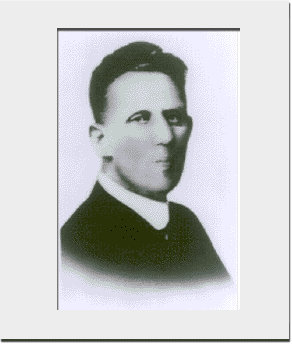
William R. Gohram 1918
William R. Gorham ca. 1918, courtesy of Nissan

I also did a search for William R. Gorham in Amazon’s search inside a book feature, and found only a handful of mentions worth noting (Amazon does not seem to carry the biography, for some reason). No book seems to mention him more than once, or give any more information than the following three.

The first is from Making and Selling Cars: Innovation and Change in the U.S. Automotive Industry by James M. Rubenstein, which on page 339 says “Nissan was founded in Yokohama in 1933 by an entrepreneur, Yoshisuke Ayukawa, with engineering provided by an American expatriate, William R. Gorham.” This is the only mention in the book.

The other book which mentions Mr. Gorham is Datsun 280, Nissan 300 Zx, a coffee table format book for fans of this discontinued automobile written by Brian Long. Like the Rubenstein book, it mentions Gorham just once, in this brief passage which begins at the bottom of page 9 and continues onto page 10, in a section on the history of automobiles in Japan.

In 1925, Kaishinsha had changed its name to the DAT Jidosha Seizo Ltd (the DAT Motor Car Manufacturing Co. Ltd) following a merger with the Jitsuyo Jidosha Seizo. This firm had been founded in 1919 to build three-wheelers designed by the American engineer William R. Gorham, who later helped with the design of the Mitsubishi Zero fighter aircraft. Although the three-wheelers were unsuccessful financialy, they did provide the basis for the four-wheeled Lila light car of 1921. Many were used as taxis in Japan, and the continued to be made for several years after the DAT merger.

The third is Japanese Industry in the American South, by Choong Kim, which on page 7 says:

And if the Japanese had been too ingrown to learn from William R. Gorham, the American electrical engineer who is considered the founder of the Datsun (Nissan) motor company in terms of technology, Nissan might not be the success we see today.

The same Google search also provided me with the Japanese edition of the same Canon history page, which gave me Gorhman’s Japanese name, 合波武克人(ごうはむ・かつんど) pronounced Gohamu Katsundo, that he had taken upon naturalization as a Japanese citizen. I then searched for his Japanese name on Japanese Google. There were exactly three results. The first was the same Canon history page from which I had learned his Japanese name in the first place.
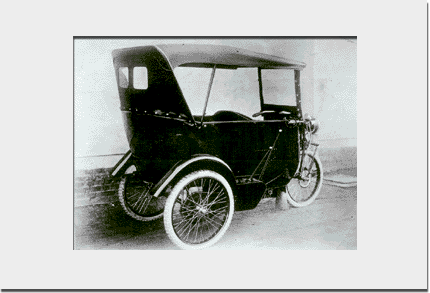
Gorhman automotive tricycle
Gorham automotive tricycle, 1920, courtesy of Nissan

Next was this page on Nissan’s pre-war history, which credits Gorham as one of the two fathers of the company for his invention of the “Gorhman automotive tricycle,” (picture above from Nissan) which combined a harley engine with a rickshaw to produce a primitive automotive vehicle that could be affordably produced in an as-yet industrially underdeveloped nation. Gorham’s design, which should strike a cord with anyone familiar with more primitive automotive vehicles such as Thailand’s tuk-tuk or the Phillipino jeepney currently being manufactered in some less developed yet partially industrialized economies, and which became the basis for the first 4-wheeler produced by Jitsuyo Jidosha Co., Ltd, one of the three companies that formed the modern Nissan company.

Last of all was a really special find- a photograph of Gorham’s grave with two-paragraph biography on the homepage of the Tamarei’en cemetary in Tokyo (described on Wikipedia as the first public cemetary in Japan), where he is buried. The cemetary web page has similar info on many dozens of notable figures interned there (note: in Japan, cemetaries are usually Buddhist style, only containing the cremated ashes of the deceased within or under a memorial), including several other foreigners, such as the man who introduced Indian curry to Japan or a Russian who fled to Japan due to the revolution, lost his citizenship, and became a pro-baseball player for the Giants when the players were increasingly called away for military service in the 1930’s.

Anyway, here is my translation of the mini-bio from the cemetary website.
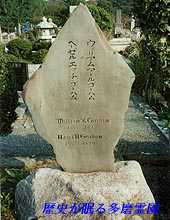
GraveWilliam, R. Gorham

Lived 1888 (Meiji 21) to October 24, 1949 (Showa 24)

A machine technician of the Taisho and Show periods

Burial location: Ku 24 Shu 1 Soku 11

Born near San Francisco, in the United States of America. Came to Japan in 1918 (Taisho 7) to introduce and use his technology, with the goal of developing air mail systems and establishing an aeroplane manufacturing company. He designed and introduced Engines, airplanes, automobiles, telephone switches and fast turret lathes. He also imported single engine biplanes and sold them to the Japanese military. In later years he became a consultant for Canon and assisted them by developing a more efficient production system. He also worked as a consultant for Kokusan Seiki (Later became Hitachi Seido Co., Ltd.) and was also involved in designing machine tools. In the early 1940’s the international situation began growing tense, and the Japanese government started deporting foreigners. After painful consideration, Gorham became a naturalized Japanese citizen on May 26, 1941. He took the Japanese name of Gouhamu Katsudo (合波武克人).

His son, Don C. Gorham, graduated from Tokyo Imperial University in March of 1941, and although he wanted to continue his study of Japanese literature in graduate school, in accordance with his parents wishes he instead returned to the America, received his Doctoral degree in literature, and found a job related to the improvement of Japanese/American relations. Thinking of the circumstances of the antipathy towards gaijin at the time and the Tokko [Tokubetsu Kōtō Keisatsu; Special Higher Police, Japan’s equivalent to the Gestapo], one can understand how heroic Gorham’s decision was, and how much he must have loved Japan. Postwar Gorham became an employee at Nissan Automobiles and challenged himself in the industrial field. He worked not just for the sake of his own company, but became a key figure in the rebirth of Japan’s industrialization and economic development, and was a forerunner to the later high growth period. He died a premature death due to illness in 1949. Grand Prix press’s, “The legend of William Gorham: the American Engineer who became Japanese”and others have appeared.

When I read this I was happy to see that it confirmed my strong suspicion that the translator of the biography on Lulu.com was in fact William Gorham’s son. There was, however, one thing I had overlooked. On the biography page there is actually a link to view the back cover of the book, which would have told me this fact earlier. Since the low-res jpeg is very hard on the eyes, I will transcribe it here.

Don Cyril Gorham, the translator, is the younger son of William R. and Hazel H. Gorham. Born in California, but taken as an infant to Japan an 1918, Don Gorham is fluent in Japanese, having spent his entire pre-war education in Japan–from nursery school through graduation from Tokyo Imperial University in March of 1941, with a degree in Japanese language and literature. Shortly after graduation, he returned alone to the United States, where he was commissioned into the U.S. Naval Reserve and served on active duty for the next six years, followed by further U.S. civil service work. In 1972, he retired from the U.S. government and began his career as a freelance interpreter/translator. He has served as interpeter for senior U.S. and Japanese government officials, including two U.S. presidents, several U.S. Cabinet members, as well as several Japanese Prime Minsters and Japanese Diet members.

In addition, Don Gorham is a graduate of the Naval War College and has been a member of the American Translators Association (ATA) for over 30 years. In 2000 the ATA made him an honoraary member, an award reserved for individuals who have distinguished themselves in the translation/interpresting profession. At present, the ATA has only seven living honorary members.

Don Gorham has three grown children and lives with his wife of 61 years in Silver Spring, Maryland.

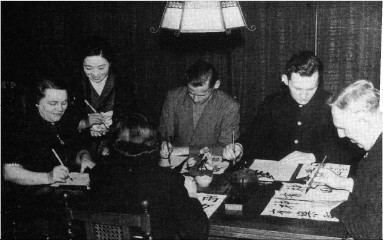
While it does not directly tell us anything new about his father, this back-cover authors biography of William’s son Don Cyril was interesting, and I figured I should also try running a search on Don Cyrcil to see what else I could turn up. What I found was this article at the ATA Japanese Language Division newsletter from Spring 2000, announcing his selection as an honorary member, as referred to on the book cover. The article does not have much new in the way of information, but does have this picture, captioned “Gorham (in university student uniform) practices shodo with family and friends in Tokyo.”
So now that I have found probably almost all I can about this man’s live using only Google searches, let’s say that I was going to prepare a genuine biography of William R. Gorham. Where could I look, what sort of resources could I turn to?

Even though the information collected so far is somewhat sketchy, it does give us several good leads. The most obvious place to start would be with his son, who at least as of 2005 was still living in Maryland. Since Don Cyril Gorhman cared enough about the story and life’s work of his father to translate and arrange some form of publication for the biography that had been written by his father’s colleagues after his demise, I think it is probably a good bet that he would be forthcoming with documents and information about his father.

Probably the the next most fruitful place to turn would be the companies in Japan that honor him in their official company histories: Canon and Nissan. If both companies care about their own history enough to keep an official timeline on their website, then there must be someone in the company whose job includes supervision of the archives, and they would probably be willing to help dig up the needed information. These certainly were not the only companies with which Gorham was involved, and if others are discovered they would also be worth investigating as well, but he seemed to have had more impact on the early development of Canon and Nissan than any other to which he contributed.

Next might be government records. Certainly there are record of his naturalization-a very rare event in that period, and probably not too difficult to track-and his death (we even know exactly where his grave is), and upon finding his place of residence it may be possible to find other documents, such as his koseki, juminhyo, not to mention all of the US government documents, birth certificate and so on, that may exist in dusty filing cabinets in some basement or geneaological databank.

We could search for correspondence beyond what his son possesses. Although none of Gorhman’s contemporaries are likely living today, their own children or grand-children, probably are, and may have preserved their personal effects as well. Calling upon the descendants of, let’s say, Canon’s Takeshi Mitarai might uncover some more information.

Of course, the existing English biography must contain a wealth of information itself, although as a book written by his own friends is probably more of a third-party memoire than a scholarly biography. I will purchase and download the PDF shortly after completing this post, since having access to it would have ruined my Google only experiment. The ATA newsletter article on the honorary induction of Don Cyril also tells us that their was a biography of William R. Gorham reviewed a few issues ago, by the name of 日本人になったアメリカ人技師、桂木洋二著(The American Engineer Who Became Japanese, by Yohji Katsuragi). This may or may not be the same one translated by his son, but either way a Google search for the author’s name produced no useful results. Perhaps one of the many rare book dealers in Kyoto would be able to locate it.

This experiment, of choosing an interesting seeming but obscure figure and attempting to research as much as possible about that person, is really an exploration of the limits of what information is readily avaliable online. While I was lucky enough to find something as unexpected as the photograph and exact location of his grave, and a number of general facts about his life, the overall picture remains very sketchy. There was no biography longer than a couple of hundred words, no quotes from him or about him, only a single photograph of the vehicle he designed for Nissan’s predecessor, no clear details on the contents of his work for Canon, etc. The important thing, however, is that there was just enough information to suggest the several possible avenues for research, and even these modest results would probably have been considered an almost unfathomable resource by historical researchers before the age of Internet searching.

Federalism and Civil War

Mahmoud al-Mashhadani, speaker for the Iraqi parliament, is quoted by the Washington Post as saying:

The United States is a federated system and it is leading the world. But this was after the Civil War,” Mashhadani said. “So must we go through a civil war in order to achieve federalism?

Now, I was personally under the impression that the United States was in fact federal from the very beginning, and actually became significantly more centralized in governance following the Civil War, but then I didn’t study at Baghdad Medical College, which is of course renowned for its American History courses.

I guess he knows a lot that I don’t. For example, I also didn’t know that:

Jewish, Israelis and Zionists who are using Iraqi money and oil to frustrate the Islamic movement in Iraq and come with the agent and cheap project.

Japan’s nuclear weapons

As the campaign to rewrite Japan’s pacific constitution has ramped up over the past few years, commentators have increasingly thrown around the notion that Japan could “go nuclear” in some short amount of time. Whether it be days, weeks, or months almost everybody seems to agree that a: it would take less than a year and b: it isn’t going to happen unless someone, such as DPRK, strikes first. Still, this column by NYT columnist Nicholis D. Kristof may be the first I have seen to suggest that this has been a deliberate policy decision, and not a side effect of advanced technology and one of the world’s most mature civilian nuclear power programs (driven by the absolute lack of domestic petroleum.)

Few experts expect Iran to give up its nuclear program altogether, but it’s likely that Iran could be persuaded to adopt a Japanese model: develop its capacity to the point that a bomb could be completed in weeks or months, but without testing or stockpiling weapons.

Unfortunately the rest of the column is inaccessible to those without Times Select access (my dad gets a password with his paper subscription), but for those who are curious, the opening line is a rather dramatic “It is quite possible that President Bush will bomb Iran’s nuclear installations over the next couple of years.” Still, Kristof is probably my favorite columnist around, one of the very few who is actually still a real reporter and not just a pundit, and who also lacks a partisan agenda about as much as any columnist possibly can.
It certainly makes sense that, despite massive public opposition should it become know, the government and military would want to have all the pieces ready just in case they ever really needed to make a nuke, but I would like to see some confirmation that this is actually policy as opposed to a “happy” accident of technological prowess and Japan’s unique lack of energy resources among developed nations, leading to a huge surplus of used nuclear fuel.

George Will on aging Japan

Never one to be left out of a discussion, in his latest Washington Post column, George Will addresses the problems of Japan’s aging population.

There’s little worth commenting on, no new ideas, no new analysis, another retreat of the same ground that any number of articles and columns on the topic have had. And of course, the same old mistaken assumptions.

But today almost one-third of all workers are “non-regular” (up from one-fifth in 1990) and have little security and few benefits.

I believe that would be one-third of office workers. Do the millions of people working in stores, restaurants, agriculture, factories not owned by a Toyota or Canon, or other low hourly jobs not count?
Just look at the latest Labor Force Survey of employees by industry. Do the 11,220,000 people engaged in the “wholesale and retail trade” or the 3,430,000 working in “eating and drinking places, accomodations” have so-called “lifetime employment” jobs? Did they ever? Even at the peak of the so called lifetime employment system, there were wide categories of jobs that were never included, and this is often overlooked in cursory analysis of Japan.

Another fine quote:

Japan, with its centuries of commitment to social harmony

Yes, if you consider a caste system with Samurai permanently on the top and eta permanently on the bottom a “commitment to social harmony,” then I suppose I can’t call him on this one.

Asian history carnival coming soon

Apologies for a lack of posting recently. Between visitors from abroad, a trip to Thailand, lousy net connectivity at home, and a persistent and unpleasant sensation that may be, or may become a mild hernia, I just haven’t gotten any blogging done for a pretty substantial period of time. Adam and Joe have been keeping up with things here, but people are starting to talk…

I will be collating the latest installment of the Asian History Carnival on the 18th of this month. The Asian History Carnival is a semi-regular feature roundup of Asian history related blog posts

According to the main Carnival site:

When recommending postings for inclusion in the carnival you may submit your own work or suggest good posts by someone else. You may submit multiple posts, but not by the same blogger. The host, of course, is not bound by such restrictions, though we will attempt to provide as much geographical and chronological coverage as possible. Carnivals will be limited to posts written since the previous installment. As with most such carnivals, each host has final, absolute, and arbitrary authority with regard to inclusion, exclusion, scope, scale, format and presentation.

You do not have to be Asian, an historian, or a carny (you do have to be a blogger, at least once); all you have to do is blog about Asian history. Our definition of Asia, for the purposes of this carnival, is pretty much the same as that of the Association for Asian Studies: East Asia, Central Asia, South Asia, North Asia, Southeast Asia, Far East, Middle East, Near East, all regions are welcome.

Any interested bloggers are invited to post their own call for submissions, and anyone is invited to submit either their own writing or some interesting post that they have stumbled across. The only requirements for submitted posts are that they be: related to Asian history in some way, not mentioned in a previous edition, and posted in the… recent past.

Please send submissions via the automated form, my own email, or the tag http://del.icio.us/tag/ahcarnival/.

Liquid terrorism

Andrew Sullivan says that the most interesting thing about the recently foiled terror plot is that the terrorists were planning on using “liquids” of some kind in the attack. Since the authorities are still being tight-lipped about the actual details of the attack we have no idea what exactly that liquid was, but there are a number of possibilities. Andrew’s pet theory seems to be that they were using a device that combines liquids from two different chambers to create hydrogen-cyanide gas. According to this BBC article, it was in fact liquid explosives, with electronic detonators hidden inside portable devices, which presumably would be dis and reassembled within the plane.

Whatever the exact nature of the liquid being used in this particular attack was, there is one major past terrorist attack perpetrated through the release of liquids inside a vehicle. I am of course talking about the Aum Shinrikyo Tokyo subway sarin gas attack of March 20, 1995.

Earlier this year I had a large translation project in which I translated a couple of hundred pages of Aum Shinrikyo related material, including a large portion of Aum and I by Ikuo Hayashi, a medical doctor and member of the cult, who participated in the sarin release. Below are some excerpts describing the preparation for, and actual release of the sarin inside the subway.
Continue reading Liquid terrorism