
Our wordpress index.php file was filled with “animal sex” spam… I reset the file, but I don’t know what the security vulnerability is. So we’re back up for now, but might not be some time soon. Let’s hope no more jackholes try to interrupt our fun.
Author: Adamu
An anthropomorphic Earth in Tokyo, as seen from space

O, the joys of Google Maps! Picture above is the roof of the Shibaura Water Recycling Center, located in Minato-ku, Tokyo, courtesy of the municipal Bureau of Sewerage (click the image to see the Google Maps representation). Why they decided to make their mascot, an anthropomorphic planet Earth wearing a manhole cover and Japan highlighted in red (see below), visible from above I have no idea, but it’s pretty sweet.

“White Collar Exemption” and the danger to the LDP
Wages remain stagnant in Japan, and are even declining, even as the economy improves. TransPacificRadio’s Ken puts it well:
Certainly, Japan is in its longest period of post-war economic growth. That said, the current ‘boom,’ if it can be called that, has returned 2-3% annual gains in GDP. Further, the recovery has been fueled by capital expenditure. This means that corporations are the ones spending the money, not consumers. Consumer spending has remained flat in Japan, and it accounts for 50% of GDP.
There are those who have argued for interest rate increases by claiming that a rate hike would provide a better return on savings accounts. This, of course, is disingenuous. Current returns are next to nil; even doubling the prime rate from 0.25% to 0.50% would mean little in the way of returns on savings accounts. It would, however, mean substantial increases in terms of mortgages, business loans and automobile loans.
Plenty of experts have wondered why consumer spending has yet to increase in Japan. Yet, the reason seems obvious: wages declined by about $4,000 on average per worker from 1995-2005 and then increased by about $400 per worker over 2006. Given that two recent effective tax hikes have taken place, in January 2006 and January 2007, the average worker in Japan simply has less money.
The bigger questions would be: Why haven’t companies been able to increase wages during this period of supposed economy recovery?
PESEK has your answer, Ken:
Abe’s predecessor, Junichiro Koizumi, changed the tone in Tokyo, forcing the need to upgrade an antiquated economic model on change-resistant politicians. Yet Koizumi, who stepped down in September, was a transitional figure. It was always up to his successor to accelerate and broaden efforts to modernize the economy. So far, Abe is failing in this regard.
That can be seen partly in how households aren’t increasing consumption as you would expect by this stage in an expansion. If households had more confidence in the outlook, they might spend more. If consumers trusted politicians to increase GDP or shore up the national pension system, people might save less.
The thing is, foreigners are far more excited about Japan’s recovery than the average Japanese citizen. That’s a problem, considering that the only way for this revival to gain momentum is by increased household spending. Exports can only get Japan so far; domestic demand is a more important dynamic at the moment.
Without faster growth and fatter paychecks, Japan will be hard-pressed to restore fiscal sobriety. Abe is right to want to reduce Japan’s reliance on debt for growth, yet the government’s plans to increase consumption taxes may backfire. The same goes for central-bank policy makers anxious to raise rates. Doing so might damage Japan’s recovery.
Abe’s task is a tall one. A key reason Japan isn’t booming as hoped is that it, like other rich economies, is increasingly facing the dark side of globalization. High-cost nations are being pressured as rarely before by fast-growing developing ones. That competition is reducing the willingness of Japanese executives to boost wages.
Combating that dynamic is a long-term process. It includes increasing productivity among current workers and encouraging more start-up companies to create new jobs. The effort would have a greater chance of success — and its benefits would kick in sooner — if Abe were focused on it. What’s more, Abe needs to improve his public-support rating if he’s going to have clout to build on Japan’s successes of recent years.
PESEK’s somewhat grim recommendations to avoid “economic booms that the average citizen doesn’t benefit from” (my convoluted and liberal translation of “jikkan dekinai keiki”) — a long-term process of productivity boosting and job creation — will assuage the concerns of neither workers nor powerful, large corporations, who both want security, in the forms of stable career paths and guaranteed profits, respectively.
These competing interests are coming to blows in recent days, as the government’s plans to submit a bill that would create a “white collar exemption” — meaning office workers who earn 4 million yen or more (or 9 million depending on what the final bill looks like) annually could no longer be eligible for overtime — have come under intense criticism.
Continue reading “White Collar Exemption” and the danger to the LDP
2ch to be shut down??!?
UPDATE: 2ch might be safe after all.
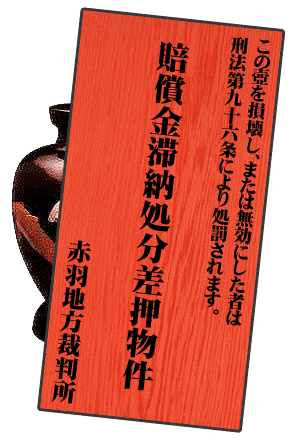 ZAKZAK reports that a 35-year-old man who is suing 2 channel founder Hiroyuki Nishimura has filed to put a lien on all Nishimura’s assets, including the 2ch.net domain. The filing comes after months of Nishimura’s complete refusal to respond to any legal actions against him, including judgments ordering him to delete inflammatory posts and even pay compensation.
Nishimura can object to the motion, but if he does not respond 2ch could be shut down in as early as 2 weeks! He may decide to move the 2ch servers to a different domain, but such a move could take up to 2 weeks due to the decentralized nature of the server.
DOUBLE UPDATE: So far it looks like ZAKZAK has the exclusive scoop on the motion to seize Hiroyuki’s assets, and we at MF have the first reporting of the development in English. ZAKZAK’s close connection to the story could stem from their earlier coverage of Hiroyuki’s legal troubles.
UPDATE: A fitting goodbye as any (if it doesn’t show up look at post 34 in this thread):
34 :名無しさん@七周年:2007/01/12(金) 13:48:23 ID:LrUGxQZl0
∧ ∧ ∧ ∧
/⌒~~~⌒\ ( ,,) (,,・Д・)
/ ( ゚〟д〟゚ )y─┛~~ ~(___ノ ~(___ノ ,?_
(_ ノ? U ∩_∩) THANK YOU 2ch ┌───────┐ \
?___J _J and (| ● ● | ヽ
/ ̄ ̄ ̄ ̄\ GOOD-BYE 2ch WORLD! /.| .┌▽▽▽▽┐ .|____|__||_| ))
/ ● ●、 ( ┤ .| | .|□━□ )
|Y Y \ またどこかで会おうね \. .└△△△△┘ .| J |)
|.| | .▼ | | \あ\ | ∀ ノ
| \/ _人|∧∧∩゛冫、 .∧_∧ | \り.\ . | – ′
| _/)/)/( ゚Д゚)/ ` . (´∀` )..ヽ(´ー`)ノ \が\ . | )
\ / 〔/\〕 U / ∩∩ ( ) (___) \と.\ .|/
| | | c(*・_・) | |ヽ(´ー`)ノ_| | | | |~ /\.\う\| (-_-)
(__)_) UUUU /∪∪ (___)(_(__) ◎ ̄ ̄◎─┘ .└──┘.(∩∩)
Aso’s cultural diplomacy: so far so good
If Foreign Minister Taro Aso can keep wonderful photo opportunities like this up, I would support him for prime minister no matter who he might want to nuke:
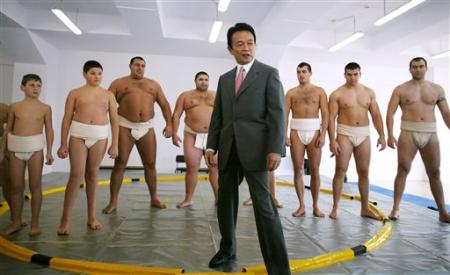
Japanese Foreign Minister Taro Aso, front centre, poses with Bulgaria’s sumo wrestlers during the opening ceremony of a donation to Bulgarian Sumo Federaton, in the Bulgarian capital Sofia, Thursday, Jan.
Bulgaria was likely singled out as it’s the home country of star Sumo wrestler Kotooshu. Kotooshu is currently an ozeki, one rank under Yokozuna, though he is unlikely to achieve yokozuna status, the top rank in the sport, for some time (Japanese Mongolian wrestler Hakuho might make it this year to the delight of people who want to see more Japanese Mongolian faces in the sport).
Aso has made promotion of Japanese cultural exports, chiefly anime and manga, a priority as he sees it integral to cultivating Japan’s “soft power.” You can read the details of his cultural diplomacy ideas (essentially, the main pillar in building a “Japan brand”) here.
A brief look at free English-language online sources on Japanese politics
Happy New Year, everybody. 2006 was Mutant Frog Travelogue’s 2nd year of existence and a good one for a number of reasons: our readership has surged, we’ve been dubbed a top 10 Japan blog, and most importantly we have learned a lot in the process, both through researching for blog posts and through reader comments. Loyal readers: thanks for the support. Newcomers: Stick with us!
We don’t pretend to offer anything but whatever inspires us to click the Publish button, but we do hope you’re interested in what we have to say. Of course, you wouldn’t want to use this site as a main source for information, especially since there are much more comprehensive and professional sites out there.
For example, if you want information on Japanese politics in the English language, there is a wealth of sources to consult. For background, you can consult Wikipedia or the CIA World Fact Book to brush up on the basics or find papers by various experts in the field (the two best sources I am aware of: JPRI and Japan Focus), all free of charge.
On top of that, the Japanese government (such as METI’s think tank RIETI and MOF’s research institute, the websites of the various political parties, especially the LDP, as well as every ministry and agency’s English websites) and various think tanks (Keidanren, Daiwa, and other corporate-sponsored tanks are often quite interesting though they often focus more on the economy) provide much of their research and information in English free of charge.
To find out what’s happening now, there are several excellent English-language sources that are either straight, on-the-scene reporting or translations thereof: Japan Times, Asahi, and Yomiuri all offer different perspectives on daily events. Though you often won’t get the “story behind the story” you can nevertheless keep yourself informed of the details. And if you’re looking for a lighter side of the news, there’s even Mainichi’s WaiWai section that includes many translations of weekly magazine articles, rife with speculation and sensationalism.
And then there are various sites run by foreigners with a particular axe to grind or focused interest. The source most narrowly focusing on politics is the Japan Considered Podcast, run by a veteran Washington Japan policy hand Robert Angel. And there are plenty of others: the people at the new TransPacificRadio take a comprehensive look at the latest news, Debito has a blog chronicling developments surrounding Japan’s treatment of foreign residents, Marxy keeps an eye on pop culture and its gatekeepers, and (until last year at least) Japan Media Review took a look at Japan’s news media industry and let us know how awful the kisha club system is.
Even compared with 2 years ago, the amount of good information out there has become almost staggering. So with so many great resources out there, what can I, Adamu, offer? Biting analysis? Not so much. I try, but there’s a lot I need to learn about Japan, and I feel that I lack a certain perspective by not actually living in the country. In essence, I try to give you two things: (1) My observations as someone who follows the news in Japan with an almost religious devotion; and (2) Translations of interesting articles that would otherwise never find their way to an English-speaking audience. And if you think the increase in freely available Japan information in English was impressive, the surge in Japanese-language online content is even more staggering. It’s not as impressive as the revolution that’s occurred in the US: Japanese newspapers have not followed their American counterparts in posting their entire contents online, for starters. But that may only be a matter of time, and meanwhile there’s enough to keep me busy in my offtime at least.
Abe’s wife’s blog not that hot, says Gendai
Even though I just got back from Japan, somehow I feel kind of out of the loop. Thankfully, Nikkan Gendai, perhaps Japan’s least prestigious (and therefore often most entertaining) daily, is there to put right back in there with some totally irrelevant news (for relevant news, read this good rundown of why PM Abe is in trouble right now from JT):
Jan 8, 2007
 Mrs. Akie’s Obscenely Embarrassing Blog
Akie Abe, wife of Prime Minister Shinzo, is humiliating her self in the extreme. She started a blog “Akie Abe’s Smile Talk” in Nov 2006 in an attempt to revive her husband’s popularity, but the contents have met with criticism, and constituents have come out against her in droves, telling her to “stop messing around.”
For example, she had this to say on Christmas:
“We visited my husband’s friend [popular singer] Agnes Chen’s house (snip) and we had a delicious meal, fun conversation, and in the end as a special treat Agnes even sang a song. I could feel the goodness of this energetic family.”
That was followed by photos of turkey and other gourmet food. On Dec 24, Xmas Eve, she posted a picture of herself eating porridge at the PM’s official residence, a shining Xmas tree decorated with decorations received from Laura Bush, and the comment “Today I just want to take it easy.”
Akie says, “I would be happy to get people to understand my candid daily thoughts by introducing a part of my life on this blog,” but Internet message board site 2-channel was less than kind: “It’s a blatant revealing of a winner’s circle celebrity bourgeoisie diary,” “She is totally screwing with us,” “Honestly, neither of them have any sense of tact,” “She’s most likely going to strangle her husband to death later on.”
Perhaps in light of the criticism, the blog hasn’t been updated since her new year’s greeting. Team Abe’s PR strategy is to put her in the spotlight, but her out of place blog might not last long.
Ibuki kind of doesn’t get the bullying issue
As part of the Education Ministry’s attempts to look like it’s doing something about the recent spate of school bullying-related suicides (Yomiuri’s English edition is doing a semi-interesting special on the topic), Minister Bunmei Ibuki has written a letter to every single school in the country urging youngsters to stop bullying their “friends.” Here’s the brief letter in translation:
A Request from the Minister of Education, Sports, Science and Technology
Dear kids, who have a future to look forward to:
It is shameful to bully friends and classmates who are in a weak position.
It is cowardly to bully your friends along with others.
You might be in a position to be bullied. Rather than wonder in the future why you did such a shameful thing, you should immediately stop the bullying that you are carrying out presently.To you who are suffering from bullying: you certainly are not alone.
Rather than suffer by yourself, get the courage to talk about the fact that you are being bullied to anyone, whether it be your father, mother, grandfather, grandmother, a sibling, a school teacher, or a friend at school or from your neighborhood. You’ll feel better if you talk about it. I’m sure everyone will help you out.December 27, 2006
Bunmei Ibuki, Minister of Education, Sports, Science and Technology
The bullying issue has been a political football for years, but the recent spate of bullying-related suicides (including letters to the minister threatening suicide, though those letters have not been validated as far as I can tell) made bullying the dominant education-related issue during the fall extraordinary Diet session and crowded out the government’s promotion of its education reform agenda to the point where the government’s handling of the suicides/threats has become an Upper House election issue. As a result, the education ministry has been desperate to look like it is doing something, with efforts including some ’emergency measures’ to prevent bullying and this letter.
Shukan Asahi reported that Ibuki wrote this letter himself. It sounds sincere enough, but this bullying issue is extremely complicated and each case has its own special characteristics. Much like anti-drug and anti-smoking campaigns in the US, this could easily backfire. I can just imagine this letter being used as material to rank on some poor kid.
To that end, the Japanese media never tire of publicizing bullying horror stories, probably because they are always so compelling. For its part, Yomiuri has run a series looking at bullying cases in detail:
An 18-year-old high school student has decided to live life keeping future goals in mind despite becoming a target of bullying that started after the student became disabled due to a traffic accident. (For personal reasons, the student, who was interviewed by The Yomiuri Shimbun recently, asked that the student’s gender not be disclosed.)
Hit by a car two years ago, the student suffered multiple fractures and hovered between life and death. While the student regained consciousness, the student’s upper body was disabled.
After returning to school, some classmates started making fun of the student’s appearance. They hurled insults at the student, saying, “Look in the mirror!” and hid the student’s textbooks and slippers. In desperation, the student cut the student’s wrists with a razor blade in spring this year. Seeing the blood pumping out of the student’s veins, the student realized, “I’m alive now, though I could have died in the accident.”
Regardless of the political leadership’s cluelessness, the even higher than usual level of attention placed on the bullying issue is apparently pushing schools to take the issue more seriously:
The recent spate of bullying cases–some of which led to suicides–has prompted boards of education around the nation to set their own criteria to identify bullying, aside from the definition laid down by the Education, Science and Technology Ministry.
Most of the new criteria allow more cases to be identified as bullying than that of the ministry; for example, if parents or children consult with a school once in connection with a case of intimidation, it should be counted as bullying.
At least 40 boards of education have made such changes, and some criticized the existing definition of bullying as inadequate for a correct understanding of the real situation.
The ministry’s definition says for a case of intimidation to be recognized as bullying, it must involve a “one-sided physical or psychological attack” by “a stronger perpetrator against a weaker victim,” with the latter experiencing “serious pain and suffering.”
Because of the strong wording in the ministry’s definition, such as “attack” and “serious pain and suffering,” many schools have only recognized very serious cases of intimidation as bullying.
Of course, people are kidding themselves if they think that broadening the definition of bullying will stop it. To trot out a well-worn cliche, Japan is a society of endurance and conformity. The comedy shows are all about smacking around the weird guy, and everyone is expected to “try hard.” The only way to manage such a situation is to keep things from getting out of hand and eliminate the dangerous structural problems (hard-hearted teachers who permit violence or egg people on, weak rules against it, etc). The endless television pleas for peace will get nowhere.
America of course has a serious problem with bullying as well. However, one thing that protects the nerds in the US is a very strong clique culture. If you eat lunch with the other nerds, you feel like less of a loser.
I certainly have no answer for the bullying issue, but when I was a high school student in Japan, I noticed that while there were distinctions between the popular girls, the people in the various sports clubs, etc, I didn’t really see much of a place for the unpopular kids to get together. A few of them used illness as an excuse to skip school for months at a time. Perhaps if there were places outside of the school system where the losers could find ways to express themselves they’d be able to have some sort of hope for the future.
Terrorist attacks in Bangkok
This is what I’ll be returning to next week:
A series of bombs exploded Sunday evening December 31, 2006, and Monday morning, January 1, 2007 in several locations in the Bangkok metropolitan area. The explosions killed two persons and caused numerous injuries. The US Embassy has confirmed that no American citizens were injured or killed in the explosions.
The Department of State and the American Embassy in Bangkok urge all American citizens in Bangkok to stay indoors whenever possible, to avoid all public gatherings, and to remain extra vigilant as they travel in and around Bangkok. Please monitor local news channels or CNN for further information.
They hit a police box near the Big C supermarket in Saphan Kwai. That’s where I shop! I think my life from now on will be a straight line from my apartment to the fried rice restaurant, at least for the time being.
Happy new year from a happy Adamu in Japan
A milestone for Adamu as we approach the end of 2006 — I’m officially getting married! Mrs. Adamu and I finally let her parents know our intentions, and while Mrs. Mrs. Adamu has some issue with mixed marriages, she won’t oppose our union and Mr. Mrs. Adamu and Brother Mrs. Adamu were happy to hear the news. Yay!