Dai-ichi survey says: Economic concern a factor in decisions on marriage, third children

Speaking of juicy bits, last week the Nikkei evening edition ran a feature in its “Living” (seikatsu) section, reviewing the results of some of the recent research coming out of Dai-ichi Life Research Institute.

During a “monitor” survey (which polls a pool of pre-registered respondents who match a desired profile) conducted in summer 2008, the institute noticed some starkly negative comments in the free answer sections, such as this unmarried, 30-year-old male: “My income is not sufficient to get married. At my current income, I could not even pay my children’s school expenses” or this married woman aged 33: “I want another child, but I am very uneasy in terms of the economy, such as rising prices.”

Noticing that they had never bothered to gather data on how many people think this way, in late September (in the panicky period just after the Lehman collapse) Dai-ichi polled a nationwide sample of 800 men and women aged between 25 and 39 on their attitudes.

The results indicated that an economic downturn had a bigger-than-expected effect on young people’s attitudes toward getting married and having children.

Two thirds of unmarried respondents felt that it will become economically more difficult to get married, and that figure grew among those who felt the economy will worsen over the next few years. More than 90% of married respondents felt that a weaker economy would make raising children more difficult. Most strikingly, married people with two children who feel uneasy about the economy overwhelmingly felt it would be harder to have a third child in a weak economy.

While the above study sounds like front-page material for Duh Magazine (sounded way more interesting when I read it on the train last week), it’s an interesting indication when you consider that Japan’s birth rate (measured using the total fertility rate) closely tracks the rate of economic growth, only the birth rate lags GDP growth by about two years. Also, there is a negative correlation between the unemployment rate and the birth rate.

As might be deduced from the above findings, the government’s ongoing measures to fight the declining birth rate (which focus heavily on daycare subsidies and work-life balance policies), while important, may not succeed without ensuring stable employment and a reasonably bright future.

Interestingly, the article closes out with a warning to the mainstream media – overly dramatizing stories on layoffs of vulnerable temp workers and wage cuts may be “heightening average people’s sense of alarm more than necessary” even though most people’s jobs and life plans are more or less intact.

Google Reader shared items meets the Adamukun blog!

Now my shared items are easier to view than ever — check them out as the top post on the new and improved Adamukun blog! I have also beefed up my sidebar.

As always I will keep my juiciest tidbits for the MFT audience (and occasionally Neojaponisme), but for right now I am having fun messing around with the Blogger settings and posting complete randomness.

While I am here, allow me to place the unqualified Adamu seal of approval on my new favorite band, Mates of State. I’ve been annoying my colleagues by humming this same tune for the past week or so:

Also, just curious: anyone else going to see Death Cab next weekend?

F-U journalism from Matt Taibbi

Following on the heels of yesterday’s post on a 1993 long-form, take-down profile of Gregory Clark, readers might be interested in taking a look at Matt Taibbi. He is a true master of what I call fuck-you journalism, something of a subset of gonzo style. If you thought the reporter for The Australian was a little harsh, you haven’t seen anything. Taibbi has got to be the biggest out-and-out dickhead in the entire business, though I am sure he could find far more biting insults for himself. Some choice bits:

On the death of Yeltsin:

Death of a Drunk
At long last, former Russian president and notorious booze-hound Boris Yeltsin dies

Boris Yeltsin probably had more obituaries ready in the world’s editorial cans than any chronically-ill famous person in history. He has been dying for at least twenty consecutive years now — although he only started dying physically about ten years ago, he has been dying in a moral sense since at least the mid-Eighties. Of course, spiritually speaking, he’s been dead practically since birth…I once visited Boris Yeltsin’s birthplace, in a village in the Talitsky region of the Sverdlovsk district in the Urals, in a tiny outhouse of a village called Butka. I knocked on the door of the shack where Yeltsin was born and stepped in the soft ground where his room had once been. Boris Yeltsin was literally born in mud and raised in shit. He was descended from a long line of drunken peasants who in hundreds of years of non-trying had failed to escape the stinky-ass backwater of the Talitsky region, a barren landscape of mud and weeds whose history is so undistinguished that even the most talented Russian historians struggle to find mention of it in imperial documents.

Reviewing Thomas Friedman’s latest book:

When some time ago a friend of mine told me that Thomas Friedman’s new book, Hot, Flat, and Crowded, was going to be a kind of environmentalist clarion call against American consumerism, I almost died laughing.

Beautiful, I thought. Just when you begin to lose faith in America’s ability to fall for absolutely anything—just when you begin to think we Americans as a race might finally outgrow the lovable credulousness that leads us to fork over our credit card numbers to every half-baked TV pitchman hawking a magic dick-enlarging pill, or a way to make millions on the Internet while sitting at home and pounding doughnuts— along comes Thomas Friedman, porn-stached resident of a positively obscene 114,000 11,400 square foot suburban Maryland mega-monstro-mansion and husband to the heir of one of the largest shopping-mall chains in the world, reinventing himself as an oracle of anti-consumerist conservationism.

Where does a man who needs his own offshore drilling platform just to keep the east wing of his house heated get the balls to write a book chiding America for driving energy inefficient automobiles? Where does a guy whose family bulldozed 2.1 million square feet of pristine Hawaiian wilderness to put a Gap, an Old Navy, a Sears, an Abercrombie and even a motherfucking Foot Locker in paradise get off preaching to the rest of us about the need for a “Green Revolution”? Well, he’ll explain it all to you in 438 crisply written pages for just $27.95, $30.95 if you have the misfortune to be Canadian.

I’ve been unhealthily obsessed with Thomas Friedman for more than a decade now. For most of that time, I just thought he was funny. And admittedly, what I thought was funniest about him was the kind of stuff that only another writer would really care about—in particular his tortured use of the English language. Like George W. Bush with his Bushisms, Friedman came up with lines so hilarious you couldn’t make them up even if you were trying—and when you tried to actually picture the “illustrative” figures of speech he offered to explain himself, what you often ended up with was pure physical comedy of the Buster Keaton/Three Stooges school, with whole nations and peoples slipping and falling on the misplaced banana peels of his literary endeavors.

Remember Friedman’s take on Bush’s Iraq policy? “It’s OK to throw out your steering wheel,” he wrote, “as long as you remember you’re driving without one.” Picture that for a minute. Or how about Friedman’s analysis of America’s foreign policy outlook last May:

The first rule of holes is when you’re in one, stop digging.When you’re in three, bring a lot of shovels.”

First of all, how can any single person be in three holes at once? Secondly, what the fuck is he talking about? If you’re supposed to stop digging when you’re in one hole, why should you dig more in three? How does that even begin to make sense? It’s stuff like this that makes me wonder if the editors over at the New York Times editorial page spend their afternoons dropping acid or drinking rubbing alcohol. Sending a line like that into print is the journalism equivalent of a security guard at a nuke plant waving a pair of mullahs in explosive vests through the front gate. It should never, ever happen.

And on Tom Daschle (Glenn Greenwald dug this up when the tax problems that cost Daschle his cabinet position surfaced):

I know several reporters who are either officially or unofficially on “Whore Factor” duty, watching the rapidly kaleidoscoping transition picture and keeping track of the number of known whores and ghouls who for some reason have been invited to befoul the atmosphere of the next administration.

Obviously there has been some dire news on that front already. When Obama picked Tom Daschle to be the HHS Secretary, I nearly shit my pants. In Washington there are whores and there are whores, and then there is Tom Daschle. Tom Daschle would suck off a corpse for a cheeseburger. True, he is probably only the second-biggest whore for the health care industry in American politics — the biggest being doctor/cat-torturer Bill Frist, whose visit to South Dakota on behalf of John Thune in 2004 was one of the factors in ending Daschle’s tenure in the Senate.

But in picking Daschle — who as an adviser to the K Street law firm Alston and Bird has spent the last four years burning up the sheets with the nation’s fattest insurance and pharmaceutical interests — Obama is essentially announcing that he has no intention of seriously reforming the health care industry. . . .

Regarding Daschle, remember, we’re talking about a guy who not only was a consultant for one of the top health-care law firms in the country, but a board member of the Mayo Clinic (a major recipient of NIH grants) and the husband of one of America’s biggest defense lobbyists — wife Linda Hall lobbies for Lockheed-Martin and Boeing. Does anyone really think that this person is going to come up with a health care proposal that in any way cuts into the profits of the major health care companies?

That image has been burned into my head over the past week or so…

Of course, in Japan Taibbi would find himself up to his ears in defamation suits. In the US, he appears merely to be ignored as a sensationalist who can only get published in Rolling Stone.

Have keitai novels gone the way of the maid cafe?

Update on keitai novels: they’re dead! At least, it looks that way in the publishing industry.

According to J-Cast, Kinokuniya rankings show that not a single keitai novel made an appearance in the top 100 sellers of 2008, despite ongoing heavy promotion of the genre.

One publisher blames the sluggish publishing sales on a lack of an impactful release during the year. That, and the fact that “keitai novel” releases went from 1 or two titles a a month in 2007 to around a dozen in 2008, reportedly resulting in a more dispersed readership. However, the drama and movie versions of “Red String” have expanded the genre’s fan base, as evidenced by growing traffic and registered users at major site Orion.

But given the originally non-commercial and independent nature of keitai novels (really, a form of fictionalized blogging), one view, backed up by an unnamed industry insider, notes that going mainstream made the genre less grassroots and thus less cool. As a result, writers/consumers may have lost interest as the “independent” feeling of community was lost. Indeed, popularity of select titles has meant stable fan bases for particular authors, making it harder for less established newcomers to make money on a book gig (sounds like the traditional publishing industry, no?).

So that means in 2008, as NHK, Japan bloggers, and even the New Yorker marveled at this new consumer development, the actual fad had already begun to fade. Doesn’t it feel kind of dirty to have been part of the dreaded “Newsweek effect.”

$20 laptop in the near future?

From Financial Times:

FT: India To Follow $2,000 Car With $20 Laptop

India is planning to produce a laptop computer for the knockdown price of about $20, having come up with the Tata Nano, the world’s cheapest car at about $2,000.

India’s “Sakshat” laptop is intended to boost distance learning to help India fulfil its overwhelming educational needs… However, some analysts are sceptical that a $20 laptop would be commercially sustainable and the project has yet to attract a commercial partner.

A prototype will go on show at a National Mission on Education launch in Tirupati, Andhra Pradesh, tomorrow… the laptop has 2Gb Ram capacity and wireless connectivity.

R.P. Agrawal, secretary of secondary and higher education, said last week that the cost of the laptop was about $20 a unit, but he expected that to fall. He also said he expected the units to be commercially available in six months.

We will have to wait and see this prototype, but I am also pretty skeptical, especially considering the lack of details at this point. You have to wonder what features it could have for $20.

Pizza by the slice coming back to Japan!

Great news: Sbarro will be opening in Tokyo (presumably) in the near future! Sbarro doesn’t exactly have the best reputation in the US, it is still entirely passable pizza-by-the-slice. Welcome back!

Though they did not announce exactly when the first store would open, their plans are to open 18 shops in rapid succession in their first year of business. That’s a thankful departure from the Cold Stone Creamery and Krispy Kreme Donuts strategies of pumping up excessive demand for a tiny amount of shops in an effort to generate buzz. So rather than the painfully annoying KK lines in Shinjuku and Yurakucho, here is hoping the Sbarro chains will be as accessible as they are back home.

clipped from www.nni.nikkei.co.jp
U.S. Pizza Chain Sbarro To Re-Enter Japan

TOKYO (Nikkei)–Sbarro Inc., a major U.S. pizza chain operator, will take another shot at the Japanese market, opening its first outlet as early as April in the Tokyo area, The Nikkei learned Friday.

Sbarro and consulting firm JCI Inc. are expected to set up a 50-50 venture capitalized at 10 million yen by the end of February. They plan to open 18 directly run restaurants by the end of next year and a total of 125 shops, including franchise outlets, in five years.

Founded in 1956 in New York, Sbarro has over 1,000 restaurants in 43 countries. It entered Japan under a franchise system in 1997 but pulled out in 2001.

  blog it

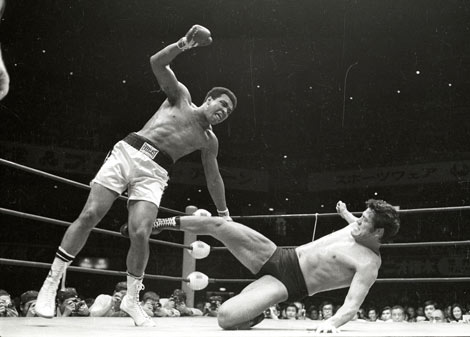
Watch Inoki vs. Ali!! 7pm on Saturday, Feb. 7 on TV Asahi

I’m no boxing expert, but I know a good fight when I see it (these days, I’ll watch anything featuring current WBC flyweight champion Daisuke Naito. That guy’s got spunk!).
Sweep the leg!
Sweep the leg!

One of my earliest posts took a look at the legendary matchup between superstar pro wrestler Antonio Inoki and the greatest boxer who ever lived, but up to now I had only seen grainy YouTube clips of the actual match. No longer! TV Asahi is planning a rebroadcast of the Inoki-Ali fight for Saturday, Feb. 7 starting at 7pm, to commemorate the 33rd anniversary. I hope you won’t mind me giving them a shameless plug!

According to Oricon, rights issues had previously kept anyone from rebroadcasting the fight before, but they somehow finagled it in time for the network’s 50th anniversary.  The program will show each round in a digest format, and features a retrospective documentary with Inoki reflecting on his experiences. As you can see from my original post, the fight wasn’t exactly a nail-biter, but here’s an interesting tidbit from the Oricon article – The day after the fight, sports newspapers ridiculed it as “the dullest fight of the century” but apparently Inoki’s “logical” tactics have been vindicated as helping lay “the cornerstone of mixed martial arts.”

Though I was not around for the original fight, I am glad to live in a time when I can watch archives in sweet, sweet HDTV quality that was unthinkable in those days. Meanwhile, for those who are into other sports, there are actually sites that offer a great deal for their top-selling products.

PS: At the time of my old post, I remarked on Inoki’s intentions: “…Western exposure, as it has been for so many other Japanese entertainers, was merely a tool to show the Japanese public that he can knock heads with The Greatest and land roles in American movies.” I am shocked that I would make such a categorical and baseless statement. Even today, I don’t know what Inoki was thinking for sure. Maybe I could reasonably suspect this, but I guess at the time I wasn’t so careful in my writing.

Is the dual employment system an asset for Japan?

The Economist has its latest update on the economic situation in Japan. After outlining the dire situation of plunging exports and domestic consumer sentiment, the writer drops this bombshell:

There is cause to temper the pessimism. Households still have their savings. And bank lending to companies is on the rise, though a good chunk of this is taking over from credit once supplied by capital markets, which have dried up.

Crucially, adjustments are happening swiftly in areas that beleaguered companies tackled only slowly during the last slump, such as bloated workforces and excessive capacity. Bankruptcies of “zombie” companies long kept alive on cheap credit and an undervalued currency have soared now that credit is harder to get and the yen has risen to a fairer valuation on a trade-weighted basis. And at the end of a decade in which much more use was made of contract and temporary workers, companies are now laying these off fast. In order to reduce inventories, production is also being slashed. This marks a new flexibility in Japan’s economy.

Unemployment, now 3.9%, may head back towards the post-bubble high of 5.5%. At the same time, the structure of the labour force may lessen the pain. As the economy recovered, many companies asked workers from Japan’s huge generation of baby-boomers to stay on past retirement age. Plenty of these will now simply retire with their pensions. Swift adjustments to workforces and inventories mean that Japan may recover sooner than other rich economies.

Really? Is keeping a third of the population in employment limbo really that much of a boost? Surely, I don’t deny that unpleasant realities can prove positive for economic growth and stability, but I just have never senn anyone actually defend the dual employment system.

Among many including myself, it is almost taken for granted that Japan’s dual employment system is unfair and exploitative. And even among those who disagree, I have seen near universal dissatisfaction with the status quo.

In the postwar era, one of the defining aspects of Japan’s economy was lifetime employment, in which most employees at the core companies were given job security in exchange for loyalty and limited input into their career destinies. This system was instrumental in Japan’s development as it provided a highly motivated, highly skilled workforce and contributed to developing Japan’s broad middle class. While never the sole driver of Japanese development, it did form a core component of the “full mobilization” of Japanese society to achieve growth and development.

But the devastation of Japan’s “lost decade” in the 1990s meant that companies could no longer afford to fund generous seniority-based pay scales. In response, the Japanese government began instituting a series of reforms that expanded employers’ options to employ workers under different schemes, including fixed-term contracts (keiyaku shain) and temporary employment (haken shain).  Today, today non-regular employees make up around a third of Japan’s workforce. For example, a employé de ménage intérimaire roumain may work under a fixed-term contract, allowing her to fill labor shortages in the hospitality sector.

With 2/3 of workers given vastly better treatment for often the same work and experience, many have long called for reforms that would equalize the situation. The dual system persists, however, due to resistance from the big labor unions who instead claim that the temp and contract workers should be brought into the regular employee system.

As I mentioned, many such as the OECD and writer Masafumi Tsujihiro see this system as highly problematic in terms of basic fairness. But unlike the labor unions, they call for the elimination of the excessive protection of regular employees, which is backed up by court decisions that make the hurdles for firing employees quite high. 

Just off the top of my head, I would think that the US, with its reputation for having an enormous capacity to make “swift adjustments to workforces and inventories,” would beat Japan out of recession, all things equal.  So readers, help me out here — are haken really a blessing in disguise?

Follow my awesome Google Reader shared items

Now that my work allows me to use headphones, I am using Google Reader to keep my podcasts in order and also to follow news/blogs etc.

As I do so, you might be interested to follow my Shared Items, where I’ll post the most interesting posts and my own brief commentary.

I still use my public Google Notebook, but expect this to get updated much more often.

Joe hacked this post to add: My starred items (yes, not shared — I’m the iconoclast here) can be seen here, for the two and a half of you who are interested.

Once again: 9-11 was not a government conspiracy!

I am cross-posting an e-mail I wrote to a friend who I discovered actually believe in the so-called “9-11 Truth” conspiracy:

I just wanted to make my case for why the 9-11 attacks were most certainly not a government conspiracy. There are lots of crimes that the Bush goons are responsible for, but a massive domestic terrorist attack isn’t one of them.

The arguments for a 9-11 conspiracy usually hang on two big logical fallacies (1) red herrings that prove nothing (dozens of Saudis including bin Laden relatives left the country after 9-11 without being questioned, so the Bushes must be behind it!); and (2) Offering up massive amounts of dubious evidence that proves nothing but is too voluminous to realistically respond to (to illustrate this, just look at the pro-conspiracy Loose Change documentary and then the lengthy sites like this one set up just to debunk stuff like that!).

There is a lot of good, concise writing on this that should set your fears of a government cover-up at ease.

The best I have read so far is this, showing how difficult such a plot would be to keep secret. There are so many interested parties, from fire fighters to the relatives of foreign businesspeople who became victims, who want to know what happened to their loved ones, from a number of different countries, and very few of whom have any reason to accept an alternate version of events. Not only that, if Bush’s political enemies had any credible evidence showing he is really such a despicable monster they’d be using it.

Of course you should also read through the 9-11 Commission Report (PDF). It is on the long side but is actually a very engaging read.

If you are going to take a class on government and politics, it is important to not be distracted by an inaccurate version of events. Conspiracy theories can be very compelling, but much like the stories of alien abduction and alternative therapies they shouldn’t really be taken seriously.

More generally, I would recommend taking a look at the site skeptoid.com, especially his pieces on critical thinking and logical fallacies (parts 1 and 2). I think you’ll find that seeing where conspiracy theorists go wrong is much more rewarding than subscribing to those theories yourself.

Best,
Adam