More eikaiwa data – mostly bad news

UPDATE & DISCLAIMER: Please note that all the data below are for all language schools, not just those that only teach ESL. By using “eikaiwa” as a shorthand for all survey respondents, I am assuming that the dominance of English as the second language of choice (and the apparent overwhelming share that English occupies in the classroom-style language teaching market) and therefore that these numbers are essentially not affected by other languages. It is entirely possible, but unknowable from this set of data, that for any of these measures, the breakdown by language could show, for example, that the growth of Korean and Chinese language schools has made those languages a bigger driver of trends.

(First-time readers – I recommend reading my previous post on this topic “English teaching in Japan by the numbers” to get an idea of where this data is coming from)

You can now use Google Documents to see the data I used to create charts in my previous post, Eikaiwa by the numbers. In future data-oriented posts I hope to use the same tool.

While I’ve got you, here are a couple more views of the eikaiwa school data. As I mention toward the bottom, amid all the woeful news are a few rays of hope – the level of new students has remained relatively stable, and sales per customer have actually risen to a recent (if not historic) high:

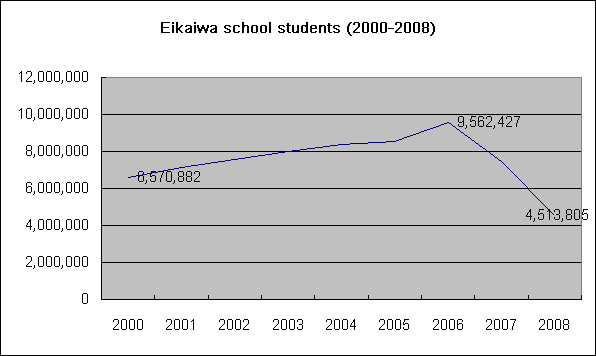
Number of students

image001

The student population went from 5.18% of the Japanese population in 2000 to 3.54% in 2008.

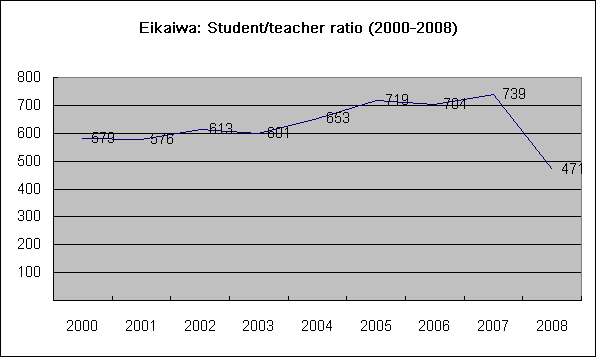
Student/teacher ratio

image002

In a very wide estimate, each teacher last year taught 19% fewer students than the teachers at the turn of the century. One has to wonder how this ratio works out – maybe student numbers include people who just come in for two lessons and quit?

Classes taught

Also, the total number of classes started the decade at around 10.6 million, peaked at around 14 million in 2004, and fell to just 6.18 million in 2008.

Classes per teacher

Each teacher on average taught 645 classes in 2008, down 31% from 2000 and 42% from the 2005 peak of 1,107.

Number of eikaiwa schools

The number of schools, meanwhile, grew from 3,139 in 2000 to 3,680 (with a spike of 4,303 along the way in 2006).

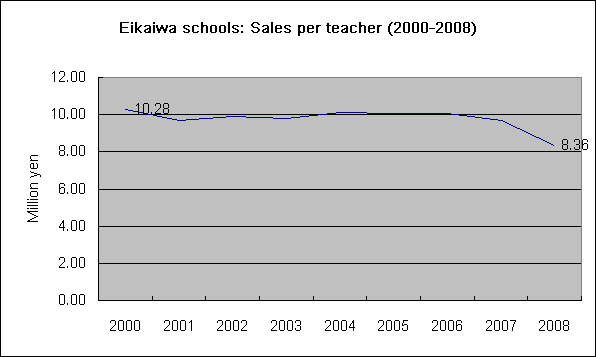
Sales per teacher

sales-per-teacher

Each teacher now brings in 18.6% less raw revenue than in 2000, in line with the student/teacher ratio.

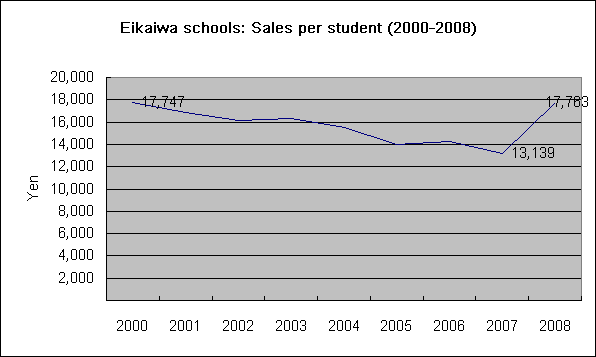
Sales per student

sales-per-student Oddly, the sales per student bounced back in 2008 to more than the figure in 2000! Either there is some sort of time lag or carry-over effect in the data (receipts do not accurately reflect the student numbers given for the same year) or the schools found some way to boost the sales per student, though apparently not improving sales per teacher.

Sales per class
The total sales per class taught increased:

Sales per eikaiwa school

However, this is not reflected in the sales per school, despite the increase in the number of schools:

Conclusion

Every measure seems to be heading downward for the eikaiwa classroom industry, except for sales per student and sales per class taught. If we note that the number of new students has not seen the same level of collapse as areas like sales, total number of students, and number of teachers, this would seem to indicate that the students who have remained are willing to pay more for the privilege.

Japanese commuters podcasting their way to English fluency

On my morning commute, my fellow salarypersons with a hand free to read are usually doing one of two things – reading the newspaper or studying for something. Of those studying, maybe half are studying English, while the other half appear to be aiming at one  nationally recognized qualification or another (very often real estate related). For those who don’t have a hand free, most listen to their iPods. Occasionally I can overhear a particularly insensitive music lover playing B’z or Koda Kumi, but otherwise I have been left to wonder just what sounds they might be pumping into their skulls.

Well, it looks like I have my answer, at least for the one in seven who are regularly listening to podcasts: The podcasts in Japan are absolutely dominated by English lessons. Take a look at the top 20 podcasts on Yahoo right now, listed by number of subscribers:

  1. Nihon Keizai Shimbun podcast
  2. ECC Eikaiwa Podcasting
  3. Classical Music Sound Library
  4. Mainichi Quick Listening Lessons Podcast – lessons based on CNN stories
  5. Bakusho Mondai Cowboy
  6. Podcasting rakugo
  7. NHK English News
  8. Hikaru Ijuuin’s Late Night Fool Power
  9. Oricon album top 20
  10. Jazz Piano Small Pieces
  11. Eikaiwa eChat Vancouver
  12. English as a Second Language Podcast
  13. Tokio Hot 100 (with Chris Pepler)
  14. Let’s Read the Nikkei Weekly (the Nikkei English edition)
  15. Fresh topics from the editor-in-chief (Nikkei Business)
  16. Melody’s “Oh! Kanchigai (cluelessly mistaken) English”
  17. Takuro Morinaga – Economy Column
  18. ALC Podcasting Station “English is training!”
  19. Cream Stew All Night Nippon
  20. The Jazz Suite

That’s eight of the top 20.  iTunes is similarly full of English lesson podcasts, though for now I can only list the top 5 since I don’t have the iTunes application on my desktop:

  1.  EnglishPod
  2. ECC Eikaiwa Podcast
  3. Bakusho Mondai
  4. CNN News
  5. Nihon Keizai Shimbun podcast

The origins of Nanaca Crash

One of our more popular posts continues to be Roy’s link back in 2005 to addictive flash game “Nanaca Crash” in which you try to control how far a young man bounces after being run into by an anime Japanese schoolgirl on a bicycle. Give it a try!

Four years later, I am only now learning of the game’s hentai origins:

Cross Channel (officially spelled CROSS†CHANNEL) is an eroge for the Windows and PlayStation 2 platforms. The Windows version was released on September 26, 2003, and the PS2 version (CROSS†CHANNEL~to all people~) on March 18, 2004.

Story

Gunjo Gakuen (Deep Blue School) is a facility designed to gather and isolate those students who got a high score on an adaptation exam (Scoring high on this exam indicates that the student is less likely to be able to be adapted to the society) mandated by the government.

After a failed summer vacation with other members of the school’s broadcasting club, Taichi Kurosu and some of the other club members return to the city, only to find that all living creatures within it except for the club members have completely vanished. In order to confirm the status of the outside world, Taichi decides to gather other club members to help Misato Miyasumi, the president of the broadcasting club, who is trying to set up a broadcasting antenna to contact any possible survivors. However, Taichi soon discovers that the world is actually repeating the week after they found the others vanished…

Nanaca Crash!! (officially spelled NANACA†CRASH!!) is an online spin off game featuring characters from Cross Channel. The object of the game is to click, hold and release the mouse button to determine the angle and velocity of Nanaka crashing her bicycle towards Taichi, sending him flying across the screen. Your score is determined by the distance of his flight. Certain characters he crashes into will greatly affect his velocity.

Japanese rastas

Wiki:

A small but devoted Rasta community developed in Japan in the late 1970s and early 1980s. Rasta shops selling natural foods, Reggae recordings, and other Rasta-related items sprang up in Tokyo, Osaka, and other cities. For several years, “Japan Splashes” or open-air Reggae concerts were held in various locations throughout Japan. For a review by two sociologists of how the Japanese Rasta movement can be explained in the context of modern Japanese society, see Dean W. Collinwood and Osamu Kusatsu, “Japanese Rastafarians: Non-Conformity in Modern Japan,” The Study of International Relations, No. 26, Tokyo: Tsuda College, March 2000 (research conducted in 1986 and 1987).

Where are these Japanese rastas today?

A comprehensive guide to Type B Adamu

A Japanese website is helpfully offering free “instruction manuals” based on your name and blood type. Here’s mine:

adamu-setumeisho

Head: Can’t remember (*won’t remember)

Mouth: Often talks to himself

Heart: Super-calm and collected

Right hand: Lots of wastefulness

Overall: Ultimately self-centered?

Accurate? Hm, not really. Try it yourself and see how you measure up!

While blood type-based personality tests are well-known to be completely baseless, many in Japan, mainly women, do believe that at the very least knowing someone’s blood type will divide them into four broad personality classes. See Wikipedia for a helpful chart of these categories.

(Thanks to Hiroshi Yamaguchi for the link)

How to kill the “turning Japanese” cliche?

Krugman!

Turning Japanese

Adam Posen of the Peterson Institute for International Economics is the go-to guy for understanding Japan’s lost decade. From prepared testimony for a Joint Economic Committee hearing tomorrow…

What follows is thankfully not Adam Posen reading the words “turning Japanese” into the Congressional record, but I swear if I see that phrase again I might just rip myself in half, Rumpelstiltzken-style.

Now, here at Mutant Frog we like to follow cliches in the media, my own favorites being the overused “kabuki” and the often-used but always amusing “slammed!”  But “turning Japanese” is just so cringe-worthy that I haven’t been able to bring myself to mention it.

I am not sure why I hate this phrase so much, but I suspect it’s got a lot to do with the grating awfulness of the original song. I mean, imagine if every time Spain is mentioned on CNN they started playing “Hey, Macarena!” That’s how this makes me feel.

So what can be done to end this painful abuse of the English language? I was thinking it might make a difference if someone came out with a new definitive song about Japan, this time without the cartoonish 80s new wave voices and stereotypically “Asian” intro melody. Please let me know your ideas so we can finally take care of this important issue.

(Bonus: See Marxy’s take on the song at the bottom of the link)

Invest in North Korea?!

Yes, says the man in the bowtie:

Feb. 24 (Bloomberg) — A U.K. businessman is seeking to raise $50 million to invest in North Korea, reviving a 2005 plan after the U.S. government removed the communist regime from its list of countries that support terrorism.

ChosunFund Pte. Ltd. will join with North Korean partners for mining and energy projects, Colin McAskill, founder of the Singapore-incorporated fund, said in an interview.

bowtie-dude
“The country holds huge natural resources but is capital starved and lacks the technology and management skills with which to develop them,” McAskill said.

McAskill, 69, said he has been consulting on potential North Korean projects since 1987. While the country attracts one-off investment deals such as a recent contract licensing Orascom Telecom Holding SAE to provide wireless telephone services, it has struggled to raise money from global financial markets since defaulting on overseas debt in the 1970s.

London-based emerging markets money manager Fabien Pictet & Partners Ltd. was considering a fund that would invest in South Korean companies that do business with the North. The idea is “on hold for the time being,” Jonathan Neill, managing director, said in an e-mail.

I understand that the terror designation was a technical barrier for to much economic aid in addition to banning most financial institutions from doing business with NK. And I know saying investing in North Korea is a bad idea is like shooting fish in a barrel.

But the US political decision to remove NK from the list doesn’t strike me as any real vote of confidence in the country, since North Korea appears to remain the dictionary definition of a state-run criminal enterprise, even if it hasn’t strictly engaged in “terrorism” the 80s. Nor is this is any real sign that the situation in North Korea is at all stable.  The ailing health of Kim Jong Il also plays a decisively destabilizing role. We could easily see a succession battle worthy of imperial Rome when he finally dies.

Still, you have to give the man credit for sticking with the idea for more than 20 years. There is always the chance that NK will stabilize somehow, so getting in on the ground floor would then be seen as a smart move. There could also be a rationale for investing in SK companies who take on NK projects with the backing of the South Korean government, or with some other guarantee to offset losses.

Roppongi is Tokyo’s toilet bowl

Walking from Nogizaka Station to Tokyo Midtown this morning, I joined thousands of commuters who were forced to step over what appeared and smelled to be a smear of human feces on the Roppongi sidewalk. Was it anti-capitalist terrorism, or just the work of a partier who couldn’t contain himself?

Now that some of my anger has subsided, I can’t help but see this as an aptly pungent metaphor for modern Roppongi. While conveniently located in the center of Tokyo, for a long time the Roppongi area was not considered a business district but overwhelmingly the notorious nightlife center of Tokyo. But the construction of business centers such as Roppongi Hills and Tokyo Midtown over the past few years has re-branded the area as office-friendly. Yet as long as the dozens of clubs continue to infest the Roppongi Crossing area, workers such as myself will be forced to commute each morning using the same streets taken by the drunks and gangsters to go home the previous night. I have had more than one run-in with drunks returning from a night out, but needless to say today’s experience trumped them all.

Why is Berlitz thriving?

My recent post about the eikaiwa industry by the numbers has made the rounds of a couple ESL job forums, and it seems to have a few people worried. My intention wasn’t to scare people off of English teaching entirely – the demand for learning English is high in this country, and while there is something of an oversupply of teachers amid slumping sales, Japan possesses some serious advantages, such as high living standards and the rule of law, that make it a better choice than some other destinations. So if some of them are still reading this blog, I just want to remind them that English teaching isn’t dead in Japan. The issue is just that the business is headed for a rough patch, not that every teacher will have to put up with crappy wages and dismal work conditions, though that may be true for many.

The private-sector eikaiwa industry appears to be hurting badly, ever since various events in 2006 led to the ignominious business suspension, flailing attempt to save through shady financing deals, and eventual collapse of former industry giant NOVA (so carefully documented by the Japan Economy News blog) shattered the image of a once booming industry and, with the disappearance of the well-known NOVA rabbit mascot, symbolized the sudden end of long-running profit machine and source of easy employment for thousands of young Westerners interested in life in a new country.  The rest of the “big four” schools also faced serious difficulty, most notably LADO which is no longer with us.

Today I want to pass on some things I learned after learning about the worsening management-worker relations at Berlitz Japan:

Benesse – happily cleaning up after NOVA?

Benesse, a long-time provider of education services, chiefly juku, jumped feet first into Japan’s English conversation market when it acquired veteran language teaching company Berlitz International in 2001. The company caught my eye when some of its unionized teachers in Japan were sued on grounds that they striked illegally. Without commenting on the merits of the dispute itself, I would like to react to one passage of the Japan Times  article (while I am generally pro-union, I simply don’t know enough about the case to have any opinion one way or the other. Feel free to discuss in the comments though!):

The financial health of Benesse Corp., Berlitz Japan’s parent company, also influenced the timing of the strike. In their annual report for the financial year ending March 31, 2008, Benesse recorded their highest-ever earnings. Operating income grew 11.4 percent and Berlitz International Inc. achieved its best result since being bought by Benesse. Operating income for Benesse’s language company division rose 36 percent from the year before to ¥6.35 billion, in part due to higher revenues and profits at Berlitz International, which benefited from “an increase in the number of lessons taken worldwide, particularly in Japan and Germany,” according to the report.

Curious about exactly how Berlitz is boosting its “number of lessons,” I decided to take a closer look at their latest annual report for FY2007 (PDF) in the hope that they would explain exactly how they could enjoy such growth as the industry as a whole is caught in a horrific vortex. It is also interesting to see Berlitz on the rise, considering that it had long lost market share to the other big chains. I came up a little disappointed, as annual reports are not the place to broadcast your super-secret business strategy to the world. But one passage did at least seem to hint that they were up to something:

[As for the business environment of] our language business area, while there are concerns over the  global economic slowdown, the demand for language learning remains robust.  However, in Japan the collapse of a major language school has led to increased selectivity of language schools among customers. (Page 11)

Considering that they are giving record numbers of lessons in Japan, one can assume that while they won’t come out and say it, this explicit mention of a flight to quality means they must be enjoying some benefit from former NOVA students in need of tutelage.  Plus, they have maintained one of the world’s strongest language teaching brands, and they don’t seem to have had the same customer service problems as NOVA, whose six-month business suspension for unfair refund policies spelled doom for the company.

Other wisdom from Benesse

In addition, it is interesting to note that the management decided to explicitly state an intention to use between 20 and 30 billion yen for acquisitions over the medium to long term, including in the language business (Page 18). Could they be looking to scoop up some underperforming rival to pick up more market share?

In the business risk section of the report, they remind investors that while they are prepared for the conventional consensus on Japan’s shrinking population (their main business is juku, so fewer kids = bad), their business will be screwed if the population ages even faster than expected.

They are also worried that the government’s measures to combat declining educational standards as measured by the international PISA tests.  The measures as listed by Benesse (to be implemented between 2009 and 2013) fall under the banner of “life skills” and include more classroom time throughout the curriculum, mandatory English instruction at elementary schools, as well as “training to develop skills in using knowledge and not merely acquiring basic knowledge.” They worry that this “increased diversification of demand” could negatively impact their business if it progresses at a more sudden pace than expected. In other words, juku have traditionally filled the gap left by the deficiencies in classroom instruction, so if the schools actually get their act together then Benesse (and to a lesser extent Berlitz) could be in trouble.