Archive for the 'Thailand' Category

Police statism around the world

Sunday, September 7th, 2008

After my post the other day, it is worth realizing that, despite worrying trends back home there are no shortage of countries that are far, far worse off. Here are some stories that jumped out at me just in the past few days.

American Filmmaker Arrested in Nigeria

Andrew Berends, a New York-based freelance filmmaker and journalist who was working on a film about the oil-producing Delta region, was arrested on Sunday and held overnight. “They didn’t let me sleep or eat or drink water for the first 36 hours,” he said Tuesday night.

Taiwan Society receives inquiry letter over rally
The Ministry of the Interior (MOI) yesterday rebutted accusations from the Taiwan Society and others that it was breaching freedom of expression by issuing a letter of inquiry to the group that organized a major rally held last Saturday.

The rally drew tens of thousands of participants protesting the government’s cross-strait policies, and called on President Ma Ying-jeou (馬英九) to defend Taiwan’s sovereignty, save the economy and help to accelerate the adoption of “sunshine bills.”


Thai Government Cracks Down on Rebellious Websites
The ICT says that 344 of the websites it listed had content it deemed “contemptuous” of Thailand’s royal family, five were considered “obscene,” two featured religious content and one hosted a sex video game.

Thai courts issued orders to shut down about 400 of the websites on the ICT’s list, while the remaining 800 are expected to be blocked by ISPs. The ICT also asked police to help round up sites’ owners, noting that it wants to “bring all violators to trial.”


Chinese Muslims cower under secret police crackdown

Being seen talking to a foreigner is enough to earn a Uighur a minimum of five years in prison and the confiscation of his business. “Please leave here,” said one man in a tea house around the corner from the scene of the attack. “We did hear things, but we cannot talk or we will be taken away.”

[...]

Fearful of the growth of an independence movement, and of the motivating effects of religion, the Chinese government has imposed debilitating measures on the local mosques. One popular mosque was even padlocked shut yesterday.

No one under 18 is allowed to visit a mosque, and schools deliberately schedule their classes over the 1pm call to prayer. Nor are imams allowed to broadcast over a tannoy.

Uighur passports are now held by the police, who refuse to let many Uighurs travel abroad. Since May, any Uighur travelling inside of China has been stopped and sent home by the police. They are not welcome at any hotels or guesthouses, under stringent regulations designed to protect Beijing or the other Olympic cities from a possible separatist attack.


And so on. This is just a small sampling of countries besides the US where the government is stepping beyond any reasonable bounds to stifle political dissent. Of these four countries, three are significantly less free than the US today and serve, in various ways, as examples of what governments should not do (the case of Thailand is extra complicated, since with their eternal coups and factions it’s hard to even tell who should be considered the government at any given time.) The fourth country, Taiwan, is particularly complicated case. A military dictatorship and full on police state until fairly recently, Taiwan is a new democracy that was ranked an impressive #32 in last year’s Reporters Without Borders Press Freedom Index. But the current administration is a return to the formerly dictatorial KMT, and there are serious worries over the possibility of recidivism. In the same ranking, the US was given a dismal 48- having slid precipitously from #17 in the 2002 Index.

Children of Darkness

Monday, August 25th, 2008

On Saturday, I went with a friend of mine to see the “Children of the Dark“(闇の子供たち) , a new film by Japanese director Sakamoto Junji primarily about child prostitution in Thailand. The story is primarily told through the perspective of the two Japanese main characters, a reporter for Bangkok bureau of the fictional Japan Times (no relation to the actual English language Japan times, but more of a pastiche of the Asahi or Mainichi. I believe the Mainichi was thanked in the credits) named Nambu, and a Japanese college student named Keiko, who is volunteering at a tiny Bangkok NGO. Secondary characters include Nambu’s mildly irritating 20-something Japanese backpacker/photographer sidekick, and a wide selection of Thai criminals, NGO workers, and abused children.

Except for a brief trip back to Japan around the middle of the film, it takes place entirely in Bangkok. The dialogue is mixed Thai and Japanese, probably with Thai dominating. Nambu speaks appropriately good Thai, as a foreign correspondent should (even if they don’t all), and Keiko speaks a bit haltingly, but according to the subtitles at least she seems to have no trouble expressing complex thoughts, or understanding what anyone says.

The central plot thread is your fairly typical “newsman uncovers a story and chases it ragged even at the risk of his own life” and makes sure to include a selection of the typical cliches, such as a back-alley gunpoint menacing in which none of the stars are harmed, despite a secondary Thai character having been shot in the head in another scene moments before or the photographer’s constant wavering between going home to safety in Japan or staying in Thailand to fight the good fight. At the beginning of the film, Nambu receives a tip that Thai children are being murdered so their organs can be transplanted into dying Japanese children. This is just one of the ways in which children become disposable in the film, but I felt like the addition of this imaginery (although certainly not impossible) scenario to the array of real horror detracted from the film’s effectiveness.

The primary goal of the film is the depiction of evils inflicted by adults on children, and there are a number of truly unpleasant scenes involving child prostitution by foreigners of both Western (American and European) and Japanese origin, as well horrendous mistreatment of the child slaves by their Thai captors. These sorts of terrible things happen all day long in many parts of the world, and it is understandable that the film makers wanted to depict it on screen, but I found the “deeper” messages to be more muddled than sophisticated.

Incidentally, the Japanese Wikipedia article on the film has a rather odd criticism I’d like to mention briefly. It mentions that Japanese blogs (2ch-kei foremost I imagine) have called it “an anti-Japanese film” since it “puts all of the blame for the selling of children in Thailand on the Japanese.” This claim is patently absurd. Of course a significant part of the film’s purpose IS to blame Japan predatory Japanese, but Western perverts are given at least as much of a spotlight in the brothel vignettes. And the Thai criminals who actually run the victimization business are hardly made out to be innocent bystanders.

For some reason I was mildly irritated by Keiko’s inexplicably competent Thai throughout the film, but it may simply have been the fact that I found the character generally pointless. When she first arrives at the NGO, one of the ladies working there asks her “Why did you come to Bangkok, isn’t there some good you can do in Japan?” While this question lingers throughout the film, and naturally Keiko does come to do some good in Bangkok, her motivations are never explored and her character acquires no depth. Why did she come to Thailand? Why is she even in this movie? She is tabula rasa- a standin for the audience, or rather for the way the film maker wants the audience to think. Her initial appearance suggested that she could have been an aspect of a message that I think the filmmakers were trying to convey-that Thailand (and presumably other countries like it, although no others are mentioned) are playgrounds for Japanese and Western neo-colonialists to act out their fantasies of either depravity or heroism without repercussion. However, despite this theme perhaps being touched on ever so briefly during her first  appearance, Keiko turns out to be nothing but an autonomic cliche of a young NGO volunteer.

I hope my ramblings do not give the impression that I hated the movie- I did not. I would, in fact, say that it was overall decent. But I did find it very disappointing. It starts well, and has a number of powerful scenes of horror and despair, but it is too long, the story is meandering and a bit cliched, and one of the leads is just dull to the point of no longer being annoying. Those with a particular interest in the problems this film addresses should see it, but wait for the DVD.

Mr. Chang - Mr. Oyama

Sunday, June 15th, 2008

After having my aching knee MRI-ed and examined by a sports medicine specialist at Kyoto University Hospital last week and been told that the problem wasn’t particularly serious and that riding a bicycle should be safe, I decided to finally go and buy one. I asked a Japanese girl I know who is a bit of a bicycle otaku to accompany me on the shopping trip so I would be decently advised in buying something a few times the price of the crappy mama-chari I rode during my previous two periods of residence in Kyoto, and she took me to a shop she likes inside the Sanjo Shotengai. After picking out the bike I wanted and the accessories that needed to be attached, I went out to the east exit of the shotengai to withdraw some cash at the 7-11 and grab something to drink.

With a cold drink in hand (Thursday was a bloody hot afternoon in Kyoto), I sat down on the bench just outside the convenience store next to a middle aged man smoking a cigarette, in the typical fashion of a 50-ish Japanese guy who would be hanging out with a cigarette in front of a 7-11 in the middle of the afternoon, and looking over his envelope of documents. I had my headphones on, listening to some podcast or other, but the man said hello, and having an hour to kill before my bike was ready I took off the headphones and talked to him for a bit.

When I asked his name, instead of just telling me, he reached into his wallet and pulled out, to my mild surprise, an Alien Registration card very much like mine. I say very much, because there were a few important differences. The first being that, as the card of a Korean national permanent resident, the fields for such information as “Landing date” and “Passport number” were filled with asterisks instead of numbers, and the name field contained both his legal Korean family name of Chang (I will leave the personal name out) as well as a Japanese family name of Oyama, in parenthesis and with the same personal name for both.

Mr. Chang was born and raised in the south part of Kyoto, where the so-called Zainichi Koreans are clustered, and described himself as “basically half-Japanese” despite having Korean citizenship and speaking Korean. He is the oldest of three children, at 55, with a younger brother practically half his age at 29 who is currently in graduate school at Kyoto University and a younger sister in the middle, around 40 years old. He mentioned that when he was younger his Korean was good enough to do simultaneous translation, for which he would practice by reading the Japanese newspapers aloud to himself in Korean, but these days he has gotten a bit rusty. Although he was actually born with North Korean (DPRK) citizenship, he changed it to South Korean (ROK) years ago, as traveling abroad is extremely difficult for DPRK citizens. He mentioned having visited New York, which I presume would have been virtually impossible as a North Korean. He also spoke more English long ago, when for a time he lived with an English woman who had no interest in learning to speak Japanese (or, presumably, Korean, although he did not even mention that possibility) but says that these days he would not even be able to string a sentence together.

Now essentially retired, aside from having to take care of certain kinds of corporation registration and tax documents such as the envelope he was holding, he is the owner of three different companies, which include several drinking and eating establishments in Kyoto, Osaka and Nagoya. He started with one izakaya 30 years ago out in the “sticks” of southern Kyoto, then opened another in Nagoya, and now at the end of his career has reached a high level of success as owner of a highly priced Gion hostess bar.

He was quite keen to talk about how the hostess club is an important part of Japanese culture, the high pricing of and lack of sexual availibility therein often baffles and angers foreigners. He mentioned that on a few occasions foreigners came to the club, and were then outraged at the final tab, not understanding that this was not the sort of place one goes for a drink if one is the sort of person who worries about the tab. There was a specific anecdote about a Turkish man who, while not outraged about the price per-se, was quite angry that such a sum of money did not allow him to bring one of girls home with him. The problem, Mr. Chang explained, was that in the West there is not such a clear distinction between businesses which provide girls for “fun” (i.e. hostesses) and those which provide girls for sex. In his own country, the Turkish gentleman would be able to take the girl home for a night of what he might consider “fun” but in Japan, there are entirely separate businesses which cater to the physical. This is, he said, the modern version of the Geisha system, which in the past also separated the working girls into those for higher and lower pleasures.

But Mr. Chang does not actually spend time in any of his bars or clubs anymore-not even the hostess bar in Gion. He has cancer, and it has metastized beyond the realm of surgical efficacy, not leaving him long for this world. As owner he takes care of the paperwork, but no longer does anything one might actually call work. The pain of the cancer is often intense, and he has trouble sleeping at night. He is close with a singer in Tokyo, who sings to him over the phone when the cancer pain keeps him up at night, until the gentle voice lulls him to sleep, with the reciever falling off to the side.

He never had any children, but he wanted to do something positive for the world, to “make up for [his] sins.” To that end, he has become the official sponsor of an AIDS hospice in Chiang Mai, Thailand, whose several-dozen residents are all, as he says, his children. Although he is the active sponsor, he was not the sole fundor. To gather funds for the community, building their bungalows, providing their education and health care, he went around to all of the “shady characters” he knew from his business dealings over the years- the fellow bar owners, the real estate people, the local yakuza-and strongarmed donations out of them. “Think about what you did to get that money,” he says he told them, “surely you can spare a few yen for this.” It turned out that they could. Tragically, every time he visists there are “those who are no longer there.” He can afford to make them comfortable and provide some level of treatment, but the drugs cocktail that keeps wealthy first-world AIDS patients alive indefinitely is still too expensive in mass quantities.

And so it was time for Mr. Chang to pick up his laundry and drop his papers off at city hall, and for me to pick up my new bicycle. He asked if I would be willing to give him some English refresher lessons, so he could have some simple exchanges with the foreigners that came into his establishment, despite having said that he no longer spent any time there. While I do not normally have any interest in English conversation tutoring, I gave him my phone number.

A Brief History of Thai-Japanese Art Exchanges

Thursday, March 27th, 2008

Given our recent focus on Thai-Japanese relations, I thought I would share some excerpts from a translation I did about a year ago on the topic. The essay was written by a Japanese scholar as part of the catalog for the Show Me Thai museum exhibit at the Museum of Contemporary Art Tokyo.

Art Exchanges Between Thailand and Japan in the Modern Era

by Masahiro Ushiroshoji

Thailand and Japan in the Early Modern Era

Thailand is the only Southeast Asian nation to have escaped Western colonization. Squeezed between the balance of power between the British Empire, which merged Burma into British India and brought the Malay Peninsula under its control, and France, which controlled the Indochina peninsula, King Mongkut (made famous in the movie “The King and I”) and King Chulalonkorn succeeded in their modernization policies and in keeping the country independent. The turning point in modern Thai history came in 1932 with a coup d’etat, whereupon the nation of Thailand started on the road modernity as it became a constitutional monarchy similar to Japan under the Meiji emperor.

Thailand’s modern art, distinct from its neighbors in Southeast Asia that became colonies of the Western powers, developed under the art policies of the government, which aimed to create a nation state. In this sense Thailand’s experience mirrors Japan’s modern art. More specifically, Thailand invited a foreign expert from Italy named Corrado Feroci, among others, to build a national school of fine arts (Rongrien Praneetsilpakam) in 1933 (which in 1943 became Silpakorn University). As a modern nation, there was a need to quickly train Thai artists, especially sculptors, to build the Democracy Monument to commemorate the democratic coup, and the “Victory Monument” intended to celebrate Thailand’s victory in a war with France, as well as monuments to the king. Since then, many Thai artists have emerged from this art school.

What is crucial to note when considering Japan’s role in Thai art history is the presence of Japanese artists in Thailand before and during the Pacific War. The Thai government invited not only Western advisors but also Japanese advisors in various fields. Accordingly, records remain of gakou (artisans specialized in painting) and choukokushi (artisans specialized in sculpting) dispatched by the Ministry of Education to Thailand.

There were three Japanese artisans/ artists who taught at Rongrian Poh-Chang—lacquerware artisan Sakae Miki, Western-style painter Niro Yokota, who joined Rongrian Poh-Chang as a teacher in 1930 and opened the school’s bamboo craftwork course.

Thai Students in Wartime Japan

It was rare for Thai students to study in Japan before the war, but Jitr Buabusaya stands out as an early pioneer.
In November 1941, Jitr, who had hoped to study in Europe, ended up in Japan since Europe was in the middle of the World War II. Ironically, Japan entered the Pacific War a mere two or three weeks after Jitr arrived in the country, and his five years in Japan coincided with the war he tried to avoid.
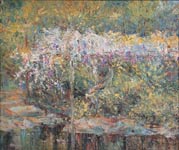
jitr-pic03.jpgJitr was born in Bangkok in 1911. He studied at the teacher training course at Rongrian Poh-Chang, and after more than a decade of teaching experience went to Japan on a Thai education ministry a scholarship. In Japan, he studied oil painting and sculpture at Tokyo Fine Arts School. It is often noted as historical fact that he studied oil painting under Kunzo Minami and sculpture under Fumio Asakura, but Jitr himself professes that he did not study under any one specific master.

As one of the few foreign students to come to Japan from Southeast Asia, Jitr was invited to events held throughout the country, such as the opening ceremony of the Kanmon undersea locomotive tunnel. He painted gorgeous scenes of Japan, rich with seasonal beauty, using his travels as inspiration. In 1942, Jitr held a solo exhibition at the Nichido Gallery and planned an exhibition in his home country as well. But tragically, most of his works, which would have served as important artifacts in the history of Thai-Japanese relations, were burned in bombing raids, and Jitr was only able to bring a few small pieces back to Thailand. Still, it is possible to glean from his remaining body of work that he had mastered portrayal of external light in the impressionist style as seen in his brilliant paintings of Japan’s vistas. Impressionism was not yet known in Thailand at the time, and Jitr is credited as the painter that brought the impressionist style to his homeland.

Jitr’s Artistic Contributions and Japan

Jitr returned to Thailand in 1946 to find the Poh-Chang school building destroyed in a bomb attack. He worked to rebuild the school and served as its headmaster. Jitr modeled the school after the Tokyo Fine Arts School where he himself had studied. He was impressed by Japan’s teaching methods, which struck a balance between Western influence and Japanese tradition, and used them to structure the school’s curriculum. He added new courses, including anatomy, composition, color theory, and art history.

Outdoor nature sketching also came into practice under his leadership. Moreover, Jitr designed the school building by himself — it was erected in Japanese-style mix of Japanese and Western convention known as the “Imperial Crown style,” only with a twist: he added a Thai-style roof to a Western structure.

Jitr’s art studies in Japan were in line with the Thai government’s goal of establishing an art system, and took place within the framework of public art administration and the training of art teachers. But Jitr the painter brought the impressionist style that took root in Japan after the establishment of the Hakubakai in 1895 which was the first Western style painters’ group in Tokyo, and from the mid-1940s to the early 1950s, Jitr provided the opportunity for French impressionism, imported via Japan, to take the Thai art scene by storm. In the late 1950s, Fua Hariphitak’s cubism made an impact among Thai painters, quickly pushing impressionism into the annals of history, but Jitr’s role in the history of Thai-Japanese art exchange will not be forgotten.

Postwar Exchanges: From Prints to Modern Art

On Jitr’s heels came many postwar artists who went to Japan to study, mainly printmakers. This group returned home after learning Japan’s advanced woodblock techniques and played a key role in the development of printmaking in Thailand. The pioneer artist who studied abroad was woodblock printmaker Praphan Srisouta. Srisouta was more interested in Japanese traditions, not in the latest printmaking techniques. Born in Lamphun in the Northern region of Thailand, he went to Japan in 1964 after studying at Silpakorn University. He reportedly spent most of his time studying Ukiyo-e woodblock prints by famed masters such as Hiroshige.

He journeyed from Japan to Germany before returning home in 1967 and went on to gain notoriety for his first solo show,
which showcased 90 of his original woodblock prints. These prints, which were dually influenced by Thai temple mural paintings and Ukiyo-e, portray the daily lives of children and feature vibrant depictions of people and beautiful black and white contrasts, and are considered some of the most precious masterpieces in all of Southeast Asia.

In recent years, Thailand’s modern art has received increased exposure in Japan, ushering in a new era of art exchanges between the two countries. Notable among these artists is Montien Boonma, who is often exhibited in Japan. His installations, which reflect an almost meditative Buddhist mindset, have remained popular even after his sudden death.

One artist of the younger generation has set in motion yet another new turning point in Thai-Japanese art exchange. That artist is Navin Rawanchaikul, who is married to a Japanese woman and works out of Fukuoka, Japan and Chiang Mai. Navin is not content to simply work out of this regional Japanese city. He closely examines the Fukuoka community where he lives and creates pieces that deal with issues within it.

These works have in turn allowed him to become involved in the Fukuoka community. He will continue to be watched as a new harbinger of Thai-Japanese interchange whether from the perspective of a teacher, learning as a foreign student, or showcasing his art.

Remembering the Railway of Death

Friday, March 21st, 2008

About a week ago the New York Times had an article entitled “Seeking Recognition for a War’s Lost Laborers” on the lack of recognition for the Asian victims of Japanese forced labor in the construction of the famous “Railway of Death.” According to the article, the history of the 200,000-300,000 Asians who were employed, and often killed, in the construction of the railway, which was being constructed to link Bangkok and the Burmese (Myanmarese) capital of Rangoon (Yangon) to provide logistical support for Japan’s invasion of Southeast Asia, has been almost completely overshadowed by stories of the smaller number of Western POWs.

Between 200,000 and 300,000 Asian laborers — no one knows the exact number — were press-ganged by the Japanese and their surrogates to work on the rail line: Tamils, Chinese and Malays from colonial Malaya; Burmans and other ethnic groups from what is now Myanmar; and Javanese from what is now Indonesia.

“It is almost forgotten history,” said Sasidaran Sellappah, a retired plantation manager in Malaysia whose father was among 120 Tamil workers from a rubber estate forced to work on the railway. Only 47 survived.

[...]

By contrast, the travails of the 61,806 British, Australian, Dutch and American prisoners of war who worked on the railway, about 20 percent of whom died from starvation, disease and execution, have been recorded in at least a dozen memoirs, documented in the official histories of the governments involved and romanticized in the fictionalized “Bridge on the River Kwai,” the 1957 Hollywood classic inspired by a similarly named best-selling novel by Pierre Boulle.


One reason given for this inequality of historical memory are that virtually none of the Asian victims were from Thailand, giving the local government little incentive to commemorate them. Another is that, unlike the American and British POWs who wrote memoirs and gave countless interviews to journalists and historians, virtually none of the Asian laborers were literate, and they lacked ready access to mass media.

At this point, I would like to present some photos I took at a very peculiar museum that Adam, his (now) wife Shoko, and I visited when we were in Kanchanaburi, the location of the famous Bridge on the River Kwai.

The Jeath War Museum (JEATH is an acronym for Japan, English, American and THai) is a rather eccentric museum based on the collection of a wealthy Japanese history buff, who apparently purchased a building a number of years ago, stocked it haphazardly with local WW2 memorabilia of both great and small interest, and has not had arranged to have it cleaned since.

First, some photos from outside the museum itself.

This is a picture of the famous Bridge which I quite like.

Here are Adam and Shoko posing with the bridge behind them. I do not know the sleeping man, but I have to assume that he is a war criminal of some kind.

This is a silly little train which lets  tourists ride across the bridge and 1 or 2km into the jungle on the other side, and then ride backwards to the other side.

I blurrily snapped this memorial obelisk in the jungle across the river, from aforementioned silly train. It says something along the lines of “the remains of the Chinese army ascend into heaven.”

This plaque is location near the bridge. I did not, however, see one for the British POWs, although I certainly could have just missed it.

And now we reach the museum portion of our tour. I do not seem to have any photographs of the entrance area, but the first thing you see upon approaching the entrance to the museum proper are these statues of historical figures, with biography written on the wall behind them. I will transcribe the highly amusing text another time.

Here is Tojo.

Adam and Shoko again, with their good friends Josef Stalin and General Douglas MacArthur.

The lovable Albert Einstein gets a wall as well.

Inside the museum we are confronted with more dramatic statues, such as this tableau of POWs constructing the railway.

Here is one in a cage. Note the real straw.

Eerie closeup of another caged POW statue’s face.

Adam and his new friend, the WW2-era Japanese soldier driving an old car.

The driver.

Another old car. I do not recognize the make, but it is covered in dust that may weigh as much as the steel.

US Army signal core teletypewriter

Recreation of Japanese army tent

Read the text carefully. Do you know when the CD was invented?

A message from Japan to the Thai people. It’s a bit hard to read, so if anyone wants I can transcribe it.

A British anti-Japan political cartoon

Overall, the museum is a complete shambles. While it has a huge array of cool stuff, it is strewn about almost at random, covered in dust, and sometimes behind other stuff. Not to mention placed in crowded and un-lit cases with poor labeling. Despite the numerous flaws, it is certainly worth a visit if you are in the area, but I can’t say that it will do much to provide any sort of historical narrative, and certainly does not even try to meet the standard hoped for by the Times article I began this post with.

A bit more on KMT remnant in SE Asia

Monday, November 5th, 2007

I was pretty surprised and fascinated by a BBC mention last week of KMT soldiers who had fled to Southeast Asia instead of Taiwan, and turned to banditry and drug trafficking instead of soldiery. In an excellent coincidence, the Taipei Times ran an article on Saturday’s issue on just this subject.


Descendants of KMT soldiers living in limbo


ON THE MARGINS: The offspring of former KMT soldiers who fled China are finding that while they are welcome to study in Taiwan, they may not be able to reside here
By Loa Iok-sin
STAFF REPORTER
Saturday, Nov 03, 2007, Page 2 “Stateless” descendants of former Chinese Nationalist Party (KMT) troops stationed in northern Myanmar and Thailand yesterday pleaded with the government to naturalize them.

Tens of thousands of KMT troops retreated across the Chinese border and stationed themselves in northern Myanmar and Thailand following the defeat of Chiang Kai-shek’s (蔣介石) Nationalist forces by the Communists in the Chinese Civil War.

As the push to retake China never took place, many of the soldiers and their families were stranded in the region.

Since these people entered Myanmar and Thailand illegally, they are not recognized by the two countries. Their descendants have thus been denied citizenship, although many of them were born and raised in these countries.

Some of these stateless people faced a new challenge after coming to Taiwan to attend college.

Chen Chai-yi (陳彩怡), from northern Myanmar, told her story during a press conference held at the legislature yesterday.

“I passed the college entrance exam held by Taiwan’s Overseas Compatriot Affairs Commission [OCAC] and was accepted by a university in Taiwan in 2003,” Chen said.

However, since she had no citizenship from either country, Chen purchased a forged Burmese passport to travel with, she said.

It was only once Chen arrived in the country that she discovered she would be required to prove her status before receiving Taiwanese citizenship.

“I wasn’t aware of this and the OCAC didn’t tell me when I took the exam [in Myanmar],” Chen said.

“I cannot return to Myanmar because I will be imprisoned for life for holding a forged passport, but my stay in Taiwan will also become illegal once I graduate from college,” Chen said. “I’m basically stuck.”

Liu Hsiao-hua (劉小華), chief executive of the Thai-Myanmar Region Chinese Offspring Refugee Service Association, estimated that more than 1,000 students from the region are in a similar situation.

Lee Lin-feng (李臨鳳), an Immigration Bureau official, said that there are difficulties involved in granting these people citizenship.

“What has blocked these people from obtaining Taiwanese citizenship is that neither they nor the Ministry of National Defense have any proof that they are descendants of former soldiers,” Lee said. “Even when some had proof, they were unable to submit a certificate renouncing their original nationality.”


Lee said she would seek a solution at the next Ministry of the Interior meeting, “considering the special circumstances.”

I’m rather surprised that these former KMT soldiers and their descendants have remained stateless for so long. It is hardly expected that Burma or Thailand would have granted them citizenship. Although both countries do have communities of Chinese citizens, they would hardly have put escaping soldiers and criminals in the same category as immigrant merchants. The article does explain that “these people [do not] have any proof that they are descendants of former soldiers,” but I have yet to see any reason for why the KMT remnant in SE Asia never rejoined their main force on Taiwan, once it was clear that they were well established there, and the threat of invasion from the mainland began to recede.

The article mentions the Overseas Compatriot Affairs Commission [OCAC] (see their official English language website here,) which handles documentation and residency for overseas Chinese citizens (Overseas Compatriot.) While in a strict technical sense, Republic Of China citizenship theoretically extends to all of China, as the ROC is constitutionally the government of China, but as the ROC itself has shrunk to include what may someday be called merely the Republic Of Taiwan, ROC citizenship today more or less means Taiwanese citizenship, and in practice excludes any citizen of the People’s Republic of China.

While I do not have time at the moment to examine it in detail, the OCAC provides rules on Overseas Compatriot status, as well as rules for applying to study in Taiwan through the OCAC, using the process referred to in the above article.

Another mention of the KMT remnant turned criminal in SE Asia comes from a surprising source- the subject of the new Denzel Washington film American Gangster, the famous real-life New York based drug dealer Frank Lucas. The following text is from an interview article in New York Magazine:

Lucas soon located his main overseas connection, an English-speaking, Rolls-Royce-driving Chinese gentleman who went by the sobriquet 007. “I called him 007 because he was a fucking Chinese James Bond.” Double-oh Seven took Lucas upcountry, to the Golden Triangle, the heavily jungled, poppy-growing area where Thailand, Burma, and Laos come together.

“It wasn’t too bad, getting up there,” says Lucas. “We was in trucks, in boats. I might have been on every damn river in the Golden Triangle. When we got up there, you couldn’t believe it. They’ve got fields the size of Tucson, Arizona, with nothing but poppy seeds in them. There’s caves in the mountains so big you could set this building in them, which is where they do the processing . . . I’d sit there, watch these Chinese paramilitary guys come out of the mist on the green hills. When they saw me, they stopped dead. They’d never seen a black man before.”

Likely dealing with remnants of Chiang Kai-shek’s defeated Kuomintang army, Lucas purchased 132 kilos that first trip. At $4,200 per unit, compared with the $50,000 that Mafia dealers charged Stateside competitors, it would turn out to be an unbelievable bonanza. But the journey was not without problems.

“Right off, guys were stepping on little green snakes, dying on the spot. Then guess what happened? Banditos! Those motherfuckers came right out of the trees. Trying to steal our shit. The guys I was with—007’s guys—all of them was Bruce Lees. Those sonofabitches were good. They fought like hell.

“I was stuck under a log firing my piece. Guys were dropping. You see a lot of dead shit in there, man, like a month and a half of nightmares. I think I ate a damn dog. I was in bad shape, crazy with fever. Then people were talking about tigers. I figured, that does it. I’m gonna be ripped up by a tiger in this damn jungle. What a fucking epitaph . . . But we got back alive. Lost half my dope, but I was still alive.”


(Via the Fighting 44s blog, pointed out by my friend Jon Lung.)

Tangential end-note: searching for “military remnant” on Google produced an article on the remnant of the Galactic Empire in Star Wars, following the end of Return of the Jedi.

Broken statue with rose [photo]

Tuesday, October 23rd, 2007

Ayutaya, Thailand
August 23, 2006

Memories of Thailand: The Sylvanian Hedgehog

Thursday, April 26th, 2007

Sylvanian Families is a line of Japanese-made toys featuring doll houses and anthropomorphic animal pals, “a quintessential part of the 1990’s boom in craze (or fad) toys” says Wikipedia. This little guy was greeting shoppers outside a Sylvanian specialty shop at Central World, a Bangkok mall with kind of a nonsense name:

p3100123-resize.jpg

After this photo was taken Mrs. Adamu and I helped ourselves to copious free samples at the mall’s upscale supermarket (hummus and pita anyone?) and watched the movie Sunshine (the new one by 28 Days Later/Trainspotting director Danny Boyle that’s not released in the US yet) for the equivalent of US$12 for two, with popcorn. Hm, I may have the dates mixed up on that (it might have been Deja Vu that I saw instead) but basically that was a good spot for myself and Mrs. Adamu.