Shizuka Kamei has been appointed minister of postal issues and financial services. The man is a fierce, fierce fighter who likes to dredge up personal scandals using his ties as a former police official. That’s probably how he got the job. Now he’s going to make sure Japan Post remains the world’s biggest and possibly worst-managed bank and he’s going to crush regional banks by allowing all the people they lended money to stop paying for three years. Great.
Adamu didn’t elaborate at the time, this is what he was talking about: Kamei is pushing for a moratorium on loan repayments for small and medium-sized companies, and says this moratorium should last for three years. This would mean that small businesses with loans or credit lines from banks which cannot be repaid can avoid being pushed into bankruptcy by their creditors and basically demand a stay as a right. And -if- when banks have problems because they can’t collect the money that they loaned, Kamei thinks the government should step in with capital infusions to the banks. And on it goes, this thing of ours.
Let’s be clear that this is not the US cash infusion into/takeover of major institutions such as Citibank, AIG, and GM. The US directly acted on the belief that these companies were vital spokes to the superstructure of the economy, and their failure would be a disaster. (Exhibit A: “Lehman Shock.”) And Washington gained an enormous level of control in these takeovers that, while controversial, do give it a major say in how macro-management operates.
Kamei’s efforts to keep small companies afloat may look noble from the little guy’s perspective. But it’s woefully short-sighted. Small companies across Japan’s countryside that are having trouble making repayments should either restructure themselves, or fail and be restructured by creditors or new management. Many have antiquated management with regards to accounting, employment rosters, operational efficiency, supply chains, etc. Companies that can’t adapt to changed economic environments are supposed to fail. Yes, some good companies caught in unlucky times are destined to be caught in the current credit crunch as they are unable to repay loans and go bankrupt. But bankruptcy is a good thing! It is the engine of economic development that allows bad companies to fail, stifled talent to move elsewhere, assets to be sold at whatever price the market will bear, and bad management to be replaced. Yes, it sucks that people lose jobs and shareholders forfeit their investments, but that’s life! Letting this happen is a necessity for economic growth.
And on top of this, the poor local banks, only barely functioning after 15 years of treading water with the bad loan crisis, will now inevitably reduce their limited lending activities to nothing. There will be no money to lend, thus no local business growth or economic development, and thus no entrepreneurial activity. A short-term benefit for stabilized employment rates means the countryside gets screwed in the long term.
Adamu said that he hopes Kamei “simply collapses under his own weight. He may well overreach in a position that gives him barely any authority at all.” Indeed — Minister of Finance Fujii opposes the moratorium plan, saying that now is not the right time, to which Kamei responded “The Minister of Finance should stick to his own job.” And while the official party line is that the moratorium is an item of discussion, Kamei has said that the “three party union” is agreed on this issue. Also, legal jurisdiction over postal privatization resides with Minister of Internal Affairs Haraguchi, who said at a press conference on the 18th “I want to work together with Minister Kamei [on the postal privatization issue].” Kamei said in an interview afterwards, “I will handle post office privatization on my responsibility as we discuss going forward. I have no intention of including Minister Haraguchi on this.”
(Oh, and an endnote to point out how much of an idiot Kamei is, in waffling over his opposition to foreigners voting in local elections, he had this to say: “The ratio of resident foreigners differs by region. It would be unacceptable if worry and dissatisfaction arose in certain areas where Japanese are the minority and their personal will is not reflected in local politics.” The town with the largest percentage of foreign residents is Oizumi-machi in Gunma prefecture, with a 10% population of foreign nationals. If I reverse engineer his point to its logical conclusion, we should implement voting for foreigners in local elections immediately and reconsider it in a few decades when there is finally a town large enough to put Japanese people in the minority.)









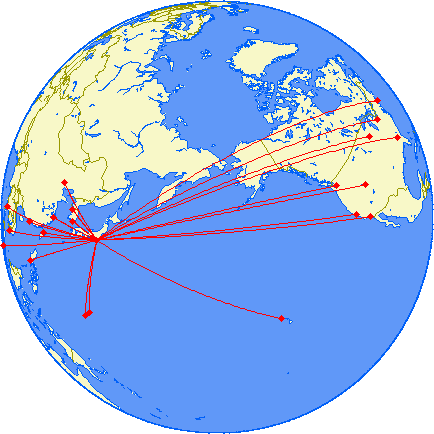 This is the ex-Narita route map of Delta Air Lines following its acquisition of Northwest. Delta is the #3 carrier at Narita with about 330 flights/week, compared to JAL’s 870 and ANA’s 500.