WITNESS the seedy underbelly of the Visual Kei scene

Everyone, stop what you’re doing and read Tokyo Damage Report’s epic piece on the visual kei music scene. The way it’s written makes it hard to quote, but here are some relevant facts. The interview is long but well worth your time. Read to find out:

  • The coming together of of shojo manga and glam rock that created Visual Kei in the 80s.
  • How Japanese recording acts are formed and popularized.
  • How popular bands find ways to maximize revenue from fans (selling photos, lots of “limited edition” merchandise, and special izakaya parties for the most gullible/hardcore fans)
  • Where the labels go to find talent (it’s mostly ex-thugs).
  • Why Japanese record producers — think Yasushi Akimoto of AKB48, Tsunku of Morning Musume, etc. — are so heavily relied upon to produce every aspect of the final product that they become drug-addled auteurs.
  • The typical salary for a visual kei band member (lots of in-kind perks, very little cash)… and why they put up with it
  • The willingness of label bosses to forego short-term financial gain in favor of long-term connections (perhaps an ubiquitous aspect of Japanese business relations)

For some reason he’s been sitting on this gem since 2008! Shame on you, man.

It’s hard to tell the credibility of some parts, but I think it’s easier to swallow as a true-to-life mockumentary than as a faithfully transcripted interview.

To close out, here’s the video for one of my favorite viz-k songs, Luna Sea’s “Tonight”:

Filipino Freethinkers

Due to aggressive evangelism and indoctrination over the course  of three centuries of Spanish colonial rule (ending in 1898), the Philippines today is overwhelmingly Catholic. A  few percent, mainly in the far south, are Muslim, a very few communities still practice pre-colonial indigenous religion, and maybe 10% or so have converted to Protestant or evangelical Christian sects due to American influence over the course of America’s half-century of colonial rule (roughly 1898-1946). While the US-derived constitution does provide for separation of church and state, Catholicism is still so deeply entrenched that the technically required secularism of public education is said to be ignored, and (as I have mentioned before) public policy in areas like birth control are largely dictated by Vatican doctrine.

But of course, there are exceptions. While abortion is utterly banned (although naturally, still available in sub-par conditions to the desperate), condoms are sold openly in every convenience store and pharmacy, and the overpopulation crisis has led to a bill in congress to provide public funding to birth control, against the will of the Church and the staunchly Catholic current president Gloria Arroyo.  (Arroyo’s term is nearly over, and the fate of the bill under the next president, yet to be chosen, is uncertain.) Homosexuality is another interesting case. While the law of the land affords no particular rights to LGBT citizens, in comparison with the recent trend in many Western countries towards allowing same sex partnerships of one variety or another, or anti-discrimination laws, the Philippines also does not persecute gays and lesbians, as for example, most Muslim countries so, and as many US state would continue to do if so allowed by the federal government. The society at large, like most of Southeast Asia, is also generally exceptionally tolerant of minority sexualities when compared with the official doctrine of the dominant, highly conservative, religion.

But while being an out of the closet gay is generally acceptable here, coming out as an atheist is reportedly considered to be something deviant. If atheists are the most distrusted minority in America, surely their status is even lower in the Philippines. While my handful of Filipino friends here, who I know from studying in Japan, all fall on or near the atheist end of the spectrum, virtually every other person I have spoken to in the Philippines has been a vocal Christian, usually Catholic.

Which brings us, finally, to the title of this post. The day before yesterday I was getting a tour around the historical district of Intramuros from a government archaeologist  named Joseph, he mentioned to me that he and his family had converted from Catholicism to American style evangelical Christianity several years before, and that he now found the idolatry of Catholicism disturbingly heretical. “These days,” he told me, “the number of freethinkers is really on the rise.” This turn of phrase both surprised and intrigued me, as the term “freethinker” is one I had always associated with the modern atheism movement, but I still understood his usage. I must admit that to make a conscious choice regarding one’s belief and walk away from the religion of one’s parents, rather than to un-critically accept it, is in a sense as much an exercise of freedom of thought as to walk away from religion entirely, even if as an atheist myself I consider both the original and adopted religion equally irrational.

With that brief conversation in mind, I was particularly intrigued when, yesterday afternoon at around 4pm, when I was wandering around the University of the Philippines Dilliman Campus, in Metro Manila’s Quezon City, following a lunch appointment I had had in the area, I was handed the following flyer and pointed to the red brick-faced UP Film Center just down the block.

Naturally, I went.

The program consisted of much what one might expect. (Full list here.) For example, the Richard Dawkins video The Root of All Evil? (Embedded below.)

<embed id=VideoPlayback src=http://video.google.com/googleplayer.swf?docid=9002284641446868316&hl=en&fs=true style=width:400px;height:326px allowFullScreen=true allowScriptAccess=always type=application/x-shockwave-flash> </embed>

And ending with Julia Sweeney’s Letting Go of God, which I have embedded part of below.

<!–copy and paste–><object width=”334″ height=”326″><param name=”movie” value=”http://video.ted.com/assets/player/swf/EmbedPlayer.swf”></param><param name=”allowFullScreen” value=”true” /><param name=”wmode” value=”transparent”></param><param name=”bgColor” value=”#ffffff”></param> <param name=”flashvars” value=”vu=http://video.ted.com/talks/dynamic/JuliaSweeney_2006-medium.flv&su=http://images.ted.com/images/ted/tedindex/embed-posters/JuliaSweeney-2006.embed_thumbnail.jpg&vw=320&vh=240&ap=0&ti=86&introDuration=16500&adDuration=4000&postAdDuration=2000&adKeys=talk=julia_sweeney_on_letting_go_of_god;year=2006;theme=is_there_a_god;theme=whipsmart_comedy;theme=spectacular_performance;theme=art_unusual;theme=master_storytellers;event=TED2006;&preAdTag=tconf.ted/embed;tile=1;sz=512×288;” /><embed src=”http://video.ted.com/assets/player/swf/EmbedPlayer.swf” pluginspace=”http://www.macromedia.com/go/getflashplayer” type=”application/x-shockwave-flash” wmode=”transparent” bgColor=”#ffffff” width=”334″ height=”326″ allowFullScreen=”true” flashvars=”vu=http://video.ted.com/talks/dynamic/JuliaSweeney_2006-medium.flv&su=http://images.ted.com/images/ted/tedindex/embed-posters/JuliaSweeney-2006.embed_thumbnail.jpg&vw=320&vh=240&ap=0&ti=86&introDuration=16500&adDuration=4000&postAdDuration=2000&adKeys=talk=julia_sweeney_on_letting_go_of_god;year=2006;theme=is_there_a_god;theme=whipsmart_comedy;theme=spectacular_performance;theme=art_unusual;theme=master_storytellers;event=TED2006;”></embed></object>

Both of those videos were ones that I already knew of, but had never seen, so I was happy to go in and watch them. And while  they were enjoyable enough, I had really been hoping to see something local, either the Philippines equivalent of a Richard Dawkins-esque attack on the pernicious influence of religious dogma on society or a documentary about the Filipino Freethinkers group itself. Unfortunately, there were no locally produced films, although they are trying to put together something themselves for the next time. But following the conclusion of the last film, Ryan Tani, president of the group, did take the lectern and microphone and give a summary of the FF’s history, purpose, and activities.

The founding members, a half-dozen friends of an atheistic/agnostic persuasion and frustrated with a lack of public space to discuss their feelings about religion, decided to organize an informal meetup group just over a year ago. After experimenting with different schedules, they settled on a bi-weekly meetup, which gets an average of 20-30 attendees, out of a total of perhaps 100 who come from time to time, and out of 800 members on their Facebook group, which also includes plenty of members who live too far away to make it to the Manila meetups.

A couple of months ago they decided to organize this film festival as a means to reach out to a wider audience. Interestingly, funding for the film festival, which seemed to borrow some of the tried-and-true hospitality tactics of campus evangelical organizations like  free snacks, was provided by a Silicon Valley entrepreneur with no apparent ties to the Philippines, who simply came across the fledgeling organization online and decided to help them out. He gave a brief comment towards the end of the program, but had to duck out before the post-event mingling and I was unable to chat with him to find out his story.

But I did spend a good while talking with those who stayed past the end of the films, which were mainly those who already knew each other from the meetups rather than new faces like myself, and ended up being invited along for dinner. (Amusingly, this was at the same restaurant I had eaten the night before with my local friends, a place called Trellis that we had been to on each of my three visits to Manila, and quite literally the only restaurant in the area the name of which I actually know.)

It is unsurprising that they chose the University of the Philippines Dilliman campus as their venue, as the flagship campus of the elite public university has a reputation for left wing – even Marxist – faculty and students. It is also unsurprising that the members of Filipino Freethinkers are themselves almost universally graduates or current students of elite schools like UP, Ateno de Manila or De La Salle.

Also unsurprisingly, it was a pretty geeky crowd, with a high representation of people in the software industry, sciences, psychology, and plenty of fandom for scifi novels, video games, comic books, tabletop role playing games, anime and manga, etc. Basically, the same kind of people I hang out with at home, with the same kinds of interests, and table discussion that sounds barely at all different from my friends back in New Jersey/New York, except for the Filipino accents, and sometimes – but surprisingly rare – interjection of Tagalog into the heavily English language conversation.

And about the same average level of religious engagement, except that while I estimate that at least half (maybe far more) of my atheistic/agnostic friends at home come from families of an already religiously apathetic bent, the Filipino Freethinkers almost all come from extremely Catholic, or at least Evangelical, families, who were strongly opposed to their decision to leave the Church. This social pressure makes clear why they decided that a specifically atheist themed social organization was needed. I suppose if I had grown up in the Bible Belt I might have longed for such a group in high school or college, but coming from Montclair, NJ it wasn’t exactly an issue, and spending several years in Japan – perhaps the most religiously disinterested nation on the planet – has put me increasingly out of touch with the reality of living in an overwhelmingly religious society.

The last several years have seen the birth of a new movement of pr0-atheism writing and activism around the world, which has even started to bubble up in the strictly Catholic Philippines. Pro-atheism films like those here are rarely, if ever, screened here (The Invention of Lying was also mentioned, as a major Hollywood film that simply wasn’t distributed in the country due to its anti-religious content), and this may very well have been the first public screening of most of this material.

The Filipino Freethinkers are trying to establish more local chapters of their informal group, and some current UP students who are formally establishing a campus chapter, as a registered campus organization, were in attendance. I won’t deny the great art and culture that religion has inspired throughout history, and I do very much enjoy learning about religion in its complexity, and do very much enjoy certain ritual aspects of religion, but as time passes I lean increasingly towards the stance that not only are the most fundamentalist religious – the Al-Qaedas and abortion doctor murders – dangerous to society, but that genuine, deeply felt religious belief is always the enemy of rationality and a danger to a stable world. It heartens me to see secularists starting to come out of the closet in this deeply religious country, and I wish them luck in persuading others of like mind to do the same.

I would also like to end by briefly making a statement along the lines of what was being proclaimed at the meeting. Opposition to religion does not mean opposition to morality, only a recognition that morality is derived from our nature as an evolved social animal, rather than from a supernatural source. Opposition to religion also does not mean opposition to the religious. Freedom of thought and belief is sacrosanct, and nothing is more important than the development of a society in which all shades of belief and non-belief are permitted.

The Filipino Freethinkers website is located at filipinofreethinkers.org , and they do most of their organizing through the Facebook group.

Time for some travel

Once again, I have made a promise to post all of my backlog of travel photos and narratives before embarking on my next journey, which yet again lies unrealized. Tomorrow – or technically today as I write this at 3.30am – I depart for a primarily research-justified trip to Manila, Philippines and Taiwan. I will be in Manila from the 23rd to the 28th of February, then fly to Taipei on the 1st of March, and back to Manila on the 14th, from whence I return to Japan on the 21st. Following that, I am taking an entirely non-research trip to Seoul from March 24-31.

Taiwan will be mainly in Taipei, but with a few days going down to the south, Kaohsiung, maybe Tainan, maybe Taichung area. Philippines will be almost totally Manila, and Korea will be basically just Seoul.

People in any of those places, feel free to get in touch and see if we can meet up!

Chinese Tourists Need Housetraining

Also posted at ComingAnarchy — please weigh in with comments there.

On the summit of Jebel Hafeet, on the border of the UAE and Oman, I found this graffiti — the characters for “China” spray painted on the rock.

jebel hafeet graffiti

I saw similar graffiti in a natural valley in Sapa, Vietnam, back in 2005. As China grows richer, and its citizens find more opportunities for overseas tourism, I guess we should expect more of this kind of vulgar graffiti to pop up in the natural tourist sites of the world.

I’m happy that China’s economic development has created an upwardly mobile middle class that has the opportunity to travel overseas. I just wish they wouldn’t take out their lack-of-modern-empire-penis-envy frustrations on the natural environment of the world. And Japan, perhaps China’s biggest buggaboo, is possibly the biggest target for this graffiti as more and more Chinese tourists flood in to visit its temples, shrines and other monuments.

(It could be worse — at least the Chinese government doesn’t have management over tourist sites outside China, which would be a real disaster for human civilization).

We’ve seen this one before, haven’t we

Spurned lover’s poisoned curry revenge

Day after day Lakhvir Singh sat in the dock at the Old Bailey, usually with her eyes closed, as family members and her love rival gave evidence against her.

From her arrest – of which a police officer said: “She appeared calm and controlled and did not show emotions” – right up to her conviction, Singh appeared detached from the cruel death she inflicted on a man she professed to love.

The court heard how the 45-year-old mother-of-three had a secret affair with Lakhvinder Cheema, which lasted 16 years.

But two weeks before he was due to be married to Gurjeet Choongh, “lovesick” Singh, laced a pot of curry with Indian aconite, which is known as the “queen of poisons”.

Trams in Japan

My long post the other day on the history of department stores in Kyoto naturally included a lot of discussion on the relationship between department stores and railways. In that I mentioned that:

The predecessor to the Hankyu Railway Company was Minou Arima Denki Kidou (箕面有馬電気軌道), or the Minou – Arima Electric Railway, and called Kiyu Densha (箕有電車). (kidou is a now rarely used word that translates to “permanent way” in English, referring to the physical infrastructure of railway tracks.)

In the comments section, Aaron corrected me by pointing out that the word 軌道 is not itself particularly rare, to which I responded. “I meant that particular usage of 軌道. Actually it’s still commonly used as railway jargon, but not among the general populace. My point is that the idea of seeing a railway actually using 軌道 in its name today would be anachronistic.”

Joe responded to this by pointing out that, in fact, there is a company with such a name in just the next prefecture, Osaka’s Hankai Tramway Co. Ltd., known in Japanese as 阪堺電気軌道.

Looking at Wikipedia’s list of Japan’s 20 or so surviving tram lines  (which thanks to Japan’s huge train otaku community, I think we can safely trust as comprehensive), there are actually three companies with this term kidou in their name. First is the aforementioned Hankai in Osaka, as well as the Nagasaki Electric Tramway (長崎電気軌道) and the Okayama Electric Tramway (岡山電気軌道). Very interestingly, Wikipedia claims that these two railway companies, founded in 1914 and 1910 respectively, are the only two (or at least two of the only, it is not entirely clear) Meiji-era railway companies in Japan to have never changed their name.

However, the Hankai Tramway is a different story. The current, old fashioned corporate name doesn’t even date from the age when it would have been a common name, with the company only having been founded in 1980 when it was spun off from the Nankai Electric Railway Co., which still owns 100% of the stock. The Hankai tramway itself dates back to 1897, and has gone through a dizzying number of acquisitions, sales, and name changes over the years. I won’t even begin to summarize it, but the important fact is that its name from 1910 to 1915, when it merged with 1915. In short, the current name is a relatively modern  (i.e. 1980) revival of a century old name, which I think can fairly be described as anachronistic.

Incidentally, Kyoto has two similar old fashioned tram lines remaining in use, which are currently two separate companies, were founded separately, but were at one point combined.  One, the Randen line going from Shijo-Omiya to Arashiyama was originally the 嵐山電車軌道 or Arashiyama Electric Railroad (founded 1910), but was acquired by Kyoto Electric in 1918. Kyoto Electric established the  Keifuku Electric Railroad Co. (京福電気鉄道) in 1942. (Randen, an abbreviation in Japanese of “Arashiyama Electric Railroad,” is still the name of the line itself, sometimes leading to minor confusion.)

While today, railway companies are most associated with department stores, early electric trains in Japan were often established by electric power companies, before electricity was such a universally available resource. Kyoto Electric (京都電燈) was founded in 1888 to provide coal power to Kyoto, and around 1892 began providing hydroelectric power from the Lake Biwa Canal.  As demand for electricity skyrocketed beyond the capacity of the Biwa Canal plant, Kyoto Electric shrunk, with Kansai Electric eventually taking over their power generation and transport operations. It went bankrupt in 1942, with Keifuku being established to continue the railway operations in its place.
The other old style line in Kyoto, the Eiden going to Kurama and Mt. Hiei, is called the Eizan Railroad (Eiden is an abbreviation of the Japanese, 叡山電鉄), but was previously  the Kurama Electric Railroad (鞍馬電気鉄道) , which had been established in 1927 to manage the railroad that had been started in 1925 by Kyoto Electric, and was later folded into Keifuku. Today it is a wholly owned subsidiary of the much larger Keihan Electric Railway, which acquired all of its shares in stages following its split from the Keifuku Electric Railroad Co. in 1985.

Incidentally, Keifuku Electric Railroad used to also run some trains in Fukui Prefecture, to which today’s Echizen Railway is a successor.

Update: One thing I didn’t specifically mention originally but meant to point out is that all three of the railway companies with kidoh in their name translate it as “Tramway” in English, while no other company or line (as far as I can tell) does so today. The standard word for “tram” itself is also 路面電車.

The Keifuku and Eiden are both trams, but Keifuku also still operates the, Eizan Cable line, which is technically a funicular, even though it is actually located in the territory of Eiden. Amusingly, the tiny cable line on the other side of Mt. Hiei, the Sakamoto Cable, is the only system operated by Hieizan Railway, which began in 1924 and today is, like the Eiden, a subsidiary of Keihan.

Japanese Names, White Faces

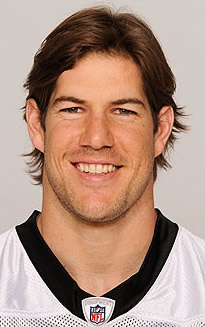
Marmot has a post titled “Funny, You Don’t Look Like a Mr. Fujita…” that looks at the case of Scott Fujita, a 6′5″ 250 pound white football player with a Japanese name who plays for the New Orleans Saints. He’s not ethnically Japanese, or even Asian, but was adopted by a family with a Japanese-American father born in the World War II detainment camps. He reportedly feels Japanese in his heart and is a fan of mochi ice cream and Pocky.

Reading the post and the comments reminded me of my meeting with Sailor Nathan Nakano, resident on the USS Kitty Hawk, when I visited as a guest of the Tiger Cruise in Yokosuka in 2006, seeing US military hardware and life on board an aircraft carrier, courtesy ComingAnarchy reader Eddie.


Curzon and Nakano, September 2006

I remember asking Nakano: That’s a Japanese name! What gives? And if I recall correctly, his father’s father was either Japanese or half-Japanese, making him one-fourth or one-eighth Japanese. You can read a news story that quotes Nathan here.

I wonder how many Westerners there are with Japanese names in the world? Marmot’s commenters have a few stories relaying similar stories about white kids with Japanese names due to adoption or stepfather relationships. There’s also a (sorta) opposite case, Haruki Nakamura, the current United States Chess Champion — he was born in Japan to a Japanese father and American mother, but his parents divorced, his mother remarried a Sri Lankan, and his stepfather, FIDE Master and chess author Sunil Weeramantry, taught him chess. So he’s got a Japanese name, but has only non-Japanese parents.

ドバイ巻き and an Overview of Dubai’s Japanese Restaurants

Sushi outside Japan has take on a number of different mutations. From the California Roll developed in Los Angeles in 1963, a number of “special rolls” have become popular in the Japanese restaurants of the world. Some are just ordinarily special, like the Dragon Roll (California Roll plus unagi eel), to the exciting Bronco Roll (California roll with salmon and tuna on top) and the amusing Disco Shrimp Roll (California roll with spicy sauce and baked shrimp on top).

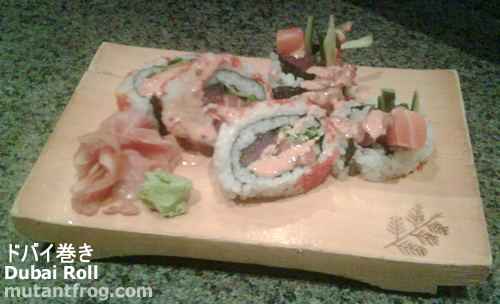
Not surprisingly, an innovative Japanese restaurant in Dubai called 弁当屋 (Bentoya) has come up with the “Dubai Roll” — tuna, salmon and cucumber (with “spicy sauce” added to give it some bite).


Sorry for the poor resolution and lighting — this photo was taken with my phone.

Why the contents of tuna, salmon and cucumber? The joke among my Japanese colleagues at the restaurant was that, since Dubai is constantly pushing to be number 1 at everything, the Dubai Roll has to have all the top sushi ingredients in one bite.

As many readers may know, once you’re hanging out with Japanese overseas, there’s an overwhelming trend to going to Japanese restaurants, and I’ve now been to them all in my 10 weeks in Dubai. Bentoya is the oldest Japanese restaurant in the city, but it’s pretty disappointing cuisine. The other notable Japanese restaurants are:

* 喜作 Kisaku: Kisaku is the most authentic Japanese restaurant outside Japan you could conceive. It was founded and is managed by Chitoshi Takahashi, a Japanese chef who started in the Middle East twenty years ago working in-house for the Iran branch of a major trading company, and who is such a fixture of Japanese cuisine in the Middle East that he was recently featured as the first person profiled in the book 中東のクールジャパニーズ. This restaurant serves everything — real sushi and sashimi, yakitori, and basically anything else you’d find in a standard izakaya fare such as shiokarashi, ika natto, and daikon sarada. Not only are all the chefs Japanese, so are most of the waitresses, and more bizarrely, at least two Filipino waitresses working in the restaurant also speak Japanese fluently (I spoke with one, and she apparently worked in Nagoya for five years before moving to Dubai).
* 菊 Kiku: Kiku is the leading competitor to Kisaku for authenticity, with possibly better sake but certainly inferior food (note: some Japanese friends disagree with me). The biggest letdown to this place is that the menu is in Japanese, the food is real, yet the Filipino waitresses don’t speak a word of Japanese. That may sound silly, but coming from Kisaku, it feels incomplete. Speaking with Japanese friends, eating Japanese food, the illusion of being back in Japan by the real Japanese food is ruined when I have to say, “A plate of hamachi sashimi, please… yes, that’s yellowtail.”
* 都 Miyako: Miyako is a lifeline for many of the Japanese who are in Dubai neither by choice nor desire. It is situated in the Hyatt Regency, which has an entire residence wing of hotel apartments that is full of Japanese people. It has a sushi bar, but is more of a standard teishokuya You can read a Japanese review here. There are a number of Japanese people who, given the option, won’t even leave the Hyatt Regency complex on weekends, part of the phenomenon I mentioned previously on MFT here.
* Nobu: The Dubai branch of the signature restaurant by world-famous L.A. Japanese chef Mitsuhisa Nobu is situated in the lowest floor of The Atlantis. Some might say that Nobu is not genuine Japanese food, it’s designed for the Western, not Japanese, pallet, and it’s absurdly overpriced, but I could never say such a thing publicly.
* Zuma: Zuma is apparently conceived by a Japanese chef but the cooking and wait staff are all non-Japanese international, from Filipino to Kenyan to Chinese to Belarussian. The food here is pretty close to being authentically Japanese but it’s missing a certain zest. Or said otherwise, Nobu is Japanese food made for Western people, where as Zuma is Japanese food conceived by a Japanese chef but made by non-Japanese. A comparison between the two can be read here.

Japan Times vs. Japan Times

February 4:

Men miss out on Valentine’s chocolate as women treat themselves

Japan’s unique Valentine’s Day tradition of women giving chocolate to men is melting away as more women show a preference for pampering each other instead of their boyfriends and spouses.

The practice of giving tomo choco (friendship chocolate) has been highlighted as a new trend in a recent survey that found 74 percent of women plan to give a Valentine’s gift to a female friend but only 32 percent intended to buy something for a boyfriend.

And the trend is well established. Ninety-two percent of respondents said they had received tomo choco from a friend last year. Just 11.2 percent said they plan to give chocolates to confess their love to someone, according to the survey by chocolate-maker Ezaki Glico, Ltd., which questioned 500 women aged between 10 and 30 over the Internet.

February 5:

Valentine’s chocolate defies recession
Cheap, expensive or made at home — Cupid says it’s all good

As many businesses continue to shake their heads over how tough it is to make sales in these financially difficult times, “cheaper is better” is the strategy of the day, with shops slicing prices for everything from “gyudon” (beef on rice) to jeans.

But one thing consumers — especially female ones — will loosen their purse strings for are those little drops of heaven that are sure to melt their darlings’ hearts come Feb. 14, say chocolate retailers, whose customer-oriented strategies have seen both luxury brands and affordable sweets fly off the shelves at equal speed.

…According to [an Isetan spokeswoman], the recession has done nothing to spoil consumers’ appetite for high-quality chocolate, with the buzz extending beyond hardcore fans this year. This follows the recent consumer trend where couples and families prefer to stay at home rather than go out, and so were interested in buying luxury chocolates to enjoy together, she said.

So is the Japanese race doomed to extinction, or isn’t it?!