Uncontent with barking up trees, Chinese plaintiffs switch to pissing in wind

Since Japanese courts will not award them compensation, Chinese plaintiffs are now suing the Japanese government in Chinese courts to claim damages for Japanese actions during World War II.

None of the more than 20 cases since the early 1990s had ended in success, Tong Zeng, a campaigner for the cause and chairman of the non-government Chinese Association for Claiming Compensation from Japan, was quoted on Monday as saying.

“The likelihood of us winning the cases in the Japanese courts, influenced by right-wing forces who show no remorse at all, is very small” the Beijing Times quoted Tong as saying.

The Japanese government insists that the issue of war reparations was settled by the 1951 San Francisco Peace Treaty, that formally ended the war, and by later bilateral treaties. It says all wartime compensation issues concerning China were settled by a 1972 joint statement establishing diplomatic ties.

But Chinese courts also had jurisdiction over the claims and could hand down more fair verdicts — by trial in absentia if necessary, Tong was quoted as saying, adding the number of the lawsuits might jump due to the lower cost.

Now, I’m sure a Chinese court can get around Paragraph 5 of the Joint Communique of 1972:

The Government of the People’s Republic of China declares that in the interest of the friendship between the Chinese and the Japanese peoples, it renounces its demand for war reparation from Japan.

‘Cuz, after all, it isn’t the government asking for reparations. But that’s besides the point.

Unfortunately for these plaintiffs, they’re obviously wasting their time, because you can’t effectively sue the Japanese government in China. This badly formatted but still useful summary details how foreign judgments are enforced in Japan. You have to go to Japanese court, and they have to make the following analysis before giving an injunction to enforce the foreign judgment.

Article 118 of the Code of Civil Procedure

A foreign judgment which has become final and conclusive shall have effect only if it satisfies the following conditions:

i. the foreign court has jurisdiction according to laws or treaties;

ii. where the defendant has lost the case, he was notified of the litigation by service of documents (except service by publication) or he had entered appearance before the foreign court;

iii. neither the judgment nor the procedure of the foreign court is contrary to the ordre public of Japan; and

iv. there exists reciprocity.

Japanese courts refuse to enforce foreign judgments on “public policy” grounds all the time. For instance, if a Japanese defendant is ordered to pay punitive damages by a U.S. court, no Japanese court will enforce that part of the verdict, because punitive damages are against “public policy” under Japanese law.

Given that these “right-wing” Japanese courts have already dismissed many claims for reparations, who’s to think that they’ll change their mind just because the case was tried in a different forum?

I’ll grant you that these new lawsuits in China will be a PR field day for the Chinese government. A verdict might come down; Chinese police might try to seize Japanese assets in China, or something crazy like that, and will probably make governments the world over scratch their heads about whether they really want to do business in the Middle Kingdom.

But that’s all they’ll be good for. Aside from having their issue publicized, the plaintiffs are not going to benefit. Meanwhile, watch as Sino-Japanese relations become even more screwed up. I’m glad to be living in Japan, where most people don’t subscribe to this lunacy (they have much more interesting lunacies here).


News to Me: Brooklyn native elected to Inuyama, Aichi Pref. City Council in 2003

It seems I am a bit late to the ball, but as a follow up to my bit on the expanding role of foreigners in Japan in my “Japan apologists” post, I’d like to introduce you to the first American elected official in Japan, Anthony Bianchi, who was voted into the city council of Inuyama City, Aichi Prefecture in April 2003. The best way for you to learn about him is to listen to this 2003 NPR interview (Requires Windows Media Player). The native Brooklynite came to Japan as an English teacher in 1989, married a Japanese woman and became a naturalized Japanese citizen in 2002 after 3 years of paperwork. It’s great to hear him explain in his thick Brooklyn accent how he managed to get more votes (3,000) than any native-born Japanese candidate in the election.

He explains that the keys to his huge success were: a) His years of teaching produced a large contingent of people of voting age who knew him from being his student; and b) Dissenting voters appreciated his promises to bring a more open style of politics to the city. In Inuyama, a suburb of Nagoya with a population of 73,000, he was able to ride his close relations with the citizens and a populist platform (given all the more relevance by his status as an experienced outsider) to victory in a low-turnout election.

Bianchi speaks in an earnest, convincing manner and uses American-style aggressive political tactics to push populist causes. His first initiative was easy: he demanded that the mayor carry out a plan to broadcast city council proceedings on the Internet, something that many other cities had done already but that Inuyama had been dragging its feet on. But it made for great press when he demanded the change in his first question after being elected. Thankfully, he did it, so now the world can watch him spout off about fascinating topics like government procurement and public comment systems here (requires Internet Explorer).

Bianchi’s story is a fascinating example of how a Western foreigner can successfully assimilate in Japan. He campaigned on a platform of “Protect traditions together and make the future bright for the sake of Inuyama,” and his homepage exclaims, “Progress over precedent, common sense over ordinances!” He also looks to be very involved in the Japanese vision of “internationalization” meaning lots of cultural exchanges and eikaiwa classes.

Bianchi’s political style stands in stark juxtaposition with that of a better-known Western-born activist in Japan, Debito Arudo (Pictured below). Debito, also a naturalized Japanese citizen who was born and raised in the US (California), is much more confrontational, divisive, and preoccupied with identity politics. Continue reading News to Me: Brooklyn native elected to Inuyama, Aichi Pref. City Council in 2003

Bazooms go boom

In the news:

[Virgin Galactic] spokesman Will Whitehorn told The Sun safety concerns have come to light for those who want to be launched in groups of eight to an altitude of more than 60 miles for 7 minutes of weightlessness.

“We’ve discovered there may well be issues with breast augmentation,” he said. “We’re not sure whether they could stand the trip — they could well explode.”

Now there’s something all those anime artists didn’t foresee.

FUNNY: Fake “The Office” PSAs on NBC

Apparently, this is an April Fool’s Day stunt: fake PSAs are being aired on NBC, featuring the cast of “The Office.” For example:

You might be out with your friends on the weekend in a cool part of town, and someone offers you a beer for nine dollars. Don’t do it. Nine dollars is way too much to pay for a beer. Just walk away.

In a feat of true generosity, NBC put all of them online. Enjoy.

Three cheers for Lin Wuei-chou

From The Taipei Times:

To highlight his disappointment with what he called the ongoing political confrontation within the Democratic Progressive Party (DPP) and its all-round degeneration, DPP Legislator Lin Wuei-chou (林為洲) yesterday quit the party, urging voters to quit political parties, become neutral and avoid getting caught up in the “partisan squabbles” provoked by politicians.

Lin, who joined the party in 2000, released a three-page statement yesterday announcing his decision to quit.

In the statement, Lin said he was loath to see both the pan-green and pan-blue camps take advantage of people’s passions to mobilize them to join large-scale parades and rallies that actually serve no concrete purpose whatsoever.

Partisan politics in Taiwan are notoriously, nay, hilariously bitter. What exactly is Mr. Lin Wuei-chou trying to escape from? Here are a couple of examples that I have blogged in the past, plus one new one from the very newest issue of the Taipei Times.


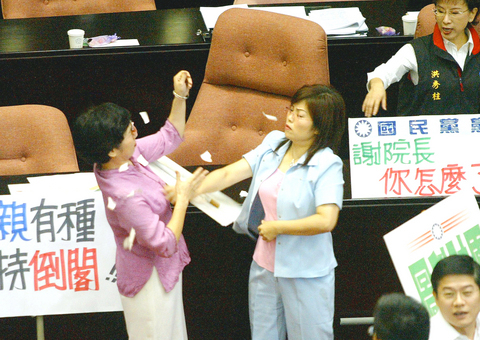
DPP Legislator Wang Shu-hui, left, attacks KMT Legislator Kuo Su-chun, right, after Kuo tore up a copy of Premier Frank Hsieh’s policy report that he was scheduled to deliver yesterday at the opening of a new sitting of the legislature.

Speaking at a separate event, TSU Chairman Shu Chin-chiang (蘇進強), however called the government a “liar” in front of DPP Chairman Su Tseng-chang (蘇貞昌) at an activity held by the Hand-in-Hand Taiwan Alliance that both men attended yesterday morning.

Shu’s remarks immediately made the atmosphere awkward.

[…]

Sitting beside Shu, Su looked embarrassed and did not respond to his criticisms.

The two men did not talk to each other and left the news conference separately.

And from today…

Friday, Mar 31, 2006,Page 4

Minister of Education Tu Cheng-sheng (杜正勝) yesterday told reporters that Chinese Nationalist Party (KMT) Legislator Lee Ching-hua (李慶華) had been acting like a three-year-old, one day after Lee called him “Dick Minister” and “Pert Minister,” referring to a shampoo brand, during a legislative committee meeting. The heated exchange of words arose over Lee’s discontent with a ministry-published high school sex education pamphlet which contained explicit sexual references. “If Lee had carefully read the pamphlet, he wouldn’t have noticed only the [explicit material]. Only three-year-old children would see nothing but [that material] in the pamphlet,” Tu said, adding that Lee was not a “well-educated person” and that him being a lawmaker could only waste the nation’s resources. When asked for comment, Lee said he had suggested Tu and his wife make public images of the two copulating in the pamphlet.

United States partisan politics may not have quite yet reached this level of clownishness, but it’s close enough so that I’m disgusted with the whole business. Therefore, I am swearing an oath-if any major partisan politician running in elections for which I am eligible resigns from their party and severs all financial and organizational ties with the party, I will vote for you. I don’t care which party it is that you are leaveing, I don’t care how you feel about the Iraq War, or Medicare, or abortion, or school lunches, or even if you’re a holocaust denyer or a convicted rapist. If you follow the brave lead of Lin Wuei-chou in Taiwan, and tell the Washington based political party establishment to go fuck itself, I, who am not, never have been, and never will be a registered member of any political party, will vote for you.

More on Lenovo

A few days ago I discussed the US State Department/Lenovo deal and the theoretical security implications that have led some congressmen to get rather hysterical about the whole thing. Since then, the story has only grown, being featured on the front page of the BBC News site, among others. The BBC piece mentions the following.

The State Department is spending about $13m (£7m) on the Lenovo computers, which are assembled at factories in North Carolina and Mexico.

Mr Carlisle added that the circuit boards are originally made in US ally Taiwan, and not mainland China.

According to an article on Dailytech.com, computers assembled entirely outside of the PRC are in fact “an oddity in the PC manufacturing business.” They go on to say:

If US companies are intimidated by probes of the USCC, such probes could be easily applied to virtually every PC manufacturer in the US: Intel motherboards are built by Taiwanese Hon Hai Precision Industries from facilities in Shenzhen; Acer components are built by component manufacturers in Shanghai; Dell PCs are assembled in factories in Suzhou and Shanghai. The same spokesperson went on to say “We [Taiwanese manufactures] do more work in China than we do anywhere else in the world. I don’t even want to think about what would happen to our US clients if we got a USCC probe.”

CDW Government, the company originally contracted to fill the orders for the US government also carries several brands that are assembled in the PRC including Acer, BenQ, D-Link, HP, Sharp and Toshiba.

Really, this entire minor uproar is at best absurd and at worst moronic and insulting. In my previous post I briefly discussed some theoretical ways in which the Lenovo PCs could be bugged, but I don’t in fact believe that there is any more of a real security risk in purchasing Lenovo computers.

Various PC components are manufactured all over the world. Here’s a brief listing off the top of my head of country of manufacture labels that I have personally seen on hardware that I have owned and used.
Hard drives: Japan and Thailand
CPUs: AMD, Germany Intel, Singapore, Malaysia
RAM: Korea, Japan, Germany, Taiwan
Motherboards: Taiwan, China
LCD Panels: Korea, Japan, Taiwan

While this absurdity may not go anywhere, Lenovo may have far more serious problems down the line, of a non-political nature.

Adam Richardses of the World: CUT IT THE HELL OUT ALREADY

Will the violence ever stop? Just once I’d like to see some wholesome, non-violent Adam Richards-related news.

31 March 2006
KNIFE THUG STABS PET DOG 16 TIMES
What knife thug screamed as he chased dog and stabbed it 16 times
By Richard Smith

DRUNKEN Richard Kilcommons stabbed his pet labrador to death after chasing it, crying out: “Let’s see how quick Bessy is!”

In a sickening attack Kilcommons, 41, plunged a 7in kitchen knife 16 times into the devoted animal’s back and sides as she yelped in agony.

The case follows a spate of shocking acts of animal cruelty. Earlier this week drug-fuelled thug Peter Dibden, of Billingham, Teesside, was fined £900 for stabbing his giant bull mastiff to death with a two-metre samurai sword.

Damien French, who dropped a live rabbit into an alligator’s mouth at a zoo in Colwyn Bay, faces jail. In January Adam Richards, 18, of Heamoor, Cornwall, was jailed for six months for stabbing and kicking to death a pregnant hedgehog.