More than Half of Japanese Men Sit Down to Pee

I’m busy packing now, but I just wanted to direct you to this recent rant from Nikkan Gendai (a sensational tabloid that uber-commentator Naoki Inose has described as a good read on the ride home when you just want to say fuck you to the powers that be). According to the writer’s unscientific observations, more than half of Japanese men are now sitting down to pee.

Question to you: is this true? I’m not sure exactly how this guy was investigating men’s rooms, but find out!

At this one place where I worked (scanning Japanese medical journal articles for the National Library of Medicine in Bethesda, MD) what pissed me off in the men’s room was noticing people purposely not flush the urinals, as if they were afraid of the germs contained in the flusher. There were days when I’d notice that none of the urinals were flushed. Granted, these are NIH contractors, so they know a lot we don’t. But that doesn’t give them some pass to “let it mellow” just because they think their immune systems can’t handle it! And anyway, isn’t leaving stagnant urine around a health risk of its own?

Koizumi Rocks out, sort of

koizumi600.jpg

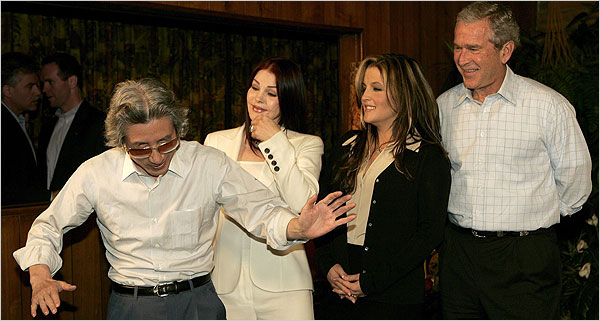
Japan’s Prime Minister Junichiro Koizumi went to Graceland with Bush today. The visit was described on NPR as a “gift” to the Prime Minister in appreciation of his unwavering support for the US.

Well, Koizumi must have liked it, because he was about as animated as he gets today – he even broke into song briefly, a move that clearly creeped out the president a little bit. Perhaps it was the PM’s choice of words – “Wise men say only fools rush in” – could this have been a subtle barb at Bush’s pre-emptive war doctrine?

You can watch Koizumi sing here on the UK’s Channel 4 along with some other little tidbits about Japan and Britain’s Elvis-mania.

UPDATE: NYT has more singing! Plus anti-whaling Elvis impersonaters!

Japan’s Evolving Superlative Status

Despite Americans’ declining interest in Japan (case in point: American reporters’ questions at the “press availability” after Koizumi’s visit to the White House yesterday all focused on the recent Supreme Court decision on Guantanamo detainees), you can still count on your average educated Joe to recall at least something that Japan is supposedly best at. You can take your pick – smartest kids, best cars, smallest electronics, biggest animation industry – but ask any reasonably educated American about Japan and they will likely be able to remember at least one. But recent developments may make such thinking a little more complicated. Here’s a quick look at recent-ish developments behind some of Japan’s distinctions:

Oldest population: Japan now has the highest ratio of old people in the world, which combined with its now-declining population/workforce and record low birth rates spells possible doom for Japan’s economy. How is a population set to hit 100 million by 2050 going to produce more GDP than the current population of 126 million? According to a report from an association of reform-minded corporate executives known as the Keizai Doyukai, the only way to do it – assuming the reported projections in terms of immigration to Japan and a shrinking population, and that female and elderly labor will reach its potential levels by 2030 – is to bring back the level of productivity Japan enjoyed in the 80s by 2030, and maintain it for 20 years, all while bringing inward FDI levels to US levels (around 22%). And how can Japan do that? While the Doyukai gives a complicated solution, one popular simplified version that basically jives with the report’s suggestions comes from Koizumi-line economist Naoki Tanaka: Japan needs to put all its eggs in Information Technology and continue economic reform policies to minimize the massive waste in Japan’s economy. So even though right now Japan won’t be winning the “most likely to succeed” award, if Japan actually does what the Doyukai and others tell them, we’ll start seeing Japan pop up a lot more in world superlatives (Most efficient supply chains? Most profitable banks? Highest robot to person ratios?)

Top scores in international math tests: Not anymore. Japan slid to sixth in 2003 from first in 2000 in the math section of OECD’s “PISA” test of middle schoolers around the world. This is an especial blow to a country whose education system was once the envy of the world. The results led one education ministry official to comment at the time: ”Their learning skills rank high by international standards but they cannot be said to be the highest.” The 2006 PISAs are going on right now, but it’s unlikely that Japan will regain its glory. This is predicted (by the Keizai Doyukai once again) that a continued lag in Japan’s education system will limit prospects for economic growth.

Highest Longevity: Still the highest, says the WHO. As noted in the above superlative, this actually poses a problem for Japan’s society. Leave it to Japan to prove that you can be too healthy.

Most Expensive City: Tokyo loses out to… Moscow?! Due to the methodology of the survey (compare everything to New York), this is basically explained by the ruble’s exchange rate strengthening against a recently weak dollar (with a similar but smaller strengthening of the yen-dollar rate). Of course, this stat has always been kind of suspect – even the Economist knows that Japan isn’t that expensive of a country if you spend right (e.g.: if you’re not trying to maintain an executive-level American lifestyle).

Yasukuni all over again

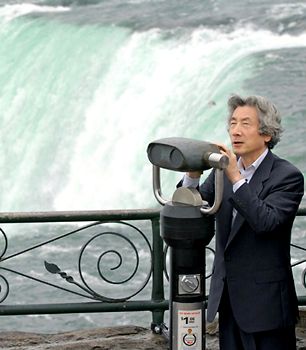
As if the Niagara Incident wasn’t bad enough (there’s currently a huge controversy in the Japanese media over whether it should be labelled the ナイアガラの滝の事件 or ナイアガラの滝の事変), and now this report!

The “King” never came to Japan, but Japan’s prime minister is making a pilgrimage to Graceland.

Elvis fan Billy Morokawa says Japanese Prime Minister Junichiro Koizumi will likely feel the power of Presley’s enduring energy when he tours the rock-and-roll legend’s home in Memphis, Tennessee, Friday with President Bush.

Did you see that? “Pilgrimage” There’s no way this visit is going to pass the church/state test, and visiting it alongside President Bush the “I was only going in my capacity as a private citizen” defense is never going to fly, particularly when considering his personal history in this cult.

Koizumi, 64, is an Elvis devotee who not only shares a January 8 birthday with his idol, but picked out his songs for a 2001 charity album, “Junichiro Koizumi Presents My Favorite Elvis Songs.” The prime minister appears on the album’s cover standing next to Elvis outside Graceland in a composite picture.

Back in 1987 when Koizumi was a mere lawmaker, he and his brother Masaya, now a senior adviser to the Tokyo fan club, helped raise funds to erect a status of Elvis in the Japanese capital to commemorate the 10th anniversary of his death.

Three years ago the prime minister, an eclectic music lover whose favorites also include German composer Richard Wagner, sang his favorite Elvis hit — “I Want You, I Need You, I Love You” — with actor Tom Cruise, then in Tokyo to promote his movie “The Last Samurai.”

Let’s just hope that this time the Supreme Court actually has the guts to face the real constitutional question and not skirt the issue on technicalities.

Chikan


In the West, few social problems are thought of as more typically Japanese than the random molester, known aschikan . He may lurk in a parking garage or dark alley, as if some sort of fungus, but his most common natural habitat is the train. During rush hour, when commuters of all ages, professions, genders are packed together like sardines-to the point that certain stations in Tokyo famously (used to?) have platform workers help people squeeze inside before the doors shut-and the hapless victim has no escape from the perverts embrace. Whether he merely breaths too close and too damply to her neck, rubs his pelvis up against her side, slides his hands over her breasts, crotch or buttocks, slips them into her clothes, or actually opens his own clothing to perform that most inappropriate of public acts, the response is always the same-nothing. The woman may be disgusted or terrified, fellow passengers may see, feel, or hear what is going on, but regardless nobody stops it, nobody calls the police, and of course nobody is ever punished.

Of course, this is all a product of Japan’s unique culture, superficially sexually repressed and yet if you scratch the surface ever so perverted. In other, normal, nations perhaps these chikan would be well-adjusted men, allowed to slake their sexual appetites with their wives or girlfriends, instead of being forced to work like robots for a family that doesn’t love them, virtually castrated by society. With no accepted outlet, he turns to increasingly depraved pornography, which gradually programs his pyche to associate his libidinous urges not just with the image of a pretty girl but outlandish scenarios until merely watching is no longer enough, and without any good Protestant values to reign him in, he feels compelled to take to the streets and do something about his fantasies, heedless of the victim’s rights or the consequences.

At least that is how the common stereotype goes. But really it’s all absolute rubbish.

The New York Times has an article on the prevalence of illegal sexual groping and exposure on the NYC subway system.

This week, as the Police Department announced the arrest of 13 men charged with groping and flashing women in the subways, women around the city nodded. Yes, they said, this had happened to them. Yesterday. Last month. Last fall. Twenty years ago.

“Every girl I know has at least one story,” said Barbara Vencebi, 23, a studio photographer standing outside the No. 6 train station at 116th Street in East Harlem yesterday.

It is a crime abetted by the peculiar landscape of the underworld that is the subway system, by the anonymity of a crowded car where everybody is avoiding eye contact. And by the opportunity for a quick escape at the next stop, to disappear behind a pillar, into a tunnel, up an escalator.

An impromptu survey of riders during the morning rush yesterday found that, for many women who have experienced it, the worst part of the crime is the sense of helplessness. What is the right way to react to a humiliating, but not life-threatening, situation? Should you announce to an entire car of strangers that you have just been violated?

Most of the time, the women said, they seethe inwardly but say nothing.

Certainly Japan has its share of sex crimes, does it really have MORE than its share? I heard so many times over the years about the prevalence of chikan and other sexual assault in Japan, but is it really any more common than other countries, or is the belief in its exceptional commonality just another turn in the decades old racial and cultural stereotypes seen in American media since before World Was II?

As an aside, for an interesting take on chikan, check out the novella J (cover image above) by the nobel prize winning Oe Kenzaburo, in which the Jay Gatsby-ish title character apprentices himself to an elderly subway chikan

Two articles on whale in school lunches

I would like to present translations of two different articles on the use of whale meet in school lunches in Japan with little additional comment. These articles are actually half a year old, but they appeared on the exact same day, which makes the contrast all the more striking. My personal take on this issue is contained in this post and comments on Adam’s recent post. Now to me, one of these sounds like a real news article and one sound like propagandistic fluff, but you be the judge. As an aside, if you are looking for some English language material in support of Japanese whaling activities, there’s an entire blog of it here.

Whale meat is super delicious
Students at the No.5 Kouyou Elementary school have “nostalgic school lunch”

Kyoto Shimbun January 27 2006

For the school lunch week from the 23rd to the 27th a menu item from the mid 1950s to mid 1960s named as “nostalgic school lunch” re-appeared for several days running at an elementary school of Mukou City, Kyoto prefecture. On the 27th whale meat with sweat and sour sauce made an appearance, and this rare menu was sampled with pleasure by the children.

The plan was to deepen the students understanding of the history and significance of school lunches. Nutritionists created the dished by consulting menus from 1957-1968 that had been preserved by Kouyou Elementary. Boiled cabbage, mixed pork and beans-even these basic foods were provided.

On this day, the menu at No.5 Kouyou Elementary had four dishes: whale with sweat and sour sauce, sesame marinated vegetables, white rice and miso soup. The whale, which these days rarely appears in school lunches, was mink whale caught for study. The whale meat was cut into cubes, deep fried with wheat flour, and slathered with sweet and sour sauce. Although it was the first time the children had eaten whale, they were delighted saying “it’s super delicious!” They never stopped asking for second helpings.

At the same school there is also a display in the hall way outside the computer lab to introduce the children to the history of school lunches, starting in 1949, and telling them about the changed in menu and preparation methods.


A week of school lunches
Whale meet appears on menu at elementary schools in this prefecture, etc.

January 27, 2006
The pan-Japan school lunch week began on the 24th, and on the 25th Tatsuta-fry made with whale meat appeared on the menu at Tanabe City’s Uwaakitsu Elementary School (Haraakira Komatsu, principal). In the prefecture a total of 174 Elementary, Junior High and other schools served school lunches using whale meat throughout the week.

Throughout the week a variety of functions were carried out to increase the awareness of children and students, teachers, guardians and area residents towards school lunches. In this prefecture they promoted this by making school lunches using various traditional and locally grown ingredients.

This is the second time that whale meat has appeared in Uwaakitsu Elementary school, the first having been March of last year. On this day the “taste of Wakayama Prefecture” menu also included the other dishes of vegetable and plum rice, boiled egg and kouya style frozen tofu, and ponkan oranges grown locally in Uwaakitsu.

In their own classrooms, the children tasted the dish which they hadn’t had in a long time. Wakana Sugi, a second year girl said of the whale meat, “I guess it’s kind of tough.”

Whale meat has largely disappeared from school lunches since commercial whaling temporarily ceased in 1982. The prefectural school lunch association called on the city, town and village education association to use whale meat to try and move along the children’s education of Wakayama food culture, and it began to appear in school lunches in January of last year.

There are also plans in Tokyo, Osaka, Kyoto and Nara prefectures to use whale meat in school lunches throughout this month.

The Ministry of Education, in commemoration of the first test school lunches in Chiba, Tokyo and Kanagawa Prefectures starting on December 24 1946, every year designates a “school lunch week” starting on January 24th, but not conflicting with winter vacation.

Business Proposal #433: Engrish Insurance

For a reasonable premium, Mutant Frog Capital Partners® will send its “adjusters” around Tokyo to clean up any sad English mistakes perpetrated by your own careless workers on posters, stationery, food packaging or wherever it creeps up. Will also provide referral service for responsible employees to MFCP affiliate “Copywriting Ga Tanoshiku Naru Eikaiwa,” located at the scenic Iwo Jima Commercial Park.

First potential client: the “Independent Insurance Agents of Japan, Inc.

Sirs: We must sadly inform you that nothing makes you look less professional and more like pedophile hitmen than proclaiming “We Are the Professional” on your website.

Negligent driver, meet negligent management and negligent legal system

If JAL’s shoddy maintenance doesn’t kill you, this guy might:

A 55-year old driver of the “Airport Limousine,” operating between the Haneda Airport terminal and aircraft parked on the apron, was found to have continued driving for nine days in May and June of last year despite having had his license suspended for drunk driving.

Tokyo Airport Transit, the bus operating company, ordered the driver dismissed.

According to the company, they had not been informed about his license suspension for drunk driving. As the buses operate on the taxiways, a “Restricted Area Driving Permit” is required in addition to a regular driver’s license. However, because on-field inspections only check to see whether the permit is being carried, it was not discovered that the driver had no regular driver’s license. The company checks its drivers’ personal violation records once per year, and only noticed the man’s violation in November.

For double the fun, take his bus to your next flight on Northwest!