
I have finally uploaded a photo gallery to accompany the article I posted on my visit to the LoSheng leper colony in Taipei. It has been appended to the original post, but I’ll embed here as well. I recommend viewing them in fullscreen mode, and titles may optionally be turned on.
Category: Asia
Wushe, then and now
The Taipei Times reported today that Taiwanese film director Wei Te-sheng (魏德勝) is currently attempting to make a film about the famous Wushe Incident of 1930, in which the aboriginal people of Wushe village rose up in armed rebellion against the Japanese occupiers, killing well over 100 Japanese (and injuring many more) before themselves being slaughtered in retaliation. What I found particularly interesting about the article, aside from the fact that I would very much like to see the film if it is ever made, is that the inhabitants of Wushe are described throughout as “Seediq“.
The Sedeq are an Aboriginal tribe that live mostly in Nantou and Hualien counties.
The film title, Seediq Bale, means “the real person” in their language.
The movie Seediq Bale tells the story of Sedeq warrior Mona Rudao who led a large-scale uprising against the Japanese in present-day Wushe (霧社) in Nantou County.
On the morning of Oct. 27, 1930, Mona led a group of more than 300 Sedeq and launched a surprise attack as the Japanese gathered to participate in a local sports event, killing 125 and wounding 215.
The Sedeq then cut the telephone lines and occupied Wushe for three days, before retreating to their strongholds deep in the mountains.
The Japanese colonial government cracked down on the Sedeq, using more than 2,000 military and police officers, and even used poisonous gas banned by international law.
After being under siege for months, Mona, along with about 300 other Sedeq warriors, killed himself.
The Seediq are one of the smallest, if not the smallest, officially recognized distinct tribe of aboriginal peoples in Taiwan, and before receiving government recognition in April of this year had been considered to be a sub-grouping of the much larger Atayal tribe. During my trip to Taiwan last month, I spent about a week traveling with a classmate at Kyoto University named Yayuc Panay, a member of the Seediq tribe who was back in Taiwan visiting family and doing some field research for a paper she is writing. In between visiting two different aboriginal villages, we actually stopped briefly in Wushe for her to transfer her legal residence (戶口) from her hometown of Puli, where her family no longer lives, to her sister’s house in another part of Nantou County. While she was in the office, I wandered around the tiny area comprising Wushe’s “downtown” and took some photos.
Despite being known almost exclusively for the Seediq uprising of 1930, Wushe is today a small village primarily inhabited by Taiwanese of Han Chinese origin, who settled there due to its convenient location as a trading post for the various agricultural goods produced in the mountains. As you can see in the photos, it looks very much like the main street of other rural Taiwanese communities.
Not the most relaxing picnic
I spotted the following item in the Taipei Times Quick Take section earlier.
Barbecue at crematorium
The Taoyuan County Funeral Service Industry Association said that anyone interested in a free barbecue on Mid-Autumn Festival should head for the funeral home in Jhongli (中壢). Last year, the association organized a barbecue for more than 1,000 people at the funeral home, while all six cremation furnaces were working. Because of the smell emanating from the furnaces, very few people, aside from employees and their families, took part in the activity. This year, the furnaces will be closed in the afternoon during the barbecue, the association said. The barbecue will take place between 4pm and 10pm on Friday.
Needless to say, this is often the most entertaining section of the paper.
Military recruiting efforts
Curzon over at Cominganarchy just posted his impressions of his visit to a new Japanese Self Defense Force recruiting center in hip Shibuya (verdict: fail). Just the other day I happened to run into another rather sad attempt at recruiting in Osaka’s Hankyu Umeda Station.
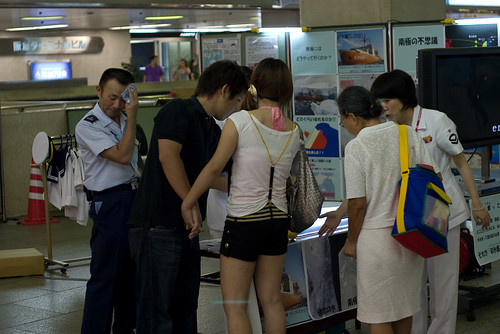
Instead of the ordinary but silly strategy of letting visitors play dress-up, the attraction here was something a little on the bizarre side – a block of ice from Antarctica.
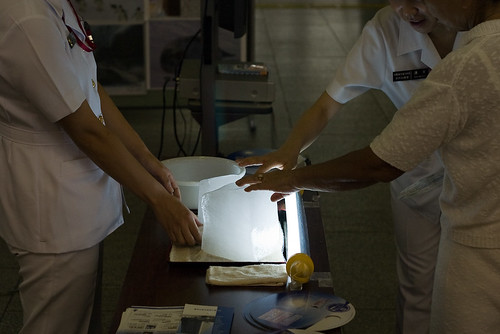
Indeed, it was very cold. The message seemed to be something about how joining the Navy lets you travel to faraway and exotic places, but I’m not sure that a block of ice was the best way to convey that, even with the helpful diagrams explaining how striation in Antarctic ice is different from that which you grow in your own freezer.
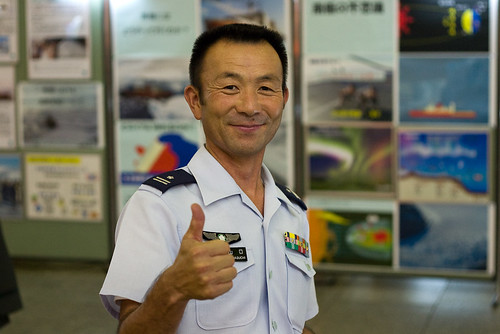
I’m not actually quite sure who does join the SDF in Japan. Back in the US I had quite a few friends from high school who either joined the military proper or the reserves, or had simply been ROTC members before graduation, and in college I again knew plenty of people who were either paying for school through the reserves or were getting scholarships from previous military service, but I can’t say I actually know a single person in Japan who is either a current or past member of the postwar military.
In fact, practicaly the only Japanese person I’ve ever met who wanted to join the SDF here was a guy I met briefly in a youth hostel in Beijin when I visited back in 2004 with my then-girlfriend. 20 years old, buzzcut dressed entirely in camo, giant thick glasses, scrawny, and big black combat boots, he was the perfect incarnation of the stereotypical military nerd who wants to be Rambo but would be lucky to even pass the basic training and get a desk job. The military was quite literally the only thing he could discuss, and even the briefest attempts at smalltalk were immediately sidelined into military talk.
One real exchange I remember:
Me: I’m from New Jersey.
Him: East coast right?
Me: Yeah, right by New York City.
Him: New York… That’s where West Point is. And it’s only a few hours drive from the big naval bases in Virginia.
Me: Uhh, yeah… that’s right. We’re gonna go check out that famous Beijing duck restaurant now – see you later.
And speaking of military otaku, the government sponsored Taiwan Journal has a rather interesting look at the niche publiching market of military themed magazines in that country, which look to me rather similar to the same type of periodical in Japan. Of course, in a country where all adult males are drafted (until they complete the ongoing transition to an all volunteer force sometime in the future) you would expect that the average level of knowledge and interest in the subject might be a lot higher.
Police statism around the world
After my post the other day, it is worth realizing that, despite worrying trends back home there are no shortage of countries that are far, far worse off. Here are some stories that jumped out at me just in the past few days.
American Filmmaker Arrested in Nigeria
Andrew Berends, a New York-based freelance filmmaker and journalist who was working on a film about the oil-producing Delta region, was arrested on Sunday and held overnight. “They didn’t let me sleep or eat or drink water for the first 36 hours,” he said Tuesday night.
Taiwan Society receives inquiry letter over rally
The Ministry of the Interior (MOI) yesterday rebutted accusations from the Taiwan Society and others that it was breaching freedom of expression by issuing a letter of inquiry to the group that organized a major rally held last Saturday.
The rally drew tens of thousands of participants protesting the government’s cross-strait policies, and called on President Ma Ying-jeou (馬英九) to defend Taiwan’s sovereignty, save the economy and help to accelerate the adoption of “sunshine bills.”
Thai Government Cracks Down on Rebellious Websites
The ICT says that 344 of the websites it listed had content it deemed “contemptuous” of Thailand’s royal family, five were considered “obscene,” two featured religious content and one hosted a sex video game.
Thai courts issued orders to shut down about 400 of the websites on the ICT’s list, while the remaining 800 are expected to be blocked by ISPs. The ICT also asked police to help round up sites’ owners, noting that it wants to “bring all violators to trial.”
Chinese Muslims cower under secret police crackdown
Being seen talking to a foreigner is enough to earn a Uighur a minimum of five years in prison and the confiscation of his business. “Please leave here,” said one man in a tea house around the corner from the scene of the attack. “We did hear things, but we cannot talk or we will be taken away.”
[…]
Fearful of the growth of an independence movement, and of the motivating effects of religion, the Chinese government has imposed debilitating measures on the local mosques. One popular mosque was even padlocked shut yesterday.
No one under 18 is allowed to visit a mosque, and schools deliberately schedule their classes over the 1pm call to prayer. Nor are imams allowed to broadcast over a tannoy.
Uighur passports are now held by the police, who refuse to let many Uighurs travel abroad. Since May, any Uighur travelling inside of China has been stopped and sent home by the police. They are not welcome at any hotels or guesthouses, under stringent regulations designed to protect Beijing or the other Olympic cities from a possible separatist attack.
And so on. This is just a small sampling of countries besides the US where the government is stepping beyond any reasonable bounds to stifle political dissent. Of these four countries, three are significantly less free than the US today and serve, in various ways, as examples of what governments should not do (the case of Thailand is extra complicated, since with their eternal coups and factions it’s hard to even tell who should be considered the government at any given time.) The fourth country, Taiwan, is particularly complicated case. A military dictatorship and full on police state until fairly recently, Taiwan is a new democracy that was ranked an impressive #32 in last year’s Reporters Without Borders Press Freedom Index. But the current administration is a return to the formerly dictatorial KMT, and there are serious worries over the possibility of recidivism. In the same ranking, the US was given a dismal 48- having slid precipitously from #17 in the 2002 Index.
Protesting in a police state
In July of 2005, when I was living in New Brunswick, NJ, finishing up my studies at Rutgers University, the apartment shared by my friend Ted and his then-wife Janice (they have since divorced for unrelated reasons) in neighboring town Highland Park was raided by a SWAT team of the FBI and New Jersey Joint Terrorism Taskforce, which took a wide variety of their property including any computers or related material, as well as their BBQ. Ted himself was never charged with a crime, and in fact was not even being investigated or targeted, but Janice had been targeted for her animal rights protest activities, which naturally included a lot of relatively harmless shouting at people who did not want to be shouted at, and in places where they did not want outsiders to enter. The actual charges against Janice were, in fact, the real offenses of trespassing and criminal mischief (i.e. spray painting graffiti on the fence of an executive of a company responsible for animal testing), but the police response to these minor offences was grotesquely out of proportion.
Some more things about Taiwan
Continuing from this post:
- Restaurant bathrooms are often oddly residential looking, sometimes even with a bathtub, which is usually converted into storage space. Oddly, this is sometimes seen even in restaurants which do not even remotely appear to have conceivably been converted from houses.
- Traffic on the right side (coming from Japan here).
- Seaweed very common in food. Much more than in Japan (at least parts of Japan I’m used to).
- Men sometimes grow a single fingernail, or one on each hand, creepily long.
- Restaurants typically bring you lukewarm drinking water, although they will add ice if you request it.
- Military bases right in the city.
- The truly genius 統一發票 system, which deserves its own post.
- Ordering food in most places is done by checking off boxes on a disposable menu. There may be room to write in any specials not included on the regular menu.
- Pedestrian crossing signals often count down how much time is left. This is an amazing stress reliever, like the electronic signs telling you how much time remains before the next train that almost every system outside of the US seems to have.
- Cell phone signals are available throughout the ENTIRE Taipei Subway-not just in the stations. I have never seen this anywhere else in the world.
Children of Darkness
On Saturday, I went with a friend of mine to see the “Children of the Dark“(闇の子供たち) , a new film by Japanese director Sakamoto Junji primarily about child prostitution in Thailand. The story is primarily told through the perspective of the two Japanese main characters, a reporter for Bangkok bureau of the fictional Japan Times (no relation to the actual English language Japan times, but more of a pastiche of the Asahi or Mainichi. I believe the Mainichi was thanked in the credits) named Nambu, and a Japanese college student named Keiko, who is volunteering at a tiny Bangkok NGO. Secondary characters include Nambu’s mildly irritating 20-something Japanese backpacker/photographer sidekick, and a wide selection of Thai criminals, NGO workers, and abused children.
Except for a brief trip back to Japan around the middle of the film, it takes place entirely in Bangkok. The dialogue is mixed Thai and Japanese, probably with Thai dominating. Nambu speaks appropriately good Thai, as a foreign correspondent should (even if they don’t all), and Keiko speaks a bit haltingly, but according to the subtitles at least she seems to have no trouble expressing complex thoughts, or understanding what anyone says.
The central plot thread is your fairly typical “newsman uncovers a story and chases it ragged even at the risk of his own life” and makes sure to include a selection of the typical cliches, such as a back-alley gunpoint menacing in which none of the stars are harmed, despite a secondary Thai character having been shot in the head in another scene moments before or the photographer’s constant wavering between going home to safety in Japan or staying in Thailand to fight the good fight. At the beginning of the film, Nambu receives a tip that Thai children are being murdered so their organs can be transplanted into dying Japanese children. This is just one of the ways in which children become disposable in the film, but I felt like the addition of this imaginery (although certainly not impossible) scenario to the array of real horror detracted from the film’s effectiveness.
The primary goal of the film is the depiction of evils inflicted by adults on children, and there are a number of truly unpleasant scenes involving child prostitution by foreigners of both Western (American and European) and Japanese origin, as well horrendous mistreatment of the child slaves by their Thai captors. These sorts of terrible things happen all day long in many parts of the world, and it is understandable that the film makers wanted to depict it on screen, but I found the “deeper” messages to be more muddled than sophisticated.
Incidentally, the Japanese Wikipedia article on the film has a rather odd criticism I’d like to mention briefly. It mentions that Japanese blogs (2ch-kei foremost I imagine) have called it “an anti-Japanese film” since it “puts all of the blame for the selling of children in Thailand on the Japanese.” This claim is patently absurd. Of course a significant part of the film’s purpose IS to blame Japan predatory Japanese, but Western perverts are given at least as much of a spotlight in the brothel vignettes. And the Thai criminals who actually run the victimization business are hardly made out to be innocent bystanders.
For some reason I was mildly irritated by Keiko’s inexplicably competent Thai throughout the film, but it may simply have been the fact that I found the character generally pointless. When she first arrives at the NGO, one of the ladies working there asks her “Why did you come to Bangkok, isn’t there some good you can do in Japan?” While this question lingers throughout the film, and naturally Keiko does come to do some good in Bangkok, her motivations are never explored and her character acquires no depth. Why did she come to Thailand? Why is she even in this movie? She is tabula rasa- a standin for the audience, or rather for the way the film maker wants the audience to think. Her initial appearance suggested that she could have been an aspect of a message that I think the filmmakers were trying to convey-that Thailand (and presumably other countries like it, although no others are mentioned) are playgrounds for Japanese and Western neo-colonialists to act out their fantasies of either depravity or heroism without repercussion. However, despite this theme perhaps being touched on ever so briefly during her first appearance, Keiko turns out to be nothing but an autonomic cliche of a young NGO volunteer.
I hope my ramblings do not give the impression that I hated the movie- I did not. I would, in fact, say that it was overall decent. But I did find it very disappointing. It starts well, and has a number of powerful scenes of horror and despair, but it is too long, the story is meandering and a bit cliched, and one of the leads is just dull to the point of no longer being annoying. Those with a particular interest in the problems this film addresses should see it, but wait for the DVD.
Some things about Taiwan
When you’ve lived in a place for a while, and then left for a while, there are any number of details that you haven’t exactly forgotten, but don’t often think about. And when you go back, you notice the un-remembered (but not forgotten) details of everyday life with a reaction that fits somewhere between remembering and discovery. During my first few days back in Taiwan, I kept a list of all of these everyday details that jumped out at me as familiar but rarely thought of since.
- Roaches- they love the sub-tropical climate. I see them out on the street almost daily.
- No plastic bag in the convenience store- costs extra by law.
- The ubiquitous Taiwanese style breakfast shops Chinese/American fusion breakfast shops.
- Trash: categories of separation, daily pickups, having to bring it to the truck yourself if you don’t live in a building with dumpsters.
- Gas powered water heater on the balcony- gas canister delivery instead of gas utility. (This works because it’s only needed for hot water and cooking, never for space heating.)
- The styles of doors and gates.
- Indoor/outdoor footwear customs influenced by Japan.
- They LOVE their sweet tea here. You have to really remember to check the labels in the store to get even unsweetened green tea, and restaurants always serve sweet black tea.
- Binglang (betel nuts) EVERYWHERE. Selling, chewing, blood-red spit stains and dried nut husk.
Next: some photos, then writeups of my visits to Aboriginal villages.
A visit to Losheng
Update: Photo gallery added on 9.23.2008. The new Flicker flash gallery has a fullscreen mode which is excellent for photos like these. Also added some additional comments by Mr. Chang.
I had meant to write a few days ago about what I’ve been doing in Taiwan, but my friend’s house mate forgot to pay the DSL bill and so I haven’t been able to get online all that easily, so tonight I finally broke down and paid the NT$100 (about US$3) for a 24 hour WiFly (WiFi service in every Starbucks, McDonald’s, KFC, etc. in Taiwan) access card.
So, today I visited Taiwan’s famous Losheng Sanitarium (樂生療養院), a leper colony built by the Japanese colonial government in Xinzhuang City, Taipei County. As in leper colonies throughout the world, Taiwanese victims of Hansen’s Disease were forcibly imprisoned in Losheng by the government, as they were in Japan by the government there. Although the leper imprisonment order was lifted in Taiwan in the 1950s (I believe someone today told me 1957), they have for the most part remained. With modern medicine the patients are no longer inmates, and no longer contagious, but nothing can de-cripple them or regrow their missing fingers and stumpy limbs. And they have nowhere to go, and no way to survive except by public welfare of some sort.
I had first heard of Losheng perhaps a couple of years ago, due to the wave of protests to the government’s plan to demolish the entire complex to make way for a train depot, as part of Taipei metro’s never-ending expansion plan. Although there are naturally no opponents to MRT expansion itself, there have been severe doubts regarding the sense of building the depot in this particular location, which apparently requires the leveling of mountain to create flat ground which naturally occurs elsewhere and is widely suspected of having been chosen to satisfy local political interests before practical considerations of engineering.
Primary opposition to the plan however, is due to a desire to preserve Losheng. The adage goes something like, you never really appreciate something to it’s gone, and it is born out time and again in the history of urban preservation. New York City’s historical preservation regime was established in the wake of the foolhardy and abhorrent demolition of Penn Station in the 1960s, and throughout the world preservationist activity is often triggered by the threat of imminent loss. The government’s plan to demolish the place made people realize for the first time that it was worth preserving, and recent protests have spurred a surge of interest in the hospital site and its residents that has gone beyond simple preservationism to community organizing attempting to integrate Losheng, which for most of its existence was in principle as isolated as a prison, into the surrounding community. This has led to large numbers of non afiliated visitors spending time with the patients for probably the first time in many years, if not ever.
Since I cannot process the files from my digital camera until I get home to my desktop computer, words will have to suffice for now in describing Losheng. it turns out that from the articles I had read in The Taipei Times, not to mention the briefer pieces I saw in Japanese media I had no idea what it was like. When I read about a hospital/leper sanitarium being destroyed to make way for MRT construction I had for some reason imagined a cluster of shabby old buildings on a city street corner. But of course a leper colony could not be in such a place, and is in fact built on slightly elevated and up-sloping terrain on mountain foothills of a part of Taipei county that, at the time, was mostly farmland. Less a modern style hospital or a prison, Losheng is actually a sprawling and rather pleasant, almost collegiate-looking, campus with abundant greenery and attractive brick buildings. The main hospital building looks properly medical, and the general sense of design reflects its Japanese period origins, with semi-exposed corridors reminiscent of the older buildings on the Japanese Imperial Universities of the early 20th century, such as today’s National Taiwan University or Kyoto National University (the two examples whose architecture I am familiar with). Most other buildings are also in the pre-war Japanese style common in Taiwan, with a few notable exceptions. The least Japanese buildings in Losheng are probably the Buddhist temple, which is in standard Taiwanese style, and the now shuttered Catholic Church, which is perhaps the most spartan Catholic church building I have ever seen, with only a spare cross on the roof and no writing of any kind on the outside, but with a green Chinese roof, oddly complete with dragon tiles on the corners, and outer walls painted in the Chinese temple fashion. It reminds me of nothing so much as the far more elaborate Tainan Catholic cathedral, which is constructed and painted completely in the manner of a Chinese temple, if you do not look too close at the paintings. Of particular interest are the residence buildings for patients (originally, remember, inmates) from particular parts of Taiwan, such as Penghu or Tainan, donated by the governments of that region.
I mentioned above activity integrating the Losheng campus into the greater community. This consists of various activities, such as holding lectures and community meetings inside Losheng, or educational programs for children. As chance had it, I happened to go on a day which was particularly active. Community activists are currently running a summer camp for children from various elementary schools in the area, using various Losheng buildings for different activities. I was taken to see the room being used for a week-long Japanese language class run by a Japanese woman studying a PhD in Urban Planning at National Taiwan University, in the room of the hospital building where the sickest patients were brought, connected by a locked iron door to the much smaller room where they were taken to die. This is either morbidly incongruous beyond belief, or an excellent symbol of the way in which the space is being reclaimed and repurposed from its grim past. But little of that darkness remains. The staff (mostly Taiwanese college students) had cleaned the room fastidiously, and it was festooned with child drawings illustrating various basic Japanese words and phrases.
Then I went to a much larger room, a sort of meeting hall I suppose, where the kids were being led in Japanese songs by some of the old patients who remember their Japanese well. One played the keyboard-no easy task with hands ravaged by Hansen’s Disease, while another sat in front of the stage in his motor chair, leading the children in Furosato.
After the class was over, I spent some time speaking to the old men, who seemed both movingly thrilled and slightly amazed to have so many young people, children, teenagers and 20-somethings, having fun inside Losheng and spending time with the patients as human beings, and not afraid of their no longer contagious disease. As is the case with many elderly Taiwanese, their first language is Taiwanese (aka Minnan, Hoklo, Fukkianese, etc.) Their Mandarin is generally weak and heavily accented, and most of them also speak Japanese to some degree, having undergone elementary education during the colonial period. I spent the most time speaking with one old man, Chang Wen-pin 张文贫 (can’t figure out how to type pinyin with traditional characters on this thing…), whose fluent Japanese was easily the best out of the group.
Mr. Chang, now 81 if my calculations are correct, went to a Japanese colonial elementary school in Taiwan and worked as, I think, a locksmith both under the Japanese and in the early years of the KMT, before he was interned. He was around 20 years old at the time of the 228 incident, and considers Chiang Kai-shek to be the worst thing to have happened to Taiwan.
To paraphrase, translated and from memory:
Taiwan’s history is full of tragedy. After WW2 Taiwan shouldn’t have been given to Chiang Kai-shek, but instead the allies should have occupied it. America, England and Russia should have managed Taiwan and then organized it for independence. If they had done that then we would have avoided the 228 massacre and noone in Taiwan would be speaking Mandarin (lit: guoyu) today!
He went on to mention that he suspected a war between China and Taiwan would involve Japan and the U.S., and expand into not just a nuclear WW3, but literally “becoming the battle of Armageddon as described in the Bible.” He mentioned his strong distrust of Ma Ying-jiu, and his worry that Ma and the other KMT supporters of unification with China would lead to the destruction of Taiwan.
When we were done speaking and I was preparing to leave, Mr. Chang and the others made me promise to come back and visit next time I come to Taiwan, and before I left he made me wait while he went back to his room and brought a copy of the photo and essay book about Losheng assembled by the preservationist activists, which he signed and gave to me.
Countless speakers have said that “A society is ultimately judged by how it treats its weakest and most vulnerable members.” (Based on a quick search, the source of this quote seems obscure.) The leper has always been a symbol for the lowest in society, and despite having no use for religion myself, I think I can understand why Mr. Chang finds his solace in Christianity, a religion in which the leper is a symbol not of disgust, but of redemption. It says a lot of a society in which lepers are no longer lepers, but patients, and the resurrection of Losheng from a medical prison into a park where children play may be taken as a symbol for Taiwan’s transformation from colony and then military dictatorship into the relatively free and effectively independent country that it is today. But the current metro expansion plan still requires the demolition of something like 30-40% of Losheng’s territory, with some buildings kept in place, a few relocated, and many destroyed entirely. Even the preservationists have abandoned their attempts to save the entire site, with construction of the nearby depot building already well under way, and their best case plan today is the “90% plan.” There is still room for improvement.