UPDATE: It turns out that Chiba asked to resign and has said she will retire from political life, but PM Kan requested that she continue, and she has accepted this request. It’s highly unusual to stay in a cabinet post after losing election, but Kan has suggested that he will replace Chiba in September when he reorganizes his cabinet.
ORIGINAL POST: Despite the setback to the DPJ in this election, Prime Minister Kan has announced that there will be no changes to his cabinet, and Keiko Chiba, despite losing her seat in the Upper House, will continue to serve as Minister of Justice.
By way of background, 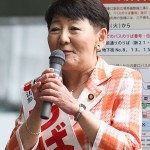 Chiba, a notably liberal member of the Diet, was appointed to Minister of Justice under Prime Minsiter Hatoyama last year, but lost her seat for reelection in Kanagawa Prefecture where she had held the seat since 1986. She was most likely defeated because activists targeted her for her liberal views, which include allowing foreigners to vote in local elections, allowing separate family names for men and women after marriage, and refusing to enforce the death penalty. She is to be replaced by Kenji Nakanishi, a former director of JP Morgan in Japan, who ran as the candidate of the upstart reformist “Your Party.”
How does she get to stay in the cabinet work? It sounds peculiar from the American perspective, where all members of the President’s cabinet are forbidden from serving in the legislature and are never subject to election. It also sounds strange from the British perspective, where all members of the cabinet are required to be members of parliament. Yet Japan has a fusion model, where private citizens can serve in the cabinet, and the only requirement is that members of parliament (who can come from either the lower or upper house) constitute the majority of cabinet ministers. Article 68 of the Japanese Constitution reads:
The Prime Minister shall appoint the Ministers of State. However, a majority of their number must be chosen from among the members of the Diet.
That means that of the seventeen members of the current cabinet, nine must be elected members of the Diet and the remaining eight can be private citizens. In practice it is very rare for more than a few members of the cabinet who are not legislators. Koizumi’s first cabinet had just one private citizen, and his second just two.
The DPJ made a big song and dance after their victory last year that they were going to copy the British “Westminster System,” promoted by academics as an efficient system, with no private citizens serving in the cabinet. But by keeping Chiba in the important post of Minister of Justice they’re reverting to Japan’s unique system of the allowing non-legislators in the cabinet.
ENDNOTE: Interestingly enough, two of the three “foreigners” serving in the upper house were up for election: Sha Renho, who is half Taiwanese, and Kyonje Park, who is half Korean. Both are former journalists, both are members of the DPJ, and both have non-Japanese fathers, which means they were denied citizenship until the law was changed in the 1980s. Despite this similar background in a uniquely homogenous country, their results in this popular election were entirely different. Renho won the largest proportion of votes of any candidate in her district in Tokyo, while Park, who ran as a proportional representation candidate, -lost along with a number of other DPJ candidates- -is in danger of losing his seat, and the result is to be confirmed- has barely secured reelection as of Tuesday morning. Park was also embroiled in some election scuffles with Ishihara and Yosano that had them dueling against each other in street speeches from their soundtrucks.