It’s a few weeks old, but this interview with MOF Budget Examiner Makoto Nakagawa is interesting enough for me to translate it in full. Budget examiners in Japan’s postwar bureaucracy historically played a significant role in determining the budgets of the other ministries as they were (and continue to be) the people who investigate each ministry’s budget applications and recommend whether to approve them or not. The struggle for control over budgeting shifted slightly in favor of the Cabinet during the Koizumi years as the PM used the Council for Economic and Fiscal Policy to make numerical budgetary targets for each ministry before they were approved by the MOF. However, nowadays it’s likely that Abe will lose the budgetary process to the bureaucrats once again since he failed to make a bold statement with the CEFP’s general policy outline. Anyway, let’s see just what kind of person holds Japan’s purse strings:
People Talking: MOF Budget Examiner Makoto Nakagawa (age 46): “I want to consider the costs and benefits for Japan”
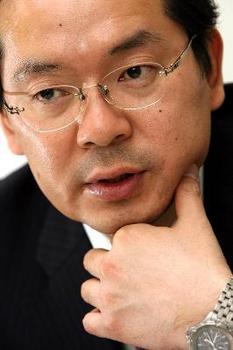 He joined the Ministry of Finance in 1983 after graduating from Tokyo University’s Faculty of Law. His study abroad, the preferred course for new career officials, was at Cambridge. He had 25 compatriots in his inaugural class. It’s been 23 years since he entered the ministry, but not a single person has left. This is reportedly quite rare.
The MOF’s Budget Bureau, which investigates the nation’s budget distribution, has a Director General, under which are 3 Deputy Director Generals. The Deputy Director Generals, nicknamed “division commanders,” in turn manage 3 Budget Examiners each. The 9 total Budget Examiners are each put in charge of their own ministries and agencies, and Nakagawa’s is the Ministry of Education, Culture, Sports, Science and Technology (MEXT). He handles a total of 5 trillion yen: 4 trillion for education and 1 trillion for science.
Nakagawa is something of a regimental commander within the Budget Bureau, but his gaze upon MEXT is profound. The chaotic Budget Examiners’ Office is located on the first floor of the MOF Building. Here is where a certain Bureau Director General from MEXT paid a visit.
30 minutes after the usual chit-chat that comes after a first meeting, Nakagawa let loose a line very typical of an elite MOF official:
“As a Budget Examiner, you need the feeling that you’re the commander in chief of the combined squadron that is MEXT. That is how I take command. I always have that attitude.” He goes on, prefacing his statement by saying, “If I may be irreverent…” continuing: “I figure out where the people are in MEXT who can bring forward new ideas. Creating relationships with people like that is the best part of putting together the budget.”
Depending on how you take that, that’s a rather bold statement. He doesn’t just speak, he gets his body moving. To get to know people, he brings bottles of sake to MEXT, and makes visits to the field of education and science in earnest. Nakagawa’s footwork is nimble, as befits a man who has stood atop Kilimanjaro, Mont Blanc, and even Mt. Everest.
His father was an employee of New Japan Steel Co. who was involved with the workings of a steel plant in Usiminas, Brazil. From age 3-7 he lived in a village 1,000km away from Rio de Janeiro and acquired survival instincts as a child.
Continue reading Sankei interview with Budget Examiner Nakagawa, who learned his survival skills on the streets of rural Brazil
 There are those who have argued for interest rate increases by claiming that a rate hike would provide a better return on savings accounts. This, of course, is disingenuous. Current returns are next to nil; even doubling the prime rate from 0.25% to 0.50% would mean little in the way of returns on savings accounts. It would, however, mean substantial increases in terms of mortgages, business loans and automobile loans.