Tokyo Prefectural Elections July 12

On July 12 the Tokyo Legislative Assembly elections will be held. While the TLA does not appear to do much in the grand scheme of things, this election is personally important to me as it will mark my first experience with an election where Mrs. Adamu can actually cast a ballot (in previous elections she could not vote for one reason or another). With that in mind and in the interest of being an informed voter’s spouse, I decided to take a look at what this is all about with a focus on Adachi-ku, the ku I call home.

How is the assembly chosen?

With 127 members (one representing roughly 100,000 people), Tokyo’s legislature is the nation’s biggest local assembly of any kind. Members come from 43 mostly multi-member districts and are elected all at once to four-year terms using the single non-transferable vote system similar to the Lower House elections prior to 1994. For example, in Adachi-ku’s case, voters choose an individual and the top six vote-getters win seats. The 42 districts consist of the 23 cities or “ku,” 18 cities within the prefectural boundaries, and one to cover all the outlying islands. Adachi-ku, where I live, is allotted six seats.

Most local elections in Japan are held all at once every four years in what are called the “unified local elections” (統一地方選) (the last round was in 2007), but Tokyo’s are held two years after that. They used to sync with the rest of the country, but the schedule got screwed up in 1965 when an LDP bribery scandal spurred leftist parties to push for a recall, leading to a voluntary dissolution and early election.

Currently, the LDP-New Komeito coalition maintains an overwhelming majority of seats (with a respective 48 and 22 members each), followed by the DPJ with 22 members, 13 Communists,  and single-digit membership from the left-leaning Tokyo Seikatsusha Network and unaffiliated politicians.

What do they do?

In typical assembly fashion, they are responsible for passing local ordinances (条例)  and approving the prefecture’s budget, which at 6 trillion yen just for the general account is on par with Finland’s GDP.

The prefectural assembly’s other enumerated powers according to the Tokyo Prefectural Assembly website include investigating and auditing the executive branch, passing a no-confidence motion against the governor, and responding to requests from Tokyo residents to investigate various grievances.

What are some of their more recent achievements?  How powerful are they?

Since Tokyo’s government is set up somewhat similarly to a US state (unicameral legislature and a fairly powerful directly elected governor), the assembly can wield significant power if the party/coalition holding a majority of seats is opposed to the governor’s agenda. However, this is not currently the case, so right now they don’t do much.

News outlets openly report that the assembly is all but a rubber stamp for the executive, owing to a comfortable relationship with recent cozy LDP-Komeito majorities (and occasional DPJ cooperation) and three consecutive terms for Governor Shintaro Ishihara, who is not officially backed by any party but has an ideological affiliation with the LDP-Komeito as one of Japan’s leading conservatives. Prefectural assembly meetings are perfunctory affairs in which the elected members simply read from a script which has been prepared in advance by bureaucrats from the governor’s office, a process euphemistically called nemawashi i.e. backroom dealing. The Communists and other leftist parties do their best to stir up scandal (Ishihara’s lavish trips abroad and the catastrophic small-business bank among them), but voters keep voting in this conservative bloc.

Most of the assembly’s routine agenda appears to be fairly mundane, except when they are called on to give their blessing to the pet projects of either Governor Ishihara or the national government. A look at the agenda of assembly meetings in 2009 shows such typical local administration as minor revisions to health service fees, approval of staff rosters for the fire departments, and the establishment of a new police precinct. However, it is unclear how much room for originality the prefecture has when they must contend with the agendas of the Tokyo prefectural bureaucracy (firmly controlled by Governor Ishihara) and the prerogatives of the internal affairs ministry.

In May, the prefecture passed an emergency supplementary budget to provide economic stimulus in coordination with the central government’s efforts. They approved spending of 134.9 billion yen (with about half the funding from the central government, with the rest paid for by revenues from prefectural revenues and a bond issue). The money went to beef up a consumer protection agency, subsidize day-care centers, pay additional outlays to pregnant women, fund high-tech education, and more.

A 2007 report from citizen journalism site JANJAN decried the governor’s strong influence over the prefectural government, owing not only to the majority LDP-New Komeito who form a loyal right-wing support base thanks to their alliance in national politics, but also to a compliant DPJ. For example, the legislature is in charge of regulations/zoning of prefecture-run wholesale markets, and this includes the world-famous Tsukiji fish market. A decision made in 2001 to move the market to Toyosu, where more modern facilities can be constructed, met with opposition at the last minute due to claims of pollution at the new site in Toyosu. However, the assembly members were not hearing it and the move remains on schedule for 2012.

In another example of Ishihara’s absolute control over his pet projects, the Tokyo legislature gained national attention recently for approving multiple bailouts of New Bank Tokyo (新銀行東京). This bank was created as the fulfillment of Ishihara’s campaign promise to start a bank for small Tokyo-based companies during a bid for reelection in 2002. After opening for business in 2004, just three years later the bank became insolvent due to notoriously lax lending standards that led to enormous losses from the very beginning. But despite this embarrassing failure, the Tokyo assembly was unwilling to refuse Ishihara’s insistence on providing the bank with 4 billion yen in new capital and a new lease on life. In this instance the DPJ members opposed the bailout but it passed with LDP and Komeito support.

The media outlets reporting these scandals seemed genuinely frustrated with the assembly for these recent scandals, but it seems like they should save their breath for the governor’s office, because once Ishihara has made up his mind the TLA won’t do much to stop him.

Other so-called “third sector” businesses directly run by Tokyo Prefecture include the “Toei” subway lines and buses and prefectural government housing.

What are the issues in this election?

There are none. If you have heard anything about this upcoming election, it is probably  that a poor showing by the LDP could spell trouble for Prime Minister Aso’s government and could trigger an early election (latest reports are that Aso might just dissolve the Lower House before the prefectural elections.  Not even the Tokyo Shimbun could identify an angle outside of whether the LDP-Komeito coalition can hold onto power. I’ll go into more detail on the candidates themselves later, but their pledges tend to focus on populist rhetoric like helping small businesses, cutting income taxes, and lowering medical fees.

Otherwise, interest in the election is fairly low (but higher than a typical US election). The last election in July 2005 boasted a mere 43.99% turnout, which falls somewhere among the typical turnout of 40-50%.

***

OK, that’s enough for now. Next time I will try and profile the candidates in the election and see if it makes a difference.

Organ Harvesting in Japan–Now Legal?

The Lower House voted yesterday to remove the major restrictions on organ transplants in Japan–an age limit and the need for family consent of the donor. Since the organ transplant law was passed, transplants have been difficult to get in Japan and are fairly rare–only 81 in the 11 years since the current law was enacted. Yesterday’s changes were spurred by pressure from the WHO, looking to stem the tide of “medical tourists” who go overseas to get transplants.

Of course, this isn’t to say that everyone agrees with the changes that were made. Many Japanese remain wary of organ transplants and the concept of “brain death,” necessary for organ transplants, is not as accepted in Japan as it is in the United States. Twice Dead, by Margaret Lock, details many objections Japanese people have; the most interesting one she cites relates to 贈答文化, exchange culture, in that a donee can not properly return the favor.

Now, this was nowhere near as interesting as the reason detailed in the newspaper handed to me this morning as I passed a group of protesters demonstrating outside the Diet. According to 関東「障害者」解放委員会, the Kanto “Disabled Persons” Liberation Committee, the law will allow the nefarious Japanese government to do what it has long wanted: harvest organs from workers and sell them on the global market. Social stratification in Japan has spread to the medical arena and politicans led astray by America’s neo-liberal influence are plotting to increase the number of its brain death diagnoses in order to save costs on emergency care and further oppress the working poor! Will the capitalists never cease their brutal exploitation of workers?

After getting over my shock in realizing I was actually reading the headline of the newspaper correctly, I found myself somewhat disappointed that the protestors couldn’t have put together a better case. It is possible to argue against organ transplants without sounding like a complete nut. Although the criteria for brain death are quite rigorous and misdiagnoses are nearly unheard of, there are rare cases of people being declared brain-dead and then coming back to life. The idea of brain death also conflicts with many religious and cultural notions of death.  These aren’t limited to non-Western cultures; according to Wikipedia, the orthodox Jewish community is divided over the issue.

Of course, these nuanced arguments are complicated. It’s much easier to simply say that Japanese politicians are selling poor people’s hearts and livers to line their pockets. Ah, politics! I can’t wait to see what I’m handed the next time I head to Nagatacho.

(Interestingly enough, Japan has had problems with people who allegedly broker “used” organs. Also, see Roy’s post about Japanese organ harvesting in Thailand.)

Japan’s Badge Phenomenon

I must confess to a certain nerdish habit when walking around central Tokyo — badge-spotting. Whether it be Japan’s many corporations and the uniform-like consistency in which employees pin the logos to their suits, or the guild-specific badges of many professionals, badges are everywhere. In particular, it’s fun to spot the legal/accounting/tax professionals, often based on a flower blossom motif. This post quickly summarizes the badges of such professionals that you are likely to see in any commercial district of Japan — if you pay close attention.

badge1

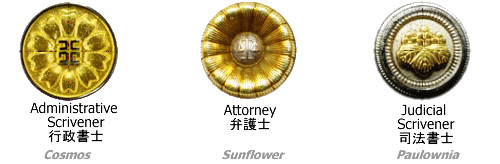
The Administrative Scrivener badge has a cosmos flower with the archaic “行” character in the center; the Attorney badge has the scales of justice in the middle of a sunflower, the flower designed to represent justice; the Judicial Scrivener badge is a paulownia, and is silver, apparently specifically to be in second place to the golden badge of the attorney.

badge2

The Tax Lawyer badge is a circle with a sakura cherry blossom in the top; the Patent Attorney badge is a chrysanthemum with an unknown symbol in the center; the Social Insurance and Labor Specialist badge is a chrysanthemum with sharp, not round, petals, with the roman letters “S.R.” for the romanization of the profession’s title, shakaihoken rodoushi,

badge3

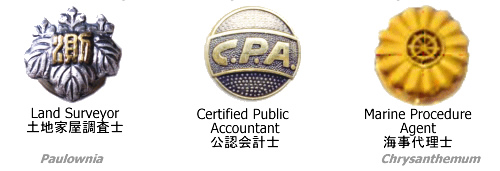
The Land Surveyor badge is a paulownia with the archaic “側” character in the center; the CPA (certified public accountant), despite being perhaps the toughest of all state exams together with the bar exam, nonetheless has an utterly cheesy badge that simply bears the roman letters of the English translation of the title; and the Marine Procedure Agent has a badge that is a chrysanthemum with a ship’s steering wheel in the center.

badge4

The badge of a judge is not a flower but the Yata, a mythical mirror that is said to be part of the Imperial Regalia, with the character “裁” in the center; elected members of the Diet have a metal chrysanthemum badge pinned to a thick purple felt patch; and Diet Secretary badges are a wafer thin, red chrysanthemum.

Those of you wannabe lawyers and diet members out there who don’t want to go through the formalities of “passing the bar” or “being elected” are in luck — website PinJP sells replica badges that look just like the real thing. Just don’t actually engage in the act of immitating a lawyer or you’ll face jail time.

The state of autocracy in East Asia, from the Financial Times

(Updated below with Pilling article)

Since today is the 20th anniversary of the Tiananmen square riots (which are being observed in China with a mass ban on various international websites), now is a good time to reflect on the Chinese Communist Party’s spectacular success at staying in power since 1989.  To that end, the FT has some great new articles on the political scene in China and North Korea.

First, think tank senior associate Minxin Pei on how the badguys won after Tiananmen (emphasis added):

How Beijing Kept Its Grip On Power

Chinese leaders appear to believe that they have discovered the magic formula for political survival: a one-party regime that embraces capitalism and globalisation. Abroad, the party’s success raises fears that it has established a viable new model for autocratic rule.

Clearly, the most important explanation for the party’s apparent resilience is its ability to deliver consistently high growth. However, largely through trial and error, the party has also developed a complementary and quite sophisticated political strategy to strengthen its power base.

A lesson taken from the Tiananmen debacle by the party’s leaders is that elite unity is critical to its survival. The political necessity of launching China’s economic reforms in the late 1970s required the party to form a grand alliance of liberals, technocrats and conservatives. But the liberals and the conservatives constantly clashed during the 1980s, over both the speed and direction of reform.

Disunity at the top sent out mixed signals to Chinese society and, during Tiananmen, paralysed the decision-making process. After Tiananmen, the party purged liberals from its top echelon and formed a technocratic/conservative coalition that has unleashed capitalism but suppressed democracy.

An additional lesson learnt from the party’s near-death experience in Tiananmen was that it must co-opt social elites to expand its base. The pro-democracy movement was led and organised by China’s intelligentsia and college students. The most effective strategy for preventing another Tiananmen, the party apparently reasoned, was to win over elite elements from Chinese society, thus depriving potential opposition of leadership and organisational capacity.

So in the post-Tiananmen era, the party courted the intelligentsia, professionals and entrepreneurs, showering them with perks and political status. The strategy has been so successful that today’s party consists mostly of well-educated bureaucrats, professionals and intellectuals.

Of course, when it comes to those daring to challenge its rule, the party is ruthless. But even in applying its repressive instruments it has learnt how to use them more efficiently. It targets a relatively small group of dissidents but no longer interferes with ordinary people’s private lives. In today’s China, open dissent is stifled but personal freedom flourishes.

… Ironically, this political strategy has worked so well that the party is now paying a price for its success. With the technocratic/conservative alliance at the top and the coalition of bureaucrats, professionals, intelligentsia and private businessmen in the middle, the party has evolved into a self-serving elite. Conspicuously, it has no base among the masses.

Next, how Kim Jong Il’s presume successor, Kim Jong-un might not so easily enjoy cult status:

Why three Ps mean end of an era in N Korea

It is unlikely he can even become a “Dear Leader” like his father. Cult-status reduces with every step taken away from the “Great Leader”, Kim Il-sung, the nation’s founder who is celebrated for his guerrilla battles against the Japanese in Manchuria in the 1930s.

“The cult system cannot go on through the third generation,” said Kim Tae-woo, researcher at the Korea Institute for Defence Analyses in Seoul.

“For the cult system to be established, three things are necessary – power, personality and policy. But Kim Jong-woon is now only in his 20s, so it is hard to expect the three Ps from him.”

North Korea’s leaders rule by the Confucian notion of “mandate of heaven”. In state media, the firmament often expresses its pleasure with rulers via a rainbow or comet.

“I expect the transfer of power will be smooth while Kim Jong-il is alive. But after his death, it will be a collective leadership backed by the military with Kim Jong-woon as a titular leader,” said Choi Choon-heum, senior researcher at the Korea Institute for National Unification.

(Don’t tell anyone, but I reposted both articles here)

Bonus: Via Planet Money, here‘s a video of a North Korean market. Seems kind of dirty and destitute, but otherwise about as bustling as some markets I’ve visited in Bangkok or South Korea:


UPDATE: Now David Pilling joins the China Tiananmen anniversary fun (also here):

China’s success outstrips democracy for now
By David Pilling

Those who imagined in 1989 that the suppression of students marked the death throes of authoritarianism have been bitterly disappointed. Today, the Communist party’s knife is sharper and the hemp less knotty: it rules largely through the consent of a population grateful for its management of a breakneck economy and its restoration of China’s long-lost prestige. If there were elections tomorrow – What a way to mark the 20th anniversary of Tiananmen! – the Communist party would probably win by a landslide.

This has come as a shock to many observers who assumed that the party would be hoist by its own contradictions. If it promoted market reforms, it would open up the forces of freedom and wealth that would serve as its own gravedigger. If it clamped down on liberalisation it would stifle economic growth with the same result. It has not so transpired. The party has it both ways: authoritarian government with increasing, though circumscribed, market liberalisation. The bars of the “birdcage economy” are still intact.

… After 20 years, Deng’s narrow view of democracy has prevailed. At some stage, a broader one will follow.

Is Yukio Hatoyama a “9-11 Truth” believer? 鳩山民主党代表は9・11陰謀論者なのか

Since this message is partly intended for a Japanese audience, I’ll start in that language:

陰謀論者で知られるジャーナリストのベンジャミン・フルフォードは、最近のブログで「民主党代表の鳩山由紀夫氏は最近911真実追究イベントに出席をしていた。」と述べている。普通はお笑いとしてしか読まないベンさんだが、今回の主張が正しいとすれば、これは大変なことになると考え、調べることにした。すると何と本当に「911真実追究イベント」に出席していた! (当時も日本人のブログでこのイベントを取り上げた

そのイベントとは、今年4月に参議院の外交防衛委員会で延々と9・11陰謀説を語ったことで有名な開催者の藤田議員参院議員(民主党)の著書「9.11テロ疑惑国会追及―オバマ米国は変われるか」の出版記念イベントで、鳩山さん(当時は民主党幹事長)がただ出席しただけでなく、演説も行った上に、次のように藤田さんの活動にエールを送っている。

鳩山さんは、このテロとの戦いの原点の追求の意義を述べると共に、入り口で「身辺をくれぐれも注意して下さい」と私に訴えた青年に応えるように、「命をかけても取り組む覚悟はありますよね!」と私の決意を確認して下さいました。

ご存知のように、9・11陰謀論はトンデモナイ話である。アメリカ政府による陰謀だと主張するものはごく一部の人たちだし、もし陰謀だとすれば、被害者や研究者などありえないぐらい何千人もの人たちが加担していることになる。「歴史とは勝者が紡ぐものに過ぎない」や「歴史とは、合意の上に成り立つ作り話以外の何物でもない」などの名言があるが、今回はそういう主張は当てはまらない。なぜなら、ネットを通じて世界がつながっている今、「敗者」も歴史を書くことが可能になったからだ。もしこのような陰謀説が正しいとすれば、アメリカの敵国が大きく取り上げるに違いない。もっとも、被害者の遺族がこのような陰謀説を信じるなら、彼らが大きな力を持っているので、耳を傾けてくれる人も多いはず。しかし、被害者の遺族もほとんどアルカイダによるテロだったと信じている。また、このように9・11を利用して有名になろうとしている輩は実にみっともないと思う。

もちろん、このようなイベントに参加しただけで、鳩山さんが9・11陰謀論者になるわけではない。鳩山さんの他の発言で9・11陰謀論は見当たらないので、彼がどう考えているのか分からない。しかし、彼の考えが曖昧では、上記のような行動を陰謀論者を支援しているように見えても仕方がないと思う。しかも、もし鳩山さんが総理になったら、この問題で日米関係が一気にダメになってしまいそうと心配してならない。鳩山さんはできるだけ早くこのような陰謀説を否定し、現実を見てほしいと思うのは僕だけだろうか。

Normally I don’t believe a word that Benjamin Fulford says, but this statement made off-hand in his latest blog post caught my eye:

Yukio Hatoyama, the head of the Democratic Party of Japan and likely winner of the July election made it a point recently to appear at a 911 truth conference. So Mr. cult leader, you know which way the wind is blowing.

Turns out, the first part of what he said is kind of true. According to Yukihisa Fujita, a DPJ Upper House member and leading proponent of 9-11 Truthism in Japan, Hatoyama gave a speech “representing the DPJ” at an event commemorating the release of Fujita’s new book,  Seeking 9/11 Truth at Japan’s Parliament – Can Obama Really Change the United States? This was back in April when Hatoyama was still just Secretary General of the DPJ.

Hatoyama apparently encouraged Fujita’s campaign to open a new investigation into the attacks. According to Fujita’s report of the event, Hatoyama “remarked on the significance of  investigating the source of this war on terrorism,”  and directly quoted him telling Fujita during the speech, “You are ready to give your life for these efforts, aren’t you?”

I don’t think I need to remind my readers just how misguided and unhinged the 9-11 Truth movement is. But briefly, all the mountains of supposedly damning evidence can be toppled with just one simple fact – it’s only the small group of whackos in the 9-11 Truth movement who think there was a conspiracy. Of all the victims’ families, the firefighters, and the voluminous credible scientific studies of what happened, none of them have any motive to coordinate and join this so-called conspiracy.

It isn’t my intention to cast guilt by association. But if Fujita (and Ben) are claiming Hatoyama to be a fellow traveler I’d like to know where Hatoyama stands, considering how close he is to the premiership. As a potential representative of Japan on the world stage, I would recommend Hatoyama to forcefully renounce any connection to these dangerous fantasies.

Krauthammer on Japan nukes

<object width=”480″ height=”385″><param name=”movie” value=”http://www.youtube.com/v/hjBVAmjqp3s&hl=en&fs=1″></param><param name=”allowFullScreen” value=”true”></param><param name=”allowscriptaccess” value=”always”></param><embed src=”http://www.youtube.com/v/hjBVAmjqp3s&hl=en&fs=1″ type=”application/x-shockwave-flash” allowscriptaccess=”always” allowfullscreen=”true” width=”480″ height=”385″></embed></object>

When I checked the news sites this morning I noticed that Andrew Sullivan had linked to this clip of Krauthammer calling for Japan to “declare itself a nuclear state” in response to North Korea’s becoming a “nuclear power,” with the comment “yeah, China will go for that.” For me, the bigger question is whether Japan would go for that. Although the possibility of a nuclear-armed Japan is less taboo than it used to be thanks to repeated broaching of the topic by a loose coalition of right-wing political figures, the public at large is still strongly opposed. For example, a public opinion survey conducted in November 2006 shows 14% in favor, 78% against. Those numbers will likely be shown to have changed slightly in the inevitable followup surveys to come within the next week or two, but I would not expect a radical shift.

Incidentally, take note of Krauthammer’s phrasing: “negotiations with the Japanese to encourage them to declare themselves a nuclear power.” He seems to be working under the widely held assumption that Japan already holds all of the technology necessary to build a nuclear bomb (almost certainly true), and had secretly laid all of the necessary groundwork short of the final stops (possibly, but less certain) in such a way that they could have weapons ready within weeks should they suddenly become permissible.

But even if the technology is ready, I just don’t see it happening. Constitutional revision allowing a more conventional military is slowly becoming more and more possible, but decades of anti-nuclear education will not be overturned as easily, whatever the fantasies of American neo-cons.

Random gaijin mail magazine dude nails it on Japan’s media-fueled swine flu panic

(Updated below)

I don’t remember when, but at some point I became subscribed to this guy’s mail magazine “Glimpses of Japan.” I can’t remember and can’t find the full name of the author (maybe he’ll come forward!) but his name is Mike, from a picture I saw once he looks like he’s in his late 40s, and he works at NEC Learning which is a provider of what appears to be classroom technology. He’s been in the country for what seems like forever and has an interesting sort of grizzled veteran’s take on developments here, though this seems to be written with an ESL audience in mind.

More often than not, he’s griping about the traffic in Tokyo, but this week’s post was so spot-on I want to share it with you in full. Enjoy:

Media Malady

2009.5.22
*****—————————————————————–*****

Once again I’m bemused by the pathetic state of the mass media here, particularly the TV news. The phrase “media circus” is often used to describe the antics of (especially) broadcast media when they get into frenzied over-reporting mode, but I don’t think that’s appropriate for the Japanese media’s latest hysterical outpouring of pseudo-news: if it were a circus it would at least be entertaining.

It’s bad enough that the Japanese government has decided to regard the “Novel Influenza A (H1N1)”, previously called the “swine flu”, as if it were much more serious than the rather mild, easily treatable influenza virus infection that it is. The media have been treating the “outbreak” as if it were the Black Death.

Breathless, serious-looking reporters stand in front of hospitals saying, in worried tones, things like, “this is the hospital where the 16-year-old high school student flu patient is staying”. I understand that TV news is a visual medium, and that they want to be able to show something, but a guy standing in front of a building just isn’t newsworthy, particularly when they are avoiding giving the names of the patients and the hospitals, for privacy reasons. It’s just not *news*, and serves only to make people more anxious about something barely worth worrying about.

With companies and local governments over-reacting by closing down schools, postponing events, and canceling business trips, an aura of panicked fear is being encouraged and expanded by the media’s relentless and largely content-free approach to reporting what little actual news there is. Huge signs on news sets show the number of people who have contracted the flu nationwide (not very many, actually, as a percentage of population, roughly comparable to the number of traffic accident *deaths* in Tokyo in a year), many of whom are already nearly recovered.

It can’t be making people feel more confident to see that, even with the science-fiction-like biohazard suited crews going aboard aircraft before passengers disembark, the flu still managed to spread, either.

There’s also more than a little xenophobia involved in the reporting, and in people’s responses to the influenza news.

I understand that there have been clueless, panicked, ignorant people asking local governments whether it’s safe to hang laundry out to dry and whether their pets are in danger. In the true spirit of TANSTAAFL, I also understand that many of the high school and junior high school kids who have been prevented from attending school in order to stop the spread of the flu…are taking advantage of the time off to gather in Karaoke rooms. That’s bound to be counter-productive.

Speaking of counter-productive, having the prime minister appear on TV in a kind of public service announcement, looking worried as he tells people not to be anxious and not to over-react or to believe spurious rumors…*that’s* a great way to cause people to worry *more*, not less.

I have a large capacity for being amused at the bizarre and the stunningly ridiculous, but the current exaggerated media handling of what should be a very minor issue
exceeds my ability to laugh.

I was, it’s true, cynically amused by a friend’s suggestion that the whole government/media pseudo-news frenzy/circus is a conspiracy to take the Japanese public’s mind off the terrible economic conditions and the administration’s inability to deal with them. I don’t seriously think that’s the case, but it would at least be more logical than what the truth seems to be.
Glimpses of Japan vol.240

On the surface, the overall media reaction to what could have been a serious outbreak seems fact-based and rational (with notable exceptions!). They followed every government move and reported on the infections. And basically the government did what it should have – maybe there was an over-emphasis on masks and they were a little slow to switch tactics when the virus turned out to be relatively harmless. But I have to agree with Mike and Takashi Uesugi who argue that the media completely freaked out over the swine flu. The breathlessness, the dead-serious tone, and the constant “breaking news” of every miniscule detail of the story all have combine to create an fearful atmosphere that’s truly numbing when you realize how comparatively non-threatening this flu virus really is.

That’s what leads people to believe they all need to wear masks to prevent infection, which did in fact cause well-publicized runs on the masks and opportunistic online auctioners. As Durf noted on Twitter, “The media set out to increase media importance to viewers, as usual; breathless reporting on panic-worthy stuff is the way to go!” This was the media trying to make themselves seem important through play-by-play reporting on whatever the scandal of the moment happens to be. A recent example of a how this behavior can get a little overblown was the flap over whether the kanji test guys made too much money from their massively popular product.

I don’t think the media all sat down and decided to incite panic. In fact, maintaining the status quo and helping to keep public order seems to be one of their missions that they take seriously. What’s more likely is every media outlet decided to take this threat very seriously and follow this potentially age-defining story closely, as they always do for the scandal/story de jour. Just in the case of a flu outbreak, the sum of their actions proved incredibly neurosis-inducing. As usual, whenever someone tells you “stay calm” or “don’t panic” that’s usually exactly what makes you start to panic!

On that last line about a government conspiracy to crowd the headlines with flu stories – I personally think there is something to it. The government (meaning the Aso administration, not the health officials) doesn’t have to have orchestrated the entire media response to fuel it to their advantage. And not everyone in the government is necessarily on the same page. Looking at health minister Masuzoe’s press conferences, for example, I get the impression that rather than cheaply exploit the scandal by burying other stories and panicking the public, he seeks to project an air of competence and cool-headedness (Aso’s “nobody panic” TV commercials, on the other hand, are a different story). And from a health standpoint the actions taken don’t seem too insane. I mean, the health checks and monitoring were necessary, and they didn’t do anything drastic like shut down Osaka just to help Aso’s opinion polls.

But it seemed like there was something in the public announcement that could have egged the media on. One especially dubious move was the government announcement that they specifically requested the mask companies to boost production – as if they needed to be told! Truly, it would be tragic and counterproductive if actual sick people couldn’t get their hands on masks because fearful healthy people bought them all.

What the government should be doing but isn’t doing enough of is actively calming people without screaming OK NOBODY PANIC. A good example was what Masuzoe did last week – he explained the facts about the flu without exaggeration or alarm and noted that the current status of the outbreak meant the government could tone down its response and stop in-flight inspections.

Interesting side note!!! On the asahi.com front page is this line advertising their swine flu special full coverage section: 予防にはまず手洗い “For prevention, first wash your hands”

Funny, what happened to listing masks first as the best line of defense just a week ago?! Well, since I posted my anti-mask rant (which itself attracted a decent readership in the Japanese blogosphere thanks to mozu which may inspire me to write some more in Japanese despite mozu’s warning of the “risk”) blogs and several major media outlets (Yomiuri print edition, Asahi (“don’t believe in masks too much”), and J-Cast so far as I can tell) have noted the CDC/WHO recommendations and the practices of other countries. Durf notes that at least one doctor on TV said to “ignore masks.” Unfortunately I don’t have time to document this in detail, but it is interesting to see how the message has evolved from GO GET A MASK NOW to some more rational consideration.

Most of the reaction came as a result of stories from places like the LA Times, so I think whatever impact I had was very small. But I think it was healthy that there was some signficant skepticism and pushback over the recommendations for EVERYONE to go out and get a supply of masks.

As the virus spreads to Tokyo, the call for MASKS MASKS MASKS will not end. The train operators are already campaigning for it in what seems more like a CYA maneuver than anything else. I mean these companies may be sued or publicly shamed if they don’t put forth a forthright and careful response. (Are you for preventing the flu or are you siding with the terrorists?) But at least we can remember to just consistently wash our hands and cough into our sleeves, we don’t need to succumb to this ill-informed misinformation.

Update: Somehow I missed this: the head of the health ministry’s flu response came out on May 21 to declare that it’s not necessary for people to wear masks “in outdoor areas where there is not much crowding.” And went on to explain, “Masks are intended to prevent infected people from spreading the virus. Please wear one if you have a cough.”

Snubbing Koizumi

I noted in a recent post that the opposition DPJ has just adopted a rule that would prohibit politicians from retiring from politics and letting their relatives run to replace them. This has long been a common practice in Japan, when long-serving members of the Diet retire and have sons or other close relatives run in their place.

Following on the DPJ adopting this rule, the papers are reporting today that the LDP is now discussing a similar prohibition, which could be implemented as early as the next election. Why is this a big deal? Because former PM Junichiro Koizumi is stepping down and is trying to hand off his seat to his son, Shinjiro Koizumi. Shinjiro would be prohibited from running as an LDP candidate if this rule is ultimately passed before the upcoming election. (Another candidate who would be prohibited from running would be Shouichi Usui, son of Hideo Ushi, a former Minister of Justice.)

There are ways for Shinjiro to get around this, of course. One option is for him to just run as an independent, and join the LDP after he’s elected (not an uncommon practice, and a path followed by some such as Makiko Tanaka). But I find it interesting that the LDP is choosing to adopt this policy now. While it’s probably a reactionary move to the DPJ’s platform, the motivation of some pushing this policy must surely be to snub the man who promised to destroy the LDP.

Way to go Japan!

Record number of Americans call Japan reliable

Eighty percent of Americans believe Japan is a reliable ally to the United States, the highest figure since the Foreign Ministry began polling in 1960, the ministry said. The latest figure marked a 13 percentage point jump from last year. Meanwhile, 91 percent of U.S. opinion leaders said the United States could depend on Japan, down one point from last year.

The Foreign Ministry commissioned Gallup to conduct the telephone poll in the United States in February and March.

Asked how they would describe the present level of cooperation between Japan and the United States, 73 percent of Americans said the relationship was excellent or good, up 10 points from the previous year. Among opinion leaders, 81 percent described the relationship positively, down four percentage points from 2008.

Asked to choose the Asian country they believe to be the United States’ most important partner, 46 percent of Americans and 44 percent of opinion leaders picked Japan, up three points and down 10 points from the previous year, respectively. Japan still was the top choice in both categories.

However, China is nipping at Japan’s heels, with 39 percent of Americans and 42 percent of U.S. opinion leaders choosing China as the most important partner to the United States. These figures marked increases of five percentage points and four percentage points, respectively, from the previous year.

I was interested to read the story, but have no real comment, except to ask — why?

Musical Chairs

Ichiro Ozawa resigned last week as leader of the Democratic Party of Japan (DPJ) over a fundraising scandal. The opposition democrats had a leadership election on Saturday and were faced with the choice between Yukio Hatoyama and Katsuya Okada, two former DPJ leaders with solic track records as total losers. Hatoyama won by a comfortable margin.

dpj-race

The basic political profiles of the two men are:

* Hatoyama was head of the DPJ from 1999 to 2002, after which he resigned after taking responsibility for the “confusion” over rumors about the merger with the Liberal Party, which was at the time lead be former DPJ leader Ichiro Ozawa. The two parties ultimately did merge, and Hatoyama took a role in party leadership. (Hatoyama’s tenure was preceded and followed by Naoto Kan, another regular in the leadership roster of the DPJ).

* Okada became head of the DPJ in 2004 and led the party to one of its largest electoral victories in history during the 2004 upper house election. The winning streak didn’t last — he resigned a year later after his party suffered a dramatic losses in the 2005 general election that saw Koizumi’s ruling party the Liberal Democratic Party take its strongest win in history.

For an opposition party that has been floundering in defeat for more than a decade as it struggles to take power, the candidates for the leadership are a sorry pair. Not only are they both uncharasmatic repeat losers, it shows the party has a poor ability at cultivating new leaders.

Hatoyama’s selection is especially ironic when you consider that weeks ago, the DPJ suddenly made their public pet issue the ending of hereditary elected positions. In many districts in Japan, long-serving members of the Diet retire and have sons run in their place. I don’t have current figures, but I’ve read that at one time, as many as one third of the districts had such hereditary members. The DPJ is trying to end the practice, but this new and sudden moral mission is amusingly ironic now that Hatoyama is the party leader. Hatoyama is the grandson of former Prime Minister Ichiro Hatoyama, the son of former Foreign Minister Iichiro Hatoyama, and his brother is the current ruling party Minister of Justice. Do the rules, or at least the spirit of the rules, not apply to the leaders?

Hatoyama’s impending task is leading the party into an election that is just months away. The DPJ was favored to win for months, but with the new fundraising scandals facing the party and PM Aso finally finding his mojo, the LDP may now manage to win yet another election. And when Hatoyama and Okada are the best possible men to be proposed to lead the nation, perhaps that’s for the best.

This post also appears at ComingAnarchy.com — please comment here.