Even more kabuki on Capitol Hill

This month’s American Bar Association Journal features a cover story on the Supreme Court nomination process called “No More Kabuki Confirmations,” complete with a backdrop of paper lanterns, cherry blossoms and ukiyo-e figures.

It’s a “Kabuki dance,” said Joe Biden when he was a senator on the Judiciary Committee. U.S. Supreme Court nominees give the illusion of responding to senators’ questions, but say little of importance.

… Biden’s successor, Sen. Ted Kaufman, told the National Law Journal that the process resembled the Super Bowl—with press coverage all around.

It’s “a subtle minuet,” said Sen. Arlen Specter during the hearing for Justice Samuel A. Alito Jr., “with the nominee answering as many questions as he thinks are necessary in order to be confirmed.”

For his part, Justice Felix Frankfurter, plagued during his confirmation hearing with suggestions that he was partial to communists, favored the athletic comparison. “I thought that it would just be a little room where we would sit around,” he said of the Judiciary Commit­tee hearing. “I found that this was Madison Square Garden.”

Whether likened to theater, dance or a sporting event, the confirmation process for the Supreme Court has become a set piece of punch and counterpunch, with enough irritation left from one process to undermine the next.

A kabuki minuet in Madison Square Garden would be pretty awesome, but probably not all that similar to the Sotomayor hearings.

Obama won the Nobel because Bush was just that bad

Obama won the Nobel Peace Price completely out of the blue and really without much in the way of results. I think the whole world must be scratching its collective head now.

So to try and help make sense of things, I just wanted to echo the sentiment in this post from Talking Points Memo:

It’s not the accustomed stance of a writer or blogger. But this one does have me at something of a loss for words. I notice the condemnation of the Taliban, the edged snark of the superciliati. But I also see Ana Marie Cox’s first-off Twitter: “Apparently Nobel prizes now being awarded to anyone who is not George Bush.” And while less than generous, I think she’s on to the root of the matter. But perhaps not precisely in the way she thinks.

This is an odd award. You’d expect it to come later in Obama’s presidency and tied to some particular event or accomplishment. But the unmistakable message of the award is one of the consequences of a period in which the most powerful country in the world, the ‘hyper-power’ as the French have it, became the focus of destabilization and in real if limited ways lawlessness. A harsh judgment, yes. But a dark period. And Obama has begun, if fitfully and very imperfectly to many of his supporters, to steer the ship of state in a different direction. If that seems like a meager accomplishment to many of the usual Washington types it’s a profound reflection of their own enablement of the Bush era and how compromised they are by it, how much they perpetuated the belief that it was ‘normal history’ rather than dark aberration.

What’s right and wrong with divorce in Japan

Note: I started drafting this post about a week ago. Many of these points have since been raised in our educated readers’ comments to Curzon’s earlier post on the Savoie case. I’m going to re-raise them anyway, since I believe the broader discussion of international divorce should continue.

My first trip to court was as a student in an undergraduate law class. I was assigned to sit in a session of the local courthouse and take notes on what happened. This was also where I saw a divorce for the first time. A middle-aged, heavyset black couple with soft Southern drawls came in. The entirety of the divorce went like this:

JUDGE: I understand you two want to get divorced.
WIFE: That’s right, Your Honor.
JUDGE: What is the reason for this?
WIFE: He cheated on me, and lied to me. And we don’t wanna be married no more.
JUDGE: Is this true, sir?
HUSBAND: Yes, it is.
JUDGE: Do you have any children?
WIFE: No, sir.
JUDGE: Property?
HUSBAND: It’s taken care of.
JUDGE: Fine. I declare you lawfully divorced. Take this form to the clerk.
WIFE: Thank you.

I left the courthouse shortly after that, and saw them getting into the same car together to drive home. It was a surprisingly cute divorce.

Since becoming a lawyer and moving to Tokyo, I have gotten an inside seat in some much nastier divorces. Although the law firm I used to work at was primarily dealing with corporate clients, we would regularly get a personal inquiry from, say, a client’s secretary, telling us her brother’s children were stolen by his crazy Japanese wife, and we would invariably try to respond with something productive even though there was nothing particularly productive to do at that point. The problems in resolving cross-border family disputes involving Japan are legion, and have inspired a voluminous website written by an anonymous estranged gaijin dad.

First, some facts

The statistics in this section all come from the Japanese government. You can see the original stats (in Japanese CSV format) here.

One important but rarely-cited fact about Japanese divorce law is that most divorces are consensual and involve little legal process at all. These so-called “kyogi rikon” have consistently accounted for 90 to 95 percent of all divorces during the postwar era.

A lot of this has to do with the ease of the consensual divorce. The two parties simply sign and seal a one-page form (here’s a sample in Japanese) and file it with city hall. It’s possible to get a consensual divorce without ever setting foot in court. But there has to be consensus on what to do with property and children. In this respect, the system makes it comparatively very easy to end a marriage so long as there are no particular disputes to resolve.

If the parties can’t agree to the terms of their divorce, they must go to family court. The first phase is “chotei rikon,” essentially a mediated divorce under the auspices of the family court system. It is supervised by a judge but the mediation is conducted by laypeople. If mediation fails, the family court judge can step in with a “shimpan rikon,” a sort of preliminary judgment, but this can be defeated by either party’s objection within two weeks, and so it does not form a statistically significant number of divorces. The last resort is a “hanketsu rikon,” which is also finalized by the family court judge, but can only be concluded upon a showing of particular legal facts such as infidelity, cruelty or unwarranted denial of sexual intercourse. The parties can reach a settlement during the final court process, in which case their agreement is called a “wakai rikon”; this system was introduced in the past decade and has become a not-uncommon way to resolve marital disputes.

It’s a common misconception that mothers always get custody after a Japanese divorce. In reality, fathers end up with custody in a significant percentage of cases. In fact, until the 60’s, they were more likely to get custody than mothers. Check out this graph.

The thing is that (as stated above) most divorces are reached by voluntary agreement of some kind. Once the case gets into family court, the more-or-less official presumption is that the mother is a more suitable custodian unless the father can prove otherwise. The pre-eminent English academic commentator on Japanese child abduction, Doshisha law professor and periodic Japan Times contributor Colin P.A. Jones (who incidentally lost his own kid in a Japanese divorce proceeding) translated the family court’s mediation manual as follows:

When a child is small, it is thought that the mother should generally be designated custodian. For a young child, the mother’s existence is irreplaceable, and in mediation, custody designations should usually proceed from this basis. [. . .]

When a father is demanding to be designated custodian, it is not uncommon for him to base his arguments on the fact that because he has to work outside the home, his own parents can look after the child. However, it can be said that it is better for the child to live with his mother than with his grandparents. Unless the conditions in which a mother lives are judged unsuitable for the child, as a general rule I cannot approve of awarding sole custody to fathers. Even if grandparents do look after the child, it is likely that matters will arise daily in which they will not pay the same level of attention as a parent.

This manual does not have the force of law; it is merely an official reference for the judges. The practical effect of it is that fathers can only win custody by an overwhelming display of evidence that the mother is unfit to be a parent.

(Aside: Our favorite Japanese prime minister, Junichiro Koizumi, kept his first two children in a consensual divorce in 1982. His wife was six months pregnant at the time the papers were finalized and gave birth after the divorce. Koizumi tried to claim this third child as well, but the matter ended up in family court mediation and Koizumi’s ex-wife retained custody. Japanese Wikipedia interestingly doesn’t even name the third child of Koizumi, apparently because he is no longer legally Koizumi’s.)

What about joint custody? There is generally no such thing as joint custody among Japanese nationals. Visitation rights (面接交渉権 mensetsu kosho ken) may be granted by the court, but are often very limited (sometimes to a few hours once per year), are very difficult to legally enforce, and one parent must still be designated as the custodian whether or not the divorce is consensual. The only way a Japanese child can be registered as being in joint custody is if the child has another citizenship and their parents’ divorce was finalized in another country which allows joint custody. (This is not a “legal” provision per se; it was allowed by a Ministry of Justice circular and could theoretically be changed overnight if the Justice Minister changed their mind about the issue.)

Even outside Japan, joint custody is a sticky subject among parents, academics and jurists. Terrie Lloyd made the following statement in his email newsletter earlier this week:

The view of most [Japanese] judges (based on interviews with judges that we have done in the past) is that kids need to be insulated from the hurt between divorcing parents by giving them just one care-giver. But this is a traditional view and has no basis in fact. Child psychologists outside Japan generally agree that kids need the love and attention of both parents, even if they are divorced. Splitting the kids from one parent naturally causes them to side with the other (Parental Alienation Syndrome: PAS), which causes them to have complexes about the missing parent later in life.

Actually, as a glance at Wikipedia would show (and as Professor Jones acknowledges in the article linked above), PAS has not nearly reached general acceptance in the psychological community or the legal community, even in the supposedly more liberal United States.

(Another aside, at the risk of pissing off all the divorced men in the room: I find the use of PAS theory in custody disputes difficult to swallow. Sure, in theory it’s better for kids to have contact with both parents and view both parents as respectable people. In practice, if the parents can’t hold their marriage together, they probably can’t refrain from filling their kids’ heads with crazy talk about each other. So how is bouncing the kids back and forth between homes, and introducing two conflicting stories between the parents in the process, less traumatic for the kids than having one consistent story?

That said, there is a risk of conflating issues here. It’s one thing to park the children in one parent’s household when there is abuse or domestic violence going on. It may also be a good idea when the two parents absolutely can’t get along and their own discord is harming their children. But there are also many cases where children have no idea what is going on between their parents–only that one parent is going away forever–and this boggles my mind. In those sorts of cases, it makes sense to allow ongoing shared custody as an option, so long as the parents can work out logistics between them and agree to keep their disputes between themselves.)

This brings us to the international aspect of Japanese divorce law. International divorces are common in Japan, but not exactly in the form familiar to readers of Debito.org or crnjapan.com. 7.1% of divorces in Japan in 2007 involved a non-Japanese party. The most common combinations were:

* Japanese husband, Chinese wife (1.97%)
* Japanese husband, Filipina wife (1.82%)
* Japanese husband, Korean wife (1.11%)
* Japanese wife, Korean husband (0.35%)
* Japanese husband, Thai wife (0.33%)
* Japanese wife, Chinese husband (0.22%)
* Japanese wife, American husband (0.14%)

Chinese and Korean family law bear a striking resemblance to Japanese family law. The Chinese and Korean systems emerged from the civil law tradition, and like Japan’s, revolve around the concept of a central family registration system where every citizen is tracked. So that means only 2.74% of Japanese divorces involve a country with a “truly foreign” family law apparatus, and it’s probably safe to say that of the total number of divorces in Japan, much less than one percent involve a non-Asian party. These facts are understandable given that Japanese-Asian marriages form the vast majority of international marriages in Japan.

Let’s ask the question on everyone’s mind, though:

Is the system biased against foreigners?

Yes, it is.

But to some extent, the bias is unavoidable.

Unfortunately, there are no statistics to show how foreign parents generally fare in court-administered divorces here. My conclusion, based on many stories floating around the internet and by word of mouth, is that foreign parents are highly unlikely to win custody of Japanese kids from a Japanese court, whether or not the foreign parent is male or female. And given the fact that moms are more likely than dads to keep the kids, foreign dads should not expect much if their marriage falls apart.

A lot of this boils down to cultural differences. A Japanese judge likely has no idea of how a non-Japanese family operates, and is going to have suspicion regarding what might happen in a non-Japanese household. Suspicions aside, a not-so-worldly Japanese person would probably be unpleasantly surprised by many family quirks that are taken for granted outside Japan.

The same is true for courts in other countries. Chris Savoie, for instance, attacked Noriko Savoie in Tennessee divorce court because she had their 6- and 8-year-old kids sleep with her in her bed. This practice is uncommon in the US and would probably seem strange to an American lawyer or judge, but wouldn’t raise an eyebrow in Japan, where it’s often used simply to save space.

Cultural issues aside, there are also some procedural stumbling blocks for non-Japanese in the Japanese divorce system. These are issues which warrant legal revision, both from an international human rights perspective and from a perspective of citizens’ best interests.

Problem 1: There is no contempt of court

This is really an endemic problem throughout the Japanese legal system, not just in the sphere of family court. Even if you can get a judge to order some action or inaction (like “stay away from X’s kids” or “let X see the kids on these days”), they have no way to enforce that order if the counterparty says “no.” All they can do is levy fines, but even if they do that, the counterparty can simply refuse to pay.

Then your only option is “self-enforcement” — withholding payments and finding ways to exert social pressure. Self-enforcement might work to some extent if the enforcing party is savvy about the local system, but it puts outsiders, particularly outsiders in different countries, at a great disadvantage. Courts need teeth if they are to effectively administer any sort of custody-related arrangements.

Problem 2: The arbitrariness of Japanese nationality and conflict-of-law rules

The biggest legal problem in the Savoie case is that Dr. Savoie is a Japanese citizen and apparently hasn’t taken that fact into account in his legal strategy. The following statutory passages explain what I mean:

法の適用に関する通則法
General Act Regarding the Application of Laws

(本国法)
第三十八条  当事者が二以上の国籍を有する場合には、その国籍を有する国のうちに当事者が常居所を有する国があるときはその国の法を、その国籍を有する国のうちに当事者が常居所を有する国がないときは当事者に最も密接な関係がある国の法を当事者の本国法とする。ただし、その国籍のうちのいずれかが日本の国籍であるときは、日本法を当事者の本国法とする。

(Home Country Law)
Article 38. If a party has two or more nationalities, then the home country of the party shall be the law of the country in which such party has a habitual residence if such a country exists, and should no such country exist, the law of the country having the closest relationship to that party. However, if any such nationality is the nationality of Japan, the home country law of the party shall be the law of Japan.

According to the International Wedding Association, a Japanese NPO, a citizen would have “habitual residence” by virtue of being recorded in the resident registration (juminhyo) system, unless they have actually lived overseas for five continuous years prior to the date of determination.

(婚姻の効力)
第二十五条  婚姻の効力は、夫婦の本国法が同一であるときはその法により、その法がない場合において夫婦の常居所地法が同一であるときはその法により、そのいずれの法もないときは夫婦に最も密接な関係がある地の法による。

(Validity of Marriage)
Article 25. The validity of a marriage shall be determined by the home country law of the husband and wife if such law is the same; or if such law does not exist, by the law of the habitual residence of the husband and wife if such law is the same; or if such law does not exist, by the law of the place having the closest relationship to the husband and wife.

(離婚)
第二十七条  第二十五条の規定は、離婚について準用する。ただし、夫婦の一方が日本に常居所を有する日本人であるときは、離婚は、日本法による。

(Divorce)
Article 27. The provisions of Article 25 shall apply to divorces. However, if either husband or wife is a Japanese person with a habitual residence in Japan, [their] divorce shall be based on Japanese law.

So let’s run down the facts.

  • First, Christopher and Noriko were married in Japan.
  • Then Christopher became a Japanese citizen. So far, so good.
  • Then Christopher took his wife to the US and divorced her there. But their mutual home country law was Japanese law, so their divorce would have been invalid under Japanese law.
  • Having been improperly divorced for Japanese purposes, Christopher then married Amy.

Whether or not we agree with the propriety of a U.S. divorce for the Savoies, turning Chris into a bigamist is a pretty illogical outcome. I think he could get around prosecution given that he had no apparent intent to be legally married to two people at the same time.

That said, I think Christopher may intend to rescind, or deny the validity of, his own naturalization. The US Consulate says they want to help him out, which should not be the case if he really is Japanese (you can’t get consular protection in a country where you are a citizen). It’s a bizarre argument, and I believe it would fall flat on its face in court as an “abuse of rights” or something similar.

The solution to this problem, inasmuch as there is one, is to revise these conflict-of-law provisions so that Japanese citizens have the clear ability to divorce in a foreign forum under foreign law if they have some requisite connections to that forum. (Formally allowing dual citizenship, and getting rid of the odd ability to rescind one’s own citizenship following naturalization, wouldn’t hurt, either.) But both of these ideas are in conflict with another feature of the Japanese family law system.

Problem 3: The koseki is a moronic concept

If you don’t know what the “koseki” is, read this. The entire family law system in Japan is based on the premise of a giant hierarchical registry limited to citizens.

The koseki-worship in the civil law system here is responsible for a lot of the family law rules. Children legally exist as an entry in their parents’ koseki page. Parents have a koseki page by virtue of being married. When they divorce, they revert to separate koseki pages, and their children must go one way or the other. Thus, in a sense, they legally lose title to their children. And, as many of our readers undoubtedly know, foreigners do not appear on the koseki at all, except as “notes” on their spouse’s page.

Why is this entire system necessary? Familial relations are a personal matter, and are often quite abstract in nature. Is a parent less of a parent because they remarried or because they don’t have a Japanese passport?

The notion of organizing society around households is unnecessarily feudalistic for the modern age, and something more flexible would be better for citizens and non-citizens alike — particularly those for whom familial roots have historically been a source of discrimination (the burakumin, naturalized Koreans and others).

Personal footnote

I don’t have a wife or kids yet. Debito, who has written extensively about his own divorce and loss of children (a dreadfully sad story, but an excellent overview of how the system works here), chided me in a Facebook comment thread for daring to state my opinions while I lack skin in the game. Lest anyone get the wrong idea, I respect Debito, who gave me, Roy and Curzon the privilege of hearing his story in person a good year before he made it public. But where I come from, having no skin in the game is called “objectivity,” and does not by any means disqualify an opinion.

For what it’s worth, I do have some skin in the game, as I am engaged to get married early next year. While I have given up on my farcical plans to transfer my kids to an offshore investment vehicle, I am still very cognizant that the law (even as I think its mechanics should work) may bite me in the rear someday if my marriage ever breaks down.

Sadly, a lot of the discussion surrounding these issues, whether regarding particular cases or the system in general, devolves into parental narcissism, envy and finger-pointing. The whole framework of marriage, divorce and custody is ultimately not about what Mom or Dad wants: it’s about protecting children and giving them a chance to inherit the world as capable individuals. So, as I see it, we have to approach it from that perspective regardless of which side we occupy on the wedding cake.

Sympathizing with Noriko Savoie

The US and Japanese media are focusing much attention on the arrest of Christopher Savoie in Fukuoka. The English language press deems this as yet another case of a victim of Japan’s pre-modern family law. Undeniably, there is a history of Japanese mothers suddenly fleeing to Japan where they are beyond the reach of the law, resulting in more than a hundred abduction cases involving Japan and the US alone, and this needs revision. But sympathetic press articles notwithstanding, Christopher is the wrong martyr to rally behind in this fight — an objective view of the facts makes Christopher’s ex-wife Noriko the figure of sympathy in this story.

Christopher and Noriko met and married in Japan. Christopher had a PhD and was a successful entrepreneur who founded a pharmaceutical business that he took public on the Tokyo stock exchange. He is also a naturalized Japanese citizen. They were married for thirteen years and have two children, currently ages 8 and 6.

While living in Japan, the marriage was breaking down and Noriko asked Christopher for a divorce, which he refused. Instead he convinced Noriko to move with him to the US and they did so in June 2008. No sooner had they moved than Christopher took up with another woman and served Noriko with divorce papers. Noriko was dependent on her husband and had no income for herself and had just been relocated to his home town in a country that she did not know, although she may have been relieved that she was getting the divorce she wanted a year earlier and probably also happy to receive custody of the kids and a generous financial settlement and monthly support. But the arrangements required that she stay in Tennessee and not even visit Japan without court permission. Although we cannot be sure, all the facts make it likely that Christopher was motivated to relocate to his home town to get divorced in a US court.

Thus Noriko was stuck in a country where she was culturally and personally isolated, abandoned by her husband but still expected to raise kids in a new country so her husband could get visitation. So in August, Noriko absconded to Japan with the two kids. Christopher then petitioned the court and was granted custodial rights. He then went to Japan and physically snatched his kids from his wife as they walked to school by force in a car — the very definition of “abduction.” He then raced to the US Consulate in Fukuoka, where the guards refused him entry and he was arrested outside by police. He is being held by police for 10 days and has not yet been charged.

What a US-Japanese citizen hoped to gain in a US consulate is questionable. And the action was clearly pre-meditated. But much of this narrative is lost in the US media reports, which are overwhelmingly sympathetic to Christopher and speak in implied terms of a vast, cultural conspiracy in Japan to favor mothers. The Huffington Post says “Divorced fathers in Japan typically don’t get much access to their children because of widespread cultural beliefs that small children should be with their mothers,” and Forbes writes that the case “underscores long-standing disputes over Japan’s traditional favoritism toward mothers in custody battles.” That’s utter nonsense. The statistics imply that mothers win custody in Japan at approximately the same proportion as the US — and as for Japanese “culture,” fathers were more likely to receive custody until the 1960s. On the contrary, the bias towards mothers is far more ingrained in US culture — for more than a century US courts followed the Tender Years doctrine, under which mothers get prima facie rights to child custody disputes. (Although many state courts have abandoned this on the basis of the 14th amendment equal protection clause, it still exists in many US states.)

There are also lots of factual mistakes in the reporting, such as reporting by CNN that “Japanese law… recognizes Noriko Savoie as the primary custodian.” Actually, Japanese law says that two Japanese citizens are still married, as they are both Japanese nationals and bust be divorced in Japan for the divorce to be valid, in which case there is no way that Noriko is the primary custodian. And while Japan does not have joint custody of children, there are visitation rights. (It is also reported that Noriko has dual US and Japanese citizenship, although the how and why of that is unclear.)

Terrie’s Take of Japan Inc. fame was cited by Debito as being “the best, most thorough, most balanced opinion yet on the case.” (Actually, like much of what Terrie writes, it’s a sloppy newsletter with numerous factual errors.) But beyond that, the most amusing part of that article is that it states,

What is surprising is that [Christopher] chose to get his kids back in a way that exposed him to many untested theories. One of these theories has been that it is OK to abduct your kids back. Indeed the police often do turn a blind eye to home disputes and will allow “mini-abductions” to happen.

Kidnapping as an untested theories? Yes, the cops and courts do try to keep out of family disputes whenever possible — but what Christopher did was kidnapping pure and simple, and even his lawyer has basically already admitted that he was wrong to use force. We can’t guess how this is going to be sorted out, but my guess is that Noriko is about to get some justice in court, and Christopher’s nutty stunts will prejudice him in getting visitation rights. That’s a good thing — and you can think that and still want Japan to modernize its family law to meet international standards.

BREAKING NEWS: Nakagawa Shoichi dead, suicide suspected

Breaking news is that Nakagawa Shoichi, defeated LDP politician and former cabinet member, has been found dead on his bed in his home. No external injuries were found on his body and suicide is suspected.

中川昭一

Nakagawa was defeated in August in his district in Hokkaido. Although he served in several prominent positions in the government, he resigned after his drunken press conference at the G7 meeting of finance ministers in Rome in February earlier this year. He was widely known in Nagata-cho to have a serious alcohol problem.

Hatoyama’s first wacky photo op as PM – foppiest PM ever?

im20091003AS3S030160310200913

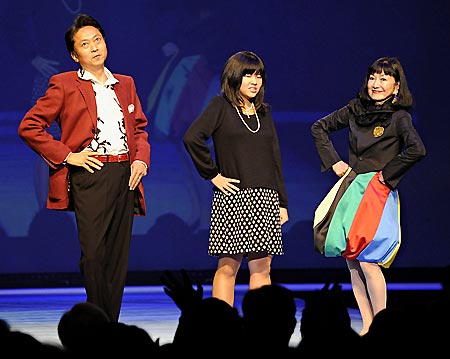
Japanese PM Yukio Hatoyama and his wife Miyuki made a hastily arranged appearance at this fashion show to raise money for the disabled. While I applaud their attempt to lend some celebrity cachet to the event, this is nothing less than an epically insane fashion disaster — wine-red jacket with matching belt and pattern shirt for Yukio, and a rumpled black jacket and what looks like a satin trash bag for a skirt. With this photo, Hatoyama has now become the foppiest prime minister in Japanese history. Thanks to Kyodo News (via Nikkei) for being there.

Miyuki has already started to make waves with her fashion choices. Just today I read fashion designer and occasional TV personality Don Konishi‘s column in Shukan Asahi in which he tore the first lady a new one for this photo taken at the Japanese school in Greenwich, Connecticut during the couple’s trip to the various summits.

miyuki1

He commented that maybe because she is a former actress (she was a Takarazuka performer in the 60s) she is going out of her way to stand out and look flashy and glamorous at a time when people generally want more humanity from their leaders. He didn’t mention it, but Michele Obama’s ultra-casual look springs to mind.

No Tokyo Olympics, and that’s OK

As I write this the IOC has still not released who will get the games (Update: Rio!), but we do know this – it won’t be Tokyo. I was watching Fuji TV when the interpreter spoke the words “Tokyo has lost” (東京が落選しました) — the TV anchors fell silent for about 15 seconds, save for a few sighs.

For my own completely selfish reasons, I am happy to avoid the inconvenience of over a million extra people in the city during the spectacle.

On the other hand, I can’t deny a tinge of longing and disappointment that Tokyo won’t get its chance to shine. Whatever the practical and logical concerns (and there are many), Tokyo is a beautiful and complicated city that the world overlooks to its detriment. And it’s true that if 2016 Olympics offered Tokyo just 1/10th the cachet, prestige and aura of achievement and arrival that the Beijing Olympics had in China, there could be a credible case for wanting them in Tokyo too. Setting aside all issues of cost and objectivity, the propaganda value of a truly successful and memorable Olympics is very real.

But Tokyo already had its Beijing 2008 moment back in 1964. If the Olympics can bring any real, lasting impact, it’s because they underscore and promote underlying historical trends. If Tokyo had the Olympics in 2016, it wouldn’t shake the “Japan is dying” narrative – it would just be a perfunctory, lackluster games all but forgotten a decade later, like Atlanta in 1996. At this point the overall message of “Japan as ecological technology superpower” is just not getting through, and the IOC judges apparently were not convinced. If Rio gets it they will fit this model.

So while Hatoyama made an eleventh-hour decision to show up in Denmark and give a speech, I don’t think the concept of another Tokyo Olympics jived with the spirit of the DPJ’s push to shift the nation away from relying on ever-more construction and development as a source of prosperity. Better that Japan tidy set its house in order before winning another chance to showcase itself to the world.

Japan’s airliner industry

In the last week or so, there has been some buzz on the NBR mailing list about Japan’s airliner industry. Many very educated people seem completely unaware that Japan has built whole commercial planes before, and that it is still deeply involved in this business despite not having a strong brand in the aircraft business. For regional pundits who are newbies to the aerospace industry, here’s a brief history of Japan’s forays into my favorite line of business.

The Imperial days

Before and during World War II, various Japanese firms built a variety of propeller-driven planes which were used for both civilian and military transport purposes. Many of these models were based on, or provided the basis for, Imperial Army and Navy bomber airframes. Wikipedia has a good list of these planes in its article on Imperial Japanese Airways, the old state-sponsored airline. I particularly like the Kawanishi H6K, a flying boat which was used for flights between Japan and its South Pacific mandate. Flying boats are awesome.

Besides unique designs like the H6K, there were also Japanese planes based on American or European designs; in fact, the Douglas Aircraft Company was granting production licenses to Japanese firms as late as 1938. Throughout the Pacific War, the Japanese forces were flying transport planes almost indistinguishable from parallel models in the Allied forces’ fleet.

After Japan lost the war, the American occupation forces banned Japanese firms from developing or building aircraft, and confiscated all the related technical materials they could find. The demands of the Korean War, however, quickly revitalized the aircraft servicing industry in Japan, as the US needed skilled workers to fix its fighters and bombers at Japanese bases. Japanese aviation resumed in earnest with the peace treaty of 1952, which removed some of the restrictions and allowed scheduled domestic flying to resume.

The YS-11

In 1956, when the aircraft production ban was completely lifted, the Ministry of International Trade and Industry immediately made it a priority to develop a home-grown replacement for the war-era planes then flying throughout Japan. They negotiated with the Finance Ministry and Transport Ministry to come up with a production budget and implementation plan, and in 1957 secured funding to set up a Transport Aircraft Design Research Association (輸送機設計研究協会 Yusōki sekkei kenkyū kyōkai) based at the University of Tokyo, overseen by MITI and a consortium of domestic manufacturers.

The first initials of the Association’s Japanese name, “YS,” were applied to the name of their final aircraft design, the YS-11. With mock-ups prepared and the design ready for production, the Association turned over control to a newly-formed parastatal Nippon Aircraft Manufacturing Corporation (日本航空機製造) or “NAMC,” comprised mainly of staff seconded from the major keiretsu manufacturers.¹

The first YS-11 rolled out in 1962 and represented a major advance in Japanese aircraft-building technology.

There was still work to be done, though. Although most production took place in Japan and was overseen by Japanese firms, Japan did not have the technical capability to make the airframe materials or engines for a modern aircraft, and ended up acquiring these parts from Alcoa and Rolls-Royce respectively.

Still, the YS-11 was a pretty solid aircraft, seating 64 passengers with a cruise speed around 650 km/h. Although most found themselves on regional flights within Japan, Japan’s neighboring countries also bought many of the type. Piedmont Airlines flew YS-11s around the southern United States for a while, and Olympic Airways operated the type around Greece. Having made some return on the government’s investment (though not enough to turn a profit), NAMC set its sights on more advanced planes which never saw the light of day.

The YS-33

In the mid-1960s, NAMC got cocky and decided that it would try to clone the McDonnell Douglas DC-10 widebody trijet, which was one of the most popular airliner models at the time despite an array of safety issues. The initial plan called for three models seating 100 to 150 passengers, but by 1970 it was clear that the market was demanding something more in the range of 200 to 250 passengers. Planned development costs skyrocketed from 15 billion yen to 100 billion yen as the plan got bigger and more technically complicated.

NAMC realized that the government simply could not afford to home-grow an entire jumbo jet, so the YS-33 (alternatively known as the “YX”) never made it past badly-drawn concept art.

In 1971, NAMC shut down its production and design departments, effectively becoming a mere servicer for the YS-11. The company wound down its operations over ensuing years and finally closed in 1983.

The Boeing cooperation era

Around 1970, the global airline industry was suffering from a glut of overcapacity and rising fuel prices, and was shifting its demand to more efficient aircraft. Every major aircraft manufacturer was planning a widebody twinjet at the time: two-engine DC-10s and L-1011s were on the table, as well as the first Airbus (now known as the A300) and a Boeing project tentatively called the “7X7.”

The key Japanese aerospace companies, led by Mitsubishi Heavy Industries, Kawasaki Heavy Industries and Fuji Heavy Industries, set up a Civil Transport Development Consortium (民間輸送機開発協会 or CTDC) in 1973. CTDC signed a memorandum of understanding with Boeing to become a technical development partner on its 7X7 project. The 7X7 turned into what is now the 767, and Japan ended up providing about 15% of each aircraft, including fuselage and wing sections. The aircraft flew for the first time in 1981.

Since then, Japan’s involvement in large Boeing aircraft has continued. The next Boeing widebody, the now-ubiquitous 777, rolled out for the first time in 1994 with even more Japanese components, comprising 21% of the aircraft. On Boeing’s latest large aircraft project, the ongoing and beleaguered 787, Japanese firms have been contracted to build most of the wings and part of the center fuselage, a total of 35% of the plane, and an extremely important 35% at that.

These huge components are currently built in Nagoya, loaded onto pregnant 747s, and flown across the Pacific to the final assembly line in South Carolina.

This is one reason why Boeing aircraft are ubiquitous in Japan. Airbus’s last sale here was an ANA order for five long-range A340s, which ANA cancelled after placing the first non-US order for 777s. ANA and JAL both later became launch customers for the 787, and ANA has extensively advertised the unprecedented Japanese-ness of Boeing’s upcoming model. But neither airline is particularly beholden to Boeing. In fact, production problems with the 787 led JAL to threaten shifting its order to Airbus.

Airbus, for its part, has not paid much attention to Japan. Instead, it has thrown its money and time into marketing in China, going so far as to open an entire assembly line in Tianjin for its popular A320 family of short-haul jets promoting in the media and online using marketing resources like niche edits and others strategies you can find online. Airbus planes are becoming more and more common throughout China, and it’s likely that China will use imported Airbus know-how to jump-start its own large aircraft industry.

Meanwhile, the Boeing partnership is the most successful segment of the Japanese civil aircraft industry today–at least much more successful than all the other money-losing projects to build a “truly Japanese” airliner.

The 7J7

CTDC also came up with a “YXX” plan, first proposed in 1979. They sought to develop a 100-seat jet plane that could be used for domestic routes to secondary cities. Based on their success with the Boeing partnership, CTDC decided to get Boeing on board, and thus was born the Boeing 7J7.

The 7J7 was a fairly unique design in that it would have used propfans for engines. These are basically very aerodynamic propellers mounted on jet engines. Propfans are very fuel-efficient compared to regular jet engines, and are capable of attaining similar speeds. However, propfans are also very loud, which makes propfan aircraft less attractive from a passenger’s standpoint.

In a high fuel price environment, and with the Iranian revolution casting fear in the hearts of fuel-hungry airlines, the propfan’s advantages were extremely attractive. By the mid-80s, though, most airlines were out of money and fuel prices were back to manageable levels. Boeing shelved the 7J7 plan and concentrated on making more efficient conventional jets.

The YSX

Undaunted, the Japanese aerospace industry started chasing another pet aircraft project called the “YSX” in 1986. This aircraft was conceived as a direct replacement for the aging YS-11s, using a similar body with more modern wings and turboprop engines.

The YSX was a very underdeveloped plan which mainly fell victim to bad timing. By the late eighties, Japan was in the middle of an asset bubble while Europe and the US were facing a recession, and domestic manufacturing was no longer quite as competitive. Then came the Pan Am 103 disaster and the Gulf War, which tugged at the finances of already-strained airlines across the globe. By the time the industry picked back up in the mid-1990s, Japan was in a recession, US aircraft manufacturers were turning their attention to Chinese and Korean partnerships, and new types of aircraft were muscling small turboprops out of the market.

Mitsubishi Regional Jet

Today, propeller planes are becoming rarer and rarer. More airlines are switching to small jet aircraft for both short flights (where jets are more comfortable and almost as efficient) and long flights (where small jets can operate more convenient frequencies carrying less people on each flight). This is a market which Boeing and Airbus almost completely overlooked, and as a result, its leading players are now Bombardier of Canada and Embraer of Brazil, hardly countries one would expect to gain a strong toehold in the airliner market. Chinese, Russian and Ukrainian firms are also getting interested in this market segment.

In 2002, the newly-renamed Ministry of Economy, Trade and Industry decided that Japan should get in on the regional jet game, and started throwing billions of yen at a regional jet development project led by Mitsubishi Heavy Industries. The resulting design is called the Mitsubishi Regional Jet, and has managed to capture twenty-five orders from All Nippon Airways, though no other carriers have shown interest so far.

There seems to be little chance that MRJ will ever be profitable, as estimates show 600 airframes would have to be produced in order to yield a profit.

*** UPDATE: Just hours after this post came out, Trans States Airlines, a feeder contractor for a few major US airlines, ordered more than 100 MRJs.

Why can’t Japan build a jumbo jet?

The large-aircraft industry has long been supported by government funding. Boeing’s early money-winners, the 707 and 747 lines, started out as military transport planes and were later adapted for passenger service.² Airbus started out with a huge amount of funding by the British, French and West German governments as a way to jump-start the lagging European aerospace industry, and its parent company EADS is still subsidized to develop military aircraft for European forces. The other country to develop a significant big-plane industry was the Soviet Union in its heyday, and since the collapse of its command economy, its once-great aircraft manufacturers like Antonov and Ilyushin have been relegated to making poor copies of designs developed elsewhere.

While we all know Japan has no qualms about throwing tons of money at questionable business plans, the state’s obvious disadvantage here is Article 9. Strategic military infrastructure is legally out of the government’s reach, yet this is the sector which has the deepest technical nexus with large airliners. Without the prospect of national defense applications, there is much less economic rationale to invest in a whole production line for a plane with more than a hundred seats. It takes a hell of a lot of infrastructure, too: Boeing’s assembly line near Seattle is the largest building in the world, covering 400,000 square meters, and is mainly for assembly, not even producing all the huge components.³

Japan certainly has the native technical capability to put together a jumbo jet; the question is whether they could ever make money on it, and whether they could even put together a business plan which makes more sense than piggy-backing on a foreign producer.

* * *

¹ NAMC’s chief technician, Teruo Tojo, was a Mitsubishi Heavy Industries employee who also happened to be prime minister/war criminal Hideki Tojo’s second son.

² The 707 airframe is still in military use as an airborne command post and mid-air refueling platform; the 747 started out life as a bid for a giant military transport plane, and morphed into a giant passenger plane after Boeing’s bid lost to Lockheed’s (which became the C-5 Galaxy).

³ It also allegedly has the busiest Tully’s Coffee in the world.

Depressing Historic Context of DPJ Victory from Nikkei Business

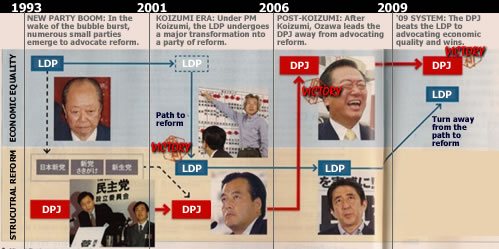
The Nikkei Business Magazine is a weekly print publication that is perhaps the Japanese equivalent of the Economist. In a recent article, they produced the following chart in their cover article to explain one context of the two parties in Japan — instead of the banal left v.s. right, liberal v.s. conservative, salaryman v.s. farmer dynamic, the article looks at the dynamic between the party promoting economic equality and the party promoting structural reform.

Reform v.s. Stability in Japan's political parties-small
Click image for a larger version of the scan.

To ensure that everyone can understand this post and participate in the discussion in the comments, I’ve translated the chart:

Reform v.s. Stability in Japan's political parties-translation

The Nikkei narrative goes something like this: following the bubble bursting in the early 90s, the LDP advocated economic stability and maintaining economic equality instead of structural reforms. Many reformers inside the LDP left the party to form a number of smaller parties. (For more context, see my recent post on the graphical timeline of the DPJ.)

However, several years later it was Koizumi who transformed the LDP in a party that advocated structural reform. In some ways this undermined the DPJ’s core platform and brought the pro-Koizumi members of the LDP to overwhelming victories. But after the Koizumi era, the DPJ effectively turned itself into the party that would correct the inequities of the Koizumi structural reforms, and the LDP old guard, never comfortable with being the party of reform in the first place, waffled on the issue of economic equality v.s. structural reforms until it abandoned the reform platform before the election — but too late to benefit from the shift in the public’s concern.

This type of fluctuation in the policies and philosophies between competing political parties isn’t new — it’s a natural development in party politics that political scientists call realignment. (To note one clear example for US readers, the Democrats were the dominant political party in the conservative South for a century from the 19th century until the 1960s, after during which time there was a slow reversal that resulted in the region becoming a stronghold of the Republican Party — the names of the parties didn’t change, but their constituents did.) That being said, it’s depressing to read an analysis that ultimately concludes that with the exception of the charismatic Koizumi, the party advocating the status quo and rejecting structural reforms is the party that wins.

DPJ supporters want to believe that the DPJ is still the party of reform. I wish this was the case — but as I see it, the DPJ is getting the little things right and the big things wrong. Minor improvements such as ending the kisha club system that grants preferences to big media and allowing married couples to keep separate names are welcome reforms. But as of this morning, the leadership appears to agree with Kamei Shizuka that borrowers should be able to skip repayments on loans, which will spread the “zombie company” phenomenon to Romero-esque levels. That’s definitely a policy heavily favoring so-called economic equality and not structural reform.

Dissolving the House of Representatives is not as straightforward as you might think

Like many Westminster-style political systems, Japan employs a system where the Cabinet has the power to dissolve the lower house of the legislature prior to the expiration of said house’s full term. Once the House is dissolved, an election is held, new legislators take office and another four-year term begins.

This has become the standard process for holding lower house elections under the postwar Constitution. Only one election has ever been held following the natural expiration of the House’s four-year term of office (the 1976 election). In twenty-one other instances so far, the Cabinet has kept its nose to the air, waiting for opportune times to torpedo the legislative branch and hopefully have themselves re-elected.

In 2005, Jun’ichiro Koizumi dissolved the House after it voted down his postal privatization plan, and his LDP surged through the ensuing election to win a commanding majority for the next four years. This past July, Taro Aso dissolved the House a month before its four-year term was due to expire, only to watch the LDP fall and Yukio Hatoyama take over the prime minister’s office.

Dissolution is thus at the heart of the greatest shifts in Japanese politics. That said, most dissolutions have been highly sketchy from a legal perspective, thanks to some inadequate drafting in the constitution. There are two big questions which the Constitution and jurisprudence have never quite resolved…

Question 1: Who can dissolve the House?

The Constitution only says this:

第七条 天皇は、内閣の助言と承認により、国民のために、左の国事に関する行為を行ふ。・・・
  三 衆議院を解散すること。
Article 7. The Emperor, with the advice and approval of the Cabinet, shall perform the following acts in matters of state on behalf of the people: …
  3. Dissolution of the House of Representatives.

So it’s technically the Emperor’s job, not the Cabinet’s. However, three academic theories (never actually enshrined in black-letter law) have led to general acceptance that dissolution is a Cabinet decision:

# The Article 7 Theory (7条説): Enumerated Imperial acts of state in the Constitution are assumed to actually be acts of the Cabinet, on the basis that the Emperor must have the Cabinet’s advice and approval before acting.
# The Systemic Theory (制度説): Instead of looking to the text of the Constitution, this theory looks to the international standard for the Westminster parliamentary system, which assumes that the cabinet has the ability to dissolve the parliament.
# The Administrative Theory (行政説) or Article 65 Theory (65条説): Article 65 of the Constitution gives the cabinet general authority over public administration, which is generally defined to mean all legal authority other than legislation and jurisprudence. Dissolution of the House is neither legislation nor jurisprudence, so it must be administrative in nature and therefore under Cabinet control.

Question 2: When can the Cabinet and Emperor dissolve the House?

This one is trickier. Again, we start with the text of the Constitution:

第六十九条 内閣は、衆議院で不信任の決議案を可決し、又は信任の決議案を否決したときは、十日以内に衆議院が解散されない限り、総辞職をしなければならない。
Article 69. If the House of Representatives passes a non-confidence resolution, or rejects a confidence resolution, the Cabinet shall resign en masse, unless the House of Representatives is dissolved within ten days.

Note that it doesn’t say the House can be dissolved in any other instance. Nor does it say that there is no other instance when the House can be dissolved. It just says that the House can be dissolved if it holds a no-confidence vote.

This became an issue of intense debate in the early postwar years. In October of 1948, Shigeru Yoshida’s newly-formed second cabinet attempted to execute the first dissolution of the House under the new Constitution, without first receiving a resolution of no confidence. The opposition, led by Tetsu Katayama, cried foul and declared that Article 69 should be the limit of the Cabinet’s power to dissolve the House. Allied GHQ, which still had military control of Japan at the time and which had written the new Constitution, sided with Katayama and the “69ers.”¹ It was a ripe situation for a constitutional law stand-off until Katayama’s side passed a resolution of no confidence, which allowed the dissolution and election to go forward. This became known as the nare-ai kaisan (馴れ合い解散) or “collusive dissolution.” Yoshida’s side won the ensuing election, and he held on to his seat for a few more years after that.

Then came the nuki-uchi kaisan (抜き打ち解散) or “surprise dissolution” of August 1952. The Occupation was over, Yoshida was still in charge of the government, and he was facing mounting challenges from Ichiro Hatoyama.² Yoshida decided to pull the trigger on a new election early, and had the Emperor issue a dissolution order “under Article 7.” The election went forward, and Yoshida’s faction won a sufficient number of seats to secure Yoshida another two years in office.

A few Diet members who lost their seats decided to challenge the validity of the election. The Supreme Court doesn’t hear “political questions,” though; it only hears actual disputes over physical or proprietary damages. So the Diet members structured their lawsuit as a suit against the government for lost pay, and cited the unconstitutional election as the illegal act which caused their financial injury. Unfortunately for anyone who wanted a clear view on the question, the lawsuit failed: the Supreme Court, in the rambling fashion typical of Japanese judges, held that dissolution of the Diet was ultimately a political question beyond the scope of judicial review.

Thus the question was settled without being settled. Today, nobody knows whether it’s really legal for the Cabinet to dissolve the Diet out of the blue. All we know is that nobody will stop them if they do so. Since 1952, the Emperor has continued to issue most dissolution orders under his Article 7 power, and the members of the Diet have faithfully followed every order.

* * *

¹ I find GHQ’s position very interesting. Being Americans, they may have envisioned Diet elections working much like Congressional elections in the US, where the executive is stuck with their legislature until the next fixed election cycle.

² At the time, he had just returned to the Diet after a five-year purge from politics by skittish Allied officials who thought he was an Imperial war machine collaborator. He was Yoshida’s main rival within the ruling Liberal Party (forerunner of the LDP) throughout the early fifties. It may have had something to do with the fact that Yoshida was Catholic and Hatoyama was Baptist. Either way, the rivalry ended up running in the family: Hatoyama’s grandson Yukio Hatoyama recently defeated Yoshida’s grandson Taro Aso to become Prime Minister.