Koreans in Washington Protesting US-Korea FTA

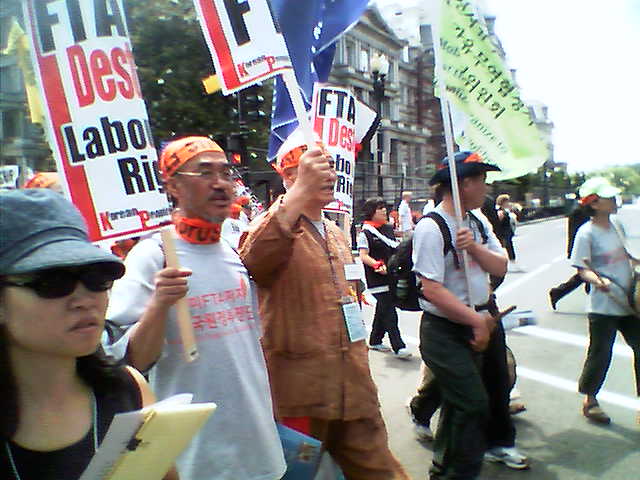
Yesterday and today Starbucks-addled workers in Washington DC have been irked by booming drumbeats and shouts of “tawn dawn FTA!” (I think it means “turn down FTA”?). The people responsible are Korean protesters (see Fox News for the story), the same kind that made their presence felt during the recent WTO talks in Hong Kong. On my way to an appointment today, I literally bumped into the group of about 100 protesters in the crosswalk in front of the White House on 17th Street and H. Of course I got out my brand spanking new camera phone and took some snapshots:
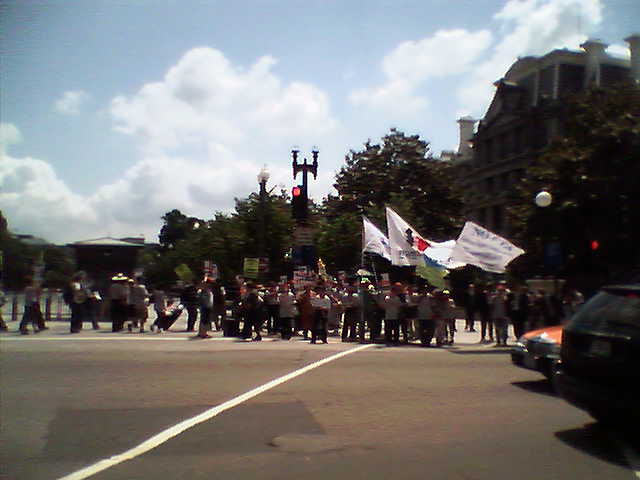
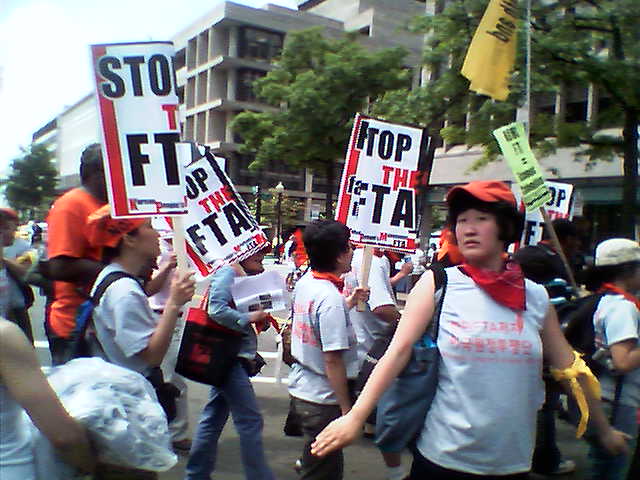
Anti FTA3.jpg

Anti FTA1.jpg

These people are chiefly farmers who don’t want their “crops” ravaged by exposure to free trade. I’m sympathetic to the argument that it’s necessary for a country to preserve a certain amount of farmland just in case the globalized system collapses. And I am not 100% in favor of free trade in every sector, such as entertainment, whose protection allows for business models that foster diverse expression that could easily be stamped out by major countries’ imports. But the fact of the matter is the Korean agricultural interests just want to preserve their cushy government protection at the expense of consumers. They can’t be allowed to derail an agreement that’s going to be crucial for the economies and trade policies of the US and Korea.

UPDATE (6/7/2006): The protester are marching past my office again. The drummers sound like an actual marching band, except I think they’re using some kind of Korean drums. One reason the protests are so small (100 or so) is because many of the Koreans who wanted to join them were denied visas. The irony is that one of the benefits that the US-Korea will be Korea’s addition the State Dept’s visa waiver program, which would make it easy for any Korean who had the notion to come to Washington and protest the hell out of free trade.
Creative Solutions from the Cambodian Hospitality Industry

Mrs. Adamu brings us a highlight from her trip to Cambodia:

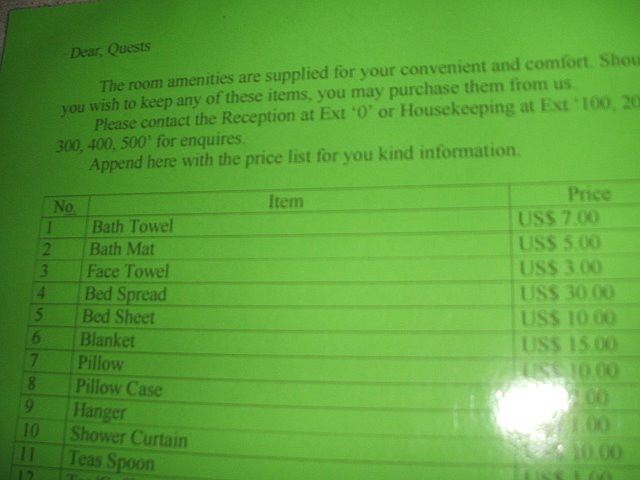
cambodian solutions.jpg

More from Mrs. Adamu and my own trip to Thailand in days to come.

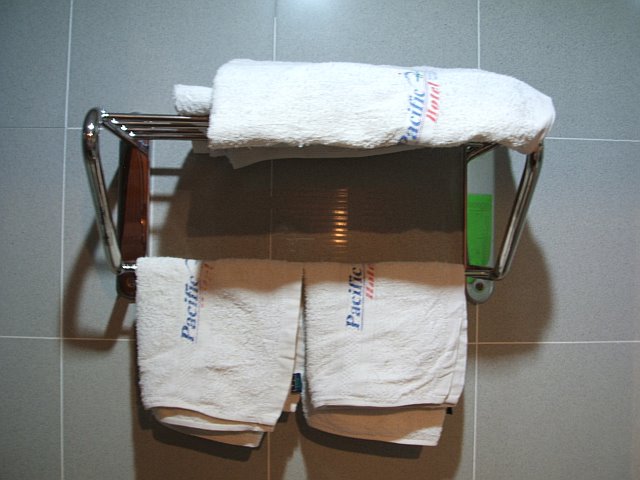
UPDATE: For those of you who thought this might NOT be the hotel being cheap about stolen towels, here are the $7 towels in question:

towels71964576809_0_BG.jpg

Added facility? Sure… for me to poop on!

Reason fails again in US government

No sooner do I write about the misinformed campaign against Chinese PCs being carried out by certain members of the US Congress then the State Department announces that none of the 16,000 machines being purchased from Lenovo will be connected to any high security networks or used to process any classified data.

As the NYT article says:

Long story short, an influential member of Congress played the China card, and the State Department folded.

It was a drama that reached a conclusion late last week, when the State Department, responding to fears that its security might be breached by a secretly placed device or hidden software, agreed to keep personal computers made by Lenovo of China off its networks that handle classified government messages and documents.

The damage to Lenovo is more to its reputation than to its pocketbook. The State Department will use the 16,000 desktop computers it purchased from Lenovo, just not on the computer networks that carry sensitive government intelligence.

I previously mentioned the absurdity of even trying to find computer constructed outside of China, as well as the somewhat unlikely prospect that Chinese trojans could be hidden in the systems without being located. Well, naturally Lenovo agrees with me about that, but there’s more. Jeffrey Carlisle, vice president of government relations for Lenovo, describes

the worry that the Chinese government might secretly slip spying hardware or software on Lenovo computers shipped to the State Department as “a fantasy.” The desktop machines, he said, will be made in Monterrey, Mexico, and Raleigh, N.C., at plants purchased from I.B.M.

“It’s the same places, using the same processes as I.B.M. had,” Mr. Carlisle said. “Nothing’s changed.”

So despite everything, by going to a company partially owned by the Chinese government (and not incidentally, also partly owned by IBM, and by other American and non-governmental foreign investors) they are actually getting one of the few sources of computers NOT made in China! Do they now think that the former IBM executives and engineers that run the Mexican and Raleigh plants are now agents of the Chinese government just because of who owns some of the stock? This notion of Communist Party control over Lenovo just seems so overblown. According to Wikipedia the actual breakdown is “as of May 1, 2005 35.2% of Lenovo was owned by public shareholders, 45.9% by Legend Holdings Limited, and 18.9% by IBM.”

Furthermore, the headquarters of the company is located in New York State and is planning to relocate to Raleigh, where the Thinkpad group is based. Yes, the Chinese government owns a large chunk of Lenovo through Legend Holdings Limited. While the corporate entity known as Lenovo may have originated in China with government backing, it has transmuted into a very 21st century transnational company, in which the Chinese government is merely a stockholder. Certainly with the force of authoritarian Chinese law behind them the CCP could do much to control operations within China, but I find very little credible reason to believe that a minority stockholder would be able to exert the level of influence necessary to illegally alter the designs of systems in a way that would be economically suicidal if uncovered at a factory in Raleigh N.C. formerly owned by IBM and managed from the Purchase, NY headquarters.

I have a Mac Classic in my attic that you could use

It has been just about two months since I last discussed the Congressional revolt against Chinese manufactured computers and for a while I thought that perhaps the story was dead, but leave it to a Congress member to not merely flog, but actually hitch his wagon to a dead horse. Washingtonpost.com is running an AP story saying that the State Department has declared that the 16,000 computers they purchased from Lenovo will not be used for classified work. This followed a complaint by Virgina Representative Frank Wolf, who while he may have been elected to represent the good people of Virgina, seems unlikely to qualify for a job setting up internet connections at people’s homes.
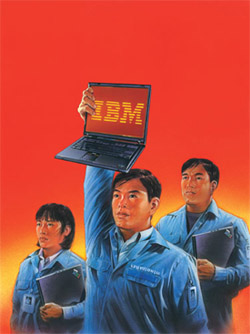
Red IBM

The government, Griffin wrote, is committed to making sure the purchase from Lenovo, the world’s No. 3 PC maker, will not “compromise our information and communication channels.”

Wolf, R-Va., chairman of the House subcommittee that finances State Department operations, said he raised alarms after he discovered that officials planned to use at least 900 of the computers in classified work and at U.S. embassies and consulates abroad. That, he said, possibly could give China access to sensitive U.S. information.

While there may in fact be a miniscule theoretical possiblity of a security breach resulting from some sort of clever trojan hidden deep in the firmware of a China manufactured computer (such as if State were stupid enough to use the Lenovo security chip), there is something unaccounted for by Mr. Wolf that would prevent them from buying computers entirely manufactured inside the United States. Namely, there aren’t any.

As a chart in this piece at DailyTech.com illustrates, over the past several years every single PC manufacturer, whether Chinese, Taiwanese, Japanese or even American, has come to do at least some of their manufacturing and basically all of their final assembly in China.

Unfortunately for Representative Wolf, banning the purchase of computers manufactured in China essentially means banning the purchase of computers. At least, unless he wants the government to trove attics and garage sales to collect 1980s models like my old Mac Classic.

But as for the real issue of whether or not manufacturing in China is a security risk. I would have to say, not particularly. While the computers may be “made” in China, they aren’t designed there. Just because a piece of electronics has “Made in China” stamped on its outer shell does not mean that the entire contents was made in China, only that the case was. But while the system may have been assembled and some of the components manufactured there, virtually none of the highest tech components responsible for the actual processing of the computer are made there.

Does it seem likely that it is possible to add a trojan to imported AMD chips made in Germany, or modify the design of an Nvidia chipset, designed in California and manufactured in Shenzhen, China by a Taiwanese company, so that it stealthily transmits keystrokes over the internet to Chinese servers?

Regardless of where the hardware is from, while the systems are preconfigured by the maker, we can assume the State’s IT department will wipe the hard drive and reinstall their own carefully tweaked (hopefully) secure disk image, and then replace the BIOS and firmware with vetted software written by the American or Taiwanese companies that actually designed the components.

Oh crap

I finally got my passport back on Friday from the Japanese Consulate in New York with my new working visa plastered in and I’m finally ready to book a flight over, and the New York Times has to go and run THIS story!

Brace yourself for a summer of miserable air travel.

Planes are expected to be packed fuller than at anytime since World War II, when the airlines helped transport troops. Fares are rising. Service frills are disappearing.

Logjams at airport security checkpoints loom as the federal government strains to keep screener jobs filled. The usual violent summer storms are expected to send the air traffic control system into chaos at times, with flight delays and cancellations cascading across the country.

Thailand Report Part 1: Reasons why Korean Air Rules

index_img_6_jpn.jpg
I just got to Thailand on a trip to visit Mrs. Adamu. The flight over on Korean Air was awesome. Let me tell you why:

  • Flight attendants that are beautiful, attentive, yet creepily identical – same height, same skin tone, same body proportions, similar facial features, same voice – think Robert Palmer’s “Simply Irresistible” video meets Kim Jong Il’s personal cabaret troupe. They seem to be extremely weak – I was asked to help load a slightly heavy carry-on bag, and then someone else had to help another flight attendant close a storage hatch. Plus there must have been 5 costume changes over the course of the flight – aprons for the food service, plain white shirts during downtimes, and brown jackets for no discernible reason other than perhaps they look smart.
  • 3 words – BIBIMBAP FOR LUNCH! And not just any bibimbap, this was actually fresh and good. Not the best Ive ever had, but it’s for damn sure the best airline food I’ve ever had. The rest of the fare was only above-average, but the frequent drink services and little perks like ice cream for dessert were nice touches.
  • Personal entertainment centers at each seat – even in coach! In the course of the trip, I caught up on the latest hits in Japan, learned that the US was continuing humanitarian aid to Hamas, saw some movies ranging from the awesome Glory Road and Syriana to this tepid Japanese movie about a boy who怀becomes an elephant trainer. Also saw this insane Korean music variety show in which a) a member of the infamous DJ DOC sang a crappy R&B song with a 60-year-old man; b) Another performer suddenly busted out a line and c) An interview in which an older female singer scolded the younger host for using the Japanese word for “pants” (zubon).
  • Ignorant passengers – As we were about to land, an older Korean couple got out from their seats, piled their numerous carry-on bags in front of an emergency exit, and started staring out the window. It took a minute for the flight crew to notice in time to smack them upside the head verbally and send them back to their seats.
  • All in all a great ride and I highly recommend it – they don’t seem to have a restriction on carry-on bags either.

    Horie: Before and After Prison

    Horie got 95 days in jail before he was even considered for release. I’m not even going to risk jaywalking in Japan from now on (though I’ll probably still scam the train from time to time):

    Before:

    After:

    The news media surrounded Horie’s van with motorcycles on his way back to his home in Roppongi Hills. Scavengers, man.

    Minister of Foreign Affairs Aso: Japanese Animation Readies Humankind for Robot Slavery

    I can’t believe I’m going to see this guy next week:

    The word “robot” is said to have come to us from the Czech word robota, which means “labor” or sometimes even “drudgery,” and thus is a word that originally carried a negative connotation.

    But through Japan’s Astro Boy or the cat-like robot Doraemon, the meaning of the word “robot” shifted, instead becoming a benevolent friend who helps human beings. In Asia and elsewhere around the globe, robots came to be understood as the “white hats” -the good guys.

    The impact of this situation is that countries with an affinity for Doraemon do not have workers who reject industrial robots, and thus in those countries, industrial productivity rises. In addition, you find that Japanese-made industrial robots sell well.

    Yaskawa Electric Corporation and the other firms of Japan’s “big three” hold a market share of half the global market in the area of robots for welding or applying coatings. Of course, Astro Boy and Gigantor-what we in Japan know as “Tetsujin 28”-are there in the background to all this. In other words, what created the climate in which all this could take place was Japanese culture, and I am continually speaking of culture’s significant contributions in this area.

    (Picture: Aso – 2nd from left – giving some kind of award to Bulgarian sumo wrestler Kotooshu (I’ll let you guess which one he is))

    Quick lesson in METI ineptitude: The PSE Law explained

    Yes, the PSE Law (which would have banned the sale of some used video game consoles and almost all vintage musical instruments) has been thoroughly declawed. Thank god. But weren’t you the least bit curious about how this all got started? I was, so it was especially interesting for me to come across this article in the 3/25/2006 issue of Japanese business weekly, Shukan Toyo Keizai (Weekly Oriental Economy, link opens PDF file). Some highlights (translated where it was easy, abstracted where it was a pain):

    Something’s Wrong Here, METI! (Part 2): Used Goods Sold No More?! Analysis of METI’s teeter-tottering over the PSE Law

    A scandal began when a used goods dealer asked a question to the Ministry of Economy, Trade, and Industry (METI).

    It was October 2005 when a letter arrived at the headquarters of major used goods chain Hard Off Corporation. It said: “Pursuant to the Product Safety Electrical Appliance and Material Law (PSE Law), electric appliances without the “PSE label” can no longer be sold as of April 1. Please take note.”

    The sender was Victor JVC. It was addressed to vendors stores selling the company’s products. Hard Off, though mainly dealing in used goods, sells some new items, so it was as if by chance that the letter made it there.

    President Ken Nagahashi of Hard Off was worried: Does “can no longer be sold” include used goods? What are the stipulations for used goods? He looked on METI’s website, but no matter where he looked he could not find anything about used goods.

    He then directly asked METI, but the person at the Product Safety Division who received his question could not give an immediate answer as to whether used goods were included. Hard Off was at a loss.
    Continue reading Quick lesson in METI ineptitude: The PSE Law explained