Banned Imports to North Korea

It has been widely reported that the sale of “luxury goods” (奢侈品) to North Korea has been panned by the Japanese government, but I have seen only example of what “luxury goods” consists of in the English media. The Ministry of Economy, Trade and Industry has a complete list avaliable on their web site(PDF), dated November 14. See below for my rough translation of this list.

As you read this list, consider which of them is so essential and valuable that you would not be willing to trade it for a nuclear bomb.

Continue reading Banned Imports to North Korea

Abe, a “cool” sunglass-donning, leather jacket-sporting man of the people

Abe meets U2’s Bono. Bono somehow loses all powers of judgment and perception and deems Japan’s prime minister to be “cool”:
Abe Bono nn20061130a3a.jpg

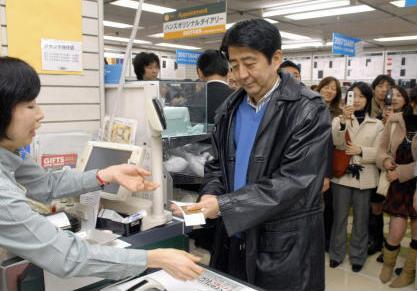
Abe finally moves into his official residence, but not before picking up a few things at the Tokyu Hands department store in Shibuya accompanied by his wife Akie and apparently the entirety of Japan’s news media:
Abe Tokyu Hands Nov 20061.JPG

Nice jacket! He bought pens, a stapler, some bath salts, cellophane tape, a blazer, some slacks, ties, and some books at Book First: a historical novel by Jiro Asada, and “for some reason” as Sponichi put it, five dictionaries, including an English-Japanese dictionary.

The Abes’ pet dog, a miniature dachsund named Roy, will stay behind with Shnzo’s mother at their residence.

Another JASRAC arrest

JASRAC, the copyright enforcement association for Japan’s music industry, has described criminal charges and arrests for copyright violators as rare. Yet less than 3 weeks after reports came out of a JASRAC-inspired arrest of a restaurant owner for singing the Beatles comes another arrest. This time, a man has been thrown in jail for distributing mobile phone ring tones on his website without permission.

CNET reports that similar to the recent arrest, JASRAC had repeatedly warned the 45-year-old suspect from Sasebo, Nagasaki Prefecture, since June 2002 to stop allowing people to download copyrighted songs from his website. In February 2003, the organization got the man’s ISP to delete the ring tones under the “ISP Liability Restriction Law” (author’s translation). However, the man continued to operate his website by linking to the files from a different source. The ISP shut down his site again in 2004, but JASRAC noticed the site was back up in April 2006. The association called the police after the man ignored a warning letter, and on November 27, the man was put in jail, charged with violations of reproduction rights and rights of public transmission as defined in Article 119 Section 1 of the Copyright Law.

In other JASRAC related news, the association recently co-released a report with the Association of Copyright for Computer Software (ACCS) estimating that monetary damage from copyright infringement of software, music, films, manga, etc, using the Winny peer-to-peer file sharing software (whose creator was arrested in 2003) amounts to about 10 billion yen (about USD$86 million), based on an estimate of the retail value of each file currently available for download using the software as of October 10. This is a pretty sloppy estimate, and it only goes to show how comparatively well-policed piracy is in Japan, especially when you compare that to the RIAA’s estimate that piracy loses the US music industry $4.2 billion annually in worldwide sales.

Japan’s Internet homeless – living the dream?

The Asahi has a report about the growing phenomenon of people living in Internet cafes:

…[F]or a growing number of young people, the coffee-shop-cum-entertainment-centers are not just a home away from home but home itself.

Most are freeters–job-hopping part-timers–who hit hard times and have no permanent place to live. They have found a haven in the cafes, which offer showers and private cubicles at a bargain price.

Net Cafe OSK200611020028.jpgOn a recent evening, a 30-year-old man from Osaka entered one such place in the city’s Umeda entertainment district. He signed up for the late-night rate, which allows a five-hour stay for 1,500 yen starting at 10 p.m. The man slipped into one of the private booths, carrying a backpack.

He quickly showered, brushed his teeth and then burrowed under a blanket that comes with the room. He stretched out in a reclining seat as best he could and tried to catnap.

Asahi gives some background to the problem later in the article:

Internet cafes that offer multiple services including overnight stays began cropping up around 1999. According to the industry organization that represents them, 1,320 such cafes had registered for business around the nation as of the end of September.

“The rates are better than saunas and capsule hotels,” says Hirohiko Kato, 52, who owns a cybercafe chain with 55 outlets nationwide. “And in addition to that, cafes offer special perks such as bottomless soft drinks. Multiple-service cafes have become especially popular in major city areas.”

A cafe manager at a large-scale cybercafe with 150 seats in Ikebukuro, Tokyo, says: “We serve about 140 overnight customers a night on average. About 10 percent are regulars we see come in carrying large bags.”

They act like this is a new problem. There have been reports of people being “caught” living in Internet cafes for a least a year now. The cafes all differ in what they offer and what they’ll tolerate, but most run 24 hours a day and many offer showers and toiletries, supposedly to cater to businessmen who missed the last train for the night.
Continue reading Japan’s Internet homeless – living the dream?

Morgan Stanley Global Economic Forum: New and improved!

You can’t understand how deeply disturbed I was a moment ago when I couldn’t access Morgan Stanley’s Global Economic Forum. Where the hell am I supposed to get frank assessments of the Japanese political/economic scene for an investment audience without the Forum?!

Thankfully, they didn’t do anything insane like turn it into a pay service. Instead, they have vastly improved their site and unified their contents section! The icing on the cake? RSS feeds of the GEF! Joy!

In our latest installment:

As shown in preliminary Jul-Sep GDP numbers, the contrast between the corporate sector and the household sector has intensified, and this gap is not likely to close for some time. We assume that it will take a year or more for a positive growth cycle to develop, as momentum on the corporate front gradually spreads to the consumer and household level. Thus, while lack of support from consumer spending is likely to result in a slowing through F3/08, we expect growth in corporate spending to allow for continued gradual growth in the economy overall. Thus, we look for improved productivity to contribute to ultra-stable prices going forward.

Ahh, it’s good to have you back, my sweet Forum.

For those of you who liked the godawful calendar format for the archives, it’s still available.

What Adamu thinks: Prime Minister Shinzo Abe

Being the preeminent experts that we at the Mutant Frog Travelogue are, some Japanese university student has decided to use us as a primary resource for a major research project (or more likely, the subject of one of the countless “survey the foreigner” projects they give in university English classes). Here’s what the questioner wanted to know:

Dear Mr. Mutant frog.
Hello! I’m a [Japanese] University student. I get your e-
mail address at MUTANT FROG TORAVELOGUE. [This university]
is Japanese university. Our English class was to sending e-mail which
has some questions about things which have interest.

Questions.

・ What do you think Prime Minister Shinzo Abe?

・ How will Japanese Prime Minister Shinzo Abe be different
from the ex-Prime Minister Koizumi?

・ Do you think Japan become better? And I want to listen to your
opinion.

Thank you.
From [a] university in Japan.

Continue reading What Adamu thinks: Prime Minister Shinzo Abe

Your seatmate is NOT your psychologist

This NYT article struck a chord with me:

WHAT is it about flying in an airplane that seems to remind some passengers of a church confessional?

I remember flying overnight from New York to London next to a dour-looking middle-aged man who kept his peace until his second Scotch. Which is when he revealed that he was a civil engineer. A very, very unhappy civil engineer.

“My profession gets no respect,” he griped. “We design all your bridges and roads, but when do you hear anything about a civil engineer?”

He didn’t wait for an answer.

“That’s right,” he continued, “only when a bridge collapses! And why should I be blamed when the contractor probably chose the lowest bidder?”

Another seatmate, a young Navy enlisted man, spent the first several hours of a transcontinental flight studying a book whose pages contained all kinds of triangles, arrows and symbols. He closed the book as our plane began descending to land and spoke to me for the first time.

“Don’t tell anyone,” he confided in a low voice, “but I am actually flying the plane.”

It all had something to do with an arcane kind of witchcraft, the key to which was in the book he held closely, he said. I hoped his job in the Navy involved a desk, not weapons.

I don’t fly nearly as much as the author, but I must be a magnet for this kind of behavior. I’ve had a 13 year old girl brag to me about making out with restaurant valets, a Japanese emigrant to America tell me about her 50 year long marriage to an Army officer, a half-Japanese chemist talk of suing to protect his farmland near Narita Airport, and several others who for some reason thought I was just the right person to tell about their problems. It would be one thing if I actually made friends with someone on a flight, but in these cases I always end up feeling used like the proverbial hole in the ground. Sometimes it is marginally interesting to hear some random person’s whole life story, but it almost never cancels out what I lose in reading or sleep time. People should really just keep their mouths shut unless they actually know how to have a conversation.

MOF vs. MIC, local entities in deepening conflict over budget

I’m just trying to get my head around this story from FujiSankei Business-i:

MOF vs. MIC, local entities in deepening conflict over budget

FujiSankei Business i. 2006/11/6  

Hot issues: JFM, early return of FILP funds

Leading up to the 2007 budget revision, conflict is deepening between the Ministry of Finance, which touts fiscal reconstruction, and the Ministry of Internal Affairs and Communications (MIC), which is backed up by the sentiments of local self-governing groups (i.e. municipalities). The two major issues are the scheme of how to deal with the Japan Finance Corporation for Municipal Enterprises (JFM), a government-owned financial institution slated for abolishment, and compensation for the early payback of funds from the Fiscal Investment and Loan Program (FILP). Debate is likely to heat up going into Nov 21, when the Deliberative Council on the Fiscal System (an advisory body to MOF) is set to finalize its budget proposal.

The MIC/municipalities side has taken the stance that the national government should subsidize the regional areas through various program revisions. MOF, meanwhile, has emphasized that the nation’s fiscal condition is even worse than that of regional areas. The two sides have collided head to head, with MOF offering up such criticisms as “The regional areas are not making serious efforts to reform the civil service.”

A typical example of this conflict is found in the JFM issue. The JFM historically procured funds from the market by issuing government-backed bonds, and lent those funds at long-term, low interest to municipalities’ water/sewage systems, hospitals, etc. However, after it is eliminated in 2008, it will transition into a new organization owned by the municipalities. The issue here is how to deal with the 2.6 trillion yen in reserves that the corporation had built up in preparation for a rise in interest rates.

MOF is of the position that, since the JFM is a 100% govt-owned financial insitution, “the leftover assets should be widely used for the people for fiscal reconstruction etc,” and is demanding that the reserves be placed in the national treasury. The MIC, in response, claims that the entire sum should be handed down to a successor organization to be jointly owned by the municipalities. At present there is no compromise in sight.

Meanwhile, the issue of compensation for early return of FILP funds began with a proposal from the municipalities. most loans received by municipalities from the government-owned financial institutions are long-term, with payback periods ranging from 20-30 years, and many of those loans were taken out during the era of high interest rates. As a result, the municipalities want to refinance while low interest rates continue, but in that case they will be required to pay compensation. Since the compensation depends on the number of years left on the loans, in reality, it will cost the majority of the future interest burden.

To that, the MIC is demanding the introduction of a system to eliminate the compensation requirement, but MOF has expressed virulent opposition. Since the compensation system was made clear in the contract signed at the time of the loan, the MOF’s stance is that the arrangement is valid whether the interest rates go up or down. Masaaki Honma, chairman of the MOF’s FILP Committee and member of the Deliberative Council, harshly questions the MIC’s attitude, remarking, “Eliminating the payment of compensation that was stipulated in the contract would be defaulting.”

The rift between the two sides is deep, placing focus on how the Prime Minister’s office will judge the matter. It will likely also be used as fodder to divine the depth of the PM’s leadership on near-term fiscal management.


USJ’s Xmas tree almost certainly pissing off KWBB workers

Nikkei gives shameless free promotion to Universal Studios Japan’s Christmas festivities. This year, like most others, the park has an enormous Christmas tree as the centerpiece of its nightly Christmas-themed fireworks jamboree:

USJ xmas tree im20061102NN002Y4980211200613.jpg

Ah, memories… I used to work as a hamburger cook at the KWBB hamburger restaurant at USJ, which was located right next to the big tree at Christmastime. Though I was explicitly banned from criticizing the theme park when I was an employee, I feel that 3 years is sufficient leeway for me to complain about how annoying it was for us to listen to the ultra-perky Disneyland ripoff that passed for a Christmas show every night as I toasted buns and burned myself on the industrial-strength hamburger grill. Occasionally, the closing shift would end just as the Xmas show (and non-xmas park-closing shows) reached its finale, allowing me to catch the tail end- lots of explosions, lots of jetskiing, lots of loud lipsynching to 50s doo-wop standards as hundreds of Japanese middle class families looked on in ultra-earnest wonder.

Now don’t get me wrong – your average visitor will no doubt find USJ an enthralling thrill of Hollywood cinema come to life, and the Christmas fireworks show at closing time can be an excellent end-cap to a day filled with ET rides and Terminator 2 action shows.

It’s just that for me, hearing the same bit every day got to be excruciating, just like hearing the same 20 American pop songs (“Happy Ending” by Avril Lavigne and “In da club” by 50 Cent in addition to standard 80s songs like Duran Duran’s “Hungry Like the Wolf”) over and over can get tiring, as in any job. One song that I never got tired of for some reason was “Magnet and Steel” by Walter Egan, a song used as “atmosphere” music just outside the restaurant.

My all-time favorite USJ attraction was the Universal Monsters Live Rock And Roll Show™, the ultimate in high-concept irony in which the famous “Universal Monsters” led by none other than a wisecracking Beetlejuice, croon topical pop songs (as of 2003 featuring “Smooth” by Carlos Santana feat. Matchbox 20’s Rob Thomas). Quoth the corporate literature:

Beetlejuice cranks up Dracula, Wolfman, Frankenstein and The Bride of Frankenstein for a mega-monster rock show filled with screamin’ demons and wailin’ guitars.

\m/ !!! Watch these video clips of the rockin’ monsters covering Bon Jovi and Kiss to see how awesome it really is. This clip of the Orlando version of the show is a bit more topical (Outkast’s “Hey Ya” makes an appearance – rock!).

Behind the Deletion of 30,000 Japanese videos from Youtube

You may have heard that YouTube deleted 30,000 Japanese videos from YouTube on the request of the powerful music industry group JASRAC. Well, here’s an article that goes into more detail on the efforts to quash the online sharing of copyrighted content.

Translated/paraphrased (translaphased?) from Nikkei (via 2ch):

Behind the Scenes of the “Request to Delete 30,000 Files” from Youtube – The 2nd Act May be to “Eliminate Anonymity”

Even if you did not receive complaints after putting another person’s music on your blog without permission in the 5 days following Oct 2, you should not rest at ease. That is because JASRAC’s monitoring team was constantly connected to American video posting site YouTube from 9 to 5 during that period. We have taken a look at the “Week of Strengthening Measures Against Youtube” during which 23 copyright-holding companies and groups launched a concentrated attack, making simultaneous requests for deletion.

“30,000 videos in 5 days” the Limit

JASRAC was responsible for about 10% of the 30,000 deleted videos. It’s a tiny number compared to the tens of thousands of videos per day on YouTube, but even regularly having a special person in charge of going around various sites on the Internet and monitoring copyright infringements, we were told in what was close to a scream, “Deletion procedures are an extremely minute process. Anything more than that is impossible.”

On YouTube, there is a web site, which regular users cannot see, that is reserved for rightsholders for them to request that videos be deleted. They search for videos by keyword and place a check next to videos subject to the request. Once the deletion request is sent to YouTube, most of the time deletion is completed the next day.

These requests seem simple, but they are rather work intensive. The page is of course in English. Since the name of the song used in the video is not displayed, there are times when it is impossible to judge whether the video actually constitutes a violation unless it is watched to the end. They cannot neglect to listen to even one part of the song.
Continue reading Behind the Deletion of 30,000 Japanese videos from Youtube