I’d state the obvious and say that Lonely Girl is the lamest bunch of crap that ever existed, but then I might hurt my own chances of a sweet product placement deal with Pocky.
Lonelygirl15 Breaks Ice With Hershey’s
MARCH 20, 2007 –
Lonelygirl15, the pseudo-video diary that became a YouTube phenomenon last year, has signed its first major product placement deal with Hershey’s for its Icebreakers Sours Gum brand.
In a video posted on March 20 on the official Lonelygirl site, Lg15.com, the show’s main character Bree is seen offering her friends a piece of Icebreaker’s gum, and a closeup of the product is shown. The sponsored episode of scripted teen drama is slated to eventually be featured on YouTube and other video-sharing sites in the near future, said officials.
This level of product integration marks one of the more sophisticated examples of branded entertainment to emerge from the rapidly-evolving world of amateur-created online video. The deal was initiated by the Dallas, Texas-based agency TracyLocke. Ad sales were handled directly by the agents from Creative Artists Agency who represent the Lonelygirl creators. “It’s empowering for us to have major international brand like Hershey’s treat us like they would any other major entertainment property,” says Greg Goodfried, Lonelygirl15co-creator. “Deals like this are good for the community – they help us pay our operating expenses, which has been an ongoing struggle.”
English-only Ghibli fans might be interested to know how people are reacting to the recently announced new Ghibli film “Ponyo of the Cliff top”. J-Cast has the story:
Hayao Miyazaki to Re-educate Son with New Film
Mar. 20
Director Hayao Miyazaki’s latest project, “Ponyo of the Cliff Top” was announced yesterday for a summer 2008 release. The main character, a 5-year-old boy named “Sosuke” was modeled after Miyazaki’s son Goro. Goro directed the Ghibli project “Tales of Earthsea” in 2006, and while the film was a major hit, many slammed how the film turned out. As a result, Hayao is attempting to re-educate his eldest son, and has included a message in the film of how he wants his eldest to turn out. Or at least that’s what everyone is saying.
The 5-year-old Lead Resembles Hayao’s Son
This will be the first film from Hayao Miyazaki ever since Howl’s Moving Castle achieved huge box office totals of 19.6 billion yen when it was released 4 years ago (November 2004). The new film is a story of Ponyo, a goldfish princess who wants to become human, and the five-year-old Sosuke. Producer Toshio Suzuki explains, “This is kind of like Miyazaki’s version of ‘The Little Mermaid.'” Tales of Earthsea, which came out last year, was supposed to have been directed by Hayao himself — he negotiated the film rights with the original author 20 years ago — but the director changed to his eldest son, Goro (pictured). As J-Cast reported earlier:
“Ghibli’s Suzuki said in an interview ‘(Hayao) said that “it would be inconceivable for Goro to take the helm.” In other words, he was totally against Goro directing it.'”
Afterward, Suzuki convinced Hayao to go along, but while the production ended up being a hit, the movie received less than favorable reviews from viewers and the original author.
The father-son feud was reported as follows in a March 20, 2007 article in Sports Nippon:
“Sosuke was modeled after Goro Miyazaki, Hayao’s 40-year-old eldest son. Goro made his directorial debut with Tales of Earthsea last year, and Hayao interpreted his son’s actions as a rebellion against his father, reportedly expressing remorse: “Things turned out this way because I was working all the time and didn’t spend time with Goro when he was 5 years old. [I’m making this] so there won’t be any more children like Goro.”
It looks like this will be a film about regrets over raising an eldest son.
“Thank goodness it’s Hayao!”
Since Hayao Miyazaki has made several statements indicating he’s retiring from directing, rumors had been circulating on the Internet wondering if there would be another Hayao-directed film. Perhaps influenced by such concerns, there are lots of blog entries from Yahoo, Livedoor, and Excite-hosted blogs placing their hopes in Hayao:
“Thank goodness it’s Hayao!!! But it looks like the kid is modeled after Goro…”
“Yes!!! YES!!!! I LOOOOOOOVEEEE Miyazaki’s movies!! Goro’s movie was just so poorly received I still haven’t watched it [Translator: Same here!], but I wonder how Earthsea turned out? Hayao’s movies almost never fail to please, so I am simply looking forward to it.”
“I am looking forward to this. Since this is coming after Goro Miyazaki seems to have misjudged the public, I am interested to see how people react to this one.”
Will this new film feature the father’s overwhelming dignity and serve to re-educate Goro?
Comment: This looks like a continuation of the human drama initiated and encouraged by Ghibli (who printed Goro’s blog that detailed the feud and an interview with Suzuki that explained more about it) since it was learned that Earthsea would be directed by the inexperienced Goro. Since, as J-Cast notes, Earthsea ended up being a hit despite bad reviews, perhaps the promoters and investors (which include notorious hit-generators Hakuhodo and Dentsu) see this reality-show spectacle as an effective way to generate hype. The personal stories probably resonate with fans of Studio Ghibli, which was voted Japan’s top-ranking brand name in a 2006 poll of consumers conducted by Nikkei BP:
Miyazaki magic
Studio Ghibli stepped up from second place in the 2005 survey, receiving fairly high marks in two of the four categories the survey conductors determined to be key factors in creating brand power. The two categories were friendly and outstanding.
The animation studio has spawned an array of popular films, such as “Howl’s Moving Castle”, released in 2004, successfully connecting with consumers on an emotional basis.
Resonating with consumers is the ultimate goal of corporate marketing.
Buried in the second half of a Japan Times story about Japan’s dogged pursuit of resolution over the North Korean abduction issues was the following.
A Japanese citizens group is one step closer to getting approval to air Japanese-language programs intended for Japanese nationals abducted by North Korea.
The International Telecommunication Union, a Geneva-based body set up to standardize and regulate international radio and telecommunications, informed the government Monday that it is prepared to allocate a shortwave frequency band to the group, sources said.
Seriously? They want to actually broadcast programs specially prepared for a population which is at most 8 people, but which North Korea claims is actually zero? Personally, I have always suspected that North Korea was being entirely truthful when they said that the remaining abductees are all dead, but that they are probably trying to cover up the circumstances of their deaths, whether by suicide, execution, starvation, or whatever unpleasant means it was.
But even if North Korea was lying and the 8 are still alive, this is still an absolutely mind-stunningly dumb plan. First of all, there is the fact that short-wave radios are entirely banned in Korea-the only radios permitted for non governmental use can only be tuned to government preset stations, which presumably does not include “Japan Abductee News.” And think about the staggering inefficiency of this plan. How much effort exactly do they propose to spend on preparing radio broadcasts that have a virtually zero chance of getting to the intended audience, which let us remember is only eight people to begin with! I can sort of understand the enormous efforts to actually retrieve or at least discover the fates of kidnapped citizens, but why send out messages that a: probably no one will here and b: even if they did, no-one back in Japan would ever know that they had heard it.
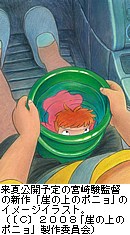
Jiji Press reports that Hayao Miyazaki announced that he is directing a new long-form animated film called “Ponyo on the Cliffs” (崖の上のポニョ), a story of a boy’s friendship with a “goldfish princess” who wants to become human.
The production, the first directed by Hayao Miyazaki since 2003’s Howl’s Moving Castle, began last October and will be completely hand-drawn, with no computers used whatsoever. The animation style is simple and childlike (see picture). The scenery is based on the Seto Inland Sea, an area of Japan where Miyazaki stayed in 2005. The 5-year-old hero is based on his son Goro, who directed the poorly-received Earthsea adaptation. The music will be done by Ghibli regular Jo Hisaishi. The final production is scheduled to be released in summer 2008.
An official press release confirms the recent reports and promises more information moving forward.
Takafumi Horie, the ex-president of Livedoor recently convicted of securities fraud, continues his role as spotlight-hog even in disgrace. He’s been the subject of numerous interviews and press stories throughout his trial. So as a man for whom winning the image war between himself and prosecutors may be even more important than whether his appeals ultimately succeed, it seems only natural that Horie would take the opportunity to SLAM the court’s decision:
Convicted Horie stays defiant, slams court
The Associated Press
Disgraced dot-com tycoon Takafumi Horie slammed his conviction and harsh sentence for securities fraud Sunday, insisting he committed no crimes and that he had more than paid for any mistakes by losing his company.
On Friday, Horie was found guilty of masterminding a network of decoy investment funds to illegally manipulate earnings at his Internet startup, and was sentenced to 2 1/2-half years in prison in the biggest white-collar-crime trial Japan has witnessed in years.
“I did not intentionally attempt to pad earnings, and there was no false accounting,” an intent-looking Horie, former president of Livedoor Co., said on a TV Asahi talk show Sunday. “I do not accept the court’s verdict.”
Animation Produced in Small Teams is a Breath of Fresh Air for the Industry: FROGMAN Co., Others Showcase A Powerful Individuality
March 13, 2007
Animation produced in small teams have been hitting the market one after the other recently, which is a new development as works are usually produced in production teams of dozens or even hundreds of people. The new works, which maintain a high level of quality while showcasing the creators’ intense vision in every nook and cranny, a feat that can only be achieved in a small team, are blowing a new wind throughout Japan’s animation industry. (by Ryuichi Taniguchi)
Improved Performance of PCs Plays a Role
Makoto Shinkai, director of “Five Centimeters Per Second” (秒速5センチメートル) gave thanks before the 200 people who had gathered to watch his animated film shown at Cinema Rise in Tokyo’s Shibuya Ward on March 3: “I am happy to show a film that I made the way I wanted it in a large space.” This was his first film since his long-form “Beyond the Clouds, at the Promised Location” (雲のむこう、約束の場所) was shown at the same theater in November 2006. He seemed to have felt a positive response from the excited crowd of waiting fans that filled the seats.
In the past, animation production was assumed to require a large staff, but Shinkai released his first 25-minute short “Voices of the Stars” (ほしのこえ) created almost entirely by himself on a PC. The imagery, which measures up to animation made by pros, and the story, about susceptible young men and women, made the piece a hit with the younger generation and gained its creator recognition as a member of the new generation of animation directors.
However, Shinkai did not choose the path of producing his work in a major studio with a large staff at his beck and call. He continued using PCs and producing his films with a small staff to complete his “Beyond” and the more recent “Five”.
Shinkai explains, “For a year and half, I had the animation staff come to my home, and created it at a steady pace using my desktop. He didn’t create the whole thing by himself as in “Voice of the Stars,” but he made drastic staff cuts compared to the number of people involved in “Beyond.” As a result, Shinkai was able to realize a film in which his vision crept into every nook and cranny, from depictions of the lyrical countryside, to the village landscapes, to the endless sky and ocean.
Productions that can make full use of the creator’s individuality because of such a small staff are made possible by high-performance PCs that can be used to draw, color, and even edit finely detailed images. It’s easy to see how individual creators like Shinkai can make it into the animation industry if they have talent and backup in terms of funding.
Product Placement Comes to Anime
The films produced by FROGMAN Co, led by a man who goes by the same name, were also born of superior talent, a PC, and the Internet. The company creates animation using Flash, an animation software that can play simple video on a PC, and began offering programs on the Internet starting in 2004. These short films gained an following, and in April 2006 FROGMAN’s “Falcon’s Claw, Secret Society” (秘密結社鷹の爪) debuted on TV Asahi.
On March 17, “Falcon’s Claw, Secret Society The Movie: The Fuhrer Dies Twice” (総統は二度死ぬ) opens in theaters. FROGMAN spoke at a sneak preview held in Roppongi on March 4: “I’m so happy because cinema is the apex of film.” Just as in the TV version, FROGMAN does almost all the voices himself and drew most of the animation. He was overjoyed to see his brainchild up on the big screen.
The big-screen version of course cost more, but the costs were covered by including product placement within the film. Since it’s a comedy, the film blatantly displays company logos and products to make the crowd laugh. They even included a “budget gauge” on the side of the screen that dips during the more elaborate CGI scenes as a gag for the audience.
Another Internet-based talent is Rareko. She published her work on the Internet and eventually worked into picture books and DVDs after they became popular. As more and more companies seek out dormant talent, it looks as though we’ll keep seeing unique, individual animation.
The Companies Backing up Individual Talent
Individuals’ talents can only blossom fully with the support of a corporation. Shinkai has received support from Comics Wave (headquartered in Shibuya) since he began work on “Voices”. CW is a company that manages publishing rights for content and scouting/development of creators. They contract with manga artists and illustrators and serve as a conduit for bargaining with companies that want to use the creators’ characters.
DLE (HQ: Chiyoda Ward), a company founded in 2001 as a company that provides consulting for the video content industry, serves as FROGMAN’s producer. In addition to producing television programs, the company also aids in Flash animation and helped bring FROGMAN into the limelight.
Fanworks (Shibuya) produces independent animation and supports Rareko, of “The Fragile Tank” (やわらか戦車) fame. When the Internet-based animation took off, they served as a conduit for commercialization demands and helped boost its popularity by forming the “Fragile Tank Coalition Force.”
—
To close out, here are some YouTube clips of some of the shows mentioned in this article:
The latest Nikkan Gendai daily e-mail magazine tries to get to the bottom of the recent scandal involving MAFF Minister Toshikatsu Matsuoka’s creative accounting (his funds management body “booked costs totaled 44.76 million over 11 years through 2005” that were supposedly incurred in an official Diet office that members use for free):
[Matsuoka’s] appointment as Minsiter was Bush’s will?!
It’s hard to imagine why the now-desperate Agriculture Minister “Something something regenerated water” Matsuoka was ever appointed to the Cabinet, but getting to the bottom of things, it looks like it was all “the gift of foreign pressure” from the US. Reportedly, the MAFF ministerial post was Matsuoka’s “merit badge” for playing the consensus-building role to re-re-open US beef imports to Japan in July 2006. President Bush, who hails from Texas, a state with a large ranching industry, exerted his will, and ex-PM Koizumi backed him up… or so the story goes. Doesn’t it just seem like that’s what must have taken place? (いかにもありそうな話ではないか。)
Once again I have to appreciate Gendai’s nerve, much in the same way I have to respect Weekly World News for continuing to put Batboy on the cover every week.
Also of note: Japan Times talks about malicious comment attacks on Japanese blogs. Are these frequent organized comment attacks on blogs a result of decades of social decay, as one expert alleges? Or could it simply be that there is a surge of new Internet users who learn their Internet manners from 2-channel? Couldn’t this problem be nipped in the bud if popular bloggers would only effectively manage their comments sections?
Blogs are really only starting to mature in Japan, so I can understand why the issue is newsworthy. What I don’t understand is why the most recent example is almost a year old.
I wonder why the article focused almost completely on victims’ stories and some expert opinions but neglected to mention what’s actually being done about the problem. A major recent development that came out 2 weeks ago was the announcement of new guidelines for ISPs that would make posters of malicious comments subject to having their personal identifying information disclosed to the victims of the comments (making it possible to sue for defamation). It’s a development that could put an end to the very practice the article is whining about, so it would have been nice of the author of a news article to let readers know what’s happening right now as opposed to last year. All we got instead was misleading bureaucrat-speak: “Currently, there is no regulation to curb enjo against Japan’s estimated 8.68 million blogs, said Yuko Fujii, an official in the information policy division at the Ministry of Internal Affairs and Communications.”
Also also of note: There’s a long interview with Wikipedia founder Jimmy Wales on the occasion of his fact-finding mission in Japan. He must have a lot to learn because these are the only substantive comments he makes about the Japanese-language version of his site:
I don’t know if it’s true or not, but it is said that in the Japanese Wikipedia, people would go to the discussion page, then discuss and discuss and discuss until they reach a consensus — and finally someone will go and very cautiously change the entry. Whereas in English, we change the entry and fight about it. I’ve heard this not just from English speakers but Japanese themselves. I wonder if it might not be some kind of self-humorous image of Japanese that endless discussions for consensus occur before something happens. It could be true, though I don’t know. But I’m told that the culture is different. Maybe I’ll be able to find out when I hang out with the Wikipedians here.
… Why do you think the rate of growth has slowed on the Japanese Wikipedia compared to other languages?
I don’t really know. That’s what I’m here to find out. Maybe it needs more promotion. But it’s very difficult to say. Some of it is the Japanese Wikipedia used to be larger than the French, and there were twice as many editors working in the French Wikipedia. So we used to joke that “there’s more French but the Japanese work harder.” (Laughs)
The part about consensus-based editing is sort of true, at least from what I’ve seen. People will complain about content without making changes immediately, but that’s not universal and I don’t think there necessarily needs to be consensus, just perhaps no big objections.
Anyway, I hope that he learns a lot during the month he’s spending in Japan, including another eye-opening phenomenon that Wikipedia Japan has created: the posting of otherwise taboo information that is little-reported in the major media (such as the fact that the famous “Kano Sisters” are not actually related, or the bogusness of the Densha Otoko phenomenon, as discussed here).
Curzon and I stumbled across this sign in a tiny village while hitchhiking across the Shimokita Peninsula in Aomori last summer. Roughly translated it says:
GREETING CAMPAIGN
Good morning!
Good day!
Good evening!
Good job!
Kids and adults! Let’s work on greeting each other! Kawauchi Community Center
Naturally, the few elderly people we saw in this village gave us puzzled stares as we passed through, leading me to believe that this sign was just there for decoration, kind of like a speed limit.
Press Holiday
Morning Edition will not be updated on Monday, March 12, because of a press holiday on Sunday.
That’s right. The concept of a 24-hour news cycle (or even a day-to-day news cycle for that matter) means nothing to Japan’s newspaper companies. On Sunday, none of the major newspapers will go to print, nor will they update their websites (though to be fair, most of them slack off on weekends anyway). This behavior is unheard of in the US, but I have to admit giving reporters a day off isn’t that bad of an idea. Given the sometimes volatile nature of breaking news, there might be a similar justification to forcing reporters to sit it out a while that there is for keeping capital markets closed on holidays and after hours. Still, it’s pretty ridiculous that newspapers took the day off on the day the postal privatization bills were initially rejected (Aug 8, 2005):
As news days go in Japan, it rarely gets bigger than it was Monday. In a narrow vote, the upper house of the Japanese Parliament voted down a pivotal piece of legislation intended to privatize Japan’s $2.9 trillion postal savings system, the world’s biggest bank. Prime Minister Junichiro Koizumi had staked his reputation on postal reform, so in retaliation, he dissolved the lower house and scheduled a general election for Sept. 11. Pundits bloviated that the turn of events could even mean the end of the ruling Liberal Democratic Party’s half century of nearly unbroken control of government…
Yet if you relied on Japanese newspapers for your news, you wouldn’t have heard about those momentous events Monday. That’s because Monday was one of Japan’s monthly newspaper holidays.
The holiday coming up is less likely to make Japan’s newspapers look so obviously like archaic relics of the past, but it still bores me half to death. I mean, why are Japan’s newspapers even allowed to form a cartel and agree all at once when not to publish? More on that later.
Read more about newspaper holidays (kyukanbi / 休刊日) at the sadly defunct Japan Media Review.
Update: This citizen journalist claims that there were no newspaper holidays when he was young. I can’t seem to find when this practice started, but apparently it’s rather recent, though these days they are accepted as a part of everyday life. And as JMR notes, the wire services Jiji Press and Kyodo News as well as the sports newspapers don’t participate. I will get to the bottom of this.

 This will be the first film from Hayao Miyazaki ever since Howl’s Moving Castle achieved huge box office totals of 19.6 billion yen when it was released 4 years ago (November 2004). The new film is a story of Ponyo, a goldfish princess who wants to become human, and the five-year-old Sosuke. Producer Toshio Suzuki explains, “This is kind of like Miyazaki’s version of ‘The Little Mermaid.'” Tales of Earthsea, which came out last year, was supposed to have been directed by Hayao himself — he negotiated the film rights with the original author 20 years ago — but the director changed to his eldest son, Goro (pictured). As J-Cast reported earlier: