Scientology (again)

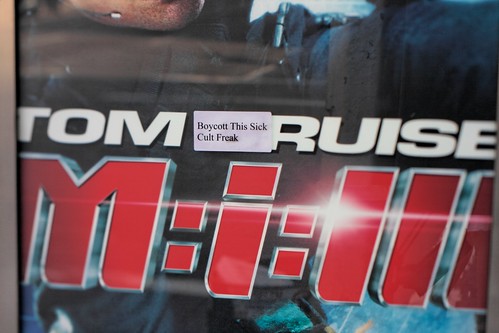
After seeing today’s news that Germany had banned a Tom Cruise movie from filming in military owned sites due to the star’s connection with the cult, I thought it would be fun to repost this piece I put up back in May 3 of last year. Below is the post originally presented a bit over one year ago.

May 3, 2006

Andrew Sullivan today calls for a boycott of the Tom Cruise vehicle Miss:ion: Imp:oss:i:ble: 3.

How creepy is Tom Cruise? The Washington Post asks; and readers answer. All I can say is: after the way this guy treated South Park, we owe it to ignore him and any movie with which he’s associated. The Boycott “MI:3” movement starts here. Blogospheric solidarity much appreciated.

Well Andrew, I am completely with you on this one, but the boycott does NOT start with you. I was walking around Manhattan with my camera on April 16th and snagged this photo on 9th Avenue somewhere between 45th and 50th Street.

It seems that some people have already had the idea.

As it so happens I ended up passing through Times Square a few minutes later, where there was a pair of tables full of copies of Dianetics, a pair of e-meters, and a bunch of money-crazed bad pulp scifi worshipping Scientologists trying to indoctrinate passers-by. (I normally avoid Times Square, but I wanted to stop by Midtown Comics on the way home and couldn’t remember exactly which cross-street it’s at, only that it’s near the corner of 7th and 40-something. For the record, it was 40th Street.)

All of the following photos taken on April 16th on the west side of Times Square with a Canon EOS 300D and 65mm Hartblei Super Rotator lens.
Continue reading Scientology (again)

Some United States. Stop one: New Jersey

As Joe mentioned the other day, I am back in New Jersey for the time being. I’ve just noticed how many weeks it has actually been since I’ve updated anything here, between a couple of weeks of travel, a couple of weeks of being extremely ill, a couple of weeks of playing tourguide to my mom and her boyfriend in Japan, and a couple of weeks of reading and getting graduate school related application stuff together-and topping it all off with trans-hemispheric relocation, a birthday, and various other odds and ends I have completely neglected this space here. So, while I have a few things that I want to write about, and a large number of photographs I want to post from my last several weeks in Japan (for this year anyway), in honor of my return to good old New Jersey, below are some choice quotes from a book of travel writing by the late humorist Irvin S. Cobb entitled Some United States (1926) purchased just this afternoon from the $1 shelves outside the famous Strand bookstore in The City. As the title of this post implies, today I bring you excerpts from the chapter on the great state of New Jersey.

CHAPTER XII

NEW JERSEY

Just Behind Those Billboards

After you cross by train through the tube under the North River, which is so-called because it is really the Hudson River and edges Manhattan Island on the west and bears no relation whatsoever to the northern boundaries of anything at all, and, this safely done, emerge from the tunnel mouth on the farther shore, you will see a large number of billboards. Well, New Jersey is just behind those billboards.

[…]

In billboards, New Jersey, regardless of comparative areas, leads all the states of the Union. I’m not sure but what she leads all the habitable globe. Next to the commuters, billboards constitute her most conspicuous product. The commuters come and go. In the morning they hurry away to New York of Philadelphia to earn their livings and in the evening they return to bed down for the night. Thus daily they come alternately under the head, first, of exports, and then of imports.

An orthodox New Jersey commuter is easily to be recognized in New York. He wears and imaginary string tied around a mental thumb to make him remember not to forget to call up the employment agency and notify the new cook who is going out to his place to spend two or three days with the family, possibly even staying the full week out, to meet him at the station for the 5:03; and she may recognize him by the worried lines in his face and the fact that he will be carrying parts for the lawnmower.

[…]

Whenever I have occasion to traverse the State of New Jersey by rail, I take advantage of the opportunity to reflect upon our outstanding institution of billboards as it presents itself to the purview of the traveler. Regarding billboards and billboarders , I have gone to the trouble of compiling some very interesting figures.

For instance, if all the billboards which desecrate the scenic areas of America were piled one on top of another, allowing twelve inches of horizontal thickness for each billboard, the total number would form a column one hundred and fourteen miles high; and to soak these properly for burning would require ninety thousand barrels of grade-A kerosene; and then when some philanthropist had applied the match, the flames of the bonfire would cast a glow visible as far away as Bermuda, and in every community in this country where people have learned to value the beauties of unblemished nature, there would be public dancing in the streets and a holiday for the school children would be declared.

Again, let us consider for a moment an even more agreeable summarization: If all the billboard art directors who go to and from in the land choosing decorative vista with a view to marring them with their billboards, where laid out side by side with lilies in their hands, it would make a very enjoyable spectacle for the rest of us provided only we were sure that one of them was in a trance.

While I speed athware New Jersey I frequently play a favorite game of mine. I call it Billboards. [Ed: his billboard obsession becomes troubling in its fetishization. Enough on that topic.]

For, when all is said and done and disregarding what figure New Jersey may have cut in the earlier days of this Republic and, before that, in the Colonial time, the question next arises: What now is she? And the answer is that she is become the smudgy and begrimed passageway that separates two great metropolii. [Ed: I know for a fact that Joe would disagree about the characterization of Philadelphia as a great metropolis.] Lying between them and holding them apart, she takes their overflow and they suck out her substances as they long ago sopped up her personality. The semicolon of the Eastern seaboard–that’s modern New Jersey. Never mind what she is commercially. Historically, she’s a cow that went dry about the time the boys got back from the Spanish War. An she has been dry every since. And from present indications will continue to be dry.

[…]

All of which, I claim, helps to explain why New Jersey is one of the joke states. It is not well for a state to be, by national estimation, a standing joke. Kansas once was one and it took her long years to live it down. [Ed: Kansas has worked hard in recent years to reclaim that title.] Arkansas was one and has not yet entirely recovered. Connecticut was one and because of traditional memories lingering in the popular mind of wooden nutmegs and shoe-peg oats, will never entirely get over it. [Ed: I have 0% idea what those references mean. I suppose that means Connecticut HAS gotten over it.] Missouri, for a spell, had a close call with being one, but lacking all else, the state which foaled a Mark Twain would have a title to immortal grandeur on that sole account.

New Jersey still is one and a hopeless patient. For half a century references to Jersey justice, Jersey skeeters and Jersey lightning made her the football of the jesters. [Ed: And all the more embarrassing for us, having invented football here.] As a matter of fact, and giving them due credit, her mosquitoes must sharpen their bills yet finer ere they may hope to compete with the Long Island variety. And in these piping Prohibition days her homemade applejack, potent though it may be, stands comparison with the bootleggers’ best. It may give you the blind staggers, but the blindness is a temporary affliction.

[…]

With time the symptoms have changed, but the case remains incurable. For to-day New Jersey is still a joke state. Outsiders think of her as the State where they suffer from billboarditis and ride on the Erie and harbor the corporations and broadcast the bedtime tales. They forget her material contributions to the national prosperity. And who can blame them?

[…]

But just look at the blame thing now! Coal tipples and garbage dumps and freight tracks and smelters and refineries invade the marshes, and the birds are mostly fled away, and for wild life the mosquitoes are left. The elm-shaded towns where once upon a time future statesmen were born and patriots grew up and writers ripened their art, have become clamorous, cindered, smoky factory places crowded with transcendently ugly workshops, the dirty, homely streets swarming with alien workers quacking a jargon of tongues fit to eclipse Babel’s Tower itself.

It is hard to believe that here, long ago, poets dreamed their dreams and painters plied deft brushes and masters in statecraft dealt masterfully with the politics of their time; that once upon a time great publicists and great orators dwelt in these spots. It is impossible to believe that any such ever again will abide here.

[…]

In all of manufacturing  New Jersey the most agreeable sight, I think, is the sign on the road to Pompton which says you are now leaving Paterson. When I get that far I stop and give thanks.

Why horizontal strokes are thinner than vertical strokes

Beer communicationIf you look at Sino-Japanese text printed in the Chinese Song or Japanese Mincho typeface (similar to serif typefaces in European languages), you’ll notice that the horizontal strokes in characters are much thinner than the vertical strokes. Here’s why:

The printing press appeared in China during the Song Dynasty. At the time, each print block contained two portrait-oriented pages placed side by side. The print blocks were all cut from rectangular planks such that the wood grain ran horizontally. Because the grain ran horizontally, it was fairly easy to carve patterns with the grain, like horizontal strokes. However, carving vertical or slanted patterns was difficult because those patterns intersect with the grain and very easily break. This resulted in a typeface that has thin horizontal strokes and thick vertical strokes. To prevent wear and tear, the ending of horizontal strokes are also thickened. These design forces resulted in the current Song typeface.

Reactions, Speculation on Matsuoka’s Suicide

As noted before, the beset agricultural minister Toshikatsu Matsuoka committed suicide yesterday. Today I want to show you some people’s reactions:

First off, Matsuoka himself left a whopping eight handwritten suicide notes, addressed to various people including the prime minister and “the people of Japan and everyone in my support club.”

The police have only released a fraction of the notes to the public so far, and they shed little light on why he decided to take the easy way out:

“People of Japan and everyone in my support club… I am very sorry and take the blame for everything. I apologize for causing so much trouble. Please take care of things after I’m gone.” And another note states: “My wife knows the circumstances behind this. Please don’t look for the whys and wherefores. Please be gentle.”

Martin Fackler of the New York Times explains for the American audience “Suicides have a long and often romanticized history in Japan, where they have been seen as a face-saving escape from public humiliation.” This sentiment is familiar to anyone living in Japan, and the suicide notes seem to back up that face-saving motivation. However, it should be noted that Matsuoka is the first serving cabinet member in Japan’s postwar history to kill himself, and only the 7th serving Diet member. While some Diet members have killed themselves over scandal (Shokei Arai in 1998 among them, who took his own life over getting caught in several stock scandals), some were due to terminal illness (See Asahi for details). And while Matsuoka may have tried to conjure up images of Japan’s face-saving suicide culture, there aren’t actually so many people who (at least overtly) sympathize with his choice to die rather than face the facts.

To get a quick perspective from both sides of the debate, today’s Asahi editorial notes: “Wasn’t there another way, such as stepping down as MAFF Minister or leaving your Diet seat?” and later “We do not intend to speak ill of the dead, but [revealing the facts and starting over if you are in the wrong] is the right way to take responsibility as a Diet member and a cabinet minister.”

The more right-leaning Yomiuri takes a different tack, portraying Matsuoka’s death as a “tragedy” somehow caused by the “psychological pressure of this string of problems” that could happen again if political fund accounting regulations are not reformed adequately. This sort of argument strikes me as patently irresponsible and implies that Matsuoka’s death was the opposition’s fault for, as they put it, using the political funds issue as a “political football” as opposed to the truth, which was that Matusoka’s suicide was a personal choice and no one’s fault but his own.

And there are still other theories as to why he killed himself. One rumor proffered by freelance journalist Takashi Kitaoka (citing “police” sources) is that Matsuoka was in 1 billion yen in debt, and that even the money he gained from immense utility expenses and political funds from forestry contractors would not pay for the interest.

The opposition parties (including the DPJ, Communists, and Social Democrats) have taken an almost uniform line that PM Abe’s protection of Matsuoka actually contributed to his death. Anonymous blogger Kikko explains the reasoning behind this:

Now the Abe cabinet, with its ministers encountering one scandal after another, is now called “the most miserably bad cabinet in history.” The irresponsibility of Shinzo Abe, who thinks of nothing but protecting his own position, has at last taken a person’s life. Minister Matsuoka, whose scandals and crimes, from the “something something recycled water” office expenses scandal, to his connections with organized crime, to the political funds scandal, and finally the “J-GREEN” government-led bid-rigging incident, had reportedly told people close to him that he wanted to quit. But Abe would not let him quit for the sole reason that “if any more cabinet ministers are made to quit, the prime minister’s responsibility for appointing them will be questioned.” In the Diet, Matsuoka was subjected to a fully-mobilized attack from the opposition, questioned harshly by police on the bid rigging incident, and even people within the LDP were calling for his resignation. Yet he was not allowed to quit even though he wanted to, all to save face for Shinzo Abe.

Pushed into a corner, Matsuoka in the end took his own life. In other words, he was forced to kill himself for the convenience of Shinzo Abe. Despite the fact that Abe’s responsibility for appointing him was obvious, what with the discovery of so much improper and illegal activity, Abe protected his own position by not letting Matsuoka quit, and this is the cause that pushed Matsuoka toward suicide. Abe should be questioned aggressively on this. Many people are killing themselves due to the growing societal disparity caused by bad policies, but for Abe to cause a suicide in his own cabinet just shows how selfish, incompentent, and irresponsible he is, and I’d like him to quit immediately.

Add notoriously corrupt (yet still alive, showing there is another way) politician Muneo Suzuki (formerly of LDP, now of the Hokkaido regional “Shinto Daichi” party) to the list of “it was Abe’s fault” proponents. As a former partner in crime, Suzuki speaks with the perspective of someone who really knows what was going on in his head:

The last time I saw [Matsuoka] was when we met on the night of May 24. I made a suggestion to him: “I am going to question you at the Committee on Audit and Oversight of Administration tomorrow, so why don’t you apologize to the people from the heart? Your explanations that you are following the law and acting properly based on the law are not understood by the public. You should bow low on the ground before them and frankly apologize by saying that you did not fulfill your responsiblity to explain yourself.” But he lamely replied: “I thank you for the advice, but my orders from the Diet Affairs Committee, the top, are to stay quiet for now. I can only follow that.”

I asked him again: “This issue will go on whatever you do, so I think you should hurry up and honestly explain to the people.” He smiled and said: “Suzuki-sensei, you’re the only person who says that.”

I feel like I understand Matsuoka’s heart. Up to the day I was arrested, Matsuoka called me to express his support almost every day.

And some are speculating that there are some members of the farm “tribe” who must be relieved that Matsuoka will never be forced to testify as to what he knows about the various dealings that go one with the network of agriculture-related publicly owned corporations. His cryptic messages also show that he kept quiet to the end.

In all, the man whose career was made on smart, if shady, political decisions seems to have miscalculated the effect his death would have on the political scene. Or perhaps he knew exactly what sort of bind it would put the Abe administration in. Unfortunately, “the people” will probably never find out the truth, partly because Abe has declined to investigate the matter.

See what Adamu’s reading

It’s not pretty, but I’ve made my Google Notebook public, so MF readers can keep track of what’s been in front of my eyeballs recently, such as Hakuho’s upcoming promotion to Yokozuna and an analyst’s description of Dentsu’s attempts to leverage its near-monopoly of TV ads to dominate the Internet market as well.

A quick look at online advertising through the lens of America

Slate wonders if online ad companies are worth what companies like Google and Microsoft are paying for them:

Last month, big establishment online company Google bought online-ad firm DoubleClick for $3.1 billion in cash. Last week, big establishment advertising agency WPP bought online-ad firm 24/7 Real Media for $649 million in cash. The next day, big establishment tech company Microsoft bought online-ad firm aQuantive for $6 billion in cash.

…this may be less a case of the market being irrationally ahead of the industry’s economic reality and more a case of the market being behind rational expectations for the industry.

Television, magazines, and newspapers may be hanging on because they are more powerful media for reaching the consumers companies most want to reach. But I suspect they’re hanging on for another demographic reason. Advertising is supposed to be a with-it, hot, trendy, tomorrow-based industry. But at root, the business of advertising is one of allocating capital, not cooking up clever jingles. And the people who make the decisions about how to allocate that $300-odd billion in capital each year—CEOs of consumer products companies, Fortune 500 executive vice presidents, media buyers, brand managers, agency heads—well, they’re old. It takes time to climb the corporate ladders to get to the rungs where really important decisions are made. Of course, these people, most of whom came of age as consumers in the 1960s, 1970s, and 1980s, use the Internet, spend a lot of time on it, and buy stuff on it. But they don’t understand it intuitively the way the younger crowd does. Do you think the CEOs of Ford, Citigroup, or Procter & Gamble are uploading photos to their MySpace pages, downloading music, and blogging?

…the question for people who invest in the stocks of online-advertising companies—as Google, WPP, and Microsoft have just done—isn’t just whether online ads are the way to reach consumers today. No, the question is whether online ads will be among the best ways to reach consumers in five and 10 years, when today’s twentysomethings will be buying cars and houses and kitchen appliances and pharmaceuticals. More important, in 2012 it’s possible to imagine that the brand managers and executives responsible for making advertising-spending decisions will be people who grew up with the medium, who didn’t need a consultant to tell them how it works. It’s a reasonable expectation that online advertising will continue to gain market share and that more and more capital will slosh into this sector. The big companies paying top dollar for online ad firms have just bought some expensive buckets.

The points of this article, plus or minus a few details, could be easily made about Japan, with the exception that Japan’s traditional media are much more nervous about aggressively engaging the Internet. I’ll go through them as we proceed to give you what you need, but for now suffice to say that Japan is awash in new technology, the young folks are growing up as avid users, but the managers at the advertisers and the agencies are too old to really get it. But as in the US, the future growth in Internet ads is understood, and traditional companies like Dentsu are realizing that they need to follow where people’s eyes are.

Taking the “Japan Brand” concept literally

The creation of a unified “Japan Brand” has been called for recently as a way to promote exports, boost tourism, and take control of how Japan as a nation is perceived abroad. To that end, the Small and Medium Enterprise Agency has recently announced a new logo for its campaign to help promote local products for export that to this blogger seems to lack a certain subtlety:

jb_symbol.jpg

(Click the picture for the full size picture. It makes a great desktop wallpaper!)

Bluntness aside, it’s a simple and attractive logo. It seems intended as a sort of umbrella logo to bring disparate marketing strategies pursued by the various regions of Japan in under a unified concept that will “create new traditions” by very efficiently letting anyone who comes into contact with a product bearing such a logo that it DEFINITELY comes from Japan, which should let a potential buyer know that, like Japan, the product stands for “quality,” “beauty,” and “pride.”

And at least this logo should make sense to outsiders. “Yokoso Japan,” the tourism version of “Japan Brand” logos, was SLAMMED last year by American Japan theorist Alex Kerr, who told a government discussion panel that it would sound like “blah blah blah Japan” to those unfamiliar with the Japanese term for “welcome.” Meanwhile, a video from image AI could bring a fresh perspective to the concept, visually enhancing how such logos are perceived globally.

UPDATE: I should note the similarity between this logo and the typeface at YH Chang Heavy Industries, a flash animation website known for its hit “Cunnilingus in North Korea:”

cink.JPG

Copyright Term Extension in Japan: Balance shifting *against* extension?

Nikkei PC Magazine reports:

Arguments for Caution at Cultural Affairs Agency Deliberation Council on Copyright Term Extension Issue
May 16, 2007

The Subcommittee for the Protection and Use of Past Copyrighted Works Etc. of the Cultural Deliberation Council’s Copyright Commission, an advisory body to the Commissioner of the Cultural Affairs Agency on the copyright term extension issue, held its 3rd meeting of 2007 on May 16.

Continuing from the previous meeting, a hearing was held consisting of 17 people including stakeholders engaging in business activities related to copyright. This time, however, moderate-thinking lawyers and academics with a background in copyright made multiple arguments against term extension.

“Cases of Copyright Inheritance are Rare”

Professor Masaru Itoga (Library Information Science) of Keio University, pointed out that gaining permission to use copyrighted materials will become more difficult by extending the copyright term from 50 years after the death of the rights holder to 70 years. “With the exception of famous works, cases in which surviving family members inherit copyrights are rare. Also, finding the addresses of corporations is easy, but the contact information of individual rightsholders is not made public. If the copyright term is extended, there is a danger that there will be an increase in the number of works that are not passed on after the rights holder’s death and it is unclear who holds the rights to them.”

[snip issue of “free use labeling”]

“The International Balance of Copyright is -600 Billion Yen Annually”

Attorney Kensaku Fukui commented that while the US, Europe, and Japan have extended copyright term repeatedly, copyright term has never been rolled back, and called for caution on a hasty extension: “The effects from term extension will felt by posterity semi-permanently. I hope for and will watch carefully for a debate that will stand up to historical investigation, showing who and with what proof did people favor, oppose, or remain silent on extension.”

He went on to question: “Those in favor of term extension argue that if a database for copyrighted works is built then past works can be easily accessed. I think there is merit in that idea, but it would be difficult to create a database comprehensive enough to cancel out the problems posed by extension. The list of authors tops 790,000 just based on the archives of the National Diet Library. Extend that to overseas works and a database would grow exponentially in size if the copyright term is extended to 70 years retroactively. Are we going to place this cost on the Japanese people?”

Fukui also commented on the fact that according to Bank of Japan statistics, Japan’s international balance of payments for copyrighted works is negative 600 billion yen annually (meaning that more copyrighted work is imported than exported) and is growing year by year: “If prewar Western works’ copyrights continue to be extended, then over-importing and the international uneven distribution of intellectual property will become permanent. There are those who argue that ‘extension is necessary to protect the works of Haruki Murakami or Japanese animation,’ but these works’ copyrights will last for at least another 30 years. The decision to extend works such as those should be made based on the situation 30 years from now, and it is no reason to extend copyright term now. I think we should stop immediately trying to find a way to cooperate whenever we are told something by the US and Europe.”

“Economic effects of term extension no greater than 1-2%”

Keio University Professor Tatsuo Tanaka (Econometrics) claimed that the economic effects of term extension would be small and that the rational decision would be to promote use of the public domain. Tanaka explained his doubtful outlook: “Citing books with past case studies, the increase in revenue for rights holders due to copyright term extension would be only 1-2% of all copyright revenue. Will raising royalties from 10% to 10.2% actually boost creativity?”

Meanwhile, arguing that the term extension is set aside would allow works to be used freely in the public domain, Tanaka concluded that not extending copyright would be better for society: “Businesses that promote new uses by exploiting the public domain are increasing. For example, Aozora Bunko boasts a lineup of 6000 titles, and the top 1000 titles are viewed by 4.5 million people per year. Cheap DVDs sell 1.8 million copies per year. There are also many examples where works whose copyright terms have expired, such as Akira Kurosawa’s Rashomon and Ayaka Hirahara’s Jupiter, have been recreated. On blogs and social networking sites, 10 million average citizens are creating and transmitting content. The public domain is the lifeblood of creativity for the next generation, and forms the basis for the average person’s creations.”

Other participants arguments’ included “I am negative on term extension, but even if the term is extended, I hope that the part of the term beyond 50 years will require a notification and that the term will not be categorically extended.” (Keio Univ. Associate Professor Kim Jong Kun [金正勲]), “As a part of a system for notification of intent, I would like a free use label to be created that indicates permission to freely use work in a museum.” (Akira Inoue, Director General of the National Science Museum)….. “Ryonosuke Akutagawa worried whether people would read his work 50 years in the future. The greatest hope of a creator is to have his/her work read by a great many people. Extending copyright term would decrease the opportunities for works to be used and lead to a cultural loss.” (Authoer/poet Chico Ryomi).

Still others’ contended: “For orchestras, the burden from usage fees they will pay to JASRAC due to term extension is a serious issue.” (Japan Orchestra Federation Standing Director Naomoto Okayama), “It is almost inconceivable that software will be used 50 years after [its copyright holder dies], making term extension unrealistic.” (Association of Copyright for Computer Software Executive Director Hiroshi Kubota)

Others Argue “We Should Lead the International Current”, “National Cultural Assets will be Lost”

Meanwhile, there were also arguments in favor of term extension, mostly from officials from rights holder groups. Hide Ikuno, Executive Director of the Recording Industry Association of Japan, noted that “copyright term for records is already greater than 50 years in 21 countries. Japan has the second largest record sales in the world, and is in a position to lead the international current.”

Kazuhiko Fukuodera, standing director of the Japan Artist Association, argued: “Edvard Munch is still copyrighted in the West but is public domain in Japan. When that happened, dolls parodying “The Scream” went on sale. We should not do things that are rude to creators. In 2009, Taikan Yokoyama’s copyrights will become public domain. The Taikan Yokoyama Memorial Center’s operating costs are taken care of in part by copyright fees, and if they become public domain the operations of the center could become difficult, leading to a loss of national cultural assets.

(by Kanto Kaneko)

Comment: Some things to be learned from/noted about this article:

1. Those who will benefit from copyright extension in Japan are overwhelmingly foreign rightsholders, such as the Beatles, Elvis, Disney and other popular foreign artists/movies.
2. The arguments for copyright extension, when shown in the light of day, are extremely weak (lead by following?!) and hold no legal water unlike the previous extension to 50 years to comply with the Berne convention.
3. The Japanese system of public hearings before advisory committees long before any cabinet decisions are made or laws passed can work much much better than, say, the American system in which copyrights can be extended through the sheer political will of Sonny Bono’s widow and Disney. This did not stop the copyright term for movies from being extended to 70 years after the rightsholder’s death due to foreign pressure from the US etc, but an increasingly copyright-conscious Japanese public may just save Japan as a bastion of consumer-friendly copyright term.
4. The bulk of the Japanese media, as major rightsholders themselves, spew endless anti-piracy, pro-rights management propaganda, though as you can see this is not always the case as there are opposing business/consumer interests involved. I’ll try and locate a good example sometime soon.

Strange confession note by boy who sawed off his mother’s head and brought it to the police

A terrible crime was committed in Fukushima, Japan recently:

17-year-old boy turns self in with severed head / High schooler tells police he killed mother
The Yomiuri Shimbun

A 17-year-old high school student was arrested Tuesday on suspicion of killing his mother after turning himself in at a police station in Aizuwakamatsu, Fukushima Prefecture, carrying her severed head, police said.

According to the police, the boy, in his third year at a prefectural high school, came to Aizuwakamatsu Police Station at about 7 a.m. on Tuesday with the head in his school bag. He told the police he had killed his mother at about 1:30 a.m. Tuesday.

The police went to the boy’s apartment in the city, where they found the headless body of the mother.

The boy was quoted by the police as saying: “I killed her by myself at home early Tuesday morning while she was asleep. I wanted to kill somebody, whoever it was.”

Later it was revealed that the boy also sawed off his mother’s arm. After the crime, he went into an Internet cafe, watched a Beastie Boys DVD, and apparently wrote the following note (apparently leaked by police):

I have committed a crime that should never be committed.

–What was your motive?

A reason? Just because.

–Other people won’t be satisfied with that!

Well if I had to say something, I guess it’s a form of self-expression.

–You had no other way to express yourself?

Maybe not.

–Don’t you feel any regret?

Not right now. I feel relieved. But I’m sure I’ll probably regret it later.

–What will you do after this?

I will go have myself charged with the crime.

–Isn’t that a foregone conclusion?

Oh, you might be right. But at the very least there is no crime I desire in reality [Note: this line was a little hard to figure out. The Japanese is reproduced below:]
 あーたしかにそうかもしれません。でも現実でだけはボクの望む罪はないと思いますが。

–Do you feel like continuing on?

Not really.

–If you keep going, what will you do next?

I don’t know since I’ve just been acting on my whims.

–Don’t you feel like killing yourself?

No, that would be scary. Plus I promised I wouldn’t kill myself.

–Who did you promise?

I don’t want to say.

–Why not?

Just because.

–Aren’t you being evasive by saying “just because”?

Perhaps. I’ve always been running away like that anyway.

–Any last words?

Thank you for putting up with my nonsense all this time.
(Thanks to the Daily Yomiuri and ZAKZAK)

Comment: This is a sad tragedy that seems to contain similarities to both Columbine (troubled teenager who couldn’t make it through his last year of high school), the Virginia Tech slayings (weapons bought beforehand, a pre-planned media strategy and a clear “self-expression” motive) combined with the all-too-common Japanese mother-son tension. The reports that I’ve seen so far seem to regard this crime as a total aberration by a troubled youth, which it is. But it looks like this sort of thing could be prevented. It’s been reported that it was known that he had been skipping school and a doctor had already diagnosed him as “mentally unstable.” As hard as it is to rein in rebellious teenagers, it’s sad that there wasn’t more done to try and help (or at least medicate) someone with clear mental problems before he became a danger.